
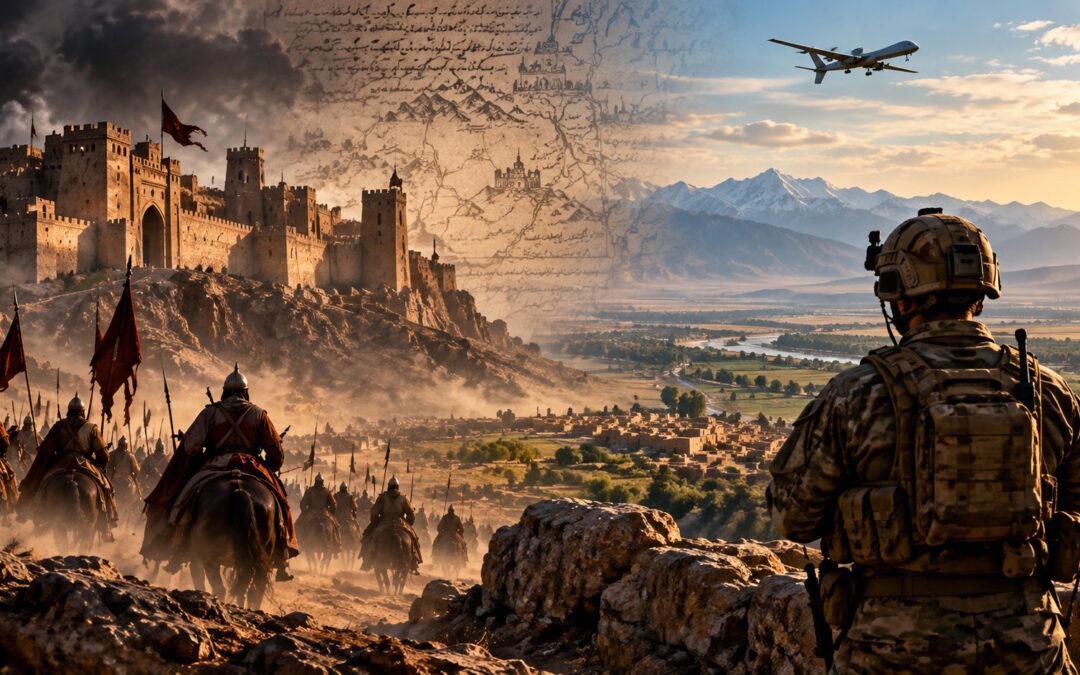
Abstract: Abu’l-Fazl Beyhaqi’s eleventh-century history offers enduring lessons in military strategy, from the dangers of overconfidence and misjudging an adversary to the importance of logistics, adaptation and sound decision-making. Through Beyhaqi’s account of military setbacks and strategic decline, this article explores why historical insights remain relevant to understanding the challenges of warfare today.
Dr Joan Swart
Keywords: Abu’l-Fazl Beyhaqi; Military Strategy; Strategic Misjudgement; Overconfidence; Military History; Logistics; Strategic Decision-Making
THE WORLD BETWEEN THE LINES: THE FORTRESS WHERE LIONS DWELL — ABU’L-FAZL BEYHAQI AND THE ILLUSION OF EASY VICTORY
In October 2026, Esmaeil Baghaei Hamaneh, spokesperson for Iran’s Ministry of Foreign Affairs, invoked a passage from a thousand-year-old Persian history to warn Iran’s adversaries against underestimating the country. The story concerned a fortress, a confident force of horsemen and an assumption that proved dangerously mistaken.
Its message was simple: the expectation of an easy victory is not the same as a realistic prospect of success.
Yet the passage offers more than a convenient metaphor for contemporary conflict. Read in its historical context, it opens a window onto some of the enduring problems of military strategy: the dangers of overconfidence, the importance of understanding an adversary, the constraints imposed by geography and logistics, and the consequences of ignoring unwelcome advice.
The historian was Abu’l-Fazl Beyhaqi, a Persian court official who lived from 995 to 1077 and chronicled the political and military affairs of the Ghaznavid dynasty. His surviving history, covering the reign of Sultan Mas’ud of Ghazna and the years 1030–1041, is remarkable not merely as a record of events but for its sharp observations of ambition, misjudgement and human frailty. Nearly a millennium later, it remains a reminder that military failure often begins long before opposing forces meet.
The fortress where lions dwell
In the passage shared by Baghaei, a group of attackers sends Okar and three hundred horsemen towards a fortress, carrying a banner and anticipating that the stronghold will eventually fall, whether through war or peace. Their confidence is premature. They have mistaken the prospect of reaching their objective for the ability to achieve it. The defenders are not the passive recipients of their intentions; they have their own capabilities and will. The attackers’ expectations collapse when they discover that the fortress is not the easy prize they imagined.
The story is vivid because its central mistake is so recognisable. The attackers have not necessarily misjudged their own strength. They have misjudged what that strength will accomplish against an opponent whose response they have not adequately understood.
This is a fundamental distinction in military strategy. A force can possess superior numbers, equipment or firepower and still fail to achieve its objective. Military power is a means, not an outcome. Its value depends on how effectively it can be applied against a particular adversary, in a particular environment, for a particular political purpose.
The attackers at the fortress appear to have confused their own determination with the inevitable outcome of the encounter. Their confidence has substituted for analysis.
The warning is not that strong forces cannot win, or that a determined defender will always prevail. It is that neither strength nor determination removes the need to understand the problem. A fortress may be vulnerable, but that must be established rather than assumed. An opponent may be outmatched, but that does not mean it will respond as expected.
The distinction matters because military plans are built on assumptions: about an adversary’s willingness to fight, the cohesion of its forces, the resilience of its political leadership, the support it enjoys, and the costs it is prepared to endure. When these assumptions go untested, a plan can appear coherent on paper while being detached from the reality it is meant to change.
When the warning goes unheeded
Beyhaqi’s wider history provides a more consequential example. His account of Sultan Mas’ud’s struggle against the Seljuqs describes the erosion of Ghaznavid power as the Seljuqs emerged as a formidable military and political rival in Khorasan, a historical region encompassing parts of present-day northeastern Iran, Afghanistan and Central Asia. The decisive defeat of Mas’ud’s army at Dandanqan in 1040, near the oasis city of Merv in what is now Turkmenistan, marked a turning point, opening much of Khorasan to Seljuq control and accelerating the decline of Ghaznavid power in the west.
This was not simply a story of one army proving stronger than another. The wider campaign exposed the interaction of strategic judgement, military adaptation, terrain and logistics. The Ghaznavids faced an opponent whose mobility and methods challenged their established way of fighting. Their ability to bring military strength to bear was constrained by the circumstances of the campaign, including the difficulties of sustaining forces in an unforgiving environment.
Beyhaqi’s account also conveys the human and political dimensions of strategic failure: the dangers of misplaced confidence, the marginalisation of sound advice and the tendency of rulers to persist with assumptions that reality is already contradicting. The problem is not always an absence of information. Sometimes the problem is that leaders fail to act on what they have been told.
This is a familiar pattern in military history. Decision-makers can become attached to a preferred interpretation of events, particularly when it supports their political ambitions or protects their reputation. Evidence that contradicts the plan is dismissed as temporary, irrelevant or the product of insufficient resolve. The opponent, meanwhile, continues to act and adapt.
The danger is cumulative. An initial misjudgement shapes the campaign plan; the plan creates logistical and operational demands; setbacks are interpreted as reasons to persist rather than reconsider; and the costs rise as opportunities for adjustment diminish. By the time defeat becomes unmistakable, the decisive strategic errors may already have been made.
Military strategy requires more than the courage to pursue an objective. It requires the discipline to reconsider whether the objective remains attainable, whether the means are adequate and whether the opponent is changing the terms of the contest.
The enduring principles of strategy
Beyhaqi was not writing a modern military manual, and it would be misleading to impose contemporary terminology too rigidly on his account. Yet, as the French historian Marc Bloch argued in The Historian’s Craft, understanding the past is inseparable from understanding the present. Read in that spirit, Beyhaqi’s history invites reflection on principles that remain central to strategic thinking.
The first is the need to understand the adversary. This means more than counting troops or cataloguing weapons. It requires an assessment of the opponent’s political purpose, perceptions, incentives, vulnerabilities and willingness to endure costs. Intelligence is of limited value when it merely confirms what leaders already believe. Its strategic purpose is to challenge assumptions and expose the possibilities that a preferred plan might overlook.
The second is the relationship between military action and political purpose. An army may capture territory, destroy equipment or defeat an opposing formation without securing the political outcome for which the war was undertaken. Tactical success does not automatically produce strategic success. The more ambitious the intended transformation of an adversary’s political order, the greater the risk that military achievements will be mistaken for evidence that the wider objective is within reach.
The third is the enduring importance of logistics and geography. Armies operate in physical environments that impose limits on movement, supply and endurance. Distance, terrain, weather and the availability of food, water, fuel and ammunition are not secondary administrative considerations. They shape what a force can accomplish and for how long. An opponent who can exploit those constraints may offset advantages that appear decisive when measured only in numbers or technology.
The fourth is the ability to learn. A strategy that was successful under one set of conditions may fail when the adversary adapts, the political environment changes or the costs exceed expectations. Military institutions need mechanisms that allow evidence from the battlefield to influence decisions. Leaders who punish dissent or disregard unwelcome assessments risk depriving themselves of the very information required to avoid disaster.
These principles are familiar, but familiarity does not guarantee their application. Indeed, the recurring appearance of similar mistakes across centuries suggests that the obstacles are not merely intellectual. They are also organisational and political. Ambition, reputation, institutional inertia and the pressure to demonstrate resolve can make it difficult to recognise when a strategy is failing.
The capacity to learn is itself a form of military power.
The past in the present
Baghaei’s invocation of Beyhaqi illustrates how historical works can be mobilised in contemporary strategic communication. By presenting Iran as the fortress where lions dwell, he warns external adversaries that apparent military superiority may conceal the prospect of a costly and unsuccessful campaign. It is a pointed message, particularly in a period of heightened tension between Iran and its adversaries.
But the lesson should not be confined to the interpretation most useful to the person quoting it. The same warning applies to defenders as well as attackers, to regional powers as well as global ones. Invoking an old text does not establish that a state has accurately assessed its own strengths, vulnerabilities or prospects. A country can warn others against overconfidence while remaining vulnerable to its own strategic assumptions.
The enduring value of Beyhaqi lies precisely in this wider applicability. His history does not offer a guarantee of victory to the weaker side, nor does it suggest that military superiority is meaningless. It reminds us that outcomes emerge from the interaction of capabilities, decisions, political purposes and circumstances. Strength matters, but its effects are mediated by judgment.
That is why the classics remain worth revisiting. They allow us to examine recurring patterns of human behaviour without becoming trapped in the immediate language of contemporary political disputes. They reveal how often strategic failure begins with a failure of imagination: the inability to conceive that the opponent may behave differently, endure more than expected, exploit an overlooked weakness or refuse the outcome that appears rational to the stronger party.
The fortress in Beyhaqi’s account is not a symbol of any one country. It represents the gap between what a powerful actor expects and what an adversary can actually do. That gap cannot be closed by confidence, rhetoric or technological superiority. It can only be narrowed through sound intelligence, realistic planning, logistical preparation and a willingness to revise one’s assumptions.
Nearly a thousand years after Beyhaqi recorded the episode, the warning remains relevant. Before assuming that a fortress will fall, a strategist must understand what it is defending, what its defenders are prepared to endure and what the attacker will have to sacrifice to take it.
The first mistake is to believe that victory is inevitable. The second is to interpret every setback as proof that more force is required.
Sometimes, the most important strategic advantage is not greater strength, but a more accurate understanding of what strength can—and cannot—achieve.
References
Beyhaqi, A. F. (2011). The history of Beyhaqi: The history of Sultan Masʿud of Ghazna, 1030–1041 (C. E. Bosworth, Trans.; M. Ashtiany, Rev. & additional commentary). Ilex Foundation; Center for Hellenic Studies, Trustees for Harvard University.
Bloch, M. (1953). The historian’s craft (P. Putnam, Trans.; J. R. Strayer, Introduction). Vintage Books.

NONGQAI’S Strategic Security Analyst Dr Joan Swart is a forensic psychologist with an MBA and an MA in Military Studies. Her work focuses on African security, geopolitics, state fragility, substate dynamics, and the intersection between governance, legitimacy, and coercive power. She is the author of several books and regularly publishes long-form analysis and opinion pieces on security and governance issues. Her writing has appeared in outlets including DefenceWeb, Maroela Media, Netwerk24, RSG, Visegrad, and other policy and public-affairs platforms. She has a weekly slot on SAfm The Global Briefing to analyse world affairs. Her work bridges academic research, policy analysis, and applied strategic assessment, and she is currently completing a second PhD at the University of Stellenbosch Military Academy. Follow her on X/Twitter, Substack, LinkedIn, and YouTube.
