Nongqai Vol 17 No 10 – (46) 46 The story of Lenie the Cradock Police Tracker Dog
Lest We Forget: The story of Lenie the Cradock Police Tracker Dog
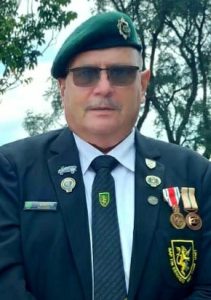
Compiled by Wolfgang Witschas
Abstract
Lenie, was a legendary South African Police (SAP) scent-tracking police dog in the Cradock District of the Eastern Cape during the late 1930s and 1940s. She was the first SAP scent-tracking police dog to be permanently stationed at a rural police station like Cradock. She died of natural causes in 1950, at the age of 13 in Cradock.
Key Words
Lenie, South African Police (SAP), Natal, Cornelius Kuyper, SAP Dog unit, Cradock, Colonel Theodouris Truter, Irene, Quaggasrand, Nose Detective, Stephen Mullineux
Introduction
History of the South African Police (SAP) Dog Unit’s scent-tracking police dogs.
1909-1913: The Start
The tracker dog unit is the oldest unit of the Dog school and tracker dogs were trained even. before the SAP was officially established.
In 1909 in Natal was the first time that police dogs were employed in South Africa. They were used as trackers in rural areas for tracking stock-thieves and escaped prisoners in the Natal Midlands
Cornelius Kuyper was an immigrant from Holland who moved to South Africa in 1897. Possibly apocryphal legend has it that his idea was born in 1907 when his daughter was witness to a murder. During the investigation, the Kuypers saw the possibility of using dog in solving such crimes. They pressed the police to try-out the way dog were being used in Germany to track suspects. Kuyper convinced the Chief Constable of the Transvaal, Police Colonel Theodorus Gustav Truter (Chief Constable from 1910 – 1928) to use dogs in investigating crime. Kuyper was appointed dog master.
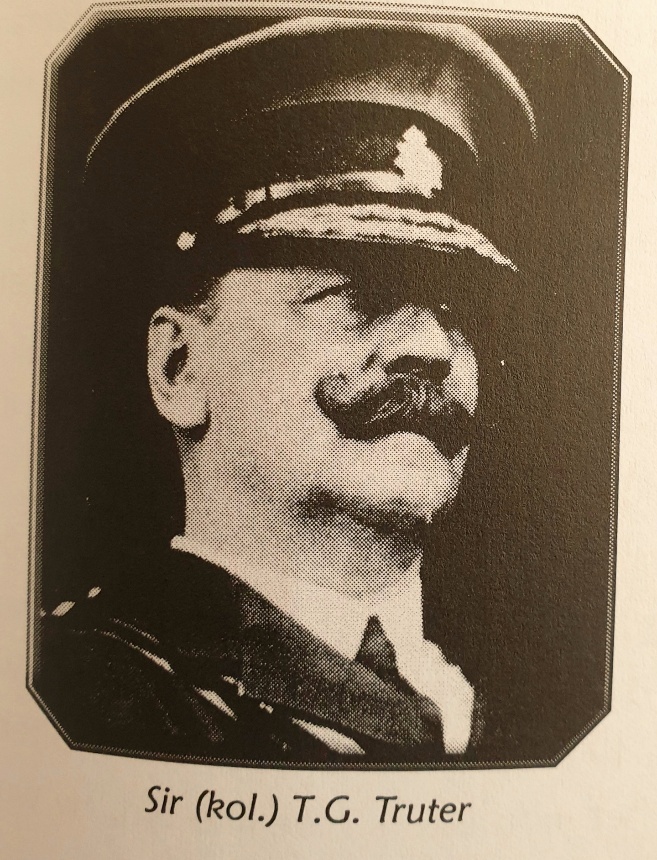
Die Glorie Jare van die Suid Afrikaanse Polisiemag: 1913 – 1994
The “amateur enthusiast” and dog master/ policeman, Cornelius Kuyper, in the winter of 1911, imported at his own cost three Doberman pinscher (Maxin, Bosco and Pitty), from the Netherlands – because the Natal Police had no kennel budget yet. Kuyper was given a year to prove himself and the dogs.
The dogs were likely Dutch Bloodhounds or Polizeihund – the old Dutch/German shepherd type. Kuyper’s training techniques are still used to day in the training of tracker dogs.
That private trial in Natal is what convinced the Transvaal Police to establish the first official training centre in 1911 at the training facility in Irene, Pretoria. By the time the brand new police dog programme was introduced in 1912, there were just thirteen dogs, five adults and eight puppies – in a training facility in the woods on Jan Smuts’ farm in Irene near Pretoria. In 1923 the school moved to Quaggasrand in Pretoria West. The idea was to train dogs at this central base and the send them out trained graduates, operating in pairs under a dog handler who trained with them. They would be stationed predominantly in the rural areas of the country and near gold mines on the reef.
The first case they investigated took place on 18 March 1912, when the dogs Bosco and Pitt were involved in a domestic assault case. They successfully tracked and pointed out the assailant. Afterthought victory Kuyper received permission to train dogs with the first group of dog handlers. He was not a young man being in his fifties, but he was as eager as a young dog on fresh scent. He was driven by a single goal creating the perfect detective dog.
He kept begging for more tracker dogs “good noses” from the Netherlands to be sent to South Africa. His passion proved infectious just as his progress proved persuasive.
On 01 April 1913 the SAP was officially established when the colonial police forces of the four Provinces amalgamated By the 1930s the SAP Dog School was issuing dogs with SAP Police Dog Numbers – metal discs on the collar. Police dogs then were called “Police Wolf Dogs” – mostly German Shepherds / Alsatians, a few Dobermans. There were about 150 dogs nationally at that time. The dog handler lived with the dog.
1912-1961: The “Nose Detective” era
Professor Sandra Swart’s research notes: “For 50 years, starting in 1912, police dogs were merely ‘nose detectives’ as sniffer dogs. They were only used for scent detection and never allowed to bite or attack. These dogs were used to track fugitives, stock thief’s and are mainly used in rural areas. The handler of a scent, ‘tracker dog is known as a “Hondemeester”.
1940s-50s: Expansion
1948: Dog Tracking Section formally formed. Dogs PD Echo, PD Emil, PD Ranger recorded making arrests in late 1940s.1953: First Bloodhound – PD Sherlock tracked murder accused.
Early 1950s: SA dogs exported – in January 1953 SAP Detectives S.F. Germishuizen and A.J. Ras flew to Nairobi with tracking dog “Boy” to help track Mau Mau killers.
In 1958 the Dog Section of the SAP was established under the Criminal Investigation Department (CID), with uniformed handlers for patrol dogs.
1961: The big change – Nose to Teeth
“The switch from ‘nose to teeth’ only started in 1961 and was driven by politics and a shift in who was being policed as apartheid intensified”.
SAP went to Germany to learn attack training, imported a wolf to improve German Shepherd bloodlines. Informal “tasting blood” training started.
By end of 1962: 76 patrol dogs in use, transferred from CID to Uniform Branch
Cradock
The Cradock Police station in the Eastern Cape was one of the first rural precincts outside Division Head Quarters in Port Elizabeth/Grahamstown to get a permanent tracking dog posted, because of stock theft and long distances in the Karoo. Before that, dogs were sent on loan from the Divisional HQ.
In the 1930s, the SAP dog tracking program was highly celebrated, and dogs stationed in the rural Karoo districts like Cradock achieved legendary status among local farming communities for their work combating stock theft.
During this era, the SAP utilized exceptional scent-tracking hounds (primarily Bloodhounds, Dobermans, and early German Shepherds) trained at the national police dog depot. These dogs were deployed to rural outposts like Cradock to track stock thieves across vast, rugged terrains, often following scent trails that were days old.
Lenie the Police Dog, No. 277
Lenie was born in 1937, and officially started her career in Cradock in the late 1930/early 1940s. Lenie was SAP “Police Dog (PD) No. 277” and worked alongside her handler, Sergeant Johan Koorsen.
She was deployed to the region specifically to assist local farmers and the SAP with tracking stock thieves across the Karoo during the height of the 1930s agricultural challenges. According to Stephen Mullineux, well-known Cradock resident’s records on file, Lenie was identified as the first police tracking dog stationed in the Cradock precinct, where she worked alongside her handler, Sergeant Johan Koorsen. The historical account credits her tracking work with helping to secure numerous arrests over more than a decade.
Key Historical Milestones & Accomplishments of Lenie The “Magic” Tracker of the Karoo
Lenie was renowned across the Eastern Cape and Karoo regions for solving complex criminal cases where human trackers had hit a dead end. Her handlers frequently noted that she could follow scent trails that were hours old across rough, arid terrain
The Stock Theft Scourge
During her service, stock theft was a major threat to the agricultural community of Cradock and surrounding area. Lenie single-handedly recovered livestock worth thousands of pounds (the currency at the time) and led police directly to the hideouts of highly elusive syndicates
Media & Public Sensation
Her exploits were so frequent and remarkable that she became a recurring feature in local newspapers. Photographed alongside her handlers in full SAP service gear, she became a symbol of community reassurance and pride.
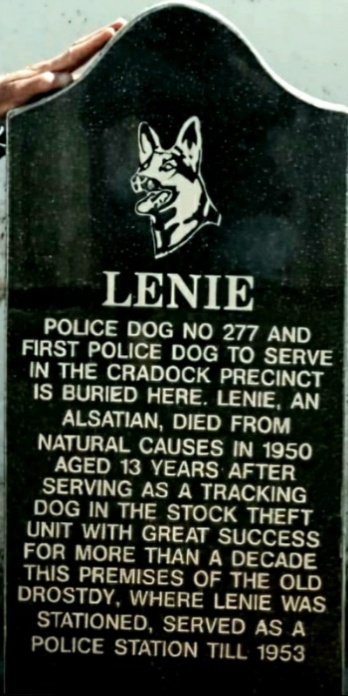
When she died of natural causes in 1950, at the age of 13, she was buried behind the police station in Sprigg Street, Cradock. Her grave was marked with a simple concrete headstone, its inscription painted on. The building had once been the magistrate’s residence. In 1953, it became Water Affairs offices, and while the work around her changed, Lenie remained in the grounds.
By September 1988, when Stephen Mullineux,
copied down the inscription, some of that painted lettering had faded. Her name and police number were still legible, but parts of the date were already unclear.
Stephen then set out to find someone who remembered her. In a telephone conversation he recorded in July 2015, former Cradock detective Bob de Lange, then 85, recalled an excellent tracking dog who had served for about 12 years.
That same year, renovations at the old Drostdy brought renewed attention to Lenie’s deteriorating headstone. Fortunately, her grave was protected during the work, and the building contractor funded a replacement.
In September 2015, the Midland News reported that a brand new granite stone had arrived from Queenstown. It was still in the storage yard, waiting to be installed, when staff went to go see it. A gravestone is a rather unusual reason for excitement at the office…
Decades after Lenie’s last working day, about 65 years ago, people at the premises where she had served were making sure her name could still be read.
Meanwhile, Stephen Mullineux had kept the old inscription and gathered the records and now there was a new stone, too.
Cradock’s police had moved on. Their tracking dog had stayed behind.
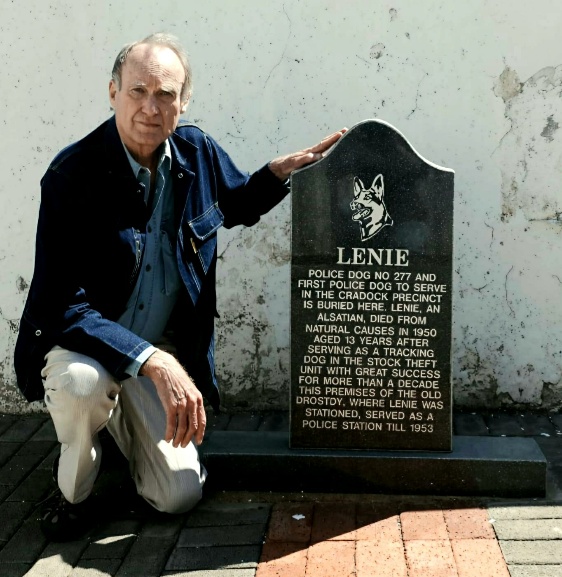 Stephen Mullineux Photograph by Clarissa Venter l Cradock & Country
Photograph by Clarissa Venter | Cradock & Country
References
Historical records and photographs supplied by Stephen Mullineux, including Midland News reports from July and September 2015
Cradock & Country: Local lives. Karoo soul.
Stories in Stone
Text © 2026 Clarissa Venter
https://www.news24.com/life/book/excerpts-the-lion-historian-how-apartheid-invented-the world-most-terrifying-police-dog-20231204
Book: “Die Glorie Jare van die Suid Afrikaanse Polisiemag: 1913 – 1994”
Chapter: Die Hondeskool
Pages: 29 – 31

