
Abstract: Recurring disruptions in the Red Sea and Strait of Hormuz have restored the strategic importance of the Cape Sea Route. Yet South Africa continues to treat its maritime position primarily as a transport issue rather than a strategic national asset. This article argues for an integrated national strategy to transform geographic advantage into economic resilience, maritime security and national power.
Dr Joan Swart
Keywords: Cape Sea Route | Strategic National Asset Assessment (SNAA) | Maritime strategy | Maritime security | National strategy | South African ports | Geopolitics
HAS SOUTH AFRICA OVERLOOKED ONE OF ITS GREATEST STRATEGIC ASSETS?
Every time instability disrupts the Red Sea or threatens the Strait of Hormuz, global shipping rediscovers the Cape Sea Route. South Africa, however, appears to forget it just as quickly.
For years, public debate has focused on the country’s struggling ports, Transnet’s operational failures and declining logistics performance. These are undoubtedly important concerns. Yet they obscure a more fundamental strategic question: has South Africa ever recognised the Cape Sea Route as one of its strategic national assets?
That question has become increasingly relevant as geopolitical instability transforms what was once regarded as an alternative shipping lane into an increasingly important component of global trade resilience.
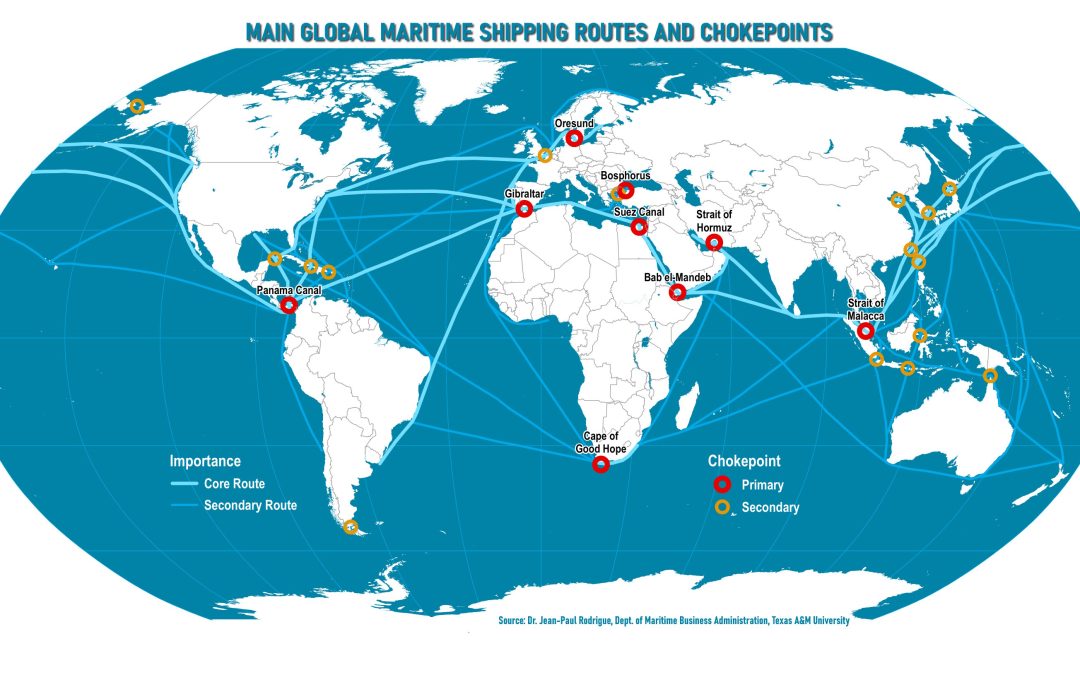
Around 80-90% of global merchandise trade by volume is transported by sea. Much of that trade passes through a small number of maritime chokepoints whose vulnerability has become increasingly apparent over the past five years. The Strait of Hormuz carries approximately one-fifth of global petroleum liquids and a similar proportion of liquefied natural gas exports. The Bab el-Mandeb links the Indian Ocean with the Suez Canal, through which approximately 10-12% of global trade normally passes. Together these waterways form one of the world’s most strategically significant maritime corridors.
When Houthi attacks on commercial shipping intensified in late 2023 and continued through 2024 and 2025, many shipping companies rerouted vessels around the Cape of Good Hope. The World Bank estimates that shipping around the Cape increased by more than 50% as traffic through the Suez Canal declined sharply. Shipping companies accepted significantly longer and more expensive voyages because they judged the additional cost to be preferable to the security risks and uncertainty associated with the Red Sea. Rerouting around the Cape typically adds around 10 to 14 days to a voyage and can increase operating costs by several million US dollars once additional fuel, charter time, crew and insurance are taken into account.
The significance of these diversions extends far beyond shipping companies. They demonstrate that global commerce now depends not only on efficient maritime routes but also on credible alternatives when geopolitical crises disrupt them. The Cape Sea Route is one of those alternatives.
Geography has therefore handed South Africa an extraordinary strategic advantage. But geography alone does not create national power.
From geography to national strategy
Military history repeatedly demonstrates that geography is not inherently valuable. Its value depends entirely upon whether a nation recognises and exploits it.
Singapore possesses almost no natural resources. Yet it has transformed its strategic location into one of the world’s most important maritime and logistics hubs through sustained investment in ports, bunkering, ship repair, maritime finance, insurance, arbitration and logistics. Geography provided the opportunity; strategy converted it into national power.
South Africa possesses an equally remarkable geographical advantage. It sits astride the junction of the Atlantic and Indian Oceans and occupies the principal alternative route between Europe and Asia whenever the world’s primary maritime corridor becomes compromised.
Yet South Africa continues to think about ports primarily as transport infrastructure rather than as components of a broader national strategy.
That distinction matters.
Ships sailing around the Cape do not automatically generate economic benefits for South Africa. Every vessel makes commercial decisions about where to refuel, replenish stores, undertake repairs, exchange crews, obtain technical support or simply wait out adverse weather. If South Africa cannot provide these services efficiently, those opportunities migrate elsewhere.
The competition is therefore not between the Cape Sea Route and the Suez Canal.
The competition is between South Africa and other maritime hubs seeking to capture value from vessels using the Cape Route.
Walvis Bay has deliberately positioned itself as a regional logistics gateway. Mauritius continues expanding its maritime services sector. Both understand a simple strategic principle: the objective is not merely to watch ships pass by but to persuade them to stop.
A Strategic National Asset Assessment
This raises a broader strategic question.
What constitutes a strategic national asset?
Traditionally, governments have regarded strategic assets as physical infrastructure owned by the state. Yet this definition is increasingly inadequate. Strategic assets include any resource, capability or geographical advantage that contributes directly to national security, economic resilience and international influence.
The Cape Sea Route clearly meets that definition.
Recognising it as such, however, should be more than a rhetorical exercise. It should form part of a coherent Strategic National Asset Assessment (SNAA) that evaluates how South Africa identifies, develops and protects those assets fundamental to its long-term prosperity and security.
Such an assessment would not be confined to maritime infrastructure. It should integrate strategic ports, digital infrastructure, energy systems, critical minerals, strategic petroleum reserves, undersea communications cables and other nationally significant assets within a single strategic framework. Too often these sectors are managed independently, despite serving the same national interests.
The question is therefore not whether South Africa should invest in ports.
It is whether South Africa possesses an integrated national strategy for exploiting its strategic geography.
Strategic assets require strategic capabilities
Owning a strategic asset differs fundamentally from exploiting one.
The Cape Sea Route itself cannot be built, bought or relocated. Geography has already provided it. What determines national advantage are the complementary capabilities that surround it.
Some are tangible assets: efficient commercial ports, naval facilities, dry docks, repair yards, bunkering capacity, vessel traffic systems, hydrographic services and logistics infrastructure.
Others are functional capabilities that are often overlooked: maritime domain awareness, customs enforcement, intelligence, search and rescue, pollution response, maritime law enforcement, skilled personnel, diplomatic relationships, private maritime services and effective coordination across government.
This distinction is important.
South Africa possesses many of these capabilities individually. What appears to be lacking is their integration into a coherent maritime strategy.
Responsibility for the maritime domain is dispersed across multiple departments and agencies, each pursuing legitimate but often disconnected objectives. Transport, Defence, Fisheries, Environment, SARS, Transnet, SAMSA and the South African Navy all contribute to maritime governance. Yet who is responsible for the Cape Sea Route as a strategic system?
The answer appears to be no one.
Strategy extends beyond commerce
The Cape Sea Route is valuable for reasons extending well beyond trade.
One of the world’s busiest maritime corridors inevitably attracts more than legitimate commerce. Illicit trafficking, narcotics, illegal fishing, sanctions evasion, human trafficking, environmental risks and threats to undersea infrastructure all demand effective maritime governance.
The route also occupies an increasingly important position within a changing geopolitical landscape.
The United States, China, India, France and other maritime powers all recognise the strategic importance of secure sea lines of communication across the Indian Ocean. Their interests will increasingly intersect around southern Africa as geopolitical competition intensifies.
South Africa need not choose between competing powers to recognise this reality.
Rather, it should define the Cape Sea Route according to its own national interests.
Failure to do so risks allowing others to determine the strategic significance of one of South Africa’s greatest geographical advantages.
Geography creates opportunity. Strategy creates power.
South Africa cannot influence instability in the Red Sea, conflict in the Middle East or tensions in the Strait of Hormuz.
It can, however, decide whether the Cape Sea Route remains merely a geographical feature or becomes an enduring source of national power.
The country’s future prosperity will not be determined simply by how many ships sail around the Cape.
It will depend on how much economic value, strategic influence and national resilience South Africa captures from those voyages.
The measure of success is therefore not maritime traffic.
It is strategic integration.
The Cape Sea Route is not valuable because ships sail past South Africa. It is valuable because geography has placed South Africa at the crossroads of global trade, energy security and maritime competition. Whether that geography becomes national power depends not on the next crisis in the Red Sea, but on whether South Africa develops a coherent strategy to exploit, govern and protect one of its most important strategic national assets.
——
Follow Joan’s weekly analyses of global events om SAfm radio, broadcast live each Friday at 6h20AM:

NONGQAI’S Strategic Security Analyst Dr Joan Swart is a forensic psychologist with an MBA and an MA in Military Studies. Her work focuses on African security, geopolitics, state fragility, substate dynamics, and the intersection between governance, legitimacy, and coercive power. She is the author of several books and regularly publishes long-form analysis and opinion pieces on security and governance issues. Her writing has appeared in outlets including DefenceWeb, Maroela Media, Netwerk24, RSG, Visegrad, and other policy and public-affairs platforms. She has a weekly slot on SAfm The Global Briefing to analyse world affairs. Her work bridges academic research, policy analysis, and applied strategic assessment, and she is currently completing a second PhD at the University of Stellenbosch Military Academy. Follow her on X/Twitter, Substack, LinkedIn, and YouTube.
