
Rhino, SAAF – Nongqai Vol 17 No 5
RHINO ARMOURED PERSONNEL CARRIER (APC)
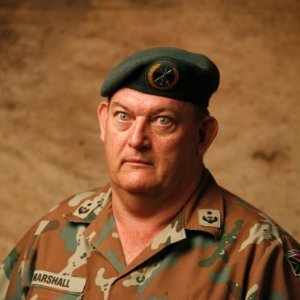
Col William Marshall
The Rhino APC was designed specifically for the South African Air Force (SAAF) from a requirement submitted to Armscor by them during 1983, its intended role was for airbase defence.
Ample operational experience with landmine and small arms protection techniques allowed Armscor to design and develop the very successful Rhino vehicle. The vehicle was mainly used to protect the crew against small-calibre infantry fire, hand grenades, shell fragments and anti-tank mines during patrol or reconnaissance missions in mine-infested areas.
Rhino basic vehicle information
The vehicle was powered by an air-cooled direct injection, 4 stroke 6 cylinder in-line diesel engine via a five-speed synchromesh gearbox through a two-speed pneumatically operated differential lockable transfer gearbox to portal-type front and rear axles with hub reductions and pneumatically operated differential locks. The electrical system is 24 Volts. Max top speed is 95km/h.
The high mobility qualities of the vehicle also include a bush bashing capability when the need arises to travel off-road. The Rhino utilised the Samil 20 (Mk1) running gear and was powered by an air-cooled Deutz engine. Mechanically, they were similar to the Samil 20 Kwêvoël Armoured Truck. It can only be described as a sort of hybrid between a SAMIL and a Buffel APC.
The vehicle interior layout made provision for a crew of 9-men seated with the driver and co-driver (commander) seated next to each other. The rest of the crew sat facing each other. Two versions were built, one seating 7-men and one with a 9-man capability. No difference in the exterior appearance of the two vehicles.
Armament was available with a co-axial 7,62mm light machine gun. The crew could fire their personal weapons through shooting ports.
By 1983, 30 of these vehicles had been built, 20 for the SAAF and 10 for other government departments. It was considered as a possible replacement for the Buffel APC which had reached its maximum development stage.
The Project “Contain 1” project team was given the task of evaluating the Rhino against the Casspir APC vehicle to address a possible use for the vehicle to be used in the Anti-Aircraft role. Pros and cons were evaluated and rejected as the Directorate Anti-Aircraft decided to place their 20mm AA gun on a Buffel. This vehicle was called the Ystervark.
POSSIBLE PURCHASING OF THE RHINO 9-MAN VEHICLES AS AN INTERIM REPLACEMENT FOR THE BUFFEL APC
Armscor was already in production with this type of vehicle and had already delivered 20 units to the SAAF and 12 units to various SWA government departments.
The prototype vehicle had undergone several technical evaluations and had met expectations in every respect. It was also known that this type of vehicle, such as the Buffel, is the most highly mobile available to the SADF.
Technically speaking, this vehicle was identical to the Bulldog concept recently evaluated by the SADF. As a standard Samil 20 chassis was used in its standard configuration. It would have been fully compatible with SADF’s logistical system.
Its level of mine protection was extremely high, and it could easily withstand a triple mine. Its angle of deflection was 87° (included), and its wedge height above the ground was 1100 mm. From this can be concluded that its level of protection was among the highest of all existing mine protected vehicles.
From a cost-per-unit perspective, the Samil 20 components were far more robust against mine explosions than, for example, Buffel components. This was proven during the Project Sireb I evaluation blast tests held at Wallmannstal.
Its bush-driving capability and cost-effectiveness in terms of vehicle damage were much better than those of the Buffel. This was proven in the Sireb II evaluation with the Bulldog. A weakness of the Samil 20, especially during bush driving, is the “tie-rod” ends. They protrude below the front axle and were very vulnerable to thick tree stumps or rocks. An alternative design could, however, have been developed.
The internal layout was such that 10 people can comfortably fit, with rear doors and an open-roof configuration (i.e., like the Casspir). It was pointed out that this vehicle (like the Casspir) does not have sufficient storage space for the crew’s full kit. In a combat situation or during patrols, however, there was sufficient space for weapons and ammunition. A machine gun mounting could also easily be fitted. When leading convoys and during movement on ordinary roads or routes, a trailer could also have been attached for carrying kit and supplies.
If the South African Army decided to purchase these vehicles as an interim vehicle, it was logical that new chassis could not be ordered because of the excessively long lead time required for SAMIL chassis deliveries. Chassis from existing stock would therefore have had to be used in order to deliver a production series quickly.
An accurate price indication for this vehicle was given as follows:
- Chassis …………… From stock
- Bodywork ………….. R19,000.00
- Glass …………….. R3,262.00
- Steel …………….. R4,300.00
TOTAL …………… R26,562.00
For 100 vehicles, the capital outlay would therefore be R2,656,200.00. For this amount, only 39 Casspirs could be purchased. For 100 Casspir vehicles, the comparable capital outlay would have been R6,750,000.00.
The estimated delivery schedule would appear as follows:
- Lead time before production begins: approximately 3 months.
- Delivery of 100 vehicles: approximately 4 months.
- Total time therefore, was approximately 7 months for 100 vehicles.
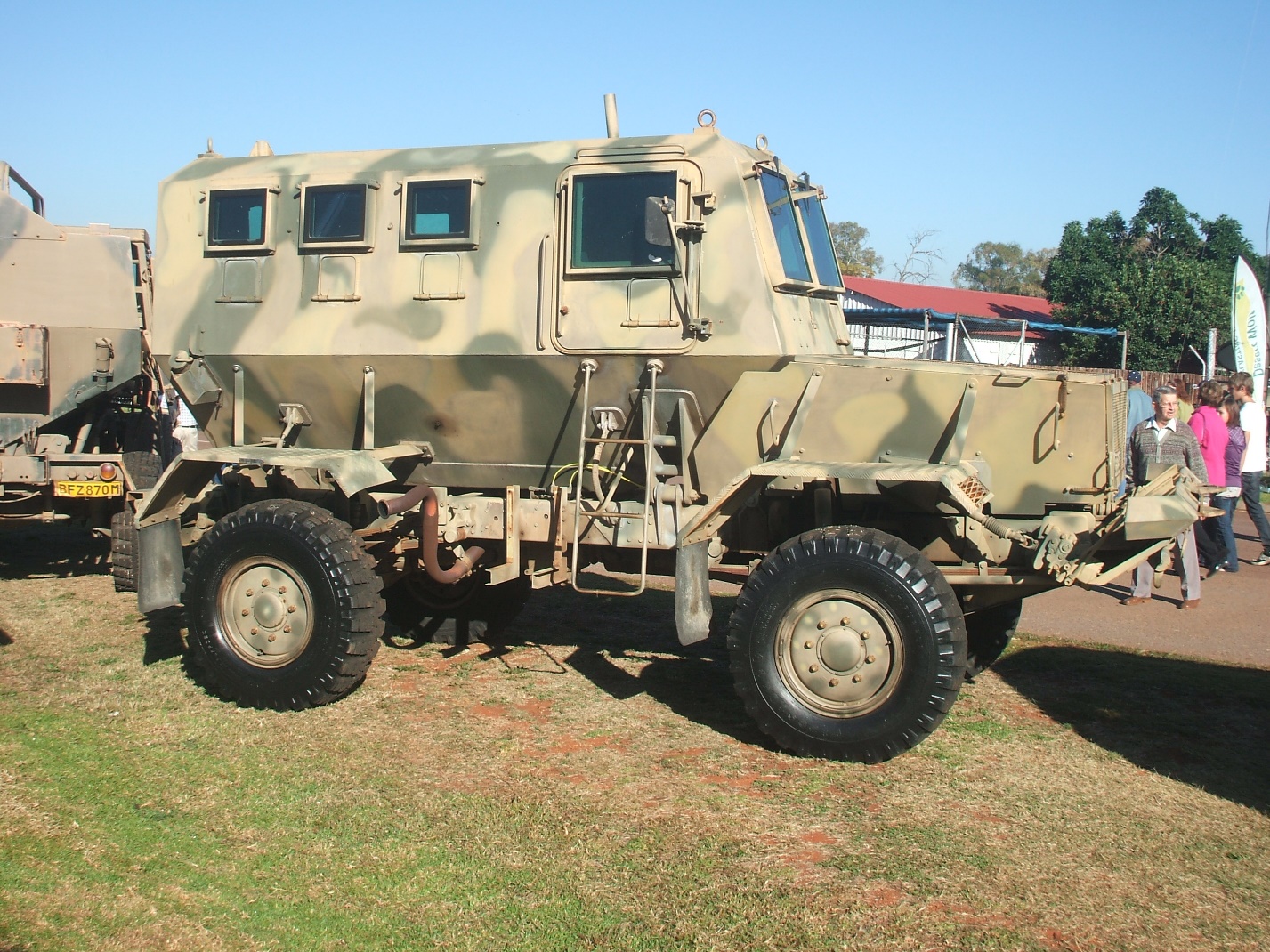
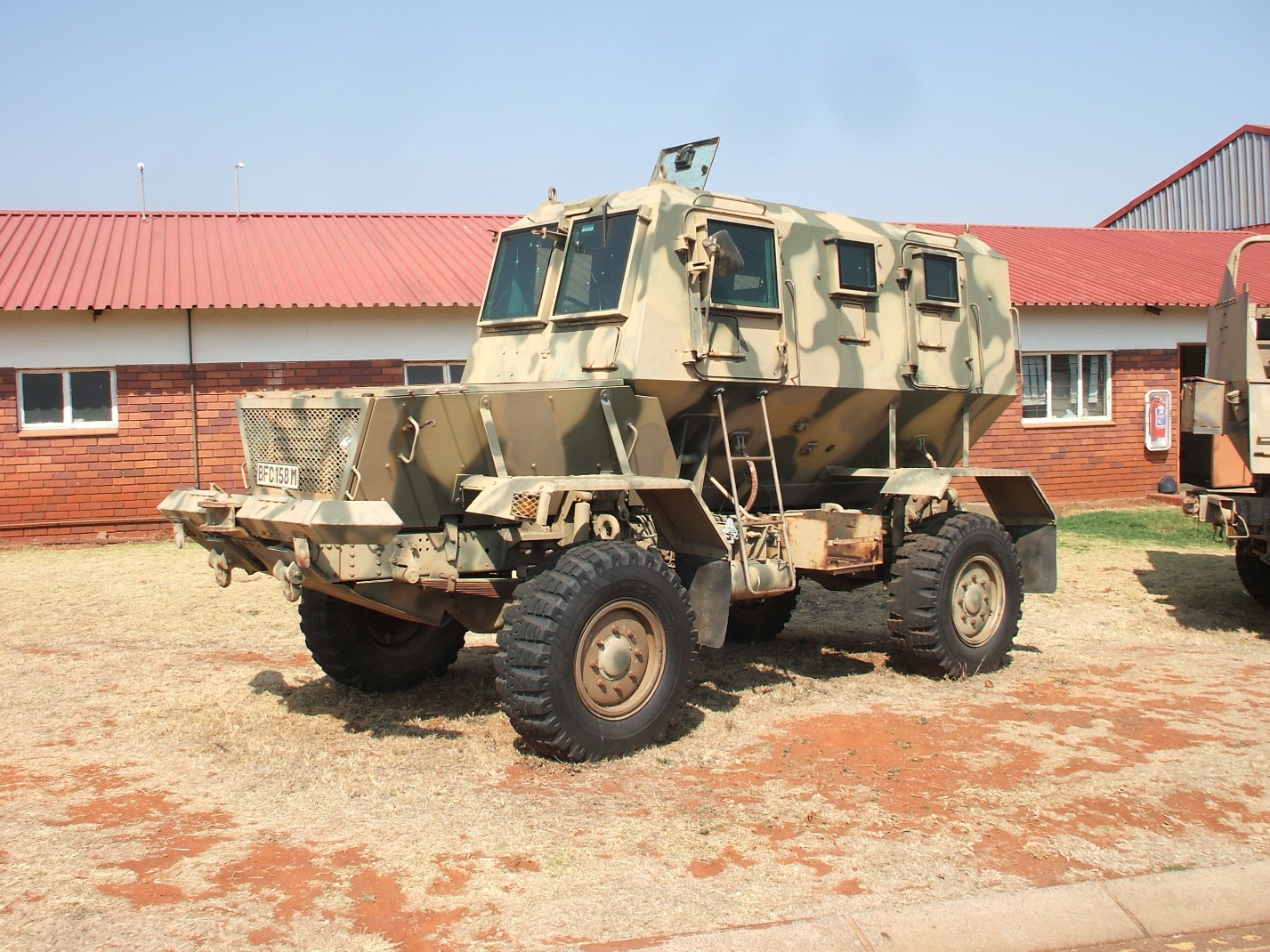
In conclusion, it was recommended that the S.A. Army also give this vehicle careful consideration as a possible interim vehicle to replace the Buffel APC. It was once again emphasized that the need existed for a new type of MPV II to replace the Buffel. Time ultimately caught up with the Rhino and the SADF would decide to purchase the Mamba APC as replacement for the Buffel.
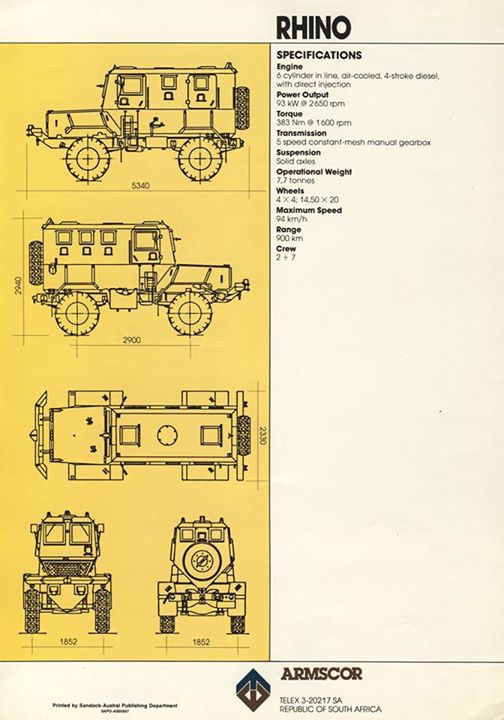
Technical Specifications:
| Hull | |
| Design | Monocoque, “V” Hull |
| Seating | Driver, co-driver and 7 men |
| Protection Levels | |
| Ballistic & Mine | To be confirmed |
| Dimensions | |
| Wheelbase | 2 900 mm |
| Overall Length | 5 700 mm |
| Overall Height | 2 900 mm |
| Overall Width | 2 400 mm |
| Ground Clearance | 470 mm |
| Masses | |
| GVM | 7 700 kg |
| Engine | |
| Make/Model | Deutz F6L913 |
| Configuration | 6-in-line |
| Max Power | 93 Kw @ 2800 rpm |
| Max Torque | 375 Nm @ 1500 rpm |
| Tyres | |
| Size | 14.5 x 20 |
| Performances | |
| Max Speed | 90 kph |


That’s really interesting to see the history behind the Rhino APC’s development, especially considering its specific design for the SAAF.
Thanks for the kind remarks!