FROM DETERRENCE TO DISCLOSURE: PIVOTAL SEPTEMBER EVENTS IN SOUTH AFRICA’S NUCLEAR PAST
René Geyer
René Geyer was a researcher for the Nuclear Proliferation International History Project (NPIHP) attached to the University of Johannesburg. She is currently affiliated with the University of South Africa’s Department of Information Science.
Excerpt
South Africa secretly built six nuclear weapons before becoming the first nation to voluntarily dismantle its entire arsenal. Key September milestones chart its historic shift from covert deterrence to verified global disarmament.
Abstract
This article outlines South Africa’s journey from a clandestine nuclear weapons state to a proponent of disarmament, highlighting key events in September. It begins with the 1979 Vela Incident and traces Pretoria’s development of a “covert deterrence” strategy, culminating in the 1985 decision to halt nuclear warhead production. The discussion covers political shifts under President F. W. De Klerk that facilitated the dismantling of the nuclear program before South Africa’s transition to democracy. The conclusion highlights South Africa’s post-Apartheid efforts to integrate into the global non-proliferation regime, including the 1991 agreement with the IAEA and support for the 1996 Comprehensive Nuclear-Test-Ban Treaty.
Keywords: South Africa; Nuclear History; Vela Incident; International Atomic Energy Agency; Comprehensive Nuclear Test-Ban Treaty; Non-Proliferation Treaty; Pelindaba.
Introduction
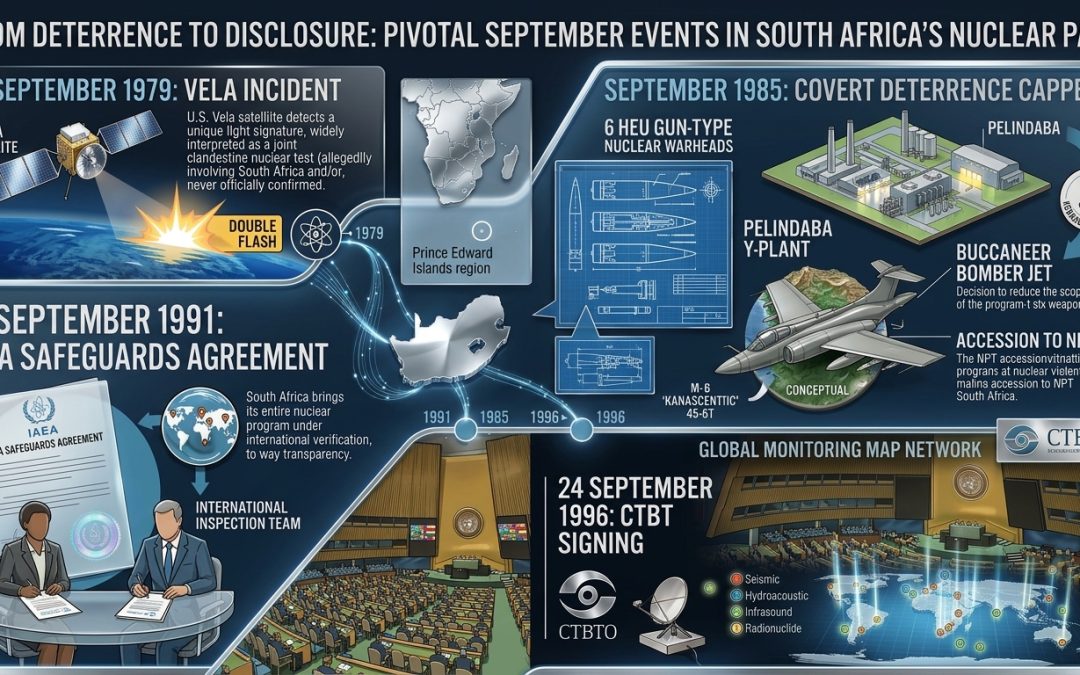
Amid Cold War tensions and the regional Border War, South Africa secretly developed a nuclear arsenal throughout the 1970s and 1980s. Pursuing a strategy of covert deterrence, the country built six air-deliverable gun-type atomic devices. As Cold War tensions eased and South Africa transitioned to democracy, it undertook an unprecedented policy shift: becoming the first country in history to voluntarily dismantle its domestically developed nuclear weapons and submit to full international non-proliferation oversight. The timeline below highlights key September milestones that chart South Africa’s journey from a secretive nuclear state to a global leader in disarmament.

The Vela Incident
22 September 1979
On 22 September 1979, the American satellite Vela 6911 detected a double flash over the remote southern Indian Ocean, near Prince Edward Island. This optical signature is typically associated with an atmospheric nuclear detonation, usually in the 2- to 3-kiloton range. US intelligence analysts suspected it was a clandestine, low-yield nuclear test by South Africa and Israel, though no official confirmation was ever provided. The detection was part of a secret monitoring program designed to verify compliance with nuclear test bans. This incident remains one of the most intriguing unresolved cases in the history of covert nuclear testing.
Program Cutbacks
September 1985
In September 1985, President P. W. Botha’s government formally limited the scope of South Africa’s clandestine nuclear weapons program, capping its arsenal at six operational devices (with a seventh under construction that was ultimately abandoned). Designed and built at the secret Kentron Circle facility outside Pretoria (managed by the state armaments firm ARMSCOR), each device was a gun-type fission weapon using highly enriched uranium (HEU) supplied by the Pelindaba Y-Plant. Each warhead contained roughly 50 to 60 kilograms of HEU and had estimated yields of 10 to 18 kilotons. These weapons—including early models code-named Melba and Hobo—were intended for delivery by modified SAAF Buccaneer bombers or as television-guided glide bombs. The decision to cap the arsenal reflected a strategic calculus: six warheads were deemed sufficient to execute South Africa’s three-phase “covert deterrence” doctrine, which aimed not at battlefield use but at leveraging the threat of a nuclear demonstration to compel Western intervention if Soviet-backed forces threatened the regime. Four years later, in November 1989, following the collapse of the Soviet bloc and the end of the Border War, newly elected President F. W. de Klerk formally terminated the program and ordered the systematic destruction of all warheads, production facilities, and classified documentation before joining international non-proliferation treaties.
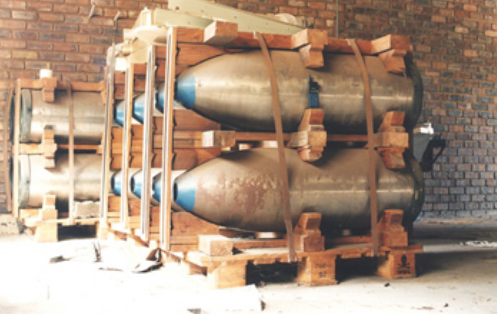
Bomb casings from South Africa’s dismantled nuclear weapons program (Photo: Atomic Heritage Foundation.)
IAEA Safeguards Agreement
16 September 1991
Following its accession to the Non-Proliferation Treaty (NPT) on 10 July 1991, South Africa signed a comprehensive, full-scope safeguards agreement (INFCIRC/153) with the International Atomic Energy Agency (IAEA) on 16 September 1991. While Foreign Minister R.F. “Pik” Botha signed South Africa’s accession to the Nuclear Non-Proliferation Treaty (NPT) on 10 July 1991, Ambassador Cecilia Schmidt signed the IAEA safeguards agreement in Vienna on 16 September 1991 alongside IAEA Director General Hans Blix. This legally binding framework required South Africa to submit an exhaustive initial inventory of all its nuclear materials—including hundreds of kilograms of highly enriched uranium (HEU) produced at the secret Y-Plant in Pelindaba—and to grant international inspectors unrestricted access to its nuclear facilities. Under Hans Blix, the IAEA conducted an unprecedented, years-long verification campaign to confirm not only the accounting of declared nuclear material but also that South Africa’s clandestine weapons program had been fully terminated and all six gun-type devices completely dismantled. By thoroughly cross-checking historical production records against operating logs and physical samples, the IAEA concluded that South Africa’s declaration was complete and accurate, formally establishing the country as the world’s first fully disarmed, non-nuclear-weapon state under international oversight.
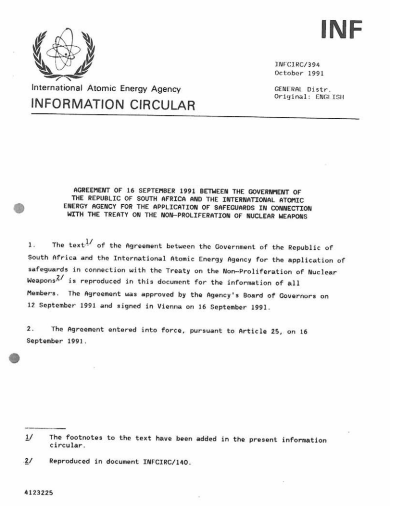
International Atomic Energy Agency Safeguards Agreement (Photo: International Atomic Energy Agency)
Test Ban Treaty
24 September 1996
On 24 September 1996, South Africa signed the Comprehensive Nuclear-Test-Ban Treaty (CTBT) at the United Nations in New York, thereby legally committing to halt all nuclear explosive testing in any environment—whether atmospheric, underground, or underwater. Having already established itself as a leader in international non-proliferation, South Africa actively chaired the treaty negotiations and formally ratified the accord on 30 March 1999.
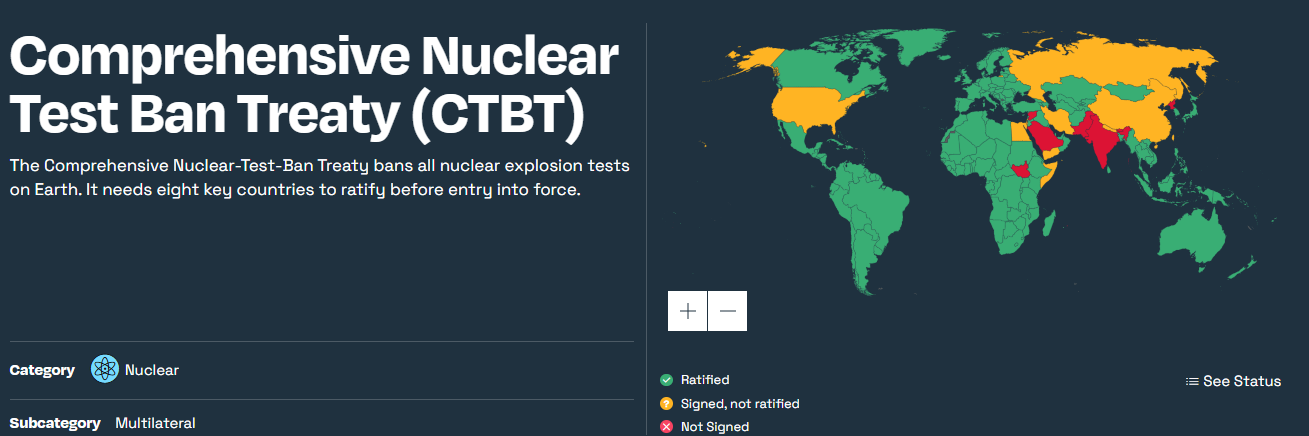
Comprehensive Nuclear-Test-Ban Treaty (Photo: Nuclear Threat Initiative)
Conclusion
South Africa’s nuclear journey is a unique case in modern international relations. Reviewing key September milestones shows that strategic deterrence, geopolitical shifts, and domestic politics drove the country to fully dismantle its nuclear arsenal. From the covert suspicions around the 1979 Vela Incident to signing the CTBT in 1996, South Africa proved that complete disarmament with international verification is possible. Its experience now sets a global example for non-proliferation and demonstrates how transparent diplomacy can effectively prevent nuclear escalation.
References:
Atomic Heritage Foundation. 2018. South African Nuclear Program. Atomic Heritage Foundation / National Museum of Nuclear Science & History. Available at: https://ahf.nuclearmuseum.org/ahf/history/south-african-nuclear-program/ [Accessed 22 September 2026].
International Atomic Energy Agency. 1991. Agreement of 16 September 1991 between the Government of the Republic of South Africa and the IAEA for the application of safeguards in connection with the Treaty on the Non-Proliferation of Nuclear Weapons (INFCIRC/394). Vienna: IAEA. Available at: https://www.iaea.org/sites/default/files/infcirc394.pdf [Accessed 23 September 2026].
Möser, R.E. 2024. Disarming apartheid: The end of South Africa’s nuclear weapons programme and accession to the Treaty on the Non-Proliferation of Nuclear Weapons, 1968–1991. Cambridge: Cambridge University Press, pp.172–195.
Nuclear Threat Initiative. n.d. Comprehensive Nuclear-Test-Ban Treaty (CTBT). NTI Education Centre: Treaties and Regimes. Available at: https://www.nti.org/education-center/treaties-and-regimes/comprehensive-nuclear-test-ban-treaty-ctbt/ [Accessed 23 September 2026].
Von Wielligh, N. and Von Wielligh-Steyn, L. 2015. The Bomb: South Africa’s nuclear program. Pretoria: Litera Publikasies.
Wilson Centre Digital Archive. n.d. South African nuclear history. Available at: http://digitalarchive.wilsoncenter.org/collection/95/south-african-nuclear-history [Accessed 22 September 2026].
