Nongqai Vol 17 No 9 – (27) 1906: the Ferreira Raid in the Cape Colony
THE FERREIRA RAID: NORTH WESTERN CAPE COLONY: NOVEMBER 1906
Compiled by Wolfgang Witschas
Excerpt
1906: the Ferreira Raid in the North Western Cape Colony
Abstract:
This article shows how political relations between the Boers and the British following directly of the South African War (1899-1902) were overshadowed by the fear of renewed armed resistance to British rule. This anxiety was aggravated by the presence of the Germans in Deutsch Südwestafrika (DSWA)/German South West Africa (GSWA), present-day Namibia. In the border region of the northwestern Cape, the aftermath of the Second Anglo Boer War (South African War), 1899-1902, became intertwined with the history of Anglo-German relations, which had been strained since 1884 regarding Imperial Germany’s acquisition of colonies in Africa and the Far East and which had deteriorated during the South African War. Relations were further complicated by internal conflicts in each territory. While the British struggled to consolidate their rule in the wake of the war against the Boers, the Germans were tied up in a drawn-out uprising of the Herero and Nama people (1904-1907). The British believed that in the event of open conflict with Germany the collusion between Boer diehards in the northwestern Cape and the Germans could ignite a ‘Second Anglo Boer War’ in South Africa. When in November 1906 some Boers, who had been employed in the German colonial army, “Schutztruppe” crossed the border into the Cape Colony and attempted to incite a rebellion, such fears were rekindled. The history of this short-lived “Ferreira Raid” reflects the tensions between the British, Boers and Germans. The raid proved to be a quixotic rehearsal for the 1914 Afrikaner rebellion.
Key Words
Ferreira Raid, Deutsch Südwestafrika (DSWA)/German, South West Africa (GSWA), Cape Colony, South Africa, Britain, Germany, Schutztruppe, Cape Mounted Police (CMP), Cape Mounted Rifles (CMR), John Hendrik Ferreira, Pieter Fischer, Frans Retief, Rennier Johannes Cornelius Potgieter, Zwartmodder (now Askham) Police post, Abeam Police post
Introduction
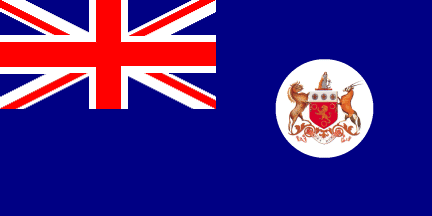
Flag of the Cape Colony
The Ferreira Raid, which occurred in November 1906, was a brief incursion into the Cape Colony by a group of armed Boers led by a man named John Hendrik Ferreira. They aimed to incite anti-British rebellion and were suspected of having ties to the German colonial administration in DSWA/GSWA. The raid, which involved attacking police posts and forcing Boers to join their cause, was quickly suppressed by the Cape Mounted Police (CMP).
John Hendrik Ferreira
John Hendrik Ferreira was a 21-year-old Transvaal Boer. He was born in the Oudtshoorn district of the Cape Colony but grew up in the Zuid-Afrikaansche Republiek (ZAR). After the Second Anglo Boer War 1899-1902, he refused to live under British rule and went to DSWA/GSWA.
Ferreira was employed by the German Schutztruppe, like many other Boers that came to DSWA/GSWA, as a transport rider and auxiliary during the war against the Herero and Nama
Here is a more detailed breakdown
Context
The raid took place in the aftermath of the Second Boer War (1899-1902) and during the Herero and Nama genocide in DSWA/GSWA.Tensions between Britain, the Boers, and the Germans were high.
Motivations
The Ferreira group, who had previously worked for the German colonial army “Schutztruppe” aimed to rekindle Boer resistance against British rule in South Africa and were suspected of receiving support from German officials.
Events
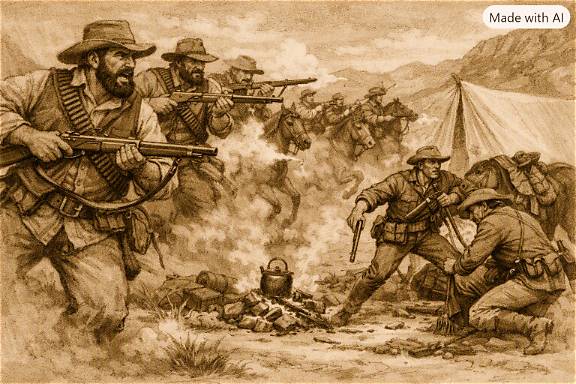
The raid involved attacking police outposts and attempting to recruit Boers, highlighting the ongoing instability in the region and the lingering resentment towards British rule.
Suppression
The Cape Mounted Police (CMP) quickly responded, capturing Ferreira and his followers within a week. Ferreira and some of his companions were tried for murder and sentenced, though their
death sentences were later commuted
Significance
The Ferreira Raid, though short-lived and quixotic, reflected the complex political landscape of the time and the lingering fears of a renewed Boer rebellion, particularly in light of the German presence in the region. It also highlighted the ongoing tensions between the British, Boers, and Germans in Southern Africa
Prelude to the Raid
Being part of the Schutztruppe gave them access to rifles and ammunition from German stores, horses and wagons. They received pay so they could stay organized as a commando and their military experience in the border area of the north-western Cape. DSWA/GSWA was a base where British Cape Mounted Police could not reach them. The southern border, around, Keetmanshoop, Warmbad and Hasuur became a staging ground. Ferreira’s group could meet, recruit other bitter-enders, and plot a rebellion against the British without being arrested.
The German administration knew about the anti-British talk and, while Berlin did not officially order a raid, local officials and settlers were sympathetic. They did not disarm them or stop them crossing.
When the raid occurred in November 1906, it had been clearly anticipated by some leading British administrators. According to the scenario developed by Hely-Hutchinson and Selborne, the authorities believed that they were confronted by dangerous Boer rebels who might attract a larger number of volunteers. The Cape Times stated that rumours of a raid had been circulating for a considerable period. But who would have thought, the newspaper asked, that ‘a few half-crazy freebooters’ would actually commit such a ruthless deed, especially when the turmoil of the Morocco crisis seemed to have died down? John Hendrik Ferreira and his cohorts had not only stolen rifles, ammunition and horses from a Schutztruppe depot, but also several khaki tunics and German-style riding breeches. This gave rise to initial reports about a joint military operation of Boers and Germans. In response to official notes from Cape Town, the Germans immediately promised to disarm their Boer employees. At first, this did not allay the fear that a general rebellion in the Cape Colony was close at hand. Rumours claimed that 200 Boers waited at the border to be joined by another 500 at Upington. The precise history of the Raid is as follows:
The Raid
On 05 November 1906, John Hendrik Ferreira and his half-brother, Pieter Fischer, absconded from the Schutztruppe with their companions, Frans Retief and Rennier Johannes Cornelius Potgieter, and crossed the border near Klipdam to South Africa. John Ferreira had moved to DSWA/GSWA and enlisted in the Schutztruppe at Swakopmund in 1902. He claimed that he had seen action during the Herero-Nama wars 1904 -1907) and had been awarded two medals. Later he was in command of a reconnaissance corps at Liefdood where he was in charge of about six Europeans and sixteen Africans, whose task was to protect settlers against Nama guerrillas, at the age of 17 and he was twice honoured for bravery. His brother, Pieter, also worked in Liefdood as a blacksmith. The involvement of another participant, Fredrik Venter, is not quite clear. Initially, he might have been forced to join the gang, but he seems to have been carried along by events, growing into the role of a Boer rebel. Calling himself a ‘fierce and bloodthirsty Africander’, he later waved a black notebook in front of a witness, claiming that it contained the names of numerous supporters of the Ferreira gang. John ‘promoted’ him to corporal, although Venter apparently deserted at a later stage.
The gang clearly believed that they would gain substantial support among the Boer population in the northern Cape, but this hope proved unrealistic. They were inept in recruiting frontier farmers and travellers to their cause. Their efforts were based on a combination of untruths and threats. John Ferreira said he was a ‘general’ who was fighting for a United South Africa, claiming that that his followers ‘were part of a general rising throughout South Africa’, and that the Englishmen were being killed in Cape Town in great numbers’. One traveller was told that an uprising against the British had already begun in the Transvaal, on 01 November 1906, and that the Boers in the German colony were on their way to lend their support.
As the Ferreira gang moved further into the Colony such stories became increasingly colourful. Counting on the ignorance of the farming population in the desolate northwest, they spread rumours that a war had already broken out between Germany and France, on the one hand, and Great Britain, on the other. Another version suggested that the German navy had already ‘practically annihilated’ the British fleet and that the rebels ‘only had to fight a bit on land’. John Ferreira emphasized that he was prepared to kill women and children because of the suffering that Boer women and children had endured in the concentration camps. He asked another passer-by whether or not he had fought for the British in the South African War, because ‘if he knew for a fact that I had fought against them, he would shoot me down on the spot, and that if he came across anybody else who had, he would shoot him’. A former member of the Prieska Town Guard managed to escape after he had been ‘sentenced to death’ by his captors for his anti-Republican stance during the war. It is tempting to speculate about the raiders’ motivations in terms of their almost millenarian expectations of dramatic political change. Indeed, in the 1914 Rebellion, armed resistance was partly encouraged by the visions of the Afrikaner prophet, ‘Siener’ Van Rendsburg. Ferreira and his men, however, were clearly inspired by a somewhat crude or naive nationalistic sentiment. They did not couch their unrealistic ambitions in religious language. Moreover, the archival records do not say much about the treatment of the handful of Africans who were captured and apparently forced to serve the gang as agterryers (unarmed servants). Nonetheless, the worst behaviour of the raiders was against a young, coloured woman, Griet Fransman, who was raped by John Ferreira, and later suffered a miscarriage as a result. A trader, Jacob Oddes, experienced the gang’s anti-Semitism which was rampant on both sides of the Cape- DSWA/GSWA border and which targeted itinerant Jewish traders. Oddes ran into the Ferreira party near Zwartkop’s Dam on 06 November 1906, but he was not easily intimidated. When Pieter Fischer threatened to shoot the ‘verdoomde jood’, Oddes called him a ‘verdoomde Boer’. The gang eventually made off with the trader’s horse and a yard of black cloth, which was made into a freebooter’s flag. By 09 November 1906, the ranks of the Ferreira gang had increased to about fifteen. Most had been forced to join the rebels at gunpoint. While resting on a farm, another gang member, Hendrik Jooste, explained to his captive audience that they were involved in a struggle against ‘capitalism’. He declared, ‘that they were fighting for independence under the black flag, that their crossing the border would be the cause of war between Germany and England, that everybody must join, and those who did not do so would be shot down’.
The British and the Germans ‘would have too much to do on the waters’. This would leave the defence of South Africa to the British troops already stationed there – overcoming them the gang apparently did not consider to be a major obstacle. The protest of their unwilling troops was again silenced by threats of execution. While the Cape government despatched a strong police force to the northern Cape to intercept the raiders and the inhabitants of Upington took up arms in defence against the raiders, it was noted with relief that the invaders remained isolated, and that no further commandos had crossed the GSWA border.
Skirmishes of the Ferreira Gang
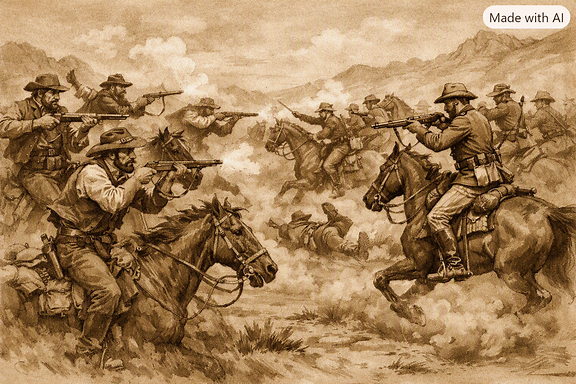
The Ferreira gang attacked two police posts near Zwartmodder (now Askham). They wounded two Cape Mounted Policemen, one fatally, and stole horses, weapons, and ammunition.
Next the police post at Abeam was attacked at night. They wounded two Cape Mounted Policemen, Constable W.O. Bellew who later died of his wounds and Constable Cox who later recuperated from his wounds in the Upington hospital.
The gang took four police horses, some rifles, a pistol and ammunition. Hereafter the gang encountered the mail coach to Rietfonteon and took £11 in mail and some packages containing clothes.
Reaction of the Cape Government
The Cape Premier, Dr Leander Starr Jameson of the Progressive Party, the leader of the 1895 Jameson Raid mounted from Bechuanaland, turned to the powerful Jan Hofmeyr of the Afrikaner Bond. The Bond’s newspaper, Ons Land, published a strongly worded warning of the political implications of the raid. The Bond washed its hands of any political adventurism that jeopardized a new dispensation in post-war South Africa.
Ferreira’s gang must be immediately stopped. We know absolutely nothing about the persons who compose the armed marauding gang, and still less can we guess what has moved these undisciplined daredevils to commit this deed. It is indeed unnecessary to say that the leaders of the Africanders knew nothing about it and had nothing to do with it. Hofmeyr asked the chairman of the Bond, T. P. Theron, and the Reverend C. Schroeder in Upington, to ‘go at once and act on the spot to preserve peace and order’ among the unruly population of the northwestern Cape. The Cape government paid their expenses. The ‘ignorance’ of the isolated farming population made it imperative that they be ‘acquainted with the true condition of affairs’, because ‘newspapers are rarely seen, distances great, and consequently exaggerated reports made by Ferreira and his friends might induce few ignorant people to join them from the consequence of hasty, ill-considered action’. Ons Land pointed out: The war in South Africa was fought out and peace was restored at the Vereeniging treaty. This peace may not be violated or broken. Since the surrender of arms in 1902 it has in every respect been most plainly shown that it is the wish of the whole people of South Africa to preserve this peace undisturbed.
Cape Mounted Police (CMP) in pursuit of Ferreira Raiders
Initial haphazard efforts by the CMP to intercept and apprehend the Ferreira gang mirrored the clumsy manoeuvres of the Ferreira raiders.
Police Inspector White was in charge of a small detachment of Cape Mounted Police (CMP) that happened to be in the vicinity of the invaders. White received the news of the raid on 08 November 1906 in Keimoes, where several officers and troops had gathered to attend the ‘King’s Birthday Sports’. Most of the policemen had come to the celebrations unarmed, and their guns had to be fetched from Upington before they could pursue the raiders. Their departure was therefore delayed for twelve hours, which led White to search for reinforcements among ‘Bastards’. These men refused to join up, however, because it was harvesting time. Further delays were caused by inefficient organization and lack of military reconnaissance. The police force eventually consisted of two officers, eleven white soldiers, two white volunteers and seventeen Africans or Coloureds. It was not until 12 November 1906 that White and his men clashed with the Ferreira gang. The disastrous organization of the police operation resulted in utter chaos when the two parties became involved in a skirmish. At the moment of contact, White was seen ‘to throw up his arms and fall from his horse’. He had to be carried out of the firing line. Having suffered an epileptic fit, he was too dazed to give meaningful orders. His men were completely confused and began firing indiscriminately. strength. At that stage, of course, the actual state of the Ferreira gang was unknown, as was the fact that most of its members were not voluntary participants in the shoot-out. Under the impression that they had to defend their lives, some of the kidnapped gang members apparently returned the fire ensuing pandemonium was compounded by misinformation. The disseminated by a CMP private, who had been captured by the gang earlier during the day, but who had managed to escape. He rejoined the police detachment ‘in very excited condition’, and the news spread that ‘the enemy were 50 strong, well armed and in laager’. Sub-Inspector Adams, who had taken over the command from his incapacitated superior, gave the order to retreat. When reinforcements arrived a little later, White received the order to continue the chase. Instead, he insisted on withdrawing his men to Upington. Meanwhile, no-one had noticed that Ferreira and his accomplices had fled. Adams continued in pursuit with a ‘force of forty-three Europeans and twenty-three natives’, while 200 more police were about to close in on the invaders.’ The precise circumstances of the raiders’ capture are not clear, but it appears that that most of their press-ganged recruits had absconded and some of the others were captured by the police, before the rest of the gang gave themselves up quite unheroically on the farm Karos, near Upington on 14 November 1906.’ After the raid, there was a sigh of relief at the Cape. Hely-Hutchinson defended the involvement of the Afrikaner Bond by emphasizing that the raid had posed a threat to peace in South Africa. He shook his head at ‘Mr Theron’s somewhat naive statement that he was “astonished” on arriving at Upington to find how willingly the farmers had come forward for the defence of their town’. Elements of suspicion, however, remained in the wake of the raid. A secret agent described how it had affected the lower stratum of the farming community: Amongst the better class of farmers, they deplore that the gang should have openly stated that they could get all the recruits they wanted there, but I find amongst the poorer class, especially of the Dopper section, some very seditious speeches have been made, and that several of them have openly stated that if Ferreira had come through, they would have joined him. Apart from these hints of some moral support for the Ferreira gang among the poor whites in the northwestern Significantly, Cape, the records are mute about the precise social base of the raiders. though, the report indicates important class differences among the Boer population, which explains why the raid did not become the signal for a massive insurrection to British rule.
The Trial There were demonstrations in support of the Ferreira gang before the trial began in December 1906. Inevitably, parallels were drawn between the Ferreira and the Jameson Raids.’07 Jokes circulated about Ferreira’s intention to replace Jameson as the prime minister of the Cape Colony.’08 Almost as predictably, British colonial government also invoked. the Slagtersnek Rebellion against the in 1815, which resulted in the hanging of five Boer rebels, was On 25 November 1906, a crowd in Market Square in Johannesburg called for the pardoning of the raiders. The ‘South African Democratic League’ presented a resolution in the name of peace and goodwill between English and Dutch-speaking ‘British subjects’, which was reputedly signed by 4,000 people. demanded that the Cape governor treat the Ferreira gang with the same clemency that had been granted to the Jameson raiders by Kruger’s government in 1895.
The court case against the Ferreira brothers and their cohorts, Frans Retief, Hendrik Jooste and Rennier Johannes Cornelius Potgieter, involved the testimony Hely-Hutchinson of 85 witnesses.
Two German officers, captains Max Brosig and Max Siebert, appeared as witnesses in the Kimberley court.”‘ The charges against three other participants, Frederik Venter, Oellof Spangenberg and Jan Pieters, were dropped because they were able to convince the authorities that they had been forced to join the gang. On 20 February 1907, the remaining accused were sentenced to death for the killing of the policeman at Abeam. Retief and Potgieter, however, were ‘recommended to mercy on grounds of ignorance and youth’. “The death sentence caused an uproar. Hely-Hutchinson was inundated with petitions and was confronted by deputations demanding the commutation of the sen- tences.” He was inclined to view these representations the accuracy of his earlier predictions in a favourable light. He basked in of a border raid. Now he was afraid that the execution of Ferreira and his men would result in ‘a second Slachter’s Nek’. He decided against ‘opening a fresh sore in the body politic, which … would take many years to heel [sic]’, and refused to create political martyrs.” In response to this pressure, the death sentences were commuted. Ferreira, Fischer and Jooste were sentenced to life imprisonment with hard labour, while Retief and Potgieter received fifteen years. The question of whether or not the Germans had actively encouraged the raiders, however, continued to preoccupy officials. Jan Smuts considered the idea of German involvement ‘pure moonshine'” and Louis Botha assured the public that any rumours of a Boer rebellion in the Transvaal were unfounded. Most South African newspapers derided the possibility that Ferreira and his men had acted on the orders of the German captain, Max Siebert, as the accused stubbornly claimed during the ensuing court trial. However, the Cape governor blamed the Germans for not preventing the incursion, even though any active involvement on their part could not be proven. The Attorney General, Victor Sampson, argued for mild punishments, because he also believed that the Germans could have instigated the raid. In the event, it turned out that about a month before the raid an unidentified ‘Dutchman’ had asked the German Consul General in Cape Town whether the Germans would support a commando across the South West African border into the Colony. Hely-Hutchinson accepted the consul’s explanation that the latter had ‘poo-poohed the idea’.’ At the British Foreign Office, where the warnings of raids from DSWA/GSWA had been treated with the utmost scepticism, suspicions about the aims of troop concentrations in the German colony were temporarily resuscitated. Sir Edward Grey, however, declined to enter into any heated exchange with the German government, which he expected to renew the usual complaints about the lack of co-operation on the border.
Epilogue
In the wake of the Ferreira Raid, the Cape government asked the German colonial government to ship their demobilized Boer scouts and transport and to disburse them at the German Consulate-General, riders back to Cape Town Boers travelling through the northern rather than having large groups of Cape with money in their pockets. The Germans officially ended the Nama war in South West Africa in March 1907, which helped to improve relations between the two colonies. British military experts, however, continued to see the Germans as ‘uncomfortable neighbours who are very pushing [sic] in their manners’. In 1909, John X. Merriman, the last Cape prime minister before Union in 1910, alluded to the Ferreira Raid when he reminded Hely-Hutchinson difficulties of the created by the German colony. But even though the Cape Colony ‘would be better without them’, the authorities did not believe that they posed a serious military threat to South Africa. The participants in the Ferreira Raid spent miserable years in the Tokai and Breakwater prisons, blaming one another for their foolish actions. Amnesty granted at the founding of the Union of South Africa brought early pardons from their fifteen-year sentence for Retief and Potgieter and they were released at the end of 1909. Hendrik Jooste, whose health had deteriorated dramatically in prison, was also discharged in 1909. The half-brothers John Ferreira and Pieter Fischer repeatedly appealed for a pardon, but Merriman, and later the South African Minister of Justice, J. B. M. Hertzog, declined to grant clemency.
The German authorities in DSWA/GSWA did not officially instigate the Ferreira Raid, but they did help to create it.
The raid in November 1906 was done by Boers who had been employed in the Schutztruppe, during the period of the Herero and Nama war 1904-1907.
When in November 1906 some Boers, who had been employed in the German colonial army, crossed the border into the Cape Colony and attempted to incite a rebellion.
Berlin did not order it and the German colonial authorities were fully tied up in the Herero and Nama uprising and wanted to avoid a conflict with Britain at that stage at any cost. Further the colonial authorities in Windhoek were struggling to consolidate rule and restore law and order after the war against the Herero and Nama.
The Germans however gave Indirect help and tolerated the Boers and their aspiration to reclaim their independence.
In 1902 they gave sanctuary to Boer “bittereinders” after the Second Anglo Boer War, 1899-1902 who refused to live under British rule.
The Schutztruppe hired them as transport riders, scouts and auxiliaries because they knew the terrain.
Inside DSWA/GSWA there was a lot of anti-British sentiment, and some local German officers and settlers were sympathetic to the idea of another “Boer War”.
The Germans did not stop Ferreira’s group – led by Ferreira and others – from leaving DSWA/GSWA armed and crossing into the northwestern part of the Cape Colony to try to rekindle Boer resistance. Why Britain thought Germany was behind it was because British intelligence had long feared that in the event of open conflict with Germany, the collusion between Boer diehards in the northwestern Cape Colony and the Germans could ignite a another “Boer War” in South Africa. The presence of Germans made Anglo-German relations strained since 1884 and deteriorated during the Second Anglo Boer War.
Historians call it a “quixotic rehearsal for the 1914 Afrikaner rebellion” – Boer initiative, using German territory as a base, but not a German government operation. The German factor was political cover and employment for the “Bittereinders” and not direct orders.
” Quixotic ‘Foolish, idealistic, hopeless from the start ‘- ‘Rehearsal ‘- a practice run for a bigger play later”
References
https://www.tandfonline.com/dol/abs/10.
https://af.wikipedia.org/wiki/Ferreira-inval
https://wwwnafricabib.org/rec.php?RID=202548112

