Nongqai Vol 17 No 9 – (20) The ZARPS and Bergendal
Excerpt
The ZARPs, turned mounted infantry, held the exposed koppie at Bergendal with exceptional discipline under hours of British shelling. Their stand, praised even by Arthur Conan Doyle, broke Botha’s line and marked the end of conventional warfare in the Anglo‑Boer War.
(Drawn from: “The ZARPs held steady behind their boulders through the whole of it…” and “no finer defence was made in the entire war.”)
Abstract
This article outlines the role of the Zuid‑Afrikaansche Republiek Politie (ZARPs) in the Battle of Bergendal, the final set‑piece battle of the Anglo‑Boer War. Positioned on a rocky koppie anchoring the weak end of Botha’s defensive line, the ZARPs endured a three‑hour British artillery bombardment and resisted a large infantry assault with notable courage and accuracy. Their eventual overrunning opened the Boer position, enabling British entry into Machadodorp and signalling the transition from conventional warfare to a prolonged guerrilla phase. The article highlights the ZARPs’ steadfast defence and the later memorials commemorating their sacrifice.
Keywords
ZARPs, Zuid‑Afrikaansche Republiek Politie, Bergendal, Anglo‑Boer War, Louis Botha, Buller, Roberts, Staats Artillerie, Johannesburg police, mounted infantry, Eastern Transvaal, Boer defence line, Machadodorp, conventional war, guerrilla war, Pohlman, Oosthuizen, British artillery, Rifle Brigade, Inniskilling Fusiliers, Gordon Highlanders
THE ZARPS AND BERGENDAL
By Gina Shepherd

Not every Boer man fighting man in the Second Anglo-Boer War arrived on a horse from a farm. Some of them arrived fresh from patrolling the dusty streets of Johannesburg.
The ZARPs, the Zuid-Afrikaansche Republiek Politie, were the ZAR’s own police force, and comprised both mounted and foot police. They’d been part of the Staats Artillerie until 1896, when they split off. There were about 1 400 constables, less than half of them mounted. Once the war had started, the entire unit changed to mounted infantry, and the Uitlanders who’d found them heavy-handed on the Witwatersrand. In battle they proved themselves to be men cut from a different mould. They didn’t look much like the popular image of a commando either.
THE RUN-UP
By the end of May 1900 the conventional war Britain expected was more or less over. Bloemfontein had fallen in March, Johannesburg at the end of May, and on 5 June Lord Roberts marched into Pretoria. President Kruger and his government had already left, decamping to Machadodorp on the Delagoa Bay railway a week earlier. The capital changed hands without much drama, and the war simply carried on without it. This is not what the British were used to, and they expended a lot of resources getting to that point. They would not have felt the victorious feeling they were anticipating.
Roberts then set his sights on bringing General Louis Botha and his commandos to a stand-up fight. In July and August two British forces converged on the Eastern Transvaal from opposite directions. From Pretoria, General French’s cavalry and Pole-Carew’s 11th Division pushed east along the railway through Middelburg. From Natal, Buller’s Natal Field Army came up from Volksrust through Standerton, Amersfoort, Ermelo and Carolina, a long, dogged trek against a Boer rearguard that harried them continually. By 24 August, Pole-Carew held Belfast, and the next day Roberts himself arrived to take overall command, along with Buller and French, and settle a plan.
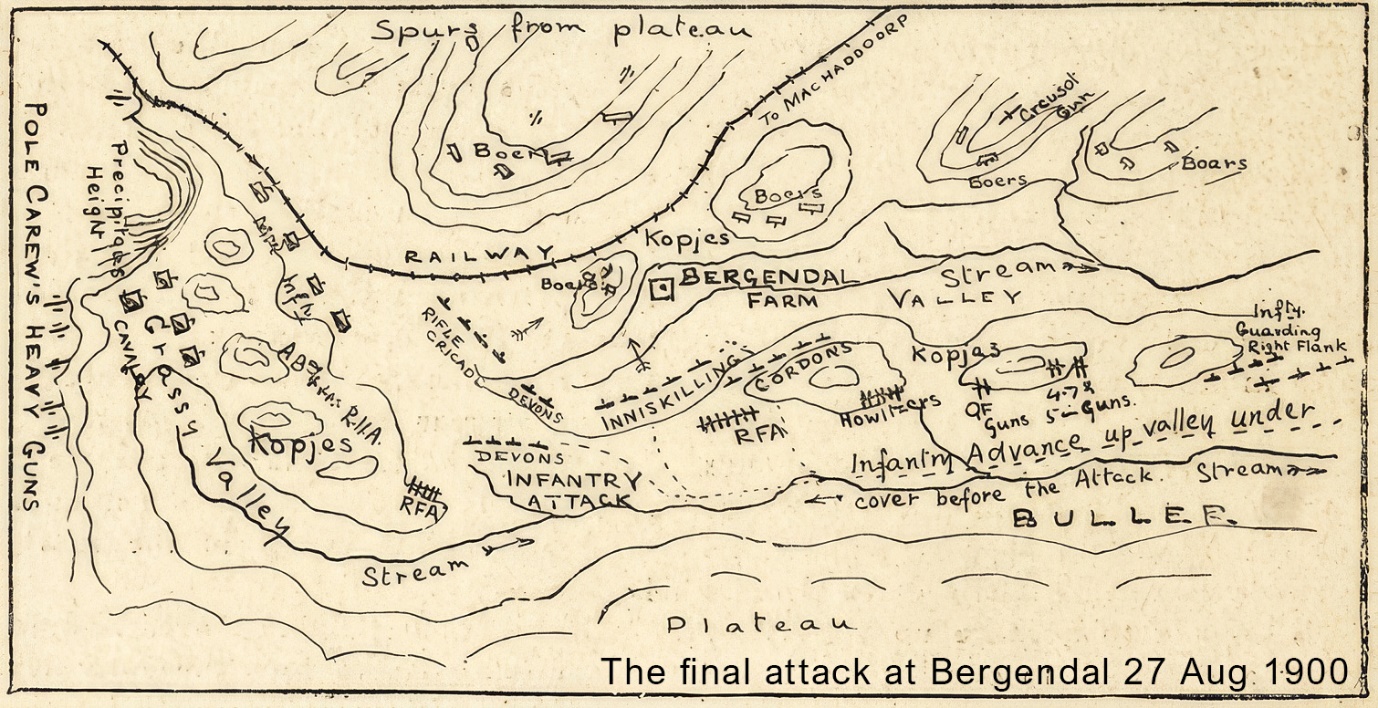
Botha, meanwhile, had drawn a defence line some 80 kilometres long, from Bothasberg north-west of Belfast down to the Komati River, its whole purpose to hold the railway and keep open the roads back to Lydenburg and Barberton. Numbers were too thin on the ground to hold it in strength anywhere, so commandos shifted along it as the British probed. On the farm Bergendal, at the junction of the Carolina and Dalmanutha roads, a stony koppie held the ZARPs. There were about seventy of them, with a thousand or so burghers on either flank but they were not properly joined to either. That unevenness in the line would matter more than anyone on the Boer side could have predicted.
Buller’s scouts determined the weakness in the Boer line on 26 August. A report from Captain Chetwode of the 19th Hussars calculated the end of Botha’s line at Bergendal, and named it the point where the whole position could be broken open. Buller agreed at once, writing to Roberts that Bergendal was “the key of the Boer position”, and moved his whole force up to attack it the following morning.
THE BATTLE
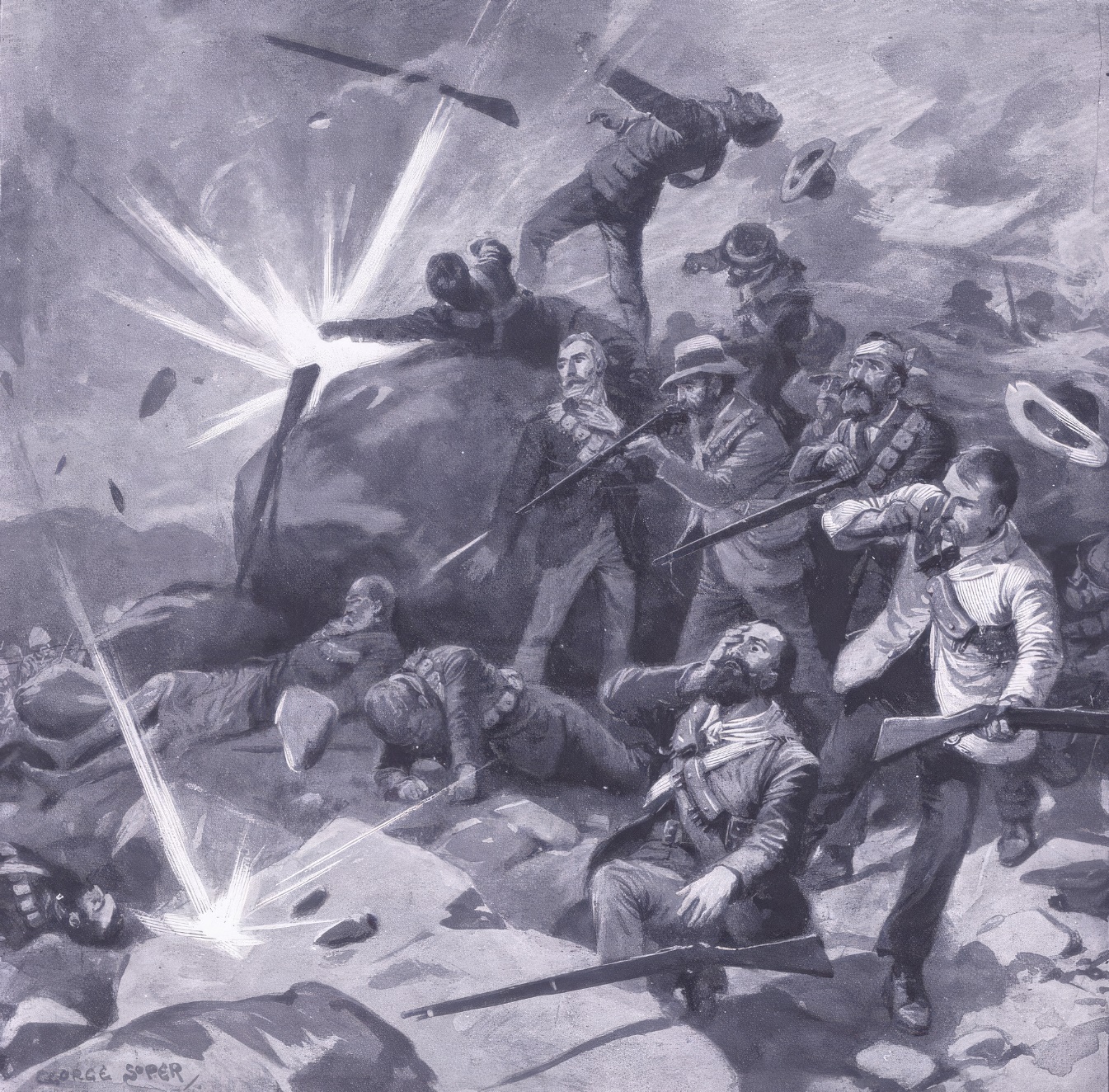
At 11:00 on 27 August, roughly 36 British guns, among them four naval pieces, opened up on the koppie and did not hold back for three hours. The Times History called it a “Vesuvius eruption of smoke, shrapnel, and shattered rock”. The ZARPs held steady behind their boulders through the whole of it. Commandant Oosthuizen was wounded early on by flying stone and had to be helped away, but the rest simply moved from one rock to the next and waited.
At about 14:00 the guns lifted, and some 1 500 British infantry (the Rifle Brigade, the Inniskilling Fusiliers, the Devons, and the Gordon Highlanders) moved across the open grassland with bayonets fixed. The ZARPs kept up a steady, accurate fire until the British were on top of them. Buller wrote to Roberts afterwards that the enemy “stood their ground with great gallantry, and only left their position when the Rifles were among them… between 20 and 30 of them keeping up the fire until actually made prisoners.” By the time it was over, Lieutenant Pohlman and nineteen others were dead, and Commandant Oosthuizen was a prisoner along with eighteen more. Those who remained got to their horses and fell back with everyone else.
This is usually named as the final set-piece battle of the war, and it did break Botha’s line. Buller marched into Machadodorp the following day. Botha’s main force pulled out largely intact, and the government stayed on the move too, first to Nelspruit and then, for Kruger himself, out through Lourenço Marques and into exile. He never came home. What Bergendal did was end the conventional war and start a protracted and more brutal one. Two more years of commandos, columns, and country unwilling to be conquered.
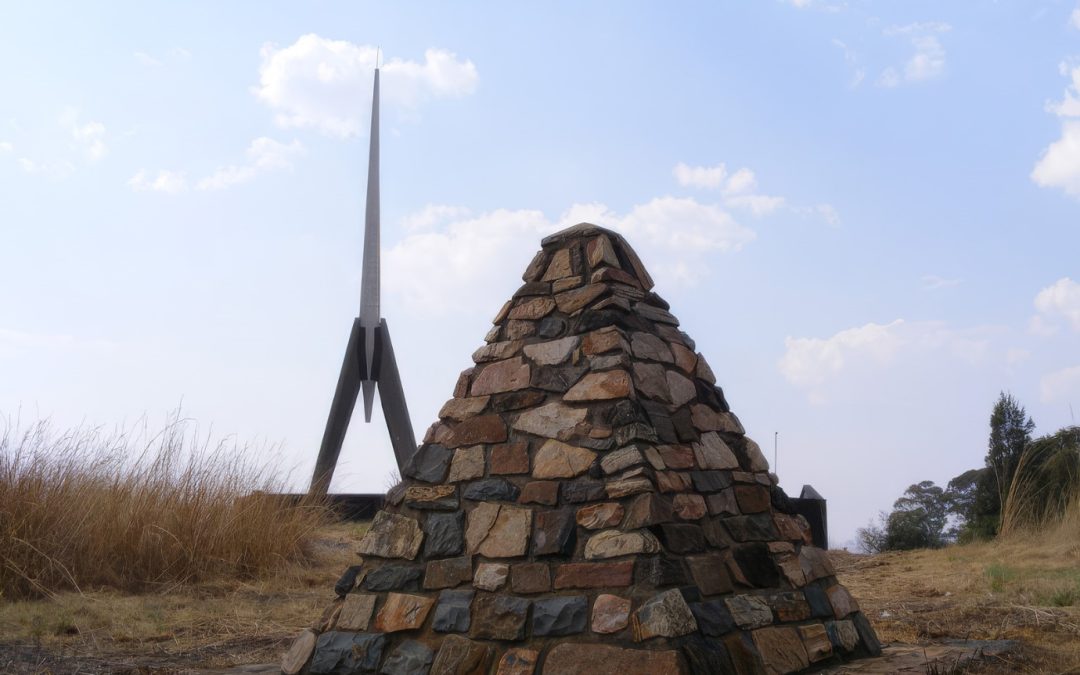
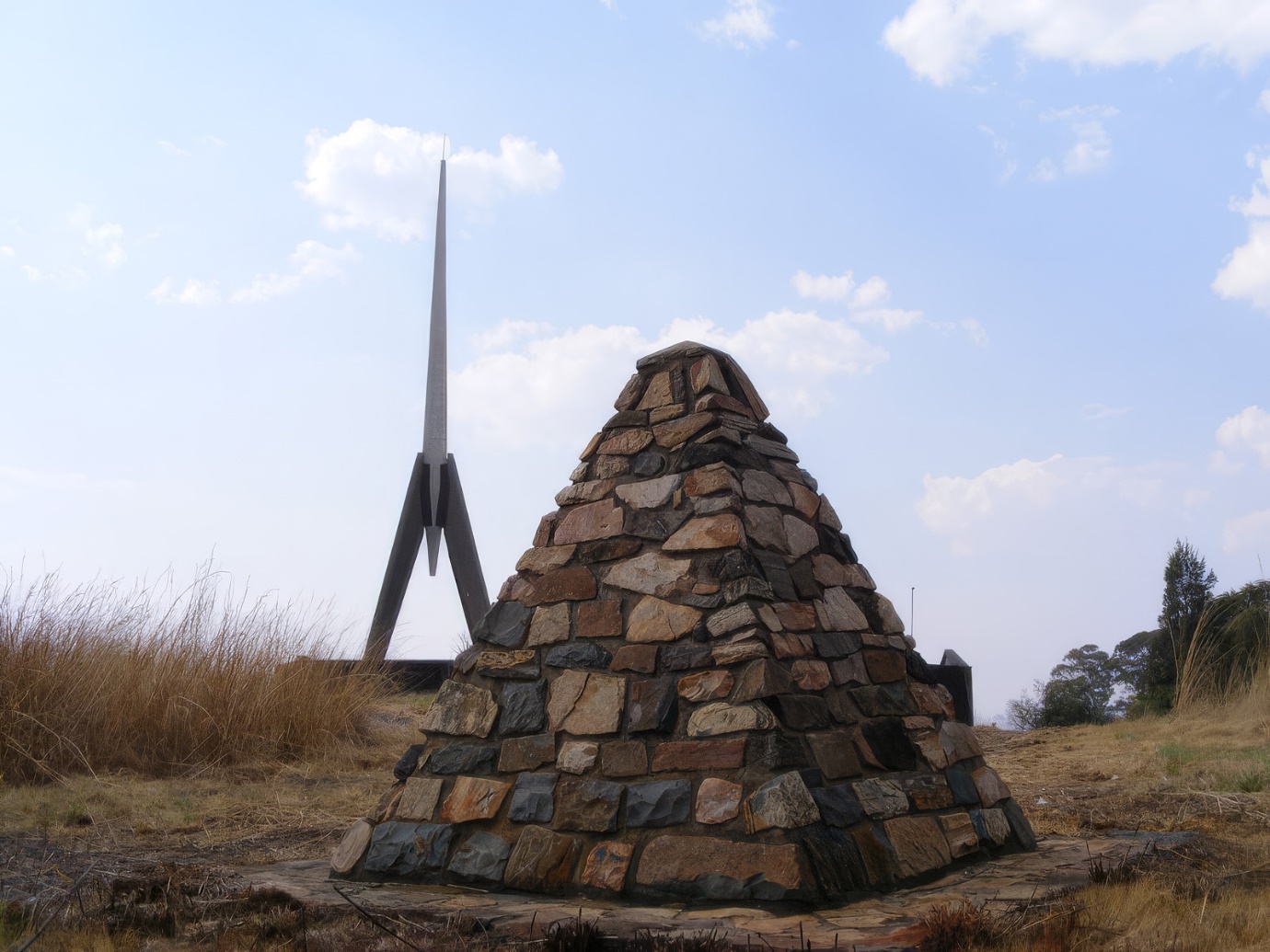
Arthur Conan Doyle, who wrote up the war as it happened and was no soft touch for the Boers, said afterwards that no finer defence was made in the entire war. A memorial to the ZARPs who died there went up on the koppie in 1935, and a much larger one, honouring all the Boers who fell in the Eastern Transvaal, followed in 1970.
SOURCES
- 1. Jooste, Cecilia P. 2002. “The Battle of Bergendal: The Last Pitched Battle of the Anglo-Boer War.” Military History Journal, vol. 12 no. 4, December. South African Military History Society. https://samilitaryhistory.org/vol124cj.html [accessed 12 August 2026].
- Battle of Bergendal. Wikipedia. https://en.wikipedia.org/wiki/Battle_of_Bergendal [accessed 12 August 2026].
- Belfast, Mpumalanga. Wikipedia. https://en.wikipedia.org/wiki/Belfast,_Mpumalanga [accessed 12 August 2026].
- South African Republic Police. Wikipedia. https://en.wikipedia.org/wiki/South_African_Republic_Police [accessed 12 August 2026].
IMAGE SOURCES
- Map of the battle of Bergendal – final attack. Wikimedia Commons: https://commons.wikimedia.org/w/index.php?search=bergendal&title=Special%3AMediaSearch&type=image [accessed 12 August 2026].
- Soper, George. 1900. The last stand of the Johannesburg police at Bergendal. After Pretoria. After Pretoria: The Guerilla War. Wikimedia Commons: https://commons.wikimedia.org/wiki/File:George_Soper%CB%90_The_last_stand_of_the_Johannesburg_police_at_Bergendal_(1900).jpg [accessed 12 August 2026].
- Bergendal Memorial. Wikimedia Commons: https://commons.wikimedia.org/wiki/File:BergEnDalMemorial.JPG [accessed 12 August 2026].

