Nongqai Vol 17 No 7 – Const WL Bos/ss
ABSTRACT
This article examines the complex service history of Constable William Lodewyk Bos/Boss, a member of the South African Mounted Rifles (SAMR) who later transferred to the South African Police (SAP). His career illustrates the transitional period in South African policing after Union, when militarised police forces evolved into national services. The article contextualises the development of long‑service awards, including the Permanent Forces of the Empire Beyond the Seas Long Service and Good Conduct Medal and the later Police Good Service Medal, instituted under Government Notice GN938 of 8 June 1923.
Constable Bos/Boss’s military and police service included participation in the 1914 Afrikaner Rebellion, the German South West Africa campaign, and later enlistment in the Union Defence Force during World War II. His unusual change of surname from Bos to Boss, confirmed only by a newspaper notice, highlights administrative irregularities of the era. Despite disciplinary infractions that could have disqualified him, he ultimately received the SAP Good Service Medal in 1949. The article reconstructs his career through service records, force orders, medal documentation, and family history sources, offering a detailed case study of early 20th‑century South African policing and medal policy.
“The award was to be known as the Police Good Service Medal…” “A letter dated 2nd January 1920… confirms to staff records at HQ that William Bos has changed his name to Boss.”
KEY WORDS
South African Mounted Rifles, South African Police, long service medals, Police Good Service Medal, Permanent Forces of the Empire Beyond the Seas, Afrikaner Rebellion 1914, German South West Africa campaign, Union Defence Force, medal policy, Constable William Lodewyk Bos, name change Bos/Boss, SAMR disbandment 1926, SAP history, colonial policing, military‑police integration, South African medal research, force orders, service records, historical policing.
Change Of Name In More Ways Than One.
By Steve Seargent
Hennie, there is a previous article regarding an Empire Beyond the seas Long Service Medal to Head Constable Charles Detmold Robbins of the South African Mounted Rifles and Permanent Police in Natal, which I am sending with this one. This is its counterpart to a member of the South African Mounted Rifles and transferred to the South African Police.
A brief recap of the policing arrangements following the formation of the Union of South Africa will assist in understanding the rationale behind these awards. Historically the police forces in South Africa were militarised performing both functions, in peace time policing and in times of war assisting the military. This trend was continued when the national forces were set up in 1912 and 1913 (see Issues 153 SAMR and 154 SAP).
Until 1923, the South African Police had no Long Service medal while members who had served 18 years in the South African Mounted Rifles Permanent Police section were still eligible for their Permanent Forces of the Empire beyond the Seas Long Service and Good Conduct Medal. This was corrected when an award was promulgated under government notice GN938 published in the Government Gazette 1324 on the 8th June 1923.
The award was to be known as the Police Good Service Medal to be awarded to policemen and Non-Commissioned Ranks who i) had served a period of not less than 18 years with irreproachable character or ii) had performed service of a particularly gallant or distinguished character. In the latter case this was to be denoted by a bar with the words Merit-Verdienste.
Interestingly the award was based on that of the Prisons Good Service medal instituted the previous year itself having a rather convoluted birth.
In 1918 a commission was set up to examine the awards structures for the non-military arms of the South African Forces especially those of the South African Mounted Rifles whose members either originally included or newly included members of the South African Police and Prison Service. Many of the latter having served in the Natal Police who were responsible for the Jails in that province.
The upshot of this was a proposal for an award with the same service criteria as the Permanent Forces of the Empire beyond the Seas Long Service and Good Conduct Medal. But general apathy and changing governments meant this fell by the wayside until in 1921 when the Director of Prisons wrote to the Governor General asking him to pass the suggested criteria for the award to the Colonial Secretary Winston Churchill. This was done resulting in HM the King approving the award of a Prisons Good Service Medal, announced in Government Notice 1432 published in the Government gazette 1264 on 1st September 1922.
The Police award followed this medals award criteria completely in design and ribbon only changing the obverse to read Police Service.
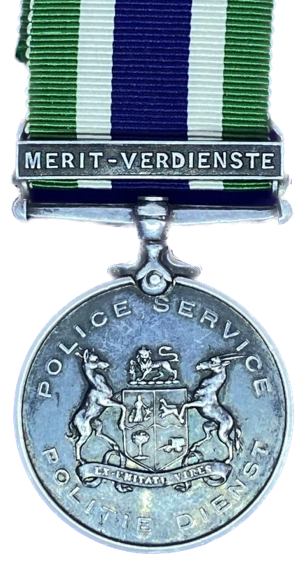
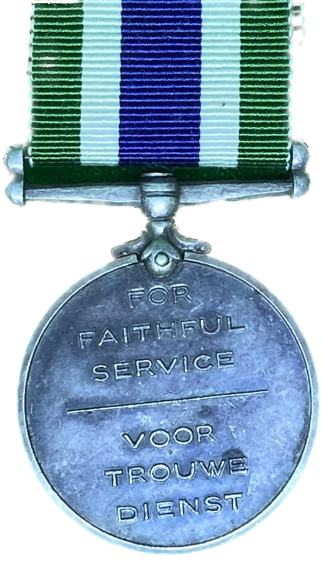
The first type Medal showing the Merit bar.
The non-English naming underwent a number of changes over the years, but I will concern myself here with just the first type issue and Constable Boss’ issue. I intend to do a later article covering this award in far more detail.
The career of William Lodewyk Bos/Boss 2nd & 5th SA Mounted Riles and SA Police
He is the reason for the rather enigmatic title of this article as will be seen later.
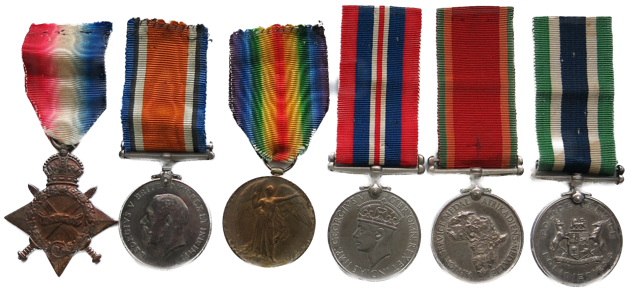
Medal group of Constable WL Bos/Boss
William Lodewyk Bos was born on 27th January 1894 (his SAMR Card shows 1896 and his UDF Application in 1945 shows 1895. The Family Search shows 1894 (based on burial records) in Bultfontein near Bloemfontein in the then Boer Oranje Vrystaatse Republiek the eldest of 6 children of Nicolaas Jan Bos and Barbara Christina Johanna Bos nee Du Bruin.
He signed on to the South African Mounted Rifles as a mounted Constable 8704 (M) on the 24th February 1914.
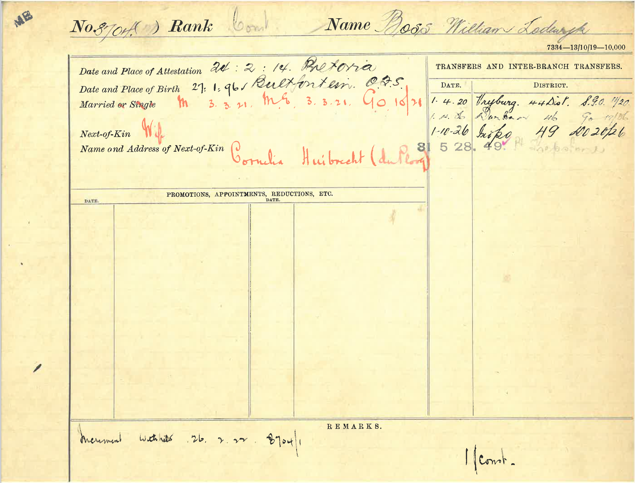
SAMR Service Record Card for W L Bos
He was granted special consent to join the SAMR on the request of the commanding officer of the 4th Regiment SAMR as he was ¾ of an inch below the minimum required height. Special consent was granted by the Minister for Defence on the 8th April 1914.
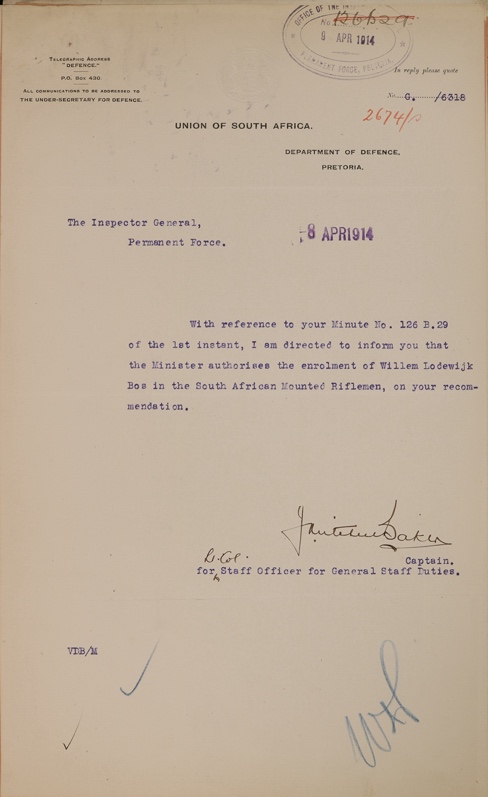
Minister of Defence Authorisation letter
He appears to have been posted to the 2nd SAMR immediately following his training period at Tempe in Bloemfontein and took part in the operations to supress the 1914 Afrikaner Rebellion in the Orange Free State and operations in German South West Africa first in pursuit of the Afrikaner rebels and then in defeating the German forces.
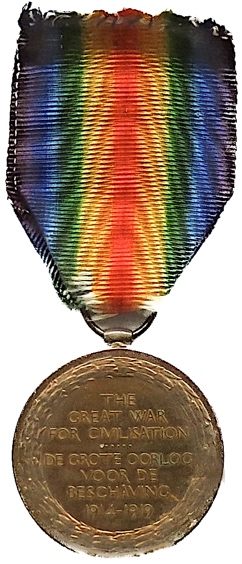
For this service he received the 1914/15 Star, the British War Medal and a South African issue Bi-Lingual Victory medal, named to Rifleman W.L. Bos 2nd S.A.M.R.
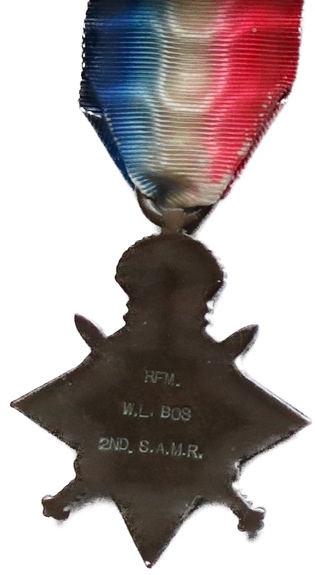
Note the naming on the 1914/1915 Star
Wording on South African Victory Medal
By 14th December 1918 he was back in South Africa stationed at the Head Quarters of 2nd SAMR in Pietermaritzburg where he applied to leave the SAMR, which surprisingly was approved the next day.
It seems that this letter written in haste and rued at leisure was brought about as he wished to be transferred to the 5th SAMR and was turned down at station level. This escalated to be dealt by HQ in Pretoria with he was allowed to take his war leave on full pay.
The final, outcome was that the transfer was approved on 18th March 1918 provided it was at no cost to the state and the discharge approval was countermanded and now No. 2674 Rifleman W.L. Bos departed for Kimberly as a member of 5th SAMR.
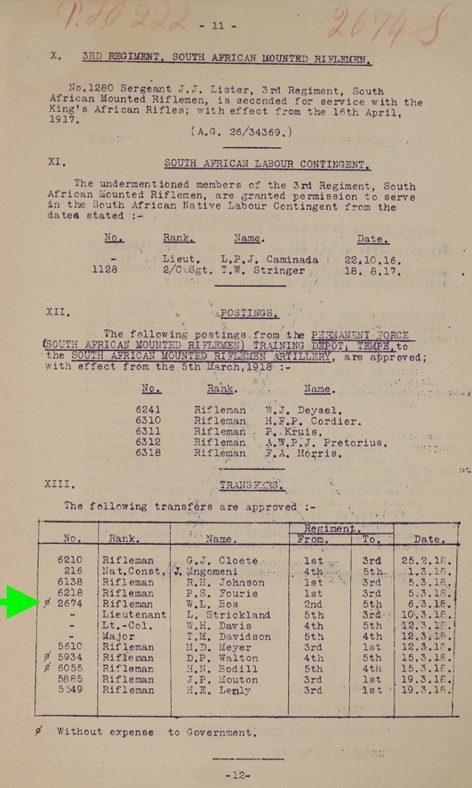
Confirmation of his transfer to 5th SAMR
For some time in official and hand written letters etc. Constable Bos had been using and signing his name as Boss rather than Bos.
A letter dated 2nd January 1920 from the commanding officer of the 2nd SAMR confirms to staff records at HQ that William Bos has changed his name to Boss. What is totally surprising bearing in mind the law, the proof is merely a newspaper announcement probably from 1919. It is also interesting to note that he is now stated as being a Lance Corporal.
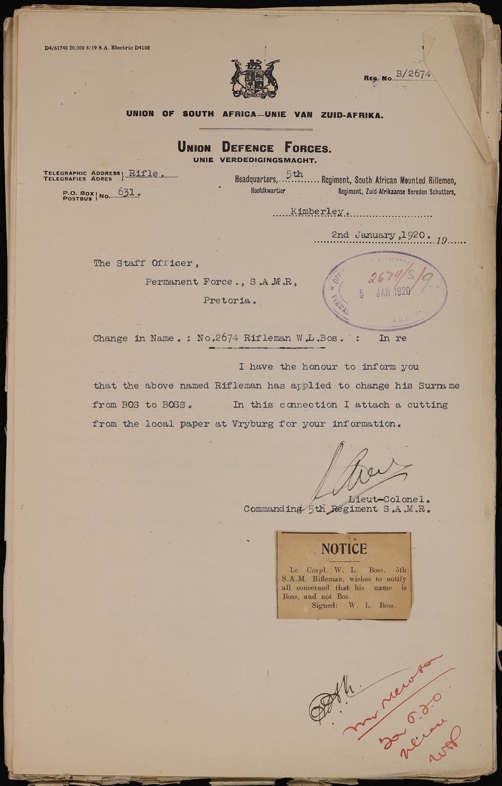
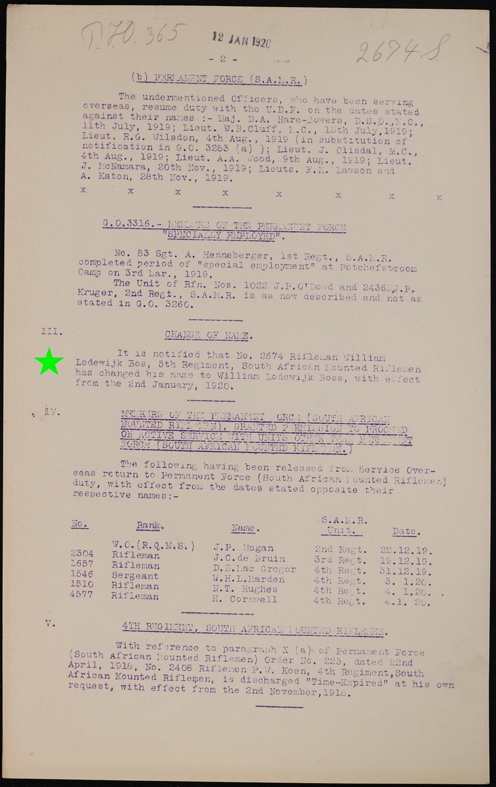
Letter informing HQ of name change (top) and force order confirming this (bottom).
Strangely, in the force order of 12th January 1920 confirming the name change his rank is again Rifleman. What is even stranger is that procedures for officially registering name changes were dispensed with and the Minister of Defence was not involved.
Later that year on the 1st April 1920 Rifleman Boss like the majority of the Kimberly based 5th Regiment was transferred to the South African Police with a new SAP Force number 8702 and posted to SA Police District 44 in Vryburg under instruction in Special General Order 11/20.
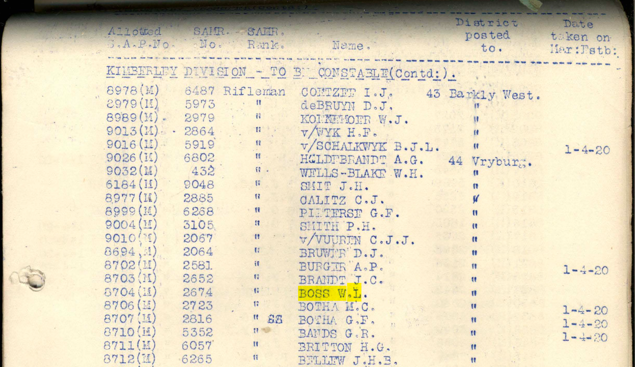
Force order confirming transfer to SAP.
For the now Constable Boss however life went ahead and on 3rd of March 1921 he married Cornelia Huibrecht du Plooy with consent of the commissioner under general order 10 of 1921.
Their only child a daughter Stella Audrey Boss was born on 23rd November 1924.
He obviously made his mark as by November of that year he was now a Lance Sergeant and had for a time been the post commander as is noted in the general orders regarding allowances in November 1921.
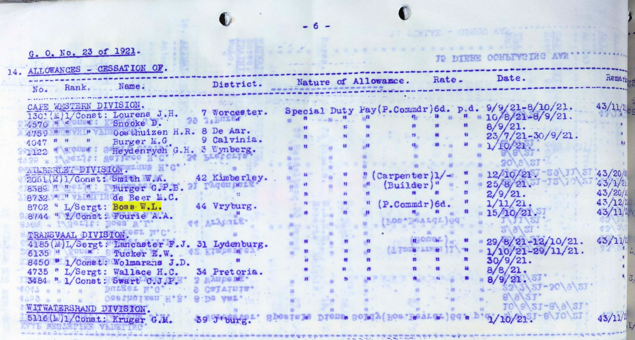
Force order showing his rank as Lance Sergeant
On 31st March 1926 the SAMR was disbanded and the remaining members faced the option of leaving or signing on for duty anywhere in the Union. Clearly, he signed as he was posted to Durban with effect the following day. He was destined to spend the rest of his police career in Natal which was the headquarters of his original posting to the 2nd SAMR.
Seniority was lost in the posting and the now Constable 8704 (F) and his family were posted to Ixopo from 1st October 1926 probably directly from Vryheid without getting to see Durban which then was then about 5 hours dive away.
On 18th May 1928 he was posted for the final time back to Durban City, where with the final withdrawal of mounted units he completed the Police Motor cyclists Course on the 20th June 1936
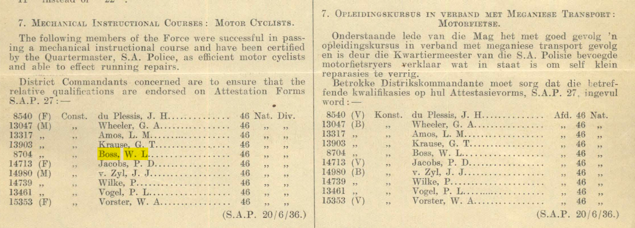
Confirmation of Motor Cyclists course
By the time war arrived in September 1939 he appears to have been office based and like many others was granted consent to enlist in the Union Defence Force which he did as part of the 2nd South African Division at Voortrekker Hoogte Pretoria on 7th November 1940 giving his address at that time as 26(a) Haswell Road Durban. His trade is given as a Policeman. His new force number was 254045.
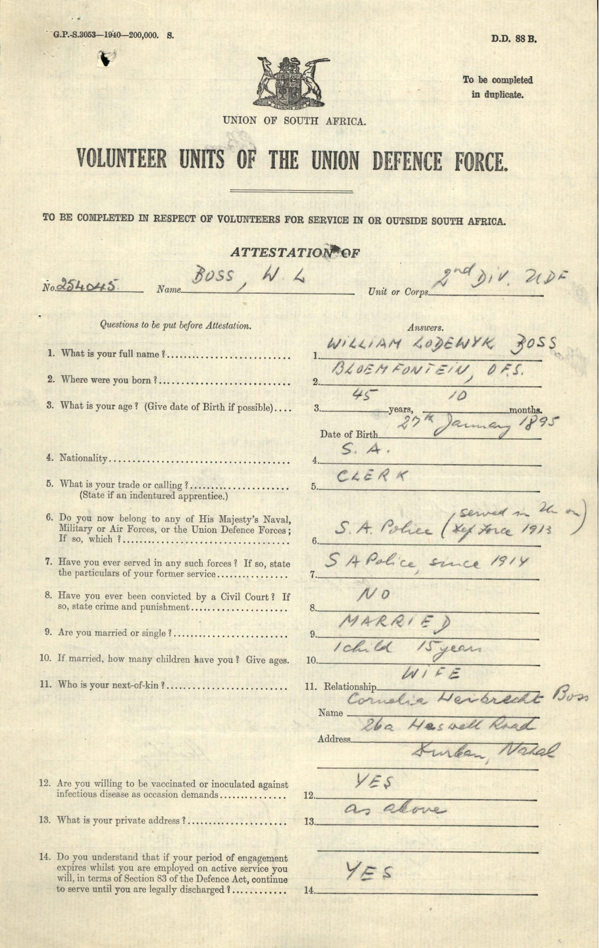
Military Application Form note date of birth
His engagement was terminated with effect from 7th March 1941 on medical reasons.
For his war service he was granted the British War Medal 1939-1945 and the South African Africa Service medal.
His war service and this award was recognised under force order 10 of 1945.
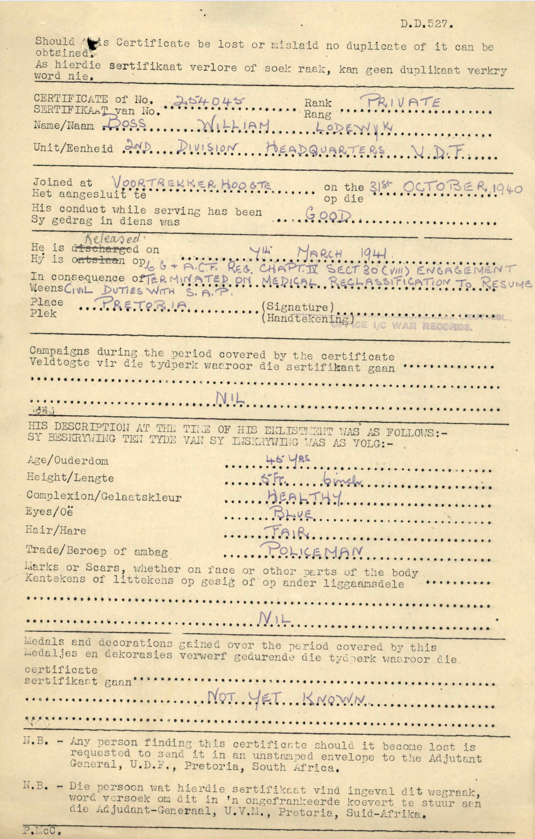
Service Certificate Union Defence Force
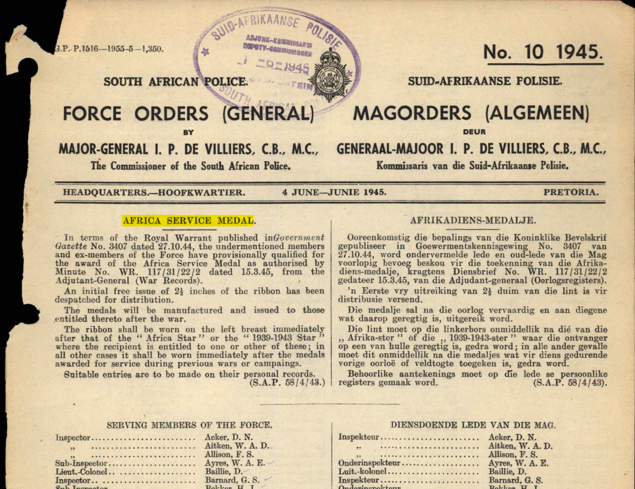
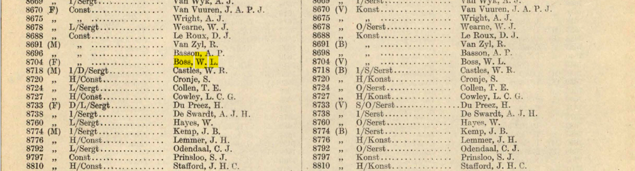
Confirmation of the Africa Service medal
Boss had served in the SAP since 1914 and could have been eligible for his Good Service award in 1932. But his SAMR defaulters record is quite busy showing t he was disciplined for a number of offenses. Including making a false occurrence book entry for which he was merely admonished, but more seriously allowing a prisoner to escape and divulging confidential police information for which he was fined £1.00 on each occasion. Any one of these would have disqualified him for the award.
However, for men who had served in the SAMR and claimed the SAP Good Service Medal their service could be counted to start on the date of the disbandment of the SAMR. Clearly, he was able to win that fight as his 18 service award was made in 1949.
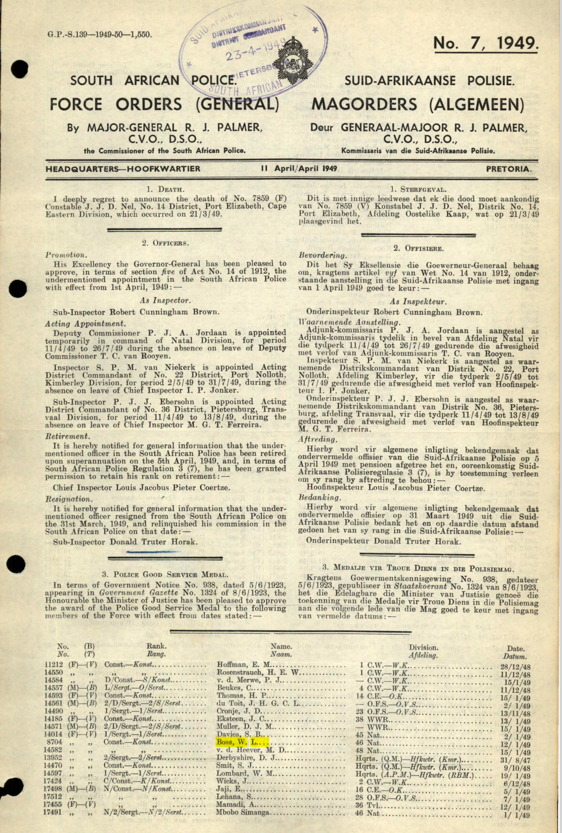
Force order confirming Award
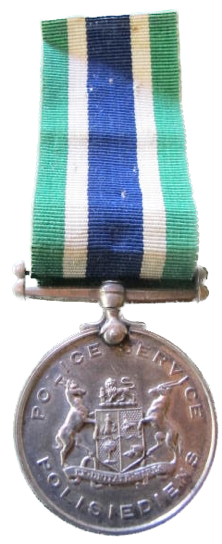
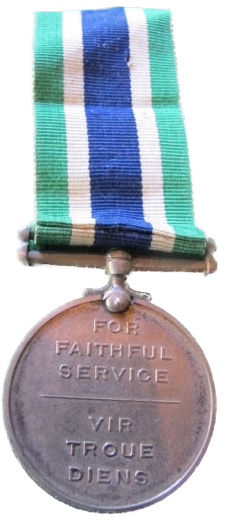
Constable Boss Good Service Medal
His medal despite being the more common second pattern has a slender swivel suspender not commonly seen on this type of medal and with engraved rather than impressed naming.
He died in Durban on 17th June 1984 and is buried in the Stellawood cemetery along with his wife who died 7th November 1985.
Sources
Family Search the Bos & Boss Families
Awards of the South African Uniformed Public Services 1922-1987 S Monick
WWW. Mmofsa
SAMR & SAP Service files via researcher DeWald Nel from WWW.Nelantiques.co.za
Find my grave Ref 216519102

