 Nongqai Vol 17 No 7B – SGC Sgt VR Moodley
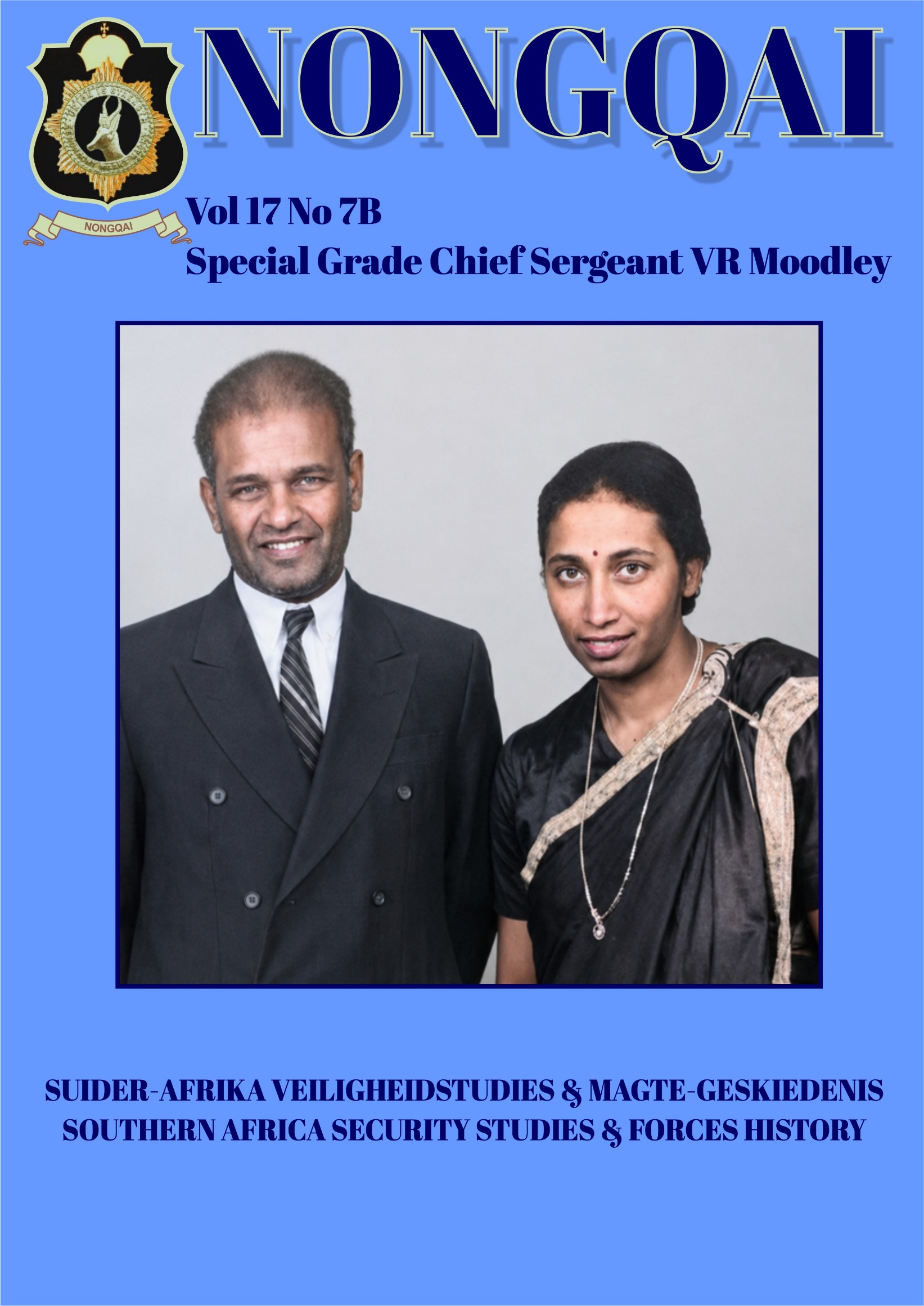
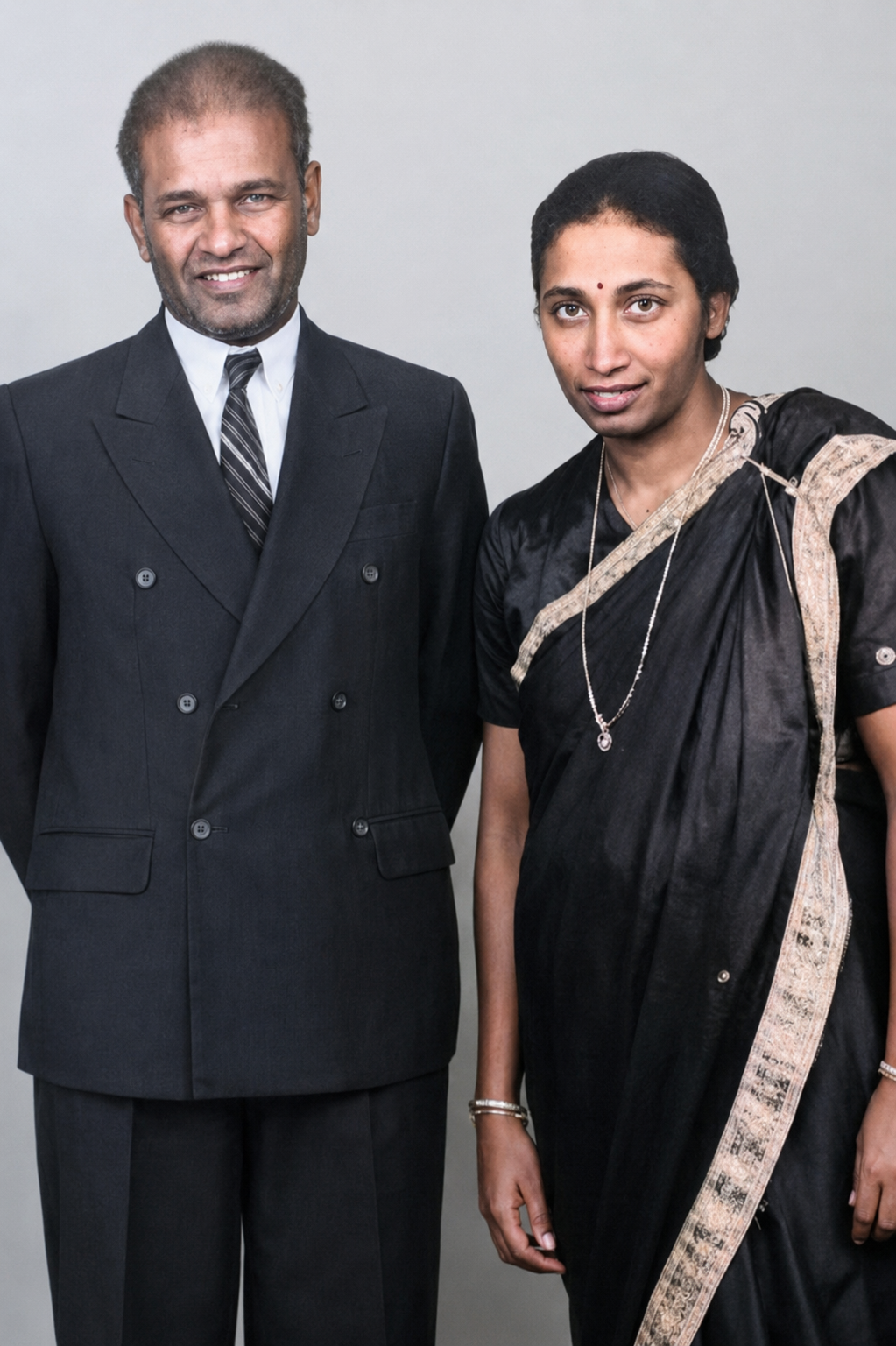
COVER PHOTO
Keywords
- Special Grade Chief Sergeant VR Moodley
- South African Police history
- Indian police pioneer
- Criminal Investigation Department (CID)
- Leadership, service and policing
Abstract
Special Grade Chief Sergeant VR Moodley was one of the first Indian police officers to achieve senior rank in the South African Police. He served with dedication for 39 years and became a respected detective and leader despite racial barriers. His work in Pietermaritzburg, Durban, Cato Manor and Chatsworth helped improve policing and inspired future generations of officers. The biography highlights his achievements, awards, family life and lasting contribution to South African policing history. It honours his courage, professionalism and commitment to public service.
SPECIAL EDITION OF NONGQAI
SOUTH AFRICAN POLICE
SPECIAL GRADE CHIEF SERGEANT VENGADASALEM
RAJARATHNAM MOODLEY
A PIONEER INDIAN POLICE MEMBER IN SOUTH AFRICA
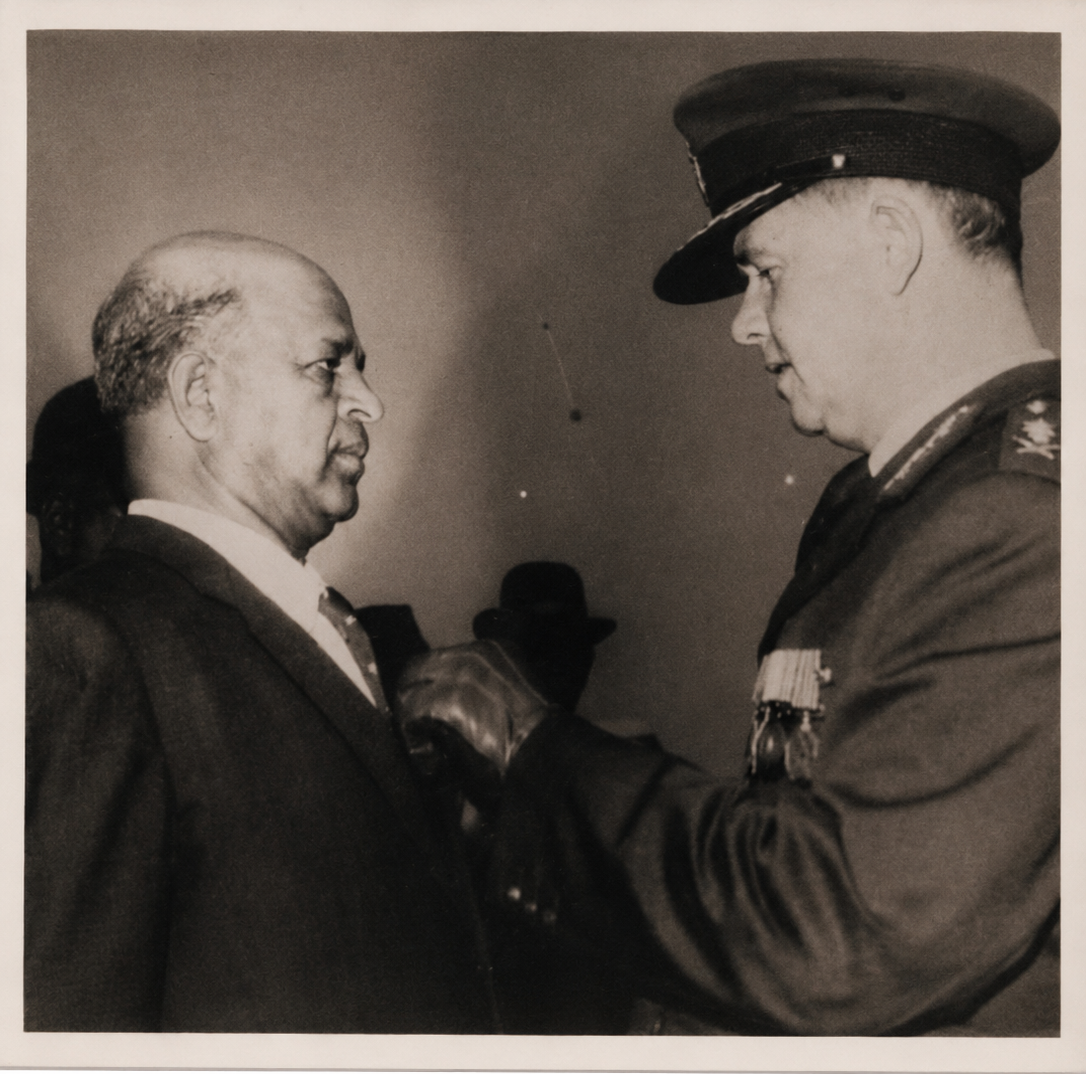
Special Grade Chief Sergeant VR Moodley receiving The South African Police Star for Merit, 30 years of loyal service and exemplary conduct from the Commissioner of The South Africa Police, General JM Keevy
F O R E W O R D
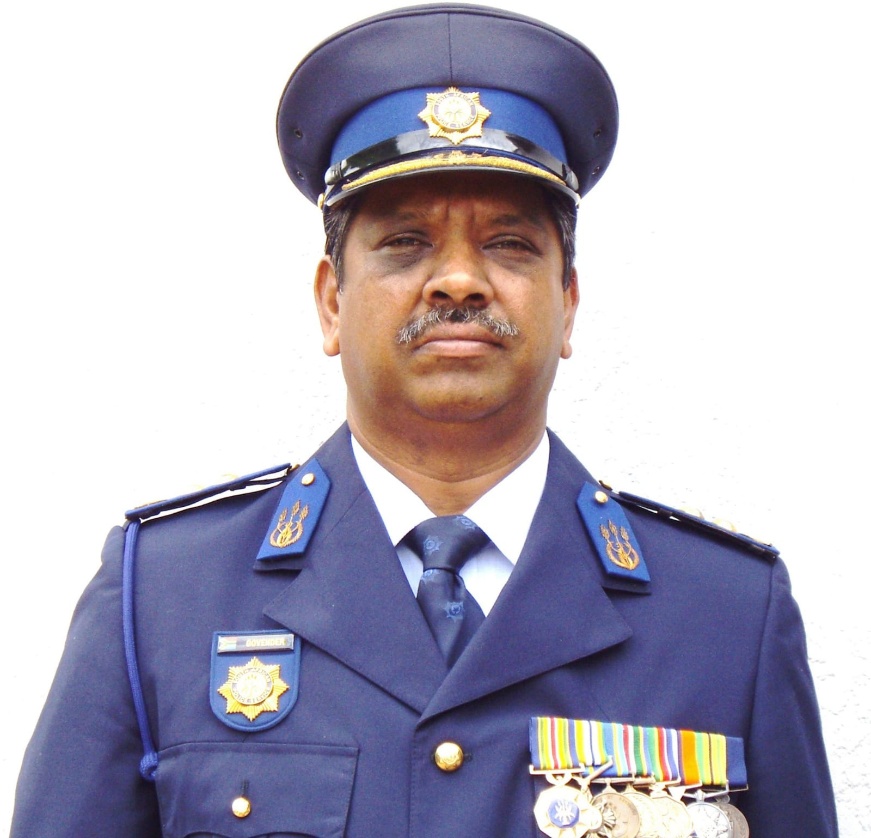
Major General (Professor) George D Govender
SPECIAL GRADE CHIEF SERGEANT VENGADASALEM RAJARATHNAM MOODLEY
It is indeed a privilege to write a foreword for Special Grade Chief Sergeant VR Moodley; one of our great leaders from the South African Police (SAP), who served the South African society diligently from 1934 until his retirement in 1972. He retired at the age of 60years, with 39 years of faithful service. Special Grade Chief Sergeant Moodley hereinafter referred to as Sergeant Moodley, was the first Detective of Indian descent to hold a command post at the Chatsworth Criminal Investigation Department (CID) (Unit 2, Chatsworth); together with late Lieutenant-Colonel Subramonia Pillai, who was then appointed Station Commander at SAP Chatsworth. The people of Chatsworth were privileged to have two commanders from the Indian diaspora serving them at Chatsworth. Both these commanders managed the crime in Chatsworth in the early 1960’s and 1970’s. Their professional leadership qualities and management style provided a high standard of service delivery to the people of Chatsworth. They also set the trend for future leaders to follow in their footsteps. Upon retirement, Sergeant Moodley was succeeded by Lieutenant K Rajgopaul. I joined the SA Police when Sergeant Moodley retired. I was not fortunate to serve under his leadership at SAP Chatsworth. However, in the late 1970’s, I joined the Chatsworth Criminal Investigation Department (CID) as a detective under Lieutenant Ray Munilall who succeeded Lieutenant K Rajgopaul. I was appraised of Sergeant Moodleys’ leadership qualities and his acumen as a detective by both the uniform and detective personnel. This memoir in respect of Sergeant Moodley has been researched by Col Logan. He gathered as much information as humanely possible. Reading the narratives highlighted by Col Logan brings out the special character of Sergeant Moodley. Sergeant Moodley was indeed a hands-on-person as a detective. Investigating a case involving the murder of Michael John speaks volumes of his knowledge, skills, talents, attitude and courage as a detective. The late Michael John’s name featured in many stories in the mass media about gangs and kings during that era, of which we became aware later in our detective careers
Sergeant Moodley started his career in 1934, at SAP Pietermaritzburg; thereafter transferred to Empangeni. In 1939 he was posted to Point in Durban and thereafter to Durban Central where he served for 21 years as a detective. He was then transferred to Cato-Manor where he oversaw the non-white CID for five years. In 1965, he was transferred to Chatsworth where he served for seven years as the Head of the CID. At Chatsworth he was promoted to Special Grade Chief Sergeant together with late Lieutenant Colonel Subramonia Pillai. Sergeant Moodley maintained this rank until his retirement. The story of Sergeant VR Moodley is indeed an historical part of SA Police history. He together with other policemen worked under difficult circumstances, when historical barriers limited opportunities for many people, especially Non-White members. Despite these challenges, Sergeant VR Moodley managed to rise through the ranks and become one of the leading Indian members in the force during his tenure. Unfortunately, due to natural attrition, fate denied Sergeant VR Moodley the opportunity to attain commissioned rank in the SA Police, during that era.
Sergeant Moodley married Navaneetham Moodley, a school teacher by profession. They had five children. Special Grade Chief Sergeant Moodley passed away on January 3, 1984, at the age of 72 years.
Major General (Ret) Doraval Govender, DLitt et Phil, SOE, F.I.S (SA).
Professor in Criminal Justice Studies
University of South Africa
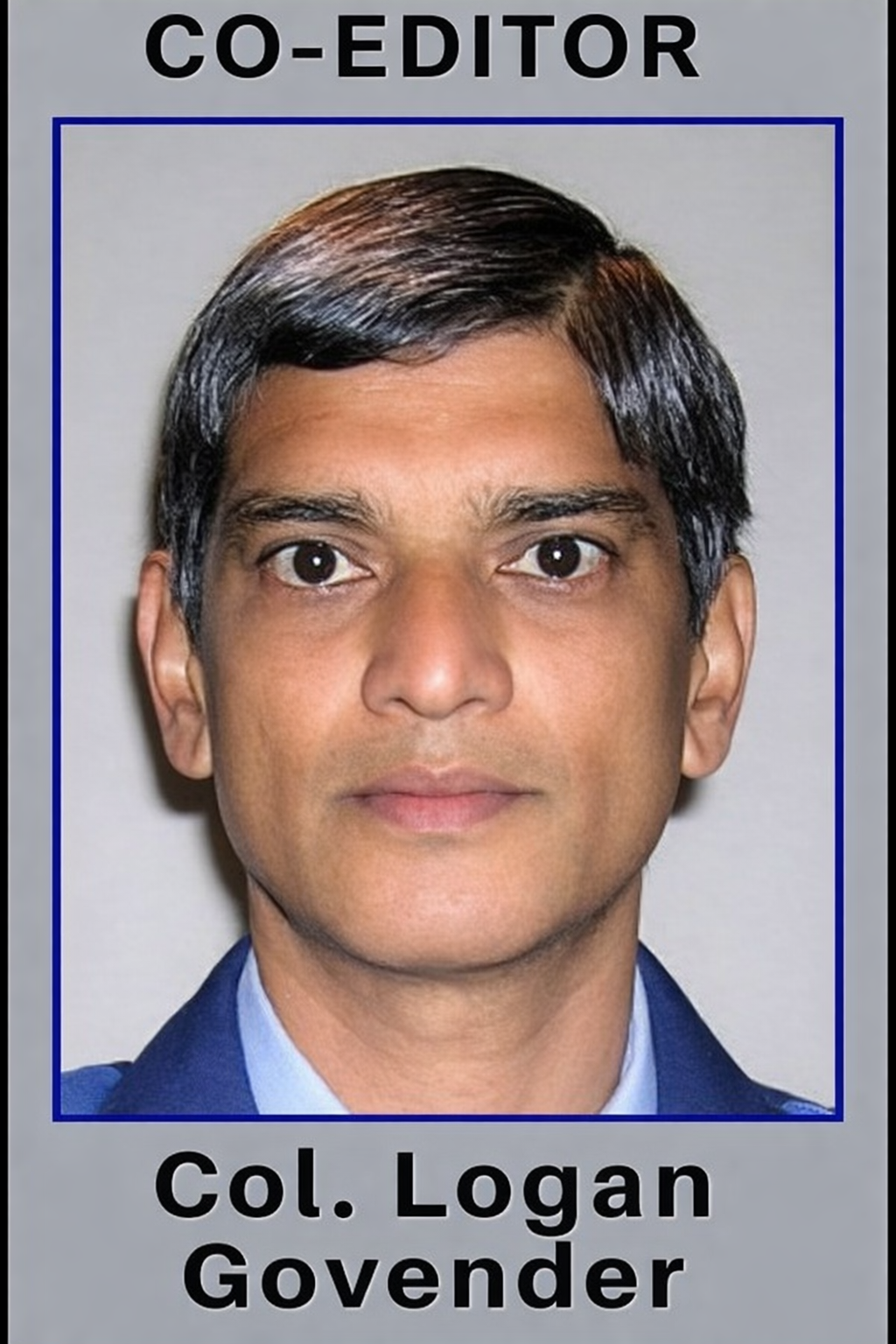
(Researched, authored, edited and prepared for publication by Logan Govender – [LG]. Based on information provided by Mr Thirunagaran Munsamy, The Chief Librarian, Ghandi / Luthuli Documentation Centre, University of KwaZulu-Natal – A copy of The Graphic; Brigadier Hennie Heymans [HBH], The Editor in Chief of Nongqai Magazine – A copy of SARP magazine; Major General (Professor) George D Govender; his daughter Mrs Ranjini Mudeliar; his granddaughter Mrs Jothi Moodley; Mr Billy Naidoo and Mr Deepak Panday from the Facebook group “The Kings of Durban” by Deepak Panday)
[LG]
AUTHOR’S NOTE
“The Nation which forgets its defenders will itself be forgotten.”
– Calvin Coolidge
This biography is written to honour Special Grade Chief Sergeant Vengadasalem Rajarathnam Moodley, one of the earliest Indian pioneers in the South African Police Force. Major General (Professor) George D Govender often stressed that Chief Sergeant Moodley is an important figure in the history of the South African Police, and that no effort should be spared in researching his life and contributions. Despite many attempts, I was unable to reach surviving members of his family earlier. A breakthrough finally came when the Chief Librarian of the Gandhi / Luthuli Documentation Centre, Mr Thiru Munsamy sent me a page from “The Graphic”, featuring an article on Lieutenant-Colonel Subramonia Pillai and Special Grade Chief Sergeant VR Moodley. The piece, titled “Personalities of the Week”, was published after their promotion to the newly instituted rank of Chief Sergeant, recognising them as the first Indian members of the South African Police to hold Command positions. Most recently, his surviving daughter, Mrs R Mudelier, along with his granddaughter, Mrs Jothi Moodley, Mr Billy Naidoo, and Mr Deepak Panday from the Facebook group “The Kings of Durban”, were located. Their contributions supported this work.
Further valuable information was provided by the Editor-in-Chief of Nongqai, who shared an article from the SARP Magazine. I am sincerely grateful to all for their assistance. This work is especially inspired by Major General George D Govender. Thank you, Sir, for your continued encouragement, guidance, support and persistence. I salute you.
Chief Sergeant Moodley’s story matters because it shows how bravery, discipline, and dedication can rise above the barriers created by an unjust system. At a time when Indian members faced severe racial restrictions, he built a respected and enduring career through commitment and determination.
In preparing this biography, I used a variety of sources that reflect both media reports and community memory. I would like to acknowledge the contributions of Mr Deepak Panday from the Facebook group “The Kings of Durban by Deepak Panday”. His efforts in preserving historical accounts, including details of the Michael John murder investigation, were extremely helpful. Additional information came from “The Graphic” article, which outlined Moodley’s achievements, his long service, and the proud family tradition he represented.
My aim has been to present his life simply and respectfully, so that younger generations may understand the challenges he faced and the progress he helped to shape. Chief Sergeant Moodley’s career stands as a reminder that perseverance can break down barriers, and that a life devoted to public service can leave a meaningful legacy for both a community and a nation.
It is helpful to explain the different categories of Sergeant in the South African Police during its earlier years. The South African Police created several Sergeant ranks, beginning with Second Class Sergeant and then First Class Sergeant, each with its own rank insignia. These categories applied to all racial groups until the early 1960s.
During the early 1960s, the structure changed to include only Sergeant and Senior Sergeant. While this cannot be confirmed with complete certainty, it appears that this distinction applied mainly to non-White members. White members were generally designated simply as Sergeants without further category, while the rank of Senior Sergeant for non-White members was considered as “equivalent”.
In 1965, a further rank, known as Chief Sergeant, was introduced specifically for non-White members. Only a small number of Indian members from Durban qualified for this rank. Among them were S Pillai, K Nayager, VR Moodley, K Rajgopaul, S Govender, Vally, SD Soobramoney, and Moodley. From the Pietermaritzburg District (No. 45), the only member to attain this rank was JR David.
In 1967, another rank that of Special Grade Chief Sergeant was created, again only for non-White members. Various reasons were given at the time for its introduction, though these are not detailed here. Once again, only a small number of Indian members reached this level, including S Pillai; VR Moodley; K Nayager from Durban, and JR David from Pietermaritzburg. This rank was abolished in mid-1970, when the first Candidate Officer’s Course for non-White members was introduced. Following this development, non-White Sergeants were placed on the same level as their White counterparts and could be promoted to the rank of Warrant Officer depending on educational qualifications; years of experience; recommendation by the District Commandant.
These rank distinctions reflect the broader system of racial segregation that existed at the time, where opportunities and recognition were often determined by race rather than merit. Such policies limited career progression for non-White officers and highlight the inequalities within the police force during that period.
Sadly, fate denied Special Grade Chief Sergeant VR Moodley the opportunity to achieve commissioned rank. He retired during a time of major change, having reached the compulsory retirement age of 60 in 1971.
It is deeply regrettable that his years of service and dedication were not recognised with the promotion he had worked so hard for. By the time opportunities for change had begun to emerge, his career had already reached its end.
It was only in August 1970 that the first non-white officers were promoted, and of that group, only two were Indian officers.
“Each day, millions of police officers do the selfless work of putting their lives on the line to protect civilians, frequently responding to or preventing crises completely with no recognition.” – Letitia James
[LG]
Introduction
Special Grade Chief Sergeant VR Moodley was an important figure in the history of the South African Police Force. At a time when opportunities for Indian members were non-existent or limited because of racial barriers, he built a long and respected career. Through hard work, discipline, determination and dedication, he became one of the first Indians to reach senior rank in the police force. His career showed determination and courage, and it helped open the door for other Indian members in the future.
Moodley served for many decades and became known as a skilled detective who solved many crimes. He also earned several medals for long and faithful service. His life story is not only about his work as a police officer, but also about family tradition, commitment to duty, and service to the community.
Early Life and Background of VR Moodley and his Dad
VR Moodley was born on 22nd December 1911 and educated in Pietermaritzburg in South Africa. He grew up in a family with strong ties to the police service. His father, Detective Constable Pavadai Venkatachalam Moodley, was a respected police officer and one of the well-known figures in the police force in Pietermaritzburg. His father served in the police for thirty-two years and was considered a pioneer in the force. (Unfortunately, a photograph of his Dad is not available. – [LG])
Following the example of his father, Moodley developed an interest in police work at a young age. This family tradition played an important role in shaping his future career. The idea of service, discipline, and dedication to the public was already present in his household.
After completing Standard Seven at school, he decided to join the police force while still young. At that time, it was not common for Indian men to hold senior positions in the police. However, Moodley chose to follow his father’s path and serve the country through law enforcement.
VR Moodley’s enlistment into the South African Police Force
Moodley joined the police force in 1934 in his hometown of Pietermaritzburg.
After joining the force, he was first stationed in Pietermaritzburg and was later transferred to Empangeni. These early postings allowed him to learn the basic duties of police work and gain experience as a young member.
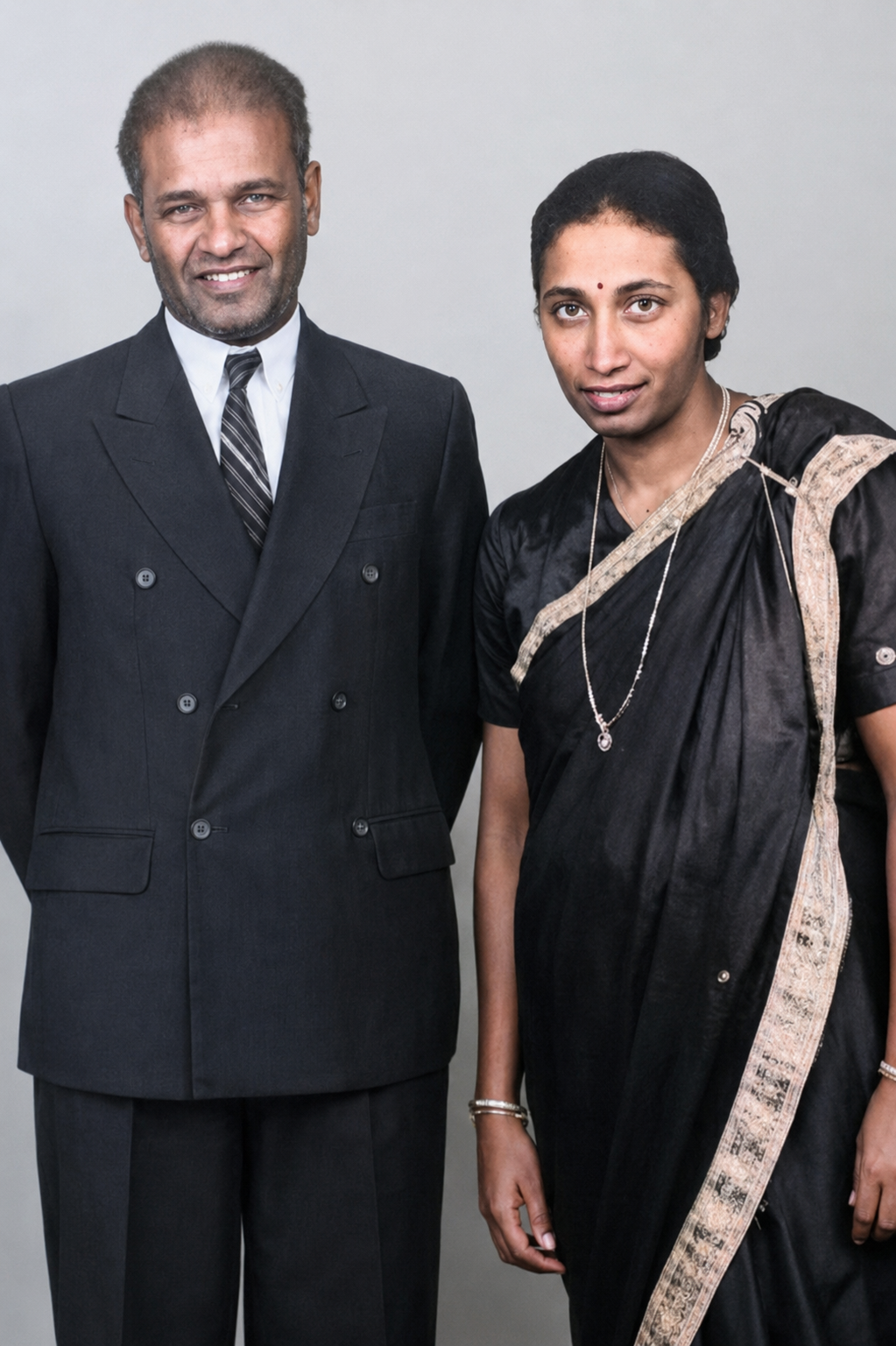
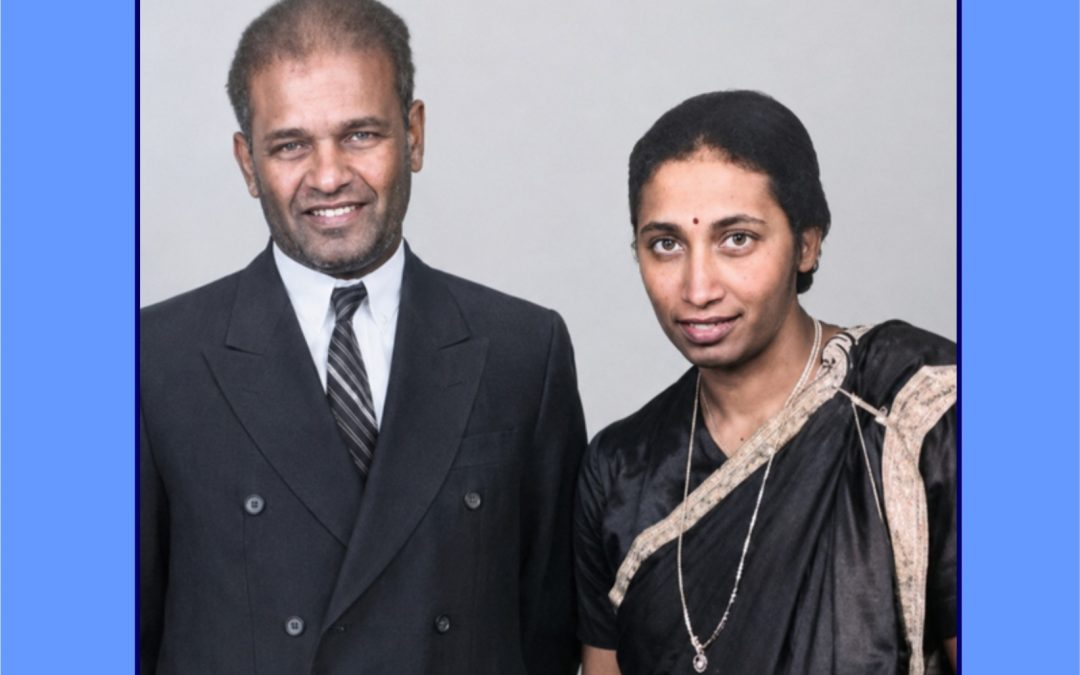
Sergeant VR Moodley and his dear wife Navaneetham
SA Police Point Road, Durban
In 1936 he was transferred to Point in Durban. This transfer happened during the time when the South African Police took control of the Borough Police. During this stage of his career, Moodley worked as a uniformed constable. His responsibilities included maintaining law and order, walking the beat, assisting the public, and supporting other senior members.
These early years helped him develop the discipline and practical skills that would later transform him into a formidable detective.
Detective Branch Durban Central
After gaining experience as a constable, Moodley moved into detective work. He was posted to Durban Central during 1939 where he served as a detective for twenty-two years. This was one of the most important stages of his career.
During this time, he worked under difficult conditions. The police department often had limited staff, especially during the years of the Second World War. Despite these challenges, Moodley continued to perform his duties with dedication.
As a detective, he investigated many criminal cases and became known for his careful and methodical approach to solving crimes. His work involved gathering evidence, interviewing witnesses, and analysing clues in order to identify suspects.
Colleagues and members of the public respected him for the professional way in which he conducted investigations. His ability to follow evidence step by step helped him solve several serious cases, including crimes connected to gang activity.
His long period as a detective also helped him build a strong reputation within the police force.
SOUTH AFRICAN POLICE
Indian Members of the Criminal Investigation Department, Durban Central
Photograph taken on the retirement of Detective Head Constable Kroukamp
19th May 1950
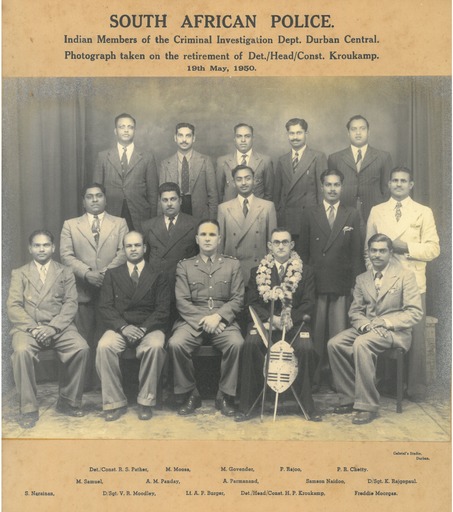
(The names of some of the members are indistinct on the scanned copy. – [LG])
Rear row, from left to right, Detective Constables RS Pather; M Moosa; M Govender; P Rajoo; PR Chetty.
Middle row, from left to right, M Samuel: AM Panday; A Parmanand; Samson Naidoo; Detective Sergeant K Rajgopaul (My Dad – Ms Poonie Rajgopaul)
Front row seated, from left to right, S Narainan; Detective Sergeant VR Moodley; Lieutenant AP Burger; Detective Head Constable HP Kroucamp; Freddie Moorgas
(Courtesy Ms Poonie Rajgopaul, daughter of Lieutenat K Rajgopaul)
Achievements and Promotions
Throughout his career, Moodley worked hard to improve his skills and move forward in the police service. In 1954 he successfully completed the Promotion Examinations that were required for non-European members at the time. Passing these examinations was an important achievement because the system placed many restrictions on members of colour.
After completing these examinations, he qualified as a first-class sergeant. This was an important step in his career and showed that his ability and dedication were recognised.
In 1960 he achieved another distinction while working in the Suspect Branch of the South African Police in Smith Street, Durban. During this period he became the only second Indian member to be promoted to the rank of Senior Detective Sergeant. The first Indian member to achieve this rank had been Vasa Pillay.
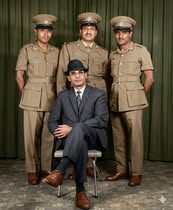
Top Indian Durban Detective Sergeant Vasa Pillay from Duran Central with other Indian members
Front Seated, Top Indian Detective Sergeant Vasa Pillay (Sergeant Vasa Pillay is reported to be the Dad of late Judge Thumba Pillay – [LG])
Rear, Standing, Constables 1st unidentified; 2nd Moodley and 3rd Gona Moopanar
(Seated up front Top Indian Detective Vasa Pillay of Durban Central, Smith Street before 1968 / 1969 according to Warrant Officer William / Aroo Moodley. – [LG])
(Courtesy of the family of Warrant Officer Gona Moopanar, late; Kindly colourised by Mr Clint Poisson)
SA Police, Cato Manor
He was later transferred to Cato Manor where he was in charge of the Non-White Detective Branch. Here he served for five years.
The promotion to the rank of Chief Sergeant marked Moodley as one of the leading Indian members in the police force. It also showed that his long experience and investigative skills had earned him respect within the department.
SOUTH AFRICAN POLICE, UNIT 02, CHATSWORTH
ESTABLISHMENT OF FIRST SOUTH AFRICAN POLICE STATION MANAGED AND STAFFED BY INDIAN MEMBERS
Media Clipping
The Natal Mercury, Wednesday, September 1, 1965
Indian Staff-Staffed Police Station
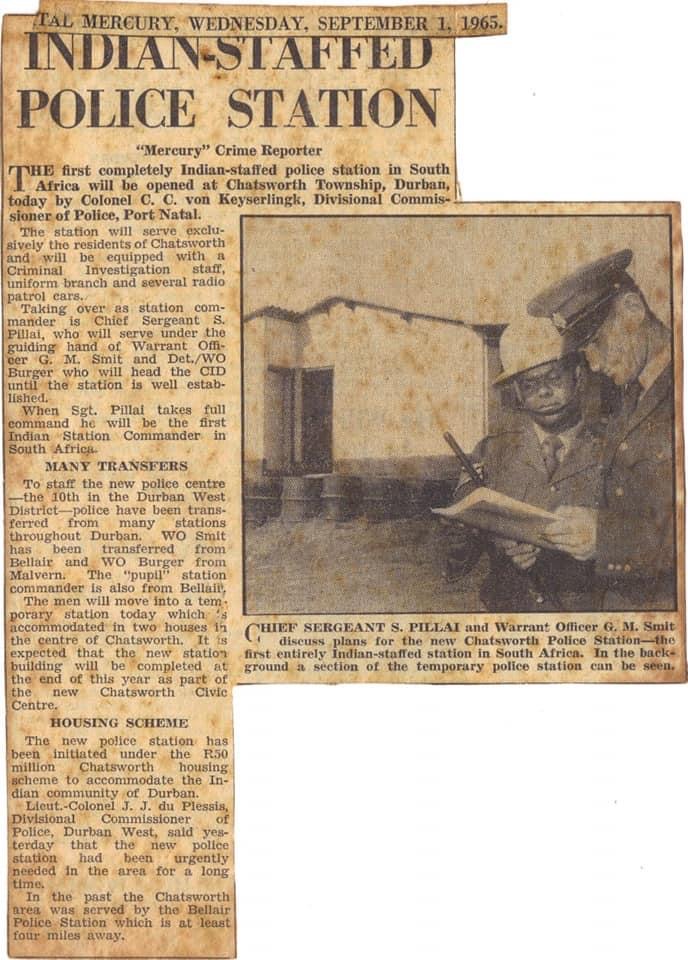
INDIAN -STAFFED POLICE STATION
“Mercury Crime Reporter
The first completely Indian-Staffed police station in South Africa will be opened at Chatsworth Township, Durban, today by Colonel CC von Keyserlingk, Divisional Commissioner of Police, Port Natal. The Station will serve exclusively the residents of Chatsworth and will be equipped with a Criminal Investigation staff, uniform branch and several radio patrol cars. Taking over the station is Chief Sergeant S Pillai, who will serve under the guiding hand of Warrant Officer GM Smit (Sterk Gert – Brigadier Hennie Heymans – [HBH]) and Detective / Warrant Officer Burger will head the CID until the station is well established (He was succeeded by Chief Sergeant VR Moodley – [LG]). When Sergeant Pillai takes full command, he will be the first Indian Station Commander in South Africa.
MANY TRANSFERS
To staff the new police centre – the 10th in the Durban West District – police members have been transferred from many stations throughout Durban. Warrant Officer Smit has been transferred from Bellair and Warrant Officer Burger from Malvern. The “pupil” Station Commander is from Bellair. (Chief Sergeant VR Moodley deputised Warrant Officer Burger who was appointed CID Head. – [LG]). The men will move into a temporary station today which is accommodated in two houses in the centre of Chatsworth. It is expected that the new station building will be completed at the end of this year as part of the new Chatsworth Civic Centre.
HOUSING SCHEME
The new police station has been initiated under the R 50 million Chatsworth housing scheme to accommodate the Indian community of Durban. Lieutenant-Colonel JJ du Plessis, Divisional Commissioner (District Commandant – [LG]) of Police, Durban West, said yesterday that the new police station had been urgently needed in the area for a long time. In the past the Chatsworth area was served by the Bellair Police Station which is at least four miles away.
Caption
Chief Sergeant S Pillai and Warrant Officer GM Smit discuss plans for the new Chatsworth Police Station – the first entirely Indian-Staffed station in South Africa. In the background a section of the temporary police station can be seen.”
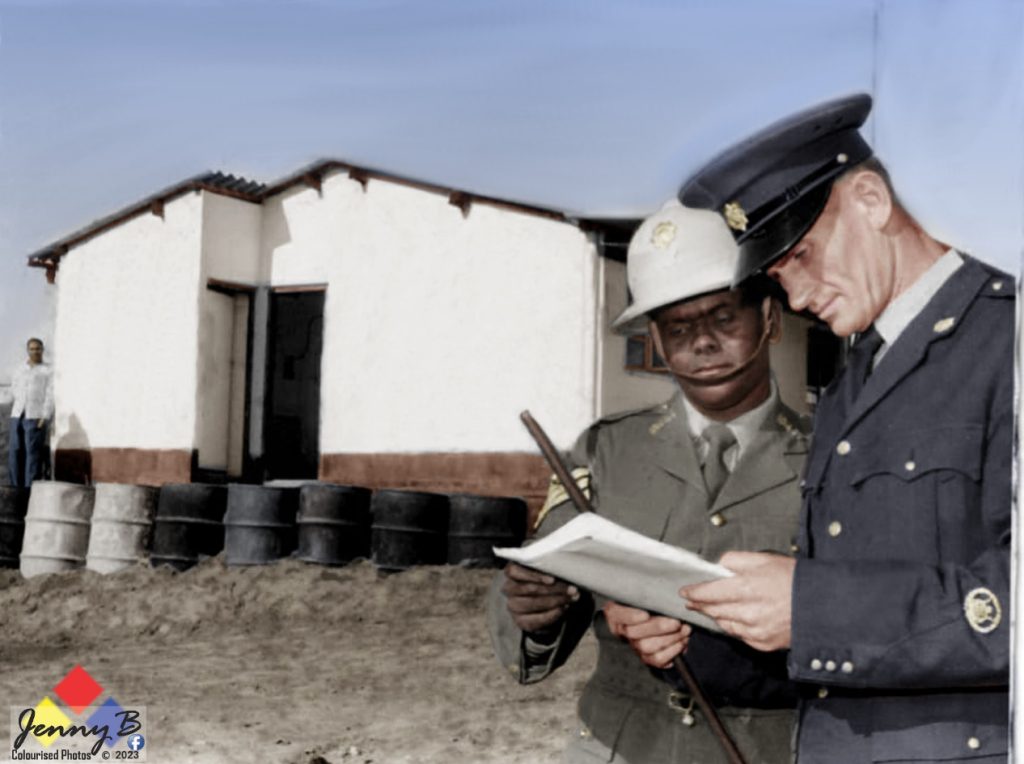
Chief Sergeant Subramoni Pillai and Warrant Officer G Smit discuss plans for the new Chatsworth Police Station – the first entirely Indian-Staffed station in South Africa. In the background a section of the temporary police station can be seen
(Courtesy of the Pillai family. The original black and white photograph was kindly colourised by Ms Jenny Bosch.)
(“Unit 2 (Bayview) West side of the semi-detached council house, administration section comprised of four rooms as offices. The Eastern side two rooms as charge office, station commander’s office and exhibit room. Detective Branch occupied a single cottage.” – Captain Donan Martin Etienne Lazarus. [DMEL])
Chief Sergeant Subramonia was appointed the FIRST Station Commander of Indian descent in the South African Police and in Chatsworth, Unit II also known as Bayview (The old Chatsworth Police Station was constructed of concrete blocks and the holding cells of wood and iron. – Major General (Professor) George D Govender [GDG]).
“It all happened in 1965 when an Indian Township was being built at Chatsworth. Major Pillai, then a Chief Sergeant was appointed as Station Commander on 18th September 1965. During his office as Station Commander, he was supervised by Captain (Warrant Officer – [LG]) S M (Not SM but GM. – [LG]) Smith for 6 months and by the late Warrant Officer Dicks for 1 year. His aptitude in command and discipline earned him the rank of Special Grade Chief Sergeant in 1967.” – (The Mercury reports that Chief Sergeant Pillai will be supervised by Warrant Officer SM; it was “Warrant Officer GM Smith for 6 months and the late Warrant Officer Dicks for 1 year.” – SARP (November 1977, pages 34 & 35) – [GDG])
“On 1st September 1965 the Chatsworth Police Station was opened and I took charge under the supervision of the then Warrant Officer GM Smit (now Major Smit) and later under the late Warrant Officer William Dicks.” – Autobiography of Lieutenant-Colonel S Pillai.
(I am of the opinion that these two photographs were taken at the Official Opening of South African Police, Unit 2, Chatsworth Station on 1 September 1965. – [LG])
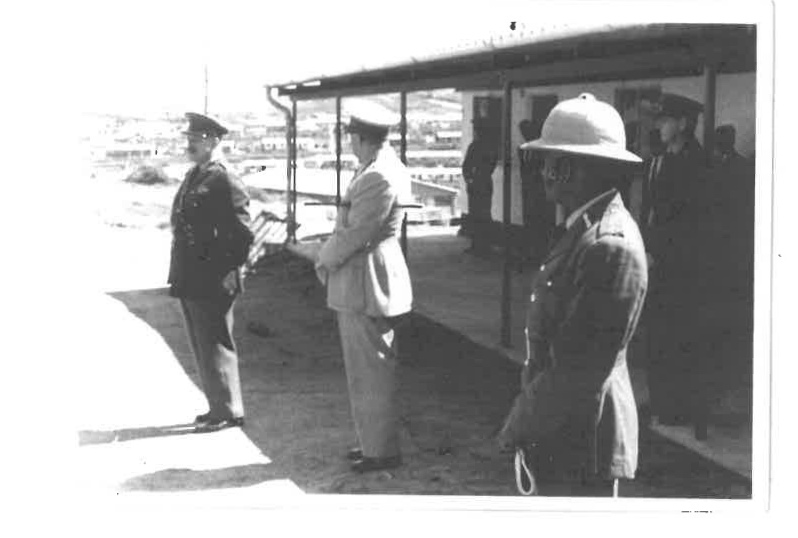
Official opening of the SA Police, Unit 02, Chatsworth Police Station
From left to right, Colonel CC von Keyserlingk, Divisional Commissioner, Port Natal Division; other officer in summer dress not identified and Chief Sergeant Subramonia Pillai. (Photograph, caption and information courtesy of – [HBH])
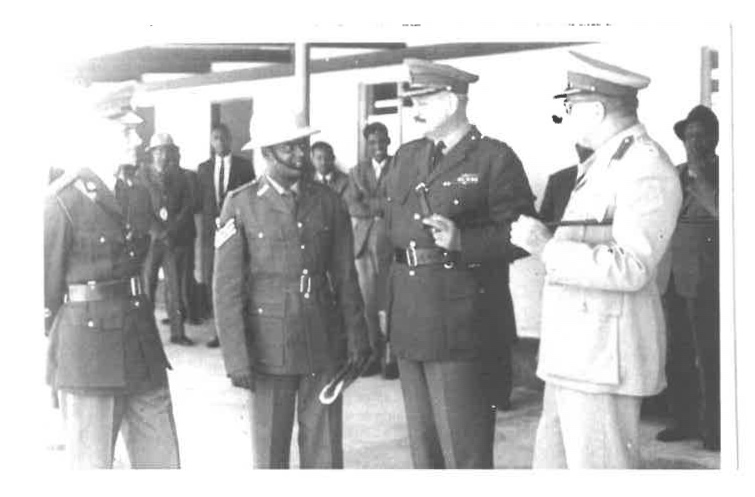
Official opening of the SA Police, Unit 02, Chatsworth Police Station
L-R, Warrant Officer Smit, Chief Sergeant Subramonia Pillai and Colonel CC von Keyserlingk, other officer in summer dress is not identified; – the summer uniform was discontinued during 1971. (Photograph, caption and information courtesy of – [HBH])
As Chief Detective Sergeant, Moodley took on greater leadership responsibilities. He was placed in charge of the CID at the Chatsworth police station. This position required him not only to investigate crimes but also to guide and supervise other detectives.
As the head of the detective branch in Chatsworth, Moodley became responsible for coordinating investigations and ensuring that cases were handled properly. His long experience in detective work made him well suited to this position.
The community and fellow officers respected him for his calm and organised way of managing investigations. His methodical approach helped younger officers learn how to conduct proper detective work.
At Chatsworth during 1967 he was promoted to Special Grade Chief Sergeant. He maintained this rank until his retirement.
Moodley served at Chatsworth where he served for seven years in charge of the detective branch.
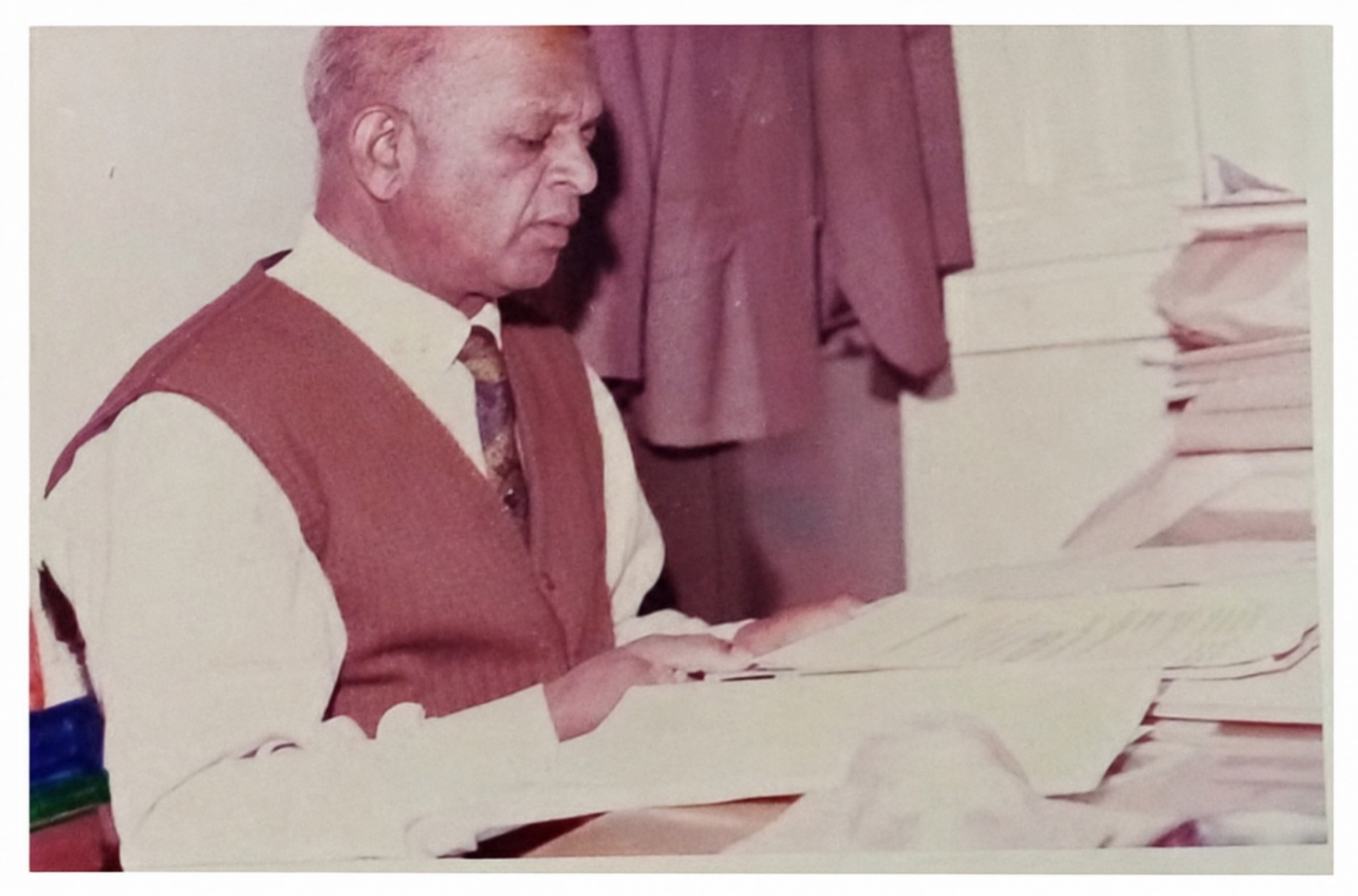
Sergeant VR Moodley busy in his office at SA Police, Unit 02, Chatsworth
SOUTH AFRICA POLICE
CID CHATSWORTH 1968
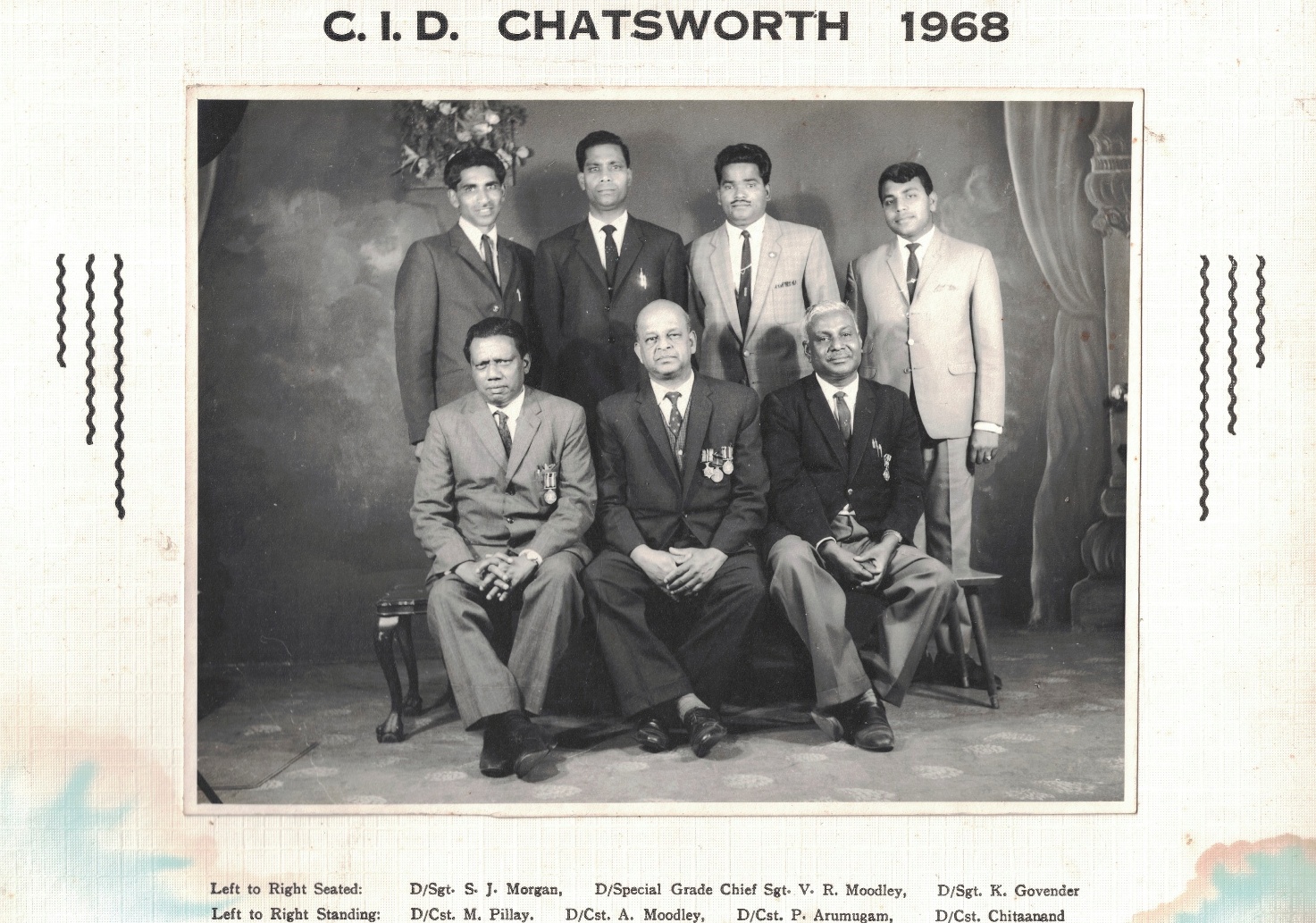
Front row, seated, L-R, D/Sergeant SJ Morgan; D/Special Grade Chief Sergeant VR Moodley; D/Sergeant K Govender.
Rear row, standing, L-R, D/Constable M Pillay; D/Constable A (Aroo / William) Moodley; D/Constable P Arumugam; D/Constable Chitaanand (Major General Hans Jissok. He was later appointed the Branch Commander, CID at Unit 5 and later as the Area Commissioner in Durban. -[LG])
(Courtesy Detective Warrant Officer William Arumugam – still enjoying his retirement at 97 years old residing in Sydney, Australia)
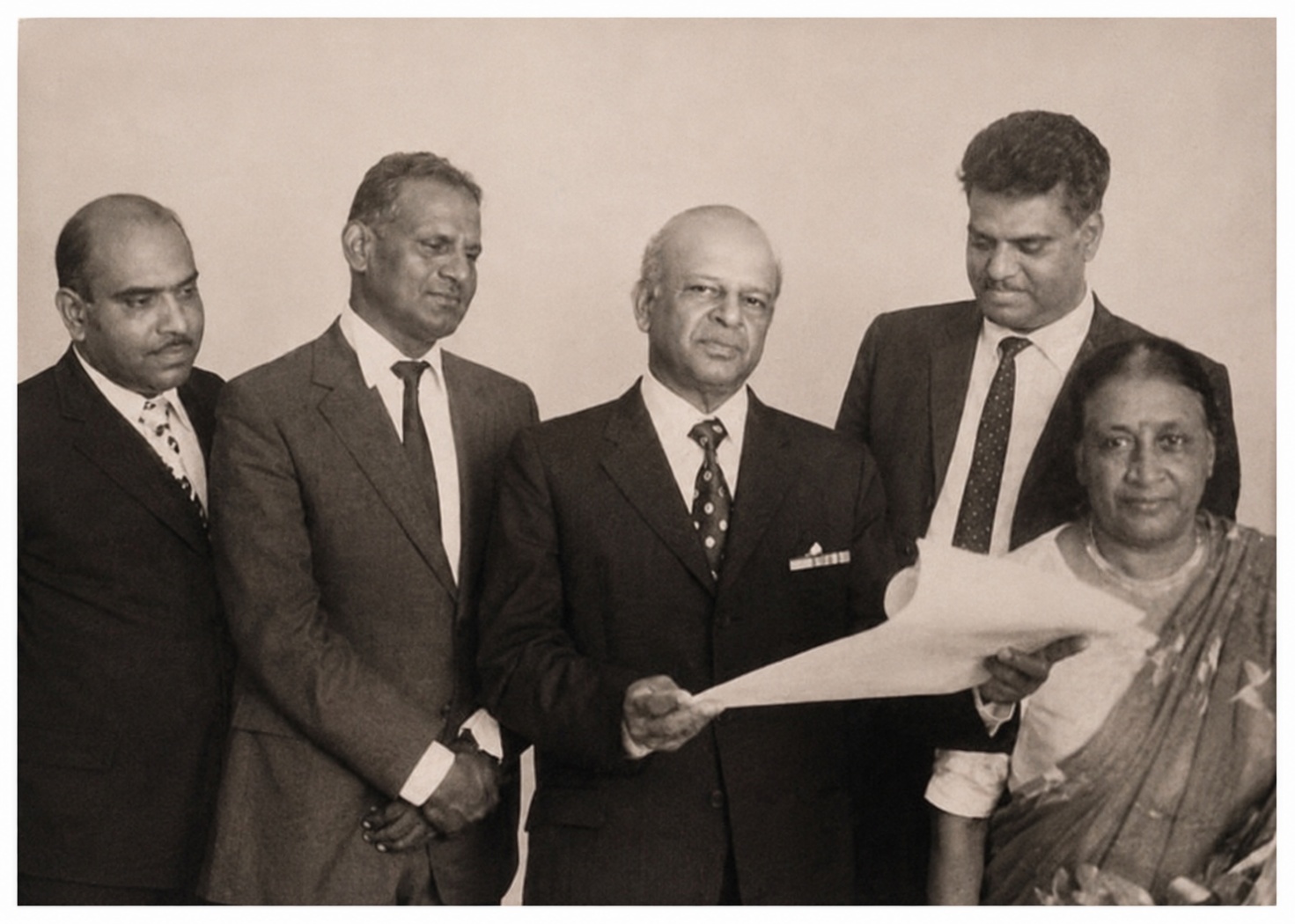
There is no information concerning this photograph
L-R, Unidentified; Sergeant Kathavarayen Rajgopaul; Sergeant VR Moodley; Unidentified; Mrs Navaneetham Moodley
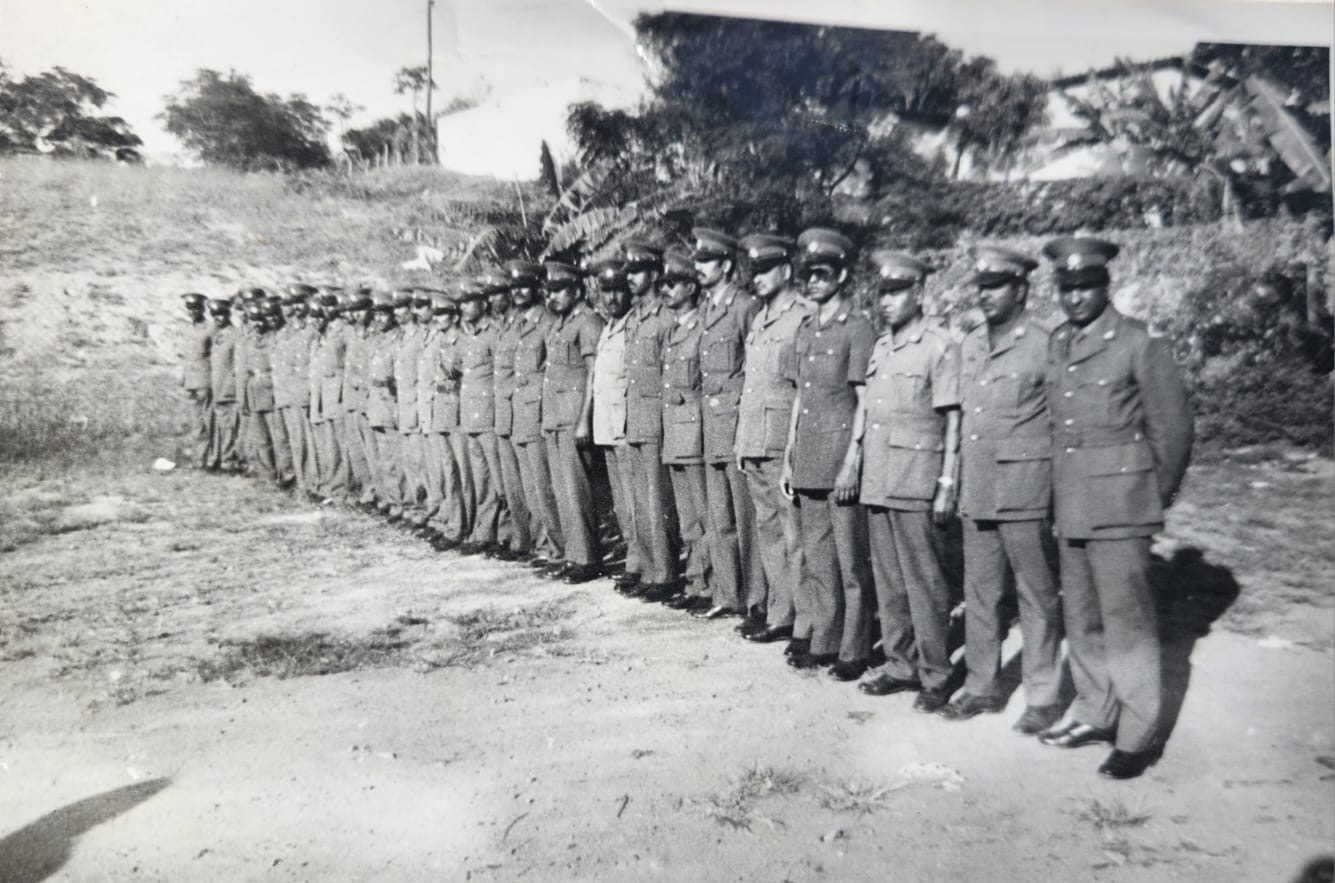
Members of SA Police, Chatworth, Unit 02 on parade circa 1970’s
Media Clipping
Three Non-white Officer Cops now
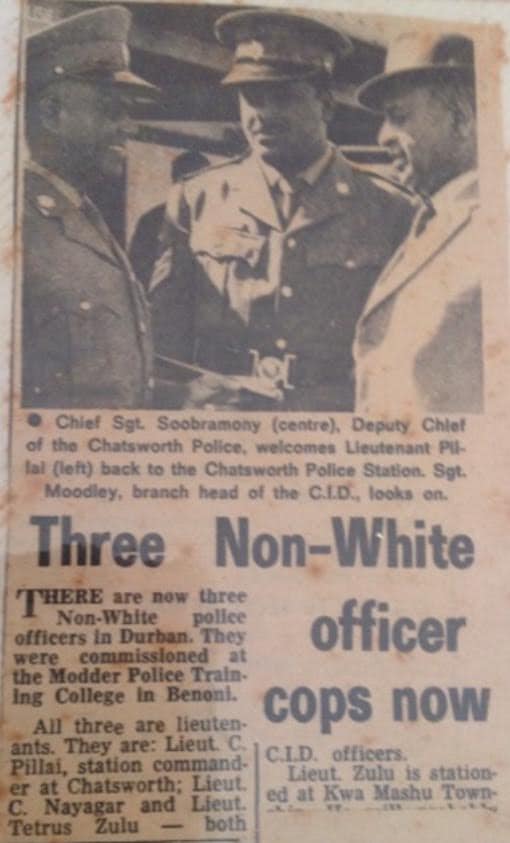
(Courtesy of the family of Lieutenant-Colonel S Pillai)
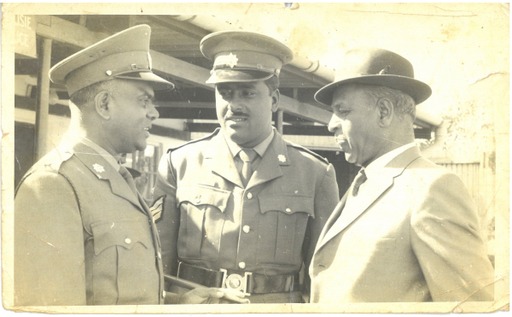
Chief Sergeant Soobramoney Govender (centre), deputy Chief of the Chatsworth Police, welcomes Lieutenant S Pillai (left) back to the Chatsworth Police Station. Sergeant VR Moodley, branch head of the CID looks on
(Courtesy of the family of Lieutenant-Colonel S Govender)
Awards and Recognition
Moodley’s long career included several honours and awards that recognised his service.
One of the early awards he received was the South African Police, Good Service Medal in 1951. This medal was given to officers who completed eighteen years of loyal and effective service in the police force.
Later in his career he received The South African Police Star for Merit for 30 years of loyal service and exemplary conduct medal from the Commissioner of the South African Police, General JM Keevey, which were given to officers who completed thirty years of service. These awards recognised not only the length of his career but also the quality of his work.
Receiving these medals showed that Moodley had maintained a strong record of dedication and professionalism throughout his time in the police force.
His achievements were particularly significant because he worked during a time when Indian officers often faced many obstacles in their careers.
Family Life
While Moodley devoted much of his life to police work, he also had a strong family life. He lived in Mayville and was the father of five children.
One of his children, RS Moodley, became a schoolteacher in Isipingo. This shows that the family valued education and community service.
His wife, Navaneetham Moodley, came from the well-known Naidoo family of Pietermaritzburg. She was also a schoolteacher. Her dedication to education and the community reflected the same spirit of service that characterised her husband’s career.
Together they built a family that valued hard work, learning, and public service.
Legacy and Historical Importance
The story of VR Moodley is important in the history of South Africa’s police force. He worked during a difficult time when racial barriers limited opportunities for many people, especially those that were Non-White. Despite these challenges, he managed to rise through the ranks and become one of the leading Indian members in the force.
His career also showed the importance of perseverance. Starting as a young constable, he gradually gained experience, passed difficult examinations, and earned promotions through dedication and skill.
Another important aspect of his legacy is the family tradition of police service. Both Moodley and his father served long careers in the police force. Together they contributed more than sixty years of service to the country.
Through his achievements, Moodley helped demonstrate that Indian members could perform at the highest level in the police force.
Contribution by Mr Deepak Panday – Facebook Group “The Kings of Durban by Deepak Panday”
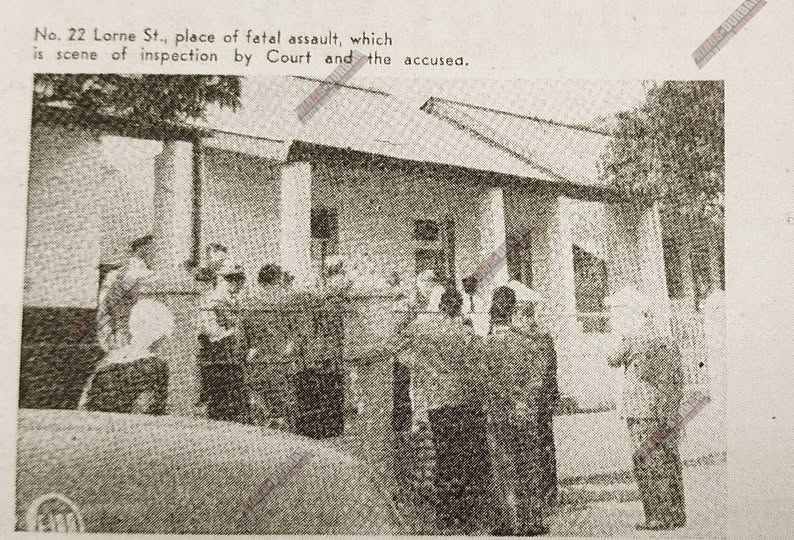
“Michael John’s Murder Scene @ His Home On 22 Lorne Street, Durban.
We get to see the prosecution team reliving young Mike’s final moments before he was brazenly attacked by men believed to be friends, guys who he once defended against other rivals.
Many theories arise around the gang related hit that calls for more media attention than any other case of the fifties and in the Kings of Durban Part II, we delve deep into the investigations taking you, the reader through every aspect that was covered by Detective Sgt. Moodley in his findings.
Advocate Mr RS Pather, a very well experienced, Durban criminal attorney defended the seven men and here we can see them all giving account to exactly how young Mike’s life ended.
The full story is covered in the Kings of Durban Part II 

‘How The Town was Won’ 

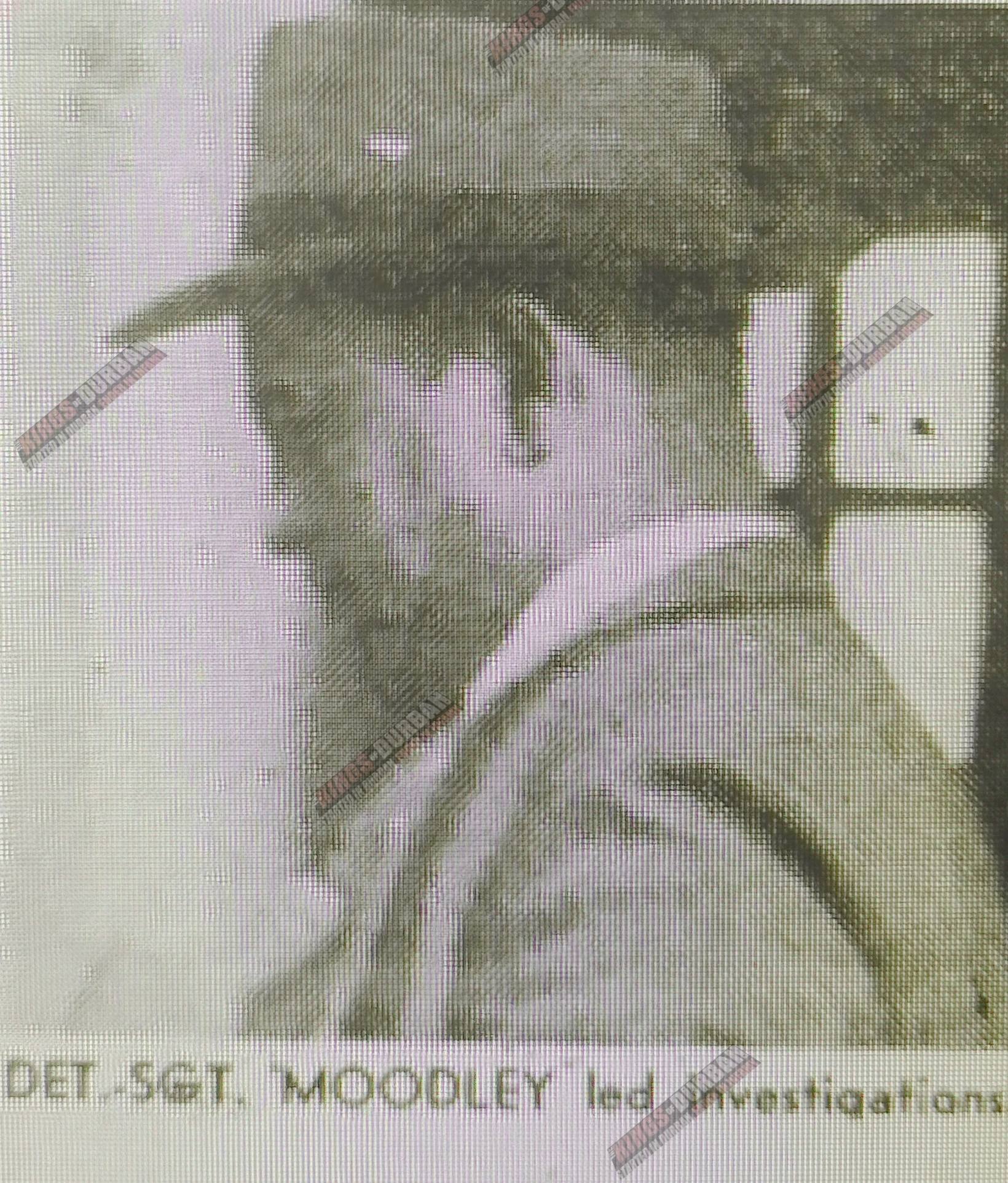
Det.Sgt V R Moodley, Investigating Officer in The Micheal John Murder Case
After the Micheal John Trial, Det. Sgt Moodley became popular for handling many high profile murder dockets.
Due to his perseverance he made history by becoming the First Indian promoted to a new position in the South African Police service as Chief Sergeant (Special Grade).
More of his cases in the ‘Untouchable’ Kings of Durban Part II 

‘How The Town was Won’ 

Information from “The Graphic”
Transcript
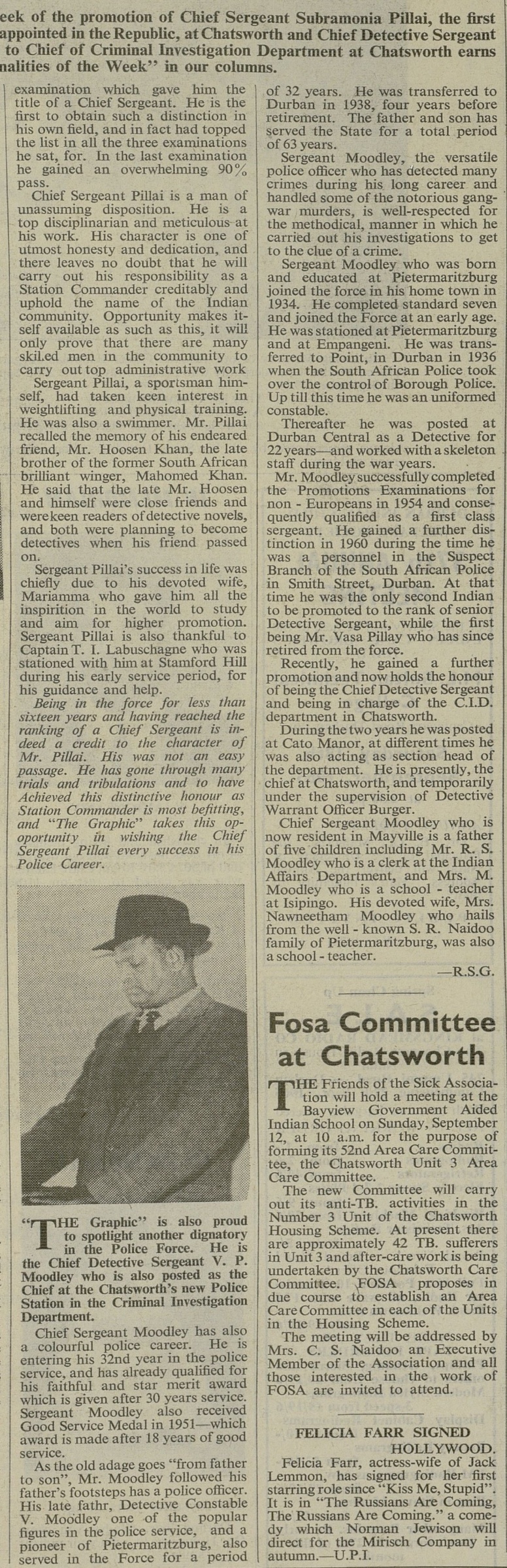
“ ‘The Graphic’ is also proud to spotlight another dignitary in the Police Force. He is the Chief Detective Sergeant VP (VR NOT VP – [LG]) Moodley who is also posted as the Chief at the Chatsworth’s new Police Station in the Criminal Investigation Department.
Chief Sergeant Moodley has also a colourful police career. He is entering his 32nd year in the police service and has already qualified for his faithful and star merit award which is given after 30 years’ service. Sergeant Moodley also received Good Service Medal in 1951 – which award is made after 18 years of good service. As the adage goes “from father to son”, Mr Moodley followed his father’s footsteps as a police officer. His late father, Detective Constable V Moodley one of the popular figures in the police service, and a pioneer of Pietermaritzburg, also served in the Force for a period of 32 years. He was transferred to Durban in 1938, four years before retirement. The father and son have served the State for a total period of 63 years. Sergeant Moodley, the versatile police officer who has detected many crimes during his long career and handled some of the notorious gang-war murders, is well-respected for the methodical, manner in which he carried out his investigations to get to the clue of a crime. Sergeant Moodley who was born and educated at Pietermaritzburg joined the force in his hometown in 1934. He completed standard seven and joined the Force at an early age. He was stationed at Pietermaritzburg and at Empangeni. He was transferred to Point, in Durban in 1936 when the South African Police took over the control of Borough Police. Up till this time he was a uniformed constable. Thereafter he was posted at Durban Central as a Detective for 22 years – and worked with a skeleton staff during the war years. Mr Det Sgt V R Moodley, Investigating Officer in The Micheal John Murder Case
After the Micheal John Trial, Det Sgt Moodley became popular for handling many high profile murder dockets.
Due to his perseverance he made history by becoming the First Indian promoted to a new position in the South African Police service as Chief Sergeant (Special Grade).
More of his cases in the ‘Untouchable’ Kings of Durban Part II 

‘How The Town was Won’
Moodley successfully completed the Promotions Examinations for non-Europeans in 1954 and consequently qualified as a first-class sergeant. He gained a further distinction in 1960 during the time he was personnel in the Suspect Branch of the South African Police in Smith Street, Durban. At that time, he was the only second Indian to be promoted to the rank of senior Detective Sergeant, while the first being Mr Vasa Pillay who has since retired from the force. Recently, he gained a further promotion and now holds the honour of being the Chief Detective Sergeant and being in charge of the CID department in Chatsworth. During the two years he was posted at Cato Manor, at different times he was also acting as section head of the department. He is presently, the chief at Chatsworth, and temporarily under the supervision of Detective Warrant Officer Burger. Chief Sergeant Moodley who is now resident in Mayville is a father of five children including Mr RS Moodley who is a school – teacher at Isipingo. His devoted wife, Mrs Navaneetham Moodley who hails from the well-known SR Naidoo family of Pietermaritzburg, was also a school-teacher.
His career shows how dedication to duty can overcome obstacles and leave a lasting impact on both a profession and a community.
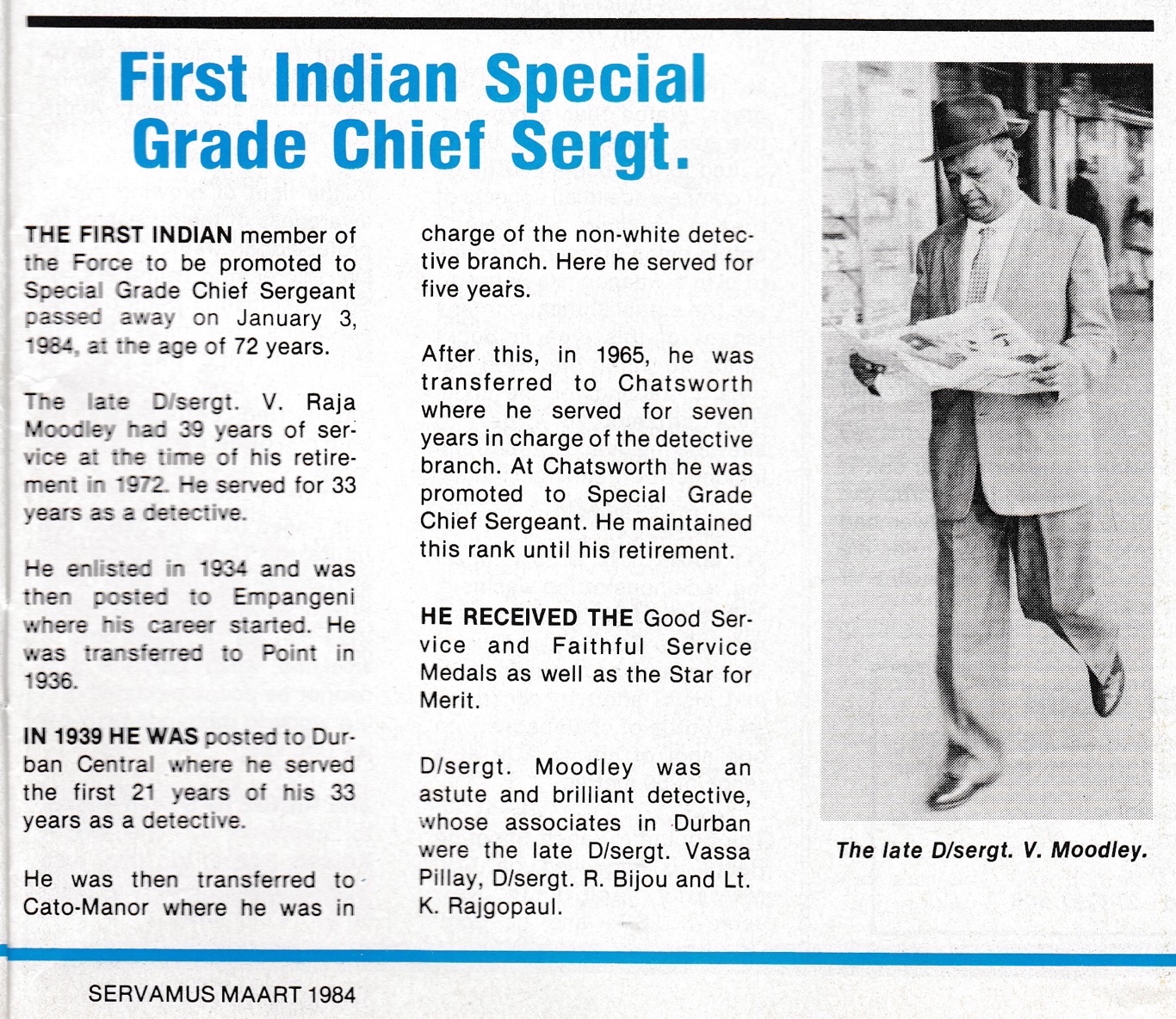
First Indian Special Grade Chief Sergeant
Transcript
Servamus, March 1984
THE FIRST INDIAN member of the Force to be promoted to Special Grade Chief Sergeant passed away on January 3, 1984, at the age of 72 years.
The late D/sergt V Raja Moodley had 39 years of service at the time of his retirement in 1972. He served for 33 years as a detective.
He enlisted in 1934 and was then posted to Empangeni where his career started. He was transferred to Point in 1936.
IN 1939 HE WAS posted to Durban Central where he served the first 21 years of his 33 years as a detective.
He was then transferred to Cato-Manor where he was in charge of the non-white detective branch. Here he served for five years.
After this, in 1965, he was transferred to Chatsworth where he served for seven years in charge of the detective branch. At Chatsworth he was promoted to Special Grade Chief Sergeant. He maintained this rank until his retirement.
HE RECEIVED THE Good Service and Faithful Service Medals as well as the Star for Merit.
D/sergt Moodley was an astute and brilliant detective, whose associates in Durban were the late D/sergt Vassa Pillay, D/sergt R Bijou and Lt K Rajgopaul.
The late D/sergt V Moodley.
SERVAMUS MAART 1984
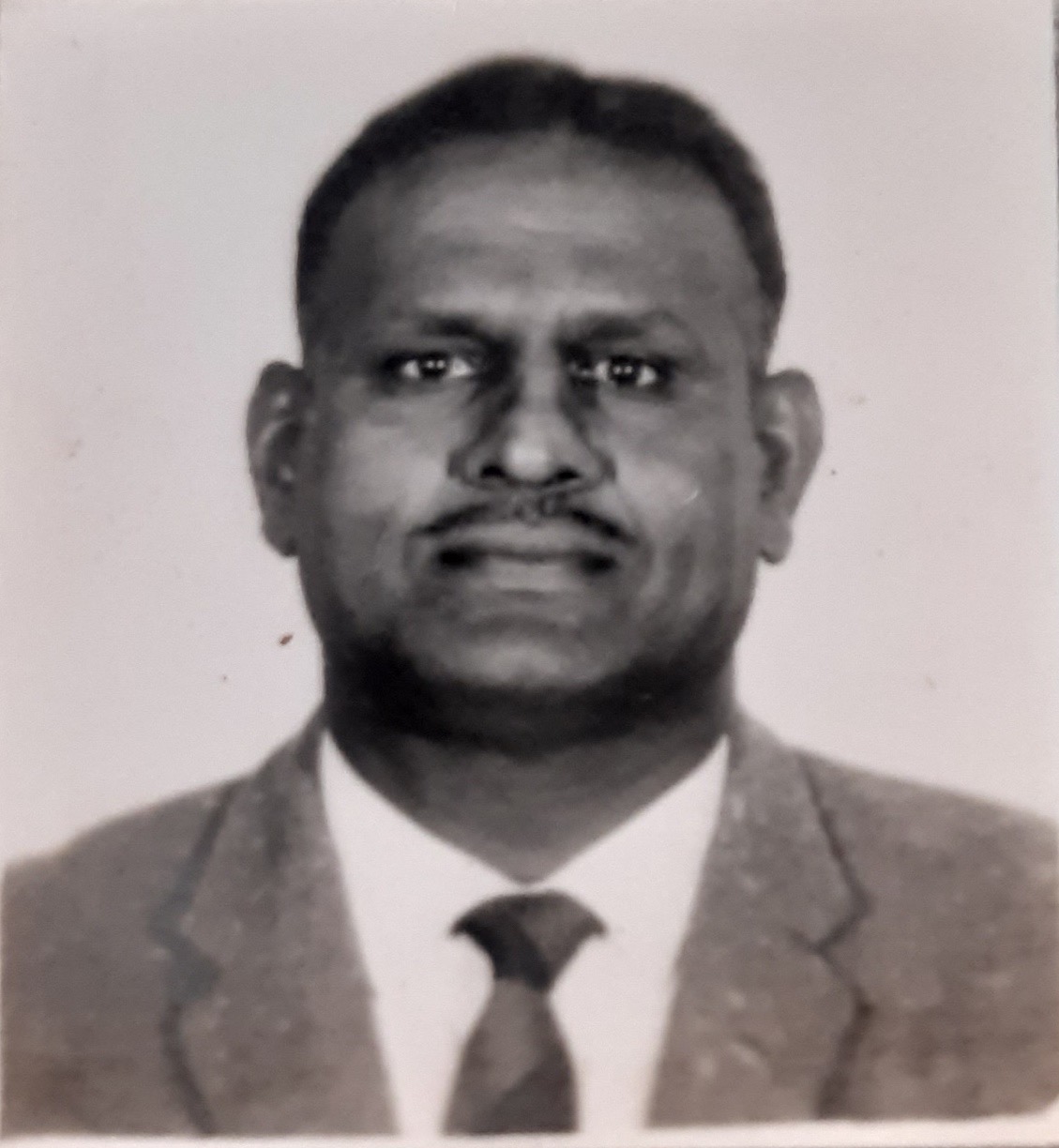
Upon the retirement of Sergeant VR Moodly he was succeeded by Lieutenant Kathavarayen Rajgopaul
AFTERWORD
The life of Special Grade Chief Sergeant Vengadasalem Rajarathnam Moodley is a story of courage, dedication and faithful service. He served the South African Police for 39 years during a difficult period in our country’s history, when racial barriers limited the opportunities available to many capable officers. Despite these challenges, he earned the respect of his colleagues and community through honesty, hard work and professional skill.
This biography is more than the story of one police officer. It is also a record of an important chapter in South African policing history. It reminds us of the contributions made by Indian police members whose achievements were not always fully recognised at the time. By preserving these stories, we honour those who served with dignity and commitment.
It is hoped that this publication will inspire future generations to value integrity, perseverance and public service. Special Grade Chief Sergeant VR Moodley’s legacy lives on through his family, the officers who followed in his footsteps, and the history he helped to shape. May his life continue to remind us that true leadership is measured not by rank alone, but by character, service and the positive difference made in the lives of others.
His name deserves to be remembered with respect and gratitude, and his contribution will remain an important part of South Africa’s policing heritage.
[LG]
Acknowledgement
I wish to recognise and thank the Editor in Chief of Nongqai, Brigadier Hennie Heymans for his tireless, often unseen efforts in helping with the creation and publication of this magazine.
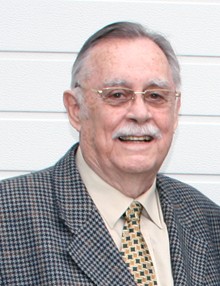
Brigadier Hennie Heymans, Editor in Chief of Nongqai
An experienced and highly skilled officer with an exceptional memory. His Dad was stationed at Somtseu Road and Mount Edgecombe during the 1940’s. Brigadier holds a Master’s degree in Strategy. Was stationed with Lieutenant-Colonel (Ray) Mathura Munilall at Wentworth. He was also based at King’s Rest (Brighton Beach); and amongst others, Soweto Region, The Public Relations Officer at Head Office and later a District Commandant at Welkom in the Free State Province.
I must also acknowledge the outstanding contributions and enduring commitment of those who strive to preserve our policing heritage.
My sincere thanks go to:
- Major General (Professor) George D Govender for the Foreword;
- Mr Michael Huxtable and Mrs Jennifer Bosch for their respective contributions;
- And finally, to my family, for their patience, encouragement, and understanding throughout the journey of researching, compiling and refining this tribute.
“Each day, millions of police officers do the selfless work of putting their lives on the line to protect civilians, frequently responding to or preventing crises completely with no recognition.” – Letitia James
“agnoscere et honorare servientibus” –
“to acknowledge and honour those who served”
“Soli Deo Gloria” – “To God Alone Glory”
Logan Govender



Thank you for the way the articles were captured. Very inspirational .
Thank you for your comment, Brigadier
Good evening col, This is truly amazing. Reading about these dedicated gentlemen who served with honour and dignity gives me a sense of pride. The research and layout of the article shows how passionate and dedicated you are , to make every journey of these distinguished gentlemen of the service a true legacy of commitment, passion and pride. Im honoured to read their stories. Thank you and God bless.
Thank you, Captain. Logan
With immense pride, our family celebrates the publication of this memoir honouring my beloved grandfather, Special Grade Chief Sergeant V.R. Moodley, whose life was dedicated to serving justice as a member of the South African Police Criminal Investigation Department (CID).
From humble beginnings, he rose through the ranks to become a respected detective, known for his unwavering integrity, meticulous investigative skills, and commitment to solving complex cases. His distinguished career, 39 years of dedicated public service, and the respect he earned from both colleagues and the community have now been beautifully preserved in this tribute.
We are incredibly proud of his achievements and the legacy he leaves behind. His story is one of perseverance, honour, and selfless service—an inspiration to our family and to future generations.
Thank you to everyone who contributed to documenting and preserving his remarkable journey.A Sspecial thank you to Col.Logan Govender for persevering to obtain the information and photographs fir this article🙏🙏🙏🤗
📖 Read his story here: https://www.nongqai.org/nongqai-vol-17-no-7b-s-g-c-sgt-vr-moodley/
.
With immense pride, our family celebrates the publication of this memoir honouring my beloved grandfather, Special Grade Chief Sergeant V.R. Moodley, whose life was dedicated to serving justice as a member of the South African Police Criminal Investigation Department (CID).
From humble beginnings, he rose through the ranks to become a respected detective, known for his unwavering integrity, meticulous investigative skills, and commitment to solving complex cases. His distinguished career, 39 years of dedicated public service, and the respect he earned from both colleagues and the community have now been beautifully preserved in this tribute.
We are incredibly proud of his achievements and the legacy he leaves behind. His story is one of perseverance, honour, and selfless service—an inspiration to our family and to future generations.
Thank you to everyone who contributed to documenting and preserving his remarkable journey.A Sspecial thank you to Col.Logan Govender for persevering to obtain the information and photographs fir this article🙏🙏🙏🤗
.
WonderfulJothi. Thank you. Logan
These are amazing stories of the Police Force. As an historian my appreciation to those that have kept these precious records. I wish that the Police these days have such integrity as you old school guys. Keep up the good work, I’m looking forward to more history.