
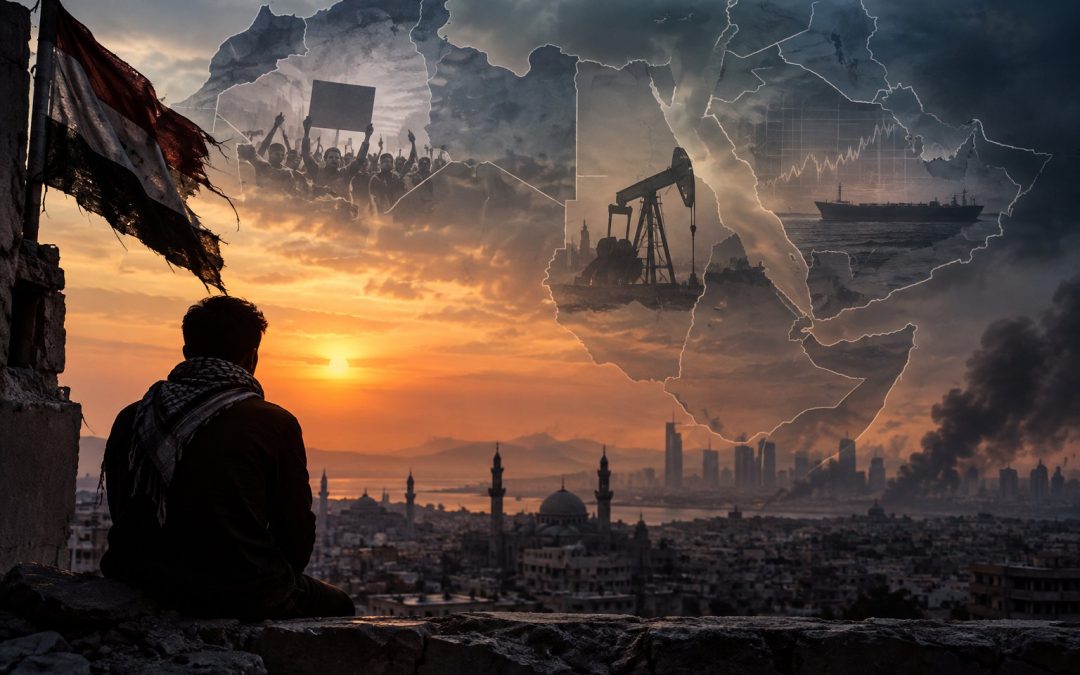
Abstract: War-related disruption, economic pressure and growing public dissatisfaction are increasingly converging across the Middle East. The conditions differ from those of 2011, but their interaction could create a second-order dynamic in which external conflict feeds existing domestic grievances and produces a new wave of regional unrest.
Dr Joan Swart
Keywords: Arab Spring | Middle East | Regional Instability | Economic Pressure | Political Unrest | Energy Security | Geopolitics
IS A SECOND-ORDER ARAB SPRING EMERGING?
Something is changing in the Middle East, but it does not yet have a name.
Across the region, economic pressure is intensifying, public dissatisfaction is increasingly visible and governments are being forced to balance domestic stability against an increasingly disruptive regional war. None of these developments, taken individually, necessarily points towards another Arab Spring. Taken together, however, they raise a more interesting possibility: that the consequences of the Arab Spring are entering a second phase.
The distinction matters. The Arab uprisings of 2010 and 2011 were driven primarily by domestic political and economic grievances. The immediate triggers varied, but the underlying frustrations were familiar: unemployment, rising prices, corruption, inequality, political exclusion and the perception that governments had become unresponsive to ordinary people.
What we may now be seeing is different. External conflict is creating economic pressure, which is feeding into domestic grievances that already existed.
Syria provides perhaps the clearest warning. On 13 September, protests spread across the country after the government sharply increased fuel prices, including a 40% increase in diesel. Demonstrators blocked roads, burned tyres and disrupted fuel shipments. Reuters described the protests as the most widespread since the fall of Bashar al-Assad in December 2024. The government attributed the increases partly to higher international petroleum costs and reduced domestic refining capacity.
The significance is not simply that Syrians are protesting expensive fuel. It is that a relatively small economic decision can become a political event when people are already living under severe economic strain.
Syria is an extreme case, but the underlying mechanism is not unique to Syria. The war has disrupted energy supplies and shipping routes, pushed up fuel and freight costs and placed additional pressure on governments that were already struggling to maintain economic stability.
Jordan illustrates another side of the problem. The government has so far chosen to absorb some of the increase in global energy prices rather than pass the full cost on to consumers, fixing September fuel prices despite sharply higher international crude prices. At the same time, recent Arab Barometer data show that economic conditions and employment remain the country’s principal concerns. Yet public trust in the Jordanian government has actually increased, reaching 49%, while trust in the armed forces remains exceptionally high.
This is an important reminder that economic hardship does not automatically produce political revolt. Governments can retain legitimacy if citizens believe that they are maintaining order and responding to their problems.
When Economic Pressure Becomes Political
Egypt presents a potentially more consequential combination. The country has enormous economic pressures, a population of more than 100 million and a government whose legitimacy depends heavily on maintaining stability. The latest Arab Barometer survey found that 72% of Egyptians regarded the economy as bad or very bad, 60% identified it as the country’s most urgent challenge, and 85% said the government was doing badly at keeping prices down. Yet 68% said stability was more important than the type of political system, while 74% preferred political reform to occur gradually.
This is not evidence that Egypt is approaching another 2011. It is evidence of something more subtle: a population that places a very high value on stability while simultaneously experiencing substantial economic dissatisfaction.
The Israel question makes the situation still more complicated.
Ninety-five percent of Egyptians surveyed by Arab Barometer opposed normalisation with Israel, while 79% expressed negative views of the United States. Across the region, public opposition to normalisation has sharply constrained the ability of Arab governments to deepen their relationships with Israel. In Saudi Arabia, one 2025 survey found that 99% of respondents regarded establishing normal relations with Israel as a negative step.
This creates a fundamental tension between governments and populations.
Several Arab governments have strategic reasons for maintaining relationships with Washington and, in some cases, Israel. Their populations may see those relationships very differently, particularly as the consequences of the current war become more tangible.
The United Arab Emirates is an especially interesting case. Abu Dhabi has developed close relations with Israel since signing the Abraham Accords, while Algeria — which has taken a sharply different position — abruptly severed diplomatic relations with the UAE this month, citing hostile or provocative conduct. Reuters reported that the disagreement reflects wider differences over Israel, Morocco, the Western Sahara dispute and regional affairs.
The UAE is structurally different from Egypt, Jordan or Saudi Arabia. Its small citizen population and highly controlled political system make a conventional mass uprising less likely, but this should not be confused with immunity from regional instability. The UAE’s extraordinary prosperity depends on the continued movement of people, capital, energy, goods and information through a highly interconnected system. A prolonged regional conflict could therefore threaten the UAE less through popular revolt than through an erosion of the economic and infrastructural conditions on which its social contract rests.
Saudi Arabia faces a different dilemma. Riyadh has increasingly distanced itself from normalisation with Israel, partly because of the political risks at home. At the same time, it is now directly exposed to the consequences of the conflict. Ansar Allah’s advance in Yemen has created a new threat to Saudi territory and infrastructure, while Washington has shown reluctance to become directly involved in another major campaign against the Yemeni movement.
The result is a narrowing of Saudi Arabia’s room for manoeuvre.
Governments and Their Populations
The same pressures are affecting the wider international system. Oil prices have risen sharply, while disruptions to Middle Eastern and Russian refining capacity are tightening diesel markets. On 16 September, Brent crude was still above $107 a barrel and European diesel prices were near record levels. Russia has also extended restrictions on diesel exports while Ukrainian attacks have damaged Russian refineries.
Ukraine is approaching another difficult winter. Although its gas stocks and electricity infrastructure are better prepared than in some previous years, the country remains vulnerable to renewed attacks on energy infrastructure, while the war continues to consume resources.
The United States is not insulated from these pressures either. Diesel prices have exceeded $6 a gallon nationally, according to Reuters, while the Middle Eastern conflict is adding another layer to an already complicated energy market.
Meanwhile, American and Israeli domestic politics are approaching important electoral moments. The US congressional elections take place on 3 November, while Israel’s next Knesset election is scheduled for 27 October.
This does not mean that governments will necessarily escalate because elections are approaching. It does mean that the political room for acknowledging strategic failure, accepting an unfavourable settlement or appearing weak may become narrower.
The proposed American sale of 40,000 2,000-pound bombs to Israel is therefore noteworthy. The $2.8 billion package, which has been informally notified to Congress but is not yet final, includes 20,000 MK-84s and 20,000 BLU-117s. The Biden administration had previously paused deliveries of MK-84s over concerns about civilian casualties; the Trump administration subsequently reversed that policy.
The weapons transfer does not prove that a new escalation is planned. But it demonstrates that, even while the costs of the war are spreading through energy markets and regional politics, the capacity for further military escalation is simultaneously being expanded.
The Wider Pressure System
This is where the idea of a second-order Arab Spring becomes useful.
The question is not whether 2011 is about to happen again. It is whether the region has accumulated enough economic and political pressure that a sufficiently powerful trigger could cause otherwise separate grievances to converge.
In 2011, the self-immolation of Mohamed Bouazizi became the symbol around which existing grievances rapidly mobilised. The event itself did not create Tunisia’s underlying problems. It gave those problems a focal point.
Something similar would be required today.
It could be another dramatic death. It could be a sudden withdrawal of fuel subsidies, a currency crisis, a major act of repression or an incident that becomes a symbol of foreign interference. It could also be an event associated with Israel or the United States that causes populations across several countries to reinterpret their economic hardship as part of a much larger political struggle.
And this is where the outcome becomes difficult to predict.
The anger could be directed primarily inward, against governments blamed for economic failure. It could be directed outward, against Israel and the United States. Or — perhaps most destabilisingly — it could be directed at both.
That third possibility deserves particular attention.
Arab governments could find themselves caught between populations demanding economic relief and opposing the war, and external partners demanding continued strategic cooperation. Governments that have maintained stability by balancing those competing pressures could discover that the balance is becoming impossible to maintain.
This is also why the present situation should not be reduced to a simple contest between “good” and “bad” actors. Governments have legitimate security concerns. States have strategic interests. Populations have legitimate grievances. Israel has genuine security concerns arising from attacks against it, while Palestinians and other populations in the region have legitimate interests in security, sovereignty and political agency. None of these realities cancels the others.
The danger arises when the pursuit of security by one actor increasingly comes at the expense of the security and agency of others.
A second-order Arab Spring, if it develops, may therefore look very different from the first. It may not begin with crowds filling a square. It may begin with a fuel-price increase, a government unable to subsidise it, a population already angry about a distant war, and one event that suddenly gives all those grievances a common meaning.
The Middle East may not be approaching another Arab Spring.
But the conditions under which a new regional wave of unrest could emerge are becoming increasingly visible.

NONGQAI’S Strategic Security Analyst Dr Joan Swart is a forensic psychologist with an MBA and an MA in Military Studies. Her work focuses on African security, geopolitics, state fragility, substate dynamics, and the intersection between governance, legitimacy, and coercive power. She is the author of several books and regularly publishes long-form analysis and opinion pieces on security and governance issues. Her writing has appeared in outlets including DefenceWeb, Maroela Media, Netwerk24, RSG, Visegrad, and other policy and public-affairs platforms. She has a weekly slot on SAfm The Global Briefing to analyse world affairs. Her work bridges academic research, policy analysis, and applied strategic assessment, and she is currently completing a second PhD at the University of Stellenbosch Military Academy. Follow her on X/Twitter, Substack, LinkedIn, and YouTube.
