
Nongqai Vol 17 No 10 – (1) Farm Murders by Dr James Myburgh
Excerpt
A historical analysis showing how revolutionary indoctrination, paramilitary training, and state neglect allowed farm attacks in South Africa to evolve into a long‑running, deadly phenomenon.
Excerpt (short paragraph)
“Reversing the demoralisation of South African society requires recognising the farm murder phenomenon for the horror that it is and was. But the goal must surely be to ensure that what is taken for granted in other societies should once again become the norm in South Africa as well…”
Abstract
This paper examines the origins, evolution, and persistence of farm attacks in South Africa from the mid‑1980s to 2026. Drawing on police data, agricultural union records, and historical testimony, Dr James Myburgh traces the phenomenon to ANC‑directed revolutionary strategies, paramilitary mobilisation, and ideological indoctrination during the late apartheid era. He argues that the reactivation of these units in 1990, combined with the post‑1994 dismantling of specialised policing capacity, enabled a sustained pattern of violent attacks on farmers and smallholders. The analysis highlights the political roots of the violence, the failure of Western governments to exert pressure during the democratic transition, and the long‑term consequences for rural security. The paper concludes that reversing societal demoralisation requires acknowledging the historical drivers of farm murders and restoring the expectation that all citizens should be safe in their homes.
Keywords
Farm attacks, farm murders, South Africa, ANC paramilitary units, revolutionary violence, MK doctrine, PAC paramilitaries, rural security, political indoctrination, home invasions, post‑apartheid crime, policing capacity, land conflict, Kill the Boer, transitional violence.
EDITED AND CORRECTED TRANSCRIPT OF THE SPEECH BY DR. JAMES MYBURGH, DIRECTOR OF THE BREMEN CENTRE FOR DEMOCRATIC RESEARCH, TO THE WHITE CROSS PROJECT CONFERENCE, NATIONAL PRESS CLUB, WASHINGTON, D.C., FRIDAY, 25 SEPTEMBER 2026

Dr James Myburgh
I’ve been invited to speak about the origins, history and nature of farm attacks in South Africa, on the best knowledge and understanding that we now have. This is in a context where many progressive intellectuals and Western journalists will deny even the existence of this horrific phenomenon, going as far as to claim that there’s no evidence farmers were ever targeted, or that the ‘Kill the Boer’ chant ever had any malign intent or impact.
The underlying numbers are, fortunately, not in dispute.
Data has been collected by the police – with some gaps over the years – and also by pro-farmer organisations since 1991. It is further underpinned by the names of the close to 3,000 documented farm murder victims who are to be commemorated tomorrow.
If we put these different sources together, we can trace the course of the farm murder epidemic from what I would call the index case to the present:
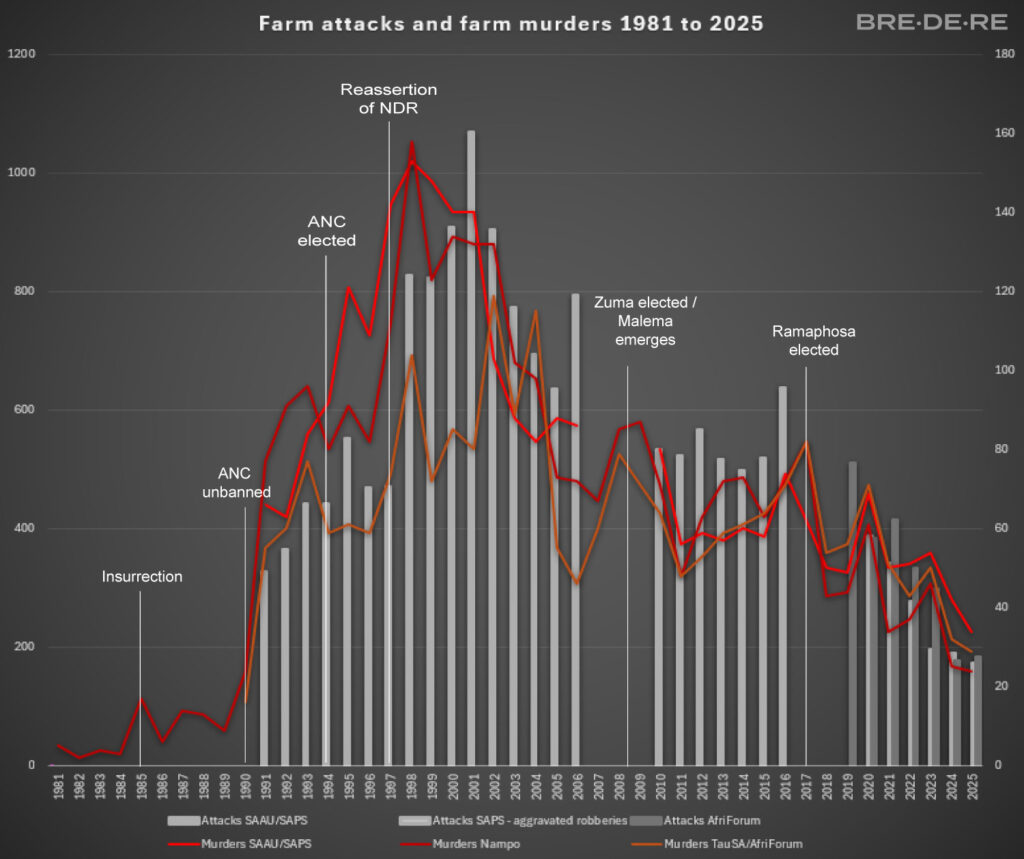 Source: BRE-DE-RE
If you look at the mid-1980s, there was a burst of violence against people living isolated on farms, and this was also reported, at the time, in the press. This seemed to disappear for a period, but then dramatically re-emerged in 1990. In 1991, the South African Agricultural Union started collecting and compiling data on farm attacks and murders, and the police also cooperated. They counted 66 murders in 1991, stemming from 327 attacks.
The numbers rose relentlessly through the 1990s, reaching 150 murders per year in 1997, a level that was then sustained for several years. The numbers fell back to just under 90 murders per annum in 2003 and remained at this elevated level until 2010. There is then a further drop-off, albeit in the context of a greatly diminished population of people living on farms and small holdings.
Since 2020, very sophisticated private security measures have measurably reduced the number of farm attacks and murders. Nonetheless, farmers and smallholders remain, according to recent estimates done by some colleagues of mine, far more likely to be attacked in or near their homes than other South Africans, and also far more likely to be killed in such attacks.
Finally, last year, under the intense spotlight focused on the issue by the Trump administration, there were 30 farm murders recorded, the lowest number in 26 years. To put that number in perspective, that is still ten times the number of people killed in residential robberies in England and Wales in 2024. It is three times the total number of people killed in all robbery murders in Germany in that same year.
To understand the emergence of the phenomenon, it’s important to go back to the farm murder index case. In the revolutionary ferment of the mid-1980s in South Africa, there was, in fact, a major ANC campaign – directed from exile – to clear the white farmers off the land.
This essentially took three forms: The first was generalised incitement, exhortations to the people “to rise up and seize the land!”, and so on. The second was a landmine warfare campaign, which was also meant to involve an assassination component. And the third was to infiltrate guerrillas from their camps in Angola into South Africa, to link up with the paramilitary bands of youth who had made the townships ungovernable, and to give them training and direction for attacks on targets in the white areas.
Indeed, guerrillas were sent on special short courses, ahead of their deployments, in how to provide such on-the-spot training once back in South Africa. This was how the first farm murders of this particular type were instigated in mid-1985, and also how the “Kill the Boer” chant – which actually originates from the Rhodesian Bush War of the 1970s – was injected into South Africa during the tumult of that era. It’s important to note as well that it was part of MK doctrine at the time that once in South Africa its guerrillas could use robbery to secure weapons and operational funds in so-called “repossession operations.” Furthermore, a common ANC/MK call to action at the time was for the youth to go into the homes, the businesses, and the farmsteads of the enemy and seize the weapons that were allegedly contained therein.
This effort to extend the war into the white rural (and other) areas was a failure. This meant that the victims of the ANC’s revolutionary violence of that era were overwhelmingly black South Africans.
So, what happened in 1990 to explain the re-emergence of farm attacks?
In February of that year, President F.W. de Klerk unbanned the liberation movements and lifted all restrictions on their legal operations. The ANC underground, however, continued with illegal work, and it set about rebuilding the paramilitary units that had been shattered through state repression.
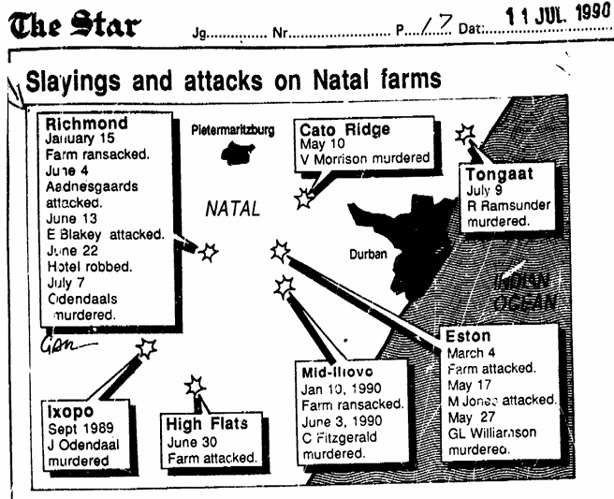
The training of these units in mid-1990 involved firearms training and ideological indoctrination. They were also taught how to obtain weapons through reconnaissance, ambush, and raiding. If you look at the next graphic, it is from the South African press in mid-1990 showing a spate of farm attacks. Those attacks occurred in areas around where these paramilitary units were being activated and trained.
To understand what the indoctrination of those paramilitary units involved, all you have to do is to turn to Julius Malema. He was recruited as a nine-year-old into one of them as a child auxiliary, and he grew up in that milieu. So, to cut a complicated story short, throughout the negotiations the ANC continued to covertly arm and train its paramilitary units, and this was dramatically ramped up in the 1993 to 1994 period. These units were also encouraged to, as the term went, “use your own initiative” to secure both weapons and funds for operations. Many of them at the time, and this was well known, became notorious for their criminal conduct.
Now, obviously, farm attacks were just one of many forms of political violence of this period. Farmers were being targeted indirectly by paramilitary units from the ANC and directly by paramilitary units from another faction of the liberation movement, the Pan-Africanist Congress. The PAC paramilitaries had an explicit policy of targeting white farmers.
In April 1994, the political miracle occurred after all political factions were brought, at the last moment, into the electoral process, with the ANC emerging triumphant.
The hope at the time was that the country would finally put the political violence behind it – whether it was revolutionary violence, state violence, or counter-revolutionary violence – and there was indeed a remarkable drop-off in most forms of politically charged violence.
Attacks on farmers were a significant exception, and farm murders continued to increase from 84 in 1993, when you had these paramilitary units operating openly, to 92 in 1994, and 121 in 1995. This was viewed by those best placed to know as a spillover into the new South Africa of revolutionary strategies and operations that had acquired considerable impetus in the final years of the old South Africa.
In 1996, those living on farms and small holdings were over 20 times more likely to be killed in home attacks than other South Africans. The following year, instead of this violence dissipating, it intensified – there was a further surge of deadly violence in 1997.
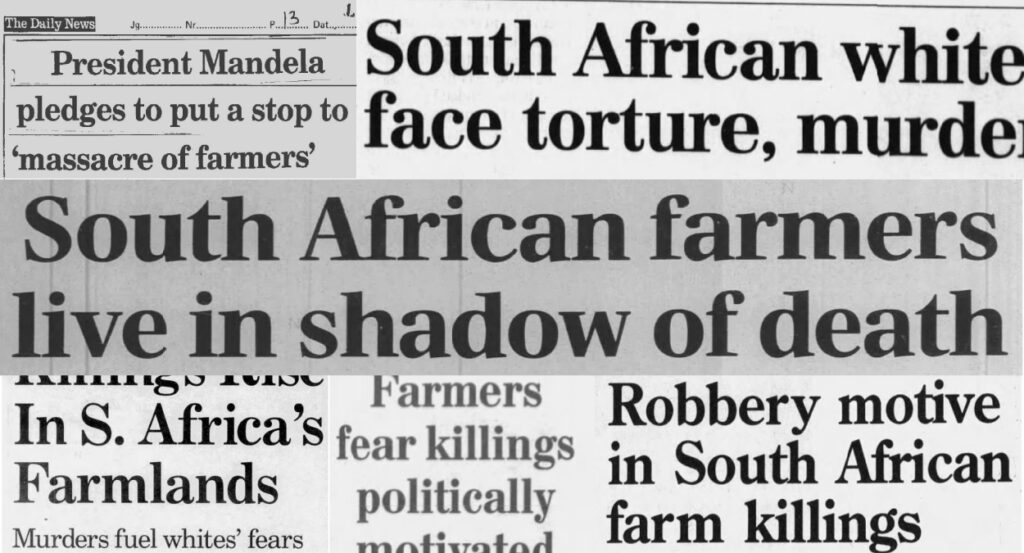
In about mid-1998, a grim milestone was passed, with 500 people being killed in farm attacks under ANC rule. This story was widely reported in the international press, under headlines such as “White Farmers in Fear of the Killers”, “South African Farmers Live in the Shadow of Death”, “Killings Spread Fear on South Africa’s Farms”, that’s the Washington Post, and “Frightened White Farmers Demand Action to Stop Rash of Killings in South Africa”, that was from The Guardian. This was a level of deadly violence akin to an insurgency situation. And, indeed, the death toll by this point was higher than the number of all white civilians killed during the entirety of the Rhodesian Bush War.
There was, in these cases, often evidence of reconnaissance having been performed ahead of an attack, sometimes over days, or of intelligence collected on the targets. According to a detailed police analysis of 443 incidents in 1997 – which were not all of them, but most of them – these were mainly carried out by armed bands of youth against usually elderly people. In a third of the cases analysed, the victims were ambushed by assailants who had been lying in wait for them.
The brutality of this violence was evidenced by the fact that there were 84 people killed in the attacks analysed, with a further 93 attempted killings, and 135 people left seriously injured. That’s a fatality rate of 20% and a casualty rate of 50%, per attack. Of the murder victims in those incidents, 82% were white and 18% were black. Often employees who came to the aid of their employers would be executed by the assailants.
As in the many pre-1994 farm attacks that would later come before the amnesty committees of the TRC – which is why we know the early 90s farm attacks were heavily politically driven – almost all attacks involved an element of robbery or looting, and particularly the seizure of any weapons that were in the farmstead.
To state the obvious, clearly this violence lay downstream – in one way or another – of the ideological indoctrination and the tactical and weapons training that had been given by the liberation movement to radical youth earlier in the 1990s. However, in late 1998, the ANC government publicly rejected suggestions that farm attacks could be considered anything other than ordinary crime. This was a line soon adopted by the ANC’s Praetorian Guard of intellectuals, who saw their central role as protecting the moral reputation of South Africa’s storied liberation movement.
What was the central piece of evidence for this claim? That these were not politically motivated? Well, it was that robbery was present in almost all attacks, and this alone disproved a political motive. This was an assertion which of course completely ignored the ANC’s own doctrine from the armed struggle.
What should have happened at that time was that countervailing pressure should have been brought to bear on the ANC government to curb this violence, particularly from the Western states which had shepherded South Africa’s democratic transition. This never happened. The moral cavalry never arrived. Not a word of condemnation was issued by any Western leader at the time for what was going on. This violence was thus allowed to run unchecked. The death toll in the second five years of ANC rule was the same as in the first: 600 people killed in 4,000 attacks.
Far from acting to curtail this kind of predatory criminal violence by building up the state institutions necessary to combat it, the government set about steadily whittling away the capacity that the security services did have. Specialised police units, such as the murder and robbery units, were dismantled. And, infamously, the commando system was abolished as well soon thereafter.
Over time, armed attacks on people in or near their homes, something which had initially been deeply shocking to people – whether it was on the farms or elsewhere – came to be regarded in South Africa much like those in the West may view suicides or car accidents: an unpleasant fact of life, but not one that any government could really be expected to do anything about.
This normalisation of farm and home attacks by our intelligentsia and the government’s dismantling of the state’s capacity to combat this kind of crime has had terrible consequences, not just for the victims of farm attacks, but for all South Africans.
In 1991, farm attacks constituted about a third of the 1,100 or so attacks recorded by police that year on people in or near their homes. In 2021, three decades on, about the same number of farm attacks were recorded. The number of armed robberies of people in their homes had, over that same period, risen to 22,000.
Reversing the demoralisation of South African society requires recognising the farm murder phenomenon for the horror that it is and was. But the goal must surely be to ensure that what is taken for granted in other societies should once again become the norm in South Africa as well, that no South African, wherever they live, should have to fear even their own houses, to fear both day and night alike.
Thank you.
- Nongqai has re-published this article with permission of Dr James Myburgh.


Myburgh’s argument is historically grounded and supported by documented police statistics, TRC testimony, and contemporaneous press reports. His central contribution is to connect the post‑1990 surge in farm attacks to earlier revolutionary strategies and the re‑mobilisation of paramilitary youth units—an angle often downplayed in mainstream commentary. The analysis is persuasive where it deals with organisational doctrine, training patterns, and statistical trends. However, attributing long‑term rural violence primarily to political indoctrination may understate other structural drivers such as socioeconomic collapse, policing dysfunction, and broader criminal evolution in South Africa. Even so, the paper provides a rigorous, evidence‑based corrective to narratives that dismiss farm attacks as apolitical or exaggerated, and it underscores the severe human cost of institutional decay in rural security.
It is important to know historical facts and understand their significance, because history helps us understand how we arrived at where we are today. Knowing the past enables us to learn from both its successes and its mistakes, to understand present circumstances in their proper context, and to make better-informed decisions about the future.
Many thanks to Dr. James Myburgh for having reminded the world about these horrible historical facts.