
Abstract: Military power is constrained by more than weapons, soldiers and technology. From Napoleon’s disastrous Russian campaign to the US war with Iran and South Africa’s operations in Central Africa, the ability to sustain forces at distance can determine what military power can actually achieve.
Dr Joan Swart
Keywords: Military logistics | expeditionary warfare | military strategy | Napoleon | Iran | SANDF | South Africa
WHEN MILITARY POWER RUNS OUT OF ROAD
Military history tends to remember battles. We remember generals, weapons, victories and defeats. Logistics is less glamorous. Yet behind almost every military operation lies a more fundamental question: can the force continue fighting?
An army may have highly trained soldiers, sophisticated weapons and a coherent operational plan, but none of these matter for long if fuel, ammunition, food, spare parts, medical support and reinforcements cannot reach the forces that need them. The problem becomes particularly acute when a military operates far from home, in another country, over difficult terrain and against an opponent able to attack its lines of communication.
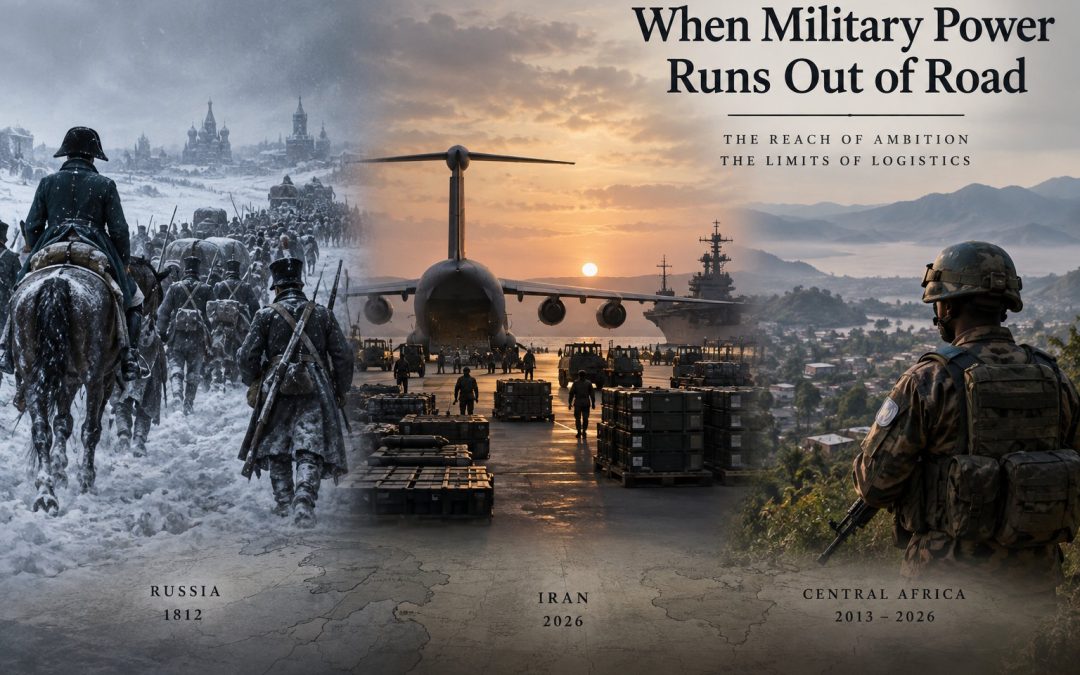
Three very different cases — Napoleon’s invasion of Russia in 1812, the American campaign against Iran in 2026 and South Africa’s expeditionary operations in Central Africa — illustrate the same underlying problem.
When the Road Runs Out
When Napoleon’s Grande Armée crossed the Niemen on 24 June 1812, roughly 500,000 men entered Russia in the initial advance. Napoleon had spent months preparing the logistical system to sustain them.
Enormous stocks were accumulated in depots in Prussia and Poland. Contemporary planning envisaged supplies sufficient to feed hundreds of thousands of men for months. The army also brought around 20,000 wagons and an enormous number of horses, which were required not only for cavalry but for artillery and transport.
The problem was not a lack of logistical preparation. It was the scale and distance of the operation, combined with assumptions about how it would unfold.
Napoleon’s operational concept was to bring the Russian armies to a decisive battle, destroy them and force Tsar Alexander I to negotiate. His logistical system was consequently designed around an advancing army that would be replenished through forward depots and, to some extent, from the territory through which it moved.
The Russians refused to cooperate.
Rather than offering Napoleon the decisive engagement he wanted, they repeatedly withdrew. The French army therefore advanced deeper into Russia while its supply lines stretched ever further behind it. Poor roads and inadequate transport compounded the problem. By the time the army reached Vilna, logistical delays were already affecting operations; one corps reportedly waited four days at Grodno for supplies.
The horses were particularly vulnerable. A horse consumed roughly 6 kg of forage a day. With the Grande Armée’s enormous animal population, the daily requirement ran into hundreds of tonnes. Poor roads, inadequate fodder and unsuitable feed caused heavy losses from the opening weeks of the campaign.
The Russian retreat also denied Napoleon access to supplies. Villages and food stocks were destroyed or removed, making it increasingly difficult for the French to live off the land.
The result was cumulative. The army marched deeper into Russia while its logistical base remained hundreds of kilometres behind it. Disease, exhaustion, desertion, hunger and the loss of horses steadily reduced its effective strength before the decisive phase of the campaign.
The Battle of Borodino on 7 September was a tactical victory for Napoleon, but it did not produce the strategic decision he needed. He entered Moscow on 14 September expecting that the loss of Russia’s ancient capital might induce Alexander to negotiate. It did not.
With winter approaching and his supply system stretched to its limits, Napoleon began the retreat in October.
The catastrophe that followed was therefore not simply a story of soldiers freezing in the Russian winter. The winter was the final manifestation of a logistical system that had already been progressively overwhelmed.
The Modern Expeditionary Problem
The technology is very different today, but distance, consumption and sustainment remain fundamental constraints.
In an analysis before the first US strikes on 28 February, the Center for Strategic and International Studies warned that the United States had the capacity for punitive strikes against Iran but faced significant logistical challenges if operations developed into a prolonged campaign.
Iran is a large country, almost four times the size of Iraq, and more than 6,000 miles from the continental United States. Its mountainous terrain, extensive urban areas and dispersed population complicate military operations, while its access to the Persian Gulf and Gulf of Oman gives it opportunities to threaten the maritime and logistical infrastructure on which an expeditionary campaign depends.
Long-range aircraft and precision weapons allow an attacker to impose considerable effects without immediately occupying territory. But air power alone does not normally deliver a political outcome; it creates conditions for whatever must follow, whether further military action or political and economic pressure. The logistical requirements therefore change rather than disappear.
Aircraft require fuel, maintenance, spare parts, munitions and crews. Sustained operations require sufficient production capacity to replace missiles, bombs and other consumables as they are expended, while air-defence systems themselves consume interceptors. Naval forces add another layer: ships require fuel and ammunition replenishment, maintenance, crew relief and suitable ports.
This is particularly important in the Gulf. American access to regional military infrastructure provides enormous advantages, but the availability and security of individual bases and ports cannot simply be assumed. If facilities are constrained, threatened or made unavailable, the logistical network has to stretch further, increasing the burden on the remaining nodes and on air and maritime transport.
The question is therefore not whether American aircraft can reach Iran. They can. The question is whether the wider system — bases, tankers, ships, ports, maintenance facilities, ammunition stocks and ultimately production capacity — can sustain the level of operations required to achieve the political objective.
South Africa’s Central African Lesson
South Africa provides a much smaller, but highly relevant, example of the same problem. The SANDF has repeatedly been asked to sustain forces far from home despite weaknesses in strategic airlift, logistics, medical support and maintenance.
The Battle of Bangui in March 2013 exposed these weaknesses starkly. About 200 South African soldiers fought a force of more than 3,000 Seleka rebels over two days. Thirteen SANDF personnel were killed and 27 wounded. The force experienced shortages of logistical and medical support; an Oryx helicopter requested for casualty evacuation was unavailable, while a surgical team only arrived with a later resupply flight. Problems were also experienced in getting priority equipment, combat vehicles and ammunition onto resupply aircraft.
More than a decade later, Goma provided another illustration. When M23 forces captured the city in January 2025, South African troops deployed with the SADC mission found themselves in an increasingly difficult logistical position. Goma’s airport was controlled by M23, cutting the contingent off from its normal air-supply route. South Africa subsequently flew additional troops, ammunition, medicine and other supplies into Lubumbashi as a contingency force was assembled. Fourteen South African soldiers had already been killed in fighting around Goma.
In July 2026, South Africa finally ended its long-running military deployment in the DRC. The operation had lasted 27 years, with the final combat personnel returning on 2 July. Around 70 personnel remained temporarily to assist with the repatriation of equipment.
The significance is not that these operations were identical, nor that logistics alone explains their outcomes. It is that in each case the SANDF was required to operate at considerable distance from its home base, in environments where access, infrastructure and resupply could not be taken for granted.
The Limits of Military Power
The lesson across these very different cases is not that logistics is merely a supporting function of warfare. It is that logistics helps define the limits of what military power can achieve.
Napoleon’s army could advance farther than it could sustain itself. American technology can project military power across extraordinary distances, but the bases, ships, aircraft, munitions and industrial capacity required to maintain that power remain subject to geography and disruption. South Africa has repeatedly discovered that deploying a force into Central Africa is easier than sustaining it there.
Military operations rarely fail because of a single logistical deficiency. More often, small constraints accumulate until they begin to determine what is operationally possible.
Military power runs out of road when its logistical system can no longer keep pace with its ambitions.

NONGQAI’S Strategic Security Analyst Dr Joan Swart is a forensic psychologist with an MBA and an MA in Military Studies. Her work focuses on African security, geopolitics, state fragility, substate dynamics, and the intersection between governance, legitimacy, and coercive power. She is the author of several books and regularly publishes long-form analysis and opinion pieces on security and governance issues. Her writing has appeared in outlets including DefenceWeb, Maroela Media, Netwerk24, RSG, Visegrad, and other policy and public-affairs platforms. She has a weekly slot on SAfm The Global Briefing to analyse world affairs. Her work bridges academic research, policy analysis, and applied strategic assessment, and she is currently completing a second PhD at the University of Stellenbosch Military Academy. Follow her on X/Twitter, Substack, LinkedIn, and YouTube.
