
-
The South African Police, and WONDERGAT
Ida Steyn
Abstract/Abstra: Wondergat, en die SAP Spesiale Taakmagte. Ida Steyn. Nongqai Vol.17 Nr. 8.
Key words: SAP Special Task Forces, Wondergat, SAP Diving, SAP Water Police.
Where is Wondergat?
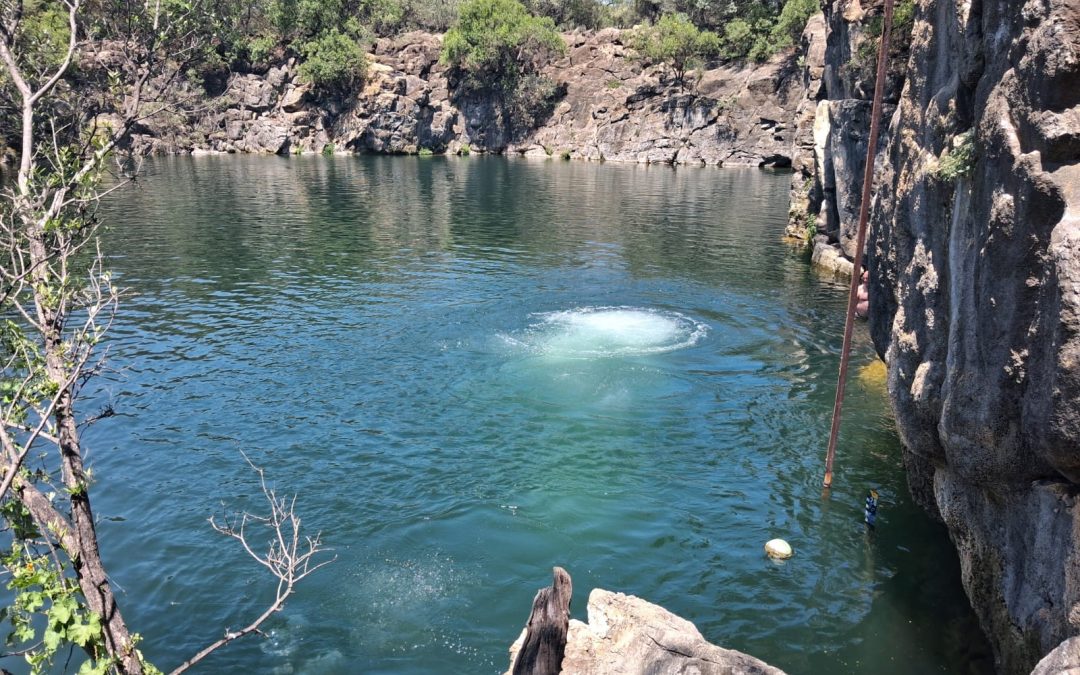
Wondergat lies in the North West Province, approximately 30 km from Mahikeng (formerly Mafikeng) and about 60 km from Lichtenburg, at an altitude of roughly 1,440–1,450 metres above sea level. It is a natural freshwater sinkhole formed in dolomite. The name Wondergat is Afrikaans and is generally understood as “wonderous/marvellous hole.” It is not an ordinary lake. What makes it remarkable is that the water fills a huge underground cavern system whose roof collapsed thousands of years ago.
How was Wondergat formed?
The geology is extremely important to understanding the site. The area consists largely of dolomite, a rock that can be dissolved by slightly acidic groundwater. Over a very long period, groundwater worked its way through cracks and weaknesses in the rock, creating underground cavities. Eventually the roof of one of these cavities collapsed. The result was the enormous water-filled opening we see today.
The surface opening is approximately 75 × 100 metres, with very steep sides descending toward the underwater shaft. The main shaft reaches roughly 36 metres before the underwater cavern system continues, and the maximum recorded depth of the site today is about 58 metres. Interestingly, historical diving records indicate that in the early 1970s divers recorded depths of more than 70 metres. The site has gradually become shallower through natural processes.
Wondergat became famous among South African divers
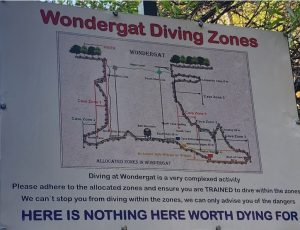
During the twentieth century Wondergat became one of the country’s best-known inland freshwater diving sites. For divers it was—and remains—a formidable environment. There are: steep underwater walls, deep water, overhangs, underwater caverns, a bell chamber, the northern and southern cavern systems, the area known as Leopard’s Cave, guide lines and grids and importantly, the memorials to divers who lost their lives there.
Wikivoyage
The combination of depth, cold water, darkness and overhead areas made Wondergat particularly unforgiving. This is why it became a training ground for highly experienced divers, including technical and instructor-level divers. Modern information about the site specifically warns that it is not a place for beginners or solo divers. Lives were lost at Wondergat. This is perhaps the most important part of Wondergat’s history. A historical compilation by experienced technical diver Verna van Schaik, drawing on older diving-club records and discussions with divers, lists 13 fatalities counted up to 2008. Because some old accidents are poorly documented, these figures should be treated as a historical compilation rather than an official government death register.
The Liquid Edge
Among the incidents recorded are: 1971 – A diver associated with the Wits Underwater Club died following an attempted free ascent after running into an air-supply problem. The incident illustrates how primitive some diving equipment and procedures were compared with today’s standards. 1975 – A diver died during a Transvaal Sub Aqua Club trip. The circumstances were never completely established, although loss of consciousness and drowning were reported as possibilities. 1977 – This became one of the particularly tragic years at Wondergat. A diver from Eskom Sub Aqua died after becoming separated from his companions. Later that year, two Wits Underwater Club divers died during a night dive—one of Wondergat’s early double fatalities. Their deaths contributed to a growing recognition that night diving at the site required extremely strict control and surface supervision. 1983 – the Nieuwenhuizen twins. One of the most remembered tragedies involved the Nieuwenhuizen twins. They were on a night dive and were connected by a buddy line but had only one torch between them. At some point they became separated from the group and the torch was lost. The torch floating to the surface was reportedly the first indication to the other divers that something had gone terribly wrong. Their bodies were recovered the following morning. The tragedy had a lasting effect on diving practices at Wondergat. One torch per diver became a strict safety rule. That is a very significant piece of Wondergat history.
Why Wondergat became so dangerous
It is important to understand that many of the deaths were not simply because the water was deep. The danger came from a combination of factors. A diver could descend into an area with Darkness → depth → cold water → reduced visibility → overhangs/caverns → equipment problems → disorientation. If a diver entered an overhead section and became disorientated, simply swimming upward was no longer necessarily possible. The water temperature can range approximately from 14°C to 21°C, depending on conditions and depth. At depth, the environment becomes particularly demanding. This is why Wondergat eventually developed a reputation among experienced divers as a place where discipline and preparation were essential.
The 1980s and the SAP Special Task Force
This is where Wondergat becomes especially important to the South African Police history you are documenting. On the bottom of Wondergat there is a historic SAP Special Task Force board. According to the historical record published when the board was restored, the original board was placed at Wondergat on 28 May 1981 by members of the South African Police Special Task Force. The names recorded in connection with the original board are Jaco van Schalkwyk, Tienie Strydom, Mick Fryer, Japie Blom, Tony Bester, Obie Oberholzer, Eddie Mollier, Roelf Pretorius, Snor Vermeulen, Johan De Bruto, Derek Dercksen, Danie Le Roux, Duppie du Plessis, Oupa Swanepoel. The sign carried the famous words: “You have never lived till you almost died and for those who fight for it life has a flavour the Protected will never know.” The wording has become part of the history and mythology surrounding the Special Task Force divers at Wondergat.
Why would the SAP Special Task Force have been at Wondergat?
This is an important distinction. The Special Task Force was not simply visiting Wondergat as recreational divers. The SAP had highly specialised personnel who required exceptional physical and operational skills. Wondergat offered an extremely demanding environment in which specialist divers could develop and test: deep-diving skills, underwater navigation, equipment discipline, buddy procedures, rescue techniques, endurance, psychological control and the ability to operate under extremely difficult conditions. The site therefore became associated with elite diving and specialist training. For police divers, the ability to work underwater was particularly valuable in operations involving submerged evidence, bodies, vehicles and other difficult recoveries.
The Wondergat memorial stones
Today, one of the most haunting aspects of Wondergat is the presence of memorial stones commemorating divers who died there. They are not merely decorations. They represent the human cost of the development of South African diving. The memorial area and the Special Task Force board are located underwater, meaning that divers literally encounter the history of the site while descending into it. That makes Wondergat unusual, It is simultaneously a geological wonder, a diving school, a training ground, a rescue environment and an underwater memorial.
Later fatalities
The danger did not disappear after the 1970s and 1980s. The historical compilation records further deaths, including 1984: a diver died after becoming entangled in a rope near a grid during a night dive. 1985/86: a diver associated with the RAU club died in the main cave. 1991: an extremely experienced instructor, Dick Grace, died during a deep rescue operation. The incident reportedly involved another diver as well. 1996: a free diver died after apparently suffering a blackout following an extremely deep breath-hold dive. 2004: a woman diver, Elna Odendaal, died after losing consciousness underwater. Contemporary reporting stated that she was already brain-dead when her husband and diving partner brought her from the water. These incidents demonstrate why Wondergat developed such a serious reputation.
The Special Task Force board was restored
There is also a beautiful piece of recent SAP heritage preservation. In 2025, divers Philip Aucamp and Herman Coetzer, both former Class IV Commercial Police Divers, undertook the restoration of the historic Special Task Force board. The original board had deteriorated over the years and the lettering had faded. The restored board was designed to slide over the original board, preserving the history while reducing the need for divers to manipulate the original structure.
The Citizen
This is particularly meaningful for the SAP/SAPS heritage community because it means that the names and words associated with those early Special Task Force divers have not simply disappeared into history.
Wondergat today
Today Wondergat remains an important inland diving destination. The current site information describes it as a location for advanced divers, instructors and technical divers. It has camping facilities, electricity, ablutions, emergency oxygen and air-filling facilities. The nearest major medical facilities are in Mahikeng and Lichtenburg. The site continues to be used for specialist diving and training. The modern safety procedures are a direct reflection of the lessons learned from decades of accidents. One important historical clarification – there is an interesting source of confusion surrounding the name Wondergat. Some material on the internet associates Wondergat with archaeological occupation dating back hundreds of thousands of years. That appears to be a confusion with Wonderwerk Cave near Kuruman, a completely different archaeological site. For the Wondergat between Lichtenburg and Mahikeng that you are referring to, the reliable diving sources identify it as the dolomite sinkhole/freshwater cavern described above. So I would not include the “800,000 years of human occupation” story in a Nongqai article about this Wondergat unless it can be independently established as referring to this exact site.
Why Wondergat is important to SAP history?
For Nongqai readers: the most powerful way to look at Wondergat is not simply as a place where divers died. It represents the development of South African specialist diving. Men—and later women—involved in police diving entered an environment where mistakes could be fatal. The experience gained there helped develop the discipline, procedures, equipment and professionalism associated with specialist police diving. And at the bottom of that dark water stands a remarkable piece of SAP history. the Special Task Force board of 28 May 1981. Those words -“You have never lived till you almost died…” capture something of the mentality of the men who volunteered for extraordinarily dangerous specialist work. For an SAP/SAPS heritage publication, Wondergat therefore deserves to be remembered not merely as a “dangerous diving hole,” but as a place where courage, loss, training, sacrifice and police heritage meet beneath the water.
Sources: Wondergat – official diving information. Wondergat – official site. Task Force board restored at Wondergat. Wondergat data.
IDA STEYN

*

Well done, beautiful and interesting.
Dankie Ida – interessante artikel!
Informative and interesting article, Thank you Ida.
Ida, baie dankie vir n wonderlike artikel.
Dankie Ida, baie interessant
Dankie Ida, baie interessant
Ida Steyn se Wondergat-artikel bring baie memories terug. Ek het baie duike daar saam met die SAP Taakmag gedoen, en ek wonder of Eddie, Snorre en die manne nog lewe. Dit tyd het gevlieg, en ‘n ruk gelede het ek vir Eddie op ‘n berg raakgeloop terwyl ons besig was met paragliding. Baie goeie artikel, Ida Steyn en ‘n goeie weergawe wat daar by wondergat gebeur het. Ek onthou ons “ysbeer-naweke” en hoe ons wetsuits moes ontvries vroeg in oggend voor jy hom kon aantrek. In die somer het ons mielies langs die pad gepluk en by Wondergat oor ‘n vuur gebraai. Die hartseer deel is die manne wat daar verdrink het – ek onthou hulle almal. – Carel Schoeman.