
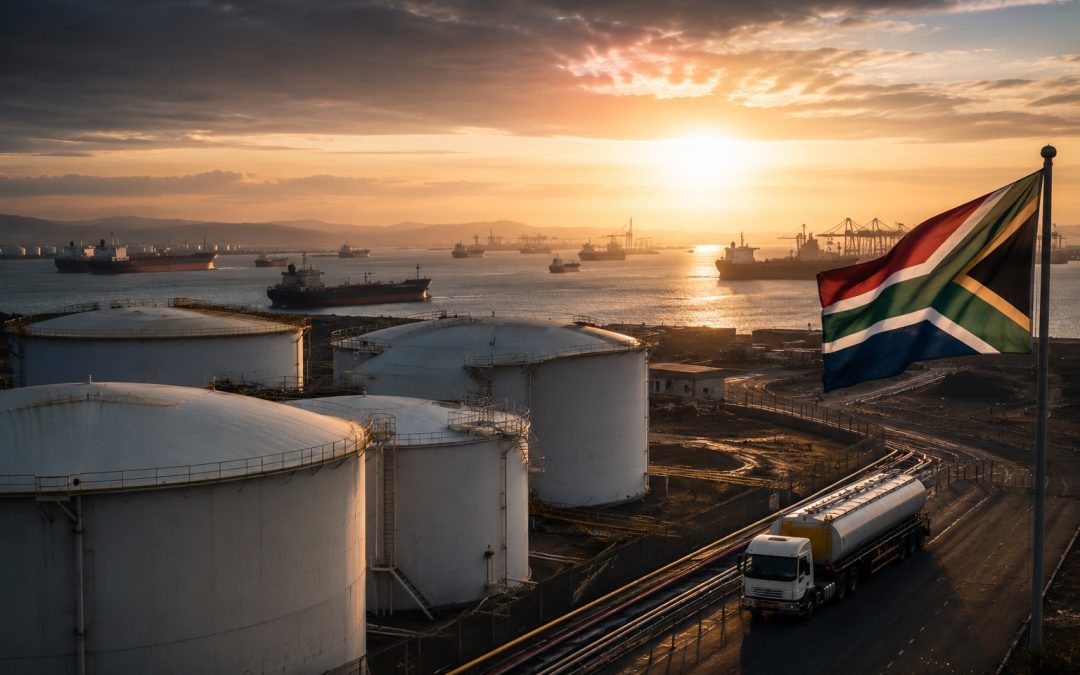
Abstract: South Africa’s draft Strategic Petroleum Stocks Policy is about far more than fuel security. It signals a renewed appreciation that national resilience cannot be left entirely to market forces, and that strategic endurance requires deliberate investment before—not during—times of crisis.
Dr Joan Swart
Keywords: Strategic petroleum reserves | National strategy | Energy security | Strategic resilience | South Africa | National endurance | Fuel security
STRATEGIC PETROLEUM STOCKS: A TEST OF SOUTH AFRICA’S NATIONAL STRATEGY
One of the paradoxes of strategy is that investments in resilience often appear unnecessary—until the day they become indispensable. Maintaining military forces that may never fight, constructing infrastructure that is rarely used to capacity, or storing petroleum that may remain untouched for years can all appear economically inefficient.
Yet history repeatedly demonstrates that resilience is most valuable precisely when normal assumptions no longer hold.
South Africa’s draft Strategic Petroleum Stocks Policy deserves attention for this reason. At first glance, it appears to be a technical energy policy proposing a significant increase in the country’s strategic petroleum reserves. In reality, it represents something much more important. It suggests that government is beginning to recognise a principle that strategists have long understood: efficiency and resilience are not the same thing.
Recent tensions in the Middle East have once again highlighted the vulnerability of global energy markets. Whether current instability ultimately develops into a prolonged disruption of oil supplies is less important than the reminder it provides. Modern economies remain heavily dependent upon complex international supply chains that cannot be taken for granted. The lesson is not that governments should attempt to predict every future crisis. Rather, they should ensure that their countries are able to endure disruption when it inevitably occurs.
That is the strategic significance of petroleum reserves.
Strategy values resilience differently
For several decades, economic policy around the world has favoured efficiency. Lean inventories, just-in-time logistics and globally integrated supply chains have reduced costs and improved competitiveness. Under normal circumstances, these systems perform exceptionally well.
Governments, however, are responsible for more than normal circumstances. Their responsibility is to preserve the functioning of society during periods when markets become disrupted by war, geopolitical tension, natural disasters or major industrial failures. The strategic question is therefore different from the commercial question.
Markets optimise efficiency.
Strategy optimises endurance.
The distinction is subtle, but fundamental. A commercial enterprise can often absorb temporary interruptions through higher costs or reduced profitability. A nation confronted by prolonged fuel shortages faces consequences that extend far beyond economics. Transport systems slow, food distribution becomes more difficult, mining production declines, emergency services are affected and military readiness begins to erode.
Viewed through this lens, strategic petroleum reserves are not simply fuel stored for emergencies. They are part of the infrastructure that enables a country to continue functioning when external shocks disrupt normal commercial activity.
South Africa’s changing energy landscape
South Africa has not always depended on today’s fuel supply model. During the latter part of the twentieth century, the country deliberately invested in strategic resilience. Sasol’s synthetic fuel capability reduced dependence on imported crude oil, domestic refineries expanded local refining capacity, and strategic petroleum stocks were accumulated to provide a measure of protection against international supply disruptions.
These investments carried substantial financial costs. Their purpose, however, was never purely economic. They reflected an understanding that energy security formed part of national security.
Following South Africa’s reintegration into global markets, the strategic environment changed. International trade expanded rapidly, shipping became increasingly efficient and global supply chains appeared dependable. Against this backdrop, maintaining extensive strategic reserves became progressively more difficult to justify economically. Commercial efficiency increasingly displaced strategic resilience as the dominant organising principle.
The result has been a gradual transformation of South Africa’s fuel system. While Sasol continues to provide an important strategic contribution through synthetic fuel production and Natref maintains domestic refining capacity using imported crude oil, the country has lost a significant proportion of its refining capability. Consequently, South Africa now imports increasing volumes of refined petroleum products in addition to imported crude oil.
This evolution has not created a crisis, but it has altered the country’s strategic posture.
Understanding strategic exposure
Public discussion sometimes creates the impression that South Africa’s fuel security depends almost entirely on the Middle East. The reality is more nuanced.
South Africa benefits from a relatively diversified supply system. Sasol continues to supply approximately a quarter of national liquid fuel demand from coal and gas, while imported crude oil and refined petroleum products are sourced from a number of international suppliers, including Nigeria and producers in the Gulf region. This diversity provides an important measure of resilience.
Nevertheless, diversification does not eliminate strategic exposure.
Regardless of where petroleum originates, much of South Africa’s imported fuel depends upon secure maritime transport, efficient ports and uninterrupted international logistics. Disruptions affecting shipping routes, maritime chokepoints, regional instability or global freight networks can affect supplies even when supplier countries remain reliable commercial partners. Moreover, petroleum products are globally traded commodities. A significant disruption to international oil flows would tighten global supply and intensify competition among buyers, meaning that sourcing fuel from outside the Gulf would not necessarily insulate South Africa from the wider consequences of a major international supply shock. Strategic resilience therefore depends not only on supplier diversity, but also on maintaining sufficient national capacity to absorb disruptions when global markets come under pressure.
The strategic challenge lies not in the geographic origin of fuel, but in the nation’s capacity to withstand disruptions to the global supply system.
Lessons from scenario planning
During my years at Sasol R&D, including leading a scenario planning team, one lesson became clear. Effective scenario planning is not an attempt to predict the future accurately. Rather, it seeks to ensure that organisations remain resilient across a range of plausible futures, including those that appear unlikely but carry severe consequences.
National strategy operates according to the same logic.
No government can predict the precise circumstances of the next major international disruption. It can, however, invest in capabilities that reduce vulnerability across multiple scenarios. Strategic petroleum reserves represent one such capability. Their value lies not in forecasting a specific crisis, but in preserving national freedom of action when circumstances change unexpectedly.
More than counting days
Much attention has focused on the proposed number of days of strategic petroleum reserves that South Africa should maintain. While this debate is important, it risks oversimplifying the broader strategic issue.
Resilience cannot be measured solely by the volume of petroleum held in storage.
National endurance depends equally upon refining capacity, storage facilities, ports, pipelines, transport networks and the ability to prioritise fuel distribution during periods of disruption. Diesel remains indispensable to freight transport, mining, agriculture and backup electricity generation, while aviation fuel supports emergency services, air transport and military operations. Strategic petroleum reserves therefore form only one component of a much larger resilience architecture.
The purpose of the draft Strategic Petroleum Stocks Policy is therefore not simply to increase fuel inventories. It is to strengthen South Africa’s capacity to absorb external shocks without allowing essential national systems to fail.
A return to strategic thinking
The greatest significance of the draft policy lies not in the number of days of petroleum it proposes to store. Its importance lies in what it reveals about the evolution of South African strategic thinking.
For many years, efficiency understandably dominated public policy. Increasingly, however, the international environment is reminding governments that resilience carries a value that markets alone cannot capture.
This is not an argument against markets, nor against commercial efficiency. Both remain indispensable to economic prosperity. It is, however, an acknowledgement that governments carry responsibilities that differ from those of private enterprise.
Some national capabilities should not be judged solely by their commercial return. They should be judged by the strategic endurance they provide when ordinary market conditions inevitably break down.
South Africa’s draft Strategic Petroleum Stocks Policy is therefore more than an energy policy.
——
Follow Joan’s weekly analyses of global events om SAfm radio:

NONGQAI’S Strategic Security Analyst Dr Joan Swart is a forensic psychologist with an MBA and an MA in Military Studies. Her work focuses on African security, geopolitics, state fragility, substate dynamics, and the intersection between governance, legitimacy, and coercive power. She is the author of several books and regularly publishes long-form analysis and opinion pieces on security and governance issues. Her writing has appeared in outlets including DefenceWeb, Maroela Media, Netwerk24, RSG, Visegrad, and other policy and public-affairs platforms. She has a weekly slot on SAfm The Global Briefing to analyse world affairs. Her work bridges academic research, policy analysis, and applied strategic assessment, and she is currently completing a second PhD at the University of Stellenbosch Military Academy. Follow her on X/Twitter, Substack, and LinkedIn.
