South Africa’s Transition What Really Happened and Why
FREE eBOOK
SOUTH AFRICA’S TRANSITION
WHAT REALLY HAPPENED AND WHY
By
Dr Willem Steenkamp
Abstract
This foreword introduces a comprehensive eBook by Dr Willem Steenkamp that examines South Africa’s negotiated transition to a non-racial democracy. Drawing on his multidisciplinary background in intelligence, diplomacy, law, and academia, Steenkamp provides an insider perspective on the political, strategic, and historical dynamics that shaped the transition. The work challenges prevailing myths and conspiracy theories by highlighting systemic dysfunction in national security decision-making, the misalignment between military and political strategies during the “total onslaught” era, and the critical role of negotiation processes. It argues that the eventual settlement was less a result of individual weakness than of structural constraints and inadequate preparation on the part of the National Party government. The study also emphasises the importance of bilateral negotiations, the prioritisation of peace over ideological objectives, and the competing strategic aims of the National Party and the ANC/SACP. By analysing key periods from 1975 to 2007 and exploring pivotal historical “what if” scenarios, the work offers insights into the determinants of South Africa’s current political landscape and identifies lessons for future governance, particularly in the context of coalition politics and democratic stability.
Keywords
- South Africa
- Negotiated transition
- Democracy
- National Party
- ANC/SACP
- Political negotiation
- National security strategy
- Total onslaught
- Intelligence and diplomacy
- Constitutional development
- Power politics
- Peace process
- Coalition governance
- Political history
- Strategic decision-making
FOREWORD: NONGQAI eBOOK – WHY WE ARE WHERE WE ARE
by
Brig Hennie Heymans
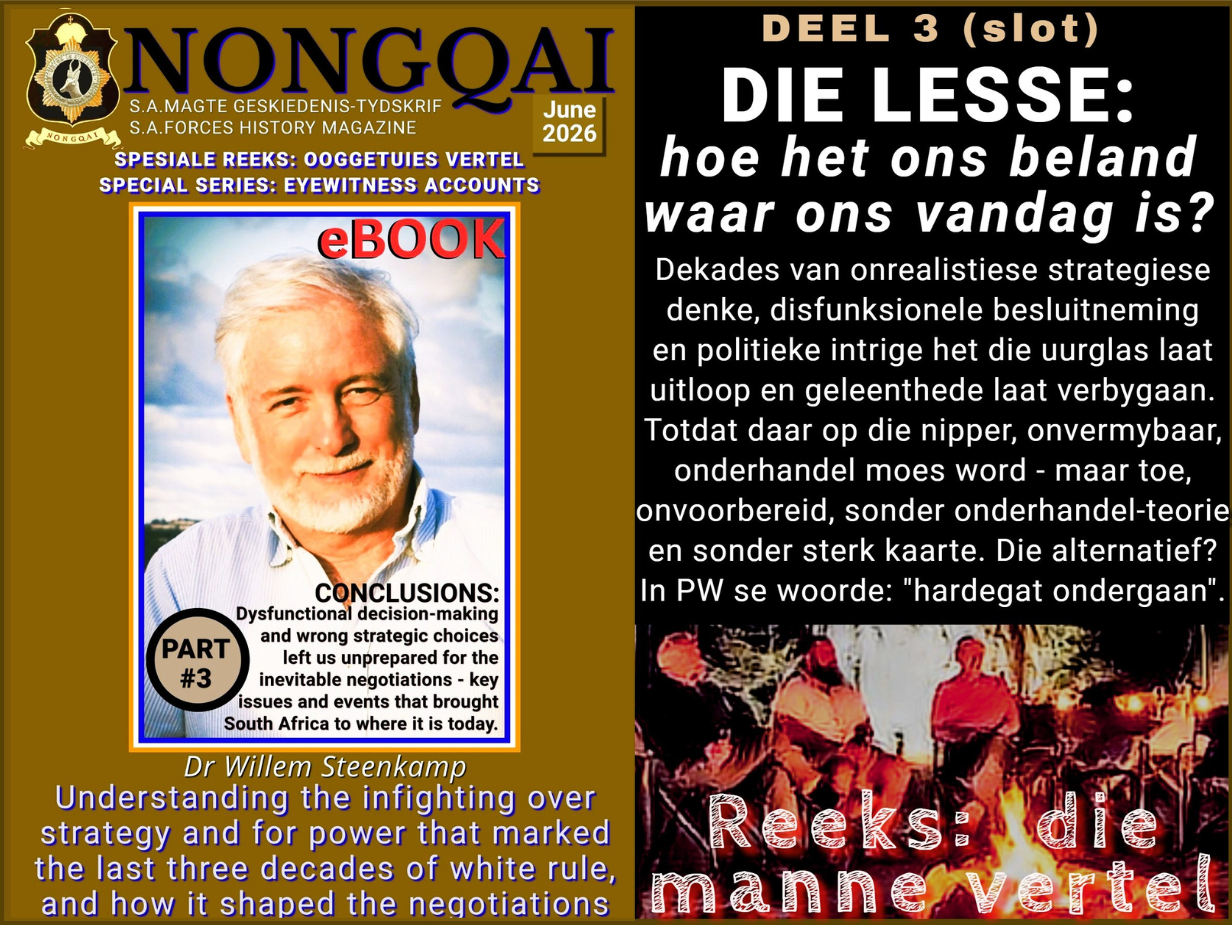
Dear NONGQAI readers: we are proud to present to you, FREE, a comprehensive eBook by our own Dr Willem Steenkamp on South Africa’s negotiated transition. It analyses and explains how (and, importantly, WHY) we got from where we were, to where we are today. Warts and all, from the perspective of someone who enjoyed unique vantage points from which to have observed and learnt what really had happened, also behind the scenes.
In this foreword, I aim to do two things: first, to tell you a bit more about the author, who went to the same school as I did and with whose father I had worked for many years.
Secondly, to provide you with an introduction to what you will encounter in the eBook (which is not a short read, but a comprehensive and detailed chronicling and interpretation of what had occurred, highlighting the lessons to be learnt with a view to a future where coalition governance at all levels seems to be ever more likely). This introduction will consist of copying here the book’s first segment, containing AI reviews of it and the author’s own executive summary.
And, of course, the link for downloading the eBOOK – you can simply click below and it will download. Remember, because it is in ePub format, you can both read it and also listen to the book, with a free App such as Google Play Books (there’s also a link for downloading the App). You can also download the book in PDF format – just click the appropriate link below.
Download Google Play Books App FREE (for Android smartphones & tablets)
Download Calibre eBook Reader FREE (for laptops)
Download Dr Steenkamp’s eBook on SA’s transition FREE
Download Dr Steenkamp’s book on SA’s transition as a PDF, FREE
======
INTRODUCING THE AUTHOR, MY FRIEND AND CO-EDITOR Dr. WILLEM STEENKAMP:
Now a bit more background about the author, affectionally known here among the NONGQAI team as “Dok Willem”.
Willem Petrus STEENKAMP was born on 16 December 1953 in Durban. He always joked that, as a police child, his mother had to wait to fit him in on a public holiday… Willem is the firstborn of the late Major General Frans Steenkamp and Maria (“Maxie”), née O’Reilly.
Willem’s father would rise in the Police Force from a renowned young detective who, among other things, had solved in record time the sensational Van Buuren murder case, after the stalled investigation had been entrusted to him. I worked under Colonel Frans Steenkamp in Durban, when he was the divisional commander of the Port Natal SAP-SB, as well as later in Pretoria, when he had attained the rank of major general and headed the Security Branch during the first half of the 80s (he took early retirement in 1985 because he could not identify with PW Botha’s approach – during a farewell function for him the then minister, Louis la Grange, said with relish that Frans Steenkamp was the only general who had ever bluntly said to him in a meeting: “Minister, now you’re talking shit”).
This strong streak of outspoken independent thinking was characteristic of that Steenkamp bloodline, of which the first arrival in the Cape – Casper Jan-Hendrik – received the farm “Het Slot” in the Drakenstein as a free burgher in 1714, after years of previous visits as a VOC soldier and sailor. One of Willem’s ancestors from the early 1800s, “Jan Slaai”, still has his name carved into the rock of Robben Island, where he was held when he stubbornly refused to pay a fine that he considered unjust at the beginning of the British occupation of the Cape.
Equally free-thinking and outspoken was Willem’s great-uncle, the well-known and beloved “Lion of Namaqualand”, Dr W.P. Steenkamp MP, an Afrikaans patriot. Willem’s own grandfather grew up in this uncle’s home, after his parents had both died young. “Ou-Dok” WP was both a medical doctor and a Doctor of Theology. For his doctorate, which he obtained in the Netherlands, he had submitted in 1910 the first-ever doctoral thesis written in the Afrikaans language, several years before Afrikaans gained official recognition. As resident of the Cape Colony he was detained during the 2nd Anglo-Boer War (and received a bayonet wound in his backside) for his suspected pro-Boer sympathies. He was then again detained without trial during the 1st World War. “Ou-Dok” was the only candidate to succeed in winning a parliamentary seat as an independent, against the two main parties of the day, in the 1929 election. He was known for his dedication to the poor, the piloting of community upliftment projects, and his unabashed setting forth of his policy positions, regardless of whether they were considered unorthodox (such as the need to step away from the Gold Standard during the Depression – for which he was first denounced as a “communist”, but which would later become government policy and lay the foundation for overcoming the economic crisis of the time).
On his mother’s side, Willem is a 13th generation direct descendant of the last of the noble Irish lords before total British domination there – Philip, the lord of Bréifne Ó Raghallaig (Bréifne was the only Irish principality to issue its own coins; it was known for its prosperity and military tradition, especially its mounted soldiers). This bloodline is therefore characterised by the “fighting Irish” spirit; among Willem’s direct ancestors was Miles “Slasher” O’Reilly (son of Philip and known today as the “Braveheart” of Ireland for the way in which he and his three hundred dragoons defended the strategic bridge at Finnae against an overwhelming British force). These O’Reillys, with their seat at the Baltrasna Estate, were still recognised by the European nobility after the British conquest. Baltrasna continued to produce distinguished generals in the service of other European rulers, such as “Bloody Alexander” O’Reilly, governor of Spanish Louisiana and Cuba, and Andreas (Andrew) Graf O’Reilly von Ballinlough of the Austrian Empire, who had led the defence of Vienna against Napoleon.
Willem’s Baltrasna-born great-great-great-grandfather, Anthony Alexander O’Reilly, arrived in the Cape in 1813 as a British officer. He would retire as garrison commander in Grahamstown, with the rank of lieutenant colonel – an achievement in those years for a true Irishman. His son, Captain John Robert O’Reilly, married an Afrikaans lady, a Hendricks. After a falling out with the British governor, he headed north in pursuit of the Voortrekkers and settled in what is now Northern Natal as a farmer. (His cousin Jack O’Reilly also moved inland, also married to an Afrikaans wife (actually, the sister of his brother’s wife) and was the person most instrumental in having that pale pebble which sparked the Kimberley rush, properly identified as in fact a diamond; Jack’s grandson William Godwin “Bill” O’Reilly was a decorated member of the Orange Free State Republic’s Staatsartillerie during the 2nd Anglo-Boer War).
In the area around Newcastle, the now thoroughly “Boere Irish” O’Reillys farmed ahead of the curve, eventually owning several farms – Willem’s great-grandfather’s entry, for example, won the gold medal for best Angora ram on show at the first Rand Easter Show in 1896, then a new industry in Southern Africa. During the Second Anglo-Boer War Willem’s great-grandmother (née Maartens) frequently clashed with British troops. Because their “home farm” physically overlooked Newcastle and three British forts as well as the main roads to the Free State and Transvaal, this fiercely anti-British attitude led to the entire family – including Willem’s then three-year-old grandfather Tom – being sent to a concentration camp in Pietermaritzburg. Willem’s mother, nicknamed Maxie, was a keen athlete and sportswoman.
Willem himself was born with that Irish “gift of the gab”. During his matric year at Dirkie Uys High School on the Bluff in Durban (my own school, although I had preceded Willem by a few years), he won the national debating contest for Afrikaans high schools. His school team was also a finalist in the SABC’s general knowledge quiz competition for Afrikaans schools that year.
After completing his undergraduate studies in Law and Political Science at the University of the Free State in 1974, Willem in 1975 joined the then Bureau for State Security (which later became the National Intelligence Service), where he completed his national service obligations and worked back his Civil Service Commission bursary.
Willem meanwhile continued his studies through UNISA and obtained four further degrees, including a D. Litt. et Phil. doctorate in Political Science, with the intelligence function as theme. This thesis was externally examined by, among others, the well-known British intelligence expert from Cambridge University, Christopher Andrew.
In the Intelligence Service, Willem (then still in his mid-twenties), had acted as head of the SWA/Namibia analytical desks, where he had to represent his department on various high-level inter-departmental committees, opposing in those meetings what the late Dr Niël Barnard would later describe as the “fever dreams” that some in the military ranks were clinging to at the time.
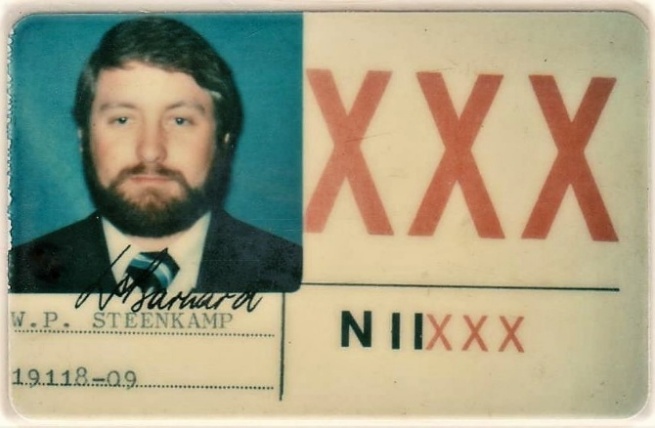
Willem designed the Intelligence Service’s then new computerised daily intelligence reporting system (to which he gave the name NIFS – National Intelligence Flashes and Sketches). Moving up from the SWA/Namibia desk, he was appointed as co-editor in the Service’s new central editorial department, N.11, in which capacity he was also the secretary of the inter-departmental Coordinating Intelligence Committee (KIK). Not yet thirty, he was by far the youngest member of the Service to carry the access ID card with three large red crosses (signifying holding “top secret” clearance for all information throughout the Service).
Willem completed part of his intelligence training in Munich, at the (then West) German Bundesnachrichtendienst, the BND. In the early eighties, he switched to the Service’s clandestine collection component, to broaden his professional background. This included a stint in the UK.
Willem recorded his experiences in the then intelligence community for NONGQAI in our series: “The Men Speak”. You can read it at this link:
NONGQAI SERIES THE MEN SPEAK Dr Willem Steenkamp Part 2 – Nongqai BLOG
After completing his compulsory national service and Civil Service scholarship obligations, Willem resigned from the intelligence service. Given the situation already observable in the country at that time, he wanted to put his academic legal qualifications to practical use by formally obtaining admission as a lawyer (Willem and his father were already concerned that there might not be a long-term future in the Civil Service for young white men). Willem served his clerkship years at Frankfort in the Free State. He passed the then notoriously difficult attorney admission examination on his first attempt (which only 14% of candidates at the time were able to do) and was admitted as an attorney of the High Court of South Africa in 1985.
With this professional qualification safely in his back pocket, Willem then decided to return to national public service and joined the South African Department of Foreign Affairs (his father had also in 1986 returned to the SAP Security Branch in a consultant role – given the then rapidly deteriorating circumstances in the country).
As had been the case during his training courses in the intelligence service, Willem also finished top of his training group in Foreign Affairs. This won him (in terms of DFA tradition), the privilege of being able to choose which of the then available posts abroad he wanted to be sent to. After consulting with his wife, he chose Paris, where the family arrived in September 1987.
Willem was First Secretary at the South African Embassy in Paris, initially in the information section and then the political section, after which he was appointed head of diplomatic training in Pretoria in 1990. There he was tasked with transforming the training programme to make it suitable for the needs of the New South Africa. In consultation with the Human Sciences Research Council, Willem designed a new system, based on an MBA approach (with a focus on “can do” ability, rather than simply studying theory in the abstract). This new course was recognised by the HSRC as a master’s degree-equivalent qualification for diplomatic cadets who successfully complete it, and laid the foundation for what is nowadays known as the diplomatic academy.
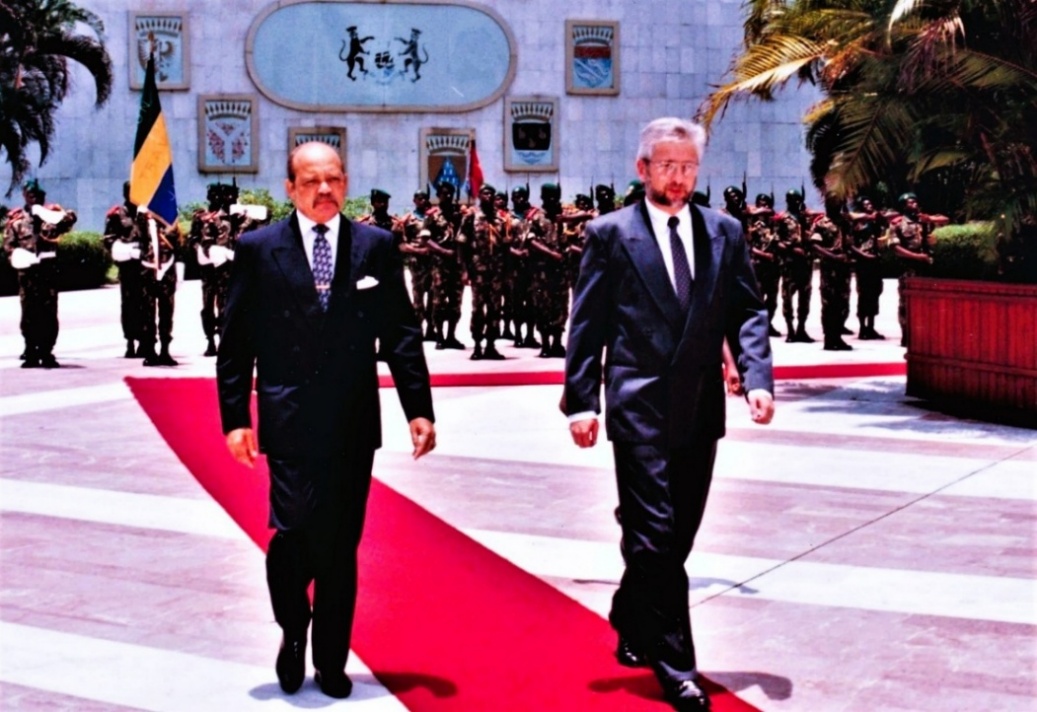
At the young age of 38, Willem was subsequently appointed ambassador. Thus, he became the New South Africa’s first ambassador to once hostile Black Africa. He was given responsibility for relations with six countries, namely Gabon, Chad, Cameroon, Equatorial Guinea, Sao Tome & Principe and the Central African Republic, with residence in Libreville, Gabon (on the equator, on the west coast of Africa).
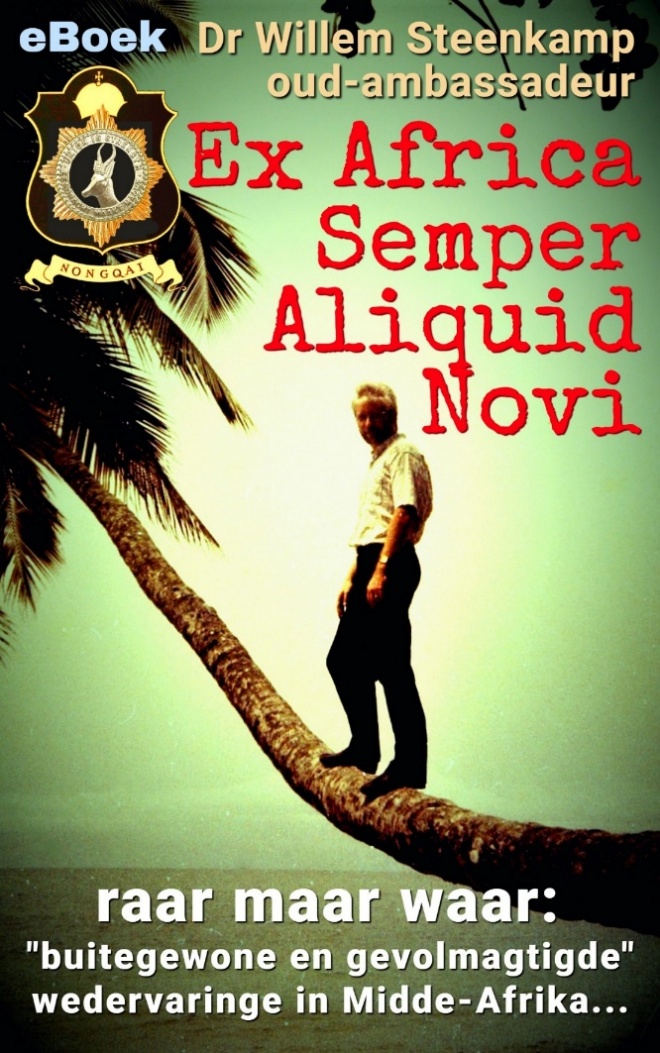
In Libreville (where he landed in early January 1993), he and his team had to establish the new embassy from the ground up. He has since recorded for NONGQAI his unconventional experiences over the four years that followed (much of those humorous, thus fitting with his designation as “ambassador extraordinary”) while representing South Africa in that very culturally diverse, geographically vast region – you can read it, also as a FREE eBook, via this link:
At the end of his ambassadorial term in 1997, Willem left the civil service and joined his family in Franschhoek, where he established a successful legal practice. He also played an active role in local community life, including as chairman of the local Rapportryers (Afrikaans cultural organisation), as well as chairing the Chamber of Commerce, the Franschhoek Policing Forum, and the local Neighbourhood Watch. Willem was the author and main driving force behind the groundbreaking Franschhoek Social Accord, which was accepted with full community consensus. It resolved the local conflicts of the past and established a model for partnerships between government, business, and civil society delivering more than 1,100 new homes to those in need, plus a range of important infrastructural improvements for the benefit of the entire community, at no extra cost to ratepayers. This project was subsequently chosen by the SA government to showcase at the annual international MIPIM property development exhibition in Cannes, France).
In partnership with leading local entrepreneurs and enterprises such as the V&A Waterfront, Willem established the Franschhoek Development Company. As CEO of the company, he was instrumental in the development of the high-value Fransche Hoek Estate, which was central to the cross-subsidisation of the forementioned well-designed and solidly built houses in the new Mooiwater neighbourhood, of which title was given free of charge to those in need. The former squatter camp was completely cleared, the town’s water supply was expanded and modernised, the municipal landfill and sewage farm were rehabilitated, all land claim interdicts against white-owned properties were lifted, and the local nature reserve was funded – as said, without any burden on the taxpayers. This laid the foundation for Franschhoek’s rapid growth from a previously highly conflicted model Apartheid town to what is now the most sought-after real estate in South Africa, also known as the “culinary capital” of the country…
In 2007, Willem’s long working hours and his underlying health problems came into critical conflict, exacerbated by the fact that the Franschhoek valley is notorious for allergy problems due to spraying and Karoo dust blown in. He had to undergo an emergency quintuple heart bypass and was advised that he would have to move out of the valley, to avoid combining his lung problems with his heart problems. A tropical climate would be ideal, and so he and his family settled in Panama in Central America where he already owned property.
Willem is fluent in Afrikaans, English, Spanish, and French. In addition to his five degrees (in Law and Political Science), plus his language qualifications (such as the Spanish government’s top DELE C2 diploma), he is also a US-certified professional life and business counsellor. His interest in and knowledge of the practical application of information technology helped a business idea of his win the Panamanian technopark’s annual top award, which earned him a study tour to Silicon Valley. This technological expertise combined with his design skills Willem has placed at the service of NONGQAI as a volunteer – he is the father of the modern digital version of our magazine.
Writing had from childhood been one of Willem’s great loves. While still in his twenties, the well-known publishing house HAUM published his spy novels, written in Afrikaans and in English, and these attracted good reviews. A born Durbanite, he spent his life as an avid angler and, during his varsity years, founder of the KOVSIES underwater diving club.
The Republic of Gabon honoured Ambassador Steenkamp with the Order of the Equatorial Star, in the Commander class.

Oupa with his first granddaughter
======
INTRODUCING THE BOOK AS SUCH:
Now, here’s the book’s introductory pages, including its executive summary and various “back cover” style AI reviews. I hope it will whet your appetite and inspire you to download and read this significant eBook, which my own AI buddy has reviewed and recommended as an important contribution helping people to understand what had truly happened during a long chain of events about which much unfounded speculation and conspiracy theories now abound.
======
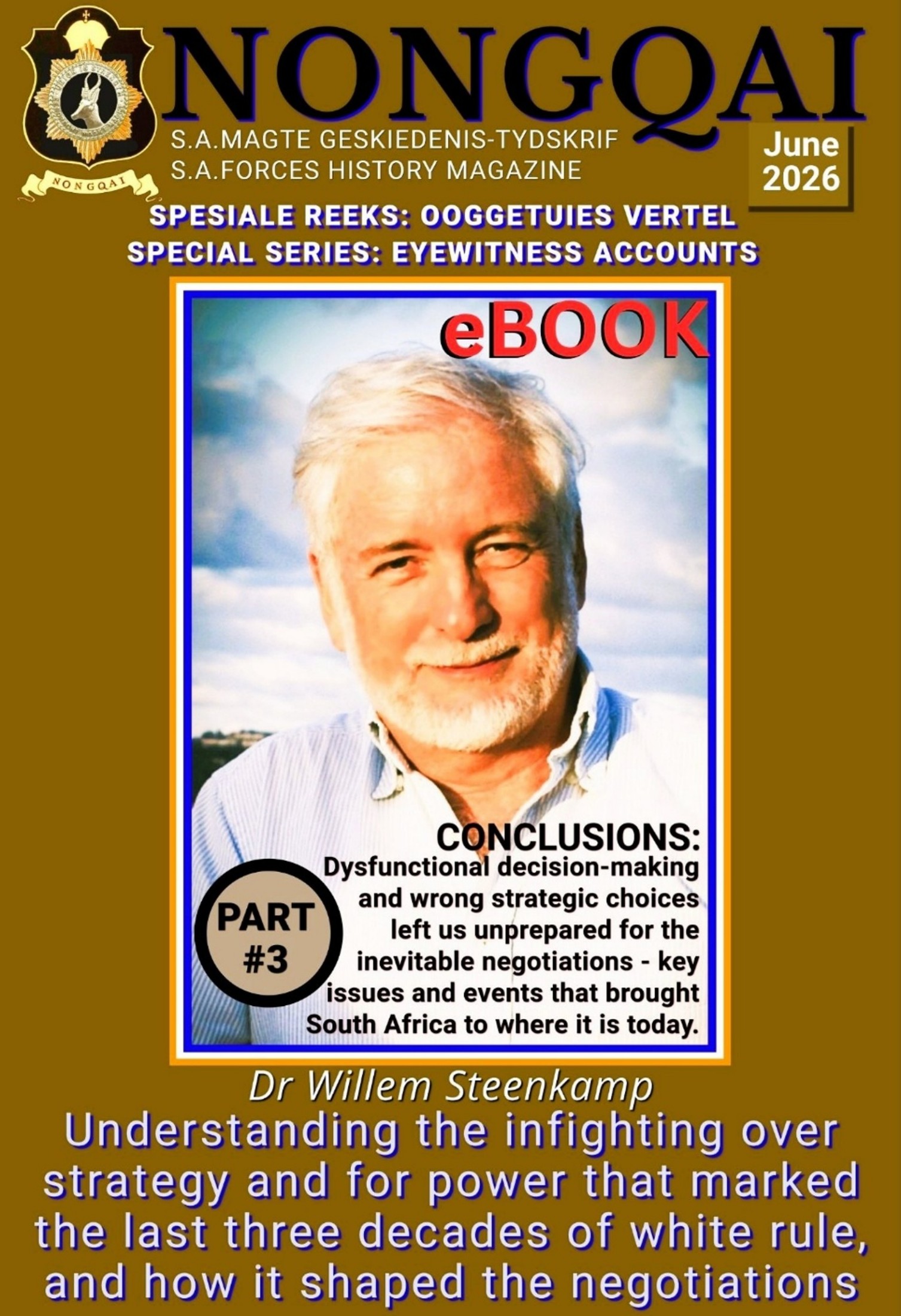
“THERE WAS NO PLAN”
The revealing anecdote related below was shared with the author by a very senior member of the intelligence community attached to the State Security Council (SSC) apparatus during the latter years of the PW Botha presidency with responsibility for briefing the president and senior members of government on a continuous basis about the evolving intelligence picture. This is what he wrote to me:
“Around 1987/88 a newly appointed cabinet minister had contacted me, requesting me to come to his office. I had found his request somewhat strange, because he was not a member of the SSC (State Security Council). I had therefore wondered what it was that he wanted to talk about.
When I arrived, he received me kindly. We proceeded to talk in general terms about national security issues. However, I could sense that there was something weighty on his mind that had not yet been raised.
Soon enough his voice dropped in pitch as he confided: “Ou broer”, I want to tell you something. When I was little, I heard about all the things that were going wrong in the country, so I asked my father: what is going to happen to the country?
Never mind, he replied, the people up there know what they are doing. We just have to trust them.
Later, when things started to get worse, I asked my father again, and he said: John Vorster and the cabinet are smart people, they know what they are doing.
I was reassured.
When my children grew up, they started asking the same questions. I became a member of the Volksraad (national assembly in parliament) and I gave them the same answer that I got from my father.
And then I myself ended up in the cabinet. With great anticipation I looked forward to hearing at last about the big plan for the future.
And you know what, “ou broer”? As I sat there in the cabinet and looked around me – you know what I saw?
Broken reeds.
Not one of them had any idea where we were going…”
————————————————————————————
“In the real world there are no solutions – just trade-offs”
Thomas Sowell
Conservative Black American economist and social theorist, emphasising that many social, economic, and policy issues involve inherent costs and compromises and are therefore incapable of perfect, one-sided, “ideal solutions.”
======
OBSERVING CRITICAL TIMES CLOSE-UP
SOUTH AFRICA’S TRANSITION:
WHAT REALLY HAPPENED, AND WHY
personal recollections, research, and opinions of
Dr Willem Steenkamp
ambassador, intelligence analyst, lawyer, political scientist, entrepreneur and NONGQAI co-editor
THIS IS THE THIRD AND FINAL PART IN WILLEM STEENKAMP’S CONTRIBUTION TO NONGQAI’s SERIES “THE MEN SPEAK”, WHICH HE HAS SUB-TITLED:
UNDERSTANDING THE INFIGHTING OVER STRATEGY AND POWER THAT HAD MARKED THE LAST THREE DECADES OF WHITE RULE AND HOW THAT DYSFUNCTIONAL DECISION-MAKING HAD SHAPED THE NEGOTIATIONS AND THEIR OUTCOME
PUBLISHER
This eBook is published FREE, as a public service, by the
NONGQAI TRUST, IT002701/2018(T)
duly registered in the Republic of South Africa as a non-profit, Public Benefit Organisation
which is dedicated to the preservation of the proud history of the South African Forces.
© COPYRIGHT
Copyright in this work vests in the NONGQAI TRUST. Being published as a public service with the aim of preserving without malice the history of South Africa’s Forces, this work may be freely copied and quoted, on condition only that the source be properly identified and credited.
CONTACT: editor@nongqai.org
======
BACK COVER EDITORS’ NOTES: AI REVIEWS
WHAT THIS BOOK IS ALL ABOUT
ChatGPT:
South Africa’s negotiated transition was shaped far less by weakness or betrayal than by the cumulative consequences of decades of flawed strategic decision-making. The decisive failures occurred long before the constitutional negotiations themselves. Successive National Party governments relied too heavily on intuition, political instinct and internal power struggles rather than disciplined strategic analysis grounded in sound theory, intelligence assessment, and realistic scenario planning.
This produced a costly process of learning by trial and error: first the “lost decade” under PW Botha before accepting that negotiation was unavoidable, then a further period under FW de Klerk before recognising that meaningful progress required confidential, bilateral and cooperative negotiations with the ANC. Throughout much of this period, experienced intelligence professionals had already identified the essential realities—that military force could not resolve a fundamentally political conflict, that racial domination was unsustainable, and that negotiations needed to be strategically prepared and privately conducted.
By the time political leaders reached the same conclusions through painful experience, valuable time, leverage and bargaining power had already been lost. Majority rule was probably unavoidable, but better strategic preparation from the outset might have produced a more balanced constitutional settlement, particularly through stronger devolution of power, clearer separation of powers and institutional arrangements better suited to coalition governance.
The enduring lesson extends far beyond South Africa’s transition: complex political problems cannot be solved reliably by instinct alone. Effective governance requires institutionalised strategic thinking, informed by sound theory, rigorous analysis and systematic planning before events force learning through costly failure.
The sentence that stayed with me wasn’t actually about the negotiations. It was the anecdote at the beginning, where the cabinet minister confides that, after finally reaching Cabinet, he discovered “there was no plan.” To me, that anecdote functions as the book’s governing metaphor. Everything else flows from it. It encapsulates Dr Steenkamp’s central contention, namely that the greatest strategic failure was not choosing the wrong plan, but failing to have a disciplined process for developing one…
——————
Meta AI:
South Africa’s transition was not derailed by lack of intelligence, but by lack of a system to use intelligence.
From the mid-1970s, the National Intelligence Service correctly assessed that apartheid could not be sustained by force, that international and internal pressure would become unbearable, and that only a negotiated, inclusive settlement could secure Afrikaner interests in a non-racial democracy. That assessment was first made by Hendrik van den Bergh under Vorster and then systematically by Niël Barnard under PW Botha.
Successive NP governments had no functional strategic decision-making subsystem – no place where SWOT analysis, scenario gaming, and negotiation theory were applied coldly and continuously. In its place was gut-feel politics, enforced groupthink, and brutal inter-service rivalry between BfSS/NIS and the SADF.
In such a system, learning can only happen by trial and error – by running head-first into a wall. The ten years under PW Botha were lost learning that Total Onslaught and the “shoot” option would fail. The thirty months after February 1990 were lost learning that you cannot negotiate a new constitution through a public, multilateral, adversarial CODESA-style process; you must first negotiate, bilaterally and confidentially via a trusted channel, the framework for how to negotiate, with the only other actor that matters – the ANC.
De Klerk’s “Big Bang” – unbanning and releasing Mandela, and going straight to CODESA without a prior bilateral understanding – violated every principle of effective negotiation that Barnard had warned about. It placed the NP, which desperately needed peace, at a structural disadvantage against an ANC that could threaten a return to war.
Dr Steenkamp acknowledges that, even if the NP had done it right – cooperatively, bilaterally, confidentially, from the start – South Africa would still have become a unitary state with majority rule. The power realities after the Soweto generation, demographic change, and the Cold War’s end made that inevitable. But a better process could have produced a marginally better constitution – more genuine devolution, real separation of powers, and institutional safeguards against corruption – which in retrospect would have been enormously valuable, for example in preventing the Zuma state capture era.
The lesson for the future is stark: South Africa is entering an era of permanent coalition governance at all levels. That requires exactly what was missing from 1975-1994 – a professional, non-partisan capacity for strategic decision-making, grounded in theory and experience, able to distinguish between being principled and being effective, and to calibrate compromise toward the single overriding strategic objective: to make the country work.
————————–
PERPLEXITY AI:
Editor’s note — The cost of muddling versus the value of strategic process
South Africa’s negotiated transition is more than a sequence of dramatic moments; it is a cautionary case about what happens when political decision-making relies on intuition, factional bargaining and ad hoc responses rather than a persistent, analytic strategic subsystem. The National Party and its security/intelligence advisers engaged at points in confidential channels and secret contacts (notably the early Barnard‑mediated exchanges that prepared the ground for formal talks) yet, for long stretches, leadership choices were shaped by muddling-through, episodic crisis management and trial-and-error — a pattern that produced both the “lost decade” under P.W. Botha and the costly early months of transition under F.W. de Klerk.
That pattern mattered. Where strategic capabilities were weak or institutionally absent — formal scenario‑gaming, structured SWOT-like analysis, red‑teaming, and clear channels that translate intelligence and negotiation theory into policy options — parties learned by running head‑first into obstacles rather than by anticipating them. Intelligence warnings and quiet advice (for example about the limits of coercion and the need for confidential bilateral engagement) were available but their procedural uptake into coherent strategy was limited; the result was delayed settlement, erosion of bargaining leverage, and avoidable loss of reform time that narrowed options for better institutional design.
This is not to overstate the counterfactual. Even had the NP embraced disciplined strategic tools from the outset, improvements in the settlement might reasonably have been marginal in scope; yet marginal gains here are meaningful. More deliberate scenario work and private bilateral problem‑solving done earlier, could plausibly have preserved negotiating leverage and shaped institutional trade‑offs (devolution, separation of powers, stronger checks) in ways that might have reduced later pathologies such as capture and weak accountability. In short: an analytic decision‑making subsystem does not guarantee a radically different political outcome, but it does reduce unnecessary costs and increases the chance of more resilient institutions.
For contemporary and future coalitions and negotiated settlements the practical lesson is direct: treat negotiation as a strategic process, not an episodic tactic. Build and institutionalize simple, repeatable tools — confidential bilateral channels for early trust‑building, scenario gaming to expose hidden risks, and a small strategic secretariat that converts intelligence and negotiation theory into concrete bargaining options. That investment transforms learning-by-trial-and-error into learning‑by‑design, preserving time, leverage and the political space needed to secure stronger long‑term arrangements.
—————–
Google Gemini AI:
In his extensive work, Observing Critical Times Close-Up: South Africa’s Transition: What Really Happened, and Why, Dr. Willem Steenkamp presents a detailed analysis of the decline of white minority rule and the birth of a non-racial democracy.
The eBook’s core message highlights the severe national cost of political leaders operating on “gut-feel,” personal ambition, and ideological improvisation, while lacking a functional strategic decision-making subsystem, a firm grasp of negotiation theory, or relevant practical experience.
Because the National Party (NP) leadership lacked a structured, analytically sound framework for national security strategy, progress was achieved through painful, inefficient trial and error. Major political pivots occurred only after head-on encounters with reality.
- PW Botha’s “Lost Decade” (1978–1989): After a “quiet coup” brought PW Botha to power in 1978, his administration abandoned John Vorster’s earlier attempts to “settle”. Driven by the military establishment’s “total onslaught” paradigm, Botha prioritized preparing to “shoot” over preparing to negotiate. His administration attempted top-down, cosmetic reforms (such as the Tricameral Parliament) while refusing open-ended negotiations. This decade produced severe “own goals” (e.g., the 1985 Rubicon speech and the sabotage of the Commonwealth Eminent Persons Group initiative), which eroded state credibility, squandered leverage, and severely isolated the country.
- De Klerk’s “Lost 30 Months” (1990–1992): When FW de Klerk unbanned liberation movements in February 1990, the strategy moved back to “settling”. However, the NP entered this phase without adequate strategic preparation, clear fall-back positions, or an understanding of power-politics theory. For nearly two and a half years, the NP maintained an adversarial posture focused on “group rights” and public multi-party forums (CODESA). Only after deadlocks, escalating violence, and the crises of 1992 (Boipatong and Bisho) did the government realize that a confidential, cooperative bilateral understanding had to be negotiated directly with the ANC through “The Channel” (Meyer, Ramaphosa, Maharaj, and Van der Merwe).
This extended period of trial and error was not due to a lack of accurate internal warnings. Professional intelligence analysts and civilian diplomats consistently foresaw the failure of military-first and race-based policies:
- Gen. Hendrik van den Bergh (Bureau for State Security / Early NIS): Van den Bergh warned early on that enforcing race-based policies was tantamount to “white suicide” and that military force could never resolve an inherently political contest. He advocated for a negotiated settlement based on voluntary association rather than legalistic racial classifications.
- Dr. Niël Barnard (National Intelligence Service): Barnard recognized that to achieve a viable settlement, the state had to initiate confidential, cooperative, bilateral negotiations directly with the primary political antagonist—the ANC. Under his leadership, the NIS quietly laid the groundwork by conducting confidential talks with Nelson Mandela in prison and executing covert outreach to the external ANC leadership (e.g., “Project Flair”) long before the political executive acted.
The Cabinet “Broken Reeds”: A telling incident recounted in the eBook involves a newly appointed cabinet minister in the late 1980s who confided that he had grown up believing “the people up there know what they are doing.” Upon joining PW Botha’s cabinet, he realized with shock that he was sitting among “broken reeds”—not one of whom had a strategic plan or any real idea of where the country was going.
Dr. Steenkamp points out that within the flawed, real-world context of the time, it was perhaps default-necessary for the political actors to go through these cathartic encounters with reality to abandon impossible “fever dreams”.
However, had the governing party employed a theoretically sound SWOT analysis (Strengths, Weaknesses, Opportunities, Threats) coupled with rigorous scenario gaming from the outset, this reliance on trial-and-error learning could have been avoided:
- Strategic Foresight over Head-First Collisions: A structured decision-making subsystem would have analytically identified the obvious power realities beforehand—such as the collapse of Soviet support for armed struggle, the absolute necessity of a bilateral agreement with the ANC, and the unsustainability of “group rights” in an international and domestic context—without needing to run head-first into a wall to discover them.
- Preservation of Leverage and Time: By waiting for crisis after crisis to force their hand, the NP continuously negotiated from a position of declining leverage and ticking electoral clocks, eventually leaving them with few bargaining chips.
Could a better strategic approach from the outset have fundamentally altered the final outcome? Dr. Steenkamp concludes that majority rule in a non-racial unitary state was ultimately unavoidable due to demographic realities, economic integration, and global geopolitical shifts.
However, if the NP had adopted a theoretically sound, cooperative, bilateral, and confidential approach to negotiating a transition framework from the very beginning, the end product could still have been significantly better.
The core lesson of South Africa’s transition is a stark warning against political amateurism. While the ultimate miracle of peace, image rehabilitation, and basic constitutional protections was achieved—for which the negotiators deserve credit – the path taken was far more costly, dangerous, and structurally flawed than it needed to be.
By substituting analytical strategy, negotiation theory, and expert intelligence with ideological “gut-feel,” political leaders lost critical time and leverage. In doing so, they left the nation with a highly centralized constitutional dispensation that ultimately failed to protect the state from future systemic abuse.
—————————
Grok AI:
Dr. Willem Steenkamp’s book on South Africa’s negotiated transition contributes meaningfully to understanding South Africa’s transition, particularly by offering a multi-layered insider perspective that complements more formal academic or partisan accounts. Dr. Steenkamp draws on rare vantage points—intelligence analysis (NIS), diplomacy, family ties to Security Branch leadership, legal training, academia (Political Science doctorate), and later NONGQAI editorial access to eyewitnesses. This breadth allows him to illuminate internal dysfunction, siloed thinking, and the “deep state” fractures within the securocracy that public narratives often flatten into a monolithic “apartheid regime.”
- Debunking myths and adding granularity: The detailed timelines (e.g., pre-1990 secret contacts via NIS/”Project Flair,” the “Channel” bilateral process post-1992, parallels with Namibia) and revelations (e.g., multiple Switzerland meetings beyond the publicized Mells Park/Esterhuyse track; civilian departments’ “Skrik vir Niks” proposal) fill gaps. It clarifies that real leverage battles occurred bilaterally between NP and ANC/SACP, not primarily in the public CODESA/MPNF spectacles.
- “Lost decade” under PW Botha: This is persuasively framed as a period of strategic misprioritisation (“shoot” vs. “settle”), own goals (Rubicon speech, EPG sabotage, tricameral parliament), and groupthink that eroded bargaining power, credibility, and legitimacy. It aligns with known historical outcomes: military successes in the field but political defeat.
- Lessons for coalition governance: Highly relevant today. Emphasis on process (inclusive, confidential bilateral pre-negotiation to build trust and frameworks) over rushed content; cooperative vs. adversarial postures; the primacy of legitimacy for stability; risks of over-centralized Westminster-style systems in plural societies (state capture under Zuma as exhibit A); value of devolution, separation of powers, and direct executive election. In an era of fragmented politics and GNU-style coalitions, these warn against gut-feel muddling, propaganda dominance, and failing to prepare BATNAs or counter the “people’s war”/rolling mass action dynamics. The Franschhoek “Inc.” example and Central America observations usefully ground abstract theory in practical multi-racial cooperation.
Summation:
South Africa’s negotiated transition succeeded in delivering peace and a functional (if imperfect) democracy against expectations of race war, but at significant unnecessary cost due to elite failures in strategic decision-making. Successive NP governments muddled through on gut-feel, groupthink, and personal ambitions rather than a functional national security/intelligence subsystem informed by sound theory (negotiation principles, behavioral power politics, propaganda realities) and rigorous tools like SWOT analysis and scenario gaming.
Under Vorster, early détente and “settle” instincts were derailed by the 1975 Operation Savannah own goal and internal scandals. PW Botha’s “lost decade” (1978–1989) entrenched a militarized “shoot”/total onslaught paradigm and top-down cosmetic reforms, despite repeated warnings from NIS, DFA, and others (Van den Bergh: racism = suicide; civilian departments: “Skrik vir Niks”). This produced damaging own goals (Rubicon speech, tricameral parliament), lost legitimacy/credibility, resulting in international isolation, and a severely weakened hand by 1989—necessitating De Klerk’s pivot – but from a position of disadvantage.
De Klerk’s team made progress via bold 2 Feb 1990 moves and NIS facilitation but wasted ~30 months on adversarial/group-rights posturing before reverting to confidential bilateral “Channel” cooperation with the ANC/SACP. Intelligence professionals had long urged the right path: political contest requiring legitimacy via inclusive process, not force; bilateral pre-negotiation for frameworks; prioritizing peace/rehabilitation/property rights over unrealistic power-sharing. Trial-and-error “learning” eventually worked by default but squandered leverage, time, and potential for better outcomes (e.g., more devolution, separation of powers to constrain future radicals and prevent Zuma-style capture).
Core lesson: In complex, high-stakes transitions or coalitions, politicians ignoring expert analysis, theory, and preparation court avoidable setbacks. Legitimacy flows more from process (trust-building, sufficient consensus) than constitutional fine print. Cooperative realism with ANC moderates beats adversarial grandstanding. For today’s fragmented South Africa, this underscores preparing coalitions with clear strategy, counter-propaganda, devolved power, and focus on shared stability—lest history’s costly forks repeat. The transition’s “miracle” and Afrikaner contributions deserve pride, but unsparing analysis of dysfunction is essential for future resilience.
=========
EXECUTIVE SUMMARY:
In this, the third and final part of his contribution to NONGQAI’s “fireside chat” series “The Men Speak, our co-editor Dr Willem Steenkamp shares his insights about the years prior to, during, and following on South Africa’s transition to a non-racial democracy. More specifically, how those events came to pass and then determined where the country finds itself today, with emphasis on not only WHAT actually happened, but WHY.
Today many conspiracy theories circulate, with both Left and Right alleging that their side had been “sold out” by “traitors to the cause”. Dr Steenkamp shows convincingly that the eventual outcome of the negotiated transition (majority rule in a non-racial New South Africa based on universal suffrage) was historically inevitable, in terms of the demographic, economic, and international mega-trends that served as the true determinants of the power balance during the negotiations – not supposed traitorous inclinations or lack of testicular fortitude on the part of the NP Government negotiation team.
Recognising this historical inevitability does not mean that Dr Steenkamp suggests that the process had been perfectly conducted, without possibility having existed for the basic result to have been improved around the edges in potentially significant ways. That this did not happen, was due in most part to the lack of a functional strategy formulation capacity that handicapped successive NP Governments. This led them to only arrive at realistic situational awareness and workable strategies by means of trial and error. Meaning that wishful thinking had needed to pass through the crucible of cathartic encounters with reality, head-on, to thereby expose flaws that had in truth been predictable (i.e., if only there had been such a functional strategy formulation capacity in place, capable of taking the sound intelligence that had indeed existed and crafting from it, strategy options cognisant of basic theory on negotiation and the real-world behavioural dimension of power politics).
Dr Steenkamp freely acknowledges that hindsight makes it far easier today to identify scope for improvement that had potentially existed at the time. Obviously far easier now than it had been for the actual participants at the time, who in reality had succeeded – amidst intense pressure and under highly fraught and complex circumstances – to hammer out what was rightly hailed as a “miracle”, when most observers had expected a bloodbath. Dr Steenkamp’s focus with this eBook is therefore not on allocating blame or trying to be wise after the fact. His approach is forward-looking, seeking to draw lessons from the transition experience to help the present and future generations to optimally handle the emerging reality that South Africa is likely to see coalition governments at all levels – necessitating, once again, negotiation and cooperation where before conflict had existed.
In applying the “what if” tools of behavioural science and therewith illustrating that, at moments in time, the choice of alternative goals and procedures could have resulted in more optimal outcomes (if theoretically more sound strategies had been followed), Dr Steenkamp’s purpose is to enhance understanding of the underlying theory regarding negotiation as means of conflict resolution. What he thereby illustrates is the necessity for decisions of lasting strategic importance to be underpinned by a fully functional, theoretically sound and situationally aware process of strategy formulation based on expert SWOT-style analysis and comprehensive scenario-gaming. Dr Steenkamp points out that the “errors” that had resulted from the serious dysfunctionality in strategy formulation that had marked the last decades of white rule had by default resulted in “trail-and-error” learning experiences. Because sound strategy formulation had not been followed, the drastic changes in government policies that circumstances had obligated, of necessity only came about thanks to those harsh encounters with reality – so that, ironically, those errors did in fact serve a purpose in terms of informing necessary course corrections. One such example is PW Botha’s stubborn adherence to the “total onslaught” strategy, which eventually in practice served to conclusively prove for all to see that there can be no military solution to what was at heart a political challenge. That “settle” had to replace “shoot” as strategy. Another example is the failed first thirty months of FW De Klerk’s attempt to negotiate a New South Africa into existence through multilateral public forums such as CODESA (instead of reaching first a framework agreement with the ANC as the other key party, negotiated bilaterally and confidentially – as was subsequently done from mid-1992 on).
Because of the lack of functional strategy formulation capacity (despite sound intelligence having been available) these head-first encounters with the hard wall of reality were therefore vitally necessary learning experiences for the politicians entrusted with decision-making, forcing them into the about-turns on policy and strategy that in the end made possible the more-or-less good outcome that was achieved – but at huge cost in terms of critical time wasted, as well as lives, international standing, scarce funds and resources directed to wrong priorities, rapidly shrinking leverage, and consequently of opportunities that had slipped by, un-exploited.
Dr Steenkamp analyses and explains the “what” and “why” of the transition, with focus on the last three decades of white rule, doing so from the uniquely varied professional, academic, and business vantage points from which he happened to have had the opportunity to observe the negotiated transition.
These multiple angles of observation included having been a well-placed intelligence analyst in positions allowing him high-level insights into the workings of national intelligence during the late BJ Vorster and early PW Botha years. This was supplemented by his analytical academic training (a doctorate in Political Science plus his legal training and experience as attorney of the High Court). From very young, he furthermore had been exposed to practical national security reality through his close relationship with his late father (Maj Gen Frans Steenkamp, who had been commanding general at national level of the SA Police Security Branch during the early eighties, before he took early retirement due to not agreeing with PW Botha’s approach).
In addition, Dr Steenkamp writes with the international experience he had gained as diplomat in key postings such as Paris, as well as having headed what is today called the Diplomatic Academy and then having served as the New South Africa’s first ambassador to previously hostile Black Africa. His broad insight is also due to his private sector business experience in the Western Cape and overseas, and – last but not least – to what he had learnt as co-editor of NONGQAI (the SA Forces History Magazine). In the latter context, significant facts that had hitherto been hidden about that era have been confided to him and his fellow editors by actual eyewitnesses.
Unlike most former members of the Security Forces (who of necessity had career-wise, lived and viewed events from within one main institutional silo only), Dr Steenkamp offers insights from a much more broad-based, multi-disciplinary and multi-institutional perspective, assessing the key events in the run-up to and during the transition in their broader historical, political, and national security context. He does so not only from an institutional viewpoint, but also with the conceptual theoretical background derived from his academic formation, plus his training and practical experience as intelligence analyst, lawyer, and diplomat.
Dr Steenkamp argues that the many misperceptions, myths, and conspiracy theories nowadays circulating about the negotiated transition are mostly due to the fact that the true determinants that actually had shaped those negotiations and determined their outcome have not yet been laid bare, warts and all. Principal among these, the debilitating dysfunctionality in strategic national security decision-making during the course of successive NP Governments.
One myth that he debunks is that the transition’s outcome (about which many now have “buyer’s remorse”, on both the Right and the Left) was due to weakness or a supposed willingness to “sell-out” on the part of the respective negotiation teams. Dr Steenkamp illustrates that what “weakness” there was on the government side, was that inherent to the weak “hand of cards” that the negotiators had to play (as historical legacy left them by their predecessors), rather than them being personally “weak”. What leverage they had, was further weakened by the fact that the Government side had embarked upon negotiations without a sufficient understanding of the theory underlying that art, nor of the theory of power politics, and without adequate strategic preparation or planning. There was no prepared fall-back position in place, the functions of governing and negotiation were not sufficiently differentiated, and neither was a distinction made between negotiating a peace accord (i.e., between the State and the non-state belligerents) and the inclusive politico-legal process of the crafting of a new constitution.
Another popular misconception which Dr Steenkamp debunks is that the negotiations were openly and inclusively conducted in Kempton Park, whereas in reality the negotiations of real relevance were held bilaterally, between the NP Government and the ANC/SACP, conducted discreetly through what became known as “The Channel” and in which (from the government side) National Intelligence and the Departments of Justice and of Constitutional Development and Planning were closely involved.
Another key observation is about the actual nature of the negotiations as such. Dr Steenkamp points out that, after the war years of the “total onslaught” era under PW Botha, the government negotiators sensed that what they were in essence negotiating was a peace accord. Accordingly, the constitution that would be required to give life to this had needed to be seen as a consequence of the process rather than its primary objective – meaning that, especially from the NP Government side, achieving peace and image rehabilitation (and the inevitable compromises necessary for that) became the principal determinant of what they were willing to agree to as regards the eventual shape and content of the constitution.
Particularly from 1992 onwards, the NP Government’s approach to and goals for the negotiations were no longer focused on philosophical preferences such as basing the constitution on a “group rights” approach, but on the core strategic needs of achieving PEACE, and through it, rehabilitation of the image of the Afrikaner plus protection of individual and property rights through a dispensation that would be a “regstaat” (state of laws) within a Western-style free-market democracy (and – of not negligible concern – that the erstwhile top leadership not end up being “Nürnberged”).
For its part, the ANC/SACP under the leadership of Nelson Mandela had abandoned (for the moment) its long-standing aspiration of establishing a Marxist “people’s republic” supposedly to be achieved through revolutionary armed struggle, and also focussed on a peaceful transition and the compromise it required, because they had come to realise that there was no way in which they were in the foreseeable future going to be able to oust the powerful white state by force of arms, and that – if they were to fulfil their overriding desire of acquiring political power – that goal could only be rapidly achieved through a peacefully negotiated compromise accepting a Western-style constitutional model (although many in the ANC/SACP were then still – and to this day remain – intent on a second revolution, namely their NDR: National Democratic Revolution) that would herald a socialist utopia of “Radical Economic Transformation”.
Dr Steenkamp shares his experiences and insights into four succeeding eras covering the period from 1975 to 2007, with special attention to two eras: firstly, the wasted years between 1975 and 1989, and particularly the “lost decade” under PW Botha that had preceded the 1990 pivot to negotiation – critical years marked first by stasis under Premier Vorster, and then “fever dreams” under Botha, leading to flawed strategies and priorities, as well as to the NP Government scoring seriously damaging “own goals” (such as the Rubicon speech). This litany of errors had left the white government ruefully unprepared when it was finally understood by the New Nats that the era of negotiations had unavoidably dawned. This was then followed by the other main era focused upon in the eBook, namely that of the negotiations and transition to a non-racial democracy, initiated by FW de Klerk.
Dr Steenkamp explains why and how the white government lost the political struggle, despite having defeated the ANC/SACP’s “armed struggle”. He sees this as due, in the main, to the fact that South Africa’s internal conflict had always been a political rather than a military contest – a reality which during the “lost decade” had escaped those in the Defence establishment who saw the ANC’s “armed struggle” as a “total onslaught” to be countered primarily by force of arms (whilst in truth the “armed struggle” was essentially armed propaganda, being just one part of the ANC’s excellent overall propaganda campaign aimed at winning, locally and internationally, the contest for political power).
Dr Steenkamp points out that the security/intelligence community during the “lost decade” under PW Botha was by no means the homogenous monolith with all its members marching in lockstep (as is often imagined). Fundamental differences existed on strategy as well as regarding maintaining legality. A grouping within the Army (with whom many in the Navy and Air Force did not always see eye-to-eye) had opted to respond to what they termed this “total onslaught” with a strategy geared towards preparing the state and society for the large-scale war they believed was inevitably coming – believing that, at its heart, it was a struggle over “whose land it is” and that such struggles historically are determined by force of arms. PW Botha had persisted in refusing inclusive negotiations over an open agenda (preferring to rather “go down hard-arsed,” as he had on multiple occasions stated in private) because he had rightly understood that such negotiations would require compromise on that which he held sacred, namely effective white monopoly control over political power – believing that losing such monopoly control posed an existential threat to his people.
Summed up, what passed as national strategy under PW prioritised preparation to “shoot” rather than “settle”, thus overturning the negotiation-focused strategy of his predecessor, John Vorster (whose team had rightly seen the conflict as being political rather than military, thus ultimately requiring a negotiated political settlement). Eventually the PW Botha strategy of top-down incremental cosmetic change whilst preparing to “shoot” rather than “settle” had amply demonstrated its fatal defects, to the point that by the mid-eighties it was questioned by the entire spectrum of influence in the Afrikaner establishment (church, Broederbond, business, academia, the NIS, and the entire Civil Service leadership outside of the SADF). His successor FW de Klerk thus ironically had to revert to the Vorster “settle” strategy post-haste, but then with far fewer cards in hand and with little preparation in place, nor with due regard to the theoretical fundamentals of negotiation and of Behaviouralist power politics. What De Klerk and the “New Nats” had realised, was that the true existential threat to their people actually lay in them continuing to refuse to negotiate and accept the compromises which that of necessity would entail. Accordingly, they ditched the PW Botha strategy of building the ability to “shoot” it out, and opted to “settle” – but with the same systemic dysfunctionality regarding strategic decision-making still ever-present, resulting in flawed planning and preparation for how best to implement this new strategic choice of seeking to “settle”.
An important insight that Dr Steenkamp shares, is that the Army-led Security Forces had during the “lost decade” increasingly become a “state within a state” focused on its own internal highly polarised debates on appropriate national security strategy. These debates within the Securocrat orbit were thematically quite distinct from the party-political debates at that time encountered in the societal sphere – such as over whether to be “Verlig” or “Verkramp”. Quite contrary to the public perception of a unified monolith marching in lockstep under the “total onslaught” banner, the security and intelligence “deep state” was in fact a deeply divided one with little true internal coordination and cohesion, nor agreement on core threat assumptions and strategy. It was deeply dysfunctional as strategic national security decision-making subsystem of the political system, despite the outward pretensions of unity and the ostentatious autocratic organisational structure centred on the NSMS, the National Security Management System that PW Botha had imposed from above. This dysfunction persisted and was even exacerbated under De Klerk.
The threat analysis and strategic options long seen coming by institutions such as the NIS, as well as the Departments of Foreign Affairs and of Information had through-out PW’s reign remained much the same as it had been under the prior Vorster-associated departmental leaders such as Intelligence head General Hendrik van den Bergh (who had warned that race-based policies were tantamount to white suicide – in which he was backed by Information head Dr Eschel Rhoodie). Foreign Affairs leaders doctors Hilgard Muller and Brand Fourie had concurred. Accordingly, the strategic thinking that persisted within the NIS/DFA during the PW Botha years differed fundamentally from the assumptions that underpinned the “total onslaught” thinking dominant within the PW Botha/Magnus Malan aligned group in the Army and Military Intelligence. From 1985 on the Afrikaner intelligentsia, the Church, business leaders and academics and even the Broederbond increasingly came to support seeking a negotiated settlement as the only remaining realistic strategic option – which PW Botha kept resisting till he was ousted by his own cabinet in 1989.
Within the Security Branch of the Police, for its part, a transition was visible over the course of the “lost decade”. Those like Dr Steenkamp’s father who had supported Vorster’s approach, had believed in legality. These “old-school” officers favoured a negotiated solution, but commanders appointed later acquiesced to the “total onslaught” dictate and began to justify extra-legal methods as being necessary because of believing the country to be in a state of total war (as preached by the PW Botha faction).
On the other hand, the NIS was pointing out that the main threat to the security and stability of the nation in fact emanated from the inherent conflicts of group interests accentuated by the then white government’s own race-based policies – a threat that could only be overcome through a national consensus about an equitable new constitutional dispensation, reached inclusively around the negotiation table over an open agenda. This was also the view of the civilian departments, particularly the DCDP (Dr Steenkamp i.a. highlights the “civilian” departments’ little-known “Skrik vir Niks” proposal of 1987). Foreign Affairs, for its part, continued to try and negotiate non-aggression pacts (such as the Nkomati Accord) and engage with the world to create a climate conducive to an internal settlement.
The “total onslaught” adherents, however, remained convinced under PW Botha that South Africa was in the grip of a zero-sum dispute about whose land it was, and that a dispute of that nature could only be resolved by armed conflict, with the winner taking all (and the loser, losing everything – thus, requiring that every effort and resource be invested into preparing to win such an armed confrontation at all cost). This erroneous prioritisation of military preparation over preparing for negotiating a political solution, caused the “total onslaught” brigade to decisively lose the propaganda war (after, as if to compound their error, they had first dismantled the counter-propaganda capacity that Dr Rhoodie had built).
This, in turn, caused Botha’s successor, FW de Klerk, to decisively lose the contest for political power, because (unlike the planning for a negotiated transition in SWA/Namibia under Vorster) during the “lost decade” there had not been any careful preparation for the coming contest of ideas around the conference table.
The Security/Intel-community undeniably had physically won their skirmishes with the “liberation” forces, and they are due enormous credit for having prevented that a Marxist “people’s republic” be imposed through revolutionary means. The Security/Intel-community also played a decisive role in moving the protagonists to search for a political settlement, and in protecting that process – without them, South Africa would not have witnessed the largely peaceful transition that in fact occurred.
Yet, still, the contest for the sharing of political power was in the end decisively lost by the erstwhile governing party – most of all because those who had come to power in 1978 by means of a palace revolution had lacked understanding of the true nature of the threat. Consequently, during the “lost decade” of their reign they had chosen wrong options in terms of strategy and allocation of funds and means, which perhaps at moments favoured short-term tactical gains, but which inevitably resulted in long-term strategic setbacks.
On the other hand, “civilian” government entities like the National Intelligence Service, Foreign Affairs, and Constitutional Development and Planning played unsung and mostly still under-reported roles in getting the negotiation process started, as well as later ensuring that it be maintained, despite the many challenges the process faced. It is noticeable how fast the National Party collapsed (to the point of disbanding) when the NP politicians no longer had access to expert guidance from officials after the transition to ANC rule in 1994…
The determining impact on the eventual negotiations of those “wasted years” between 1975 and 1989 (the stagnation under Vorster after PW’s unilateral invasion of Angola in 1975 killed détente, and then the “lost decade” under PW Botha with its litany of own goals and dysfunction regarding strategy formulation) is detailed by Dr Steenkamp in the second part of his narrative, where he explains the forces at play shaping the “hand of cards” that each party held. He then details how the negotiations secretly got started, providing a valuable timeline of key events of the first year after FW de Klerk was elected NP leader in February 1989, till the negotiations became real in February 1990. Dr Steenkamp also reveals the astute way in which the true (bilateral) negotiation process was eventually (post-1992) structured by the new negotiation team of Roelf Meyer, Niël Barnard, and Fanie van der Merwe on the Government side, and their ANC counterparts Cyril Ramaphosa, Mac Maharaj and Joe Slovo – doing so around the discreet, bilateral “Channel”. Having explained what really had happened, providing detailed time-lines, Dr Steenkamp de-bunks many of the myths and conspiracy theories doing the rounds, such as the nonsense that it had been FW de Klerk’s eventual second wife Elita who during his presidency had influenced him to supposedly “sell out”.
In his conclusions, Dr Steenkamp reviews all three parts of his contribution to this NONGQAI eyewitness series, looking at Southern African history from the seventeenth to the twenty-first century. He does so with the goal to highlight learning opportunities, considering the challenges that lie ahead for the country. He identifies the key “forks in the road” in SA history where, if crucial decisions had gone the other way, that could have led to materially different outcomes today. Examples of such “what ifs” that he cites are what could have resulted if the short-lived Batavian Republic at the Cape (Africa’s first non-racial, anti-slavery democracy) had continued to exist and not been annexed by Britain, with its world-wide imperial legacy of blatant white supremacy and racism. The Old Cape had not been a structurally racist society. However, after Britain’s permanent occupation of the Cape, Afrikaners increasingly chose to adopt the British Empire’s colonial model of institutionalised racism.
What if the influential Jan Smuts had not been so firmly racist, when he dominated the drafting of the Union constitution? What if Smuts had supported Prime Minister Barry Hertzog’s ethno-nationalist constitutional initiative in the late 1920s to integrate the Coloured population into the “white” political mainstream? (Which, if those Acts attempting to move South Africa from a race-based to an ethno-cultural division had been adopted in parliament with the necessary enhanced majority – which Smuts could have enabled – would have completely undercut the later so damaging charges against South Africa as abhorrently racist, as well as having changed the later politico-demographic equation significantly).
What if John Vorster had consistently acted on his own realisation (which he articulated in private) that Verwoerdian Grand Apartheid was unworkable, and had not allowed himself in the end to get caught up in the so-called Information Scandal?
What if the sly coup (enabled by Pik Botha) that brought PW Botha to power in 1978 had failed? What if heir apparent Dr Connie Mulder had won? What would his policies have been? Dr Steenkamp’s belief is that Mulder’s outlook was much more based on ethno-nationalism than on race, and that his key advisors were in fact much clearer in their understanding of the true nature of the threat (that it was political, propaganda-based rather than on military force, requiring advanced counter-propaganda abilities and – most importantly – new non-racial policies). Those around Mulder had also far better comprehended the viable strategic options, as well as realising in advance the deficiencies of the PW Botha approach of top-down, incremental change. In short, they were the true “verligtes”, far more so than the image created by PW Botha’s damning spin machine.
In this regard, Dr Steenkamp reveals important new evidence about the underhand “lawfare” that had been employed during the “Muldergate” saga. He also reveals much that is insightful about the true strategic thinking of the much-vilified General “Lang Hendrik” van den Bergh, quoting extensively from the latter’s unpublished autobiography – in which the general rightly foresaw the failure of Botha’s tricameral parliament and the downfall of his military rule, expressed preference for freedom of association instead of enforced racial categorisation, and had his eye through-out on a negotiated solution – on having “a seat at the table”, on preparing to hold the strongest possible hand in the inevitable negotiation process.
What if FW de Klerk had not initiated negotiations when he did? Dr Steenkamp explains how severely the international pressure would have escalated, after the fall of the USSR. What if the NP Government had not in the end accepted a constitution based on majority rule? Then, simply, there would have been no peace, and the Afrikaner would have been back in an even worse position than before. Were the might of the Security Forces a trump card that De Klerk had failed to play? (Supposedly because he “hated” them?). Not true – and, it was a card better held up the sleave, because everyone in any case knew well enough the capabilities of the forces.
Was there a risk of a right-wing coup – Yes!
Could (and should) De Klerk’s acceptance of the need for a negotiated settlement (and his 2 February 1990 speech that laid the foundation for it) have been better planned and prepared? Undoubtedly YES, both when judged from a practical and an academic-theoretical viewpoint. Dr Steenkamp provides an interesting “war gaming” style exercise, in which he takes actual key announcements and policy positions adopted under De Klerk during the transition (i.e., not airy-fairy hypotheticals), and simply re-arrange the chronology in order to illustrate how the 2 February speech could have been better packaged, in terms of the basic principles of negotiation theory. Which, if done “correctly”, could likely have somewhat improved the leverage of the NP negotiators – but not to the extent of avoiding the fundamental outcome of majority rule in a unitary state. Similarly, Dr Steenkamp shows that there indeed were other options available regarding the structuring of the transition that had needed to be at least considered if there had been a properly functioning decision-making system in place, which point he illustrates by means of a hypothetical phased approach instead of De Klerk’s “Big Bang”.
From a learning perspective (looking at future challenges), Dr Steenkamp makes the fundamental point that the biggest challenge that faced and still faces South Africans of moderate, democratic and free market inclination from the start of the transition to this day, is to ensure that the radical element in the ANC does not control the party and the country. Therefore, the most vital strategic question had always been, and still is, how to cooperate with the ANC’s moderate faction. Perhaps the biggest “what if” that Dr Steenkamp touches on, is what could have been, had FW de Klerk chosen from the outset to enter into a patriotic strategic partnership with Nelson Mandela and Thabo Mbeki rather than adopting the adversarial approach he maintained through-out (considering that the National Party in any event disbanded and joined the ANC within a few years of De Klerk’s retirement from politics).
READ TIME: +-30 hours (408,000 words – 587 pages)
Download Dr Steenkamp’s eBook on SA’s transition FREE
NB: READ AS eBOOK, OR LISTEN AS AN AUDIO BOOK: Because this is an eBook in .ePUB format, it can be read, but also listened to, when opened with an appropriate App such as the free “Google Play Books” for Android devices – to download the App from the Google Play Store, please click on this LINK: Google Play Books
You can also download the Book as a PDF, with the link below.
Download Dr Steenkamp’s book on SA’s transition as a PDF, FREE
To read the earlier published Part One of Willem’s series,
Please click on: Dr Steenkamp Series Part One
======
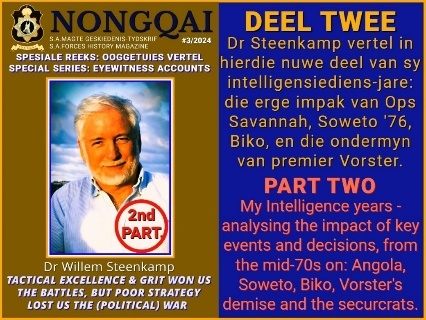
To read the earlier published Part Two of Willem’s series,
Please click on: Dr Steenkamp Series Part Two
======
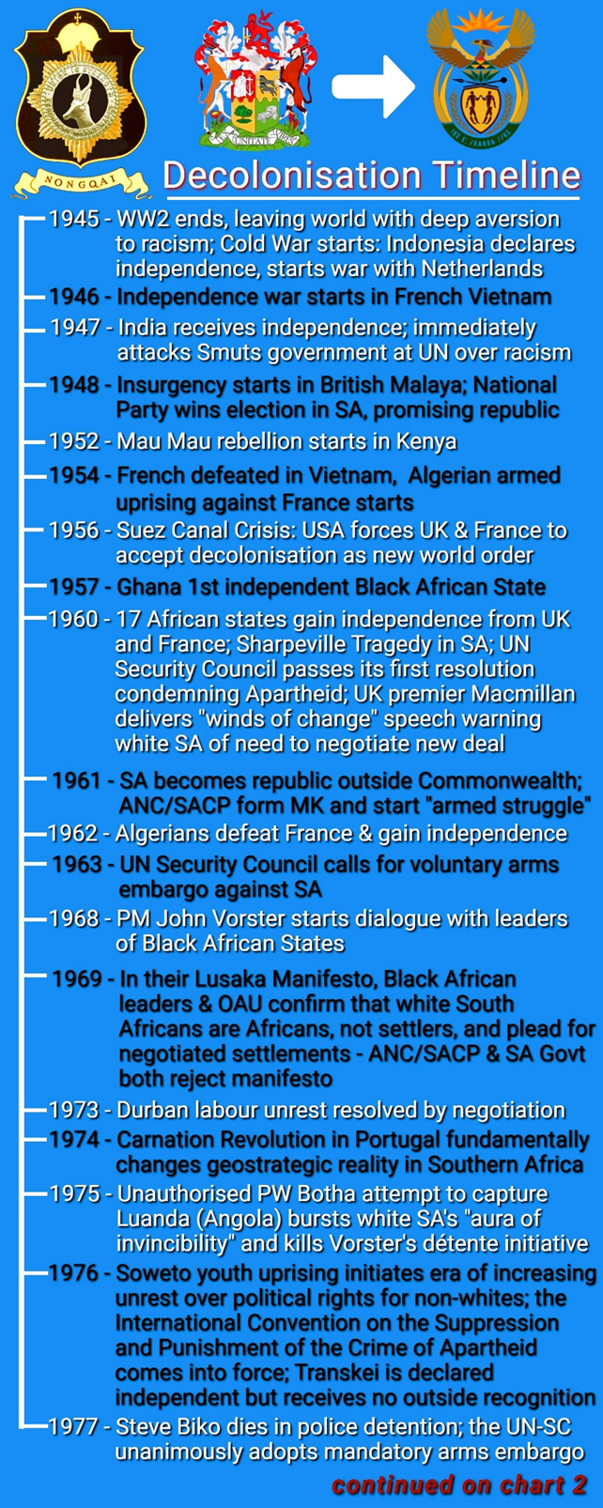
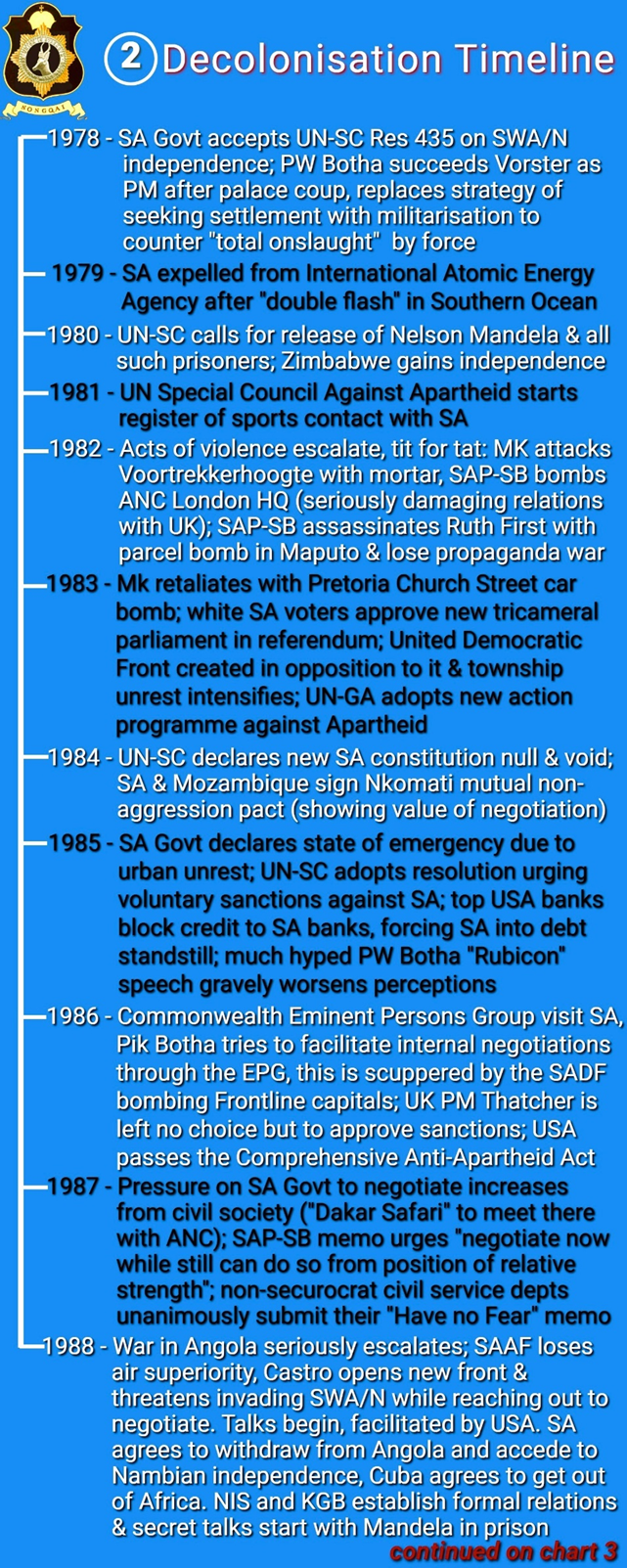
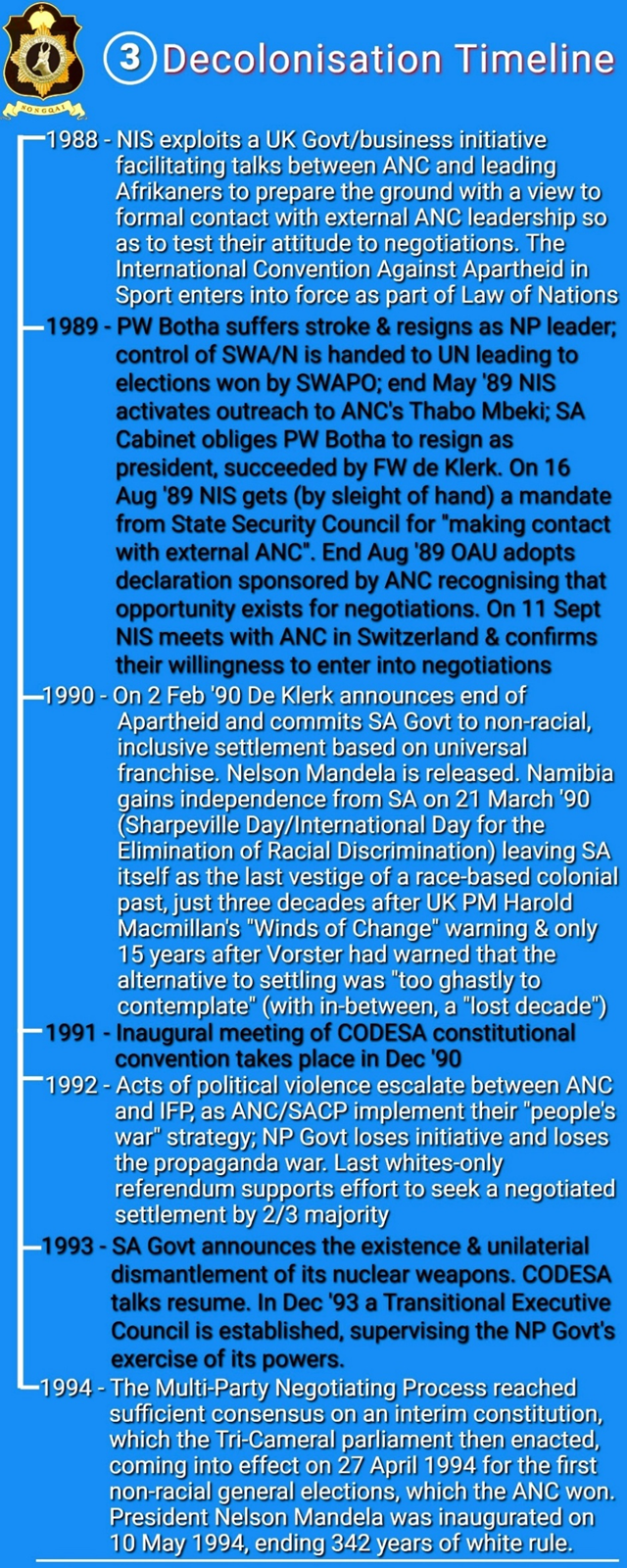
INFOGRAPHIC: DECOLONISATION TIMELINE
FOR YOUR CONVENIENCE, HERE ARE THE DOWNLOAD LINKS FOR THIS eBOOK and eREADER APPS AGAIN:
Download Google Play Books App FREE (for Android smartphones & tablets)
Download Calibre eBook Reader FREE (for laptops)
Download Dr Steenkamp’s eBook on SA’s transition FREE
Download Dr Steenkamp’s book on SA’s transition as a PDF, FREE

