
Nongqai Vol 17 no 6 – Camels in GSWA
Abstract
The one‑humped camel was introduced to German South West Africa from 1889 onward. Early shipments came from the East African coast, Port Said, British India, Somaliland and Arabia. Camels were difficult to obtain at the time due to global military and infrastructure demands. The first major shipment to DSWA included 76 camels from Port Said, followed by an additional 403 animals acquired through Hagenbach’s Somali and Arab trading contacts. Later, a large consignment of 2,000 Somali camels arrived after a sea voyage of 192 days. Initially, the camels were intended for railway construction between Lüderitzbucht and Keetmanshoop, but they soon became essential to military operations in the arid interior.
Keywords
Deutsch Südwestafrika, German South West Africa, DSWA, GSWA, camels, camel corps, Kamelreiter, Karib camel farm, Schutztruppe, Friedrich von Erckert, Simon Kooper, Nama War, Herero War, Kalahari Expedition 1908, Seatsub battle, camel patrols, desert warfare, railway construction, colonial logistics, Somali camels, Bactrian camels, dromedaries, German colonial military, Kalahari, Omaheke, Kaokoveld, Namibia history, camel transport, colonial policing
DEUTSCH SÜDWESTAFRIKA (DSWA) / GERMAN SOUTH WEST AFRICA (GSWA): THE USE OF CAMELS, 1889–1915

Compiled by Wolfgang Witschas
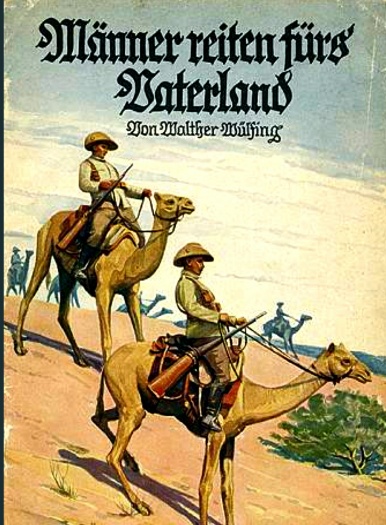
Early Introduction and Logistics
First Arrival (1889)
- The first 200 camels arrived under Commissioner Curt von François.
- Both Bactrian and dromedary camels were imported from British India and Somaliland.
- The 1897 rinderpest epidemic destroyed ox‑wagon transport, increasing reliance on camels.
- Germany sourced camels globally through established animal‑trading networks.
- German soldiers initially struggled with camel riding; the “camel pace” caused seasickness.
Karib Camel Depot
The main camel stud and breeding station, Kaiserliche Kamelfarm Karib, was established 30 km west of Windhoek. Reasons for choosing Karib:
- Reliable grazing and fresh water
- Proximity to Windhoek (Schutztruppe HQ)
- Ideal for acclimatising Somali and Indian camels
Herd size: peaked at 600–800 animals, with stables, corrals and a veterinary station.
Challenges
- Feed: Camels ate thornbush and dry vegetation but still required fodder at depots.
- Handling: German saddles caused sores; Somali saddles and Nama handlers solved the problem.
- Speed: Camels were slower than horses short‑distance, but superior over multi‑day marches.
- Cost: Importing and training camels was expensive, limiting unit size.
Military Deployment – The “Kamelreiter”
Horses and oxen frequently died from thirst and disease. Camels enabled long‑range mobility, leading to the formation of the 7th and 8th Camel Cavalry Companies.
Main Patrol Areas
- Windhoek → Okahandja → Karib → Outjo → Kaokoveld
- Kalahari/Omaheke Desert (Herero War, 1904–07)
- Namib coastal routes (Walvis Bay–Swakopmund)
- Gobabis → Bechuanaland Protectorate
- Swakopmund → Trekkopjes → Usakos (WWI operations)
Operational Advantages
- 2–3-week patrols in desert regions
- 200–250 kg load capacity per camel
- Ability to locate water sources
- Quiet movement for night operations
- Reliable postal and administrative transport
- Essential for railway construction
Hauptmann Johannes Felix Friedrich von Erckert
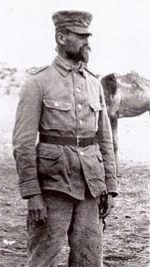
Hauptmann (Captain) von Friedrich von Erckert https://de.wikepedia.org/wiki/Friedrich_von-Erckert
Von Erckert, a Prussian officer and later district administrator of Omaruru, recognised the strategic value of camels during his first DSWA service (1899–1902). He became known as the “Father of the Camel Rider Troops”.
He returned during the Herero and Nama Wars (1904–07), fighting in the Great Karas Mountains and along the Orange River. He was a key adversary of Nama commander Jakob Marenga.
The Nama/Herero War (1904–1907)
After the war officially ended in 1907, one Nama leader, Simon Kooper, refused to sign peace agreements and continued cross‑border raids. Attempts to track him failed due to lack of water and fodder for horses.
Von Erckert therefore converted his mounted forces to camel units, retraining animals and men for deep‑desert operations.
The 1908 Kalahari Expedition
Composition of the Force
- 23 German officers
- 373 rifles
- 4 medical personnel
- 120 African auxiliaries
- 710 camels
- Horses, mules, oxen
- 4 Maxim machine guns
British Bechuanaland Police cooperated due to cross‑border Nama activity.
Battle of Seatsub (16 March 1908)
- Nama scouts misjudged the size of the German force.
- Von Erckert was killed early by rifle fire.
- After 2½ hours of fighting, the Nama withdrew to avoid encirclement.
- Casualties: 13 Germans (including von Erckert), 19 wounded, 58 Nama killed.
- Kooper escaped but ceased further raids.
Running out of water, the Germans ended the pursuit.
Aftermath and Legacy
- Kooper signed a treaty with the British in 1909 and settled at Lokgwabe.
- Von Erckert became a celebrated figure in settler historiography; a memorial was erected at Gochas in 1910.
- The graves of the 13 Germans killed at Seatsub were never found; symbolic headstones were placed at Gochas.
South African Period (1915–1955)
- South Africa captured 500 camels and continued using Karib as a camel depot.
- Camels served in police and military patrols until motorisation in 1939.
- Final camel operations in remote areas ended in 1955.
Enduring Legacy
- Camels proved essential for controlling desert interiors before motor vehicles.
- “Kamelmänner” remains Namibian slang for tough desert patrolmen.
- Some Baster and Nama communities retained camel herds.
References:
https://en.wikipedia.org/wiki/Imperial_Schutztruppe_for_German_South_West_Africa#/media/
https://de.wikepedia.org/wiki/Friedrich_von-Erckert
File: Bundesarchiv_Bild_105-DSWA0095,
_Deutsch-S%C3%BCd-Westafrika,_
Kamelreiterpatrouille.jpg

