Nongqai Vol 17 No 6 – John William Reynolds
ABSTRACT
This document presents a biographical account of John William Reynolds, a 19th-century law enforcement officer and soldier from Grahamstown in the Cape Colony. Born in 1856, Reynolds served in the Divisional Police and later as a plain-clothes detective in the Urban Police. During the Anglo-Boer War, he enlisted in the Grahamstown Town Guard and was awarded the Queen’s South Africa Medal for his service. The narrative traces his personal life, including marriages, family, and career transitions, alongside the socio-political context of frontier life in the Eastern Cape. It also highlights his dedication to policing duties, health struggles, and the circumstances surrounding his death in 1907. The account provides insight into colonial policing, civic military service, and the personal challenges faced by individuals in that era.
KEYWORDS
John William Reynolds,
Grahamstown,
Cape Colony,
Urban Police,
Divisional Police,
Anglo-Boer War,
Grahamstown Town Guard,
Queen’s South Africa Medal,
Colonial law enforcement,
South African history,
19th-century policing,
Detective work,
Frontier society,
Military service,
Biography,
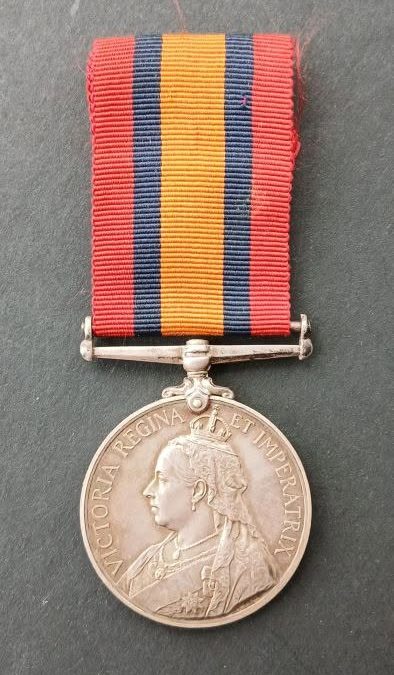
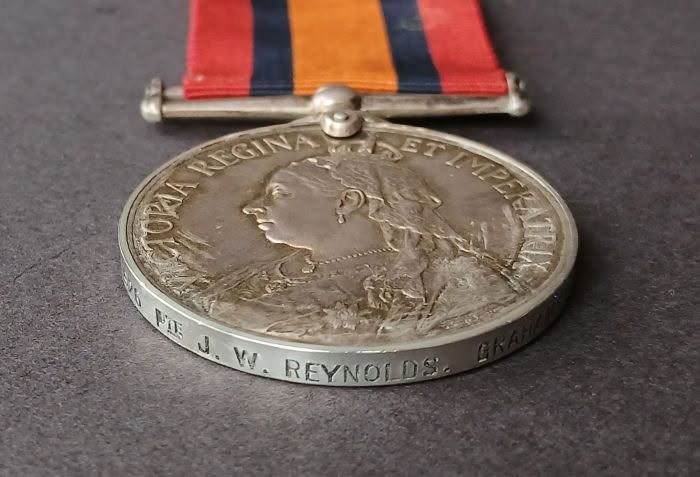
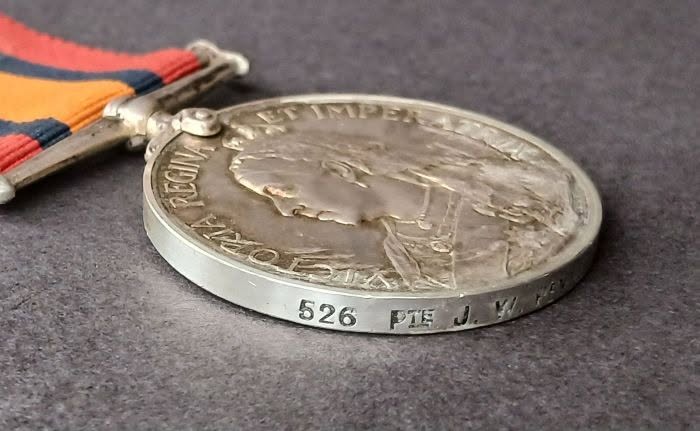
QUEENS SOUTH AFRICA MEDAL TO 526 PTE J.W. REYNOLDS. GRAHAMSTOWN TOWN GUARD.
By Rory P Reynolds
Police Constable, Divisional Police, Cape Colony
Private, Grahamstown Town Guard – Anglo Boer War
Plain Clothes Detective, Urban Police, Grahamstown
John Reynolds was born in Grahamstown in the Eastern part of the Cape Colony on 9 January 1856 the oldest of twelve children born to John Reynolds and his wife Mary Aldridge. The couple had married in Grahamstown on 16 October 1854.
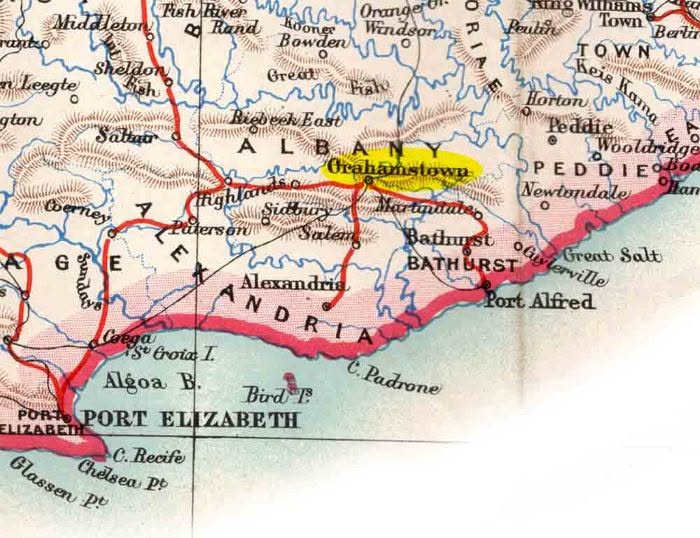
Grahamstown, inland from Port Elizabeth, was very much Frontier country as it was then known. It was a small but cultured hamlet surrounded by marauding Xhosa tribesmen, hell-bent on ridding the territory of the European settlers who had been granted land in the area and who had defied the odds by establishing themselves as successful farmers and traders.
Growing up a young John would have ruled the roost over his younger siblings – Ellen Jane (1857), Caroline Louisa (1860), Mary Ann (1862), Samuel George (1865), Josiah Charles (1868), Eliza Edith (1870), Gertrude Emily (1872), Arthur Bertie (1874), Clement James (1877), Ethel Maude Aldridge (1880) and Clifford Owen Aldridge (1882). A thought should be spared for the long-suffering Mrs Reynolds who endured the rigours of childbirth twelve times over a period of twenty-six years – no mean feat in what were quite primitive conditions.
Our first proper glimpse of John came via his marriage to 18-year-old Sophia Dunlop in the Commemoration Church in Grahamstown on 22 July 1878. Aged 23 he was described as a Policeman whilst his wife was a Servant. Sophia didn’t survive many years after the nuptials. Having provided John with a son, Wreford Owen, in 1879 she passed away at her father’s residence in nearby Port Alfred on 26 July 1883, aged 26.
The preceding year, the Eastern province Year-Book and Commercial Directory for 1882 contained an entry, under the Grahamstown section, where Reynolds’ name appears as a member of the Divisional Police, Cape Corps Camp. His duties and responsibilities would have been the keeping of the peace, which would have included the locking up of late night revellers at the many hostelries in town, and the general maintenance of law and order.
Not quite two years after Sophie’s death, in the Grahamstown Commemoration Church on 1 January 1885, he wed Elizabeth Dowson Mountfort. He was described as a Harness Maker, suggesting that he and the police had parted company.
As the end of the 19th century drew near the two Boer Republics of the Orange Free State and the Transvaal went to war with Great Britain. The sabre rattling ended with a declaration of war on 11 October 1899 and, although Grahamstown was not initially in the firing line, as the war progressed and the Boer Commandos were hard-pressed for additional men and supplies, they moved across the Free State border into the Eastern Cape, occupying and plundering many of the small villages and towns in their path.
Town Guards, active members of a town’s citizenry, were hurriedly called into being and Grahamstown was no exception – with a large population they were able to put over 2000 men into the guarding of life, limb and property. Reynolds was thus one of many who came forward to “do his bit,” enlisting with the rank of Private and no. 526.
After many scrapes and near skirmishes with the enemy the Grahamstown Town Guard was disbanded with the advent of peace on 31 May 1902 and the men were able to go about their civilian occupations once more. Reynolds, for his efforts, was awarded the Queens South Africa medal.
He must have resumed his police work before the war commenced – this according to an Application for Leave requested by him on 18 December 1905. Described as a Detective, Urban Police, Grahamstown, he had 7 ½ years service and was on an annual salary of £130. His request was for a period of 12 days and was for a “Serious Indisposition.” His request was approved in full with payment and allowances included.
The cause of his distress was revealed by a Medical Certificate, signed by Dr R. Cuthbert Mullins, who claimed to have been treating Reynolds for Dysentery which had rendered hi incapable of discharging his duties.
Having recovered from his malaise Reynolds took up the cudgels of his profession once more but not for very long. A further application for leave was submitted by him on 13 March 1907. This was in respect of his annual leave which, after 9 years service, amounted to 21 days. His destination was Daspoort, Pretoria c/o L. Hanson – possibly a friend or relative that resided there. The leave was agreed to by the Resident Magistrate and Reynolds went upcountry.
But Reynolds time was almost, so to speak “up” – a Memorandum from the Office of the Inspector, Urban Police, Grahamstown to The Resident Magistrate dated 27 December 1907 broke the sad tidings:
“Sir, It is my painful duty to report the death of Detective J.W. Reynolds of the Urban Police Force. He died at his residence in Croft Street on Tuesday the 24th instant. A post-mortem examination has been held by the District Surgeon but I have not yet heard the result.
A re-arrangement of the detective work is, I consider, highly necessary. Hitherto we have struggled along with only two detectives or rather plain clothes constables – and I think you will agree with me that this is not sufficient for the requirements of this city in view of the large Native locations on the outskirts, within a mile from the Cathedral and apparently without any proper municipal control.
Ever since the Cape Mounted Police have rigidly enforced the provisions of the location Acts in the country, a great many squatters and idlers have made for the Grahamstown locations where they have found a haven of rest. These men never work and still seem to thrive there. There are at least a couple of hundred of these men in the Locations at present.
Detective Reynolds, who, as you know, was a very hardworking and conscientious official, spent the greater part of the day and most of his nights in these Locations in the execution of his duty, and but for that we would have had a great deal more crime in the city during the last twelve months.”
On the same day the Albany (Grahamstown) Civil Commissioner penned a note to the Law Department, entitled “Appointment of a Detective” it read thus:
“Sir, I have the honour to forward a letter received by me from the Chief Constable, reporting the death of Constable Reynolds who for some years has been employed on plain clothes duty, and suggesting the appointment of a qualified detective. I am quite in agreement with the views set forth by Captain Ryneveld – I think it absolutely necessary that there should be one properly trained detective stationed here – but he should be an absolutely temperate man.
Detective Reynolds took to heart the criticisms upon his conduct of the Kerr case, and following upon that he unfortunately shot a native – who refused to stand when called upon – with a revolver. Reynolds I think committed suicide by taking strychnine – I have not yet received a report from the Analyst.
I have the honour etc. etc.”
So there was the cause of death – suicide and by one of the most painful means possible – poisoning. His Notice of Death intimated that his wife and family “were present at death” – an unenviable experience for all.
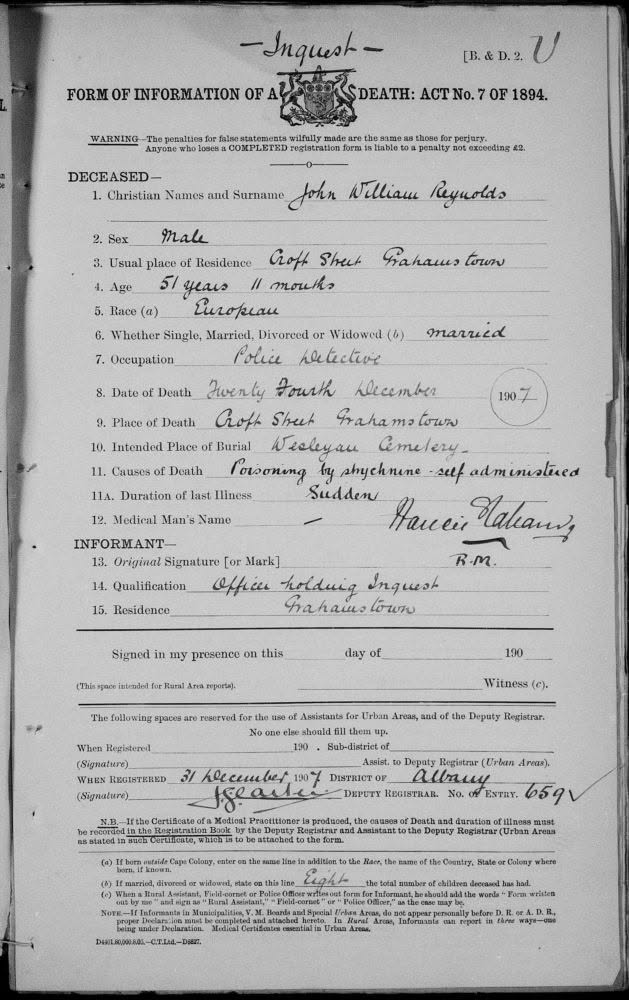
Reynolds’ official Death Notice confirmed that he had died by Poisoning by strychnine – self-administered. He was 51 years and 11 months old. Minor children of his second marriage were Melville William Reynolds, Herbert Graham Reynolds, Keith Aldridge Reynolds, Laura Matilda Reynolds and Pearl Ruth Reynolds. An older child, Ada Sophia Reynolds, born in 1885, had died earlier in 1907.
Acknowledgments:
– Anglo Boer War Forum for map showing Grahamstown
– South African Archives, Cape Town for official documents iro his leave, death etc.
– Ancestry for Medal Roll
– Familysearch for birth/baptism details.

