
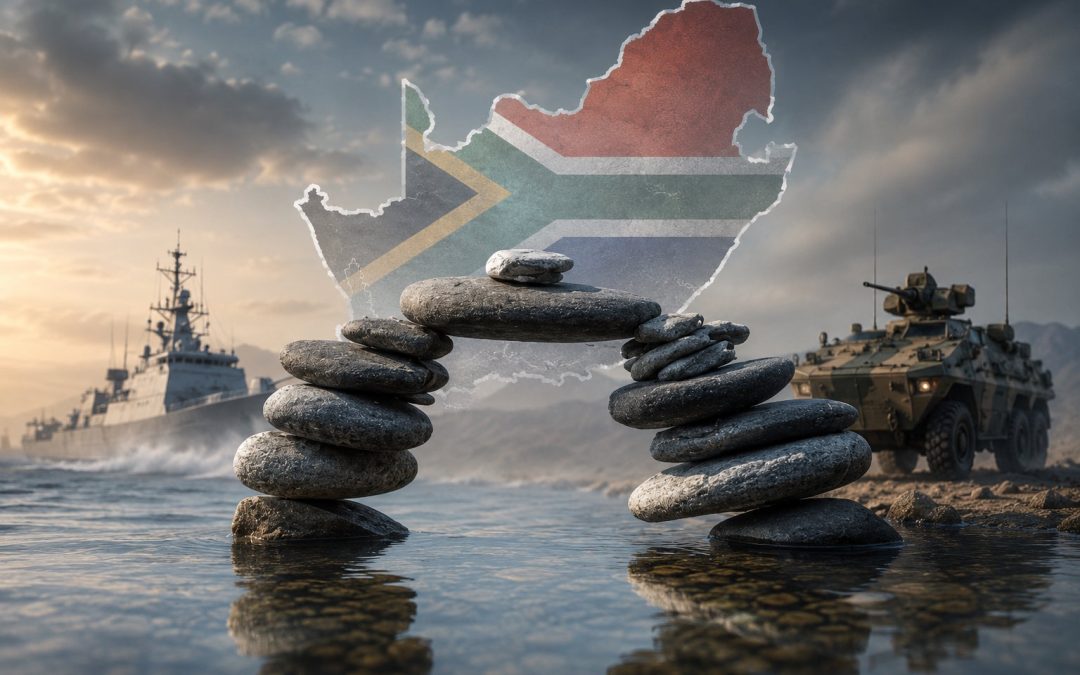
Abstract: South Africa’s defence crisis is often framed as a problem of insufficient funding. This article argues that the deeper challenge is one of strategic incoherence. Using the Clausewitzian framework of ends, ways, and means, it examines how misalignment between political ambition, force design, and available resources has contributed to the SANDF’s gradual erosion. The article contends that sustainable defence renewal requires sequenced institutional regeneration, realistic strategic prioritisation, and a revitalised defence-industrial base rather than aspirational expansion alone.
Dr Joan Swart
Keywords: SANDF, strategic coherence, defence policy, defence planning, military strategy, ends, force design, defence-industrial base
THE SANDF’S CRISIS IS NOT FINANCIAL — IT IS STRATEGIC
Carl Niehaus is correct to warn that the South African National Defence Force stands at a dangerous crossroads. The recently approved “Journey to Greatness” long-term capability plan arrives at a moment when the SANDF faces mounting operational strain, deteriorating infrastructure, procurement dysfunction, and declining readiness across multiple domains.
His scepticism toward a strategic roadmap introduced without comprehensive parliamentary scrutiny, detailed costing, or a transparent implementation framework is equally justified. South Africa has seen ambitious defence visions before. The Defence Review 2015 itself gradually became a cautionary example of how sophisticated strategic aspirations can drift into institutional paralysis when political ambition, fiscal reality, and organisational execution fall out of alignment.
Yet the SANDF’s crisis cannot be understood merely as a story of underfunding, procurement failure, or administrative decay. Those are symptoms of a deeper structural problem.
A Crisis of Strategic Coherence
At its core, the SANDF suffers from a prolonged crisis of strategic coherence.
This is ultimately a Clausewitzian problem. Carl von Clausewitz’s enduring insight that military force functions as an instrument of policy remains the most useful framework for understanding institutional military decline. Military effectiveness depends upon the alignment of ends, ways, and means: the political objectives a state seeks to achieve, the operational concepts through which it seeks to achieve them, and the resources available to sustain those efforts.
When these elements drift out of synchronisation, military capability begins to erode beneath the surface of institutional continuity. Political rhetoric increasingly outpaces operational reality. Strategic documents become detached from executable capability. Eventually, force structures remain visible on paper while readiness, sustainment, and operational resilience quietly deteriorate underneath.
South Africa’s defence posture increasingly reflects precisely this form of strategic incoherence.
The political ends have remained ambiguously defined since the post-1994 transition. South Africa continues to project aspects of a middle-power identity: a regional stabiliser, continental peacekeeping actor, maritime security contributor, border-security provider, disaster-response mechanism, and diplomatic security partner. These roles are not inherently contradictory, but they require coherent prioritisation and proportional resourcing.
Instead, the SANDF has gradually accumulated overlapping mandates without a corresponding recalibration of force design, doctrine, or fiscal structure.
The ways — the operational concepts and force employment patterns intended to support these ambitions — have similarly drifted. The SANDF was shaped largely by post-Cold War assumptions that privileged peace-support operations, developmental tasks, and internal stabilisation in an era where conventional interstate conflict appeared increasingly unlikely. Yet the contemporary security environment now confronting South Africa and the broader region is characterised by hybrid conflict, transnational criminal networks, cyber vulnerability, insurgent fragmentation, maritime insecurity, and growing geopolitical competition.
Incoherence Has Real-World Implications
The recent operational difficulties surrounding the SADC mission in eastern Democratic Republic of Congo illustrate this reality clearly. Fragmented conflict environments characterised by overlapping insurgencies, illicit economies, weak state authority, and contested sovereignty are unforgiving of institutional drift. Such environments demand adaptive command systems, sustainable logistics, integrated intelligence, and high operational readiness. A force caught between political ambition and operational reality will fragment long before it formally loses capability.
This is why the SANDF’s crisis cannot be solved simply by increasing defence expenditure.
The emerging “Journey to Greatness” framework already reveals the dangers of declaratory ambition detached from executable sequencing. Proposals linked to raising defence expenditure toward 1.5% of GDP may appear strategically attractive in theory, but they risk becoming structurally unrealistic if foundational institutional distortions remain unresolved.
South Africa’s fiscal environment is already constrained by slow economic growth, rising debt-servicing obligations, weak state capacity, and mounting social expenditure pressures. Under such conditions, major defence expansion assumptions become politically fragile and economically difficult to sustain.
More importantly, additional funding alone cannot restore capability if structural inefficiencies continue absorbing operational resources.
The SANDF’s current institutional architecture remains distorted by several overlapping pressures:
- escalating personnel expenditure;
- maintenance and sustainment backlogs;
- procurement dysfunction and delayed acquisition cycles;
- deteriorating audit outcomes and governance instability;
- declining technical and industrial retention;
- ageing prime mission equipment;
- and fragmented alignment between strategic planning and operational execution.
Without resolving these structural constraints, large-scale budget expansion risks reinforcing institutional inefficiency rather than restoring operational capability.
Strategic Regeneration Rather Than Force Expansion
This is why defence renewal must begin with sequenced strategic regeneration rather than aspirational force expansion.
The first requirement is political clarity regarding South Africa’s realistic strategic role.
The country cannot indefinitely maintain the rhetoric of a continental stabilising power while sustaining a force structure increasingly constrained by fiscal pressure and institutional overstretch. Strategic ambition must be narrowed, prioritised, and aligned with sustainable national capacity.
This does not imply strategic retreat. It implies strategic realism.
South Africa still possesses important advantages within the African security environment. It retains comparatively advanced military-industrial infrastructure, sophisticated institutional planning frameworks, experienced officer corps, maritime positioning, and regional diplomatic influence. But these advantages require coherent preservation.
The defence-industrial sector is particularly important in this regard.
No military institution can sustain long-term capability without a functioning industrial and technological ecosystem capable of supporting maintenance, regeneration, adaptation, and selective modernisation. A hollowed-out industrial base gradually transforms military capability into dependency.
This is where the current debate surrounding strategic renewal becomes critically important.
If defence-industrial regeneration can be stabilised through predictable procurement pathways, targeted recapitalisation, improved governance, export competitiveness, and stronger state-industry coordination, it may gradually provide the foundation for sustainable capability recovery. Without such industrial stabilisation, however, ambitious capability plans risk remaining largely declaratory.
The SANDF therefore requires more than a new capability roadmap.
It requires a phased institutional realignment.
Before ambitious expansion trajectories can become credible, South Africa must first stabilise:
- governance and audit integrity;
- maintenance and sustainment systems;
- force composition and personnel balance;
- procurement predictability;
- logistical resilience;
- and defence-industrial survivability.
Only once these foundational systems begin functioning coherently can more ambitious capability development pathways become executable.
This is the uncomfortable strategic reality confronting South Africa.
The state increasingly recognises the symptoms of defence decline. Recent strategic documents openly acknowledge fiscal constraints, governance failures, maintenance crises, capability erosion, and the need for a revised “level of ambition.” Yet recognition alone does not produce coherence.
The real challenge now lies in whether the political system is prepared to align strategic ambition with institutional capacity, fiscal reality, and long-term sustainability.
Carl Niehaus is therefore correct to warn that the SANDF stands at a precipice. But the deeper danger is not simply military decline.
It is the gradual normalisation of strategic incoherence.
Military institutions rarely collapse suddenly. They erode incrementally through the accumulation of unresolved contradictions between political ambition, operational requirements, and sustainable national capacity.
Reversing that erosion will require more than funding increases or rhetorical modernisation.
It will require political honesty, institutional discipline, strategic prioritisation, and the difficult work of rebuilding coherence where strategic drift has been tolerated for far too long.
South Africa’s future strategic relevance — and ultimately its ability to exercise meaningful sovereignty within an increasingly unstable regional environment — may depend upon whether that process begins before institutional decline becomes irreversible.
* This article was originally published in DefenceWeb

NONGQAI’S Strategic Security Analyst Dr Joan Swart is a forensic psychologist with an MBA and an MA in Military Studies. Her work focuses on African security, geopolitics, state fragility, substate dynamics, and the intersection between governance, legitimacy, and coercive power. She is the author of several books and regularly publishes long-form analysis and opinion pieces on security and governance issues. Her writing has appeared in outlets including DefenceWeb, Maroela Media, Netwerk24, RSG, Visegrad, and other policy and public-affairs platforms. She has a weekly slot on SAfm The Global Briefing to analyse world affairs. Her work bridges academic research, policy analysis, and applied strategic assessment, and she is currently completing a second PhD at the University of Stellenbosch Military Academy. Follow her on X/Twitter, Substack, and LinkedIn.

Absolutely, the focus on strategic incoherence makes so much more sense than just a lack of money. It’s a really important point about aligning goals with actual capability.