
Abstract: Five years after the July 2021 unrest exposed serious weaknesses in South Africa’s national security architecture, questions remain about the country’s preparedness for future instability. Drawing on the findings of the Expert Panel and SAHRC investigations, this article examines what lessons were identified, what vulnerabilities remain, and whether South Africa is better equipped to prevent localised unrest from escalating into a broader national crisis.
Dr Joan Swart
Keywords: July 2021 Unrest | National Security | Intelligence | Crisis Preparedness | SAPS | SANDF | National Resilience
FIVE YEARS AFTER JULY 2021: IS SOUTH AFRICA BETTER PREPARED?
Dr Joan Swart
As South Africa approaches another potentially contentious period of public mobilisation, memories of the July 2021 unrest inevitably return. While the circumstances surrounding the planned 30 June protests differ significantly from those that triggered the events of 2021, the comparison nevertheless raises an important question: has South Africa learned the right lessons from one of the most significant internal security crises in its democratic history?
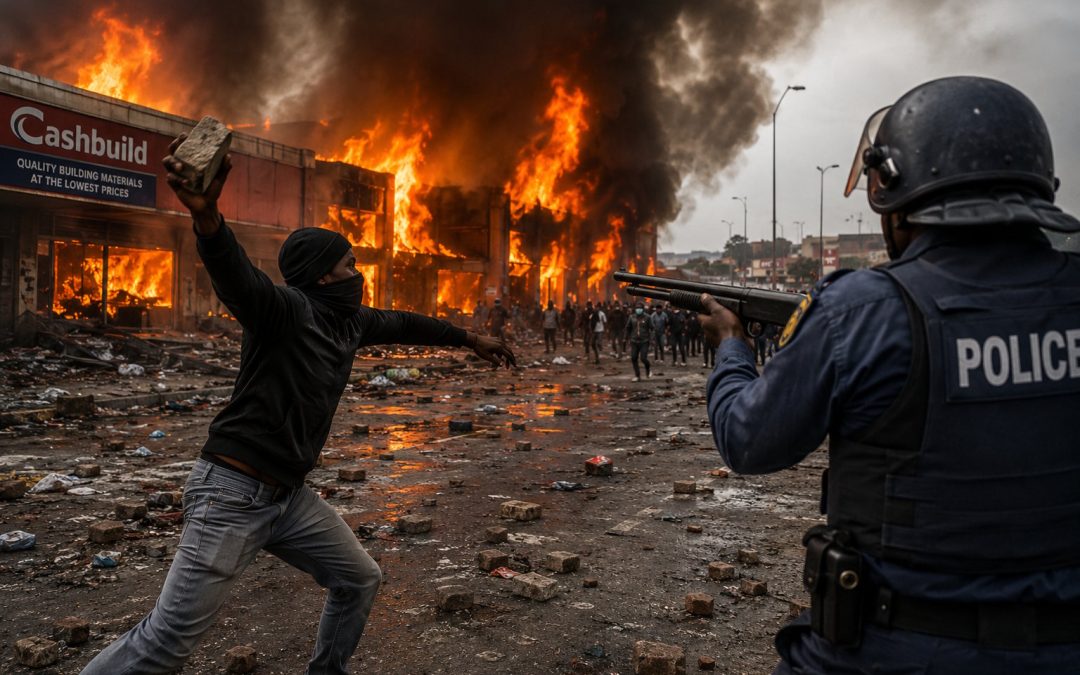
The July 2021 unrest was unprecedented in scale. Triggered by the imprisonment of former president Jacob Zuma, demonstrations rapidly escalated into widespread looting, destruction of property, attacks on infrastructure, and a breakdown of law and order across parts of KwaZulu-Natal and Gauteng. More than 350 people lost their lives, thousands of businesses were affected, and the economic cost was estimated at approximately R50 billion.
What began as a political dispute quickly evolved into a national security emergency.
The findings of both the 2021 Expert Panel Report and the South African Human Rights Commission’s 2024 investigation paint a concerning picture. While differing in emphasis, both reports identified serious shortcomings in intelligence gathering, information sharing, coordination, decision-making, public order policing, and crisis management. Both concluded that the unrest was not simply the product of spontaneous public anger, but rather the result of a complex interaction between political mobilisation, criminal opportunism, socio-economic grievances, and institutional weaknesses.
The most important lesson from July 2021 may be that South Africa did not experience a simple policing failure, intelligence failure, or political failure. It experienced a failure of alignment across the national security system.
Modern security challenges rarely fit neatly within institutional boundaries. Intelligence services may identify emerging threats, but police must maintain public order. Political leaders must make timely decisions. The military may provide support. Municipalities, logistics operators, businesses, and critical infrastructure providers all become part of the broader security environment. The failure of one component can rapidly undermine the effectiveness of the entire system.
In this respect, the July unrest exposed weaknesses in what security practitioners often describe as a whole-of-government approach. The challenge was not merely that individual institutions made mistakes. Rather, the national security architecture struggled to function as an integrated system.
From Intelligence Failure to National Security Failure
One of the strongest themes emerging from both investigations was the role of intelligence.
The Expert Panel identified serious concerns regarding the collection, analysis, dissemination, and utilisation of intelligence. Similar concerns emerged from the SAHRC investigation, which highlighted shortcomings in information sharing and coordination between various state structures.
Yet intelligence failures are often discussed as though they occur in isolation. In reality, they become national security failures only when warnings are not translated into decisions and decisions are not translated into action.
An intelligence report has little value if decision-makers do not receive it in time. Early warning achieves little if institutions cannot coordinate an effective response. Likewise, operational plans become irrelevant if resources cannot be deployed where they are needed.
The true significance of July 2021 therefore lies not merely in the intelligence shortcomings that were identified, but in the fact that weaknesses across multiple institutions combined to produce a systemic failure.
The events demonstrated that national security depends not only on individual capabilities, but also on the ability to align intelligence, decision-making, planning, communication, and operational responses under conditions of uncertainty and pressure.
Is the State More Alert?
The most obvious difference between July 2021 and today is not the threat itself, but the degree of institutional awareness surrounding it.
Unlike the period preceding the unrest, the planned 30 June protests have been the subject of extensive public discussion and visible security planning. NATJOINTS, SAPS, and other security stakeholders have publicly acknowledged potential risks, conducted contingency planning, and communicated various preparedness measures. Whether these measures prove sufficient remains to be seen. However, they suggest a level of situational awareness that was not always evident during the lead-up to the July unrest.
Whether these measures prove sufficient remains to be seen. However, they suggest a level of situational awareness that was not always evident during the lead-up to the July unrest.
Preparedness also serves a deterrent function. Security operations are not solely designed to respond to unrest; they are intended to discourage escalation before it occurs. The visibility of current planning, public messaging, and inter-agency coordination sends a signal that potential flashpoints are being monitored and that authorities are actively preparing for a range of contingencies. Potential agitators, opportunistic criminals, and those seeking to exploit public mobilisation are confronted with a very different security environment than existed in July 2021. While deterrence is difficult to measure, it remains an important component of crisis prevention.
This matters because awareness is the first prerequisite for preparedness.
The security system cannot respond effectively to threats it fails to recognise. The fact that multiple institutions are actively discussing potential risks suggests that some lessons from 2021 have been absorbed.
Awareness, however, is not the same as capability.
South Africa’s security institutions continue to operate under significant constraints. SAPS faces persistent resource and capacity challenges. Public Order Policing units remain under pressure. The SANDF continues to grapple with readiness concerns, budget limitations, and competing operational commitments. Questions regarding intelligence reform, institutional coordination, and decision-making structures remain relevant.
The true test of preparedness will therefore not be whether meetings have been held or warnings issued. It will be whether institutions can respond rapidly, coherently, and proportionately should events begin to escalate.
The Unofficial Security Response
An often-overlooked aspect of July 2021 was the role played by society itself.
As state institutions struggled to contain the unrest, community organisations, neighbourhood watches, businesses, volunteer groups, and private security companies stepped into the vacuum. In many areas they played a critical role in protecting communities, supply routes, shopping centres, warehouses, and other critical assets.
Without these interventions, the economic and security consequences may have been significantly worse.
This demonstrated an important source of national resilience. It also revealed a potentially uncomfortable reality.
The effectiveness of these responses reflected not only the strength of communities, but also the extent to which citizens felt compelled to compensate for weaknesses within the state’s security response.
While private security and community-based initiatives can provide valuable support during crises, they cannot become substitutes for the state. Such arrangements raise important questions regarding accountability, legitimacy, coordination, use of force, intelligence sharing, and command structures.
A resilient society is an asset. A security vacuum filled by competing actors is a risk.
One of the enduring lessons of July 2021 is therefore that South Africa’s resilience did not reside solely within state institutions. It also resided within society itself. The challenge is ensuring that such resilience strengthens rather than fragments the broader national security architecture.
Beyond 30 June
Five years later, perhaps the most important question is not whether South Africa can prevent every future incident of unrest. No security system can guarantee that.
The more realistic measure of success is whether localised instability can be prevented from escalating into a broader national crisis.
That requires more than police numbers or military deployments. It requires effective intelligence, rapid decision-making, institutional coordination, public confidence, and the ability to align multiple actors around a common response.
The significance of 30 June therefore lies not in whether protests occur, but in whether South Africa’s security institutions demonstrate that they can translate the lessons of July 2021 into effective action.
The unrest exposed serious weaknesses in the country’s national security architecture. It also revealed unexpected sources of resilience within South African society. The challenge now is not simply whether government is better prepared, but whether the state, private sector, communities, and civil society can function as a coherent system when confronted by future crises.
Ultimately, South Africa’s preparedness will not be judged by the warnings received, the plans drafted, or the assurances offered before a crisis. It will be judged by whether the next warning becomes another report—or another July 2021.

NONGQAI’S Strategic Security Analyst Dr Joan Swart is a forensic psychologist with an MBA and an MA in Military Studies. Her work focuses on African security, geopolitics, state fragility, substate dynamics, and the intersection between governance, legitimacy, and coercive power. She is the author of several books and regularly publishes long-form analysis and opinion pieces on security and governance issues. Her writing has appeared in outlets including DefenceWeb, Maroela Media, Netwerk24, RSG, Visegrad, and other policy and public-affairs platforms. She has a weekly slot on SAfm The Global Briefing to analyse world affairs. Her work bridges academic research, policy analysis, and applied strategic assessment, and she is currently completing a second PhD at the University of Stellenbosch Military Academy. Follow her on X/Twitter, Substack, and LinkedIn.
