Abstract: In 1993, pilot Crause Steyl flew the Ghost Rider into Soyo as UNITA forces advanced and the town’s defenders fled by boat. His unexpected decision to land helped turn a seemingly doomed operation around, opening the way for Executive Outcomes’ first contract and its subsequent role in training Angola’s army.
Keywords: Soyo | Angola | Executive Outcomes | Crause Steyl | Ghost Rider | UNITA | Private Military Companies
THE DAY EVERYONE WENT TO THE BOATS
Soyo, Angola, 1993 — a pilot’s account of Executive Outcomes’ first operation
There is a particular smell to the mouth of the Congo, and once it is in you it never entirely leaves. Salt, crude oil, and the green rot of a river that has come two thousand miles through the belly of Africa and arrives at the Atlantic too tired to argue with it. The Congo does not so much enter the sea at Soyo as shoulder its way in, an enormous brown animal, and it stains the ocean the colour of old blood for thirty miles out. From two thousand feet in a Cessna 404 you can see the exact line where the river gives up and the sea begins, and in the autumn of 1993 that line was, give or take a few burning pump stations, the front.
Angola had come apart at the seams the year before. The election had been held, Savimbi had lost it, and UNITA had reacted to defeat in the manner of a man who has been told the rules of the game and has decided, on reflection, to keep the ball. The country slid back into a war it could no more afford than a drowning man can afford a second anchor. And the war went, as wars in Angola always went, straight for the money. Soyo was the money. The whole northern tip of the country was a hissing, ticking maze of pipelines, tank farms and pump stations strung along the river and the coast, and UNITA had taken the town in late 1992 and begun walking west toward the offshore platforms with the unhurried confidence of men who did not expect to be stopped.
The government had tried twice to take it back with its own army and had twice been thrown off with its nose bloodied. So the MPLA, pressed hard by oil companies whose installations were falling into rebel hands one by one, did what governments in a corner do. They rang a man in Pretoria. His name was Eeben Barlow, and his company was called Executive Outcomes.
I was one of perhaps eighty who went in. Lafras Luitingh led one of the three fighting groups. Simon Mann held the picture in his head. Tony Buckingham made sure the money did not run out before the war did, which was a closer-run thing than anyone liked to admit. I flew.
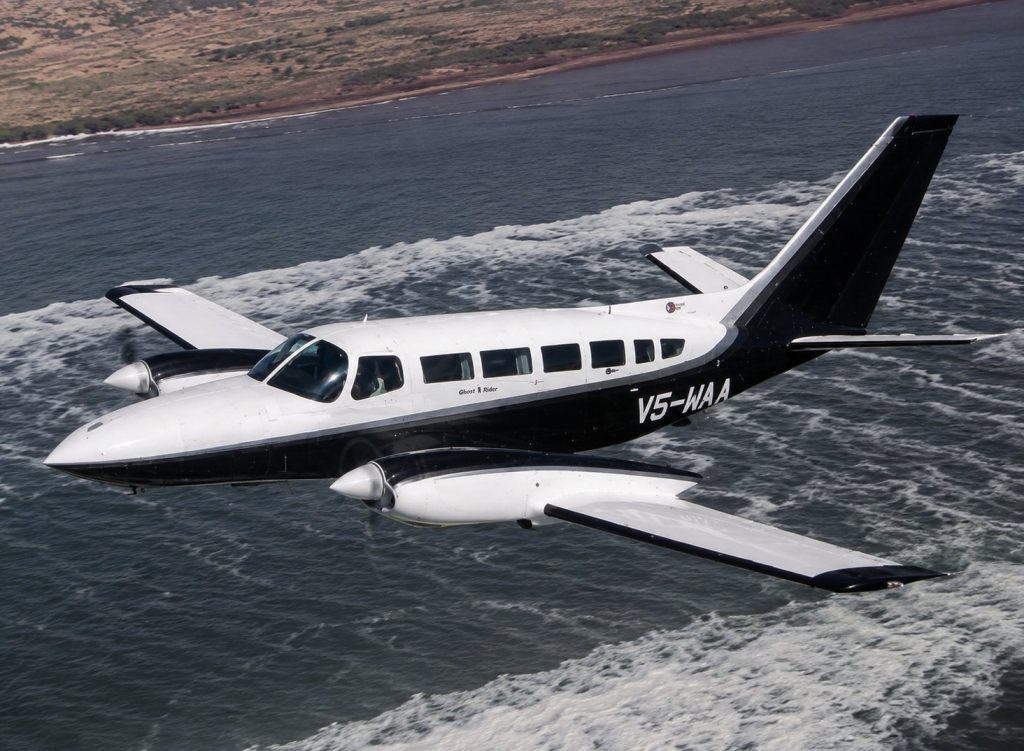
The Ghost Rider — Cessna 404 V5-WAA, out over the Atlantic during the Soyo operation, 1993.
The air bridge
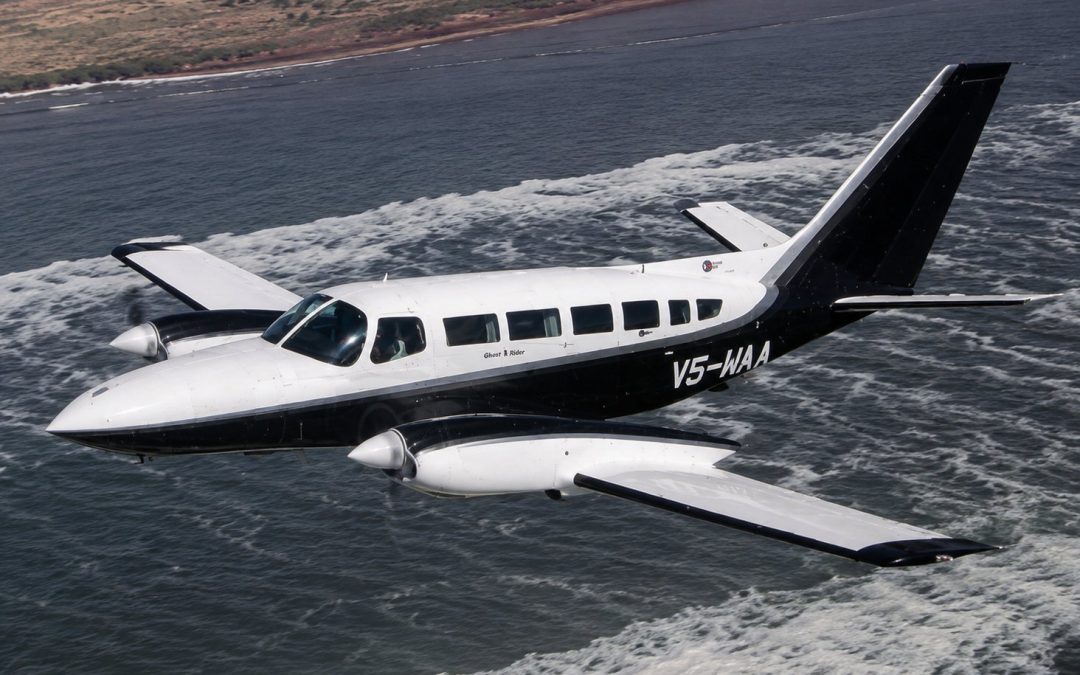
She was a Cessna 404 with Namibian letters on her tail, V5-WAA, and we called her the Ghost Rider, half in affection and half in superstition. A twin-engined piston with a respectable appetite for load, a forgiving stall, and a registration that had the considerable virtue of provoking fewer awkward questions at the Luanda end, where awkward questions were a currency nobody enjoyed spending.
What they asked me to build, and then to keep alive, was an air bridge: Johannesburg to Windhoek to Luanda to Cabinda to Soyo, and back, by day and by night, for as long as the men on the ground were alive to need it. I said yes with the easy confidence of a man who has not yet been handed the small print. Werner and Johan flew the Baron 58s. A pilot we knew only as Hercules flew his rotations. I flew mine. Replacements went north; the wounded came south; and in between went the unglamorous freight that quietly wins or loses every war ever fought — ammunition, fuel, water, and the medical supplies that kept the dying from completing the transaction.
You learn things on those over-water legs. You learn to listen to two engines the way a mother listens to a sleeping child. You learn that the sky behind you is worth watching as closely as the fuel gauge, and that both can betray you. I flew Harry Ferreira out to Windhoek myself after he took a round clean through the forearm: ten hours, eighty percent of it over ground UNITA held, with Francis Smith, our doc, working in the cramped few feet behind my seat and doing the genuinely hard part while I merely moved the aeroplane from one place to another. That is not a flight on which a man permits himself one careless minute. You fly straight and level and humble, and you get your man home.
The day everyone went to the boats
The day it nearly all came down, I had no idea that anything was coming down at all. That, I have since decided, is the only reason it ended as it did.
I was inbound to Soyo on what I took to be a routine run, and I did what one does: I circled the field to read the ground before committing to it.
Something was wrong. Not a thing you could point to; a wrongness in the pattern, the kind a pilot learns to trust over his own eyes. A withdrawal has a shape. It has a discipline, a rhythm, men moving in files. This had none of that. Figures streaming toward the water. Boats being loaded in a tearing, elbowing hurry. It was not a retreat. It was a rout. Everyone was leaving.
I landed anyway. I would love to tell you this was courage. It was closer to a cocktail of habit, obligation and not remotely understanding what I was letting myself down into. You land because you said you would. You land because turning away at the last second sends a signal down the entire length of an operation that you cannot afford to send. And, in my case, you land because you are still green enough not to have grasped that the wiser men have already voted with their feet — or rather with their boats — and that the wisdom was in the leaving.
The wheels had barely stopped bouncing when the radio crackled.
Portuguese. One of the last Angolans on the field with a working set.
“Crause, os rapazes à sua volta — são UNITA ou MPLA?” The men around you: are they UNITA or MPLA?
I looked. I genuinely could not tell. The field was half-emptied and incoherent, men moving in directions that answered to no logic I could find. The famous fog of war turns out to be precisely and literally that. You stand in the middle of it and cannot see ten metres in front of your own boots.
“Não sei,” I said, in the dog-rough Portuguese I had been assembling on the run from necessity and gesture. I don’t know. Where has everyone gone?
A pause that lasted a small eternity. Then: “No mar. Fugiram.” Into the sea. They’ve fled.
So that was it. The position had been abandoned wholesale. Lafras and his men were out on that ochre water with everybody else, and UNITA was about to stroll into Soyo and take the oil, and with the oil everything Barlow and Simon and Tony had so carefully built. I sat in the Ghost Rider with the engines ticking and thought, with great clarity, that I had just landed on the wrong side of history.
Then the second call came, and it came from the boats. “Crause, você pousou? Está seguro?” You’ve landed? Are you safe?
“Sim,” I said. “Estou bem.” Yes. I’m fine.
And then I listened to them talking among themselves, fast and low and tight, and even through the static I felt something in the day begin, very slightly, to turn.
Because I had landed. Because a pilot who presumably knew his business had looked that airfield over, judged it worth setting down on, and had not crashed and was not screaming into the radio. None of which was, strictly speaking, true. I had landed mainly because I did not understand the situation well enough to be properly frightened of it. But they did not know that. And a misunderstanding, arriving at exactly the right moment, can be worth a great deal more than the truth ever manages to be. War, I have slowly come to believe, is nine parts mind-game to one part everything else.
The boats turned round. Lafras and a handful of others — six men, when you counted the heads that came back up the beach — stepped ashore and reoccupied the positions they had quit an hour before. Among them was a man named Steven who had once built the swimming pool at my house in Johannesburg and had asked, with the mild directness of someone enquiring about a weekend’s fishing, whether he might come along. A bullet later went straight up the barrel of his rifle and, for reasons it never disclosed, declined to kill him.
That night UNITA came again. Close to two thousand of them, thrown against the six. Grenades and machine-gun fire, men dying within a few metres of one another’s faces, the kind of fighting Simon later described as storm waves breaking against a wall. The six held. By dawn the first FAA reinforcements were stepping off the boats, and the line began to set like cooling iron. By the third day it was plain to everyone that Soyo was going nowhere, and the air bridge turned on above it as though nothing whatever had happened.
Tallies
War presents its bill when you are least braced for it. We lost three men killed in action across the whole Soyo campaign; that is Eeben’s figure, and I have no reason on earth to dispute it. The one I still carry, cupped in my hand like water I cannot put down, is the man we knew as Tallies, taken and killed, the enemy broadcasting the fact deliberately to break our nerve. In the days after, the men threw themselves at the work, walking and re-walking the perimeter, because work was the one thing that held the grief at arm’s length. I learned then, and for good, that it is never the tactics that carry you through. It is the men beside you, and the love you are not permitted to call by its name.
Hobatere
There is a coda, and it is set a long way from the oil. After Soyo we flew north-west across the vast tawny emptiness of Namibia in a King Air and put down at Hobatere, a remote lodge on the western edge of Etosha where the bush runs to the horizon in every direction and the silence has a weight to it. Simon had gone for a walk the evening before with a pump-action shotgun, an unused precaution against a pride of lions known to be in the area. UNITA were also, possibly, in the area. One took one’s precautions.
The following day General Luis Faceira, Chief of the General Staff of the FAA, flew in with his brother, General Antonio. We sat out in the late copper light with elephant and giraffe coming down to the floodlit waterhole below the deck, the dust of their coming hanging gold in the last of the sun, and the general spoke plainly, soldier to soldier. The government was losing the war. The war had to be ended before the country could even begin to rebuild. Would we help train the Angolan army?
We knew what it would cost. We knew it would call down the anger of powerful men back home who were aligned with the other side of the board. We said yes. EO’s training contract for the FAA’s 16 Brigade began that September, and by the time it had run its course the army that had been losing in 1992 was prising strategic towns back out of UNITA’s hands one by one.
I want to be careful in the telling, because it would be the easiest thing in the world to dress this up into something it never was. Lafras and Steven and the others did the fighting and came within a hair of dying in the doing of it. Francis kept the wounded breathing. Werner and Johan and Hercules flew the same punishing rotations I flew. Barlow, Simon and Tony carried weights I never had to lift. I was merely the man who happened to land when the others were running for the boats, and at the time I did not so much as understand that I had done anything at all.
It was not heroism. It was naivety and commitment stirred together in roughly equal parts, and the fog of war lifting for just exactly long enough to let me make one decision that mattered before I grew wise enough to talk myself out of it. Sometimes, it turns out, that is the whole of what a war requires of a man.
About the author
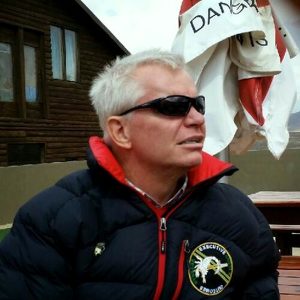
Crause Steyl was born in Lindley in the Free State in 1965. He founded Pro Pilot Aviation in Windhoek in 1991, ran Ibis Air through the 1990s, flying Boeing 727 and King Air operations into Angola, Sierra Leone and Zaire, and since 2000 has headed the Aerocare air ambulance operation, which has flown the Northern Cape’s provincial air ambulance service from Kimberley since 2012. He holds airline transport pilot licences in South Africa and the United States. This piece is adapted from his memoir, A Life in Flight.
