

Abstract: South Africa’s defence sector does not appear to suffer from a shortage of audits, reviews, investigations or task teams. It suffers from a shortage of implementation. Using recent calls for a new defence task team as a starting point, this article explores why many of the same governance, capability and institutional challenges continue to reappear, and argues that meaningful reform may require greater strategic clarity, alignment and accountability across South Africa’s defence ecosystem.
Dr Joan Swart
Keywords: Defence Governance | Strategic Alignment | SANDF | Defence Industry | National Security
DEFENCE GOVERNANCE: ANOTHER TASK TEAM OR A STRATEGIC RESET?
The recent call by General Bantu Holomisa for an independent task team to investigate governance failures and recurring audit concerns within the Department of Defence has reignited an important debate. Given the persistent challenges facing the South African National Defence Force (SANDF), few would dispute the need for serious intervention. The more difficult question is whether another task team is likely to produce a different outcome from the many reviews, investigations, audits and oversight processes that have preceded it.
South Africa does not appear to suffer from a shortage of diagnoses. It suffers from a shortage of implementation.
Over the past decade, concerns about declining military readiness, infrastructure deterioration, procurement challenges, governance weaknesses, skills losses and budgetary constraints have been extensively documented. The Defence Review 2015 warned of many of the challenges currently confronting the SANDF. Industry bodies, parliamentary committees, the Auditor-General and independent analysts have repeatedly highlighted similar concerns.
This raises an uncomfortable but necessary question:
Why do many of the same problems continue to reappear?
A common tendency in both politics and public administration is to address visible symptoms rather than underlying causes. Audit findings generate corrective action plans. Procurement failures lead to investigations. Capability shortfalls prompt requests for additional funding. Export permit disputes trigger legal challenges and parliamentary interventions. Yet the recurrence of these issues suggests that deeper structural problems may remain unresolved.
In medicine, repeatedly treating symptoms without addressing the underlying condition rarely leads to recovery. The same principle applies to institutions.
Several explanations may contribute to the persistence of these challenges. Some recommendations may be politically difficult to implement. Others may require resources that are unavailable or contested. Institutional responsibilities may be fragmented across multiple departments and agencies. Capacity constraints, leadership turnover and competing priorities may further complicate implementation. In some cases, recommendations may identify what should be done without sufficiently addressing who should do it, by when, at what cost, and under what authority.
Most likely, the answer lies in some combination of these factors.
However, there may be an even deeper issue at play.
Many debates surrounding defence governance focus on immediate concerns such as budgets, procurement, audit outcomes or organisational performance. These are important matters, but they are ultimately downstream consequences of strategic decisions made elsewhere. Before institutions can function effectively, there must be clarity regarding national interests, security objectives, defence priorities and resource allocation.
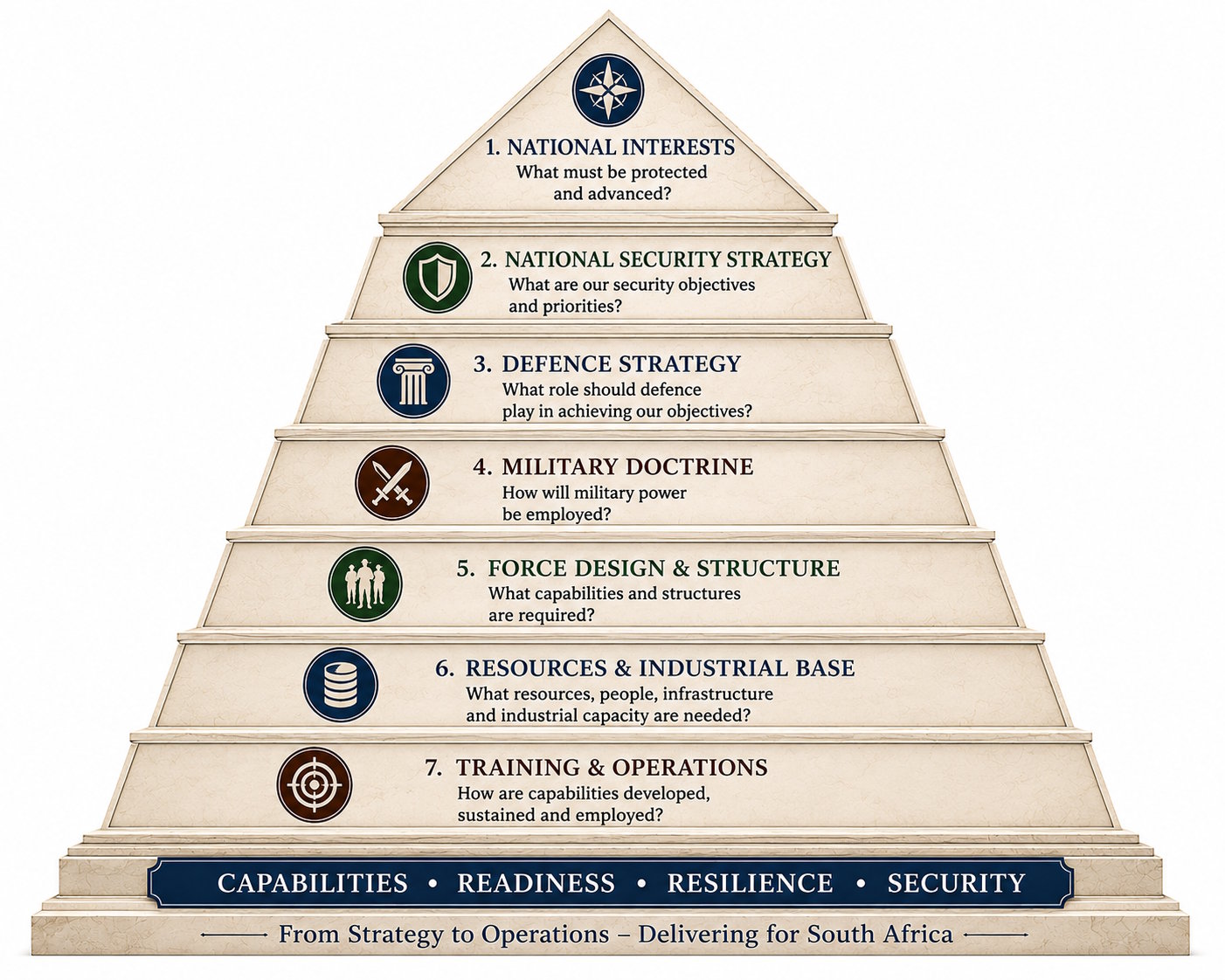
Figure 1: Strategy Hierarchy
The strategic hierarchy above illustrates a simple but important principle. Effective military capability does not begin with procurement, training or operations. It begins with a clear understanding of national interests and security objectives. Those interests inform national security strategy, which in turn shapes defence strategy, military doctrine, force design, resource allocation and ultimately operational capability.
Problems observed at the bottom of the pyramid are often symptoms of weaknesses higher up.
If national priorities are unclear, contested or inconsistently applied, downstream institutions will struggle to align their activities effectively. This does not necessarily imply incompetence or bad faith. Rather, organisations often perform according to the incentives, mandates and constraints within which they operate.
This observation may help explain why multiple stakeholders within South Africa’s defence ecosystem frequently express dissatisfaction, albeit for different reasons.
Industry organisations have raised concerns regarding regulatory predictability, export approvals and the long-term sustainability of the defence-industrial base. Civil society organisations have questioned the consistency of arms export decisions and their alignment with South Africa’s stated foreign policy principles. Parliament has highlighted governance and accountability concerns. Government departments continue to balance competing priorities relating to security, economic development, diplomacy and fiscal constraints.
Each stakeholder may be observing a different manifestation of the same underlying challenge.
The challenge is not merely governance.
The challenge may be strategic alignment.
In a recent article examining South Africa’s arms export controversy, I argued that tensions surrounding defence exports may reflect a broader challenge of strategic coherence within the country’s defence-industrial ecosystem. The same argument may apply more broadly to defence governance itself.
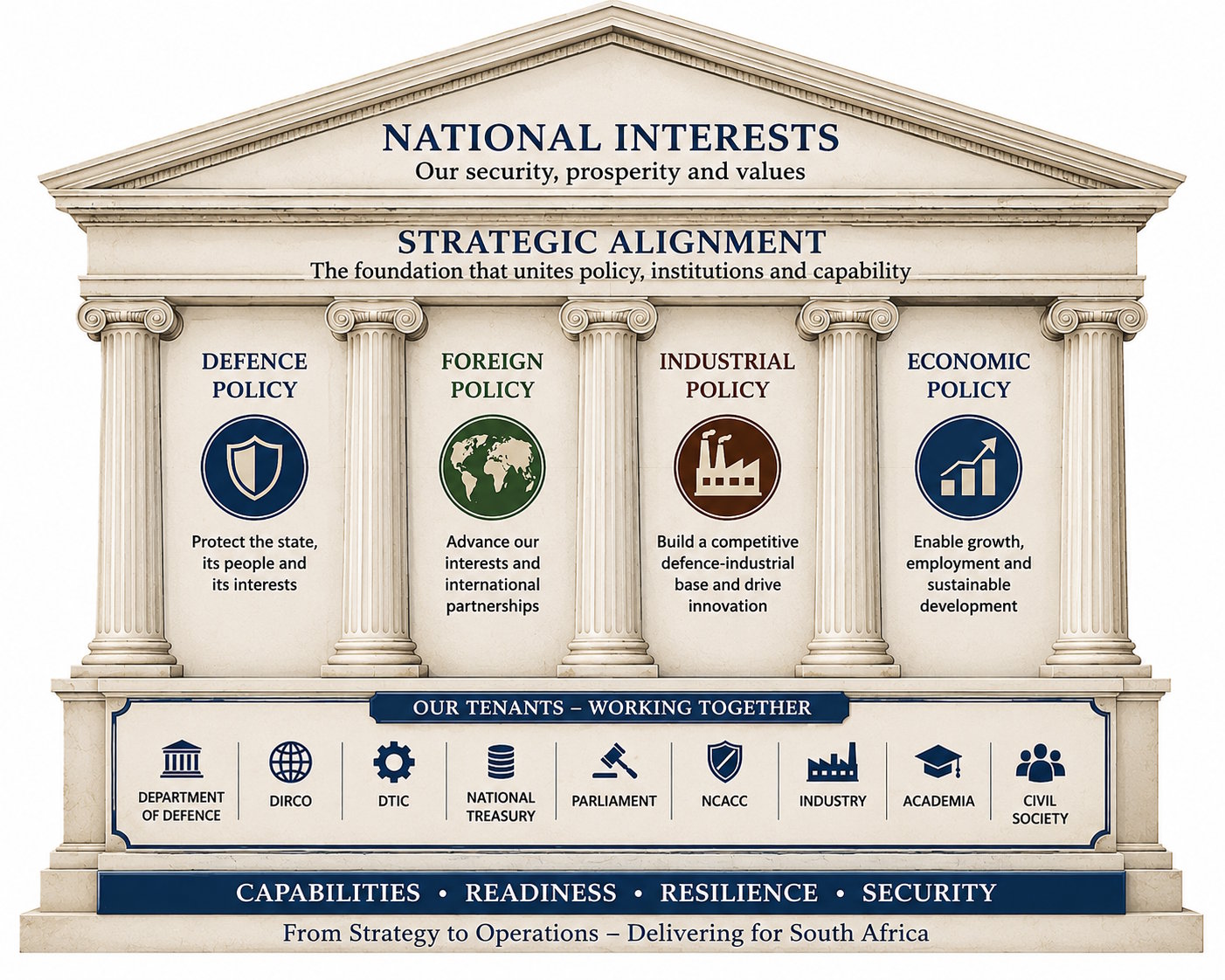
Figure 2: Pillars of Strategic Alignment
The second diagram illustrates this concept.
National interests sit at the top. Beneath them are several policy domains that should ideally reinforce one another: defence policy, foreign policy, industrial policy and economic policy. Supporting these pillars are the institutions responsible for implementing them, including the Department of Defence, DIRCO, the Department of Trade, Industry and Competition, National Treasury, Parliament, industry, academia and civil society.
The foundation supporting the entire structure is strategic alignment.
Without alignment, even capable institutions pursuing legitimate objectives can produce fragmented outcomes. Defence policy may become disconnected from available resources. Industrial policy may become disconnected from defence requirements. Foreign policy objectives may generate unintended consequences for industrial competitiveness. Oversight mechanisms may focus on compliance while broader strategic outcomes receive insufficient attention.
The result is often frustration among stakeholders who are each responding rationally to their own mandates but who lack a common framework through which competing objectives can be reconciled.
This brings us back to the question of another task team.
Perhaps the most important contribution such a body could make is not identifying additional governance failures. Many of those are already well documented.
Its real value may lie in helping South Africa answer a more fundamental question:
What strategic framework is required to align institutions, resources, capabilities and accountability in support of clearly defined national interests?
The answer may involve governance reforms. It may involve improved accountability mechanisms. It may require policy updates, institutional restructuring or enhanced coordination across government, industry and academia. It may even require revisiting assumptions that have guided defence planning and resource allocation for many years.
Whatever the answer, meaningful reform is unlikely to emerge from diagnosis alone.
The ultimate measure of success will not be the quality of another report. It will be whether the recommendations are translated into implementation, ownership and measurable outcomes.
South Africa’s defence sector does not appear to suffer from a shortage of diagnoses. It suffers from a shortage of implementation.
Perhaps the time has come to ask not merely what is wrong, but why previous attempts to fix it have so often fallen short—and what conditions are necessary to ensure that the next intervention succeeds where others have struggled.

NONGQAI’S Strategic Security Analyst Dr Joan Swart is a forensic psychologist with an MBA and an MA in Military Studies. Her work focuses on African security, geopolitics, state fragility, substate dynamics, and the intersection between governance, legitimacy, and coercive power. She is the author of several books and regularly publishes long-form analysis and opinion pieces on security and governance issues. Her writing has appeared in outlets including DefenceWeb, Maroela Media, Netwerk24, RSG, Visegrad, and other policy and public-affairs platforms. She has a weekly slot on SAfm The Global Briefing to analyse world affairs. Her work bridges academic research, policy analysis, and applied strategic assessment, and she is currently completing a second PhD at the University of Stellenbosch Military Academy. Follow her on X/Twitter, Substack, and LinkedIn.

That’s a really insightful point about implementation. It’s frustrating to see so much analysis without the follow-through – a strategic reset seems like a necessary shift.