Nongqai Vol 17 No 10F – National Intelligence Service – Covert Collection
0 Introduction
Excerpt
A personal and professional journey from the South African Railways Police to the National Intelligence Service, tracing the evolution of covert operations and the author’s role in shaping a new intelligence capability.
Abstract
This introduction provides the background to a series of publications chronicling the development of the Directorate of Covert Operations between 1986 and 1994. The author reflects on his early career in the South African Railways Police, his achievements within the Special Task Force, and his eventual recruitment into the National Intelligence Service. The narrative offers historical and professional insight into the formation of a covert intelligence structure while maintaining respect for legal and ethical obligations regarding classified information.
1
Excerpt
What began as specialised training support to the National Intelligence Service evolved into a career-defining transition into the world of intelligence and covert operations.
Abstract
This newsletter recounts the author’s first professional interactions with the National Intelligence Service through the provision of specialised training to elite VIP protection teams. It explores the relationship established with Director Jack C. Malan, the subsequent recruitment process, security clearance procedures, psychometric assessments, and the eventual acceptance of an intelligence appointment on 1 October 1986. The article illustrates how professional cooperation became the catalyst for a significant career transformation.
2
Excerpt
The establishment of a covert division required the creation of secure offices, administrative systems, cover identities, and operational structures from the ground up.
Abstract
This article describes the formative phase of establishing a covert operational division within the Directorate. It details the selection of service cover, acquisition of covert offices, recruitment of specialised personnel, development of administrative and financial systems, and implementation of strict compartmentation principles. Particular emphasis is placed on plausible deniability, operational security, and the creation of sustainable covert structures that enabled the Division to function effectively while remaining concealed.
3
Excerpt
A demanding endurance march through the Kalahari tested the physical resilience, mental endurance, and operational adaptability of Division K44’s operators.
Abstract
This newsletter documents a challenging 1987 endurance exercise undertaken by Division K44 through the Kalahari Gemsbok Park. Facing harsh terrain, water shortages, physical injuries, predators, and environmental hardships, the team relied on teamwork, discipline, and survival skills to complete the mission. The exercise reinforced core operational values and demonstrated the importance of adaptability, self-reliance, and collective resilience in preparing covert operators for demanding assignments.
4
Excerpt
Division K44 developed a unique training programme designed to prepare covert operators for independent action in complex and often hostile operational environments.
Abstract
This article examines the development and implementation of the specialised training programme used by Division K44. It outlines the philosophy, structure, and practical application of a curriculum that combined surveillance, countersurveillance, disguise, covert communications, target assessment, operational security, language acquisition, and realistic cross-border exercises. The programme sought to produce highly adaptable operators capable of functioning independently while maintaining the highest standards of professionalism, security, and operational effectiveness
General Comment:
Taken together, these first four newsletters and the introduction form an excellent historical narrative describing the origins, establishment, culture, training, and operational ethos of Division K44. The series combines personal memoir, organisational history, and professional intelligence practice, making it valuable not only to former intelligence practitioners but also to researchers interested in South African intelligence history and the development of covert operational capabilities.
Keywords
NI – K44, covert operator training, covert operators, surveillance, countersurveillance, intelligence collection, intelligence tradecraft, intelligence operations, intelligence structures, intelligence history, operational security, operational readiness, covert communications, cross-border operations, covert office, covert administration, covert operations, service cover, compartmentation, plausible deniability, recruitment, intelligence recruitment, security management, security clearance, disguise, National Intelligence Service, Directorate of Covert Operations, South African Railways Police, Special Task Force, Jack C. Malan, VIP protection, hostage negotiation, psychometric testing, career transition, national security, South African security history, Kalahari Gemsbok Park, endurance training, survival skills, teamwork, resilience, field exercise, leadership, professional development, historical memoir.
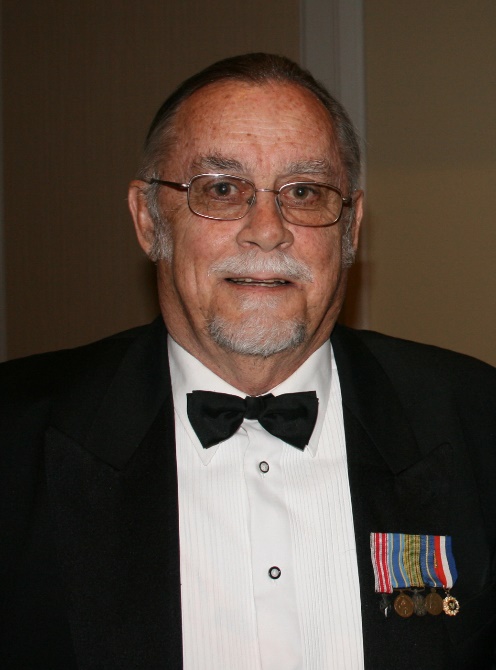
EDITORIAL NOTE: HENNIE HEYMANS
I have had a lifelong interest in intelligence and covert, sub rosa activities, and I have studied intelligence as an academic discipline. Throughout my police career and subsequent historical research, I have remained fascinated by the role intelligence has played in shaping events, influencing governments and safeguarding nations. Few subjects combine history, strategy, human nature and statecraft as completely as intelligence does. It is therefore a field that I regard with both professional respect and personal fascination.
Intelligence gathering is as old as South Africa itself.
The origins of intelligence in Southern Africa can be traced back to the seventeenth century when a shipwreck on the southern coast led the Dutch East India Company (VOC) to establish a refreshment station at the Cape of Storms, later known as the Cape of Good Hope. Communication between Amsterdam and the colonies relied on ships carrying correspondence, reports and vital information, forming the earliest intelligence networks in the region.
With the arrival of the British came the Royal Navy, colonial administration and the Foreign Office, all of which were experienced practitioners of intelligence collection and analysis. The authorities in the British colonies gathered information on matters affecting imperial interests, security and commerce. The Diamond Detective Branch was later established to protect the Crown’s substantial financial interests in the diamond fields.
The Boer republics developed their own intelligence capabilities through local officials such as the Landdrosts and Vrederegters, who maintained close knowledge of conditions within their districts and provided valuable ground-level information.
The Zuid-Afrikaansche Republiek Police (ZARP) established a secret service capability, variously known as the Geheime Dienst or Geheime Politie, under the authority of Attorney-General J.C. Smuts. During the Anglo-Boer War, scouts and intelligence operatives such as Danie Theron distinguished themselves through their exceptional reconnaissance and intelligence-gathering abilities.
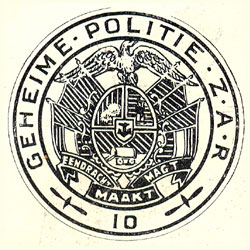
The South African Constabulary and the Transvaal Town Police also performed important intelligence functions during the post-war period.
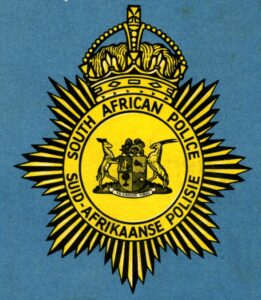
The South African Police (SAP) was founded on 1 April 1913. During the labour unrest, strikes and rebellions of the early twentieth century, including the Rand Revolt of 1922, the SAP played a significant role in gathering intelligence and maintaining internal security.
During the Second World War, Captain Jan Taillard rendered valuable service in South West Africa (SWA). Under the direction of Mr Esselen, Captain Taillard resigned from the SAP in order to undertake highly confidential intelligence assignments. His intelligence work contributed to the internment of pro-Nazi elements in the territory. He later played an important role in tracing and facilitating the arrest of Robey Leibbrandt.
The wartime Special Branch also rendered sterling service. As sworn police officers, its members served the government of the day and played a central role in monitoring and suppressing subversive activities. Many members of the Ossewabrandwag and its militant wing, the Stormjaers, were arrested as a result of intelligence operations.
The 1960s ushered in a new era characterised by sabotage and revolutionary activity. General Hendrik van den Bergh was appointed head of the Security Branch. Around this period, Advocate B.J. Vorster, General M.J. Keevy and Colonel H.J. van den Bergh met at the SAP Holiday Resort in Port Edward to discuss the establishment of the highly secretive Republican Intelligence Service (RIS), with its headquarters in Johannesburg and branches throughout the country.
Most members of the Republican Intelligence Service (RIS) subsequently formed the nucleus of the Bureau for State Security (BfSS), later known as the Bureau for State Security (BfSS) under the leadership of General Hendrik van den Bergh. BOSS became South Africa’s first fully-fledged civilian intelligence service and expanded the state’s intelligence capabilities beyond traditional police and military functions. Its responsibilities included strategic intelligence, counterintelligence, foreign intelligence collection and the coordination of national security matters.
During the decades that followed, South Africa’s intelligence community continued to evolve in response to the Cold War, regional conflicts in Southern Africa, revolutionary threats and changing political realities. This evolution resulted in the creation of specialised organisations, each tasked with distinct intelligence and security responsibilities.
Several South African intelligence organisations subsequently developed specialised covert capabilities:
- The SAP Security Branch later established an Intelligence Division.
- National Intelligence (NI) maintained a dedicated covert operations component.
- The South African Defence Force (SADF) operated the Directorate of Military Intelligence (DMI) and later the Civil Cooperation Bureau (CCB).
Throughout this long history, intelligence officers, policemen, soldiers, diplomats and covert operators worked largely in anonymity. Their successes were seldom publicised, and their failures often remained hidden behind the veil of secrecy. Yet their efforts contributed significantly to the defence, stability and strategic decision-making of the state during the periods in which they served. Understanding their story is essential to understanding the broader history of South Africa itself.
As a student of intelligence history, I regard this as one of the most fascinating and least understood aspects of South Africa’s past. While much has been written about overt political and military events, comparatively little is known about the men and women who operated in the shadows, often anonymously and without recognition. Their contribution deserves to be recorded and preserved as part of our national historical heritage.
It is against this historical backdrop that we now turn our attention to one of the least-known chapters in South African intelligence history: the Chief Directorate Covert Operations (CDCO) of the former National Intelligence Service (NIS).
Many respected students of intelligence history remain unaware of the existence, scope and achievements of this highly compartmentalised covert capability. Even some former intelligence officers knew little of its structure because of the strict need-to-know principle under which it operated. The story that follows is therefore not merely an intelligence story. It is an important chapter in South Africa’s history that has remained hidden from public view for far too long.
Lifting the veil
The following chapters, based on the experiences and recollections of Mr Johan Lotriet and Dr Tony Turton, provide a rare glimpse into this secret world.
Mr Lotriet, the former commander of the covert component within National Intelligence, and Dr Turton, one of the pioneering covert operators recruited into the system, were uniquely placed to record this history. Their accounts shed light on a capability that operated quietly and professionally during a critical period in South Africa’s development.
Whatever one’s political views may be, historical honesty requires acknowledging the dedication, professionalism and personal sacrifices of those who served in these structures. Many undertook difficult and often dangerous assignments with little expectation of recognition. Their successes remained classified, and their stories untold.
For too long, the history of South Africa’s covert intelligence capability has remained behind a veil of secrecy.
The chapters that follow seek to lift that veil.
HENNIE HEYMANS

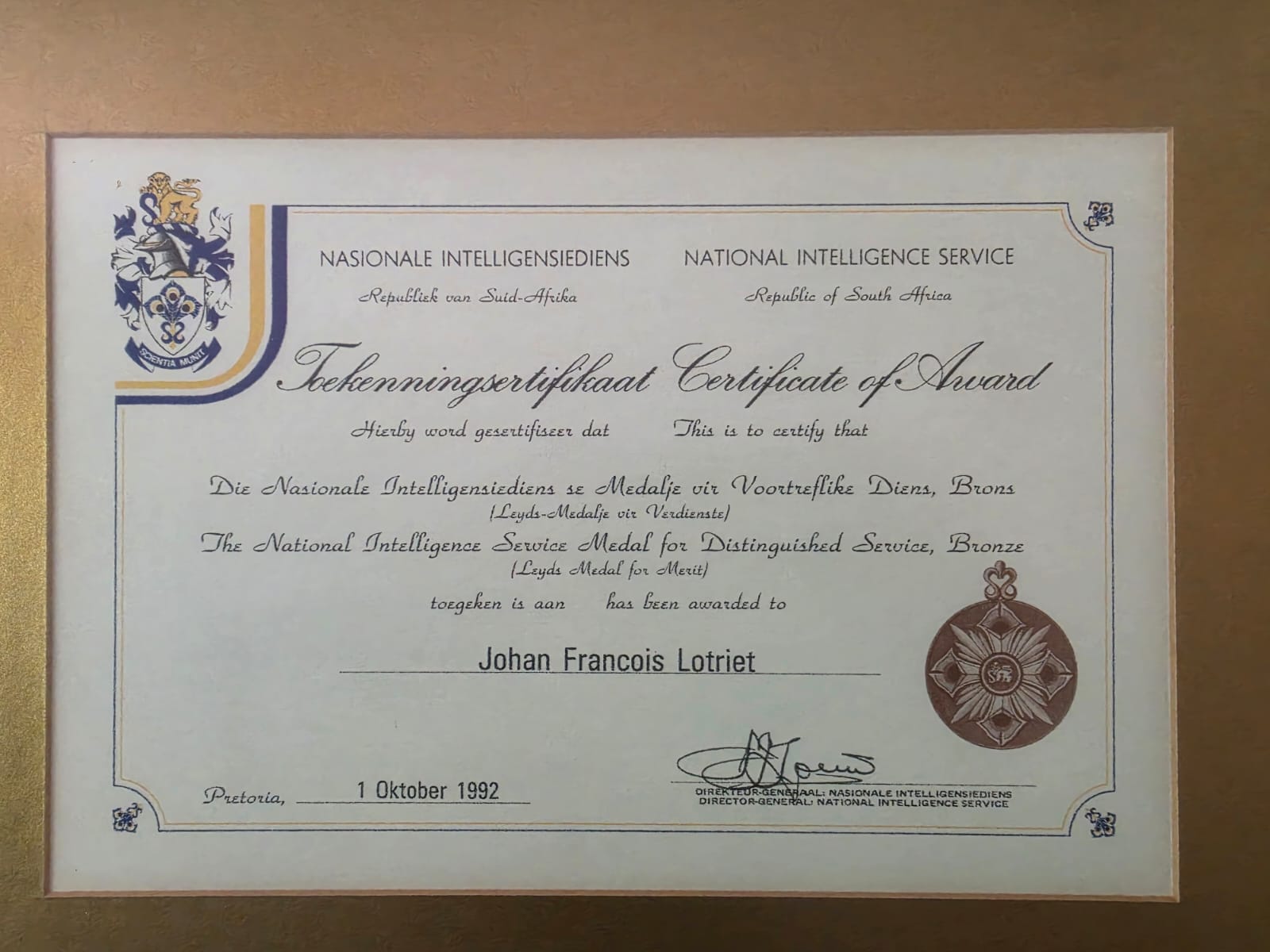
We pay tribute to Mr JL Lotriet, OOB
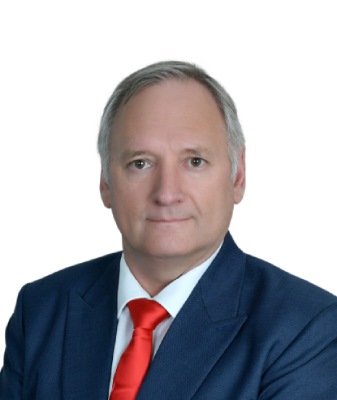
Dr Tony Turton
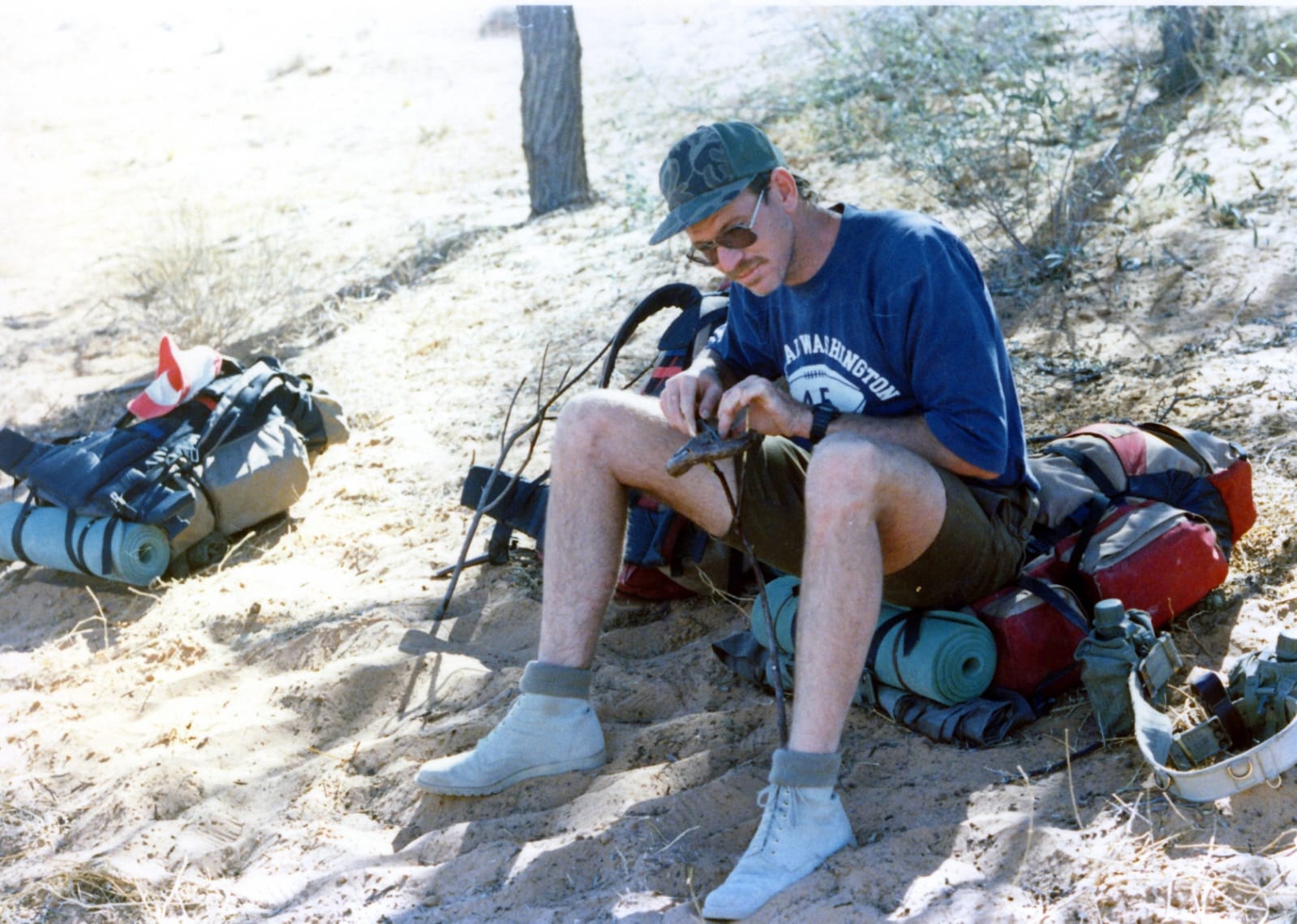
Anthony Turton during a Vasbyt in the Kalahari in the early days of K44.Anthony Turton during a Vasbyt in the Kalahari in the early days of K44.
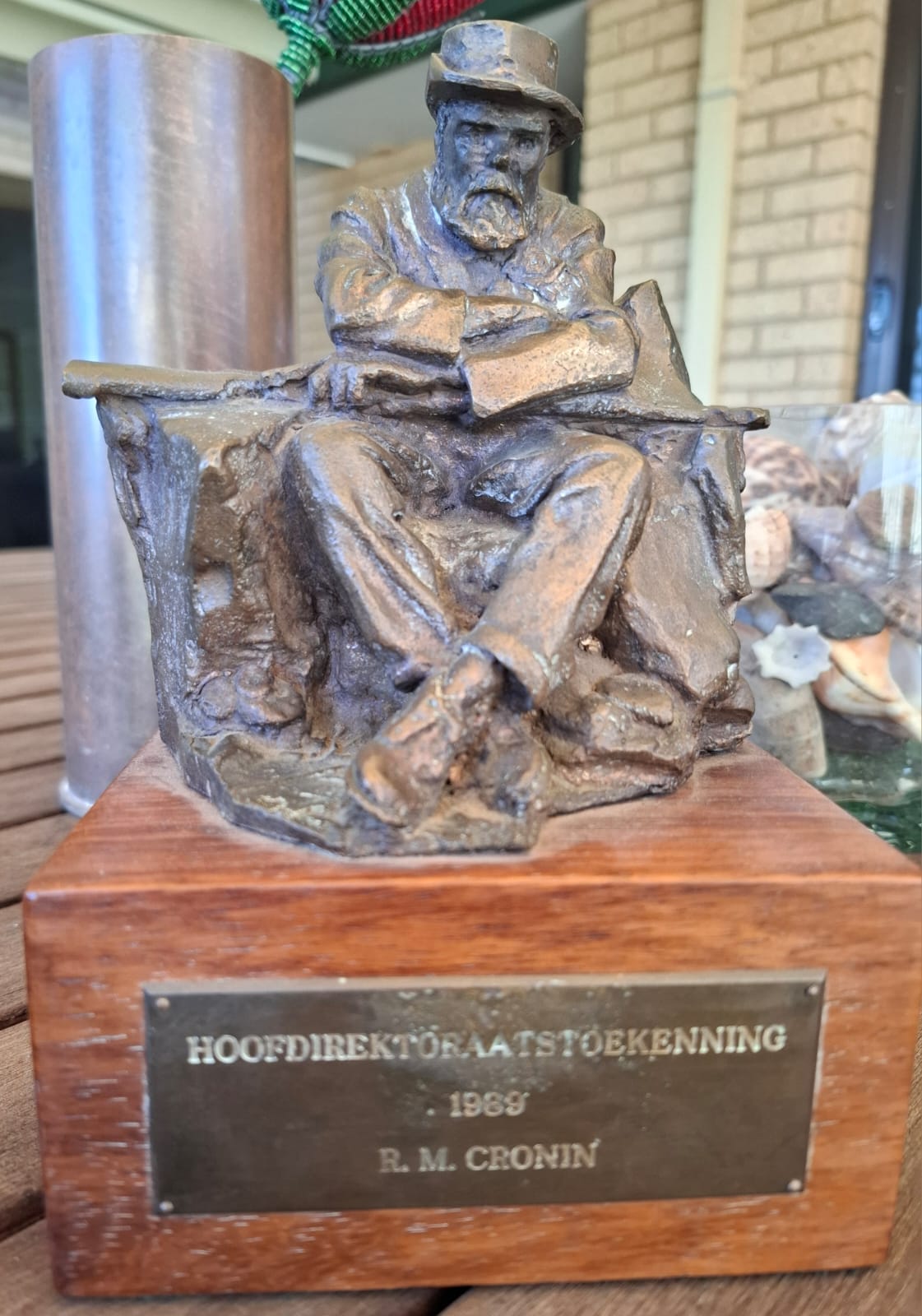
The Chief Directorate Award 1989. Dr Turton’s Service Name was Roger Cronin.


Compiled by: Johan F Lotriet, OOB
INTRODUCTION
A Journey Through the Directorate of Covert Operations (DCO): 1986–1994
My involvement with the Directorate of Covert Operations between 1986 and 1994 forms the core of this series of reflective publications. However, this story cannot be fully understood without acknowledging the path that brought me to that point, a journey that began in 1971 when I commenced my career with the South African Railways Police in Port Elizabeth.
What initially started as a young man’s entry into the uniformed service soon evolved into a career characterised by dedication, academic excellence, and increasing levels of responsibility. During my fifteen years in the South African Railways Police, I served in a variety of capacities, each contributing to the development of my professional identity. These years were not merely a preparation for what would follow; they were a period of intense growth, achievement, and personal development.
During basic training, I had the privilege of graduating as the top student with an average of 100%, an achievement that clearly began to shape both the direction of my career and the expectations placed upon me. Later, during my instructors’ course at the Infantry School in Oudtshoorn, I once again achieved distinction as the top student. This combination of academic and practical excellence not only confirmed my own capabilities but also positioned me to play a meaningful role in developing new operational capacities within the South African Railways Police.
In 1975, I had the distinct privilege of being a founding member involved in the establishment and training of the Special Task Force, an elite unit that would later become an integral component of the South African Railways Police’s operational capability. My involvement deepened over the years, and I eventually advanced to the position of third Commanding Officer of the Special Task Force. In this role, I devoted myself not only to strengthening the unit but also to developing it into a permanent, highly professional, and internationally recognised capability. The ethos of discipline, precision, and operational integrity that characterised the Special Task Force would shape my career forever.
With the amalgamation of the South African Railways Police and the South African Police in 1986, a new door opened. I was recruited and appointed by the National Intelligence Service (NIS), a transition that added an entirely new dimension to my career. The skills, experience, and leadership I had acquired over fifteen years enabled me to progress rapidly in an environment where discretion, analytical ability, and operational insight were of critical importance.
By 1986, I had taken my first steps into the world of Covert Operations, a domain that was still in its conceptual infancy at the time. The Directorate had yet to establish its identity, structure, and functional framework amidst a complex and evolving national security environment. What I witnessed during these years was the evolution of an organisation from an embryonic concept into a highly effective, structured, and professional entity.
The purpose of this series is not to expose operatives, operations, or classified information. I remain fully bound by the Protection of Official Secrets Act and will continue to operate strictly within the boundaries of legal and ethical responsibility. What I do seek to provide is a personal, historical, and professional account of the development of a Directorate that played an indelible role in both my career and my understanding of national security.
This foreword serves as the introduction to a chronological journey, a journey through the formation, growth, and maturity of the Directorate of Covert Operations, and through my own role within it. It is a tribute to the people, the structures, the ethos, and the path we travelled together.


Compiled by: Johan F Lotriet, OOB
NEWSLETTER 1
Initial Contact with the National Intelligence Service, Training Provided to Them, and the Subsequent Recruitment: A Professional Crossroads (1984–1986)
By the mid-1980s, the South African Railways Police Special Task Force had already established a reputation for operational excellence, rigorous training standards, and a unique capability to manage high-risk situations. As Commanding Officer of the Unit, I carried not only the responsibility of maintaining these standards but also of sharing the Special Task Force’s expertise with other security agencies whenever it served the national interest.

It was within this context that my first formal contact with the National Intelligence Service (NIS) took place, a relationship that would ultimately have a profound impact on the direction of my career.
Collaboration with Director Jack C. Malan: The Beginning of a Professional Association
From approximately 1984 onward, I provided annual specialised training to the VIP Protection Teams (Takkraal), an elite protective component under the command of Director Jack (“Skipper”) Malan of the NIS, a man for whom I held the highest professional regard and whose legacy is still recognised within the security community today.
The training I presented was highly specialised and focused on critical skills essential for the protection of high-profile principals:
- Identification and handling of foreign weapons.
- Practical exposure to and identification of improvised explosive devices.
- Understanding the dynamics of the Stockholm Syndrome during hostage situations.
- The use of helicopters for the rapid extraction of VIPs and protection teams.
This training not only enhanced the capabilities of the VIP protection teams but also established a professional bridge between the Special Task Force and the NIS.
Following the completion of the Hostage Negotiation Course, developed in conjunction with the Military Psychological Institute (MPI), the Special Task Force subsequently provided two complete training and certification modules to the National Intelligence Service (NIS). These modules formally qualified NIS personnel as hostage negotiators and formed part of the early interdepartmental cooperation between the South African Railways Police Special Task Force and the NIS during the mid-1980s.
The Amalgamation and a Life-Changing Question
When the South African Railways Police and the South African Police were amalgamated, the security landscape underwent significant change. It was during this period of structural reorganisation that Director Malan approached me with a question that would redefine my career:
“Would you consider a career in the National Intelligence Service?”
This question was not asked lightly. The NIS did not advertise vacancies or conduct public recruitment campaigns. Recruitment was undertaken through talent scouts, individuals responsible for identifying people with the potential, character, and suitability required for the unique demands of intelligence work.
My exposure to the NIS during the years of training had already left a lasting impression:
- The quality of the people was exceptional.
- The facilities were modern, well managed, and purpose-built.
- Their methods and procedures were professional, structured, and highly impressive.
My answer was affirmative.
Recruitment, Interviews, and Security Clearance: The Gateway to a New Career
Shortly after my acceptance in principle, an NIS recruitment officer contacted me for a comprehensive interview. The process was thorough, demanding, and highly professional. This interview was followed by a complete security clearance process, a standard requirement for any candidate being considered for a sensitive position.
Upon successfully obtaining security clearance, I underwent psychometric testing, which I passed. These assessments measured more than suitability alone; they evaluated the ability to function in an environment where discretion, analytical thinking, and emotional stability were critical requirements.
The positive outcome held considerable significance for me. It confirmed that I was not merely an applicant, but someone identified for a specific role, an acknowledgment that I accepted with both pride and humility.
The Offer and a New Beginning: 1 October 1986
The National Intelligence Service eventually extended a formal offer to me. Not only was it favourable when compared to my salary as a Captain, but it also presented an opportunity to become part of an organisation playing a crucial role in the strategic security of the country.
I accepted the offer.
On 1 October 1986, my journey with the National Intelligence Service began.
It marked the beginning of a new chapter, one in which the experience, training, and leadership I had gained in the Special Task Force would find new application within the fields of covert operations, intelligence gathering, and strategic security work.
Concluding Reflection
The initial contact with Director Jack C. Malan, the training presented to the VIP protection teams, and the subsequent recruitment process collectively formed a crossroads that would permanently alter the course of my career. What began as professional cooperation evolved into an opportunity to join an organisation that fulfilled a unique and critical role in safeguarding the nation.
This article serves as a historical account of that transition, a fitting acknowledgment of the people, processes, and circumstances that shaped my path to the National Intelligence Service.


Compiled by : Johan F Lotriet : OOB
NEWSLETTER #2
The First Meeting with MCB and the Establishment of the Division
My first meeting with MCB, the Divisional Head and my direct superior until my transfer in 1990 to another section within the Directorate, laid the foundation for the creation of a unit that would eventually play a critical role in the covert operational capability of the Directorate. Even during these initial discussions, it became clear that MCB occupied a unique position: he was the only person with direct access to the Chief Directorate Headquarters and to the Chief Director, Mike Kuhn. This exceptional access made him the primary link between the Division and the highest level of the Chief Directorate.
The Selection of an Appropriate Service Cover
One of the first subjects MCB and I addressed was the selection of an appropriate name for the Service Cover. This cover was essential for all correspondence, salary payments, and administrative activities and therefore had to be both credible and sustainable. The finalisation of the Service Cover became the first formal step in establishing the Section.
Responsibilities and Nature of the Division
Our discussions also focused on the nature and scope of the Division’s responsibilities. It was clear that the Division would need to identify and recruit members who met a specific profile, individuals possessing the necessary discipline, operational mindset, discretion, and the ability to function effectively undercover.
Management of the Office and Personnel
Although MCB was the only individual with access to Headquarters and the Chief Director, the management of the Covert Office and its personnel was entirely my responsibility. Administrative operations, internal processes, financial systems, and the operational support structure all fell within my mandate. This division of responsibilities created an essential security buffer and reinforced the principle of compartmentation.
The Acquisition of a Covert Office
Securing a Covert Office with sufficient space and facilities for operators was one of the most significant initial challenges. Once suitable premises had been acquired, the office cover was quickly formalised, and a bank account for the payment of expenses was established with little difficulty.
Cash Purchases of Furniture, Vehicles and Operational Equipment
Because no National Intelligence Service structures could be utilised for procurement purposes, all furniture, office equipment, and operational resources had to be purchased in cash. These acquisitions ranged from basic office furnishings to specialised equipment required for covert operations.
The same principle applied to the purchase of vehicles intended for operational deployment. The use of cash transactions was essential to conceal entirely the existence of the Division, its financial footprint, and its operational capabilities.
Alarm Systems and Security
The installation of alarm systems and the security of the offices were major priorities. The nature of the Division’s activities required that the office be not only physically secure but also subject to strictly controlled access. The security system became an integral part of the cover arrangement and enhanced the credibility of the office as a legitimate business enterprise.
The Initial Salary Process
During the initial phase, no formal salary system existed. Salaries were distributed monthly to members in brown envelopes, which I personally collected from MCB’s residence. Although necessary for maintaining cover, this method initially caused administrative and operational delays. Over time, the process was refined and streamlined, resulting in a more stable administrative routine.
The Absence of Regulations and the Creation of Policy Frameworks
During the formative phase, it became apparent that no existing regulations governed covert arrangements, the operation of covert offices, security, administration, or financial management. This gap required me to devote a considerable amount of time to drafting and implementing policy and procedural documents. These documents laid the foundation for the effective functioning of the Section.
The Team Takes Shape
Following the formal recruitment process, the team quickly began to take shape. It consisted of members drawn from the Special Task Force, Special Forces, a pilot from the South African Air Force, and other specialised individuals. This diversity of skills created a unique operational capability.
The Establishment of Covers and Legends
Initially, considerable time was devoted to establishing Service Cover, Personal Cover, and Operational Cover. The creation of legends, credible alternative identities, required the severing of ties with close family members and friends, a process that demanded considerable personal sacrifice.
Administrative Systems and Compartmentation
The establishment of filing systems for both the Covert Office and operational matters was a priority. Members were familiar with one another’s covert service names, but strict compartmentation played a critical role in enforcing the need-to-know principle. Only MCB and I were fully informed about all aspects of the Division, an essential security measure that ensured the integrity of the operational structure.
The Implementation Phase
The complete implementation of these systems, cover arrangements, recruitment processes, administrative structures, and operational frameworks took approximately one year. This period was characterised by intensive effort, continuous refinement, and the establishment of a Division that would ultimately play a key role in the covert operational capability of the Directorate.
A core principle embedded throughout the design and execution of these frameworks was that of plausible deniability. Every operation, covert structure, and administrative process was developed in such a manner that the identities of operators, the involvement of the organisation, and the true nature of activities were separately protected and, where necessary, could be credibly denied. This principle was not merely a security precaution but a fundamental operational requirement that safeguarded the integrity of sources, the security of personnel, and the strategic objectives of the Directorate.
The successful application of plausible deniability required that all elements of the system be seamlessly integrated, ensuring that no single action, record, or administrative trail could compromise the organisation’s ability to distance itself from sensitive operations. The effectiveness of this approach depended on meticulous planning, disciplined execution, and a culture in which operational security was regarded as an absolute priority.
This implementation phase ultimately transformed a concept into a fully functional covert capability, providing the Division with a secure, resilient, and highly adaptable operational platform capable of supporting a broad spectrum of sensitive intelligence activities.


Prepared by Johan F Lotriet, OOB
Newsletter # 3
Endurance on Foot: The K44 Division’s March Through the Kalahari Gemsbok Park, July 1987
Introduction
July 1987 wrote a unique chapter in the history of Division K44. At a time when the development of multi-disciplinary covert capabilities was essential, an endurance exercise on foot through the Kalahari Gemsbok Park was launched — a test designed to measure the physical, mental, and operational resilience of the small, specialised team.
With strict park regulations, limited resources, predators, winter cold, and the unforgiving terrain of the Kalahari as constant companions, the exercise became a test of character, discipline, and adaptability. It was a trial that would define the spirit and culture of Division K44.
The Team: A Fusion of Expertise
Division K44 consisted of only nine members — a deliberate combination of diverse skills:
- operators from the Special Forces,
- specialists from the South African Air Force,
- members of the Special Task Force,
- academics,
- and other professionals from various sectors.
This diversity formed the core strength of the Division: covert operations require not only tactical skill, but intellectual flexibility, technical insight, and the ability to function together in unpredictable environments.
Preparation for a Week of Endurance
The team prepared for a full week on foot. Each member had to operate independently and be fully equipped:
- backpacks, food, and water,
- sleeping bags and basic gear,
- medical kits,
- flashlights (Toors),
- an HF radio with predetermined frequencies and communication schedules,
- and a bottle of Old Brown sherry for the cold nights.
Twee Rivieren: The Formal Starting Point
The team travelled by bus from Pretoria to Twee Rivieren, where they met the park warden, Joep le Riche — a man with deep knowledge of the park and an unwavering focus on safety.
Joep handed the team a detailed map of the Kalahari Gemsbok Park, indicating windmills that supposedly had fresh water — critical points for a week‑long trek in a dry desert environment.
Here the team also met their guide: Vet Piet, a legend in his own right — simple, experienced, and with an intuitive understanding of the Kalahari.
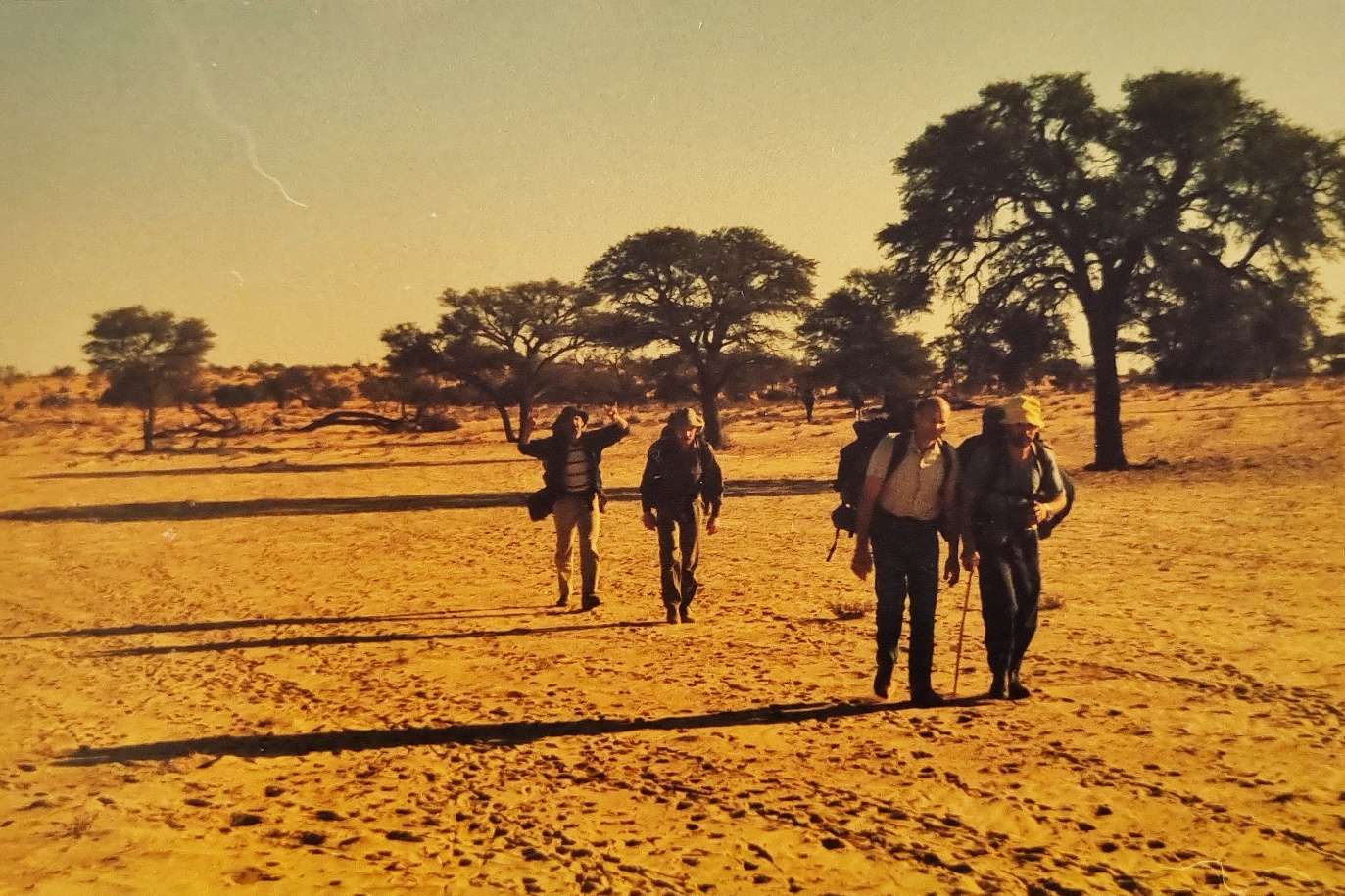
Drop-off point
Encounter with the Brown Hyena or Strandwolf
Upon being dropped off in the northern part of the park, near the Namibian border, the group immediately encountered a long‑haired brown hyena or strandwolf — a large, curious, and unpredictable animal that followed the team at a distance for several days.
Its presence was not aggressive, but constant. It created an atmosphere of tension that continually reminded the team of the reality of the Kalahari: Its presence was not aggressive, but constant. It created an atmosphere of tension that continually reminded the team of the reality of the Kalahari: You are never alone here.
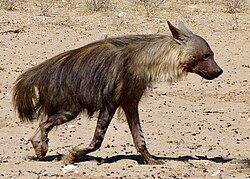
Brown Hyena or Standwolf
After the sobering discovery that the water from the first windmill (shown in the picture) was saline, the team faced a dilemma. Without water progress would be slow. The water was so saline that when mixed with the energy drink in the rat packs a chemical reaction caused a curdling process. One member trued to drink it and immediately began to retch.
That’s when Vet Piet explained how to find the Tsammas. The team loaded them into our backpacks with relish. They were heavy but life-saving. They also smelt bad when opened, so it took self-control to actually devour the fruit.
With backpacks fully laden with Tsammas, the journey continued, with the hyaena a constant shadow trailing about 20 metres behind the last man in the line snaking its way through the desert and over the mouse tunnels.
After a day or so of its menacing presence, one member decided to chase the hyaena away by throwing a Tsamma at it. Landing with a thud in front of the hyaena, he never blinked an eye. Glancing inquisitively between the Tsamma and the thrower, it advanced furtively. After sniffing it, the hyaena looked at the thrower, opened its jaws and crunched the contents with the ease of a desert dweller that knows stuff that visitors don’t. His eyes never left the thrower while the entire Tsamma was consumed.
Those were mind games of an intensity that tested the men while forging them into a single unit with laser focus on the mission ahead.
The Route: A Trial of Sand, Tracks, and Endurance
The team moved southward on foot — across sand dunes, dry riverbeds, grass plains, and vast silence. Their pace was constantly dictated by the terrain.
Soft sand and mouse colonies
Large sections of the route consisted of soft, loose sand that made every step a struggle. In addition, the Kalahari’s mouse colonies — underground tunnels and cavities — caused members to sink up to their knees in certain areas.
This dramatically slowed the pace and increased the physical strain on every member.
Foot injuries and pain
The terrain took its toll:
- toenails were lost,
- blisters tore open,
- feet became raw and swollen,
- and the sand worsened every wound.
In primitive field conditions, there was little room for comfort — each member simply had to keep moving.
Mathalyte: The red miracle
For blisters, there was only one remedy: Mathalyte — the red antiseptic liquid that “burns everything out.”
Mathalyte healed the blisters, but it burned every last bit of pain out of the wound. The pain was intense, but the effect undeniable. It enabled the team to continue walking, day after day, kilometre after kilometre
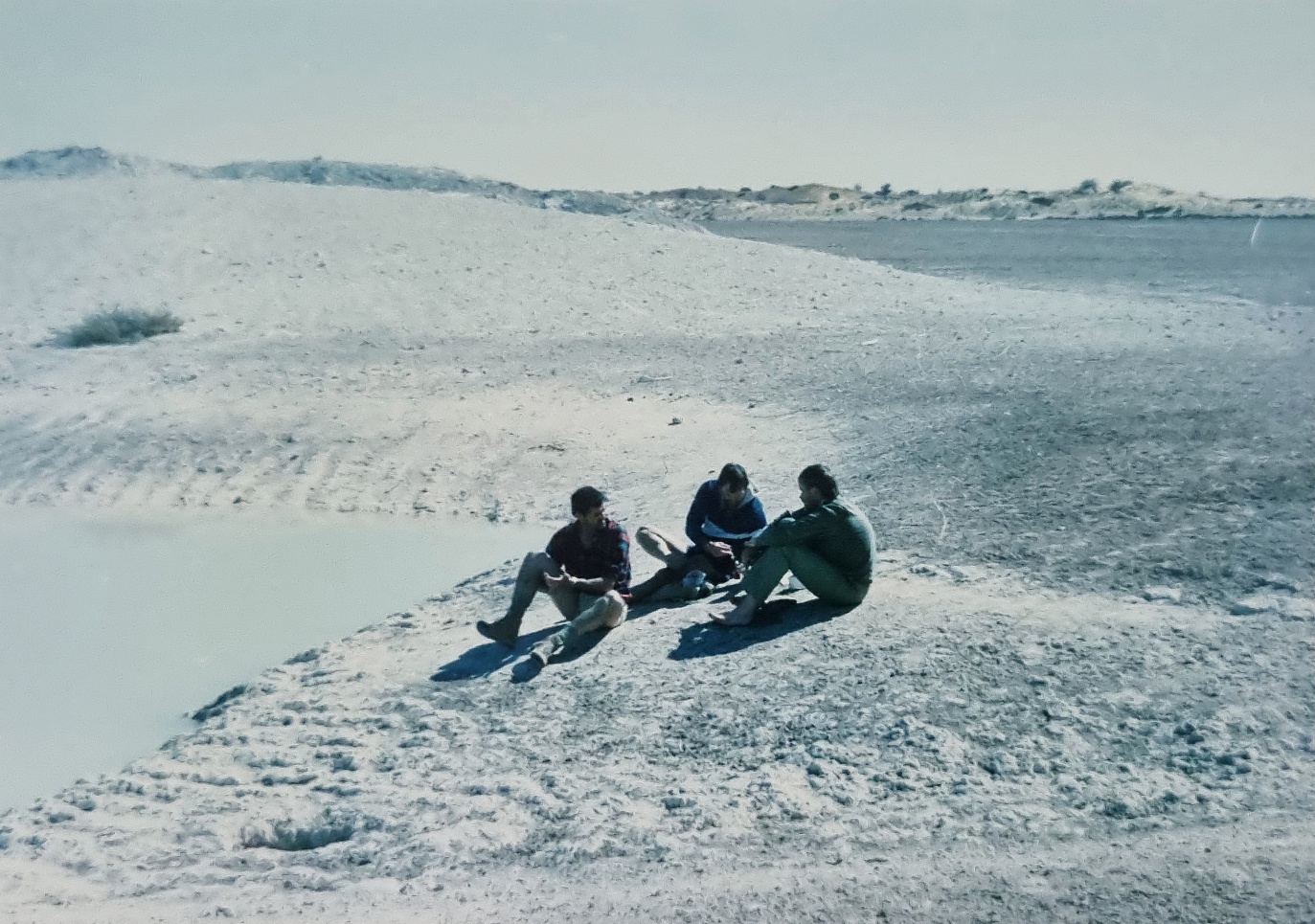 .
The author is treating his blisters with Mathalyte
The Water Crisis: An Unforeseen Trial
The map provided by Joep indicated windmills with fresh water. But upon reaching the first points, a harsh reality became clear:
- Many windmills had no fresh water.
- Some did not work at all.
- Others produced only brackish water — undrinkable and dangerous.
After the sobering discovery that the water from the first windmill (shown in the picture) was saline, the team faced a dilemma. Without water progress would be slow. The water was so saline that when mixed with the energy drink in the rat packs a chemical reaction caused a curdling process. One member tried to drink it and immediately began to retch.
That’s when Vet Piet explained how to find the Tsammas. The team loaded them into our backpacks with relish. They were heavy but life-saving. They also smelt bad when opened, so it took self-control to actually devour the fruit.
With backpacks fully laden with Tsammas, the journey continued, with the hyaena a constant shadow trailing about 20 metres behind the last man in the line snaking its way through the desert and over the mouse tunnels.
After a day or so of its menacing presence, one member decided to chase the hyaena away by throwing a Tsamma at it. Landing with a thud in front of the hyaena, he never blinked an eye. Glancing inquisitively between the Tsamma and the thrower, it advanced furtively. After sniffing it, the hyaena looked at the thrower, opened its jaws and crunched the contents with the ease of a desert dweller that knows stuff that visitors don’t. His eyes never left the thrower while the entire Tsamma was consumed.
Those were mind games of an intensity that tested the men while forging them into a single unit with laser focus on the mission ahead.
Kalahari Cucumber and Tsammas: Survival from the Sand
Vet Piet taught the team how to:
- find Kalahari Cucumber — a plant with a spongy, water‑holding core,
- locate Tsammas — a root plant traditionally used by San communities to obtain water.
These plants carried the team through the critical phase.
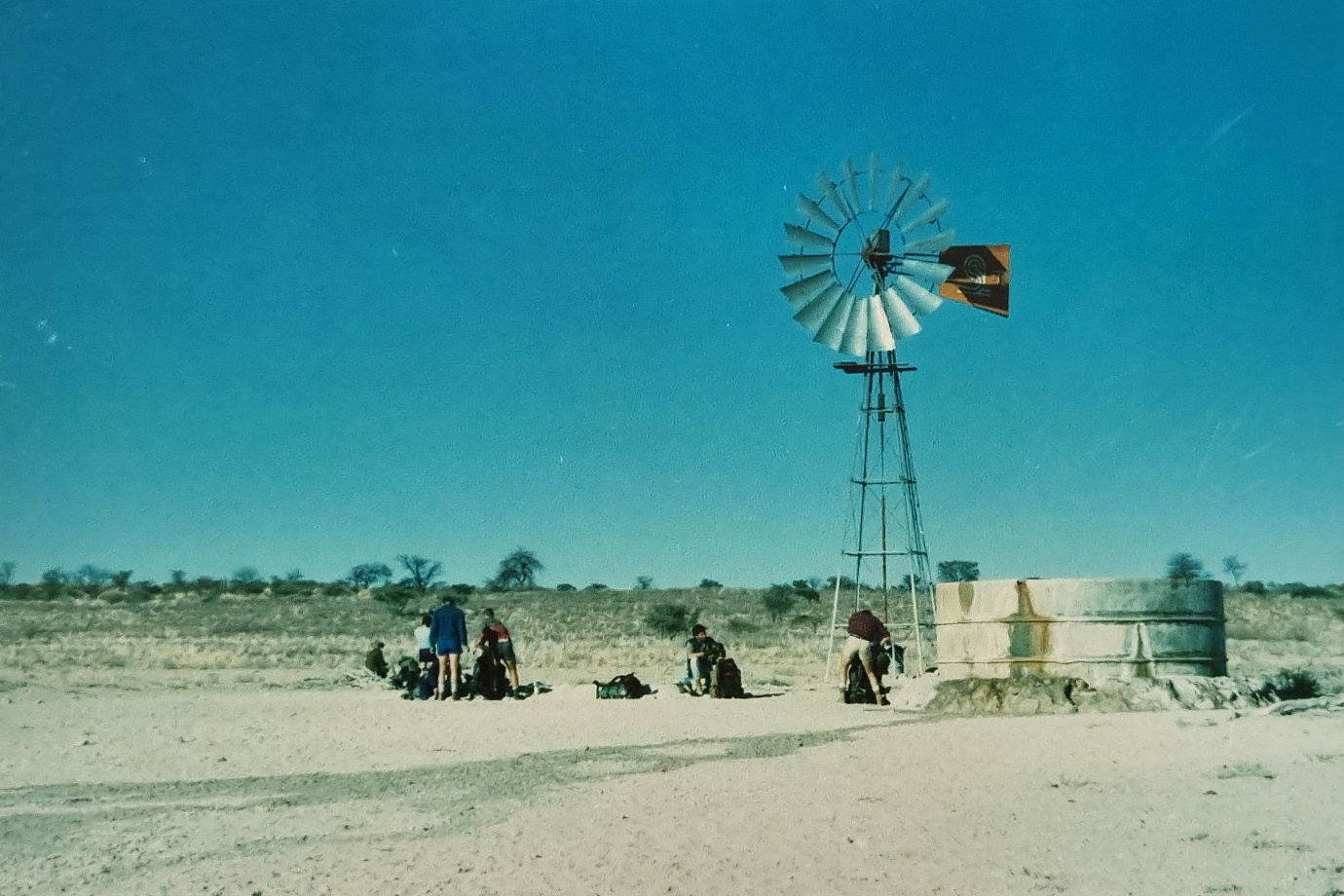
Most of the watermills supplied only brackish water and were therefore undrinkable.

Kalahari water melon
Night Safety: The Design of the Laager
The constant presence of the brown hyena, the tracks of lions, and the knowledge that other predators were nearby forced the team to design a structured laager for every night’s rest.
The laager was built around the fire, with:
- backpacks on the outside,
- members sleeping with their heads toward the fire,
- and the fire as the central protective element.
The logic was simple:
If a predator grabbed something, it would likely grab a backpack — not a man.
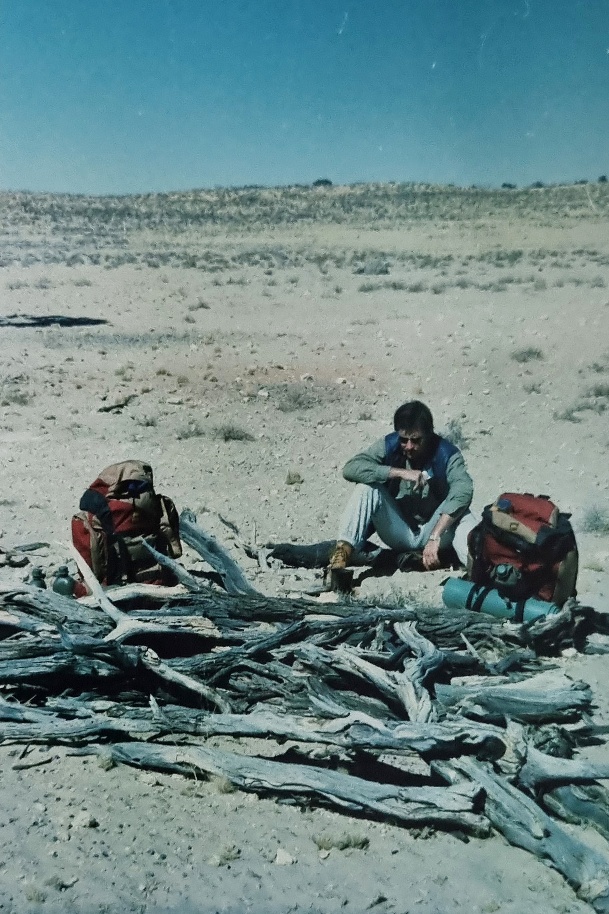
Enough firewood had been secured to keep the animals at bay throughout the night.
The primary purpose of the guard roster was to ensure that the fire remained burning high, so that it not only provided warmth but also served as a deterrent. Should a dangerous animal approach, the guard had to make as much noise as possible to scare it off and protect the group. On the first night, Vet Piet asked whether everyone had torches.
The group answered affirmatively, but when the first guard produced his Mini Maglite, Vet Piet’s expression changed instantly. Clearly upset, he exclaimed that the light was far too weak and that the lions would undoubtedly devour us. To calm him down, the men offered Vet Piet half a cup of Old Brown Sherry. He downed it in one decisive gulp—and barely thirty minutes later he was fast asleep, snoring loudly, with no further concern about the lions.
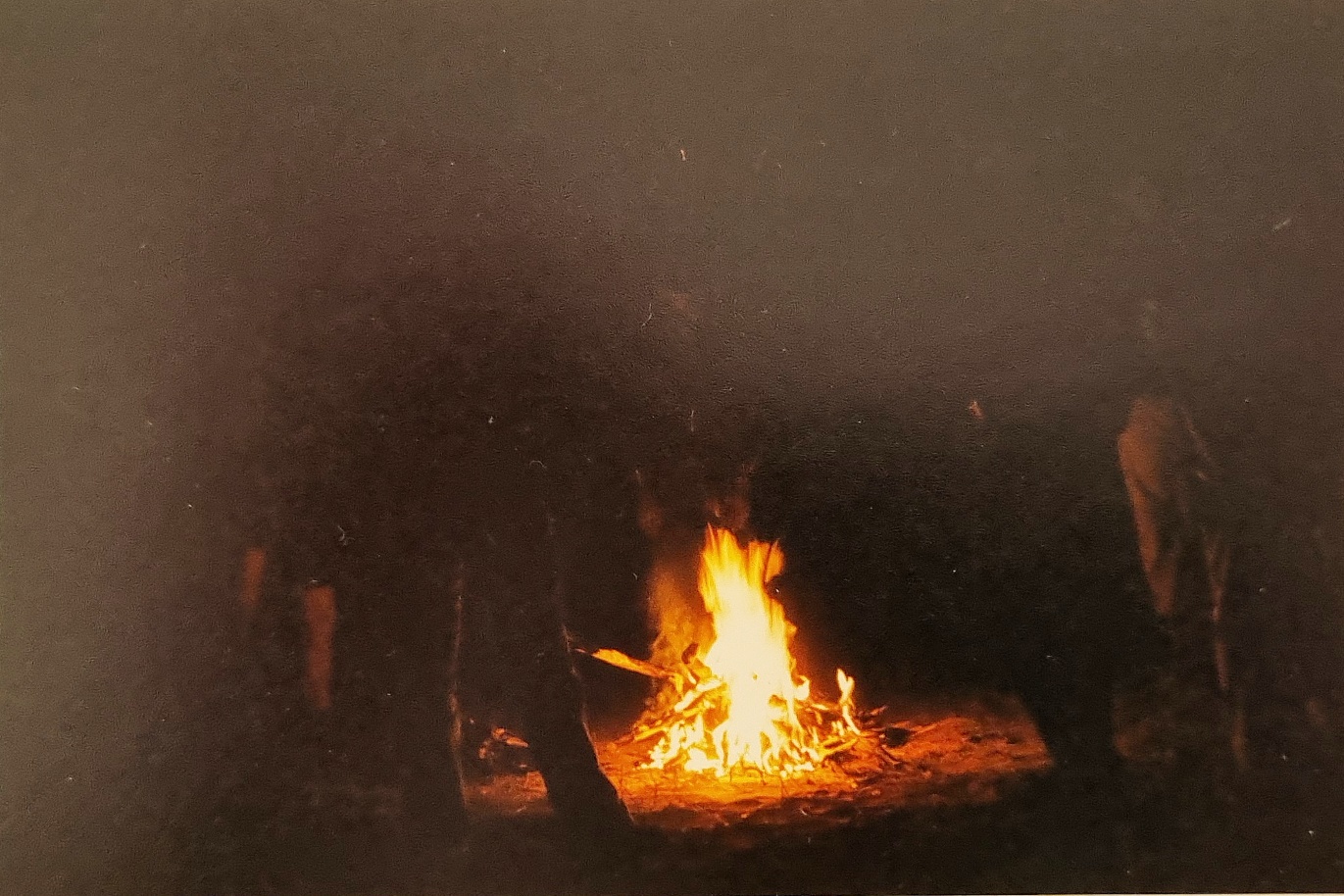
The laager was built around the fire
Prof. Fritz Eloff’s Camp: An Unexpected Oasis and a Piece of History
At one point along the route, the team came upon an overnight camp built by Prof. Fritz Eloff — a simple but ingenious structure consisting of:
- wooden poles,
- wire mesh,
- and corrugated iron sheets as a roof.
The camp was primitive, but it offered a sense of shelter and safety in an environment where predators were never far away. The team spent a night here — a welcome relief after days of open terrain, sand dunes, and constant vigilance.
The camp also had academic significance: Prof. Eloff used it as a field base for his research on the Kalahari lions, work that would eventually lead to the publication of his authoritative book on the behaviour, distribution, and ecology of these iconic predators.
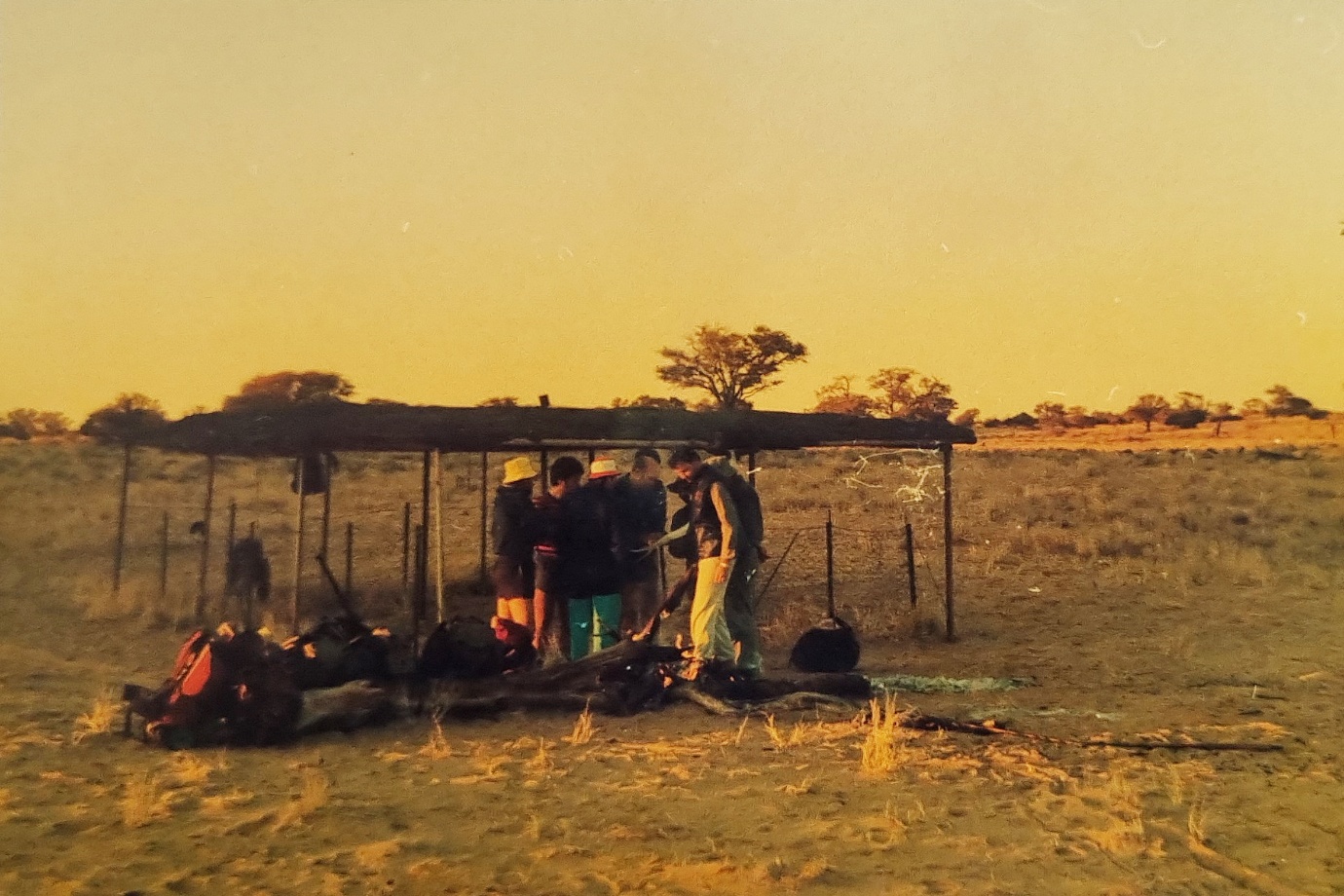
A structure built by Prof. Fritz Eloff during his research on the Kalahari lions
Bitterpan: Joep le Riche’s Unexpected, Unforgettable Arrival
Halfway along the route, at Bitterpan, Joep le Riche kept his promise — in a way the team would never forget.
He arrived in his Landcruiser, the rear converted into a field bed for his own comfort. With him he brought:
- fresh meat for a braai,
- and confirmation that despite the water crisis, predator threats, and physical pain, they were still safe and operational.
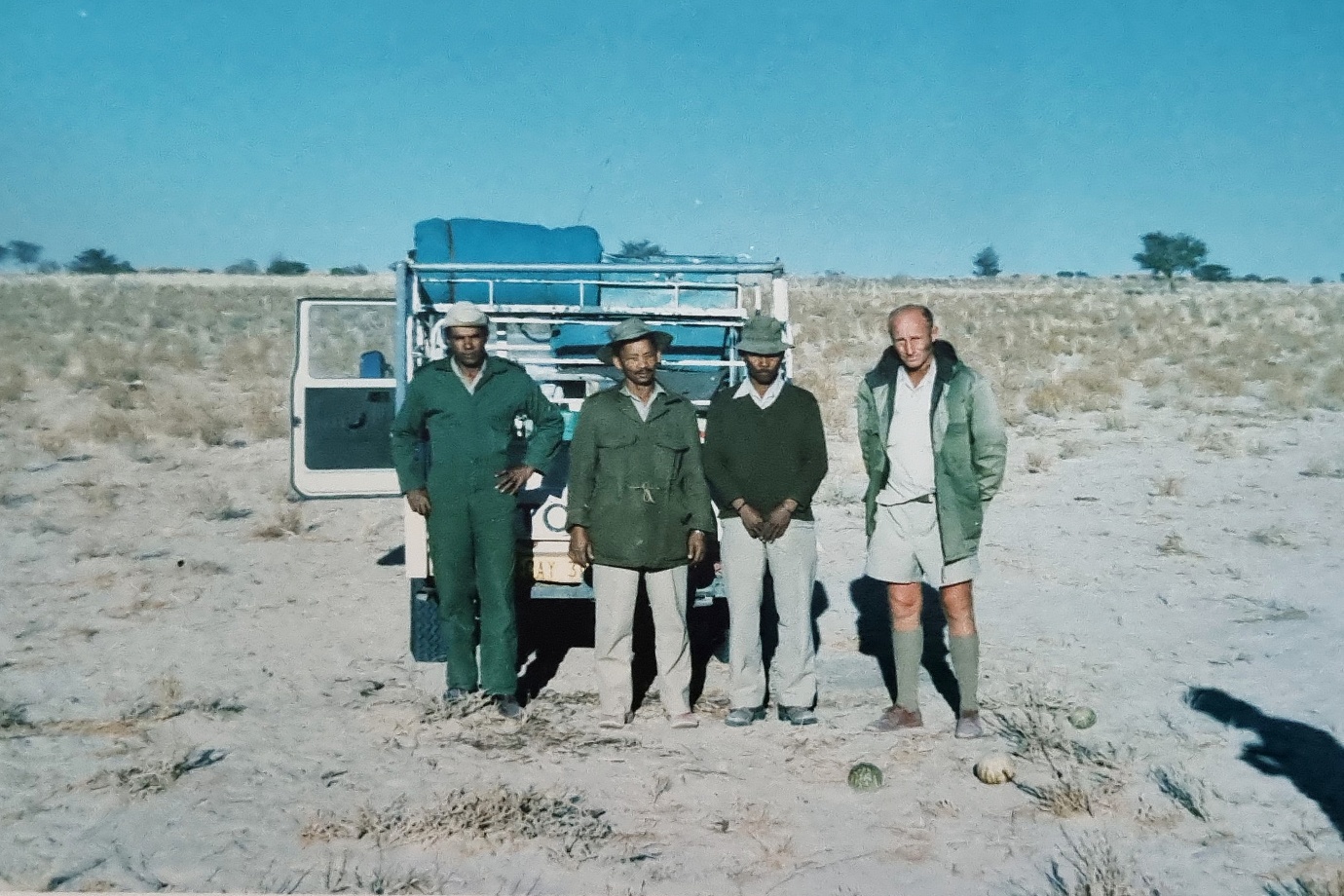
Joep le Riche to the right and Vet Piet 2nd from the left
The Meaning of the Exercise
The endurance exercise confirmed the core principles of Division K44:
- Discipline,
- Teamwork,
- Adaptability,
- Self‑reliance,
- Character.
The water crisis, predator threats, Prof. Eloff’s primitive camp, soft sand, mouse colonies, foot injuries, and survival using Kalahari plants doubled the value of the exercise.
Conclusion
The Kalahari endurance march of July 1987 left a lasting impression on the members of Division K44. It was not merely a physical trial, but a test of humanity, character, and the ability to function in the most challenging circumstances.
The faulty water points, the brown hyena that followed the team, Prof. Fritz Eloff’s primitive camp, the design of the night laager, the soft sand and mouse colonies, the painful foot injuries, the Mathalyte treatment, the survival using Kalahari plants, and Joep le Riche’s arrival at Bitterpan gave the exercise a human dimension the team would never forget.
The Kalahari did not only test them — it shaped them.

Prepared by Johan F Lotriet: OOB
Newsletter # 4
The Training of Covert Operators of Division K44
1. The Development of a Unique Training Programme
With the establishment of Division K44, it was soon realised that no existing training curriculum or training institution was available that could accommodate the unique requirements of the new Division. The unit had been created to perform highly specialised covert functions that extended far beyond the scope of conventional intelligence work.
The primary role of K44 was the conduct of covert intelligence collection, surveillance and tracking operations, technical surveillance and technical collection, as well as the protection of agents and handlers during briefings, debriefings and sensitive meetings. These functions were performed both domestically, in cross-border operations and during foreign deployments. Operators were therefore required to function under diverse conditions and often in hostile environments without exposing their true identities or operational objectives.
There was no existing training model on which the new Division could simply build. Consequently, the management of K44 had to develop a training philosophy and training programme from the ground up. The guiding principle was straightforward: the training had to prepare the operator for the actual role for which the Division had been created.
In addition to developing the unique operational skills required, it was also necessary to ensure that members were not disadvantaged in terms of their careers. Operators were therefore required not only to complete the specialised K44 courses but also to attend formal service-related intelligence collection courses and other officially recognised training programmes. In this way, they could remain on par with their counterparts in other divisions in terms of professional qualifications, competency requirements and promotion opportunities.
During the Division’s first social gathering at the braai facilities at Fountains Valley in Pretoria, Dr. Neil Barnard addressed this matter directly. He assured members that K44 personnel would not be disadvantaged because of the unique nature of their service and that the organisation would ensure that their career development and professional advancement remained on an equal footing with those of other intelligence officers. This undertaking contributed significantly to the morale and commitment of the members of the newly established Division.
2. The Training Environment
Due to the sensitive nature of the Division’s work, operators were not permitted to receive training at conventional NIS training institutions. The risk of them being identified or associated with specific operational functions was simply too great.
Training was therefore conducted at remote and strictly controlled locations where complete anonymity could be maintained. During the formative years, instruction was provided primarily by experienced retired operators who possessed extensive practical field experience. This system was later expanded through the appointment of permanent training facilitators and instructors responsible for the standardisation and further development of the training programme.
The head of covert training received training in Israel, among other places, and the influence of Israeli intelligence practices was clearly evident in the methodology, standards and philosophy of the K44 training programme. As with the Mossad approach, considerable emphasis was placed on independent thinking, self-discipline, adaptability, observation skills and the ability to function effectively under pressure.
3. Core Training Modules
The training programme encompassed an exceptionally broad range of skills designed to develop an operator who was fully self-sufficient and operationally versatile. Subjects included the following:
4. Core Training Modules
4.1 Cover and Personal Cover
One of the fundamental disciplines was cover and personal cover. Operators were trained to develop and maintain credible identities, while ensuring that their behaviour, appearance and communication remained consistently aligned with their cover. Every aspect of an operator’s life had to support the cover story and reveal no contradictions.
4.2 Sensory Sharpening
Observational ability was of critical importance. Operators were trained to sharpen their senses and detect subtle changes within their environment. Exercises focused on memory development, pattern recognition, situational awareness, and the identification of anomalies that could indicate threats or surveillance activities.
4.3 Computer Applications
As technology began playing a greater role in intelligence collection, extensive training in computer applications was introduced. Operators were required to become technologically proficient and capable of using electronic tools effectively for information processing, analysis and security, clandestine communications, and monitoring operations.
4.4 Sensor and Counter-Sensor Techniques
Sensor and counter-sensor techniques formed an important component of the K44 training programme and were intended to familiarise operators with the principles of covert surveillance, interception, and countermeasures. One aspect of this training involved understanding methods through which communications and documentation could be intercepted for intelligence- gathering purposes. Operators were required to understand both the theory and practical application of how mail items, documents and other information sources could be discreetly intercepted, examined, duplicated and returned to circulation without necessarily alerting the intended recipient.
Equally important was the opposing discipline of counter-sensor techniques. Operators were trained to recognise possible signs of interference, manipulation or compromise involving documents, correspondence and other communication channels. Emphasis was placed on developing procedures and security measures to reduce the risk of interception and provide early warning of possible compromise.
The training further reinforced the principle that a successful covert operator must not only understand how intelligence is collected, but also how to protect his own communications, documentation, movements and operational activities against the same techniques. This balanced understanding of offensive and defensive measures enabled operators to better understand the threat environment and continually improve their own operational security.
4.5 Disguise
Disguise involved far more than simply changing clothing. Training focused on altering physical appearance, body language, speech patterns and personal habits. Operators had to be capable of functioning within different social and cultural environments without arousing suspicion.
4.6 Offensive and Defensive Driving
Vehicles were often a critical component of operations. Operators received advanced driving instruction, including the handling of vehicles under challenging conditions. Defensive driving training emphasised escape manoeuvres and safety procedures, while offensive driving focused on controlling situations during operational emergencies.
4.7 Surveillance and Countersurveillance
The ability to conduct surveillance while simultaneously identifying hostile surveillance was a core skill of every K44 operator. Operators learned techniques for discreetly following individuals, as well as procedures for determining whether they themselves were under observation.
Surveillance training encompassed three primary disciplines: foot surveillance, vehicular surveillance and technical surveillance. During foot surveillance training, operators learned how to follow targets through urban and rural environments without attracting attention. Emphasis was placed on teamwork, the use of multiple observation points, distance management and maintaining natural behaviour within the operational environment.
Vehicular surveillance focused on discreetly following targets over long distances through changing traffic conditions and across both urban and remote areas. Operators learned how to maintain continuous observation of targets without establishing recognisable patterns that could compromise the surveillance operation. This training was frequently combined with offensive and defensive driving techniques.
Technical surveillance involved the use of available technological tools to monitor the movements, behaviour and activities of targets. Operators received training in the deployment of technical surveillance equipment as part of integrated intelligence-collection operations and in identifying similar technologies that might be employed against them.
Countersurveillance was equally important. Operators were required to remain constantly aware of their own security and the possibility that they might be monitored by hostile intelligence or security services. Training focused on recognising surveillance patterns, confirming possible surveillance, employing countersurveillance routes, and implementing procedures to prevent operational compromise.
This training ensured that K44 operators were not only capable of conducting highly effective surveillance operations, but also possessed the skills required to protect themselves, their agents, handlers and operations against similar techniques. The integrated application of foot, vehicular and technical surveillance ultimately became a core component of the section’s operational capability.
4.8 Lock Picking and Lock Manipulation
These technical skills enabled operators to gain access to specific environments without leaving visible signs of entry. Training required a thorough understanding of mechanical locking systems and their operation.
4.9 Monitoring and Listening Techniques
Operators were trained in the principles and application of various listening and monitoring techniques. The emphasis was on gathering intelligence discreetly without compromising operational security.
4.10 Target Assessment
Before any operation was conducted, the target had to be thoroughly analysed. Operators were trained to systematically evaluate individuals, organisations and infrastructure, identify risks and determine potential vulnerabilities.
4.11 Precision Mechanical Techniques
Precision mechanical training included the handling, modification and maintenance of specialised equipment. Great emphasis was placed on precision, patience and technical accuracy.
4.12 Collection and Advanced Collection Courses
These courses formed the core of intelligence collection training. Operators learned how to identify, collect, document and evaluate information. Advanced courses focused on more complex operational environments and the management of sensitive intelligence sources.
4.13 Concealment Techniques
Concealment techniques focused on the covert placement of personnel, equipment and support materials within operational areas. This training required meticulous planning, environmental awareness and a high degree of discretion.
The overall objective of the programme was to develop operators capable of functioning entirely independently and conducting covert operations in any environment without compromising the security of the operation, the source or the organisation.
4.14. Learning of a foreign language
An additional compulsory requirement for members of the Division was the acquisition and maintenance of proficiency in at least one foreign or third language. This requirement was driven by the operational realities of covert deployments, cross-border assignments, liaison activities with foreign security agencies, and the need to operate discreetly within diverse linguistic environments. Members were therefore encouraged, and in many instances required, to develop working competence in languages relevant to their operational areas. Language training formed an important component of personal and professional development, enhancing members’ ability to gather intelligence, conduct undercover activities, establish local credibility, and operate effectively in multinational environments without drawing unnecessary attention to their presence.
5. Practical Cross-Border Exercises and Operational Simulations
The true test of an operator did not take place in the classroom, but during highly realistic operational exercises designed to replicate the realities of field operations.
During these exercises, each operator was required to plan and execute his own operation independently. Candidates had to develop their own cover identity, prepare supporting documentation, arrange travel and formulate alternative explanations for their movements. No complete operational plan was provided; they were expected to develop the details themselves, exactly as would be required during an actual deployment.
Operators were required to identify and plan infiltration and exfiltration routes, determine secure meeting points, establish emergency extraction plans and prepare alternative routes should the operation become compromised. Concealment techniques formed an important part of these exercises, and participants were required to identify and utilise covert storage locations for documentation, equipment, funds and communications devices.
Accommodation and transport arrangements had to be managed independently. Operators were required to identify and book suitable accommodation without exposing their cover. They also had to obtain and operate vehicles in a manner consistent with their cover identity while avoiding recognisable movement patterns.
During these scenarios, operators were assigned various intelligence targets. These targets had to be located, observed and photographically documented without the subject becoming aware of the surveillance. The quality of photographs, observations and reports formed part of the final evaluation.
Covert contact meetings played a further important role. Operators were required to organise meetings during which messages, documents or objects could be exchanged securely without exposing the meeting to surveillance. The success of these meetings was measured according to discretion, timing and operational security.
The identification, approach and recruitment of potential sources also formed part of advanced training exercises. Operators were required to identify individuals with access to valuable information, assess their motivations and develop strategies to establish and manage trusted relationships.
6. Testing Under Operational Pressure
One of the most demanding components of the training programme involved realistic scenarios in which operators were unexpectedly “arrested” or detained during exercises. In most cases, these exercises took place in neighbouring countries, where candidates were intercepted without warning by training teams and subjected to intensive interrogation.
The objective was to assess the operator’s ability to maintain his cover under circumstances where he might be intimidated, deceived or exposed to extreme stress. Interrogators deliberately searched for inconsistencies and attempted to compel candidates to deviate from their cover story.
Physical and psychological stress factors were also occasionally employed to simulate the pressures of real operational circumstances. These scenarios were not designed merely to develop resistance to interrogation, but rather to evaluate the candidate’s self-control, judgment, discipline and commitment to operational security.
By the conclusion of these exercises, operators were assessed on their ability to remain calm under pressure, maintain a credible cover, protect sensitive information and continue working toward achieving their operational objectives.
7. Conclusion
The training of K44 operators involved far more than the acquisition of technical skills. It was a deliberate process aimed at developing individuals capable of functioning independently, adapting to changing circumstances and operating professionally within some of the most complex and demanding intelligence environments.
Through a combination of specialised technical training, realistic operational simulations, cross-border exercises and continuous professional development, a cadre of operators was created who possessed the capability to execute sensitive assignments both domestically and internationally with the highest levels of discretion and professionalism.
Ultimately, the training programme formed the foundation upon which the operational success and reputation of Section K44 were built.
Footnote by Dr Anthony Turton: Dr Anthony Turton is one of South Africa’s best-known experts on water security, environmental risk, and strategic resource management. His career is unusual because it combines experience in science, intelligence, military operations, public policy, academia, and environmental advocacy.
Dr Anthony Turton joined Division K44 in 1987, where he successfully completed the full spectrum of the Division’s covert operator training curriculum. This demanding programme encompassed advanced tradecraft, clandestine operations, intelligence gathering, covert communications, operational planning, surveillance and counter-surveillance, cover and legend development, and the execution of high-risk assignments under austere conditions.
During his tenure within the Division, he made a significant contribution to intelligence operations and rapidly established himself as a capable and respected operator. Upon his departure from K44, he continued to apply the knowledge and skills acquired during his service, particularly in the development and training of operatives within K3 structures. Drawing extensively on the methodologies, operational disciplines, and covert techniques inherited from his K44 experience, he played an important role in transferring specialist knowledge to a new generation of operators.
The influence of his K44 training remained evident throughout his subsequent career, where the principles of intelligence-driven operations, strategic analysis, adaptability, self-reliance, and disciplined execution became defining characteristics of his professional achievements. His contribution illustrates how the rigorous standards maintained within Division K44 extended far beyond the operational environment and helped shape individuals who would later make substantial contributions in the fields of intelligence, strategic planning, risk assessment, and resource management.
In his own words: “The origins of the tactical aspects of deep cover operations in the Chief Directorate Covert Operations are found in the innovation that took place in K4 in general, and K44 in particular. The other two directorates – K2 and K3 – were deeply compartmented and separated for operational security purposes. Each of these three directorates were highly specialized and laser focussed.
K3 became increasingly important when foreign covert structures were created as independent entities capable of withstanding an investigation by the active opposition. Crossover training became important to fast-track tactical skills development in K44 across to K3. This was achieved in two ways.
Firstly, a K44 member became an instructor in the Covert Operations Training wing. This was conducted separately from the Intelligence Academy for operational security reasons.
Secondly, K44 was directly used to provide close-in surveillance during the certification phase of candidate covert operators in K3. This was done during a deployment into multiple foreign countries, during which each candidate was tasked to perform a series of complex tasks, while operating solo for the first time. This joint activity ensured that K44 remained at peak levels of skill, because they were up against enthusiastic young operators, fresh out of training, and close to their personal goal of becoming certified to operate independently in a foreign hostile environment. At no time did a candidate report that they were under surveillance, yet in all cases the instructor could provide hard evidence that they were.
K44 was a significant asset. It was the crucible of tactical innovation within NIS. It can realistically be compared with 14 Intelligence Company, known as “The Detachment”, developed by the British to perform close-in surveillance of hard targets in the IRA. This is an elite structure that is not known to the outside world.”



Hierdie reeks artikels werp vir die eerste keer lig op ‘n unieke en grootliks onbekende dimensie van Suid-Afrika se intelligensiegeskiedenis.
Anders as baie intelligensiebeamptes wêreldwyd wat onder diplomatieke dekking vanuit ambassades opereer, het hierdie operateurs dikwels sonder die beskerming van amptelike status gewerk. Indien hulle ontmasker of gearresteer is, kon hulle nie op diplomatieke immuniteit staatmaak nie.
Hulle moes dus oor buitengewone selfstandigheid, dissipline, geestelike weerbaarheid en professionele vaardigheid beskik.
Die opleiding van K44 was besonder in die Suid-Afrikaanse konteks.
Operateurs is nie bloot opgelei om inligting in te samel nie, maar om onder feitlik enige omstandighede te oorleef en effektief te funksioneer. Die ontberings van die Kalahari-oefening het dieselfde doel gedien as die opleiding in waarneming, teen-waarneming, vermomming, dekidentiteite of legendes, vreemde tale en koverte kommunikasie: om individue te vorm wat op hulself aangewese kon wees en onder druk kon funksioneer sonder om hul operasie of hul bronne in gevaar te stel.
Die besondere waarde van hierdie opleiding was dat die manne ewe tuis moes wees in die Kalahari, die strate van Europa of die uiteenlopende omgewings van Afrika. Hulle moes leer om volkome in te skakel by hul omgewing, geloofwaardige legendes te handhaaf, onder alternatiewe identiteite te leef en vertroue te wen sonder om aandag op hulself te vestig.
Elke operateur het onder ‘n nom de guerre gefunksioneer en moes sy dekverhaal met dieselfde geloofwaardigheid leef as sy werklike identiteit.
Die artikels toon verder dat suksesvolle intelligensie-werk nie op toerusting alleen berus nie, maar op mense. Die vermoë om bronne te identifiseer, te werf en te bestuur; om inligting diskreet in te samel; om aggressiewe ondervraging te weerstaan; en om kalm te bly wanneer omstandighede skeefloop, was kernvereistes van die beroep.
Hierdie eienskappe was die produk van doelbewuste, intensiewe en realistiese opleiding.
Wat besonder opval, is die vlak van professionaliteit wat bereik is. K44-operateurs is nie net opgelei om ander waar te neem nie; hulle is opgelei om self onsigbaar te bly.
Hulle moes toesig kon uitvoer sonder om aandag te trek, terwyl hulle terselfdertyd voortdurend bedag was op die moontlikheid dat hulle self onder waarneming was. Hierdie kombinasie van waarneming en teen-waarneming het hulle in staat gestel om in vyandelike omgewings te funksioneer, bronne te beskerm, inligting in te samel en sensitiewe operasies uit te voer sonder om hul teenwoordigheid te verraai.
Persoonlik herinner hierdie artikels my aan gesprekke wat ek oor die jare met veterane van die veiligheids- en intelligensiegemeenskap gevoer het. Reeds dekades gelede het manne soos mnr PC Swanepoel, genl. Johan Coetzee en ander pioniers die behoefte aan ware koverte insamelingsvermoëns besef.
Die stigting van Koverte Insameling binne die Nasionale Intelligensiediens het uiteindelik gestalte gegee aan ideale wat oor baie jare ontwikkel het. Dit was die verwesenliking van ‘n visie wat veel verder gestrek het as gewone polisiëring of ondersoekwerk.
Wat uit hierdie reeks na vore kom, is die beeld van ‘n klein, hoogs gespesialiseerde groep professionele operateurs wat, gemeet aan internasionale standaarde, met die beste in die wêreld kon meeding.
Hulle bydrae was grotendeels onsigbaar en hul suksesse selde openbaar erken, maar hul werk het ‘n betekenisvolle rol in die intelligensie- en veiligheidsomgewing van hul tyd gespeel.
Hierdie publikasies is daarom veel meer as persoonlike herinneringe; dit vorm ‘n belangrike historiese rekord van ‘n besondere Suid-Afrikaanse vermoë wat tot dusver grootliks in die skaduwees gebly het.
Ons salueer hierdie stille krygers van die Nasionale Intelligensiediens, wie se werk selde gesien is, maar wie se invloed dikwels verder gestrek het as wat die publiek ooit sou besef.