Nongqai Vol 17 No 9 – (21) Intelligence War in GSWA
The Intelligence War between Deutsch Südwestafrika (DSWA)/German South West Africa (GSWA) and British South Africa: 1899 – 1915
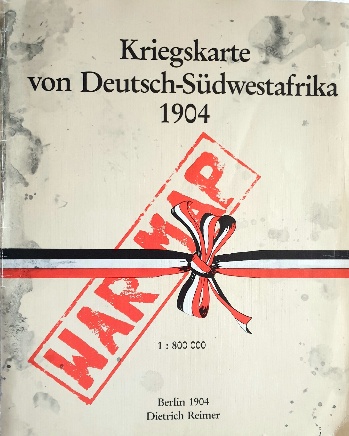 Kriegskarte von Deutsch Sûdwest Afrika-1904 Compiled by Gunter von Schuman & Walter Rausch
Compiled by Wolfgang Witschas
Excerpt
The Intelligence War in GSWA
Abstract
On 12 March 1878 the British flag was hoisted by Captain Richard C. Dyer of HMS Industry at the only natural harbour on the South Western coast of southern Africa, a place called Walvis Bay. Walvis Bay and the adjacent land, the enclave of 1,124 km² / 434 sq miles, was confirmed as British possession on 14 December 1878, then annexed to Cape Colony on 07 August 1884.
It is the only good deep-water harbour on that whole south western or Skeleton Coast of 1,500km of coast with no other natural protection. Swakopmund, Lüderitz are open surf. Walvis Bay is sheltered by Pelican Point spit.
The British motive was to forestall Germany as in 1878 the Cape Prime Minister John Molteno and London knew German traders Adolph Lüderitz) and missionaries were pushing for land. Britain grabbed the harbour to make sure if Germany took the desert, Britain kept the only port that makes the desert usable. Quote from Colonial Office at time: “to guarantee control of the good deep-water harbour and forestall German ambitions” That is why Germany was furious — they got 1884 Deutsch-Südwestafrika (DSWA/German South West Africa (GSWA) a huge country with NO working harbour. They had to build the Swakopmund “Mole” or breakwater and later a jetty from scratch because Britain held Walvis Bay as an enclave.
These events and the general ambition of Imperial Germany to acquire colonies in Africa, Asia and Pacific caused antagonism between Germany and Britain as Britain then viewed Germany as a threat to their empire. When Germany in 1884 proclaimed the South Western part of Africa as their colony, Deutsch Südwestafrika (DSWA)/German South West Africa (GSWA), Britain immediately viewed the German colony as a future potential threat. Britain immediately started to monitor all activities in the German territory.
British espionage and intelligence gathering in DSWA/GSWA specifically during its era prior to and during World War I—served as a crucial precursor to the region’s eventual conquest by Allied South African forces. Because Great Britain viewed Imperial Germany’s expansion into Southern Africa as a direct geopolitical threat, it aggressively built an intelligence network in and around the territory.
Key words
Great Britain, Imperial Germany, Deutsch-Südwestafrika (DSWA)/German South West Africa (GSWA), Walvis Bay, Cape Colony, Intelligence, espionage, Schutztruppe, Landespolizei, World War I, Windhoek, Cape Town, Wireless stations
Kriegskarte von Deutsch Sûdwest Afrika – 1904
Compiled by Gunter von Schuman & Walter Rausch 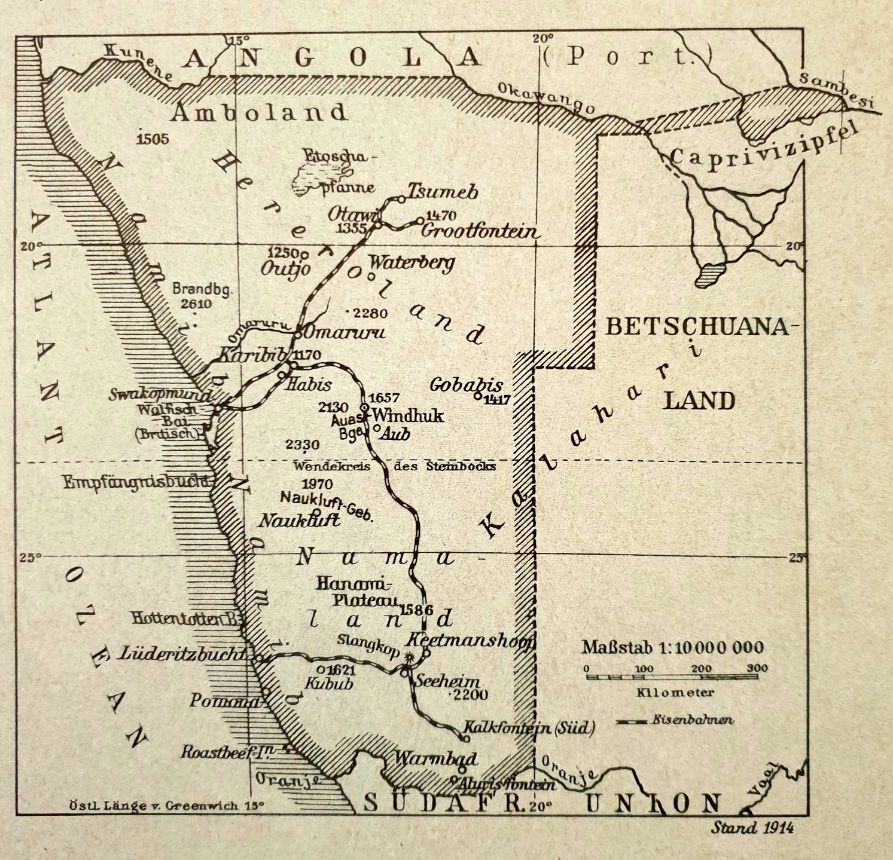
Background
Deutsch Südwestafrika (DSWA)/German South West Africa (GSWA) (modern day Namibia) officially became a German colony in 1884 until 1915.
The Kaiserliche Schutztruppe für Deutsch-Südwestafrika (DSWA) or “Imperial Schutztruppe for German South West Africa (GSWA)” was the official military formation that maintained the Imperial German rule in its colony including policing duties. No official police force existed until 1906.
After the Nama/Hereo uprising (1904 -1906) the German authorities with permission from the “Reichskolonialamt” (Imperial Colonial Office), the established of the “Landespolizei” or Territorial Police for the colony.
Imperial Germany’s Military intelligence/ “Abteilung IIIb” — Section IIIb of the General Staff (Unofficially: Nachrichtenbureau)
Background
Abteilung IIIb was Imperial Germany’s military intelligence service — the forerunner of the Abwehr.
• Created 1889 inside the Great General Staff in Berlin.
• Official cover name was “Abteilung IIIb” — Section IIIb of the General Staff. Unofficially: Nachrichtenbureau.
• Its job: counter-espionage inside Germany, and espionage outside — France, Russia, Britain, and after 1910 also British colonies like the Union of South Africa.
Intelligence Responsibility in DSWA/GSWA: 1889 to 1915 Schutztruppe
From 1884 to 1906 the Schutztruppe as the protector of the colony was responsible for the collection of intelligence. The Schutztruppe however had no formal “Ic” or
Enemy situation/intelligence — “Feindlage, Spionageabwehr” (German Army staff abbreviation for Intelligence) i.e. intelligence branch like a German Army corps in Europe.
Berlin’s IIIb (military intelligence) only had one officer for all colonies (4 colonies in Africa and about 10 territories in the East Asia and Pacific Islands).
Although the Schutztruppe had no formal “Ic branch” and no dedicated intelligence staff officer, the collection of intelligence and field reconnaissance was performed by
company commanders and experienced senior soldiers on patrols and visits to remote areas of the colony.
Intelligence was collected by means of the following:
• “Erkundungsoffiziere” (Reconnaissance Officers)— company officers sent on “patrols” to map waterholes, roads, Boer farms south of the Orange river. That was really reconnaissance.
• The big wireless station at Windhoek — it could communicate directly with the Berlin station at Nauen or when conditions were bad, via the station at Kamina, Togoland now Togo and the wireless stations in Swakopmund and Lûderitz. Before the war the station in Windhoek was used to pass political reports about British movements in the Union.
• Officers on leave — used as informal defence attachés in Cape Town. The British noted “German Schutztruppe officers on leave” as a source of spying
Landespolizei
The Landespolizei was formed during the period 1905-1907 after the Herero-Nama war. By 1914 about 500 plus German “Wachtmeister/Sergeanten” Police officers plus ∼300 African “Polizeidiener” Police Assistants spread over 70 stations, including the diamond Sperrgebiet and Capriv Zipfel (Strip).
The Landespolizei became the real intelligence organ and their official job was “claiming the monopoly of legitimate use of physical force” — but in practice:
• Every district Bezirksamt and police station had to file monthly “politische Berichte” political reports on English traders, Union police activities near the borders, on Boer dissidents, missionaries.
• They controlled the border passes — any Union man crossing had to get a “Passierschein” pass and all the personal detail was sent to Windhoek
• Local black inhabitants that frequently migrated across the border to the Union were identified an interrogated regarding the activities of the Cape Police
• They ran informants among Afrikaners in the south: In 1906 the Ferreira Raid already showed German SWA links to Boer rebels
• This is how the Germans received knowledge of the Boer rebel leader, Manie Maritz and other pro-German Boers at the outbreak of World War l.
The Landespolizei political reports were forwarded via Governor Seitz to Berlin, “Abteilung IIIb”, the German Consuls in Cape Town and Lourenço Marques.
In 1914 it was the office that authorized contact with Maritz and other Boer rebels — Operation to trigger an Afrikaner uprising against General Louis Botha’s government.
German Intelligence Efforts
Germany was also spying from DSWA/GSWA into the Union – supporting Afrikaner dissidents. That became the Maritz Rebellion in 1914. Manie Maritz had secret contact with the Germans and defected to them.
When war broke out in August 1914, General Botha had intelligence to invade, but not enough – most of the early Union maps were wrong, and they underestimated German resistance until they captured Windhoek on 12 May 1915.\\
German counter-intelligence from DSWA/GSWA
Germany was using DSWA/GSWA as a base to stir up a Boer revolt. In 1906 the Ferreira Raid – Boer rebels with German DSWA/GSWA connections raided the Cape. In 1914 Manie Maritz, put by Smuts in command of the north-western district, “had established secret contacts with the Germans and he defected to them in 1914”. That was the Maritz Rebellion. British feared German SWA was mobilising 16,000-30,000 men and had “recruited between three and four thousands Boers” for an invasion of the Union.
Comment: These allegations however could never be verified by substantial evidence/facts
Governor Dr. Theodor Seitz’s intelligence chief in the Schutztruppe was Major von Estorff and later Major Franke and the Landespolizei it was Chief von Goldammer. Seitz ran his own spy net into the Union via German traders, missionaries (Rhenish Mission), and the Deutsche Kolonialgesellschaft. Seitz received regular reports from 1912 onward from the following sources:
• German consuls in Pretoria and Cape Town
• Traders at Ramansdrift, Hasuur police post on the border
• Afrikaner rebels like Maritz — Maritz was on his payroll as a German informant from 1913
In August 1914 Seitz optimistically declared martial law, mobilized the Schutztruppe (about 2,000 Germans + 2,500 reservists + African auxiliaries). His order of 10 Aug 1914: “England’s war is our opportunity — the Union will not fight for England.” which he based on the following:
• Seitz wrongly believed General Botha would not attack because of the Boer Revolt — his spies told him the Afrikaners would side with Germany. When Botha did attack, Seitz was surprised
Intelligence function of a Postmaster
The position of Postmaster in DSWA/GSWA was a spy position. Postmasters had to open, copy, and file all suspicious mail, post-surveillance “Postüberwachung”, under the instruction of the Governor Dr Seitz: R 1002 / 2549 at Berlin Archives is “Postkontrolle gegen englische Spionage”.
In July 1914, just before war, DSWA/GSWA had 43, “Postanstalten” (Post offices) and 11 “Hilfspostanstalten” (agencies), 54 total.
They were run by the “Reichspost”, Imperial Mail not the colonial government which meant that the Postmaster was a Berlin official with censor powers.
The main offices — 3 Postämter (1st class) with a Postdirektor:
• Windhoek — Head Post Office, opened 1891. Postdirektor for whole colony.
• Swakopmund — opened 1895 — harbour post, handled all sea mail
• Keetmanshoop — opened 1892 — handled all southern mail including Hasuur border post, Ramansdrift and Warmbad border posts with the Union of South Africa
Intensified British spying
The Germans were very aware of intensified British spying and from about 1910 and actually they became paranoid about it.
Measures put in place
The tightening of border control in DSWA/GSWA was done by instructions issued by Governor Dr. Theodor Seitz. The following instructions were issued:
• All English-speaking traders, transport riders and prospectors crossing from the Union or Bechuanaland had to report to the Bezirksamt. The Polizei kept lists of “verdächtige Engländer”.
• Schutztruppe officers on leave in Cape Town and Walvis Bay noticed they were being followed — those were the South African Scouts the Union sent out.
Most people that crossed into DSWA/GSWA did so via the border between the enclave of Walvis Bay to Swakopmund, the harbours of Swakppmund and Lûderitz, the border crossings on the Orange River and border post on the Eastern border (Kalahari).
The Germans had spent from 1892 to 1913 building their own very detailed maps of DSWA/GSWA — the Kriegskarte 1:800,000, then the Krokierblätter 1:100,000. When British officers started asking about waterholes, pans and passes, the German administration knew that it was invasion preparations. They issued orders not to give maps to foreigners.
German Counter-Espionage
• The Governor in Windhoek had a standing order: any British “tourist” asking about the wireless stations at Windhoek, Swakopmund, Lûderitz, the railways or ammunition depots was to be reported to Windhoek
• In Lüderitz and Swakopmund, British consular staff were openly watched.
• Before 1914, German intelligence in SWA was actively running agents south into the Union — that is how they made contact with Manie Maritz and the Afrikaner rebels. They were trying to flip Boers because they assumed Britain was doing the same to Germans in SWA
German Intelligence collection point on the border with the Union
Hasuur a small German police post and store, right on the DSWA/GSWA – Union border, in the south-eastern corner:
• The smuggling gap: 1910-1914, Hasuur was the main crossing point. German trader Gustav Weidlich ran the store there. He was also a paid agent of Governor Seitz. He reported every Union policeman, transport rider, and “Engelsman” who crossed the border
• Union side counterpart:Nakop / Rietfontein on SA side. Union mounted police post at Rietfontein was the SA listening post watching Hasuur. The Baster guides, Links, Klaase, used to go to Hasuur from Rietfontein with cattle, carrying messages both ways.
Staging point of an attack
• On 20 August 1914, Schutztruppe from Hasuur raided Nakop and killed a SA policeman which was the first shot of the SWA campaign on that front. The Union claimed Hasuur was used to supply arms to Maritz rebels — 500 rifles were cached there in September 1914 from General Botha’s intelligence report.
• Scotland’s trading post at Ramansdrift on the Orange River was 40km west of Hasuur — so Scotland would have informed Hasuur intimately. Hasuur is a small German police post, post agency and store, right on the DSWA/GSWA / Union border, south-eastern corner.
• The smuggling gap: 1910-1914, Hasuur was the main crossing point. German trader Gustav Weidlich ran the store there. He was also a paid agent for Seitz — reporting every Union policeman, transport rider, and “Engelsman” who crossed.
• Union side counterpart:Nakop / Rietfontein on SA side. Union mounted police post at Rietfontein was the SA listening post watching Hasuur. The Baster guides you asked about — Links, Klaase — used to go Hasuur → Rietfontein with cattle, carrying messages both ways.
• 1914 action: On 20 August 1914, Schutztruppe from Hasuur raided Nakop and killed a SA policeman — first shot of the SWA campaign on that front. The Union claimed Hasuur was used to supply arms to Maritz rebels — 500 rifles were cached there in Sept 1914 per Botha’s intelligence report.
• Scotland’s trading post at Ramansdrift was 40km west of Hasuur — so Scotland would have known Hasuur intimately.
The German Hasuur agents were filed as follows:
• “Vertrauensmann H” or agent H
• or “Trader at Hasuur” — not full name, to protect them
• Paid from the “Geheimfonds” Secret Service Fund — £2 to £10 per report, so no rank
The South Africans/British captured Hasuur on 19 September 1914. In the store they found the ledger. Botha’s intelligence copied it. Names listed as: Weidlich, Burger, van Wyk, plus 2 Basters.
The farm itself: Hasuur was not a town — only three white families lived there in 1913 census:
• Gustav Weidlich (storekeeper, German agent)
• J.P. Burger (stock farmer, supplied both sides)
• D.H. van Wyk (transport rider)
• Baster servants — usually recorded as “Klaas Links and son”.
Like the British, the Germans were not ready for war outside Europe. The paper notes: “neither side was prepared for war outside Europe” and “few records of the missions undertaken or the intelligence produced survive”. So they knew they were being spied on, but thought any British invasion would fail due to water and logistics.
That is why Maritz defecting with a promise of German help in September 1914 shocked Pretoria, but Windhoek thought they could hold — until the Union columns actually came in early 1915.
Did the Germans catch any spies
Yes — but not many formal espionage trials, mostly internment and expulsions.
In the one case that is cited by name of a South African scout for being caught:
“German command made full use of its superior intelligence, having previously detained a South African scout and holding the allegiance of the rebellious Force B commander Manie Maritz”
That scout is unnamed in German records — listed only as “Kap-Späher”. In Union records his capture is noted as reason for Lukin’s defeat at Sandfontein.
The Germans, treating anyone mapping the territory or using advanced photography gear as high-level British assets.
In German South-West Africa 1914-1915:
• At outbreak of war on 7-8 August 1914, German police rounded up all British subjects in Swakopmund, Lüderitz and Windhoek as “enemy aliens” and interned them. Among them were several men the Germans listed as “verdächtig wegen Spionage” suspected of espionage — traders and prospectors who had been asking about water and wireless. They were not shot, just interned then later exchanged via Walvis Bay.
• The Germans also claimed they caught Union Scouts near the border — men posing as cattle buyers with notebooks marking wells. Those men were turned back or held at Keetmanshoop.
Espionage on the Union / British side
The Union’s pre-war intelligence was not done by a professional service — it was done by District Staff Officers and Police Magistrates on the border who were asked to submit “Intelligence Reports” after 1910. Those reports were paid under “Secret Service” vote.
• Major A.J. Selby — Staff Officer at HQ Pretoria, responsible for compiling maps from Scout reports before 1914
• Lt Col J.H. Grant and Capt. E. Knapp — the two officers who ran the “Scout system” along the Orange River. They recruited ex-National Scouts
• Resident Magistrate at Walvis Bay F. Myburgh who compiled monthly letters to Cape Town are full of German troop counts, e.g. “2 officers 80 men left for Windhoek”
• Police Constables of the Union — e.g. Constable P. Mostert at Rietfontein — filed the report about German camel patrols at Witkop in July 1914
• The Union arrested German reservists and Schutztruppe officers who were on leave in South Africa when war broke out. Some were held at Roberts Heights as suspected spies.
• The most famous case from that front was not in SWA but just across: The Union caught German agents trying to link up with Maritz’s rebels in 1914 — carrying money and rifles. Maritz himself defected.
During WWI the intelligence game was still very amateur. The study notes “few records of the missions undertaken or the intelligence produced survive” — spies were mostly just watched and chased off.
British/South African Intelligence efforts
British and Union of South Africa intelligence treated DSWA/GSWA as the main threat in Southern Africa
The British brief from London on what British intelligence wanted after South Africa became a Union in 1910:
The Union of South Africa turned its eyes to the northwest to keep watch on its German neighbour in DSWA/GSWA. For English South Africans, the Kaiser’s vow of support for the Boers before the Second Anglo Boer War was still remembered.
Why Britain was obsessed
For South Africans of English descent, the question of Germany’s intentions was especially important:
The German Kaiser’s vow of support for the Afrikaners prior to the Second Anglo Boer War was still remembered with some trepidation (feeling of fear, anxiety, or hesitation about something that may happen).
The War Office in London published a secret Military Report on DSWA/GSWA in 1913 — basically an invasion guide with maps, railways, waterholes etc.
What the British/South Africans collected
Strategic Mapping Preparations
The years of prior British intelligence gathering paid off immensely when the Union of South Africa (then a British Dominion) launched the South West Africa Campaign in 1915. South African and British commanders utilized extensive, pre-compiled British intelligence dossiers detailing waterhole locations, terrain traps, and German defensive positioning.
• Topography: British and French mapmakers, many employed by military intelligence, traversed African territories. Some produced the first cartographic information charting topography, roads, railways, harbours, cables, telegraphs, water sources and rainfall
• In SWA that meant mapping the Kalahari waterholes, the Otavi railway, Swakopmund and Lüderitz landing beaches.
• Human intelligence: South African Scouts sent across as transport riders and traders. German Schutztruppe officers on leave in Cape Town followed. British consuls in Lüderitz and Swakopmund filing reports on troop strength.
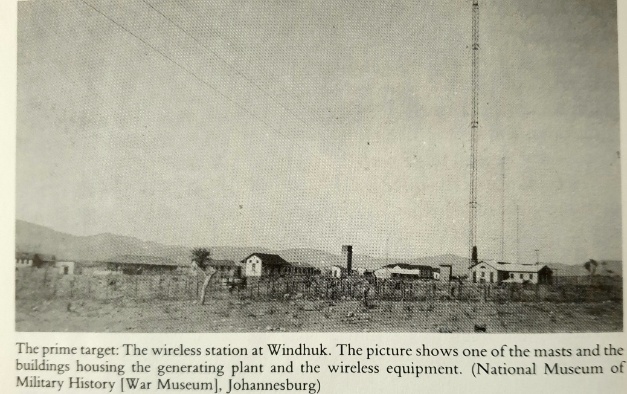
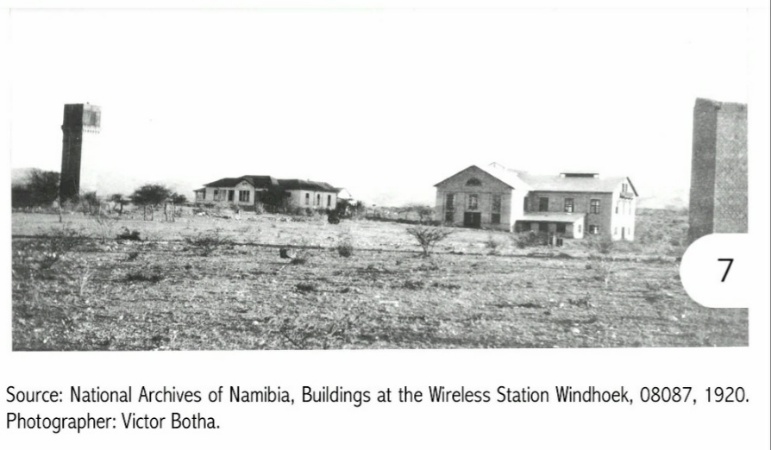
• Wireless: The high-power station at Windhoek that could communicate direct to Berlin was a top target. The two smaller stations in Swakopmund and Lüderitz were also important to the British
• After 1914, “British intelligence monitored all wireless traffic for source location and content.
• British defence attachés – posted to cover German colonies
• German Schutztruppe officers on leave – followed by British agents when they travelled to Union or Cape
• South African Scouts – Union intelligence officers, often ex-Boer War scouts, sent across the border as farmers, traders, transport riders to map waterholes, roads, railways and Schutztruppe strength
• Alleged civilian spies – Germans living in SWA reported as spies by British consuls in Lüderitz and Swakopmund, and vice-versa
German Wireless Stations in DSWA/GSWA
From 1911 to 1912 the Germans built three fixed radio/wireless stations in DSWA/GSWA:
• The largest and most powerful in the capital Windhoek
• One in Swakopmund
• One in Lüderitzbucht (now Lüderitz).
“Großfunkstation Windhoek”
This was Germany’s most expensive station in Africa, built to make DSWA/ GSWA independent from British submarine cables. The station was built by Telefunken Gesellschaft (Siemens + AEG), to the South west of Windhoek. Three towers, each 120 metres tall (390 ft), steel lattice with T-antenna between them. The radio was powered by a 100 kW quenched-spark transmitter and electricity supplied by diesel generators, which were building half-underground bomb-proof. The wavelength was 300-4500 m longwave. The call sign was “WKA”.
The British government was well aware of the installation of the new German radio system. On 24
December 1913, the British consul in Lüderitzbucht reported to the Foreign Office the following:
“Sir, I have the honour to inform you that a wireless telegraphy station is in course of erection in Windhuk. The station is designed to establish direct communication with Nauen in Germany and it is
expected that the new service will be in full working order by the 15 May 1914British Consul in Lüderitzbucht”
Walvis Bay: British/South African spying base on DSWA/GSWA
Walvis Bay was a British enclave and harbour since 1878, when it was annexed to the Cape Colony. A small enclave — about 1,124 sq km — completely surrounded by DSWA/GSWA and the Atlantic ocean to the west, with its own Resident Magistrate, customs house and police, connected by sea to Cape Town.
Walvis Bay was ideal for spying
Legal observation post:
• Any German railway movement Swakopmund → Windhoek, any Schutztruppe column, any ship into Swakopmund/Lüderitz had to pass the enclave’s sight line • The resident British magistrates of Walvis Bay, established and oversaw a widespread network of informants that successfully infiltrated the western and central regions of the German Colony. The local African populations, who suffered heavily under German colonial rule and the devastating Herero and Nama genocide, frequently provided critical intelligence on German locations and harsh conditions to British operatives • The Resident Magistrate sent weekly reports to Cape Town on German troop strength, ammunition shipments, wireless construction. The building of the “Mole” (massive stone breakwater forming an artificial harbour basin) and later first the wooden and then the steel jetties. Built 1899-1903, because Walvis Bay was British. They needed their own port to land the Schutztruppe and supplies for Windhoek
• Traders and transport riders — many of them Cape Coloured and Boer drivers who worked for both sides — used Walvis Bay to pass information. The Germans complained that “English Kaffirs” from Walfish Bay were counting their horses
In 1914 there was no underwater wire cable from Walvis Bay to Cape Town. The only British submarine cable was the British All-Red Line of the Eastern Telegraph Company
The submarine cable ran from Cape Town → St Helena → Ascension → London and from Cape Town → Durban → Zanzibar → Aden
It did not land at Walvis Bay. The closest British landing was Cape Town. The Germans had refused to let the British cable land at Walvis Bay enclave as it would have given Britain a telegraph base inside German colony. That is why Walvis Bay was so vulnerable, and why Magistrate Myburg was so important.
Between Walvis Bay and Swakopmund was a single overhead iron wire on wooden poles, 35km, across dunes, which was built by the Germans, but maintained by Cape.
The Germans cut the wire on 06 August 1914 which was the first act of war in DSWA/GSWA and Walvis Bay went dark.
German Submarine Cable
Swakopmund had a German-owned submarine cable which ran from Swakopmund → Lüderitzbucht → Cape Town. It was operated by “Deutsche Südwestafrikanische Telegraphengesellschaft”. From Swakopmund via Windhoek to Keetmanshoop by overhead wire on poles to Hasuur at the Union border.
At the outbreak of WWI August 1914
• The Germans immediately put Walvis Bay under surveillance, then invaded it. 12 August 1914 Schutztruppe occupied Walvis Bay and Swakopmund. The British officials and Cape police withdrew to the HMS armed trawler.
• The occupation was brief. The South Africans retook Walvis Bay on 25 December 1914 and used it as the landing base for Botha’s 1915 invasion. British intelligence from there gave Botha his maps for the final push on Windhoek.
The border in the Namib desert was porous:
• Cape police at Walvis Bay ran informants right into Swakopmund — especially among the Rehoboth Basters who disliked German rule.
• In reverse, Germans used Walvis Bay too. German agents in 1914 used the enclave’s postal service to try to get letters to Afrikaner rebels in the Union.
https//en.wikipedia.org/wiki/Alexander_Scottland
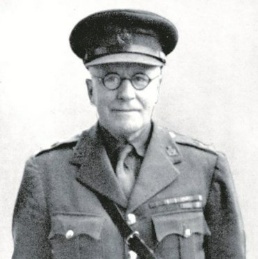
Alexander Paterson Scotland Known British Spies
Alexander Paterson Scotland was born on 15 July 1882 Middlesbrough in England to Scottish parents from Perthshire. His father was a railway engineer.
In 1902 he travelled to South Africa with the intent of joining the British Army, during the Second Anglo Boer War, as his brother was serving there and promised to get him in his unit. However, the war had just ended by the time of his arrival. He then worked for an insurance company before returning to the grocery and provisions trade. He lived in the town of Ramansdrift, at the border between South Africa and German South West Africa. German forces became his chief customers, and he learned to speak German fluently. At the invitation of a German officer, Scotland joined the German Army as “Schottland”. He took part in “several battles” with the Namas who then were nagged in an uprising against German rule. He served in the German Army from 1903 to 1907.
Upon return to Cape Town, Scotland was appointed General Manager of the government trading post at Ramansdrift by Leander Starr Jameson, Prime Minister of the Cape Colony. He however also joined the British South African forces, became intelligence officer. The appointment made Scotland influential with British, German and Nama forces, and he became involved in cease-fire talks with the Nama leader Johannes Christian. Scotland was awarded the Order of the Red Eagle for his services.
It was during that time, that Scotland began unofficially reporting on German manpower and other information to British intelligence in Cape Town “and to General Smuts ‘agents on their periodic visits to his bush land commercial headquarters”.
Over time, the Germans became suspicious of him, but no action was taken and he continued his work for both sides until 1914, when he was imprisoned by the Germans on suspicion of espionage. He was interned in the prison at Windhoek until 06 July 1915, when the area was captured by British Empire troops from the Union. He returned to England upon his release.
He died on 0 3 July 1965 London.
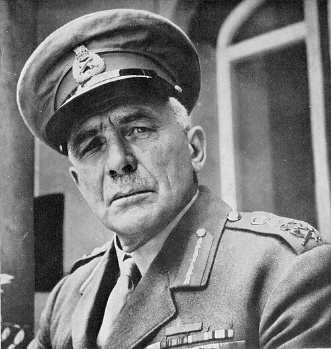
Captain William Edmund Ironside — later Field Marshal Lord Ironside, Chief of the Imperial General Staff in 1939-40
https//en.wikipedia.org/wiki/Edmund_Ironside,_1st_Baron_Ironside
Early Life and Early Military Career:
Born in Edinburgh, Scotland, on 06 May 1880. He joined the Royal Artillery in 1899 and fought in the Second Boer War in South Africa, where he was wounded three times.
After the war he was still a member of the British forces in the Cape Colony.
In 1912 the 32-year-old Captain was in the Royal Artillery, but seconded to the General Staff, Intelligence. Speaks fluent German which he learned at a university in Germany.
His official cover.was: “Captain Edmund Ironside, Royal Artillery, on leave for language study”. He was sent by MO2 (War Office Military Operations, intelligence) to DSWA/GSWA because previous intelligence that had been gathered got outdate.
Travelled as “Mr. Edmund Oppenheimer” — posing as a colonial farmer / ostrich feather buyer, also sometimes as a German-speaking South African. His diary says he bought a wagon and oxen at Upington.
He travelled from Upington → Rietfontein → Keetmanshoop → Gibeon → Windhoek → Swakopmund → Lüderitz. He spent 3 months riding the colony. He reported back the following:
▪ Exact location of Schutztruppe depots, machine gun numbers (6 Maxim per company)
▪ Sketch of the new Windhoek wireless station (could talk to Berlin)
▪ Note that German railways could not sustain more than 1 brigade beyond Keetmanshoop without ox-wagons — this became key to Botha’s plan to attack via rail
▪ Report that Afrikaners in DSWA/GSWA were organizing for revolt against Union — predicted Maritz
The Germans almost caught him at Keetmanshoop were the Landespolizei asked for his pass, he spoke such good German that they let him go as “Boer from Prieska”.
In 1914 he was back in South Africa as a staff officer with Botha’s invasion force — chief intelligence officer for the Central Force. Then went to France.
The Germans had him on their list as “der Englische Spion Ironside” — “Abteilung IIIb” noted him in 1913.
British Military Attachés — legal spies under diplomatic cover: 1905-1908
Lieutenant Colonel Frederick Trench DSO
Trench was born in the 1860s and was the first real British spy inside DSWA/GSWA. Not much personal information about him is known, but his work shaped the British/South African SWA Campaign .
He was a British Army, Royal Artillery officer and veteran of Second Anglo Boer War (1899-1902) and earned a DSO.
He spoke fluent German, good horseman, “Hoffähig” — able to live at Kaiser’s court. The German Emperor, Kaiser Wilhelm II, personally requested him by name to go to DSWA/GSWA. He was posted as British Military Attaché to German HQ in Windhoek 1905-1906. This was during the height of the Herero and Nama uprising when the Schutztruppe Lieutenant General Lothar von Trotha, the man who ordered the genocide.
Trench’s Brief:
Officially the Military Attaché/”military observer” invited by Germans. His secret mission was to obtain information and write field reports to the Governor of the Cape Colony, Foreign Office in London and the British Embassy in Berlin.
Part of his reports covered von Trotha’s extermination order, of the Herero and Nama to break their military strength.
His main other reports covered the following targets:
Trench submitted a number of copies of maps that would have been valuable to a military planner, including details of the German communications network in the protectorate, showing rail, telegraph, and heliograph connections throughout the country. (the three wireless station were only built in 1912)
Notably, Trench pinpointed suitable targets for destruction in the event of war – the submarine telegraph cable, the wharves and piers at Swakopmund, and the water desalinisation condensers at Lüderitzbucht. With the exception of the condensers, all of these sites were disabled or attacked in August and September 1914.
In a strategic context, Trench assessed the Germans were preparing for possible offensive action against the Cape Colony. This was a theme that Trench would continue, following his reassignment to Berlin in 1906 where he reported extensively on the bellicose nature of the Germans towards England. In one report, Trench states: I cannot escape the impression that the suppression of the native revolt is going hand in hand with preparations for the subsequent use of the Schutztruppe – or a portion of them to attack across the Orange River into the Cape Colony should the occasion demand it.
The archived copy of Trench’s report is bound together with a number of translated and de-ciphered secret telegrams detailing logistics issues between the German headquarters in DSWA/GSWA and the German consulate in Cape Town. Trench does not say where he obtained the telegrams, but he uses them well to illustrate his assessments. Those reports were copied verbatim into the British Army handbook Military Report on German South-West Africa first printed 1906, reissued 1913 — the book Every British officer used to invade in 1914.
In 1906 the Germans realised he reported the atrocities at Waterberg and the desert death march of the Herero. He was quietly withdrawn in 1906 and was replaced by Major Wade who continued the same work until 1908.
Major C Wade
Major C. Wade was even more shadowy than Trench. The British War Office never published his first name, just “Major Wade”.
Wade replaced Trench as in 1906 and stayed in DSWA/GSWA until1908 when he replaced Trench as British military attaché / observer attached to German Schutztruppe HQ.
He stayed longer than Trench , for two years, traveling with German columns during final Nama War against Jacob Marengo,
His task was to update Trench’s 1906 Military Report on DSWA/GSWA, the information on waterholes, police posts, border posts, personally strength, telegraph lines, wireless stations rail and other transport capacities.
His report went straight into the 1913 re-issue of the British Army intelligence handbook: “Military report on German South-West Africa”, that was first printed in 1906 and re-issued in 1913. This edition the Union Defence Force (UDF) used to invade DSWA/GSWA in 1914.
Like Trench, he also reported on Shark Island concentration camp at Lüderitz — his reports together with Trench’s report of earlier, were source for later Foreign Office memo where Sir Edward Grey wrote in margin: situation “as bad as the Congo”.
Major A.C. White the successor of Major C. Wade, toured Lûderitz in 1912 as “bird watcher”. Major White’s network was handed over to Alexander Paterson Scotland in 1914 — Scotland reused Wade’s old contacts at Hasuur, Keetmanshoop, and Rietfontein.
Britain’s military attachés shaped strategic thinking prior to World War I, especially its perception of Germany as an aggressor, and it seems clear that Trench and Wade were influential in decisions by London and Pretoria about Germany and its colonies at the outset of the war.
South African Mounted Reconnaissance Scouts operating from Walvis Bay
Late to the game – the South Africans At the outset of the war, the Union Defence Force (UDF) was not organised to conduct intelligence operations against the Germans. The UDF’s organisation for meeting its requirements was mostly ad hoc at the beginning, and was largely focused on tactical intelligence.
The General Staff section of the UDF was tasked for the mission just prior to the hastily organised invasion of GSWA and efforts revolved around the deployment of scouts and the newly developed art of wireless interception. The mission of Major Langbaard Grobler is a case in point. He and his 50-man unit, known as Grobler’s Scouts, were deployed to Walvis Bay where he was instructed to collect information on the German town of Swakopmund and the surrounding area.
General Botha and the other Union commanders were very familiar with the employment of mounted reconnaissance scouts, having used them extensively against the British. Of scouts and their product (tactical intelligence) Sir Robert Baden-Powell said, Either the winners have won through knowing all about the numbers and position of their adversaries … or the loser, through ignorance of these points, has been unable to save himself.
The Germans had great respect for the capabilities of the Boer commandos and their scouts, and their official history of the campaign refers to specific burgher officers known for their reconnaissance skills. The history makes it clear that the South Africans also used indigenous troops to scout out the land.
Later during WWI on 22 February 1915, a Schutztruppe patrol encountered and routed a South African patrol near the village of Garub, near Aus, where the Germans were facing General Mackenzie’s troops. The patrol comprised Nama scouts led by a white officer, and, in the skirmish, the officer and two Nama were killed. Upon investigation, the Germans found the dead white officer was Captain Copernicus Kepler de Meillon of the Imperial Light Horse, who had lived in Lüderitzbucht before the war, ostensibly as a photographer and diamond prospector. These activities would have provided him excellent access to the countryside and a way to collect information unobtrusively. Because of this, the Germans were convinced that he must have been a spy.
Information Peddler
The most known information peddler that sold information to both the Germans and the British in the south of DSWA/GSWA was
George St Leger Gordon Lennox, better known as “Scotty Smith”
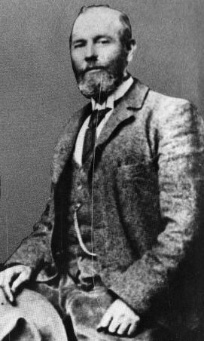 https//en.wikipedia.org/wiki/Scotty_Smith
George St Leger Gordon Lennox or Scotty Smith was born on 22 November 1845 in Edinburg, Scottland, into a noble Scottish family.
He was trained as a veterinary surgeon in Scotland and was sent to Australia. He worked as a gold miner in Western Australia and briefly joined the British Army before arriving in South Africa around 1877.
Scotty arrived in South Africa in 1877 to join the Frontier Armed and Mounted Police. He saw action in the Gaika War. It is not known exactly when his military career ended, or when he got his nickname “Scotty Smith”, although he claimed that he took the papers of a fallen comrade by that name. Due to lack of more evidence, it is concluded that he may have used stolen papers in the name of “Scotty Smith” to escape military life at some point, but there is no actual proof of this.
Life as “Scotty Smith”
Outlaw Career:
Operating mainly in the Kalahari and Northern Cape taverns and gambling dens, he became notorious for horse-rustling and evasion of the law.
Robin Hood Persona:
He gained a reputation for a charming demeanour, daring escapades, and sometimes stealing from the Germans and the wealthy to aid others, blending fact with folklore. His base was in the Rietfontein, Hasuur, Upington area, From the 1880s to 1914 he was the Kalahari’s most famous smuggler / horse thief / illegal diamond dealer.
He also worked as a frontier policeman and later served in intelligence/military roles as “information Peddler”, during conflicts like the Anglo-Boer War and for both the Germans and British during the pre World War I era (1906 to 1914). The DSWA/GSWA Landespolizei often chased him but he always evaded to the Union. He died in September 1919 in Upington during the influenza pandemic at the age of 73.
Legacy
His grave in Upington remains a localized historical landmark and tourist attraction.
World War l: 1914 to 1915
When war broke out in August 1914, General Louis Both had enough intelligence to invade, but not much and detailed – most of the early Union maps were wrong, and they underestimated German resistance until they captured Windhoek on 12 May 1915.
South African intelligence and scouting operations in DSWA/GSWA
During World War I the South Africans primarily relied on military reconnaissance scouts and field intelligence officers rather than traditional long-term espionage networks.
Intelligence Preparations in DSWA/GSWA (1914–1915)
• Ad-Hoc Organization: At the outbreak of World War I, the Union Defence Force (UDF) lacked a formal, dedicated foreign intelligence apparatus and built its scouting networks on an ad-hoc basis
• General Staff & Scouts: The UDF’s General Staff deployed specialized reconnaissance scout leaders and local pathfinders with regional area knowledge just prior to the 1914 invasion
• Wireless Interception: Operations during the campaign heavily integrated early wireless telegraph interception alongside mobile cavalry scouts to track the German Schutztruppe
• Field Surveyors: Officers such as Major J.G.W. Leipoldt acted as official surveying and intelligence officers, mapping terrain and tracking enemy movements for General Louis Botha’s forces.
• Units Involved: Specialized bodies like the Rand Intelligence Corps provided critical tactical intelligence and reconnaissance support during the 1914–1915 campaign
The actual names in the UDF Intelligence Branch 1912-1915, from the SANDF Documentation Centre files the papers cite, are:
• Major (later Lt Col) J.G.W. Leipoldt — This is the real Staff Officer. Qualified as surveyor, instructor at Military School Bloemfontein in Military History and Tactics 1912. At outbreak of war posted to Prieska as intelligence officer during the Rebellion, then succeeded Wyndham as Chief Intelligence Officer of the Union in May 1915. Served in SWA and later Tanganyika, then posted to Defence HQ end of 1917 to create the Intelligence Branch. He resigned 1924.
• Col. Wyndham — his predecessor as Chief Intelligence Officer until May 1915 (referenced in same file).
• Major C.L. Emmett / Captain. E. Knapp — officers running the northern Cape District Staff who controlled the Scout payments — but again, those are District Staff, not a formal Ic.
Because the Union Defence Force (UDF) relied on tactical military reconnaissance scouts, pathfinders, and intelligence officers rather than a traditional civilian espionage network, historical records focus on designated officers and unit leaders rather than undercover agents.
Prominent military intelligence and scout figures who operated for South Africa or the British Empire in German South West Africa DSWA/GSWA include:
Key British/South African Intelligence Officers & Scout Leaders
• Major J.G.W. Leipoldt: Served as a primary surveying and intelligence officer attached to the South African forces. He was responsible for mapping the terrain ahead of the UDF advance and compiled the official tactical intelligence reports submitted to the British War Office
• Field Marshal William Edmund Ironside (British Intelligence): Though acting on behalf of British intelligence prior to WWI, Ironside famously infiltrated DSWA/GSWA disguised as a Boer wagon-driver and ox-handler. He mapped German railway lines and infrastructure, later serving as a primary inspiration for the character Richard Hannay in John Buchan’s spy thrillers
• General J.J. Collyer: While a senior commander, Collyer directed the overarching intelligence gathering and movement plans for the campaign, coordinating local scout guides and early wireless interception efforts
• Reconnaissance Scout Leaders: The UDF utilized deep-penetration tactical scouts selected specifically for their linguistic capabilities or pre-war geographical familiarity with the territory
• The Rand Intelligence Corps (RIC): The South African military established the Rand Intelligence Corps (officially designated as the 7th Intelligence Unit) specifically for the 1914–1915 GSWA campaign. It was a short-lived tactical body comprised of roughly 51 men—primarily English-speaking South Africans and civil servants
• Lieutenant W. Lane: One of the formally recorded field members whose service medals verify operational intelligence duties within the RIC during the push into DSWA/GSWA
Conclusion
The primary intelligence failure of the German colonial administration in DSWA/GSWA between 1899 and 1915 lay not in a lack of information, but in its inability to exploit the information it had already collected. During this intelligence war, the German authorities consistently failed to convert fragmentary reports on British and South African espionage activity into effective counter-espionage operations.
Intelligence reports were sent to the German Governor who sent them to Berlin. Berlin’s IIIb (military intelligence) only had one officer for all colonies (4 colonies in Africa and about 10 territories in the East Asia and Pacific Islands).
This failure can be attributed to three structural deficiencies.
First, the Schutztruppe possessed no dedicated intelligence organization. It had neither intelligence officers (formal “Ic”) nor standing reconnaissance units, and the limited assets that were employed for intelligence gathering had only low-level access and no centralized analysis.
Second, the Landespolizei, which was tasked with counter-intelligence, was only established in 1907 and remained chronically undermanned. Its personnel were required to perform routine police duties across an immense territory, and were therefore unable to fulfil a sustained counter-espionage mandate.
References:
https://scientiamilitaria.journals.ac.za/pub/article
Go Spy Out the Land: Intelligence Preparations for World War I in South West Africa: James Stejskal
Windhoek National Archives file ZBU 1914
Windhoek National Archives — ZBU 445
Windhoek National Archives : BArch R1002 / 2420 — Personalakten der Landespolizei 1907-1915 — alphabetical.
SANDF Archives Pretoria — Diverse 1914-15 Box 3 File 7
SANDF Documentation Centre file “World War I, GSWA Campaign, Intelligence 1914-15” .
Book: Urgent Imperial Service/South African Forces in German South West Africa: 1914-1915
Gerald L’ Ange

