Abstract: As the global order becomes increasingly multipolar, South Africa faces a strategic dilemma: it possesses significant geopolitical advantages but lacks a settled conception of its national interest. This article explores whether strategic culture, sovereignty and strategic autonomy can provide common ground despite the country’s competing histories, identities and political traditions.
Dr Joan Swart
Keywords: South Africa | multipolar world | strategic culture | strategic autonomy | national identity | sovereignty | geopolitics
VOLTAIRE, HUNTINGTON, BRZEZINSKI, AND SOUTH AFRICAN STRATEGIC IDENTITY IN A MULTIPOLAR WORLD
The international order is changing, and South Africa will have to navigate that change whether it is prepared for it or not.
The relatively unchallenged dominance of the United States that followed the Cold War is giving way to a more complicated distribution of power. China has emerged as a major economic, technological and military power; India is acquiring increasing geopolitical weight; Russia remains a significant military and nuclear power; and a growing number of middle powers are seeking greater freedom to pursue their own interests.
At the same time, the language of the Global South has become increasingly important, while groupings such as BRICS, the African Union, the Arab League and ASEAN provide platforms through which countries seek greater influence over an international system they regard as having been shaped disproportionately by established Western powers.
None of this means that the world is neatly dividing into competing blocs, nor should demographic or cultural groupings be mistaken for coherent geopolitical actors. But the direction of travel is clear: the international system is becoming more multipolar, while national, civilisational and ideological identities are again becoming important elements of international politics.
South Africa therefore finds itself in an intriguing position. It is not a great power, and its economy and military capabilities are modest compared with those of the major powers. Yet its geographical position gives it significance beyond its apparent weight. It sits at the junction of the Atlantic and Indian oceans and alongside one of the world’s important maritime routes. It possesses substantial mineral resources, has considerable diplomatic experience and influence, and belongs to institutions and groupings that give it a voice beyond what its economic size might otherwise suggest.
These are strategic assets. But possessing strategic assets is not the same as knowing how to use them.
That raises a question that is less frequently asked: what happens when a country has considerable geopolitical possibilities but an unsettled conception of its own national interest?
From the clash of civilisations to the chessboard
Samuel Huntington’s famous 1993 essay, “The Clash of Civilizations?”, was written at the beginning of the post-Cold War period. His argument became controversial because he suggested that future conflicts would increasingly be shaped by cultural and civilisational identities rather than the ideological divisions that had characterised the Cold War. An equally important part of his later formulation, however, was his description of the emerging world as multipolar and multicivilisational.
Zbigniew Brzezinski approached the changing world from a very different perspective. In The Grand Chessboard, published in 1997, he concentrated on geography, power and the strategic importance of Eurasia. His concern was initially how the United States could preserve its post-Cold War primacy, but he also recognised that the concentration of global power in one state was unlikely to last indefinitely. In his later reflections, he explicitly contemplated the emergence of a more multipolar order.
The two thinkers therefore offer complementary ways of looking at the same problem. Huntington directs attention towards identity and the distribution of power among different civilisational groupings, while Brzezinski directs it towards geography and the strategic possibilities created by a state’s position.
Neither, however, tells us what a particular state will actually do with those possibilities.
Brzezinski’s concept of geopolitical pivots is useful here. A country’s strategic importance need not correspond neatly with its size or conventional power. Geography, resources and location can give relatively small states disproportionate significance.
But geography provides possibilities, not instructions.
Geopolitical position gives a state possibilities. Strategic culture determines how consistently it exploits them.
And this is where South Africa’s real problem begins.
Strategic culture and the durability of states
Geopolitical circumstances create possibilities and constraints; strategic culture shapes how a state interprets them and therefore how it chooses to act. It consists of the assumptions, historical experiences and habits through which a state understands power, sovereignty, security, geography, alliances and threats. Governments and circumstances change, but a relatively durable strategic culture can impose continuity on them.
This helps explain why countries with very different political systems can nevertheless pursue recognisable long-term strategies. China, Iran and Russia, for example, have maintained strong conceptions of sovereignty, national autonomy and strategic depth across changes of leadership and circumstance. India and Türkiye illustrate a somewhat different model, in which strategic autonomy and freedom of manoeuvre allow governments to adjust relationships with competing powers without necessarily abandoning the underlying principle of preserving room for independent action.
Strategic continuity does not mean behaving in the same way at all times. A durable strategic culture can accommodate considerable tactical flexibility; indeed, flexibility may itself be part of the strategy. What matters is whether there are enduring assumptions about what the state is trying to preserve or achieve.
This becomes particularly important in a multipolar world. As power becomes more dispersed, opportunities for smaller states to diversify relationships and pursue strategic autonomy increase, but so does the burden of choice. Without some idea of where it wants to go, a country can become strategically opportunistic rather than strategically autonomous, moving between relationships in response to immediate pressures and allowing external powers to define the choices available to it.
Brzezinski’s analysis of the Soviet collapse is instructive in this regard. He did not attribute the Soviet Union’s failure simply to military weakness, but considered political vitality, ideological flexibility, economic dynamism and cultural appeal among the factors determining whether a great power could sustain itself. Power is not merely something a state possesses; it also depends on the political and intellectual capacity to organise and sustain it.
For South Africa, therefore, the question is more fundamental than whether it should be “pro-Western”, “pro-BRICS”, non-aligned or some combination of the three. Before deciding how to position itself among competing centres of power, it needs some conception of what interests it is positioning itself to protect.
That is more difficult than it sounds.
The South African problem
South Africa has all the formal characteristics of a sovereign state, but its political community is unusually difficult to describe in terms of a single historical identity.
The country did not emerge from a pre-existing national community with a broadly shared historical consciousness. Its modern boundaries and political institutions were shaped by a succession of very different processes: indigenous African political formations, colonial conquest, British imperial interests, Afrikaner nationalism, African nationalism, segregation and apartheid, liberation politics and finally the constitutional settlement of 1994.
Nor did 1994 simply erase these competing historical identities. It created a new constitutional state and, for a brief period, something approaching a shared national moment. The symbolism of the transition, the first democratic election and the extraordinary political leadership surrounding it generated a powerful sense that a different South Africa was possible.
But a founding moment is not necessarily a founding culture.
The different communities that constitute South Africa did not suddenly acquire a common historical narrative in 1994. They continued to understand the country’s past, present and future through different experiences and political traditions. The result is a state with a strong legal identity but a less settled conception of the national identity that lies behind it.
This matters strategically because foreign policy ultimately requires someone to decide what constitutes the national interest. The state can continue to conduct foreign policy without such consensus, but policy may then reflect the preferences of the government of the day rather than a strategic culture capable of surviving changes in government and circumstance.
There are, however, reasons not to conclude that South Africa has no meaningful national identity. Some of the most revealing evidence comes from somewhere other than formal politics.
It comes from sport.
The Springboks may be the closest South Africa has to a genuinely shared national symbol. Their importance is not simply that they are successful or popular. Supporting them does not require South Africans to settle their disagreements about history. A person can retain an Afrikaner, Zulu, Xhosa, Coloured, Indian, African nationalist, liberal or any other identity and still experience the Springboks as “our” team. Sport therefore offers an intriguing demonstration that a higher-order South African identity can coexist with powerful subordinate identities.
The question is whether something similar can exist beyond the rugby field.
Sovereignty as a test of national identity
The response to recent pressure from the United States provides an unexpected test. The confrontation surrounding the Trump administration’s treatment of South Africa, including its claims concerning Afrikaners and the country’s domestic policies, produced vigorous disagreement within the country. Yet the broader reaction was not simply one of acquiescence to an external power. Many South Africans who disagree profoundly about domestic politics nevertheless appeared to share the instinct that South Africa’s internal affairs should ultimately be decided in South Africa.
They did not necessarily arrive at that position for the same reasons. For African and Pan-African nationalists, the issue could be understood through sovereignty and resistance to external domination. For many liberals, the objection could be framed in terms of constitutional democracy and the right of citizens to determine their own political arrangements. For Afrikaner nationalists, self-determination could lead to a similar rejection of foreign authority, even where their understanding of South Africa’s history and political future differs radically from that of other groups.
The significance is not that these groups suddenly agreed about South Africa. They did not. Rather, an external challenge appeared capable of activating a broader sense of political belonging than ordinary domestic politics often manages to produce.
The Gaza conflict exposes a related but different fault line. South Africa’s unusually strong position on the Israeli-Palestinian conflict reflects, among other things, the governing political tradition’s interpretation of the country’s history and its identification with struggles against racial domination and colonialism. That position has attracted substantial support, including among people who see the issue as part of a broader struggle for justice in the Global South, but it has also generated strong opposition among South Africans whose historical, political, religious or geopolitical perspectives lead them to very different conclusions.
Again, the disagreement is not merely about foreign policy. It reveals competing conceptions of what South Africa is and what kind of role it should play in the world.
The Pan-African dimension adds another layer. For some South Africans, the country’s sovereignty cannot be separated from the sovereignty of Africa itself. South Africa’s identity is therefore simultaneously national and continental: defending South African interests and resisting external domination form part of a broader African political project. For others, African solidarity is important but does not determine every question of foreign policy.
These identities need not be mutually exclusive. The difficulty arises when they generate conflicting answers to the question of ultimate political loyalty or national interest.
The most striking example is perhaps the Afrikaner nationalist response to American pressure. Some organisations representing Afrikaner interests have not merely welcomed foreign criticism of the South African government; they have actively sought external political pressure and support. From their perspective, this can be understood as an attempt to obtain leverage against a state they believe is acting against their interests. But it creates an obvious tension when viewed through the wider question of South African strategic culture. If sovereignty is a principle to be defended, does that principle apply only when the sovereign state acts in accordance with one’s own interests, or does it also require accepting that domestic political disputes must ultimately be resolved by the country’s own citizens and institutions?
This is not a question that can be answered simply by accusing one group of disloyalty. Domestic groups have always sought international support for their causes, and grievances against one’s own government do not disappear because sovereignty exists. The strategic question is what happens to a state’s capacity for collective action when different parts of its population appeal to different external powers to advance competing conceptions of the national interest.
South Africa’s national identity may therefore be neither as absent nor as coherent as it sometimes appears. It may be strongest at precisely those moments when the country confronts something external to itself. The Springboks provide the benign version: an external opponent creates a common “us” without requiring agreement about history or politics. A perceived threat to sovereignty can produce a more serious version of the same phenomenon. But an external threat can also expose the limits of that solidarity by revealing that some citizens regard the existing state as the legitimate expression of their political community while others place a different community, identity or conception of justice above it.
What could hold a strategy together?
The answer may not lie in trying to manufacture a single South African identity. The country contains historical memories and political traditions that cannot simply be reconciled by declaring them subordinate to a new national narrative. Nor is it necessarily necessary that they should be. A durable state does not require its citizens to agree about where they came from; it requires sufficient agreement about the interests and principles that allow them to live together and act collectively.
South Africa may therefore need something less ambitious: a relatively thin conception of national interest capable of accommodating thicker and sometimes incompatible identities. Sovereignty would be an obvious component, along with territorial integrity and the freedom to determine the country’s political arrangements without coercion by external powers. Economic security, strategically important infrastructure and resources, and the ability to protect the country’s maritime approaches might belong to the same category. These are interests that should survive changes of government.
But sovereignty by itself is insufficient. A state can become fiercely protective of its sovereignty while becoming intolerant of dissent within its borders. National independence can become an excuse for arbitrary government, just as international alignment can become an excuse for surrendering domestic autonomy. Strategic autonomy therefore raises a second question: autonomy for what?
This is where Voltaire becomes relevant, not as a geopolitical theorist but as a reminder that political freedom has a content. His insistence on freedom of thought and expression, religious tolerance, reason and scepticism towards arbitrary authority offers a useful counterweight to the temptation to treat sovereignty as an absolute value. A country should be free to determine its own affairs, but that freedom is diminished if its citizens are not themselves free to question those who exercise power in their name.
The combination matters. Sovereignty without liberty can become authoritarianism; liberty without sovereignty can become dependency.
For South Africa, the challenge may therefore be to discover whether a sufficiently broad strategic culture can be constructed from principles and interests rather than from an imposed interpretation of history. Such a culture would not require an Afrikaner nationalist, a Pan-Africanist, an African nationalist and a liberal constitutionalist to share a common understanding of the country’s past. It would require them to recognise certain interests as common even when their explanations of those interests differ.
That may sound modest. In a country as historically divided as South Africa, modesty may be a virtue. But recognising common interests is only the beginning. Those interests have to be translated into priorities: what must South Africa protect, what must it remain free to decide, and what can it afford to compromise?
Strategic autonomy is not strategic isolation
Strategic autonomy does not require distance from all major powers. It is better understood as the ability to maintain freedom of decision while engaging with other states according to one’s own interests. India provides a useful contemporary example. Its relationships with the United States, Russia, Europe, the Gulf states and others do not fit comfortably into a single bloc because preserving freedom of manoeuvre is itself part of its strategic culture. That flexibility has given India considerable room to manoeuvre, but it also means that potential partners cannot always assume that India will align itself with them when their interests diverge from its own.
South Africa should not seek to reproduce India’s strategy; its circumstances are very different. But the principle is relevant. A multipolar world potentially gives South Africa more room to manoeuvre, not less. It can engage the United States and Europe while deepening relationships with China, India, the Gulf and other African states. It can participate in BRICS without making BRICS membership synonymous with its foreign policy, and pursue African interests without assuming that every African government shares the same interests.
The difficulty is that such a policy requires discipline. Without a durable conception of national interest, “strategic autonomy” can easily become a euphemism for opportunistic alignment: a government may describe every relationship as pragmatic and independent while making decisions primarily according to short-term political considerations. The result is not strategic autonomy but strategic drift.
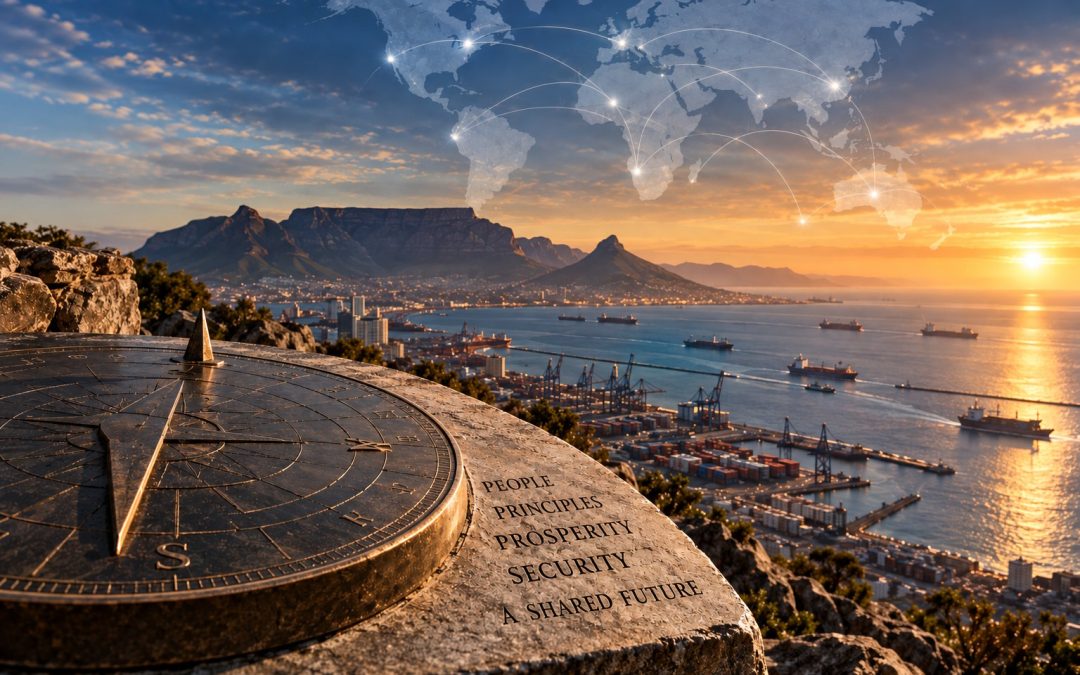
South Africa’s geographical position makes this particularly consequential. The country sits alongside an increasingly important maritime route at a time when instability in other maritime chokepoints is increasing the value of alternative routes. Its ports and naval capabilities therefore matter not merely to South Africa but to the wider trading system; its mineral resources matter to countries attempting to secure critical supply chains; and its diplomatic relationships matter to powers seeking influence in Africa.
These circumstances give South Africa choices. They also make it attractive to others.
A geopolitical pivot does not necessarily control its own strategic importance. Other powers may recognise its value before it does. South Africa can consequently become an object of other states’ strategies even while believing that it is pursuing its own.
The difference is strategic culture. A country with a durable strategic culture can look at competing offers of investment, security cooperation, diplomatic support and political alignment and ask which of them advances its enduring interests. A country without one may instead ask which offers the greatest immediate advantage. Over a decade or a generation, the distinction can determine whether a country is exercising strategic autonomy or gradually surrendering it.
What are South Africans prepared to defend?
South Africa therefore faces a rather different strategic challenge from simply deciding whether it belongs with the West, the Global South, BRICS or some future grouping. The danger is not necessarily choosing the wrong camp. It is entering a multipolar world without a sufficiently durable understanding of what South Africa itself is trying to protect.
There are reasons for both optimism and concern. The response to external pressure suggests that a sense of sovereignty can unite South Africans across some of the divisions that dominate domestic politics. The extraordinary identification with the Springboks suggests that a higher-order South African identity is possible without requiring people to abandon their other identities. Pan-Africanism provides another layer of belonging that need not be incompatible with South African interests.
But these examples also reveal the limits of such cohesion. The fact that some groups actively seek external intervention when they believe the South African state has failed them demonstrates that sovereignty is not understood in precisely the same way by everyone. The disputes surrounding Gaza and other foreign-policy questions similarly show how different historical and ideological conceptions of South Africa can produce radically different interpretations of the national interest.
Perhaps South Africa does not need to settle the question of who it is before it can develop a strategy. It may instead have to discover what it can agree to defend despite its disagreements about history, identity and ideology.
A strategic culture does not have to tell citizens who they must be. It has to establish enough common ground to answer a narrower and more consequential question: what are we prepared to defend together?
The multipolar world may give South Africa more choices than it has had for some time. Whether those choices amount to strategic freedom will depend on whether the country can make them according to interests that endure beyond the political moment.
Whether that is enough to constitute a durable South African strategic culture remains an open question. But the emerging multipolar world is unlikely to wait for South Africa to answer it.

NONGQAI’S Strategic Security Analyst Dr Joan Swart is a forensic psychologist with an MBA and an MA in Military Studies. Her work focuses on African security, geopolitics, state fragility, substate dynamics, and the intersection between governance, legitimacy, and coercive power. She is the author of several books and regularly publishes long-form analysis and opinion pieces on security and governance issues. Her writing has appeared in outlets including DefenceWeb, Maroela Media, Netwerk24, RSG, Visegrad, and other policy and public-affairs platforms. She has a weekly slot on SAfm The Global Briefing to analyse world affairs. Her work bridges academic research, policy analysis, and applied strategic assessment, and she is currently completing a second PhD at the University of Stellenbosch Military Academy. Follow her on X/Twitter, Substack, LinkedIn, and YouTube.
