Abstract: The funeral of Ayatollah Ali Khamenei demonstrates how states can employ ritual, symbolism and mass mobilisation as instruments of strategic communication before military force is ever employed. Recognising and correctly interpreting such signals is an increasingly important competency for military professionals operating in a multipolar world.
Dr Joan Swart
Keywords: Strategic communication | Strategic culture | Cultural intelligence | Military strategy | Intelligence analysis | Iran | Statecraft
THE BATTLEFIELD BEFORE THE BATTLEFIELD: WHAT MILITARY PROFESSIONALS CAN LEARN FROM IRAN’S FUNERAL DIPLOMACY
Carl von Clausewitz famously described war as the continuation of politics by other means. Implicit in that observation is another strategic truth that is often overlooked: politics, diplomacy and communication are the preferred means through which states seek to achieve their objectives before resorting to armed conflict. As Lawrence Freedman argues, strategy is fundamentally concerned with influencing the behaviour and decisions of others. Military force is only one instrument through which this is achieved. States also seek to shape perceptions, communicate intent and influence the calculations of allies and adversaries long before force is employed.
Military professionals therefore ignore strategic communication at their peril.
The state funeral of Iran’s Supreme Leader, Ayatollah Ali Khamenei, in July 2026 provides a compelling illustration of this principle. While international media understandably focused on the political implications of the leadership transition, another dimension of the event received comparatively little attention. As foreign delegations entered the official mourning ceremony, different verses from the Qur’an were reportedly recited to each delegation. Analysts have suggested that these verses were selected deliberately to reflect Iran’s relationship with each state or organisation represented.
Whether every interpretation is correct is ultimately less important than recognising the sophistication of the communication itself. If the selections were indeed deliberate, Iran succeeded in conveying different strategic messages to different audiences without issuing a single diplomatic statement. Allies, partners, rivals and regional actors all participated in the same ceremony, yet each may have received a different message. Some verses appeared to reassure allies, others encouraged resistance movements, while still others subtly addressed complex diplomatic relationships. Rather than relying upon a single narrative, the organisers appear to have tailored their communication to the nature of each relationship.
For military practitioners, this should immediately raise an important question. How often do we focus our analytical effort on force structures, weapons systems and operational capability while overlooking the symbolic language through which states communicate intent?
The Intangible Dimensions of Military Power
Military organisations are naturally inclined to measure what can be counted. Order of battle, missile inventories, logistics, force readiness and defence expenditure all lend themselves to systematic analysis. These remain indispensable elements of military assessment. Yet strategy has always involved intangible dimensions that resist quantification. Political legitimacy, national identity, historical memory, religious symbolism and societal cohesion all influence strategic behaviour. They are no less real because they cannot be expressed in tables, satellite imagery or intelligence estimates.
Modern military analysis understandably privileges what can be measured. Force ratios, logistics, industrial capacity and technological sophistication remain essential indicators of military effectiveness. Yet history repeatedly reminds us that wars are seldom decided by material factors alone. Political legitimacy, societal resilience, national identity and collective purpose often determine whether military capabilities can be translated into lasting strategic success. These intangible dimensions of power are more difficult to quantify, but they remain central to strategy.
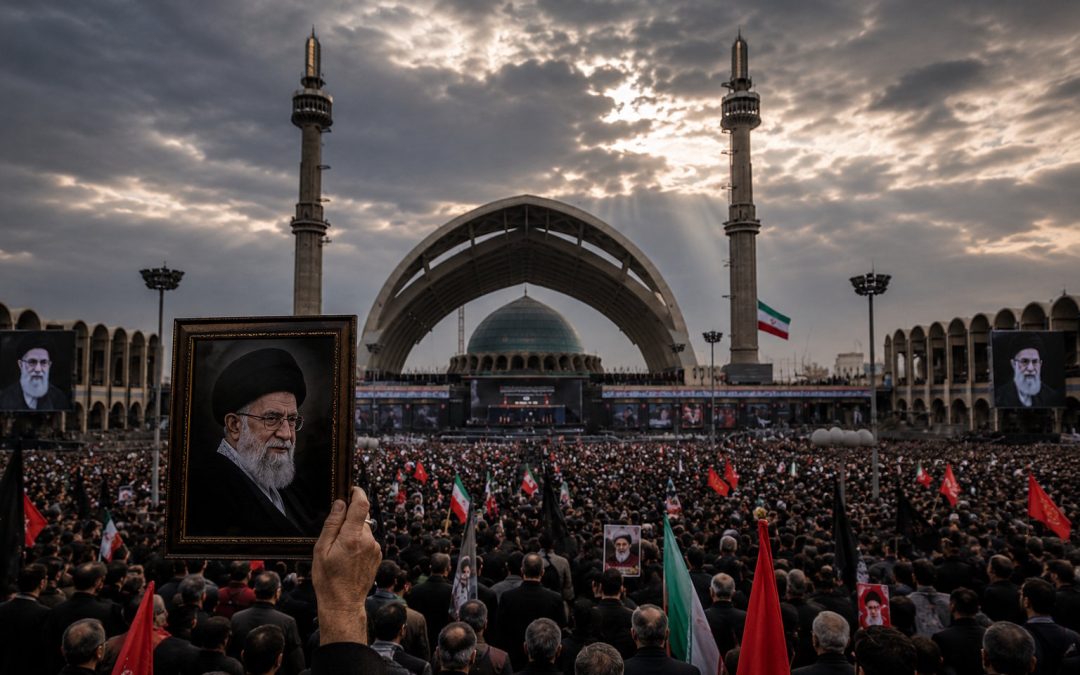
Equally significant was the audience beyond the official delegations. Strategic communication is rarely directed at a single recipient, and the funeral appears to have addressed several audiences simultaneously. Domestically, it projected continuity following the death of Iran’s highest political and religious authority. To regional allies and partners, it communicated resilience and cohesion. To external adversaries, including the United States and Israel, it conveyed another, equally important message: any assessment of Iranian power should take account not only of military capabilities, but also of the regime’s capacity to mobilise identity, legitimacy and collective action.
Regardless of the precise attendance figures—which remain difficult to verify independently—the funeral processions across multiple locations in Iran and Iraq projected an unmistakable image of mass mobilisation. Whether tens of millions attended or considerably fewer is, from a strategic perspective, less important than the perception deliberately created. The ceremony presented Shi’a social and political cohesion as a strategic resource in its own right. Such demonstrations remind observers that military power does not reside solely in missiles, aircraft and troop numbers. It also resides in political will, collective identity and the ability of a society to mobilise behind a common cause.
This distinction is not unique to Iran. Throughout military history, technologically superior powers have repeatedly encountered opponents whose principal strength lay not in equipment but in cohesion, legitimacy and strategic resolve. Strategic communication therefore serves not merely to influence opinion; it also projects these intangible sources of power before military force is ever employed.
Intelligence, Culture and Interpretation
The funeral also illustrates an aspect of intelligence analysis that deserves greater attention. Military intelligence traditionally seeks to understand an adversary’s capabilities and intentions. Yet intentions are communicated through culture as much as through doctrine. States do not all communicate according to the same conventions. Some rely heavily on official policy statements, while others communicate through ritual, symbolism, historical references or religious texts. Analysts who interpret every signal through their own cultural assumptions risk overlooking messages that were entirely clear to the intended recipients.
Mirror-imaging has long been recognised within intelligence studies as a persistent analytical danger. It occurs when analysts assume that other states think, communicate and make decisions according to the same cultural logic as their own. Strategic surprise often results not because information was unavailable, but because available information was interpreted through an inappropriate cultural framework.
Colin S. Gray repeatedly argued that strategy cannot be separated from the culture within which it is conceived and practised. Understanding another state’s strategic behaviour therefore requires more than analysing its military capabilities. It also requires understanding the historical experiences, symbols, traditions and values through which strategic meaning is communicated.
As a forensic psychologist, I have often reflected on the importance of cultural intelligence. A psychologist cannot hope to understand a client by interpreting every action exclusively through the psychologist’s own cultural assumptions. Professional competence requires an effort to understand another person’s symbolic world before attempting to explain behaviour. This does not imply agreement with every belief or value held by the client. It simply acknowledges that meaningful interpretation is impossible without first understanding the context within which behaviour acquires meaning.
The same principle applies to military strategy. Understanding another state’s strategic communication does not require sympathy for its government or agreement with its policies. It requires professional discipline. Intelligence officers, military planners and strategists who fail to understand the cultural and historical frameworks within which their counterparts communicate increase the likelihood of analytical error. In an increasingly multipolar world, cultural intelligence is therefore not a political virtue; it is an operational competency that improves strategic assessment and reduces analytical error.
Lessons for Military Professionals
Perhaps the most enduring lesson from Tehran is therefore not theological, political or even specifically Iranian.
It is methodological.
Military professionals must learn to recognise that strategic communication extends well beyond speeches, policy documents and diplomatic communiqués. States communicate through ceremonies, military parades, commemorations, protocol, architecture, symbols and carefully choreographed public events. These are not peripheral aspects of strategy. They are often integral to how states articulate political intent, reinforce alliances, deter adversaries, project legitimacy and demonstrate resilience.
The battlefield begins long before the first shot is fired.
By the time military force is employed, states have often spent months or years shaping perceptions, signalling intentions and communicating resolve through instruments that many observers dismiss as mere ceremony. Learning to read these signals is therefore not simply an academic exercise. It is an essential component of strategic literacy and professional military education.
For soldiers, intelligence analysts and strategists alike, the first responsibility is not merely to observe military power.
It is to recognise the many ways in which states communicate it.
References
Clausewitz, C. von. 2007. On War. Oxford University Press.
Freedman, L. 2013. Strategy: A History. Oxford University Press.
Gray, C.S. 1999. Modern Strategy. Oxford University Press.

NONGQAI’S Strategic Security Analyst Dr Joan Swart is a forensic psychologist with an MBA and an MA in Military Studies. Her work focuses on African security, geopolitics, state fragility, substate dynamics, and the intersection between governance, legitimacy, and coercive power. She is the author of several books and regularly publishes long-form analysis and opinion pieces on security and governance issues. Her writing has appeared in outlets including DefenceWeb, Maroela Media, Netwerk24, RSG, Visegrad, and other policy and public-affairs platforms. She has a weekly slot on SAfm The Global Briefing to analyse world affairs. Her work bridges academic research, policy analysis, and applied strategic assessment, and she is currently completing a second PhD at the University of Stellenbosch Military Academy. Follow her on X/Twitter, Substack, and LinkedIn.

That’s a really insightful observation about Khamenei’s funeral – it’s fascinating to see how much beyond just the military these states are using these kinds of events to send messages.