Capt MN Melville – Nongqai Vol 17 No 6
Abstract
This article describes a farewell reception held in Durban for Captain MN Melville on his retirement from the South African Police. The event took place at Wentworth Police Headquarters and was organised by members of the Durban South CID. Police officers and colleagues gathered to honour Captain Melville for his loyal and dedicated service.
During the ceremony, Sergeant S Chetty presented him with a wall clock as a sign of appreciation and respect. The reception highlighted the importance of recognising the service, leadership, and commitment of retiring police officers.
Key Words
South African Police,
Captain MN Melville,
Farewell Reception,
Durban-South CID,
Police Retirement
Wentworth
SOUTH AFRICAN POLICE
FAREWELL RECEPTION FOR CAPTAIN MN MELVILLE
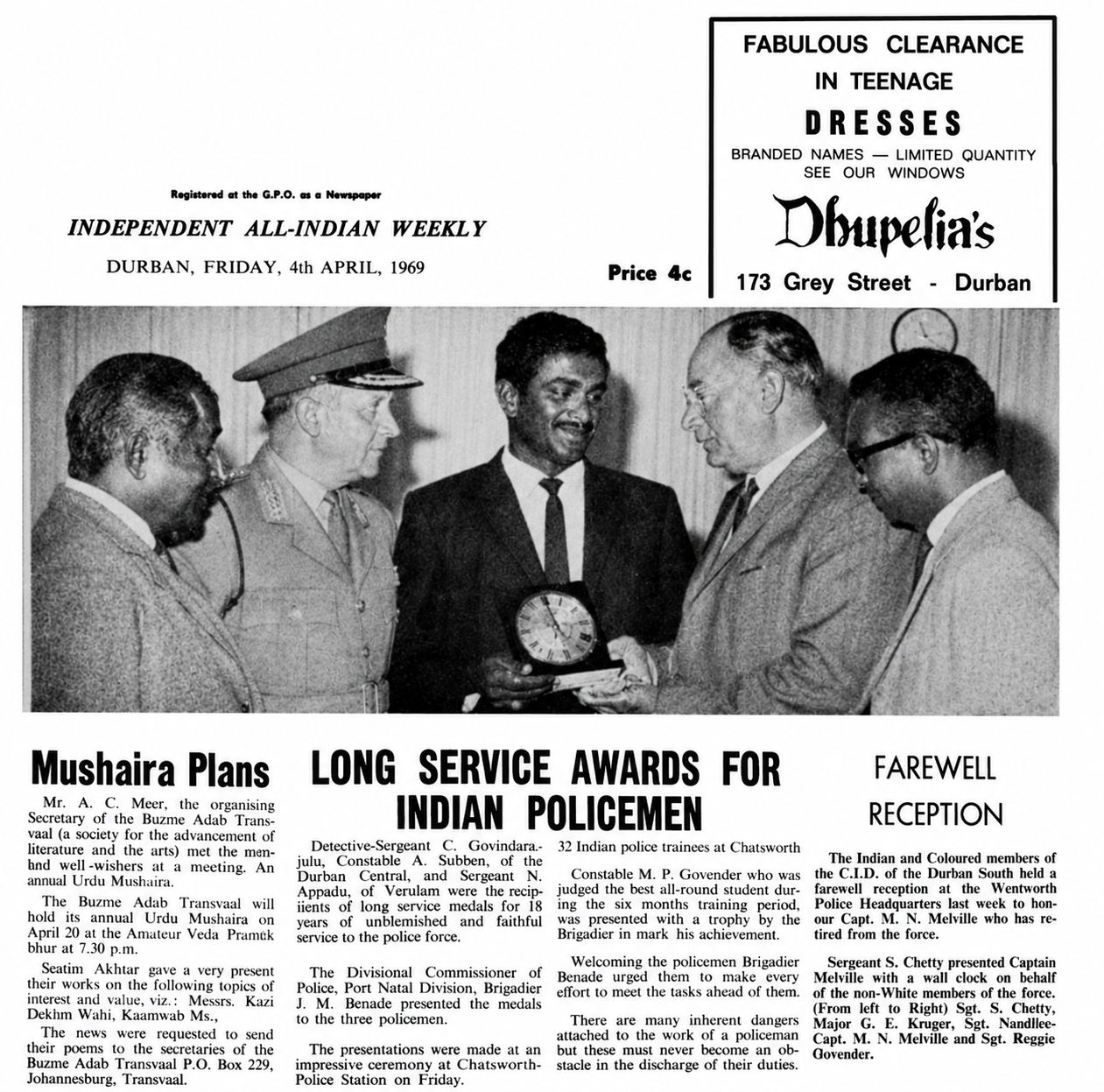
(Courtesy Independent ALL-Indian Weekly dated Friday, 4th April 1969. Chief Librarian, UKZN, Mr Thiru Munsamy, Ghandi / Luthuli Documentation Centre)
(Researched, authored, edited and prepared for publication by Logan Govender – [LG])
“The Nation which forgets its defenders will itself be forgotten.”
– Calvin Coolidge
[LG]
FAREWELL RECEPTION FOR CAPTAIN MN MELVILLE
A special farewell reception was held in Durban to honour Captain MN Melville on his retirement from the police force. The event took place at the Wentworth Police Headquarters and was organised by the Indian and Coloured members of the Criminal Investigation Department (CID) of Durban South. The gathering provided an opportunity for colleagues and friends to express their appreciation for Captain Melville’s years of dedicated service.
The reception was attended by members of the police force who had worked closely with Captain Melville during his career. It was a warm and respectful occasion that recognised his leadership, commitment, and contribution to policing. Those present gathered to thank him for the guidance and support he had given to those under his command.
As part of the ceremony, Sergeant S Chetty presented Captain Melville with a wall clock on behalf of the non-White members of the force. The gift served as a token of gratitude and respect. It symbolised the high regard in which Captain Melville was held by his colleagues and reflected the strong working relationships he had built throughout his career.
Several senior police officers were also present at the reception. Their attendance demonstrated the importance of the occasion and highlighted the respect Captain Melville had earned within the police. The event allowed fellow officers to share memories and acknowledge the positive impact he had made during his years of service.
Farewell receptions such as this are important because they recognise the contributions of individuals who have devoted their lives to public service. Police officers often face many challenges in their work, and retirement marks the end of a long period of commitment and responsibility. Honouring retiring officers helps to preserve their achievements and inspires younger members of the force to follow their example.
The farewell reception for Captain MN Melville was therefore a fitting tribute to a respected police officer. It celebrated his career, recognised his dedication to duty, and expressed the appreciation of his colleagues. The event reflected the values of respect, loyalty, and service that are important within the police profession and ensured that Captain Melville’s contribution would be remembered with pride.
“Each day, millions of police officers do the selfless work of putting their lives on the line to protect civilians, frequently responding to or preventing crises completely with no recognition.” – Letitia James
“agnoscere et honorare servientibus” –
“to acknowledge and honour those who served”
“Soli Deo Gloria” – “To God Alone Glory”
Logan Govender
Comments by Hennie Heymans
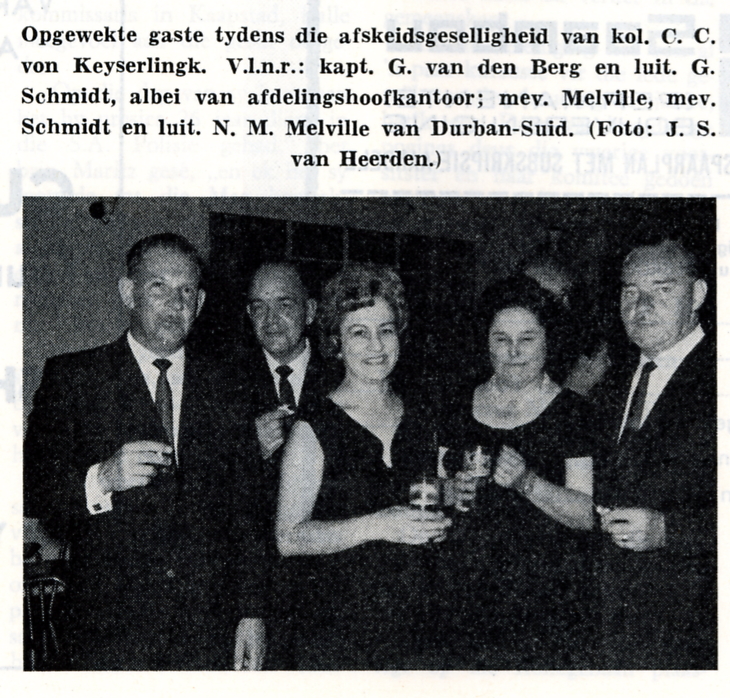
I gladly share another photograph of Capt. N.M. Melville, one of my officers during my time in Durban‑South. He served as a Detective Officer and was a veteran of the Second World War. As a young constable I often drove him on night duty when he acted as Duty Officer for Port Natal.
In those days, commissioned officers were few and far between. Many only reached that rank later in life — unlike today, where young men and women are appointed to senior positions at an early age. Officers of Melville’s generation carried a certain gravitas, shaped by experience rather than promotion boards.
I still hope to make contact with Brig Schmidt’s children.

