BSAP – Nongqai Vol 17 no 6
RIGHT OF THE LINE
Rhodesia’s British South Africa Police, the Formative Years
1889–1902
Gerhard van Tonder
ABSTRACT
This article provides a comprehensive historical overview of the formative years of the British South Africa Police (BSAP), tracing its evolution from 1889 to 1902. Emerging from the British South Africa Company Police and several regional mounted units, the BSAP developed as a uniquely paramilitary force shaped by Cecil John Rhodes’s imperial ambitions and the political dynamics of southern Africa. The narrative outlines the BSAP’s early operations, including its role in escorting the 1890 Pioneer Column, its involvement in territorial disputes with Portugal, and its participation in the Matabele War of 1893, the Jameson Raid of 1895–96, and the Matabele and Mashona Rebellions of 1896–97. The article highlights how the BSAP, “a police force in name only,” functioned as both a military and civil authority during the establishment of Rhodesia. It also details the organisational changes, uniforms, equipment, and the integration of various mounted police units into a single national force. Through these developments, the BSAP became deeply intertwined with the political, military, and colonial expansion of the region, laying the foundation for its later role in Rhodesian history.
Quoted lines: “Thus was born Rhodesia’s national police force, the BSAP, quintessentially paramilitary…” “The Pioneer Column reached the site of the new country’s capital, Salisbury, on September 12, 1890.”
KEYWORDS
British South Africa Police (BSAP),
British South Africa Company,
Pioneer Column,
Cecil John Rhodes,
Matabele War (1893),
Jameson Raid (1895–96),
Matabele and Mashona Rebellions (1896–97),
Rhodesian colonial history,
Mounted police units,
Bechuanaland Border Police,
Mashonaland Mounted Police,
Matabeleland Mounted Police,
Royal Charter of 1889,
Rhodesian paramilitary policing,
Early Rhodesian administration,
An 1890-1980 Overview
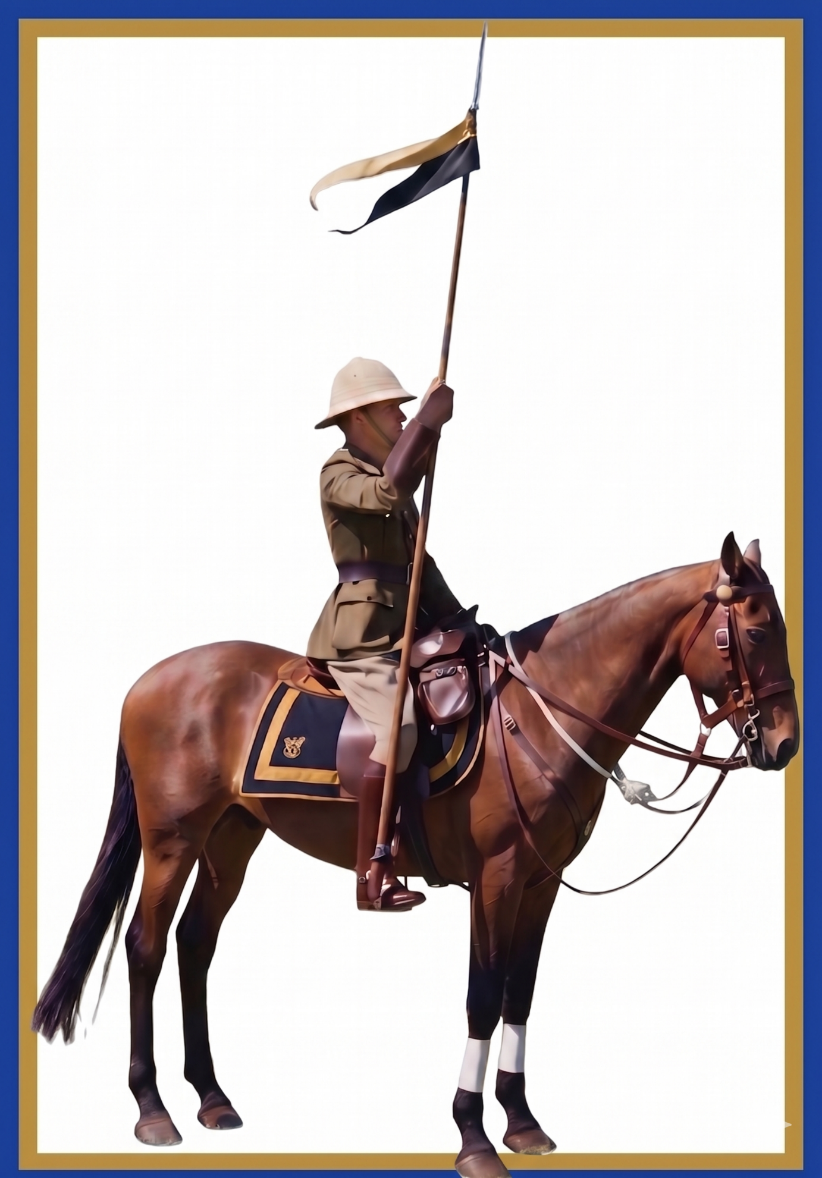
The BSAP was an amalgamation of the original British South Africa Company Police – who provided the escort to the 1890 Pioneer Column to Mashonaland – the Mashonaland and Matabeleland Mounted Police forces (MMP), members of the Bechuanaland Border Police (BPP) and other local police units.
Police General Order dated August 22, 1898, brought about a change in title for the force and the word “Company” was dropped. The BSAP comprised four divisions: Bechuanaland Protectorate Division, Matabeleland Division, Mashonaland Division and North Zambezi Division. The first division was disbanded in 1903 and the fourth became the Northern Rhodesia Police (NRP). During the Second Boer War of 1899–1902 the BSAP served with British forces under Colonel Robert Baden-Powell at Mafeking and the Rhodesia Regiment in the Transvaal.
At the outbreak of World War One, the BSAP again answered the call of the Crown. No. 1 Mobile Troop was mobilised in August 1914 and was joined by No. 4 Troop (a machine-gun troop) to form the BSAP Mobile Column under Major Algernon Capell. The unit operated alongside the NRP in German South West Africa. The BSAP Service Column, led by Major Ronald Murray, served against the Germans in German East Africa. Murray’s Column saw much action against General von Lettow-Vorbeck. At this time Sergeant Frederick Booth, BSAP, who was attached to the Rhodesia Native Regiment, was awarded the Victoria Cross for gallantry as well as the Distinguished Conduct Medal and a Mentioned in Dispatches.
The BSAP reorganised itself in 1923 when Southern Rhodesia was granted Responsible Government by Britain after the British South Africa Company relinquished responsibility for the territory. This meant that the BSAP was now controlled by the Department of the Attorney General. The force was divided into District Police, with headquarters in Salisbury, Umtali, Hartley, Fort Victoria, Gwelo, Bulawayo and Gwanda; Town Police divided into an A and B Division; and the Criminal Investigation Department (CID). In 1924 the Town Police stations were commanded by District Officers. The Railway Police were a part of the Town Police but were paid by the railways.
In 1935 members of the BSAP were airlifted to the Copperbelt of Northern Rhodesia to assist the NRP with a strike on the copper mines and in 1937 a mounted contingent took part in the coronation ceremony of King George VI in London. Shortly thereafter the Criminal Investigation Department and Security Branch were also established, playing an active and important role in the day-to-day police tasks expected of them.
The BSAP served during both World Wars, and when Queen Elizabeth II was crowned Queen in 1953 the BSAP was represented at the coronation by a mounted troop. The Federation of Rhodesia and Nyasaland was formed on the August 1, 1953, when a Federal Army was established. Thus the BSAP took on the specific role of a civil police force in Southern Rhodesia.
In February 1954, Queen Elizabeth, the Queen Mother, consented to become the Honorary Commissioner of the BSAP, a position that was withdrawn by Britain in 1970. The BSAP continued to serve Rhodesia until 1980 when the country became Zimbabwe.
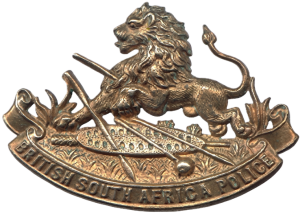
BSAP cap badge 1897–1903. (Col Dudley Wall)
Origins
The British South Africa Police (BSAP) was a very unusual and rare body in the annals of agents of law enforcement. Generally, such units are constituted civil bodies empowered by the state to maintain public order and to prevent and detect crime. However, the roots of the BSAP are not constitutional, nor was it raised as a civil organ. It rather owed its existence to a series of historical events generated by one man’s desire for wealth and the expansion of the late-Victorian British Empire.
The formation of the BSAP is directly linked to diamond magnate Cecil John Rhodes’s desire to enhance his burgeoning wealth by exploiting gold deposits north of the Limpopo/Crocodile River, rumoured to surpass that of the Witwatersrand. He also had a strong desire to expand the British Empire northwards, with a vision of a Cape to Cairo railway. However, the militaristic amaNdebele kingdom, first established by Mzilikazi, had to first be rendered powerless to allow Rhodes access to what would become Rhodesia.
During the so-called Mfecane (1810s–1840s), a historical period of heightened Nguni military conflict and migration associated with indigenous state formation and expansion in Southern Africa, Mzilikazi, of the Khumalo royal house, fled the wrath of the ruthless Zulu King Shaka in 1823. After clashing with Boers in the Transvaal, the itinerant Mzilikazi and his followers were forced westwards into what is present-day Botswana.
He then later migrated northwards towards what is now Zambia, but he was unable to settle there because the prevalence of disease-carrying tsetse fly proved fatal to his cattle. Mzilikazi was forced to move once more, this time south-eastwards into what became known as Matabeleland, situated in the southwest of present-day Zimbabwe, where he settled.
For Mzilikazi, interaction with outsiders was very limited. He maintained a long-standing relationship with missionary Robert Moffatt, whom he had first met at Kuruman. Then there was the occasional hunter who was obliged to “seek the road” from Mzilikazi to enter his realm.
In 1865, one such hunter, Henry Hartley, stumbled across numerous ancient gold-mine workings. On his next visit Hartley was accompanied by minerologist and archaeologist Karl Mauch, who found gold dust “everywhere” at a spot on the Umfuli River. At another, he found a reef of gold where an elephant had fallen; the area dotted with rubble dumps, trenches and the ruins of a smelter. Upon leaving Mauch took rock samples as evidence of what he described as “vast goldfields.”
With Lobengula’s accession to the throne after Mzilikazi died in 1868, hunters and prospectors, driven by visions of an Eldorado, flocked to the new king’s court at GuBulawayo to seek his permission to look for gold. Among these, albeit only as a hunter of elephant, was the 20-year-old Frederick Courteney Selous.
In 1887, in Cape Town a group of adventurous young white men formed the Northern Gold Fields Exploration Syndicate and immediately left for GuBulawayo. Their names, Frank Johnson, John Spreckley, Maurice Heany, Ted Burnett and Henry Borrow, would soon become household names as pioneers of a new territory called Mashonaland.
That year, when news reached Rhodes that Lobengula had granted exclusive prospecting rights to South African Republic (Transvaal) President Paul Kruger, he immediately responded by despatching his partner on the diamond fields, Charles Rudd, Zulu linguist Francis “Matabele” Thompson and legal expert Rochfort Maguire to GuBulawayo to counter this development.
After prolonged procrastination by Lobengula, Rudd was able to persuade the monarch to grant Rhodes “complete and exclusive rights over all metals and minerals contained in his kingdom”, which, Lobengula claimed, included the whole of the adjacent Shona-speaking territory referred to by the white visitors as Mashonaland. In return, Rudd promised Lobengula a monthly stipend of £100, 1,000 Martini-Henry rifles and a steamboat on the Zambezi River. The historic signing of what became known as the Rudd Concession took place at GuBulawayo on October 13, 1888.
An ebullient Rhodes wasted no time in setting up the instruments that would legitimise his right to enter the territory over which Lobengula held sway, and to establish a permanent presence based on mining and agricultural enterprise.
The Charter
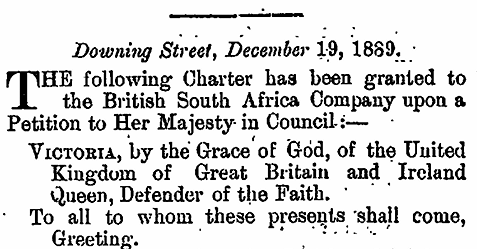
Sending his close Kimberley associate, Dr Leander Starr Jameson, to Lobengula’s court, Rhodes wanted to ensure the king remained loyal to his cause while he sought to convert the Rudd Concession into a legal Royal Charter in Britain.
Assisted in no small way by members of Britain’s influential aristocracy, The London Gazette of December 20, 1889, (extract above) promulgated the granting of a Royal Charter by Queen Victoria in the name of the British South Africa Company:
VICTORIA, by the Grace of God, of the United Kingdom of Great Britain and Ireland Queen, Defender of the Faith.
To all to whom these presents shall come, Greeting.
WHEREAS a Humble Petition has been presented to Us in Our Council by the Most Noble James Duke of Abercorn, Companion of the Most Honourable Order of the Bath; the Most Noble Alexander William George Duke of Fife, Knight of the Most Ancient and Most Noble Order of the Thistle, Privy Councillor; the Right Honourable Edric Frederick Lord Gifford, V.C.; Cecil John Rhodes, of Kimberley, in the Cape Colony, Member of the Executive Council and of the House of Assembly of the Colony of the Cape of Good Hope; Alfred Beit, of 29, Holborn Viaduct, London, Merchant; Albert Henry George Grey, of Howick, Northumberland, Esquire; and George Cawston, of 18, Lennox Gardens, London, Esquire, Barrister-at-Law.
And whereas the said Petition states amongst other things:-
That the Petitioners; and others are associated for the purpose of forming a Company or Association, to be incorporated, if to Us should seem fit, for the objects in the said Petition set forth, under the corporate name of The British South Africa Company.
That the existence of a powerful British Company, controlled by those of Our subjects in whom We have confidence, and having its principal field of operations in that region of South Africa lying to the north of Bechuanaland and to the west of Portuguese East Africa, would be advantageous to the commercial and other interests of Our subjects in the United Kingdom and in Our Colonies.
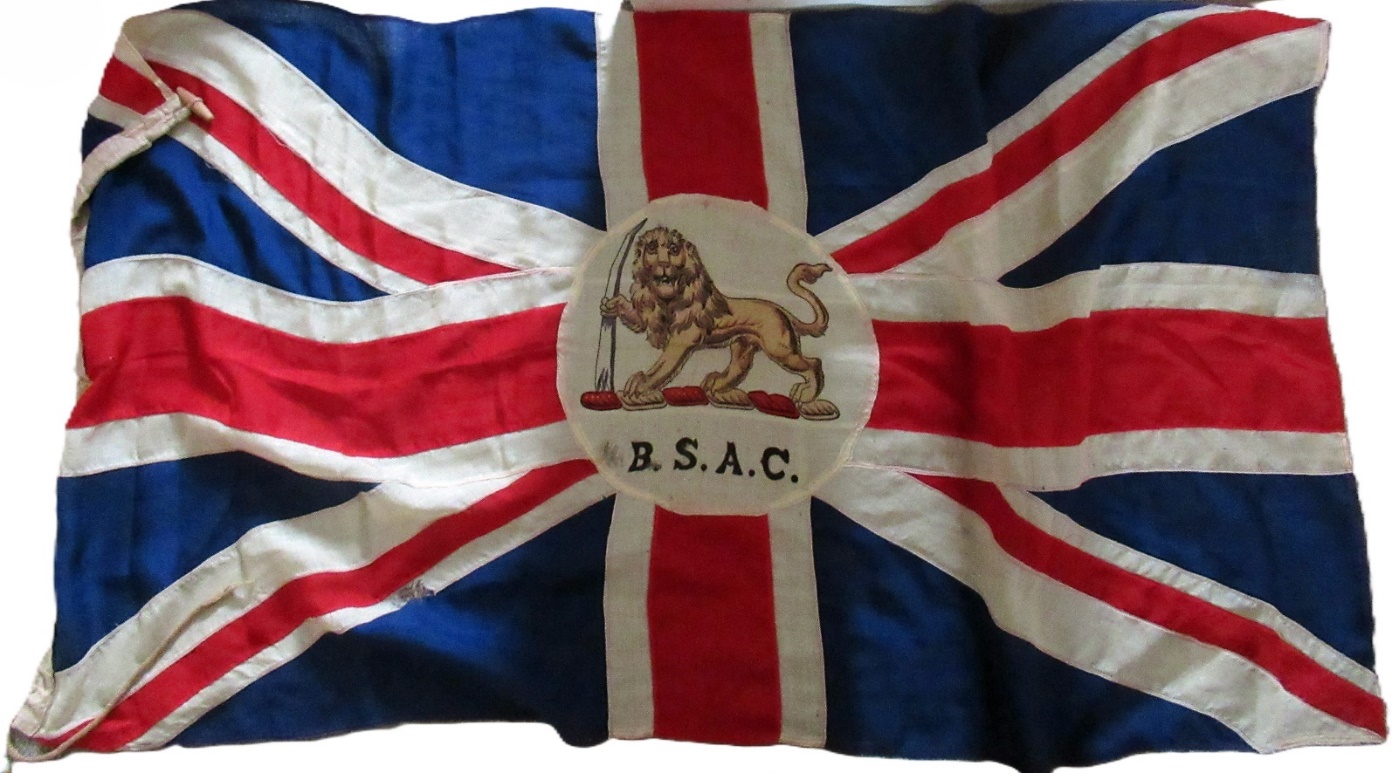
Flag of the BSACo. (Col Dudley Wall)
The lion and tusk emblem remained that of the Rhodesian Army throughout its whole existence.
For Rhodes, this was the carte blanche he was earnestly hoping for. He could – and would – justify his actions as being on behalf of the Crown, with the undefined boundaries wholly in line with his own grand designs that easily fell under that which would be advantageous to the “commercial and other interests” of Britain and her colonies.
However, the astute Rhodes was fully aware that the single biggest threat to his ambitious venture was Lobengula’s military might. Therefore any intended expedition of his BSACo into the new territory would have to be well-defended. For this, Rhodes used Clause 10 of the Charter to validate raising an escort force of 500 men – essentially soldiers – titled the British South Africa Company Police:
10. The Company shall to the best of its ability preserve peace and order in such ways and manners as it shall consider necessary, and may with that object make ordinances (to be approved by Our Secretary of State) and may establish and maintain a force of police. (author’s emphasis)
Thus was born Rhodesia’s national police force, the BSAP, quintessentially paramilitary with military-style ranks and uniforms, and equipped with weaponry befitting a military force. It was, as fully intended by Rhodes, a police force in name only.
Pioneer Column
The “Pioneer Column” was to be at the core of Rhodes’s expedition, a body of armed and uniformed men with a sprinkling of civilians. This body would be responsible in the first instance for establishing a fortified settlement at Mount Hampden, several hundred miles over marginally chartered terrain northeast of GuBulawayo.
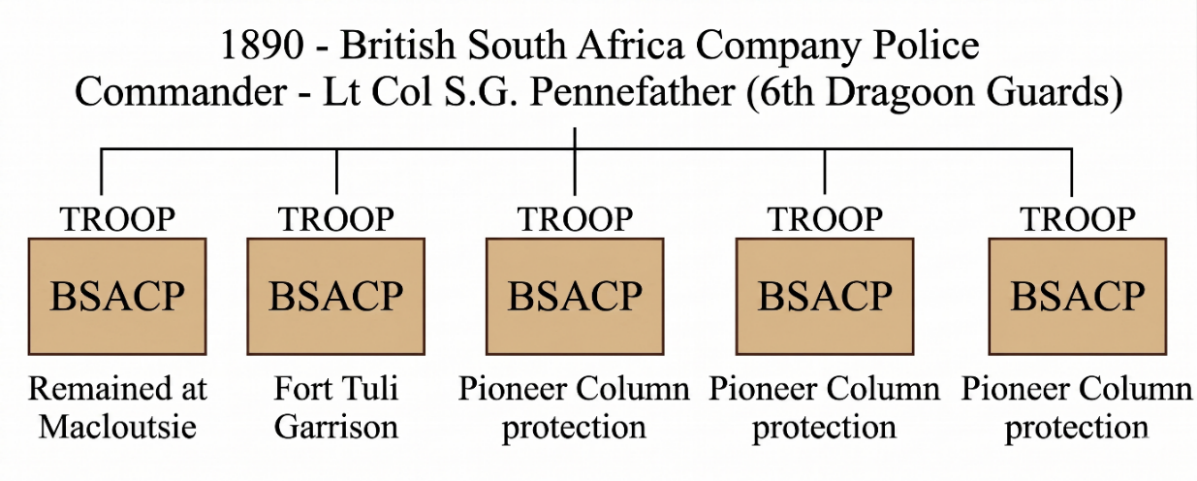
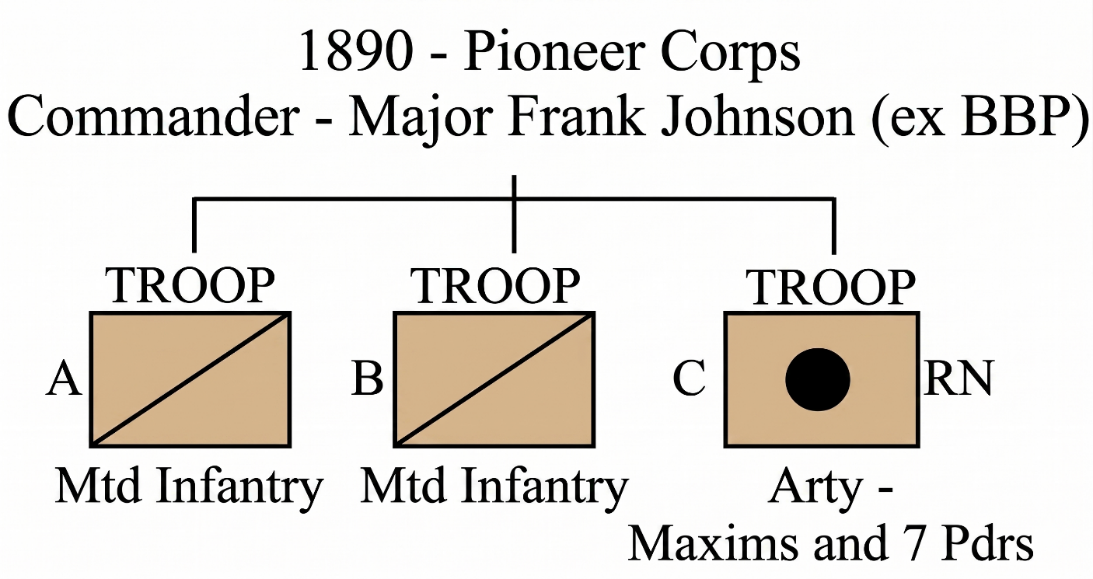
The two constituent bodies of the Pioneer Column. (Col Dudley Wall)
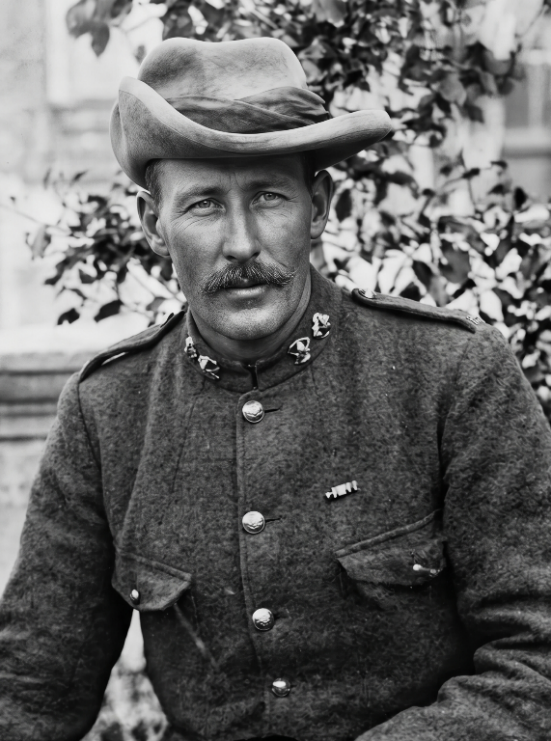
(NAZ)
The column was commanded overall by Irishman Lieutenant-Colonel Edward Pennefather, above, an officer in the 6th Inniskilling Dragoons, detached from the regiment which had been serving in South Africa since the late 1870s. His command included the accompanying BSACo Police. The plan was to establish forts at Tuli, Victoria, Charter and Salisbury to secure the safety of the members of the column who, when they reached their destination, would take up the tasks of prospecting, farming and establishing a new country based on the Rudd Concession granted by Lobengula, king of the amaNdebele nation.
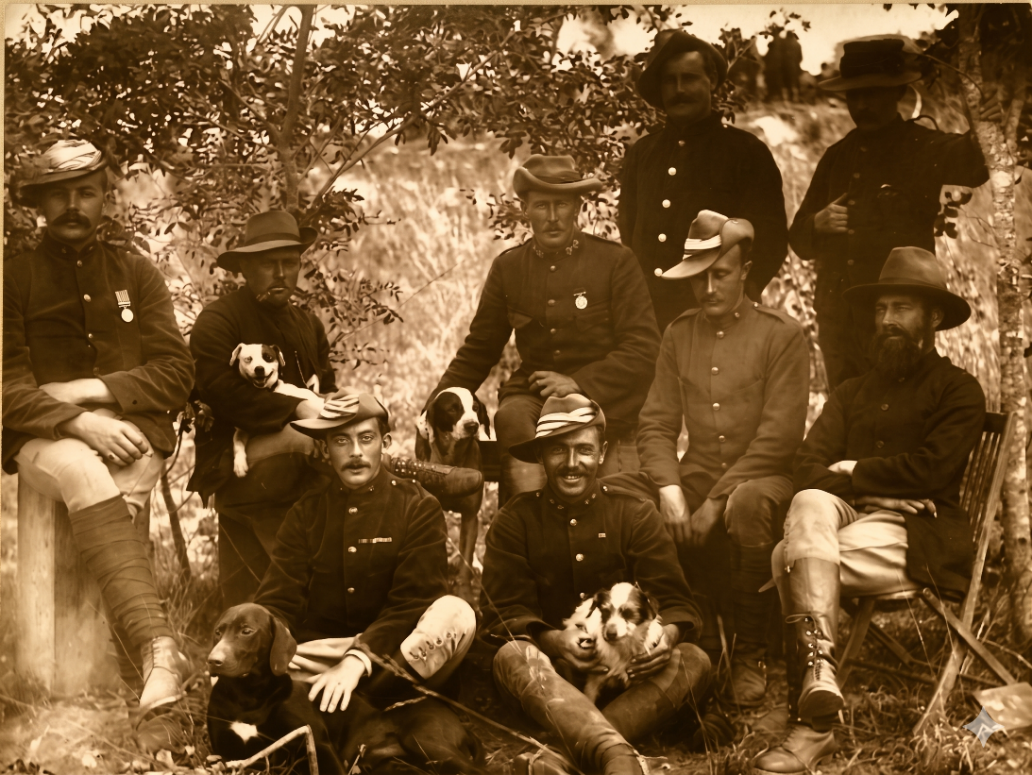
Col Pennefather, centre, with Pioneer Column officers. (NAZ)
The Pioneer Corps itself, which included 16 civilians, was commanded by Major Frank Johnson and consisted of 212 men. These were allocated local military ranks and formed into three troops: A Troop, commanded by Captain Maurice Heany, B Troop by Captain Henry “Skipper” Hoste and C Troop by Captain John Roach. Legendary hunter, explorer and renowned scout, Frederick Courteney Selous, was appointed as the Intelligence Officer. Major Allan Wilson, of the ill-fated 1893 Shangani Patrol, Cecil Rhodes’s right-hand man, Dr Leander Starr Jameson, and Administrator-Designate, Archibald Colquhoun, completed the Pioneer Corps complement.
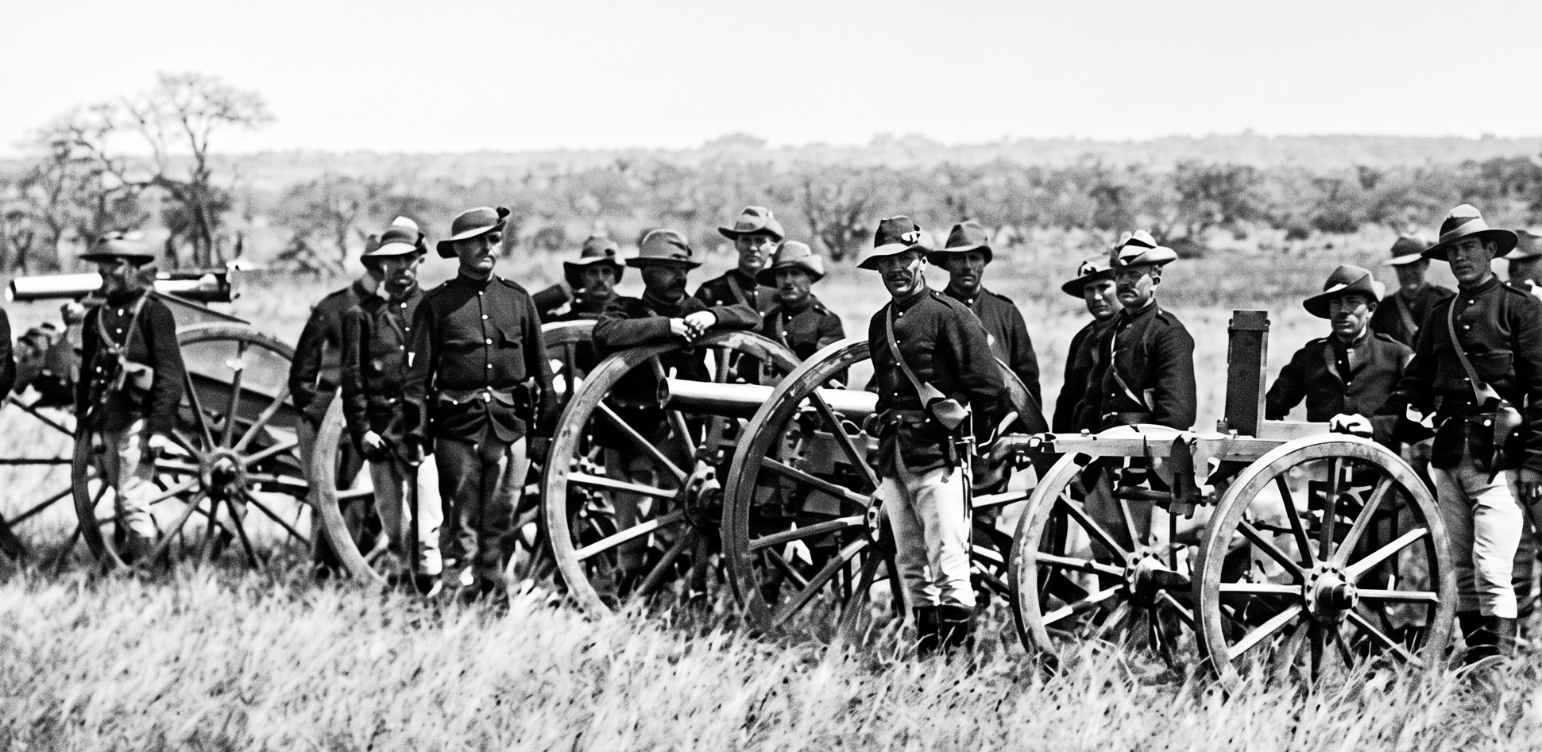
Elements of C (Artillery) Troop, BSACo Police, 1890, with an array of ordnance. (NAZ)
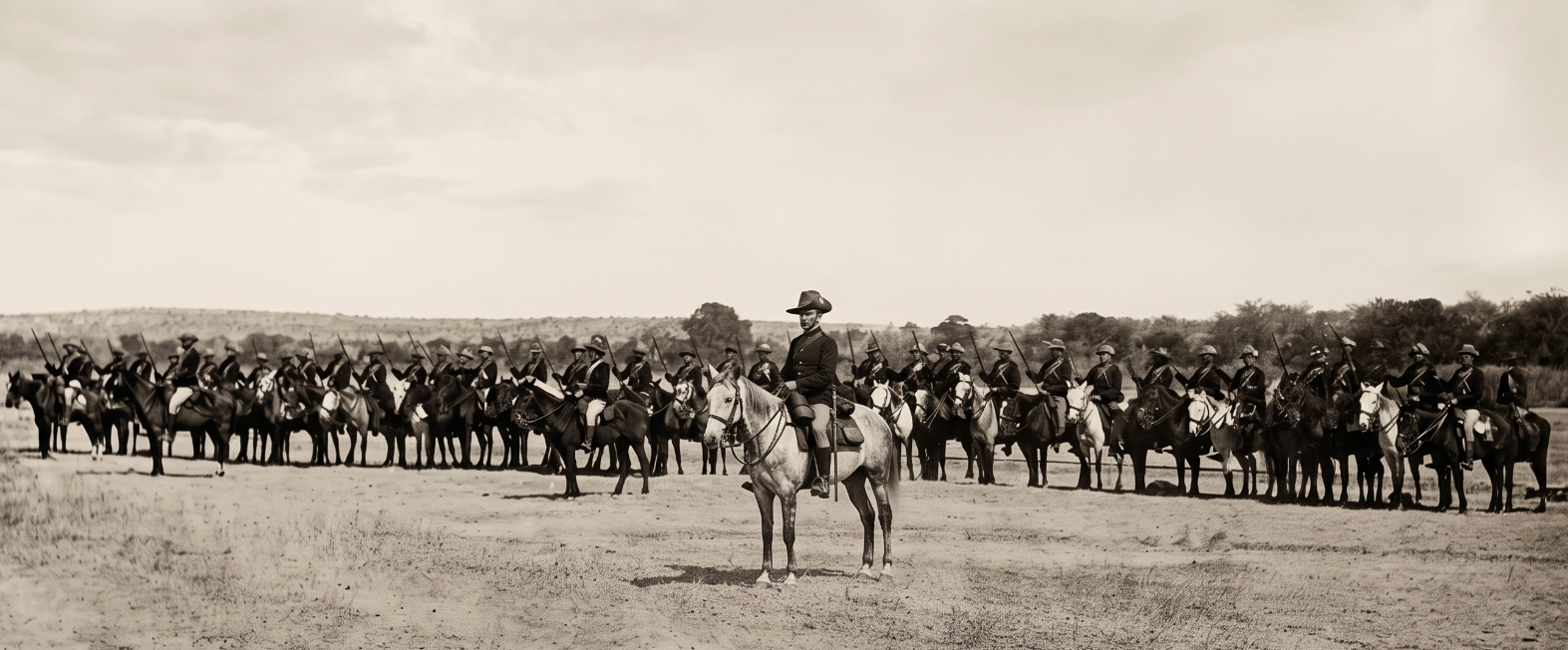
B Troop, BSACo Police, 1890. (NAZ)
Specifically raised as an armed force to protect the column on its journey, the 500-strong BSACo Police consisted of five troops and 200 Ngwato porters from the Bechuanaland Protectorate. The BSAC0 Police was equipped with two 7-pounder artillery pieces, two Gatling guns, two Gardner guns and a Maxim machine gun, as well as a steam engine-driven searchlight mounted on a wagon. The policemen were paid five shillings a day and, once Fort Salisbury had been established, most left the force and were rewarded with a grant of 4,500 acres of land.
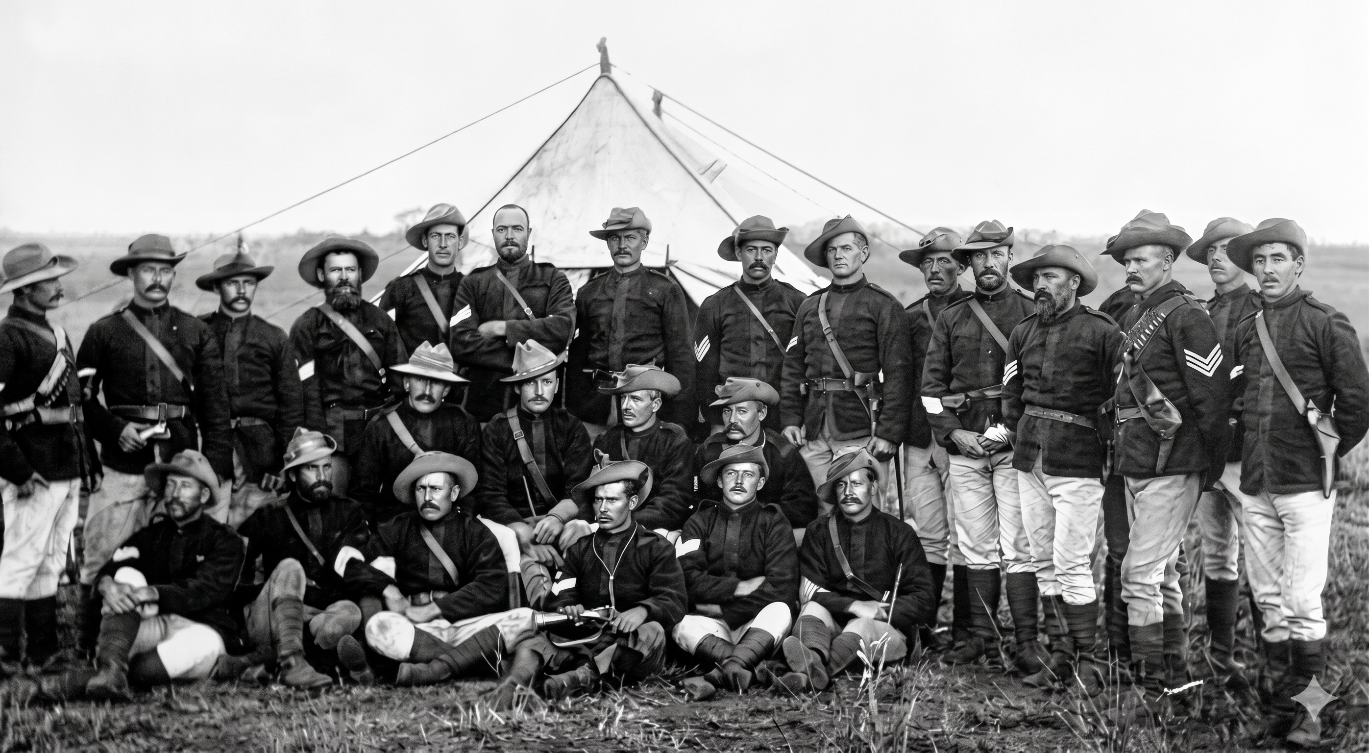
Non-commissioned officers of the BSACo Police escort to the Pioneer Column. (NAZ)
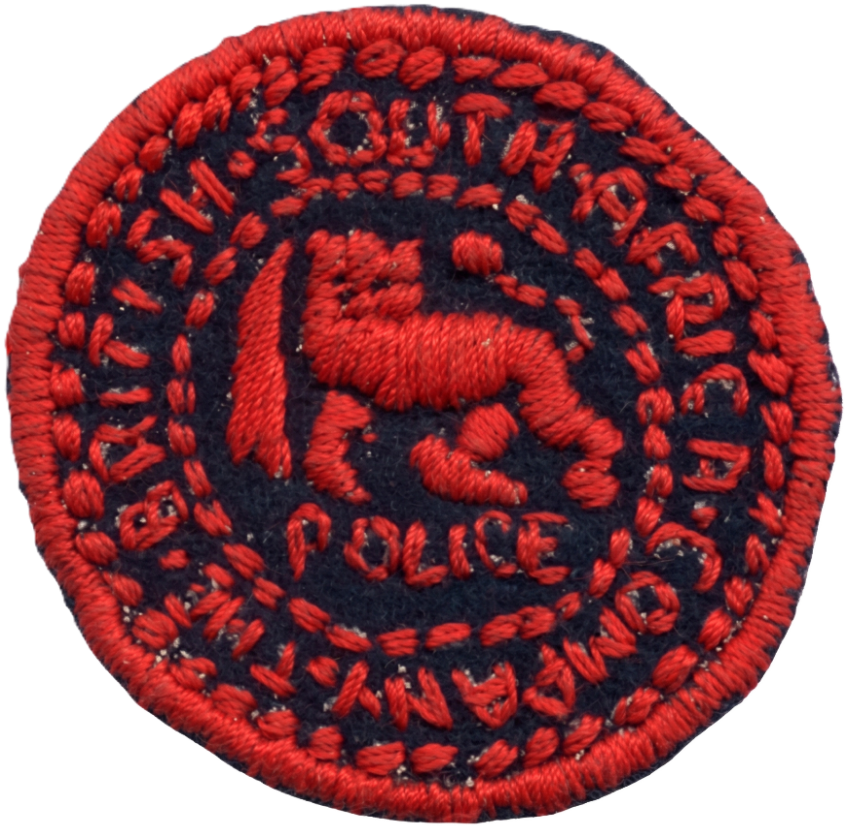
All the BSACo Police badges, such as this slouch hat one, were hand-made in Mafeking
before the Pioneer Column set off for Mashonaland. (Col Dudley Wall)
In the early 1890s, other police units also came into being before full incorporation into a single force:
Mashonaland Mounted Police
With a strength of 150, the Mashonaland Mounted Police (MMP) was raised and equipped after the Matabele War of 1893. It was organised on the basis of a small cavalry regiment, which was supported by an establishment of African Auxiliaries. It also took part in the Jameson Raid. The badge was a monogram in blackened brass “MMP” sometimes on red felt.
In the field the MMP wore a grey slouch hat with blue puggaree with white spots (guinea-fowl pattern). The left side was turned up and a blackened brass metal monogram badge consisting of the letters “MMP” was affixed to it. A forage cap, known as a Torrin cap, made of black material with a red crown and piping, was also worn, often by officers. The same badge was worn on the left side towards the front. According to photographic evidence, this form of headgear appeared more popular. Uniforms were loosely based on the Cape Mounted Rifles. The tunic and breeches were made from Bedford corduroy and were almost black in colour. Officers wore light-brown breeches. All ranks wore black knee boots and spurs. Officers also wore black leather Sam Browne belts and carried swords.
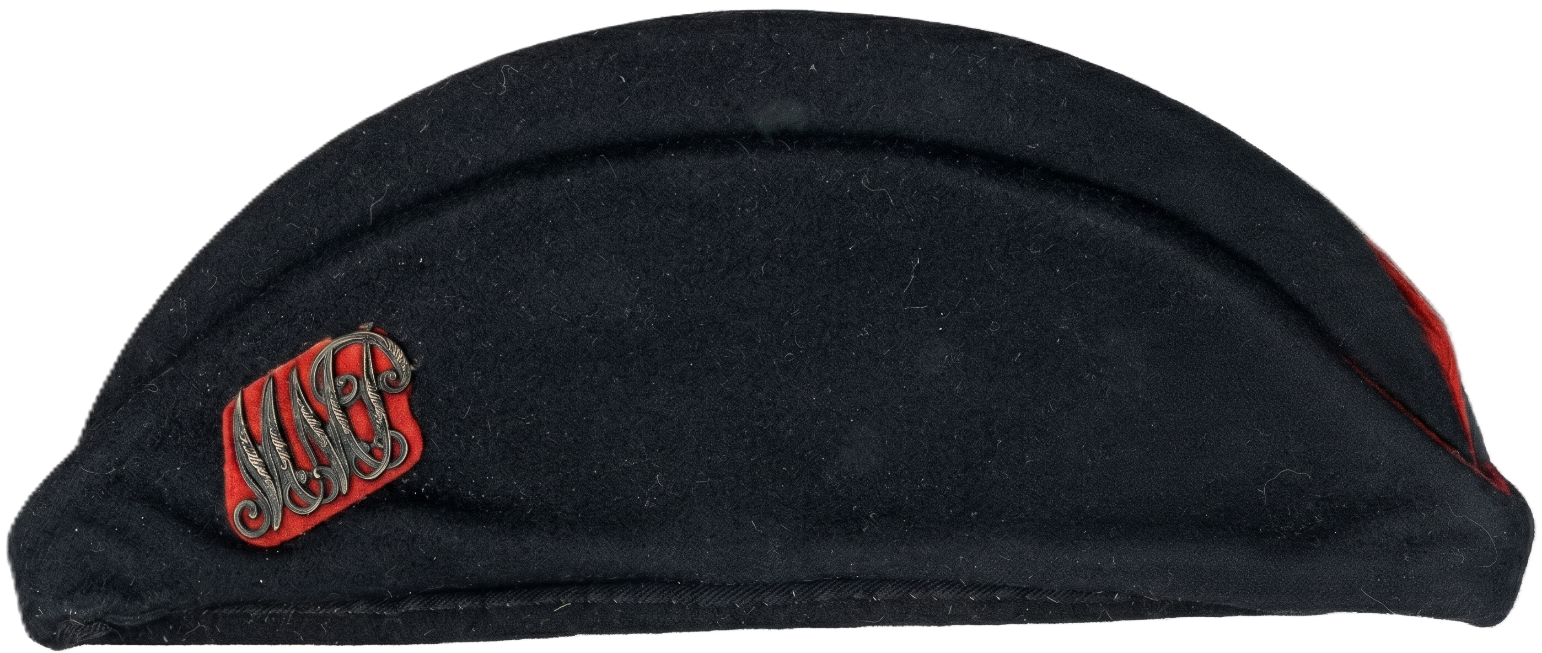
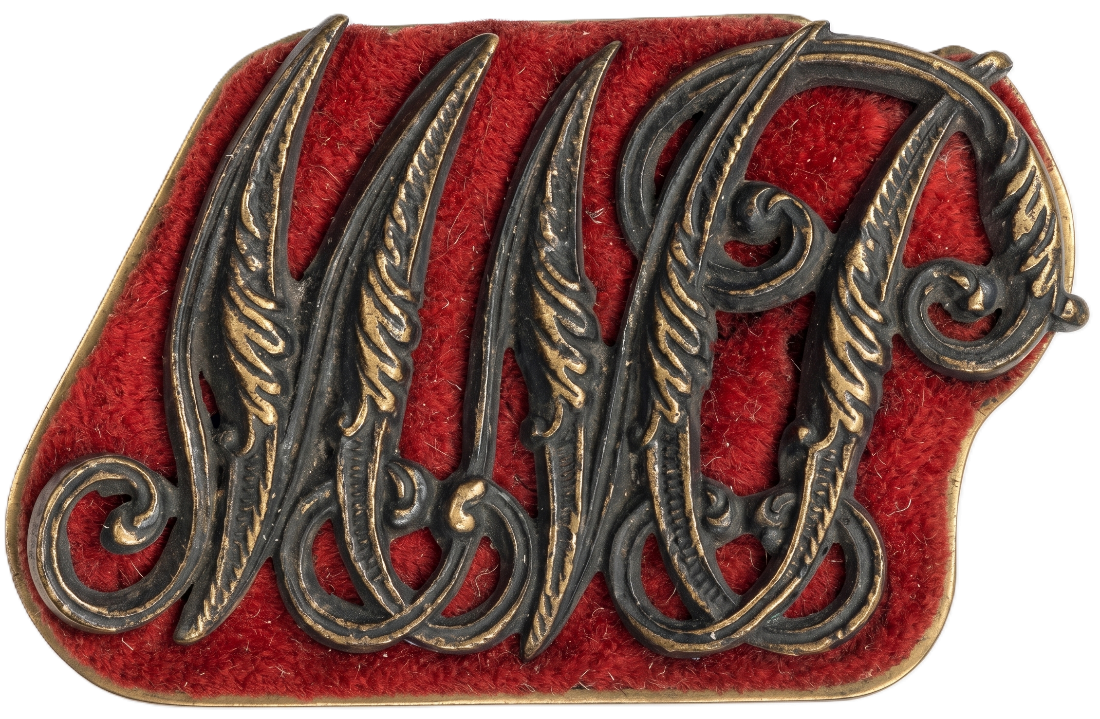
Torrin cap, top, and a Mashonaland Mounted Police hat badge. (Col Dudley Wall)
Matabeleland Mounted Police
Formed as a regular force, the unit included former members of the BSACo Police. Lieutenant William Bodle originally raised 150 men. The unit then consisted of 48 officers and men under command of Inspector Southey. Twenty-two men were stationed at Bulawayo and the rest at police stations in Gwelo, Selukwe, Belingwe, Inyati, Mangwe, Tuli, Matopos, Umzingwane and Iron Mine Hill.
The Matabeleland Mounted Police wore a grey felt slouch hat in the field with a blue polka dot guinea-fowl pattern puggaree. The left side was turned up and a blackened brass metal monogram badge consisting of the letters MMP with a red felt backing affixed to it. A Torrin cap made of black material with a red crown and piping was also worn. Officers wore the same badge with red felt backing on the left side of the cap towards the front. The badge and headgear was exactly the same as that for the Mashonaland Mounted Police.
Mashonaland Constabulary
This force was raised as a Town Police. It was sometimes referred to as the Municipal Police and was deployed on foot or bicycle. The Mashonaland Constabulary wore a blue “Austrian” cap, except for the mounted section that wore a dark blue forage cap. There is evidence of a cap badge being worn on the Austrian cap. It consisted of the letters VR under a Crown surrounded by a laurel wreath. It is unknown if it was made from brass metal or embroidered cloth. The tunic and trousers were in dark blue and the tunic had lighter blue braid across the chest. Shoes and S-clasp belt were made from black leather. The mounted section wore drab Bedford breeches with blue knee-length puttees and black leather ankle boots. (Police General Order, May 28, 1900)
Matabeleland Constabulary
The Matabeleland Constabulary was raised as a police force for Matabeleland. Constables and sergeants wore an “Austrian” cap with a cap badge featuring a Queen Victoria Crown in a laurel wreath. It appeared to be wire embroidered. Officers wore a white doeskin cavalry pattern helmet with a white metal spike. The tunic was in dark blue and had lighter blue braid across the chest. Trousers were either white or blue. Shoes and “S” clasp belt were made from black leather. Officers wore the same cap with silver tracing braid or a white doeskin cavalry pattern helmet with white metal spike and chain with no badge. Officers did not wear a waist belt. A black leather pouch belt with silver fittings was worn. A khaki undress uniform was also issued for field wear. The mounted section wore drab Bedford breeches with blue knee length puttees and black leather ankle boots.
(Police General Order, April 3, 1900)
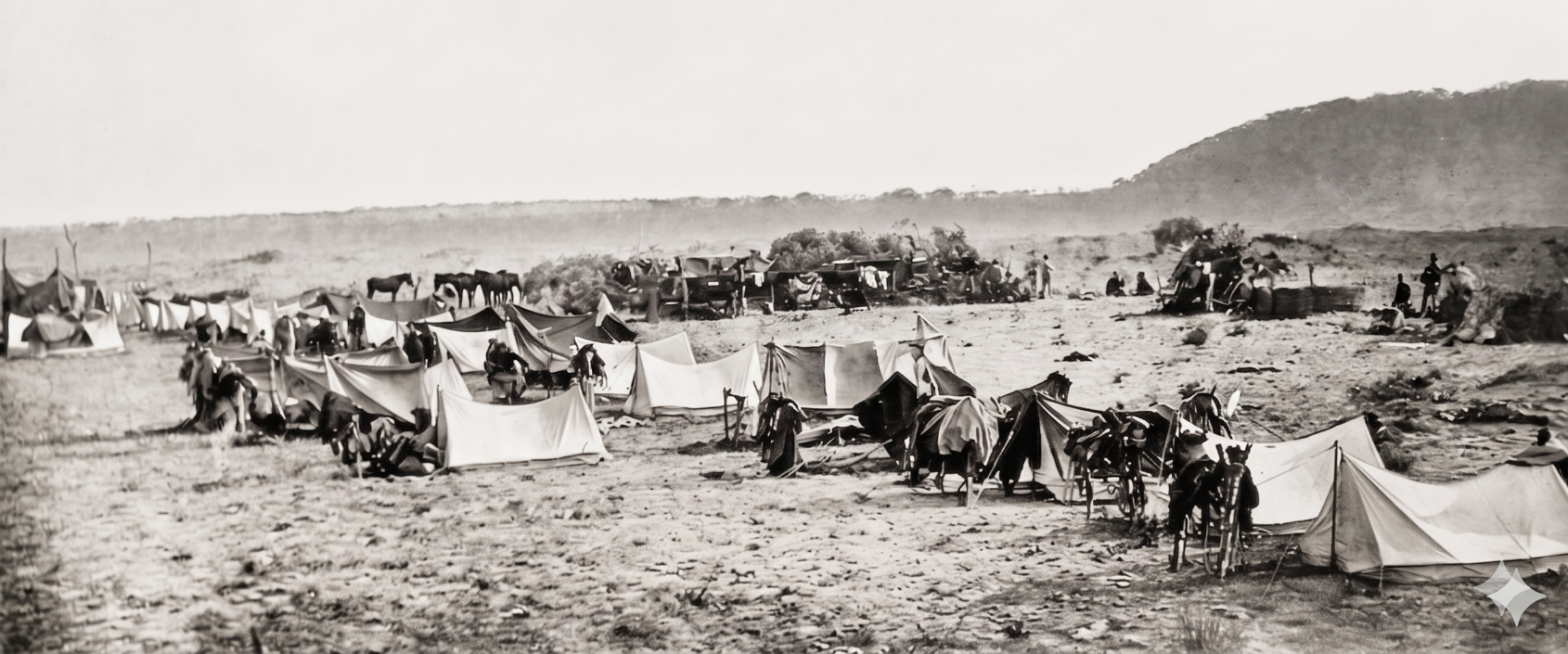
BSACo Police troopers’ tent lines, looking east towards “The Kopje”, Fort Salisbury, 1890. (NAZ)
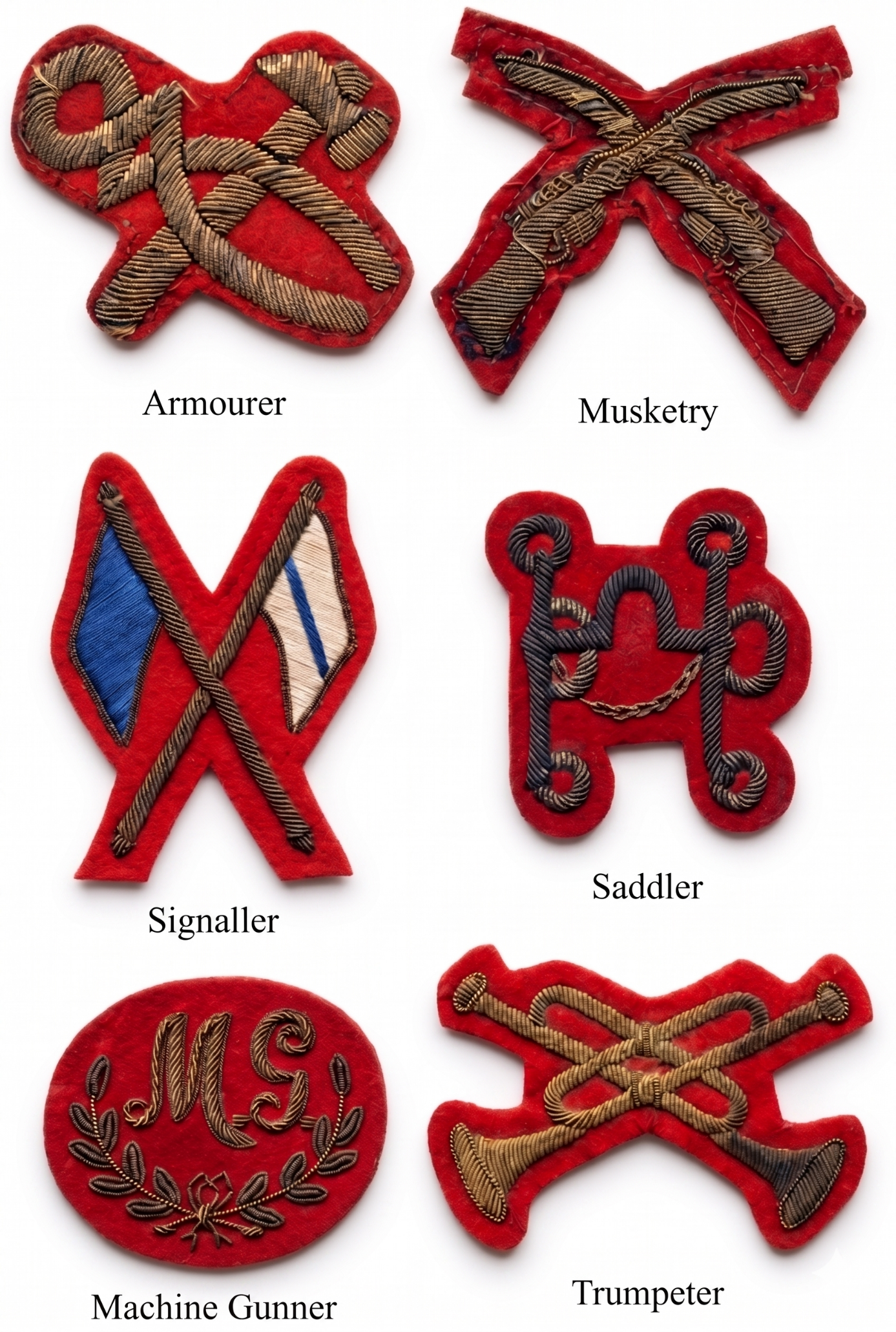
British South Africa Company Police trade badges, 1890. (Col Dudley Wall)
The force, therefore, was as old as Rhodesia itself: 90 years. Most of the men came from the Bechuanaland Border Police, and their crest was the lion and tusk of the Charter Company. The force went on to see service in the Matabele War of 1893 and in the Jameson Raid on the Transvaal in 1896. Then came the Matabele and Mashona Rebellions of 1896 and 1897, which were in some measure due to the disaster which overtook Jameson’s force and the fact that Rhodesia was denuded of men to protect the settlers. The BSAP played a worthy part in the suppression of these rebellions, and it was in 1896 that they were first named the British South Africa Police. During the Second Boer War, elements of the regiment played a key role in the defence of Mafeking before deployment into the Transvaal.
1890–1892
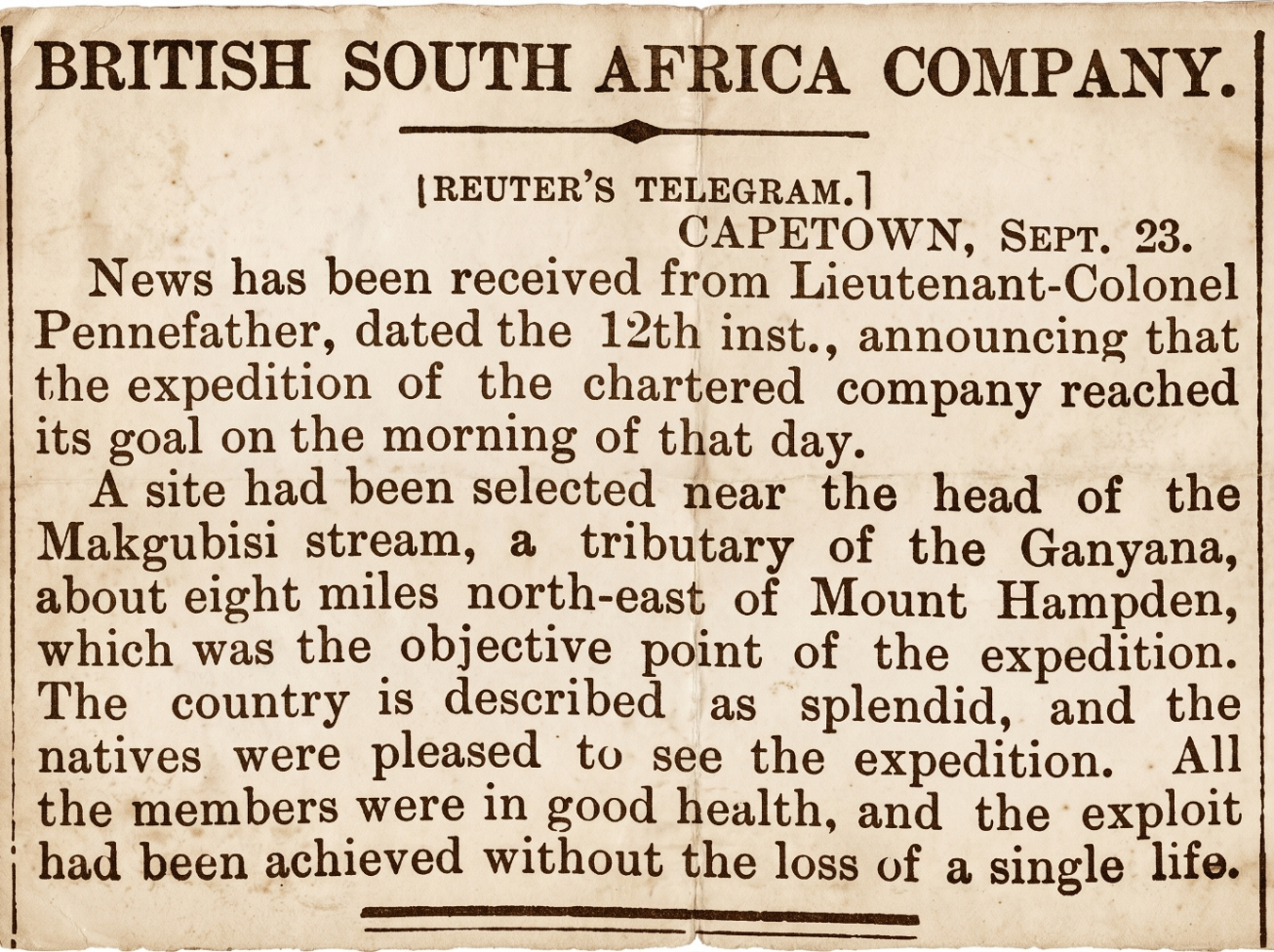
The Pioneer Column reached the site of the new country’s capital, Salisbury, on September 12, 1890.
(Morning Post, September 24, 1890)
On October 18, 1890, at Macloutsie, Bechuanaland, the BSACo Police held its first ceremonial parade. The occasion, organised by Captain Arthur Leonard, E Troop, was to honour the visit of Sir Henry Loch, Governor of the Cape Colony and British High Commissioner to South Africa. On parade were 3 officers, 5 sergeants and 49 other ranks.
While the Pioneer Column was still en route, at the newly established Fort Charter news was received of a territorial dispute to the east in Manica, to which the Portuguese laid claim as part of Portuguese East Africa by rejecting BSACo’s declared ownership. Portuguese tactics involved entering into pro-Portuguese treaties with Shona-speaking chiefdoms, in particular the powerful Chief Mutasa. Rhodes instructed Administrator-Designate Archiebald Colquhoun to leave the column to assess the situation on the ground in Manicaland. He took with him an escort of seven details of the BSACo Police. Four policemen, under Lieutenant Malcolm Graham, were left at Mutasa as an advance party.
On November 5, 1890, Captain Patrick Forbes arrived at Mutasa with several armed men. A further 25 men of A Troop, BSACo Police, under Lieutenant Eustace Fiennes, were on their way from Fort Charter. Forbes resolved the immediate issue by arresting the senior Portuguese officials and sending them off to Fort Salisbury.
Captain Herman Heyman, A Troop, replacing Forbes, established a camp at Umtali with 33 dismounted men and 15 volunteers from the now disbanded Pioneer Column police. All the while, international tensions between Britain and Portugal over the Manicaland question flared. In May 1891, a handful of BSAC Police with a 7-pounder effectively and with great determination frightened off a Portuguese (largely Angolan levies) attack, and finally word was received that London and Lisbon had settled their differences. Manicaland was now officially within what would soon become Rhodesia.
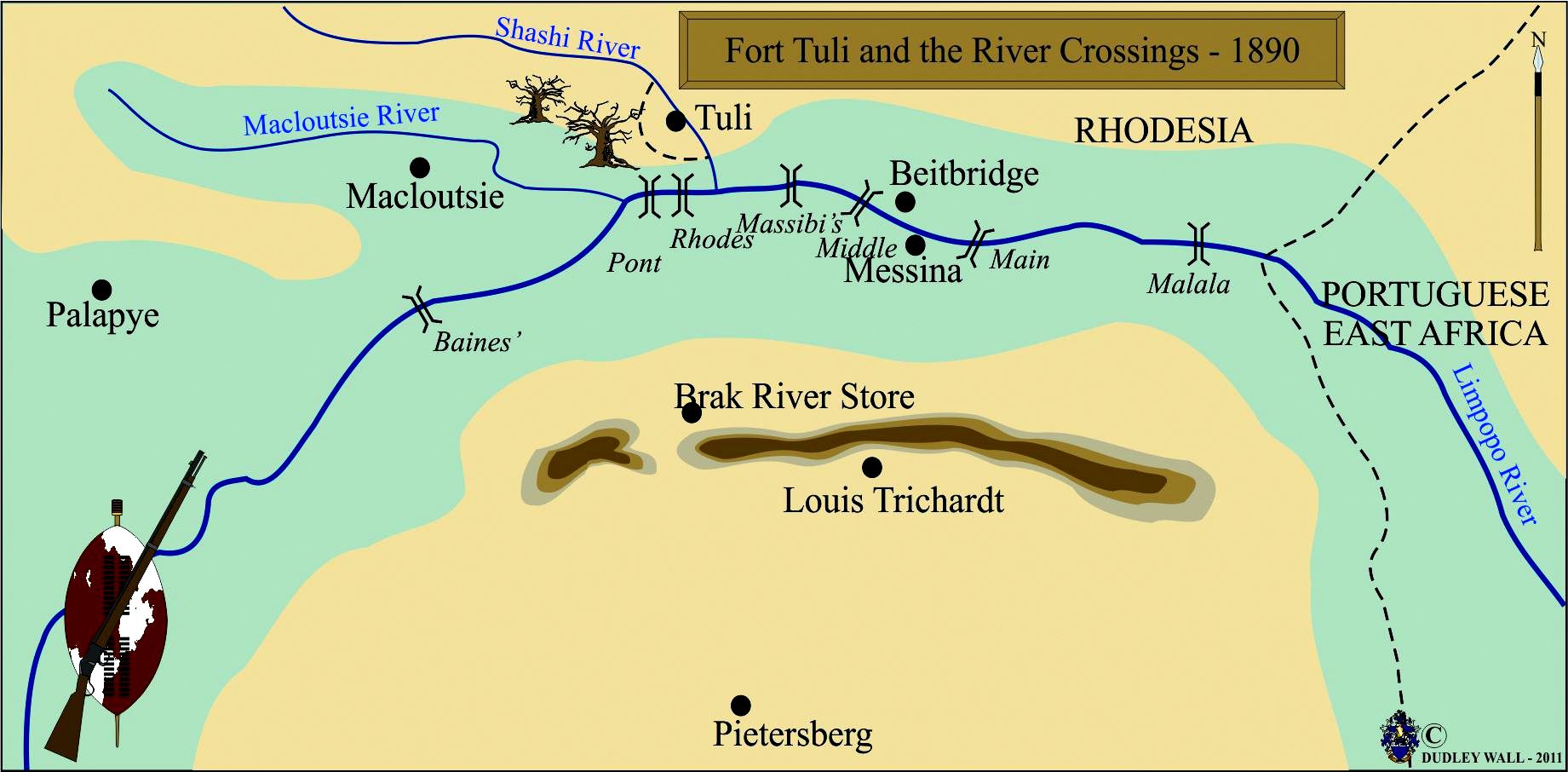
In the interim, from February 1890 there were strong rumours of a force of 1,500–2,000 Boers about to cross into Matabeleland to claim the territory. Not put off by the arrival of the Pioneer Column at Ft Salisbury, by April 1891 Transvaaler Colonel Ignatius Ferreira was finalising plans to cross the Limpopo. Despite the fact that Ferreira could only muster a small force, Captain Leonard, commanding E Troop, BSACo Police, Tuli, positioned 70 of his men and two Maxims at three drifts across the Limpopo. Reinforcements doubled his strength, allowing him to defend a further two drifts. However, Jameson, who had arrived to assess the situation, pre-empted any bloodshed by successfully warning Ferreira and his party of around 130 Boers not to cross the Limpopo. Not for the last time, Rhodesia’s police stood to arms to defend their country.
(Col Dudley Wall)
After July 1891, very few more recruits attested into the company’s police. The company was struggling with spiralling expenses, and the Portuguese and Transvaal issues had been resolved thereby reducing the requirement for a large force. In September and October many policemen took their discharge.
Matabele War 1893
Fully established in Mashonaland and Manicaland, Rhodes increasingly focussed on dismantling Lobengula’s kingdom and annexing Matabeleland to the new territory. Following questionable company decisions and actions involving raiding amaNdebele warrior-raiders at Ft Victoria, in July 1893 a punitive party of 30–40 mounted police clashed with the amaNdebele, killing ten of them.
This precipitated, under orders from Jameson, the mustering of Salisbury and Victoria columns, with the sole objective of marching on Lobengula’s seat of power, GuBulawayo, and deposing the monarch. In Salisbury, volunteers were rapidly enlisted, even without regimental numbers, to “bear true allegiance to Her Majesty Queen Victoria. . . and that we will faithfully serve in the British South Africa Company’s Police”. Captain Patrick Forbes was placed in command.
In Ft Victoria, Captain Allan Wilson was appointed commander of the settlement’s contribution to the force, titled the Victoria Rangers. In charge of the Civil Police at Ft Victoria, Captain Frederick Fitzgerald commanded 1 Troop and assisted Wilson in training, drilling and equipping the Rangers.
On October 16, 1893, the two columns joined at Iron Mine Hill on the GuBulawayo–Salisbury “Hunters Road”, where Forbes assumed command of the whole force, numbering 942. After brief battles at Bembesi and Shangani, the force occupied GuBulawayo on November 4. Lobengula had fled north after putting his kraal to the torch.
On the 24th, Forbes took 158 men on a fateful pursuit of Lobengula. At the flooding Shangani River, lack of strong leadership and poor decision-making by Forbes resulted in the massacre of Wilson and the 33 men of his patrol at the hands of Lobengula’s warriors. Of this number, no fewer than ten were members of the police or had served in the company’s police, the most senior being Captain Fitzgerald.
In May 1894, with the amaNdebele perceived to have accepted BSACo rule, it was considered that the new police force could handle the requirements of law and order and the remaining Bechuanaland Border Police were withdrawn.
Jameson Raid 1896
In December 1894, Rhodes and Jameson, accompanied by Captain Sir John Willoughby left for England to get the endorsement of Imperial authorities in the accomplishment of immediate BSACo plans in southern Africa.
Permission was also sought from the company’s board to increase Rhodesia’s armed forces, then only numbering 350 police in Mashonaland and Matabeleland. Authority to raise a volunteer corps was granted, together with permission to acquire rifles and Maxims to arm a force of 1,500 men. The corps, titled the Rhodesia Horse, was made up of two divisions:
- The Matabeleland or Western Division, commanded by Captain Herman Heyman, Civil Commissioner of Bulawayo;
- The Mashonaland or Western Division, commanded by Captain The Hon. Henry White of the Grenadier Guards.
In September 1895, Henry White also assumed command of the Rhodesia Mounted Police as Chief Commissioner, succeeding his brother Charles White who was in Johannesburg in an advisory capacity to the Reform Committee, a body committed to addressing discontent among the so-called uitlanders, or foreigners, in the Transvaal. By now it was very evident to these senior leaders that the stage was being set for an invasion of the Transvaal, an independent Boer Republic.
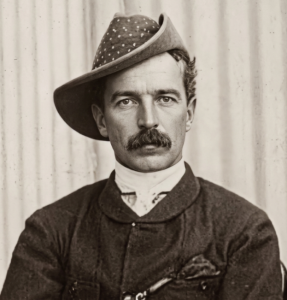
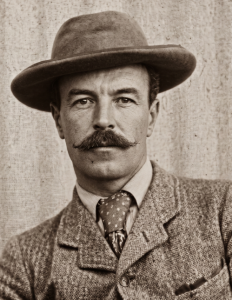
Henry White, top, and brother Charles (below). (NAZ)
On October 18, 1895, Jameson was gazetted as Resident Commissioner of the tribal areas along the new railway line north of Mafeking, for him an important requirement which entitled him to use the route to Pitsani, the staging post for what infamously became known as the Jameson Raid. As a consequence, Jameson issued orders for Rhodesian police detachments to move south, leaving Bulawayo on the 20th.
The majority of the force of 372 Rhodesian policemen, made up of five troops, came from the Matabeleland Mounted Police, but there was at lease one contingent of the Mashonaland Mounted Police, commanded by future BSAP Commissioner, Sub-Inspector Alfred Tomlinson. This number was complemented by an additional 122 men from the Bechuanaland Border Police. Military command of the whole force fell under Lieutenant-Colonel Sir John Wolloughby.
In the well-documented account of Jameson’s ill-conceived raid, at Doornkop Farm on January 1–2, 1896, Boer forces overran the Rhodesian invaders, killing 16, wounding 56 (of whom one died) and taking 459 prisoner.
Matabele Rebellion 1896
The Jameson debacle almost totally decimated Rhodesia of its white police. With the Chief Commissioner in prison in England, Inspector H. Hopper took over command of the Mashonaland Mounted police, while Inspector C.H. Southey fulfilled this role for the Matabeleland Mounted Police.
Against this background, and aggravated by a drought, plagues of locusts and rinderpest, amaNdebele dissatisfaction boiled over into a full-blown insurrection, generally referred to as the Matabele Rebellion. In March 1896, gangs of armed amaNdebele went on the rampage, murdering 145 white men, women and children at isolated farms, trading stores and mines.
Eight members of the Matabeleland Mounted Police and one from the Mashonaland Mounted Police were killed in action while serving with the Matabeleland Relief Force under Major Herbert Plumer (future general of World War One Messines fame). Plumer’s force included those members of the Rhodesia Mounted Police who had been captured in the Transvaal during the demise of the Jameson Raid. By the end of April, Plumer led around 800 men on the road to Bulawayo.
In June, Major-General Sir Frederick Carrington, who had previously been overall commander of forces north of Mafeking to the Limpopo and across to the Indian Ocean, arrived in Bulawayo to assume command of the Rhodesia Relief Force.
In August, hostilities ended in Matabeleland after several battles in the Matopos, refuge of the amaNdebele. During the rebellion nine members of the Matabeleland Mounted Police were killed in action.
Birth of the British South Africa Police
After quelling the amaNdebele uprising, the BSACo made a landmark decision in the history of its police when the company agreed to release the services of Plumer and the Imperial troops. With their departure, a new policy was introduced which reorganised and increased the establishment of the Rhodesian police.
A direct descendant of the old forces, a new corps came into being on October 1, 1896. From this date until 1980 with the advent of Zimbabwe, Rhodesia’s national police force would carry the title British South Africa Police.
Because of the Jameson Raid, the Imperial authorities kept a tight control over the colony’s police. While still paid and equipped by the BSACo, London appointed Colonel Richard Martin as Commandant-General of the company’s police in Mashonaland, Matabeleland and Bechuanaland. Erstwhile commanding officer of the 6th (Inniskilling) Dragoons, Martin held this post until 1895. He also assumed supreme military command in Rhodesia on the departure of General Carrington.
The new force was organised in two divisions, each with its own commandant/commissioner: the Matabeleland Division, commanded by Lieutenant-Colonel John Sanctuary Nicholson (7th Hussars), and the Mashonaland Division under Lieutenant-Colonel The Honourable Frederick Rossmore Wauchope Eveleigh de Moleyns (4th Hussars).
It appears that the designation BSAP did not come into immediate use as the force continued to be referred to as the Rhodesia Mounted Police. The first Regimental Order under the new title is dated December 12, 1896.
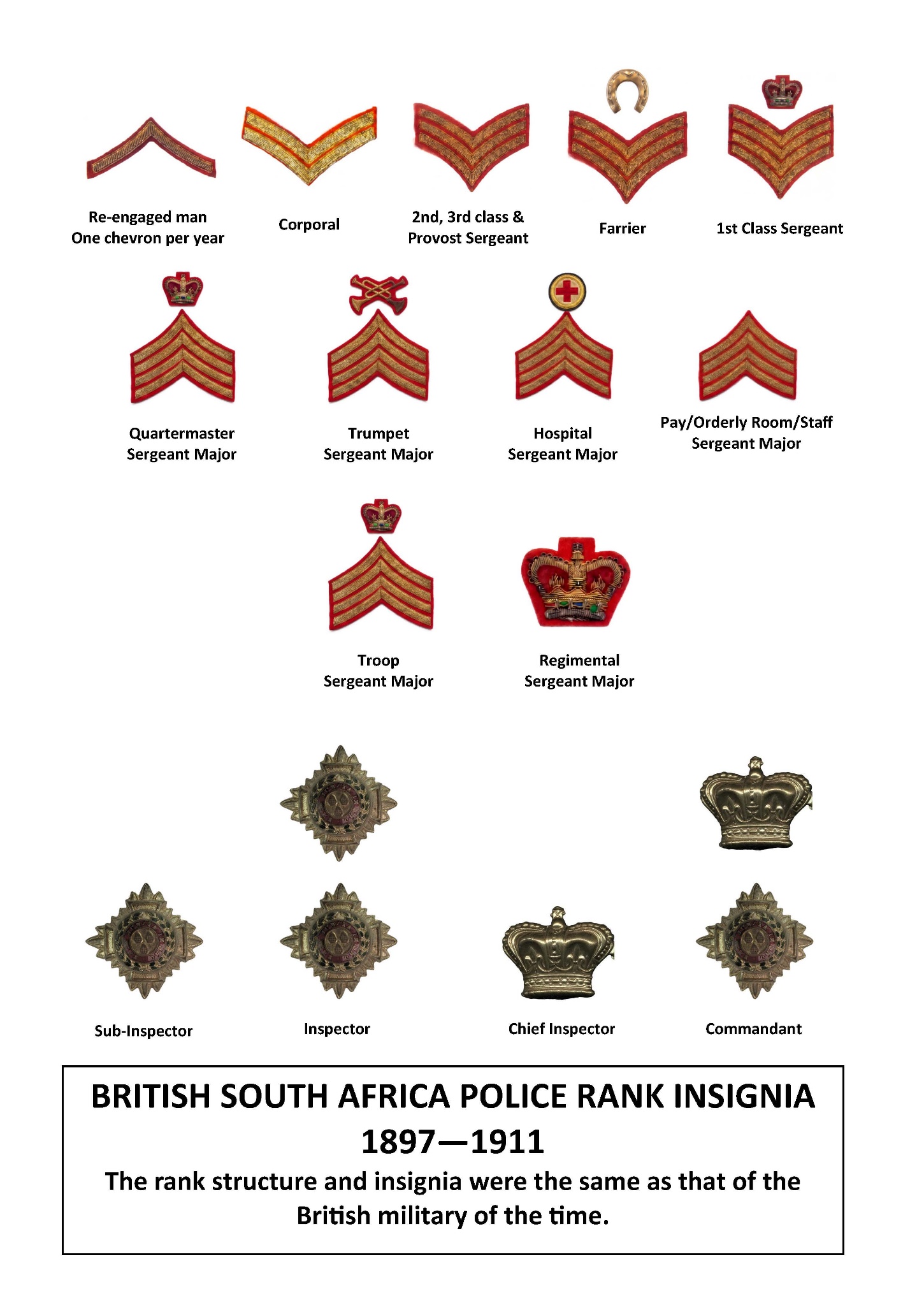
(Col Dudley Wall collection)
Mashona Rebellion 1897
In June 1896, the hitherto peaceful Shona-speaking tribes east of Matabeleland also rose up against the white settlers in Mashonaland, murdering 117 men, women and children.
Salisbury went into laager and numerous local volunteer units were raised to deal with the rebellion. On July 19, having travelled from South Africa via Beira, Major Edwin Alfred Alderson, Queen’s Own (Royal West Kent Regiment), arrived in Umtali with two companies and support units – 380 men – of Imperial Mounted Infantry. After raising a 132-strong local regiment, Brevet Colonel Alderson’s combined force was titled the Mashonaland Frontier Force.
With the strengthened forces the Rhodesians went on the offensive in a multitude of patrols against rebel strongholds throughout Mashonaland, and from November 29 to mid-December, their mission deemed a success, Alderson and his Imperial contingent left Rhodesia.
Operations continued, now under the command of Colonel Martin. The first group of 180 of the new BSAP arrived in Salisbury on December 10, where de Moleyns succeeded Alderson. Over the next few months, patrols, often led by de Moleyns himself, identified and neutralised tribal and spiritual leaders known to be prime instigators of the rebellion. The arrest and imprisonment of two leading spirit mediums (zvikiro), Nehanda and Kaguvi, in October 1897, effectively ended the rebellion. The two were executed on April 27, 1898.
Of the 76 uniformed men who lost their lives during the rebellion, 35 were from the BSAP, including the Mashonaland Mounted Police.
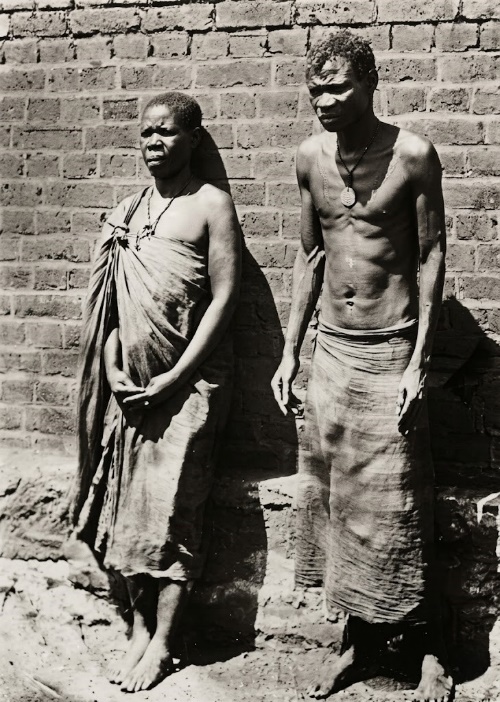
Mbuya Nehanda, left, and Sekuru Kaguvi. (NAZ)
Captain Randolph Cosby Nesbitt VC, Mashonaland Mounted Police
On June 19, 1896, near Salisbury, Captain Nesbitt led a patrol consisting of only 13 men to rescue civilians at the Alice Mine in Mazoe Valley, who were surrounded by hordes of rebels. Captain Nesbitt’s patrol fought their way through the enemy, rescued the beleaguered party (including three women), and transported them back to Salisbury in spite of heavy fighting in which three of the small party were killed and five wounded.
Nesbitt’s award of the Victoria Cross was promulgated in The London Gazette of May 7, 1897. The citation reads,
This officer, on the 19th June, 1896, led the Mazoe Rescue Patrol, consisting of only thirteen men, fought his way through the rebels to get to Salthouse’s party [mine manager], and succeeded in bringing them back to Salisbury, with heavy fighting, in which three of his small force were killed and five wounded, and fifteen horses killed and wounded.
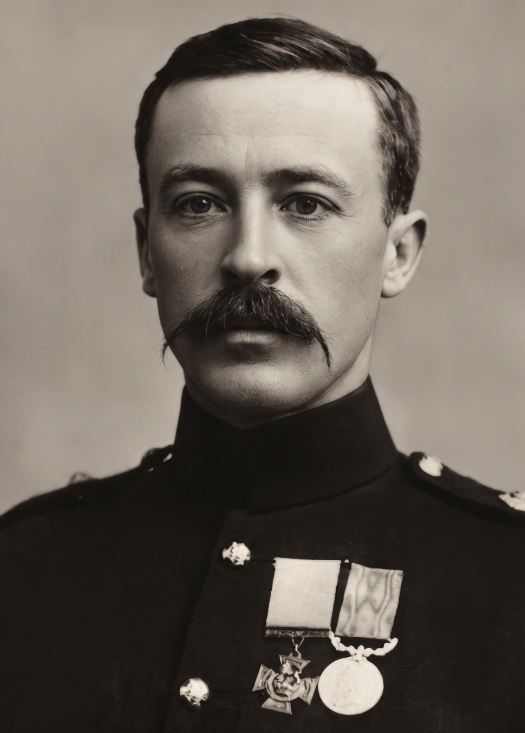
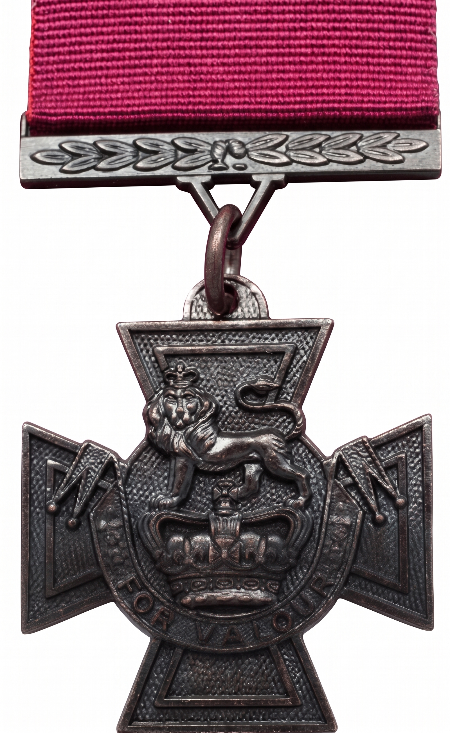
Randolph Nesbitt VC. (NPG)
In 1896, Queen Victoria sanctioned the issue by the British South Africa Company of a medal (see table below) to troops who had been engaged in the First Matabele War. In 1897, the award was extended to those engaged in the two campaigns of the Second Matabele War, namely Rhodesia (1896) and Mashonaland (1897). The three medals are the same except for name of the campaign for which the medal was issued, inscribed on the reverse.
In 1927, the government of Southern Rhodesia re-issued the medal and instituted a new clasp, to commemorate the Pioneer Column that operated within Mashonaland in 1890. Those previously awarded the medal were required to exchange it for the new version.
The recipient’s first eligible campaign is inscribed on the reverse, either ‘MATABELELAND 1893’, ‘RHODESIA 1896’ or ‘MASHONALAND 1897’, with any subsequent campaign indicated by an appropriate clasp, of which there are four. The one exception is the medal for Mashonaland 1890, issued in 1927, where the reverse bears no details of the campaign, with all eligible campaigns represented by a clasp.
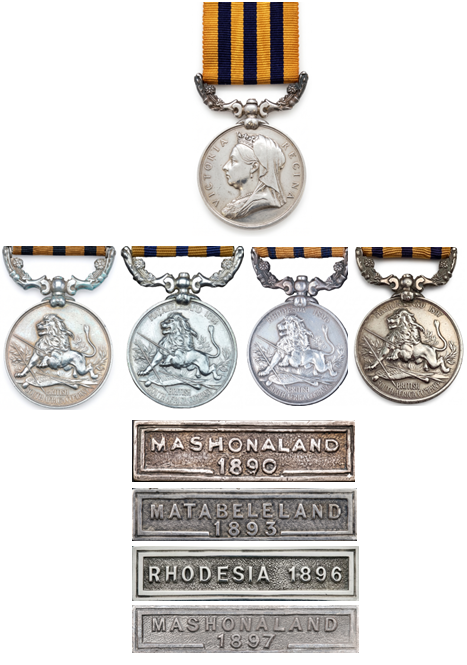
It is important to note that the lion, spear and shield motif on the reverse of all the medals is the same as the insignia of the BSACo Police and its successor, the British South Africa Police. Today, the same motif features on the centre of the Zimbabwe Republic Police flag, thus perpetuating the 1890 legacy.
Second Boer War
By 1899, when war threatened between Britain and the South African Republic (Transvaal), the BSAP consisted of three divisions: Division I based at Mafeking; Division II on Matabeleland and Division III on Mashonaland. All three divisions acquitted themselves well during the Second Boer War, uniquely participating in both the defence and relief of Mafeking.
After having served in the suppression of the Matabele Rebellion, Colonel Robert Baden-Powell returned to Southern Africa in July 1899. Instructed by the War Office to raise two local regiments to defend Rhodesia and Bechuanaland from Boer aggression – the Rhodesia and Bechuanaland regiments – Baden-Powell described his remit as including “to take charge of and organise the Police of Rhodesia and Bechuanaland as part of my force.”
At this stage he based himself in Bulawayo while he raised the two regiments and built up large stocks of stores and provisions at Mafeking. He then moved the force he had at Ramathlabama into Mafeking, to be joined by Lieutenant-Colonel John Walford, Division I, BSAP, with a contingent of 90 officers and men. Major Francis Panzer, BSAP, his second in command, was an artillery expert, which proved to be a great asset to Baden-Powell in the weeks ahead.
Mafeking
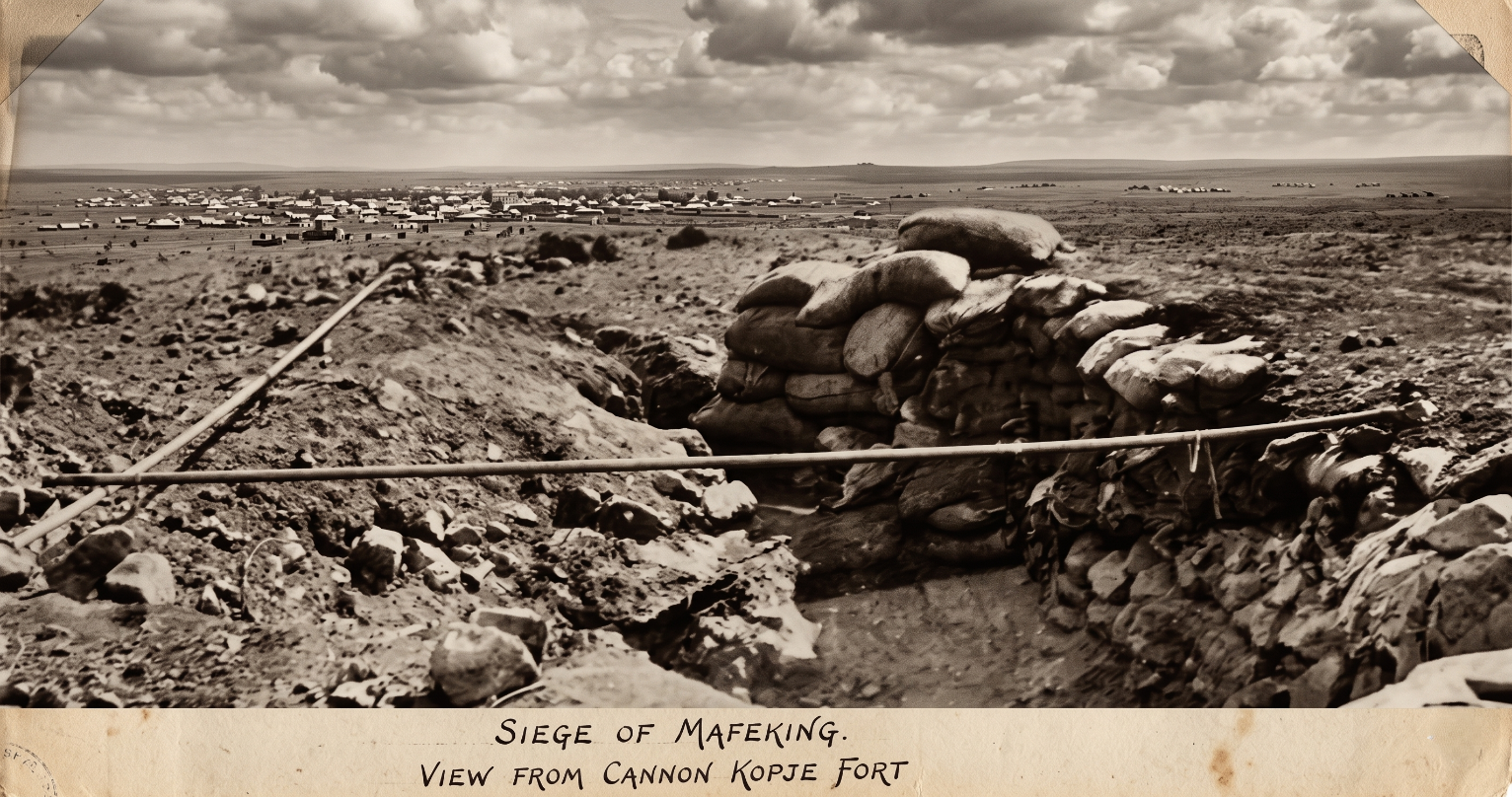
In Mafeking, the BSAP were tasked with defending Cannon Kopje, an outlying position to the southeast of the town. Optimistically called a fort, Walford and his men constructed rudimentary accommodation and defences as best they could with limited resources.
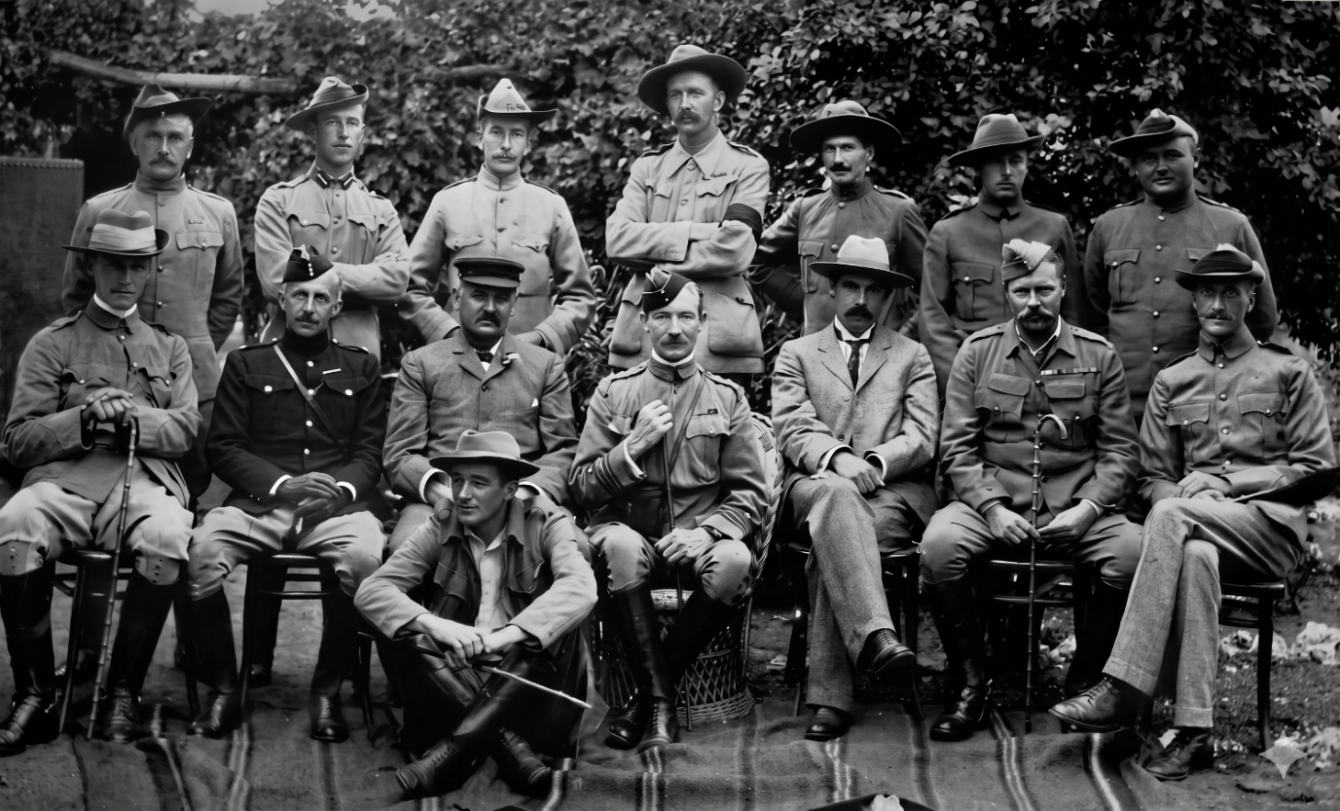
Baden-Powell’s Headquarters staff, Mafeking, 1899.
Standing L–R: Maj Panzera (BSAP), Artillery; Capt Ryan, Commissariat; Capt Greener (BSAP), Paymaster;
Maj Lord Edward Cecil, Chief Staff Officer; Capt Wilson, Aide-de-Camp to Baden-Powell;
Lt the Hon Hanbury Tracy, Press Censor; Capt Cowan, Bechuanaland Volunteers.
Seated L–R: Maj Godley, Royal Dublin Fusiliers; Col Vyvyan, Town Commandant;
Mr Bell, Resident Magistrate and Civil Commissioner; Col Baden-Powell, Commanding;
Maj Whiteley, Mayor of Mafeking; Col Hore, Protectorate Regt.; Dr Hayes, Principal Medical Officer.
Seated in front: Lt the Hon Moncrieff, extra Aide-de-Camp to Baden-Powell.
(J. Angus Hamilton)
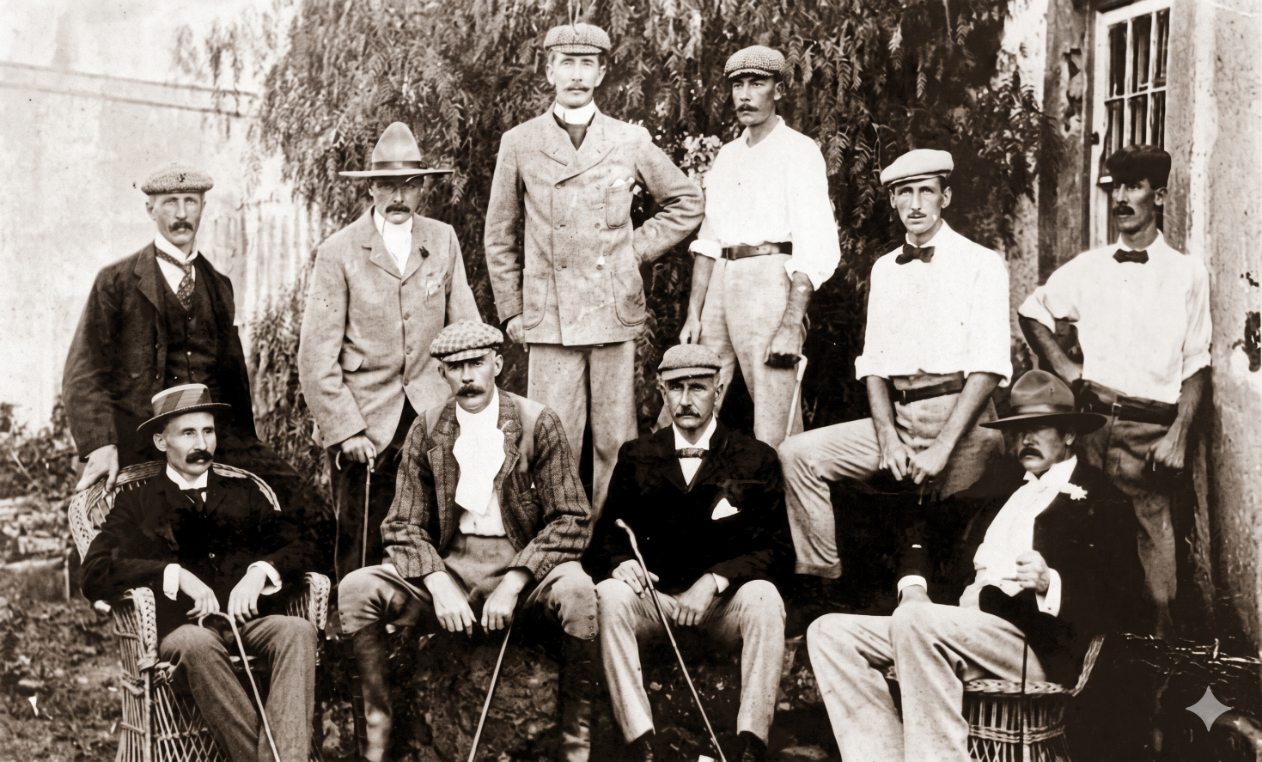
BSAP officers of the Mafeking siege.
Back row: Capt Stuart Scholefield, Capt Ashley Williams, Capt Herbert Greener,
Lt A.H. Martin, Lt Rowland Daniel, Lt Adrian Hope.
Seated: Dr Frank Holmden, Col John Walford, Maj Francis Panzera, Maj William Hepworth. (Wikimedia)
Cannon Kopje was in itself a malformed cluster of stones, perched upon a rocky ridge, which commands the town, a mile across the veld. The outcrop was a death-trap, and whatever may have been the determining element in its original construction, the possibilities of it coming under shellfire were never very seriously contemplated. It was thrown up during the Warren expedition of 1885, and was neither removed nor replaced until the Boer bombardment established its complete uselessness under shell fire.
(NAZ)
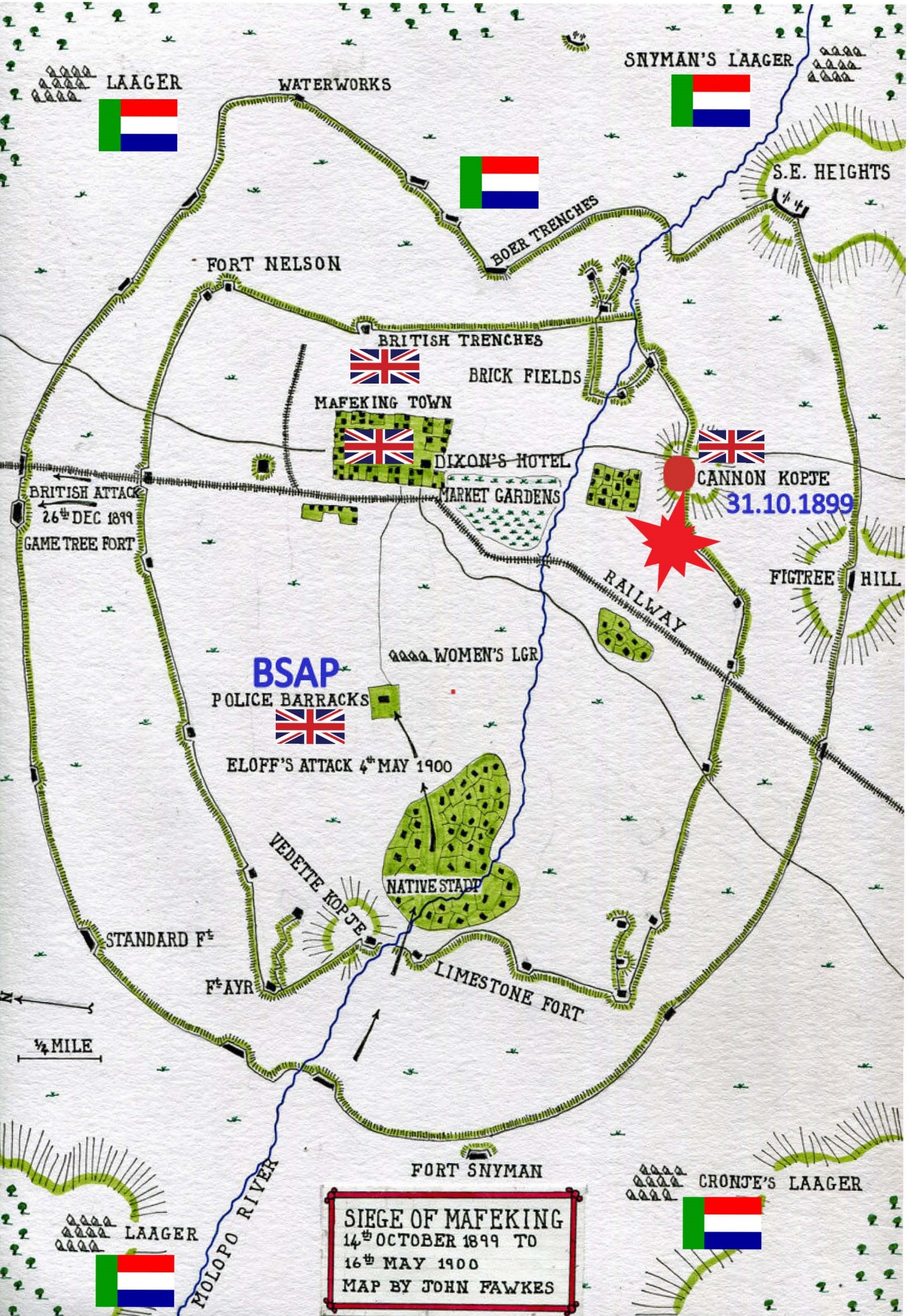
Recognising its commanding strategic value, at first light on October 31, 1899, the Boers commenced their attack on Walford’s stronghold. For 30 minutes the Boer big guns rumbled over the plain, the shells falling on and around the fort. Boer ordnance at Mafeking was eclectic: in the extreme west there was “Big Ben” and a 7-pounder. “Big Ben”, named “Grietjie” by the Boers, was a 155mm Creusot gun that lofted 96-pound shells over distances of up to 11,000 yards. Over to the east there was a 12-pounder, and within a circle from these two points, and within effective range, a 7-pounder and quick-firing Maxim-Nordenfeldt had been stationed. The big gun took no part at all in the attack on the kopje, but at every moment that the enemy’s shellfire lapsed, the Boer marksmen opened up with their 7mm Mauser rifles.
To Walford, as he viewed the Boer disposition, at least a third of the forces before Mafeking had been concentrated upon Cannon Kopje. Against a mere gun emplacement and 44 men, shellfire from four guns was directed and a force of 800 men utilised. The Boer execution of the attack is described in detail in the book Die Beleg van Mafeking (Smit, A.P., Mare, L., HSRC Press, 1985).
The fire was accurate and soon pieces of the watch tower lay on the ground. The terrific gunfire was therefore no surprise to the Cannon Kopje defenders. Having endured a couple of days of continuous shelling of the kopje, Walford was convinced the Boers attached great strategic value to the kopje, and would soon attack it in force. If the kopje fell into Boer hands it would have threatened several of the nearby British defence works from the rear to such an extent that they would either have fallen or had to be evacuated, thereby throwing wide open to the Boers the narrow pass leading to the heart of the town. For this reason, Baden-Powell had placed at Walford’s disposal two Maxims and a 7-pounder with crew.
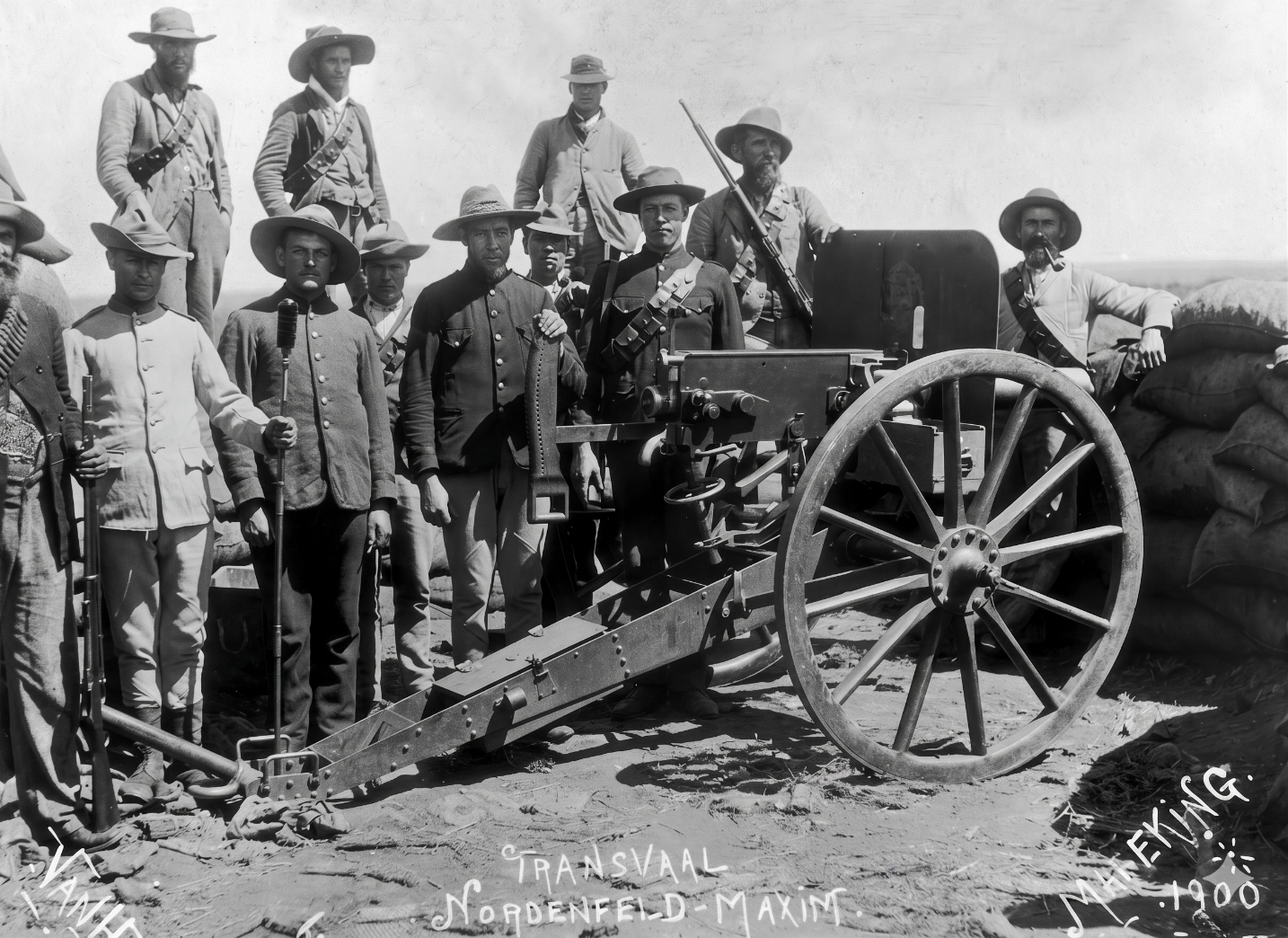
Boer quick-firing Maxim-Nordenfeldt at Mafeking. (Rijksmuseum)
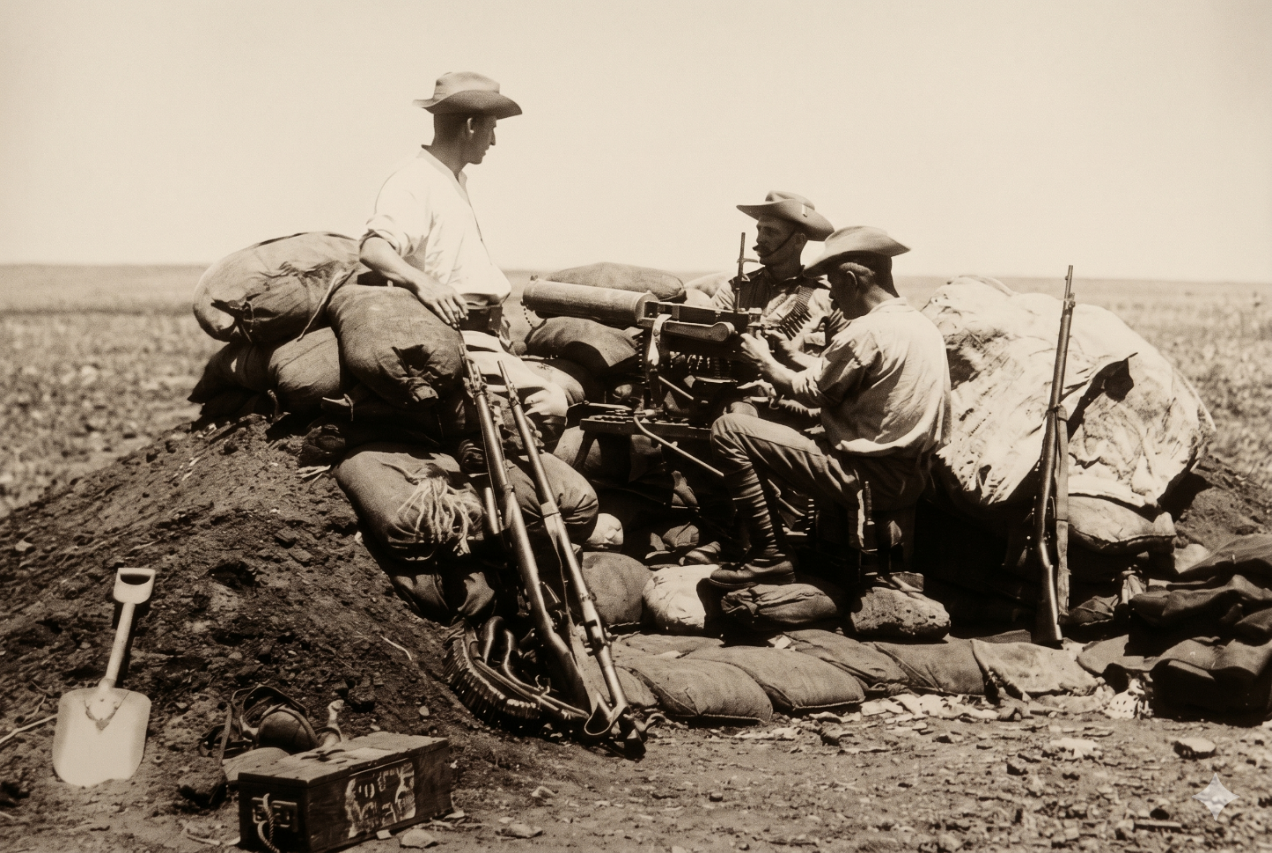
BSAP Maxim crew, Cannon Kopje. (NAZ)
During the shelling, Walford dismantled and put away their cannon and two Maxims in order to protect them from enemy shells. Walford alone stayed behind at the fort in one of the underground holes – measuring eight feet long, three feet deep and three feet wide – to keep an eye on developments.
Due to the coverage of their artillery, the attacking Boers had the opportunity to approach unchallenged their objective in the front and on the flank to within a distance of about 400 yards. At this point, Walford deemed it necessary to make the enemy understand that he had survived the bombardment. He ordered his men to move from the trench to the ring wall and open fire on the attackers. This order was carried out but it was a major task to maintain a proper defence against the Boer artillery fire, demanding absolute courage.
Discouraged because their own heavy artillery crossfire had not already neutralised all enemy resistance in the fort, the Boers who undertook the assault stalled. This was despite the fact that even though those in front had already approached the fort to within a distance of 300 yards and had tried with concentrated rifle fire to compel the crew in the trench to surrender.
But Walford’s men held the fort and the assailants broke off the attack. It is believed General Cronje assumed that Walford’s defence of Cannon Kopje was so strong that the fort could not be taken by his men. Later Baden-Powell wrote of the attack on Cannon Kopje,
Cannon Kopje in itself was a terrible lesson; but it was also a magnificent example of gallant conduct in the field. Colonel Walford and Colonel Baden-Powell have each expressed their high appreciation of the conduct of the men who survived the attack, and although, as befits their rank, the example of the officers was admirable, it was no better in reality than the action of the men over whom they were commanding. The attack of the Boers upon Cannon Kopje had been so sudden, so utterly unexpected, and the manner in which these men of the British South Africa Police had met their death, had been so valorous that the sympathies of the entire town had been most keenly aroused and overcome by the appalling swiftness of the tragedy; there was no one who did not feel that in some way he was himself a mourner even though the men who had been killed were quite indifferent to him.
During the siege of Mafeking, 30 members of the BSAP lost their lives, including the eight killed in action gallantly defending Cannon Kopje.
Elands River
On June 4, 1900, Lord Roberts entered Pretoria with his army. Consolidating the advantage, Roberts instructed Baden-Powell to address the Boer threat north of the Magaliesberg and then to move on Warmbaths. However, little cognisance had been taken of developments to the west where Boer Generals Koos de la Rey and Christiaan de Wet continued to believe that victory might still be within the grasp of their respective republics.
With pockets of die-hard “bitter einder” commandos scattered throughout the region, especially in the Magaliesberg, Baden-Powell deployed two mobile columns to effectively search out and neutralise these Boer units. One of these columns, the northern one, was under Colonel Herbert Plumer, with a force of 500 mounted men of the Rhodesia Regiment, with four guns of the Royal Canadian Artillery. A small reserve of 100 mounted men of the BSAP was split between the two columns. In addition to this, each of 200 dismounted troops of the Rhodesia and Protectorate Regiments were held at Mafeking and Zeerust.
Of note was that there were no British troops in the whole northwest of the Transvaal Republic. Sir Frederick Carrington, protecting the northern frontier on the Limpopo, had a force of 4,000, comprising Yeomanry Battalions and Bushmen from Australia and New Zealand.
With the objective of occupying Rustenburg, Plumer’s Column move eastwards from Zeerust via Magatosnek in the rugged Magaliesberg. This extensive range of mountains provided a substantial barrier, but several passes, referred to locally as “neks,” allowed access to columns of troops with field guns. En route, Plumer left a garrison of 100 men of the Southern Rhodesian Volunteers at the drift through the Elands River. Large supplies of provisions and ammunition destined for Rustenburg and brought up by wagon from Mafeking and Zeerust would be secured at this staging post.
Baden-Powell in the meantime had moved closer to Pretoria, occupying the Zilikats and Commando Neks to the west of the Transvaal capital. He left behind at Rustenburg a squadron of the Protectorate Regiment under Lt Colonel Charles O’Bryan Hore, but a few days later Hore was ordered to retreat down the road towards Zeerust and the staging post at Elands River as reports were being received of a large force of Boers descending on the town.
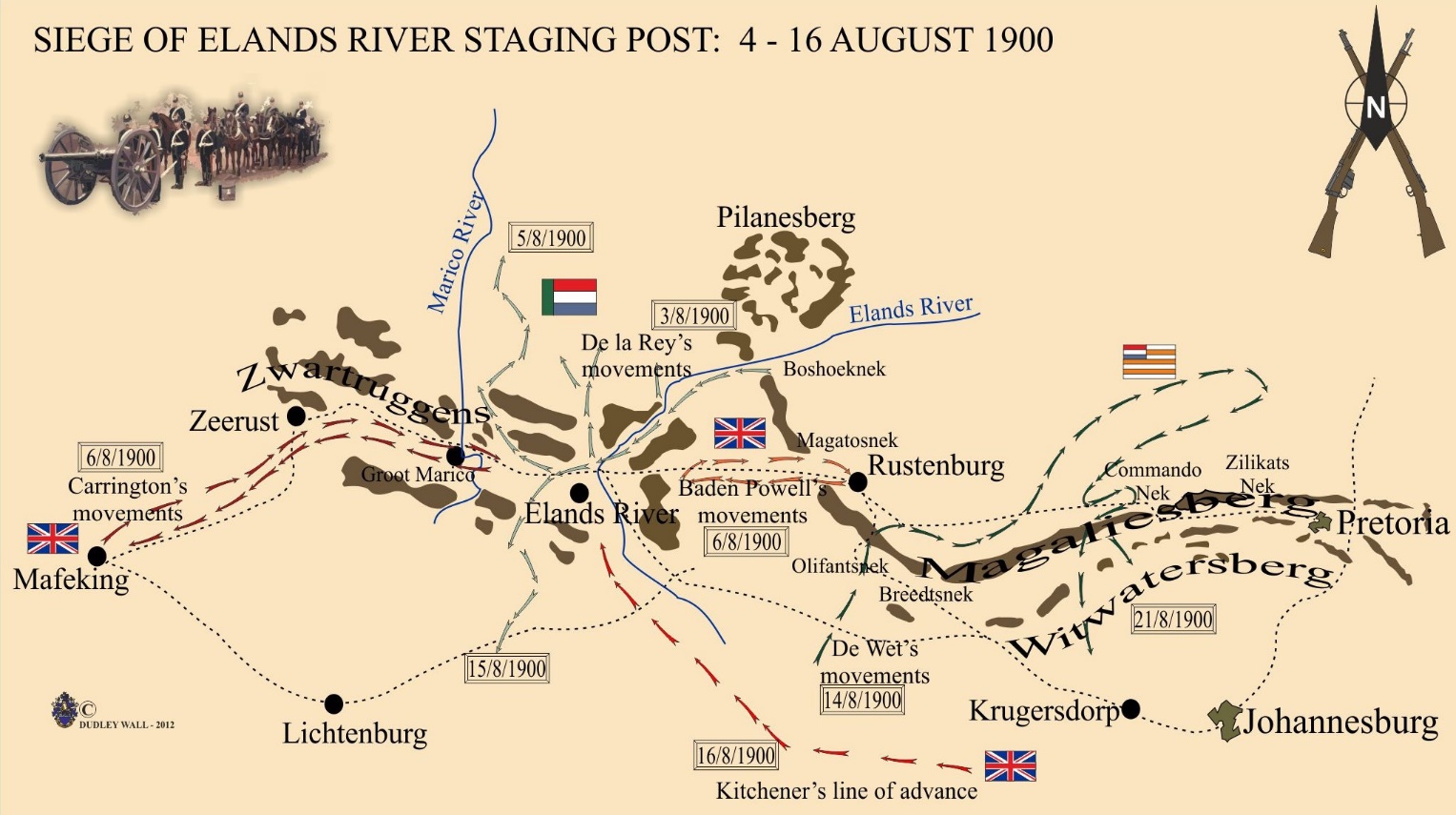
(Col Dudley Wall)
Carrington, in response to a requirement to bolster troop strengths in the region, had reached Mafeking on July 27, but he was told not to proceed any further east than Elands River in anticipation of Rustenburg being evacuated in the face of large numbers of Boers under de la Rey, de Wet and Lemmer.
By now, Elands River on Brakfontein Farm, in the shadows of the Swartruggens Mountains and once just a communications post between Mafeking and Rustenburg, had become a fortified stronghold under the command of Colonel Hore. His force, made up entirely of colonials, comprised 201 Rhodesian Volunteers and BSAP troops under Captain Sandy Butters, 105 New South Wales Bushmen, 141 3rd Queensland Mounted Infantry, 53 Mounted Infantry from other Australian states and 50 African drivers. Significantly outnumbered, surrounded by high kopjes and mountains, and with only one 2.5” 7-pounder gun and two maxims to supplement their small arms, the garrison dug in, hoisted the Union Jack, and prepared themselves to defend the accumulation of stores and ammunition for which they were responsible.
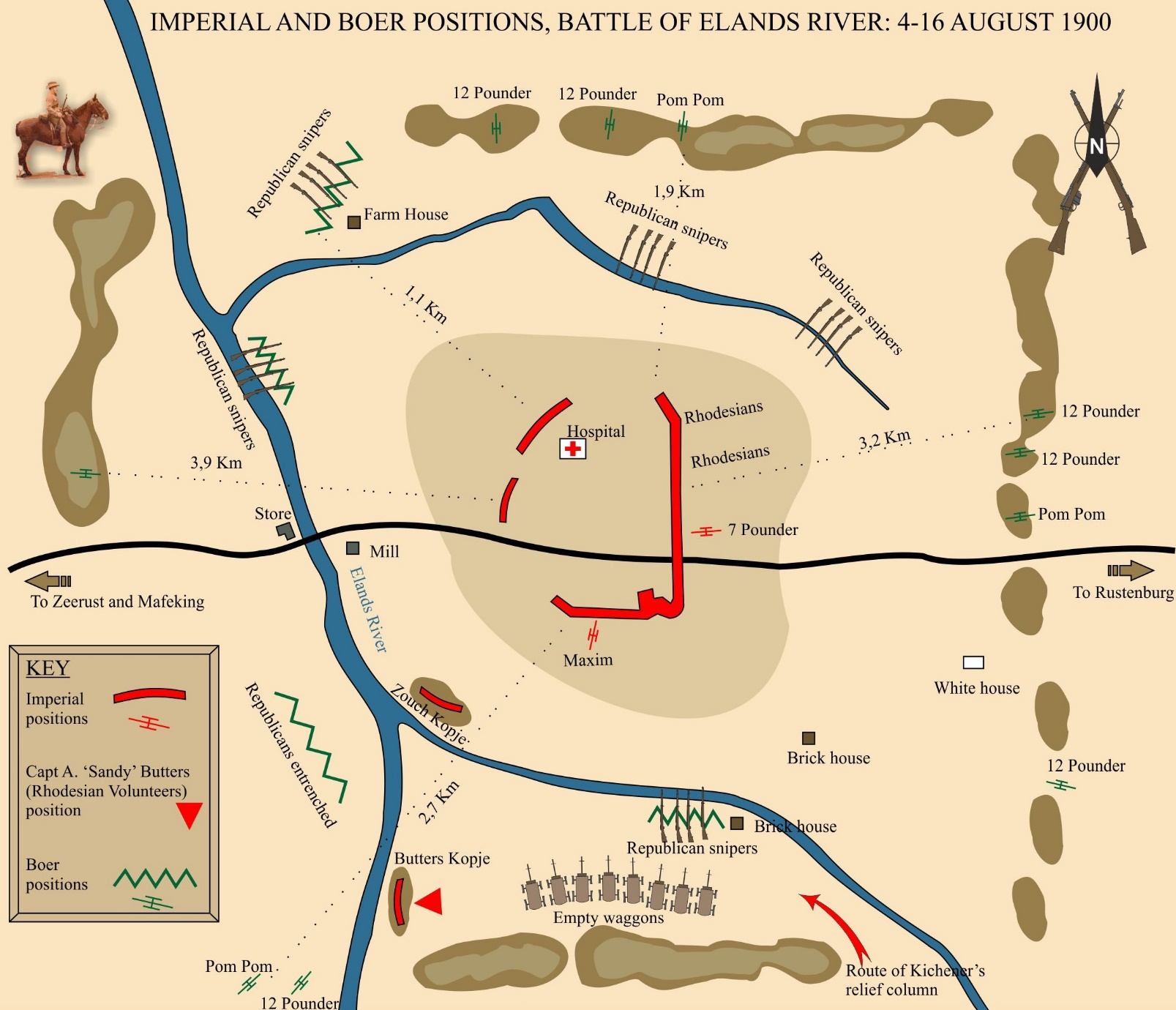
(Col Dudley Wall)
At breakfast on August 4 the siege commenced as the first Boer artillery shell destroyed the telegraph. This was followed by barrage of artillery and rifle fire from the surrounding Boers, a force of 2,000. From kopjes to the west and east, 7- and 12-pound guns and Pom Poms opened fire on the post, ranging from 3,000 to 4,000 yards.
The Boer guns to the north were much closer, bombarding the hapless colonials, and in the process killing 1,379 of the 1,540 draft animals and horses in the camp. Boer snipers had entrenched themselves in the dry creeks to the north and south and on either side of the Elands River to the west where it cut the Zeerust to Rustenburg road.
The previous day, Carrington, with a column of 1,100 colonial volunteers and irregulars, had reached the Marico River, where he left 350 men with the 50 wagons needed to uplift the stores and ammunition at Elands River. He believed his progress would be more swift without the lumbering ox-wagons, plus he would replenish his own supplies when he arrived at Hore’s camp. Two days later, and a mere eight miles from Elands River, Carrington parked up the mule transport and continued east with 650 men.
As the column neared their objective, Carrington became concerned that the superior numbers of the Lichtenburg and Marico Commandos would not only hinder his passage, but that attempting to cross the last two or three miles over open ground would prove to be disastrous. After deploying two small patrols to find their way to Hore’s camp just to have them taken prisoner, Carrington withdrew. As he retired, he felt that the only safe position would be Mafeking, resulting in his decision to recover all his troops from the Marico and Zeerust.
The post at Elands River was left to its own fate, but Hore and his men were not to know that they had been left on their own to hold their position. This was to prove historically unique, as there were no Imperial armies anywhere nearby, with the consequence that Rhodesians would fight for Rhodesians and Australians for Australians.
Only by the 13th was news received that Hore was bravely holding out at Elands River, despite round the clock bombardment. The Boers commenced attacks at night, with the objective of cutting off the garrison’s water supply. The fortified camp safeguarding the war material was in fact about half a mile from the Elands River, their only source of water. Such forays by the Boers were repulsed by a small party of Southern Rhodesia Volunteers under Captain Butters, operating from a kopje to the east of the camp.
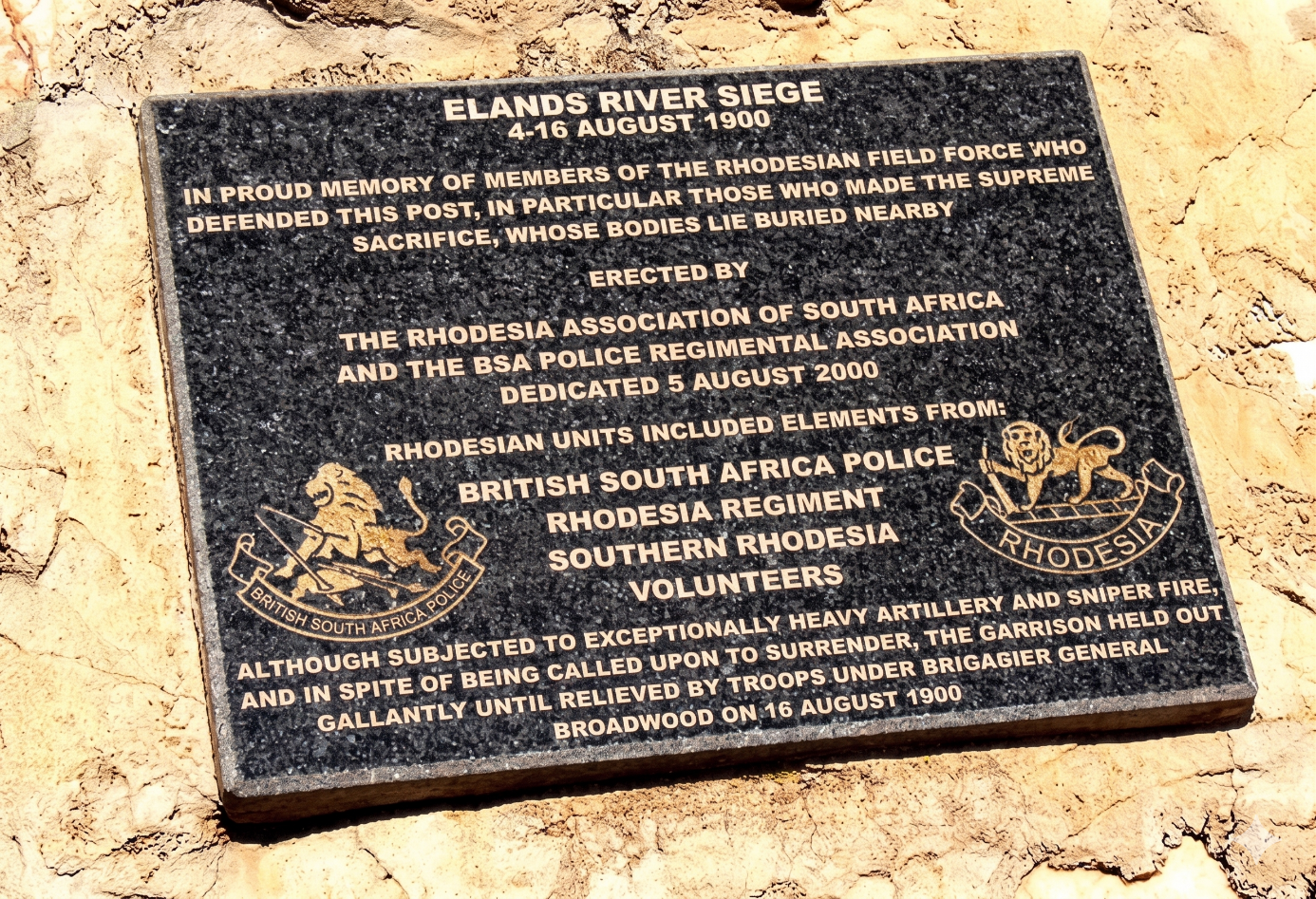
The memorial plaque at the site of the siege.
(National Boer War Memorial Association – Queensland, Australia)
Shortly after daylight on August 16 Lord Kitchener, with a relief force of 20,000, arrived at Elands River. The men of the garrison had had to endure almost two weeks of constant attack from the Boers, spending days in roughly hewn pits, suffering from the heat and thirst and the all-pervading reek of the rotting carcasses of dead animals. Four Rhodesian Regiment troops were killed, the Southern Rhodesia Volunteers lost two, and a further two BSAP troopers perished during the siege. The Australians lost seven, while seven local porters were also killed. There were 58 wounded. Boer General Jan Smuts later said of the defenders of Elands River,
Never in the course of this war did a besieged force endure worse sufferings, but they stood their ground with magnificent courage. All honour to these heroes who in the hour of trial rose nobly to the occasion.
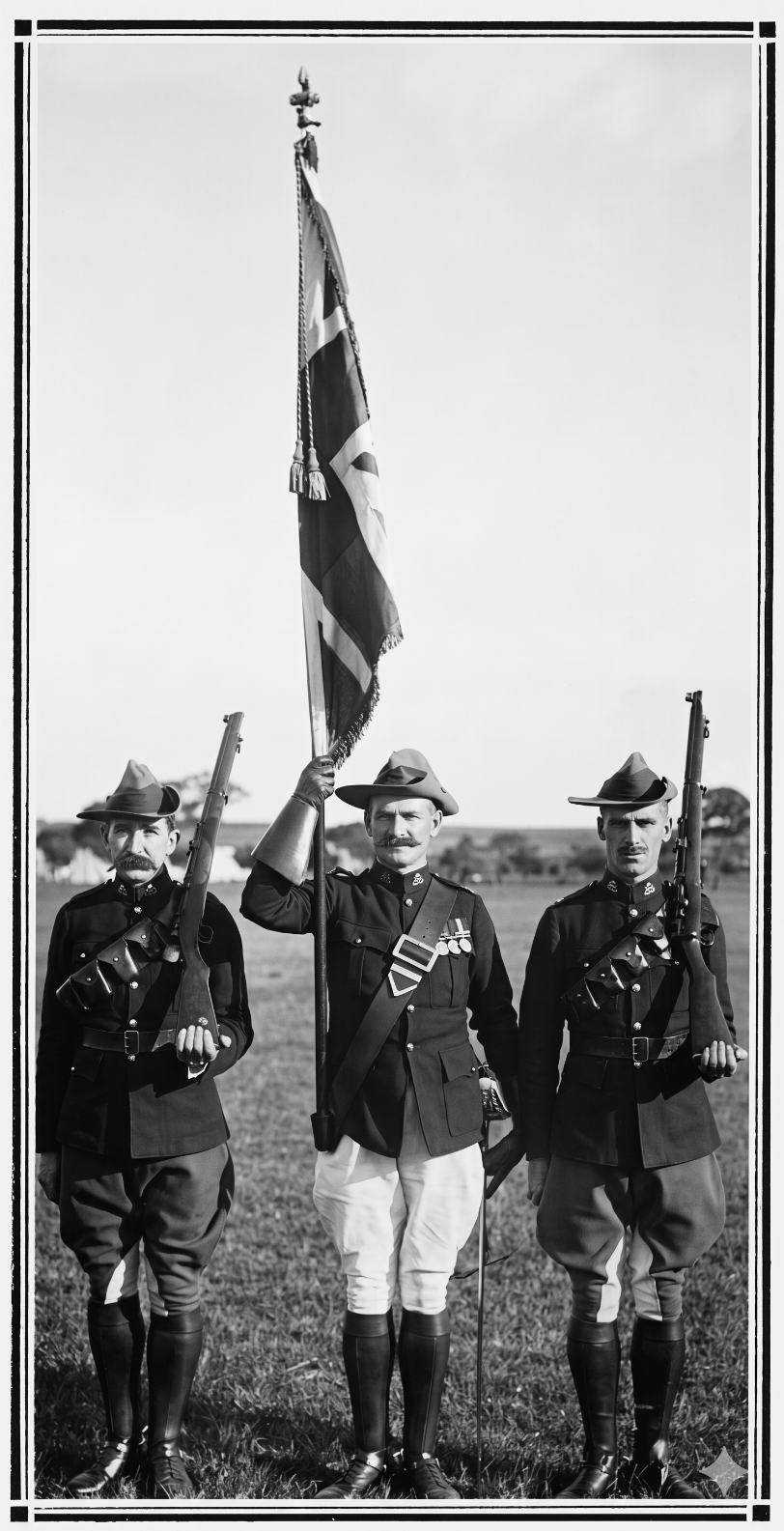
Men of the BSAP and the regiment’s banner – not colours – c.1906.


My great grandfather was a Jameson Raider and was wounded. I suspect he was a colonial volunteer, his name was Henry Edgecombe. We were always told that he had been embarrassed about it, whether it was about being involved or about being wounded, I dont know. How can I find out if he is on any list of the Raiders?