

Abstract: South Africa’s Zama Zama crisis extends beyond illegal mining into organised crime, institutional vulnerability and national security. Tactical operations can disrupt activity, but lasting progress requires intelligence-led investigations, institutional integrity, financial disruption, community cooperation and economically viable long-term solutions.
Dr Joan Swart
Keywords: Zama Zama; illegal mining; organised crime; national security; SANDF; institutional integrity; strategic response; South Africa
THE ZAMA ZAMA PROBLEM: BEYOND ARRESTS AND OPERATIONS
On 29 September, 121 suspected illegal miners were arrested in Fochville during a major multi-agency operation. Five firearms, including an AK-47, were recovered, along with ammunition, illegal mining equipment and gold-bearing material. The operation involved the SAPS, SANDF, Hawks, Home Affairs and Sibanye-Stillwater’s tactical security team.
Two days later, police in Mpumalanga were investigating the discovery of two bodies near Schoemanskloof amid suspected violence between rival illegal-mining groups. Rifle and pistol cartridges, an AK-47 magazine and live ammunition had been recovered in the area. Police were investigating a possible turf war, although the circumstances remained under investigation.
The juxtaposition is revealing. In one place, a substantial state operation produces more than a hundred arrests and weapons seizures. In another, suspected illegal-mining violence is spilling onto a major transport route. Neither event, on its own, tells us whether South Africa is making meaningful progress against the zama zama problem.
It does, however, tell us that arrests and operations are only part of the answer.
The term zama zama tends to focus attention on the people found underground. But illegal mining is not simply an occupation undertaken by individuals. As I pointed out in a recent SABC panel discussion, it can form part of a wider economic and criminal system involving miners, organisers, equipment suppliers, buyers, distributors and financial channels. The Minerals Council of South Africa describes a multi-tiered structure extending from underground workers and local buyers to regional and international buyers and distributors.
This distinction matters because the people at the most visible end of the system are not necessarily those controlling or benefiting most from it.
Economic hardship can make dangerous informal mining attractive to people with few alternatives, but poverty alone does not explain armed groups, territorial competition, criminal financing or the market that absorbs illegally mined gold. Where valuable resources generate profits, networks will develop to control access to them.
The security implications therefore extend beyond illegal mining itself. Firearms and violence threaten communities, legitimate mining operations and law-enforcement personnel. Illicit mineral trading can generate financial flows that intersect with wider organised crime. And where criminal networks can exploit weaknesses in policing, immigration controls, regulation or prosecution, the problem begins to affect the authority and integrity of the state itself.
This is where the distinction between operational and structural responses becomes important.
South Africa needs tactical operations. The recent Fochville operation is a good example of what coordinated forces can achieve. The SANDF cordoned the area before police and mine-security personnel conducted the operation, while intelligence reportedly helped guide the intervention.
Operation Prosper has demonstrated this capability on a larger scale. During June 2026, SAPS and SANDF reported 1,149 arrests and the seizure of 25 illegal firearms and 238 rounds of ammunition during intelligence-driven operations targeting illegal mining, organised crime and related criminal activity.
These are operational achievements and should not be dismissed. Nor should the contribution of mining-company tactical teams, whose personnel operate in environments where immediate security risks are considerable.
But an operation can secure a site without changing the system that produces the problem.
This is where the response can become a game of displacement rather than disruption. When security forces enter an area, illegal operators may disperse, conceal themselves or temporarily suspend activity. Equipment may be seized and individuals arrested. Once the operation ends, however, the underlying economic incentives, networks and markets remain. Activity can resume or move elsewhere.
The SANDF is particularly useful in this context because it can help stabilise a security environment in which ordinary policing capacity is under severe pressure. It can provide manpower, mobility, perimeter security and operational support. But it cannot, by itself, investigate criminal finances, prosecute organisers, regulate mineral markets, protect witnesses or reform compromised institutions.
A tactical force can stabilise a theatre. It cannot stabilise the system that keeps reproducing the problem.
The longer-term response therefore has to move beyond the mine shaft.
The first requirement is intelligence. Instead of concentrating almost exclusively on the people found underground, investigations need to establish who finances operations, supplies equipment and weapons, purchases the gold, moves the product and handles the proceeds.
The second is institutional integrity. Organised crime does not have to capture an entire institution to undermine enforcement. A compromised official in a strategically important position can provide information, protection or access that is disproportionately valuable. Internal controls, independent oversight, whistleblower protection and credible investigations of corruption are therefore security requirements, not merely administrative improvements.
The third is community intelligence. People living around affected areas frequently know who is operating, where activity takes place and what patterns are changing. But communities cannot be expected to confront armed groups themselves. They need secure reporting channels, protection and evidence that credible information will produce an appropriate response.
The fourth is sustained measurement. The number of arrests is an operational indicator, not necessarily a measure of strategic success. A more meaningful assessment would ask whether criminal networks have been dismantled, illicit financial flows disrupted, weapons removed from circulation, prosecutions secured and affected communities made safer.
There is also a legitimate debate about formalising artisanal and small-scale mining. But international experience suggests that formalisation is a tool, not a universal solution.
Peru provides a useful warning. Its prolonged formalisation process created a grey area in which many operations remained outside full legal compliance. The lesson is not that formalisation cannot work, but that it requires clear rules, credible verification, enforcement and viable economic conditions.
Ghana provides another lesson: enforcement can struggle when political, economic and institutional interests benefit from illegal mining. The lesson for South Africa is that policing the visible activity is insufficient if the incentives and networks behind it remain intact.
These countries are not directly comparable with South Africa. Their value lies in demonstrating recurring mechanisms rather than providing ready-made policies.
There is also a specifically South African problem with the idea of simply formalising existing zama zama operations. Much of the activity takes place in abandoned or disused industrial mining infrastructure, including deep underground workings. Historical research has documented mining at considerable depths and the serious risks associated with falls of ground, gases, fire and violence.
This raises a basic economic and engineering question. A mine does not become commercially viable simply because its legal status changes. If an industrial operation ceased because continued extraction was no longer economically viable, converting its abandoned workings into safe, legitimate small-scale mining would require investment in access, ground stability, ventilation, water management, occupational safety and other infrastructure.
Formalisation therefore cannot simply mean issuing permits or creating cooperatives. The underlying economics and physical viability have to work first.
There is another complication. Where an illicit economy has developed around a valuable resource, criminal networks have an economic interest in maintaining control over access and markets. They are unlikely to surrender those interests simply because government creates a new regulatory framework.
The answer is consequently neither to abandon enforcement nor to imagine that enforcement alone will solve the problem.
South Africa needs the ability to stabilise the immediate security environment while simultaneously dismantling the system that reproduces the insecurity.
That means tactical operations where necessary; intelligence-led investigations; financial disruption; prosecution of organisers and facilitators; institutional oversight; community cooperation; better legislation and interagency coordination; and, where appropriate, legitimate economic opportunities that address the incentives drawing people into the illicit economy.
The objective should not be to measure success by the next raid or the next arrest tally. Those remain necessary indicators of activity, but strategic success lies further down the line: fewer criminal networks capable of operating, fewer weapons circulating, fewer communities exposed to intimidation, stronger institutions and a reduced economic incentive for illegal extraction.
South Africa does not simply have a problem of people illegally entering abandoned mines. It has a problem where resources, economic vulnerability, criminal markets, firearms and institutional weaknesses intersect.
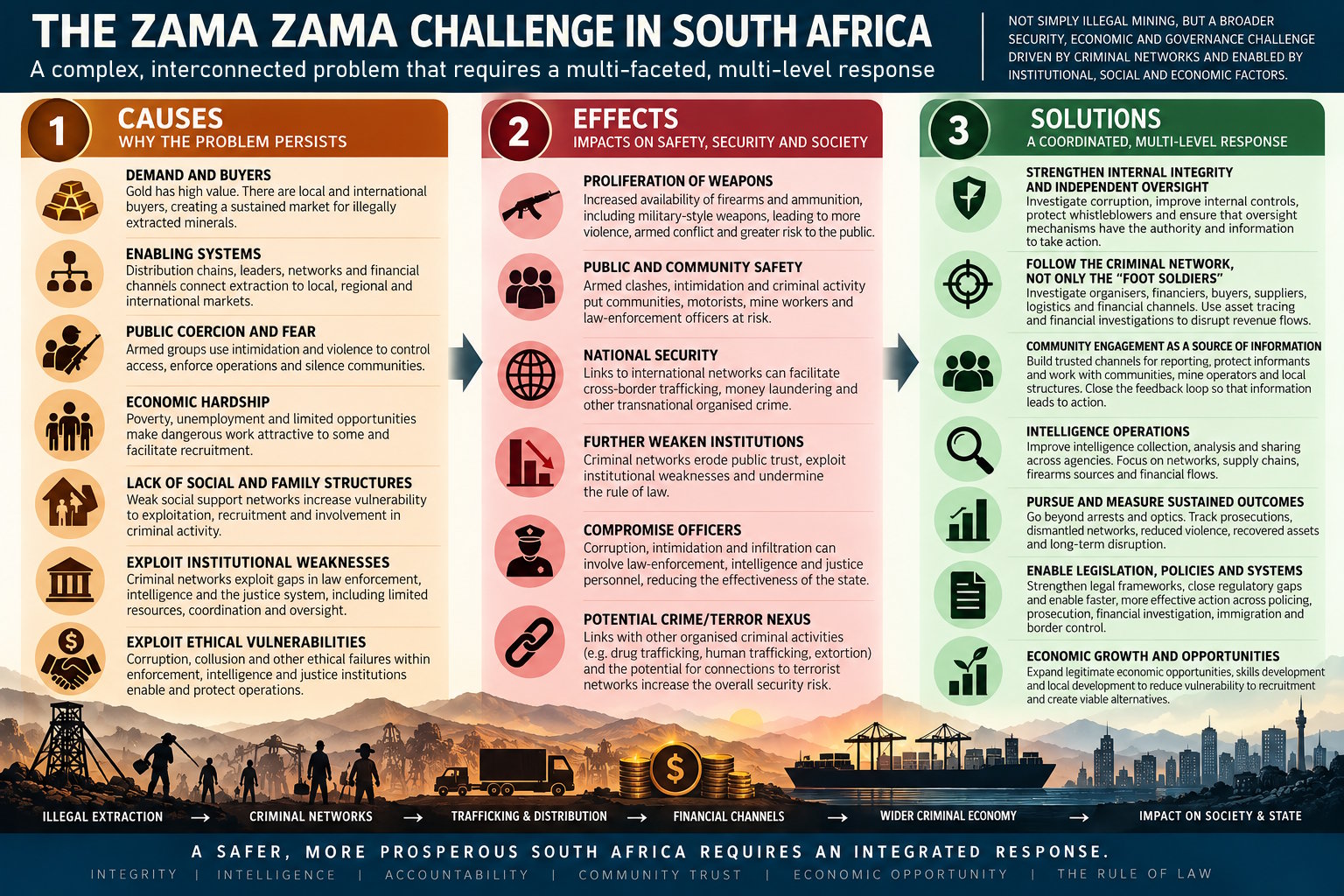
That is why the response needs to be multi-level and interdisciplinary.
The challenge is not simply to conduct more operations. It is to make the system that makes those operations necessary progressively less viable.

NONGQAI’S Strategic Security Analyst Dr Joan Swart is a forensic psychologist with an MBA and an MA in Military Studies. Her work focuses on African security, geopolitics, state fragility, substate dynamics, and the intersection between governance, legitimacy, and coercive power. She is the author of several books and regularly publishes long-form analysis and opinion pieces on security and governance issues. Her writing has appeared in outlets including DefenceWeb, Maroela Media, Netwerk24, RSG, Visegrad, and other policy and public-affairs platforms. She has a weekly slot on SAfm The Global Briefing to analyse world affairs. Her work bridges academic research, policy analysis, and applied strategic assessment, and she is currently completing a second PhD at the University of Stellenbosch Military Academy. Follow her on X/Twitter, Substack, LinkedIn, and YouTube.
