
Nongqai Vol 17 No 9 – (7) Horses in the Anglo Boer War
Opsomming in Afrikaans
Die Anglo‑Boereoorlog het ’n ongekende beroep op perde en muile gestel. Duisende diere is uit lande regoor die wêreld ingevoer—van die VSA, Argentinië en Australië tot Indië, Rusland en Europa. Die oorlog het egter vinnig gewys dat swak perdebestuur net so dodelik kon wees as vyandelike vuur. Lang seereise, onvoldoende rus, onbekende kos, siektes, oorlading en harde klimaatstoestande het tot massiewe verliese gelei: sowat 60% van alle perde het gesterf, teenoor slegs 3% van die soldate.
Die Boere het ’n groot voordeel gehad met hul geharde Kaapse en Boerperd‑ponies, wat gewoond was aan die Karoo se gras, min water en lang afstande. Baie ingevoerde perde kon eenvoudig nie die Suid-Afrikaanse omgewing hanteer nie. Die Britse leër het veral swaar verliese gely omdat perde oorlaai, swak bestuur en te vinnig na uitputtende seevaarte ontplooi is. Hul gemiddelde lewensduur ná aankoms was soms net ses weke.
Die dokument beklemtoon ook die enorme logistieke uitdaging: meer as 109 000 perde en 81 000 muile is tussen 1899 en 1902 vanaf New Orleans verskeep. Op een reis het 187 van 2 090 muile gesterf. Argentynse perde het dikwels getraumatiseerd geraak omdat hulle van hul klein kuddes en “bell mares” geskei is. Siektes het veral ingevoerde perde getref, terwyl plaaslike perde meer weerstand gehad het.
Die verhaal word verder verryk deur individuele perde wat beroemd geword het—Freddy van die Household Cavalry, De Wet se Fleur, De la Rey se Bokkie, en Major, die enigste Nieu-Seelandse perd wat huis toe teruggekeer het.
Die geheelboodskap: die oorlog was ’n harde les in perdehigiëne, logistiek en dierlike uithouvermoë—’n herinnering dat ’n leër se oorlewing net soveel van sy diere as van sy soldate afhang.
Aanhalings uit die dokument: “Dit is beraam dat ongeveer 60% van die perde gesterf het, vergeleke met ongeveer 3% van die menslike vegters.” “Op een reis alleen het die SS Manchester City 36 dae op see deurgebring, waartydens 187 van die 2 090 muile aan boord gesterf het.”
Excerpt in English
The Anglo‑Boer War placed unprecedented demands on horses and mules, drawing animals from across the world into a conflict for which many were unprepared. Long sea voyages, unfamiliar fodder, extreme climate, disease, overloading and poor management resulted in catastrophic losses—around 60% of all horses died, compared with only 3% of human combatants.
The Boers benefited from hardy local Cape horses accustomed to the harsh South African environment, while imported British horses often survived only a few weeks after arrival. Between 1899 and 1902, more than 109,878 horses and 81,524 mules were shipped from New Orleans alone, with many dying en route. Diseases such as mange, strangles, influenza, pneumonia and tick‑bite fever ravaged the imported stock.
Individual horses became legendary: Freddy of the Household Cavalry, who survived 1,780 miles of campaigning; Fleur, De Wet’s conspicuous white Arab; Bokkie, De la Rey’s beloved mount; and Major, the only New Zealand horse to return home. Their stories highlight both the suffering and the extraordinary endurance of the animals that carried the war.
Keywords in English
Anglo-Boer War, war horses, mules, remount depots, horse losses, British Army, Boer commandos, Cape horse, Boerperd, Missouri mule, New Orleans shipments, sea voyages, equine diseases, mange, strangles, influenza, pneumonia, tick-bite fever, horse husbandry, logistics, Freddy, Fleur, Bokkie, Major, Argentine horses, bell mare, Weston Remount Depot, horse memorial, military animals
THE HORSES THAT CARRIED THE WAR
Jennifer Bosch
The Anglo-Boer War placed an extraordinary demand on the horses of both armies. They were needed for cavalry, mounted infantry and artillery, and came from almost every corner of the world—England, Australia, Argentina, Canada, New Zealand, Burma and southern Africa.
Some were magnificent English chargers, while others were sturdy Australian horses, tiny Burmese ponies or hardy Basuto ponies. The little Burmese ponies were particularly remarkable, carrying a man and his equipment from dawn to dusk despite their small size and limited food. The Basuto pony was equally renowned for its ability to endure hardships that brought many other horses to grief.
But the war exposed a devastating weakness: poor horse management could be just as deadly as enemy fire. Long distances, inadequate rest, unfamiliar forage, starvation, disease and overloading resulted in enormous losses. It has been estimated that around 60% of the horses died, compared with about 3% of human combatants.
The Boer commandos had an advantage in their Cape horses, which were accustomed to the rough grasses and harsh conditions of the Karoo. Many imported horses simply could not cope with the South African environment.
The tragedy was not necessarily that the horses were unsuitable. In many cases, they were simply asked to do too much, for too long, with too little food and rest.
The Boer War therefore became a grim lesson in horse husbandry, endurance and logistics—a reminder that in warfare, the survival of an army can depend just as much on caring for its animals as on caring for its soldiers.
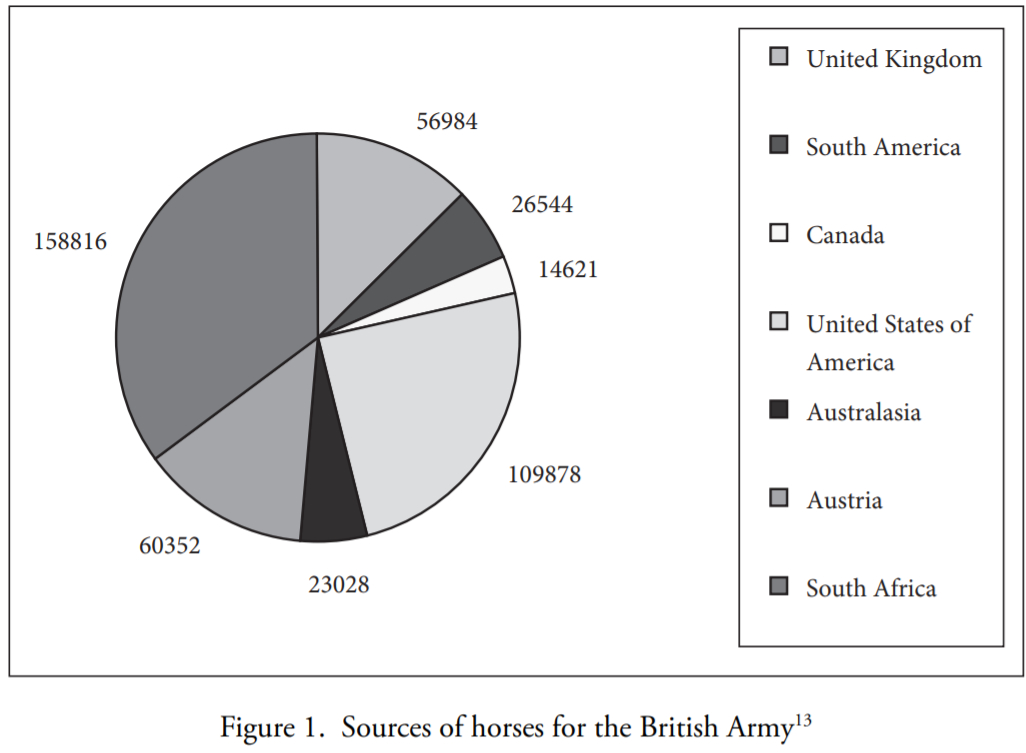
Horses were shipped from England, Ireland, the United States, Australia, New Zealand, Austro-Hungary, Russia, Argentina, and India.
Most of the horses and mules imported into South Africa during the Anglo-Boer War came from the United States. Between October 1899 and June 1902, a total of 109,878 horses and 81,524 mules were transported from New Orleans to South Africa on 166 voyages. The animals and their transportation cost an average of around US$597,978 per month.
The long sea journeys took a heavy toll, with many animals dying en route. On one voyage alone, the SS Manchester City spent 36 days at sea, during which 187 of the 2,090 mules on board died.
It is important to remember that horses were not all alike; different groups had their own distinctive behaviours and social patterns. The horses brought from Argentina, for example, had previously lived in small, semi-wild herds. Each herd followed a particular “bell mare”, whose role was to lead and guide the others. When these horses were separated from their herds and sent to South Africa for remount duties, many became distressed and panicked at the loss of their leader and companions. Some became so depressed that they lost condition, grew emaciated and appeared to pine for the herds they had left behind.
For horses serving with the Imperial forces, the unfamiliar conditions of South Africa could prove deadly. Eating unfamiliar fodder, drinking excessive amounts of water after strenuous work, or being exposed to extreme heat or cold could all put their lives at risk. They also encountered unfamiliar diseases, pathogens and plants to which they had little or no resistance. As a result, imported horses were generally far more susceptible to illness than the hardy local horses known as the Boerperd breed.
On the Boer side, General Ben Viljoen observed that around one-third of the horses brought into the field were not adequately trained for the demands of warfare. He also noted that many of the newly enlisted burghers of foreign nationality—foreign volunteers fighting alongside the Boers—had little or no experience riding horses.
Src:
Swart, S. Horses in the South African War, c. 1899-1902. Society and Animals 18 (2010) 348-366.
Viljoen, B. (1902). My reminiscences of the Anglo-Boer War.
thestoryofemily.com
Horses for the War.
The Second Boer War took a devastating toll on horses, with losses on a scale unprecedented in modern warfare. The British forces suffered particularly heavy casualties among their horses, partly because the animals were overloaded with unnecessary equipment and saddlery, given insufficient time to rest and acclimatise after lengthy sea voyages, and often poorly managed by inexperienced mounted troops. For many British horses, the harsh conditions proved fatal: their average life expectancy after arriving at Port Elizabeth was only about six weeks.
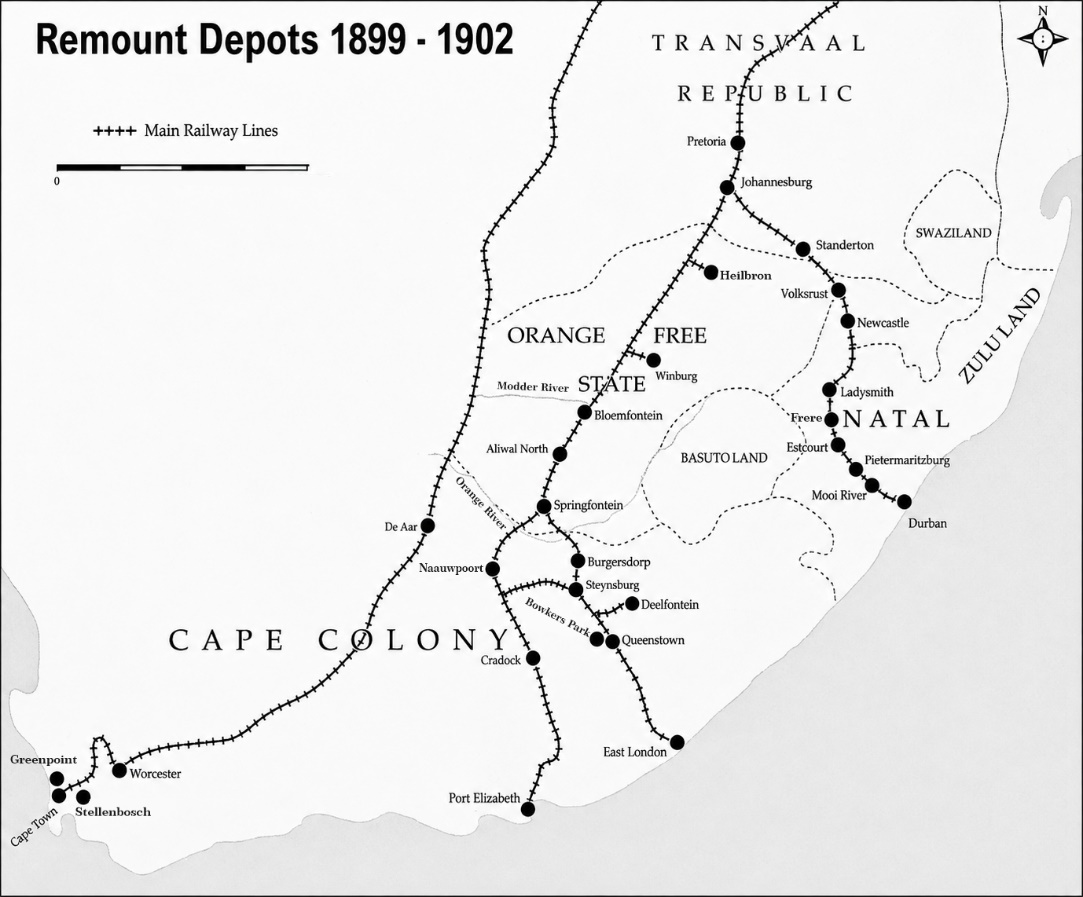
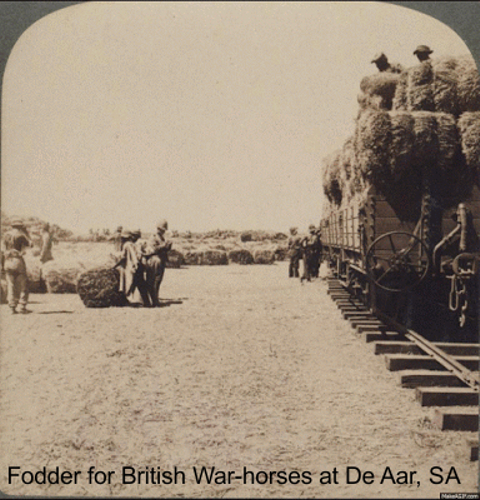
The imported were offloaded at Cape Town, Port Elizabeth and East London harbours, and from there they were transported to the front lines by rail.
The majority of horses and mules imported into South Africa came from the United States. Between October 1899 and June 1902, 109,878 horses and 81,524 mules were transported from New Orleans to South Africa on 166 voyages.
The long sea voyages themselves also resulted in significant losses. During the 36-day voyage of the SS Manchester City, for example, 187 of the 2,090 mules aboard died before reaching South Africa.
The enormous loss of horses during the war is commemorated by the Horse Memorial in Port Elizabeth, which honours the approximately 300,000 horses that died during the conflict.
Mules for the War
The mule was regarded as an indispensable draft animal in southern agriculture, particularly for the continuous work required in cotton and corn production. In fact, its value was considered so great that no modern army could effectively conduct a major war without an adequate supply of mules.
Missouri was renowned for producing large, well-proportioned and strongly built mules. When the British Army sent agents to North America to purchase animals for the Anglo-Boer War, they established a major distribution centre at Lathrop, Missouri. From there, vast numbers of mules were shipped overseas.
One of the leading firms involved was Guyton & Harrington of Lathrop, which operated what was described at the time as the largest horse-distributing barn in the world. During the Boer War, the company supplied the British Government with approximately 115,000 Missouri mules and 65,000 horses.
The Missouri mule’s reputation extended well beyond the Boer War. The animals served extensively with the British forces during the conflict, and their success helped establish the mule as an important agricultural animal in the regions to which they were subsequently introduced. When war broke out between Russia and Japan in the Far East, Missouri was again called upon, with the Russian Army purchasing a large consignment of mules.
Missouri farmers understood that producing strong, useful mules depended on carefully selecting large and well-conformed parents. Small, poorly developed mules, such as those commonly found in some parts of the South, were considered far less profitable to produce.
The quality of Missouri’s mules was largely attributed to the care taken by local breeders. They were highly selective when choosing mares for breeding, applying much the same standards they would use when producing high-quality horses. This careful breeding, combined with Missouri’s reputation for producing powerful, durable animals, made its mules particularly sought after by both armies and farmers.
Extract and photos from saltofamerica.com/contents/displayArticle.aspx?6_390
Other photos – statehistoricalsocietyofmissouri.org/…/…/imc/id/15576
Extract from – Working Horses: Looking Back 100 Years to America’s Horse-drawn Days By Charles Philip Fox
(At time of writing, the links were active but are not current at this time.)
About 40 miles north of Kansas City, Missouri, 2 cousins, JD Guyton and WR Harrington developed an enormously successful Mule Company in the first 2 decades of the 20th Century. Their headquarters was in Lathrop. In their cast operation, the 3 principal mule barns housed 1000 animals each . It took 500 buyers spanning the countryside to keep up with the demand.
The Guyton and Harrington Mule company secured an exclusive contract with the British War office. They started by supplying the British during the Boer War and later during WWI.
Other ref – Book of Mules: Selecting, Breeding, and Caring for Equine Hybrids By Donna Campbell Smith
The enormous logistical challenge of keeping the British forces mobile was captured vividly by historian Thomas Pakenham in The Boer War. Horses arrived by the thousands from across the world—Indian, Burmese, Argentine and other horses—having endured journeys of thousands of miles before being sent onwards by rail. The rapidly advancing British army consumed horses at an extraordinary rate, much as a modern mechanised army consumes fuel.
The scale of the problem can be illustrated by French’s Cavalry Division, which lost around 1,500 horses through death, illness or disappearance during the advance to relieve Kimberley. At the Battle of Poplar Grove on 7 March 1900, the division lost a further 213 horses in a single day.
These losses raised a critical question for Lord Roberts’s strategy. His plan called for approximately 15,000 men to be mounted as Mounted Infantry—but with horses being consumed at such an enormous rate, the crucial question was: where would enough horses come from?
Many mounts for the British Army were brought to South Africa from Argentina, and suffered terribly during the sea voyage, with an estimated 13 000 dying before they even landed in Durban. Mules also paid a vital part in the war and were imported for military purposes from America for the first time, also suffering terrible losses. Of 150 000 mules purchased, some 50 000 perished. Animals injured during battle were brought to Weston to recover from their wounds. Boer mounts were hardy non-Thoroughbreds that could live off meagre grazing and travel for many miles a day. An assessment of the Boer ponies by an English source, concluded, “He is a hardy, in some essential respects a disease-proof, animal; his life has been largely spent in the open. Limited fare has rendered him both economical in use and an excellent forager. He is docile, hardy and wary, but small and frequently plain; he is light in both body and limbs, which leaves the impression that he is not up to the weight of the British soldier, although he mostly carries a man whose body weight is greater than that of the average mounted British soldier.” – hartford.co.za/…/unveiling-of-south-african…
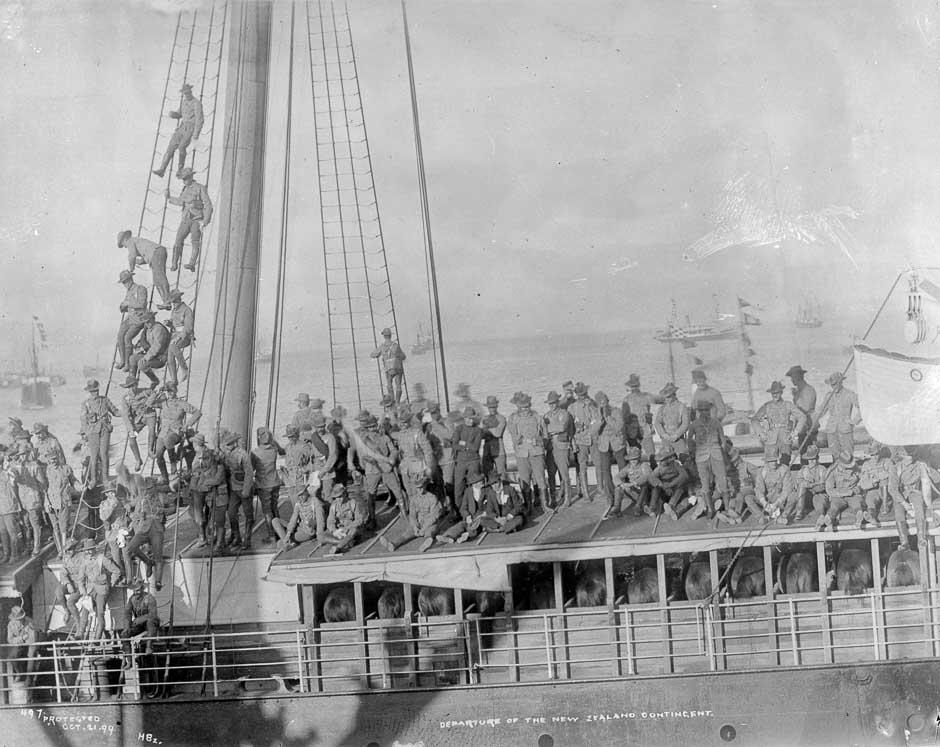
The 1st Contingent departed from Wellington on Shaw Savill & Albion Ltd’s Waiwera on 21 Oct1899. Prem. Richard Seddon wanted the New Zealand Contingent to be the first group of colonial troops to reach South Africa, and the steamer successfully raced Australian troopships across the Indian Ocean. Note the horse stables on the deck of the ship. – Src.- New Zealand History
Departure.
Arrival at their Destinations.
A -Horses, men and gear of the 4th Imperial Victorian Bushmen being unloaded from the steamer Victoria at Beira, Portugese East Africa, 1900.
B -A horse being offloaded for the war effort in a South African harbour. Could be Cape Town…ABW……Nico Moolman
C –Durban
D – Disembarking a horse at the Point, Durban Harbour, 1902. Graham Leslie McCallum
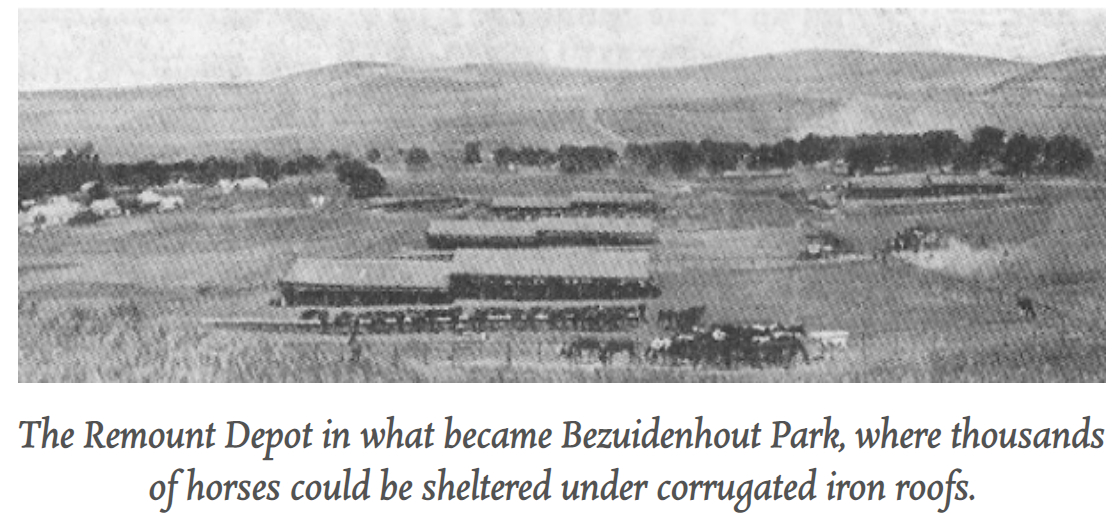
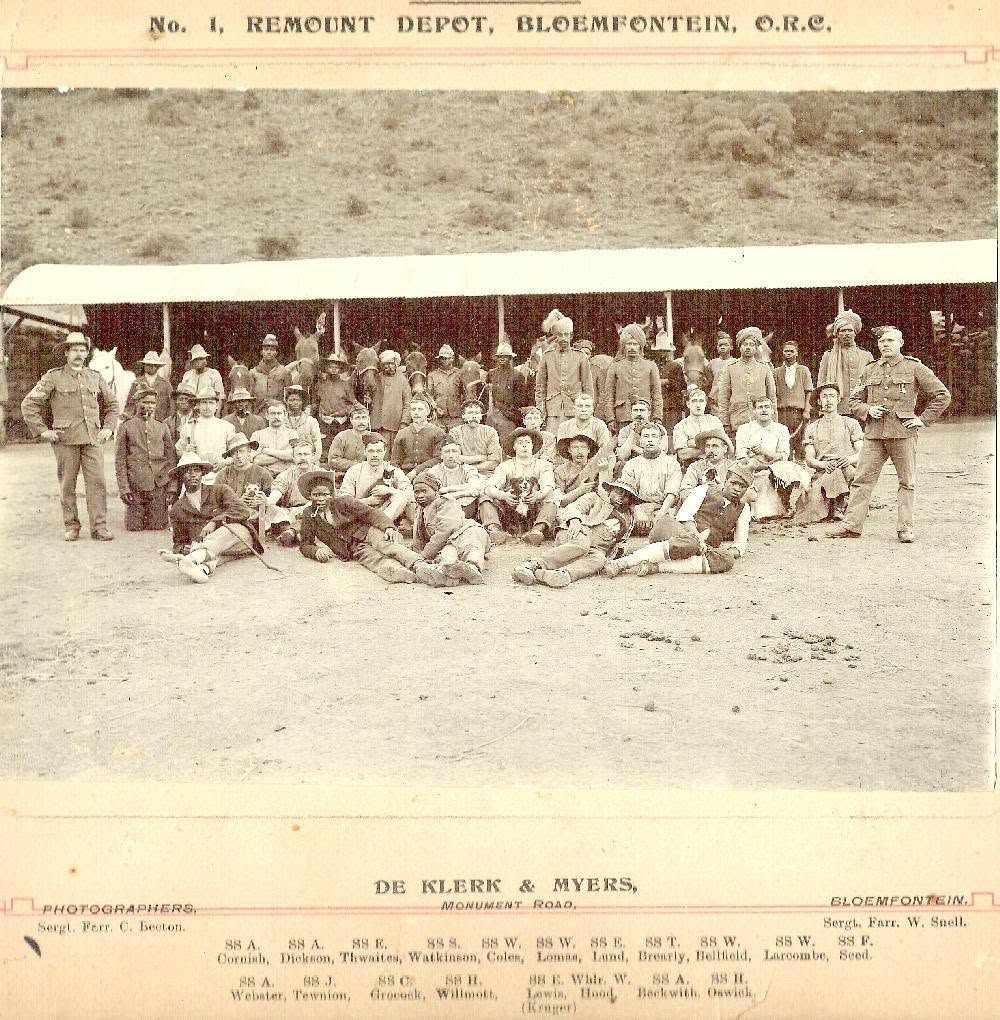
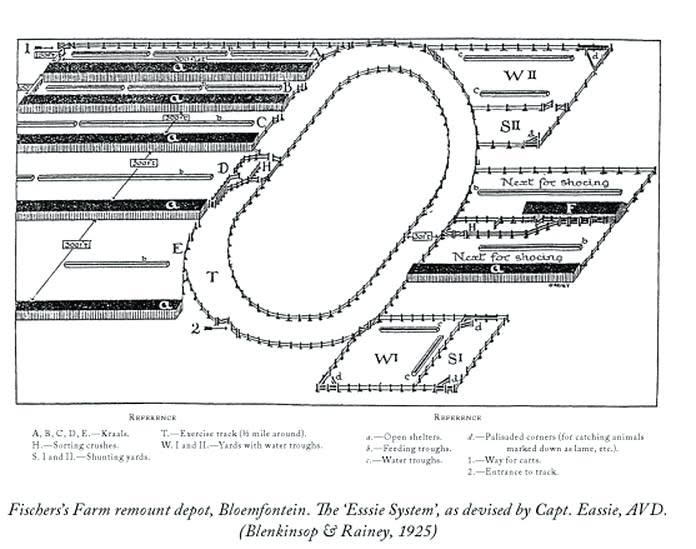
Remount Depos
Definition: an establishment where newly acquired horses were received, inspected, treated, rested and prepared before being issued to units.
Weston
The Weston Farm and the ‘Weston Common’ on which Weston Agricultural College, near Mooi River, stands today, was the site of No 6 Remount Depot. It is estimated that approximately 30 000 horses and mules died or were destroyed during the war and were buried on this farm and the surrounding area. The memorial has been designed in a horseshoe shape, mounted by an obelisk-shaped monument created out of old horseshoes found on the farm.
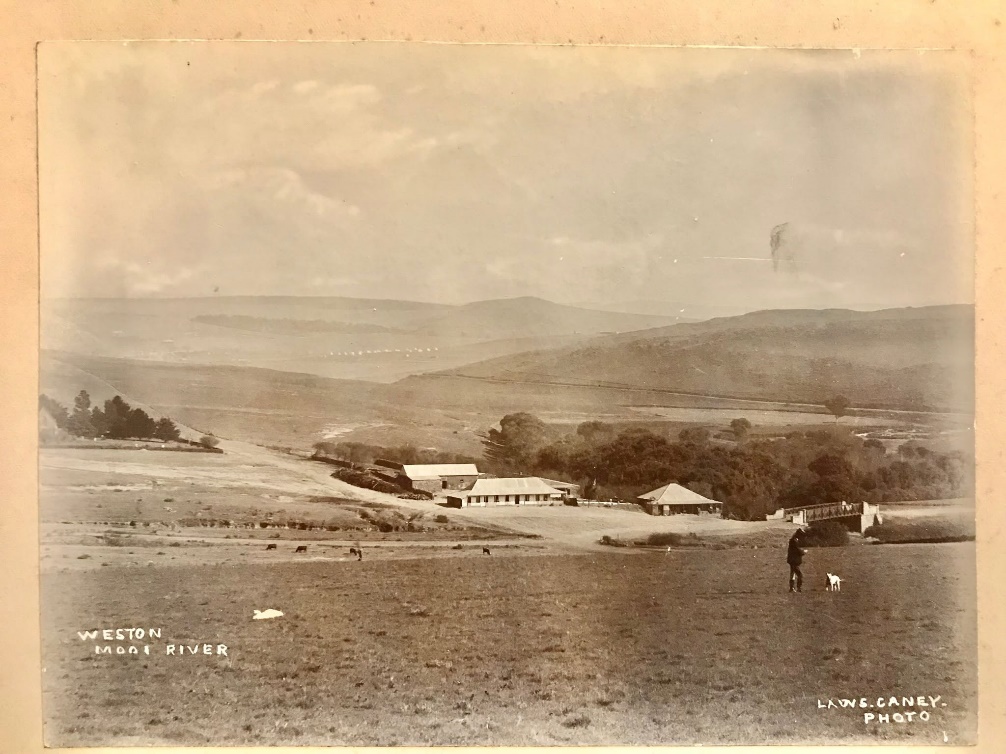
The inverted horseshoes of this centrepiece are in keeping with the tradition at a cavalryman’s funeral, where his boots are reversed in the stirrups on his horse. The structure is topped with a specially crafted bronze statue of a horse that is the work of Weston old boy and acclaimed Midlands artist, Kim Goodwin. The monument is backed by a Wall of Remembrance where plaques commemorating the animals lost in the battle are mounted. A box containing some bones of horses buried on the farm was placed within the Wall of Remembrance.
http://www.hartford.co.za/…/unveiling-of-south-african… and http://samilitaryhistory.org/vol145kg.html
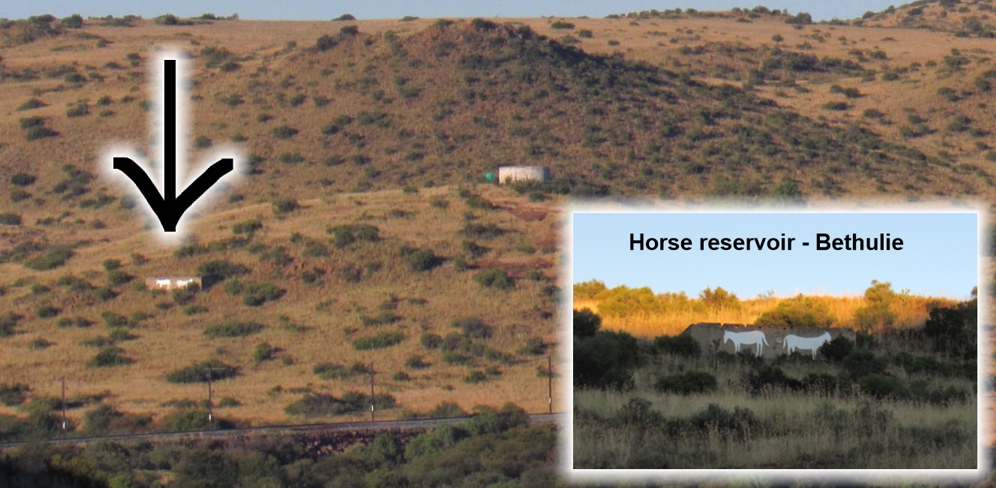
“Make for the White Horse”
A Naval Brigade was situated there for a considerable time during the Anglo Boer War to protect Bloemfontein against the Boer invasions. The White Horse was laid by the men of a remount depot and was inspired by the famous white horse of their home country, Wiltshire.
“Make for the White Horse” became the instruction given to the men bringing the remounts in.
Further reading: http://www.angloboerwar.com/…/pdf/TimesHistory06-206.pdf
Did you know:
South African horses would eat both oats and mealies;
New Zealand horses who would eat oats but would not touch mealies;
Australian horses who would eat mealies but not oats (Pilcher, 1903).
All horses had to become accustomed to the British manner of bridling horses, a practice that the foreign horses often found strange and upsetting.
In Argentina, for example, mares were seldom broken in. Instead the horses would live in free-roaming little herds of riding horses. Each man-made herd had one matriarch whom the others trusted (Sessions, 1903). When separated for remount work, the scattered horses would miss the guidance of the senior mare and could grow emaciated, pining for their erstwhile companions.
Strange ailments, like a mysterious “tongue illness” (probably vesicular stomatitis) spread from the American imports to local stock, who had little resistance to it.
Mange, a highly communicable disease, affected more equines than any other disease. During the war there were around 27,300 cases of mange.
Strangles (an infectious disease of the respiratory system) and equine influenza were triggered by the stress induced by transportation and became more widespread as large numbers of animals were suddenly brought together, their vulnerability compounded by the conditions of poor hygiene in which they were kept.
Pneumonia was yet another disease that levied a high cost and was especially dangerous for horses after gruelling sea voyages and extended overland transportation.
Biliary or tick-bite fever (caused by a parasite in the red blood cells and carried by the red tick, which was picked up during grazing), to which South African horses were partially immune, affected most of the imported horses.
Local horses had more immunity to local diseases and were usually more robust because they had not suffered the rigors of maritime transportation.
* Horses in the South African War, c. 1899-1902 – Sandra Swart – University of Stellenbosch.
A Horse named Major
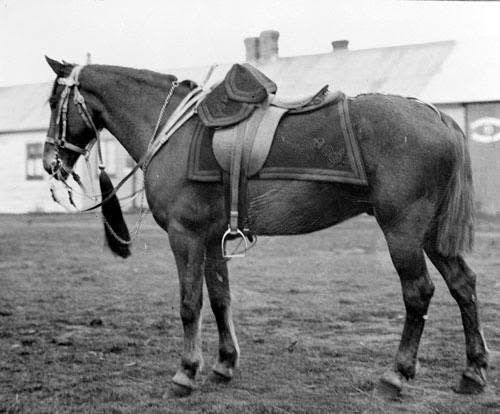
‘Major’ was the only New Zealand horse to serve in the AB War to ever be returned home.
He was the horse of Lieutenant Robert Collins of the 4th Contingent New Zealand Mounted Rifles or ‘Rough Riders’ (pictured). After Collins was wounded, ‘Major’ was used by other riders until it came to be the horse of Lieutenant-Colonel Thomas Porter. Colonel Porter used the ‘Major’ until the end of the war and then took him to London in 1902 as commander of the New Zealand Coronation Contingent.
Colonel Porter returned to New Zealand with his faithful horse
More than 8000 horses were shipped to South Africa during the ABW from New Zealand. Hundreds died on the ships on route and many more on arrival being in such a bad condition. However the horses served their troops well only to eventually be “rewarded” with a shot between the eyes!
Only one horse “Major” made it back to New Zealand. – Src: nzhistory.net.nz/media/photo/major
A Horse Named Freddy
Freddy was a black gelding of the 2nd Life Guards, one of the Household Cavalry horses sent to South Africa. He had joined the regiment as a four-year-old in 1897 and was trained at Knightsbridge before moving to Windsor and then Regent’s Park Barracks. In November 1899, he sailed aboard the troopship Maplemore.
The journey took about a month and many horses died during the voyage. Once ashore, the horses were immediately subjected to the extreme heat, lack of water, exhausting marches and military action. The scale of horse losses was enormous: the Household Cavalry lost 549 horses, mostly through disease and exhaustion.
Between 11 February and 28 August 1900, he travelled an astonishing 1,780 miles, with only 48 days of rest. He was ridden by Corporal of Horse Stephens. Freddy took part in five major actions and several cavalry charges, including the Relief of Kimberley and the captures of Bloemfontein and Pretoria.
His survival was particularly remarkable because food for the horses was often inadequate. The regiment had very little forage available locally, and its first substantial resupply from Britain did not arrive until 20 August 1900, almost nine months after the men and horses had reached South Africa. Freddy nevertheless survived the campaigning when thousands of other horses did not.
Queen Alexandra noticed that Freddy was not wearing a Boer War campaign medal and asked why. She ordered that he receive one. The War Office complied. Freddy was awarded a medal bearing five clasps: Wittenberg, Kimberley, Paardeberg, Driefontein and Transvaal.
He retired from military service in 1905, remaining at Combermere Barracks in Windsor. He died in 1911, aged 18, and was buried beside the parade square. Freddy was the only surviving horse of the regiment to be greeted again at Windsor. Src: Horse & Hound – “Great horses in history: Freddy”.
General de Wet and Fleur
Kotie (de Wet’s son) acquired a magnificent white Arabian for £30. De Wet’s first reaction was that the horse was far too conspicuous—“the English will see me from miles away.” Yet he kept the horse, named him Fleur, and the supposedly unsuitable white horse became his trusted companion throughout the war. Fleur carried De Wet through thousands of miles of campaigning and numerous battles, becoming almost as legendary as the general himself.
The irony to the story: the horse De Wet initially thought would make him an easy target became the horse that carried him through some of his most remarkable escapes from the British.
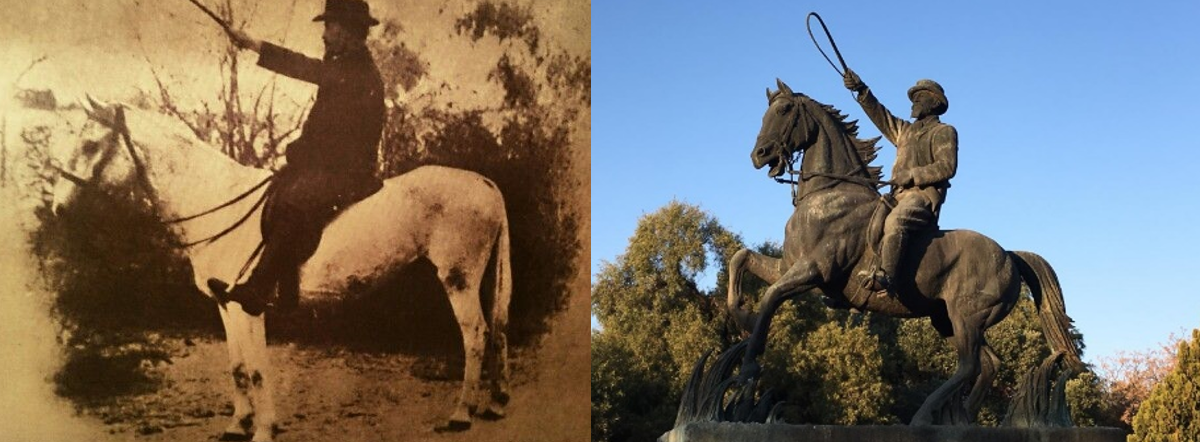
Lord Robberts and Vonolel
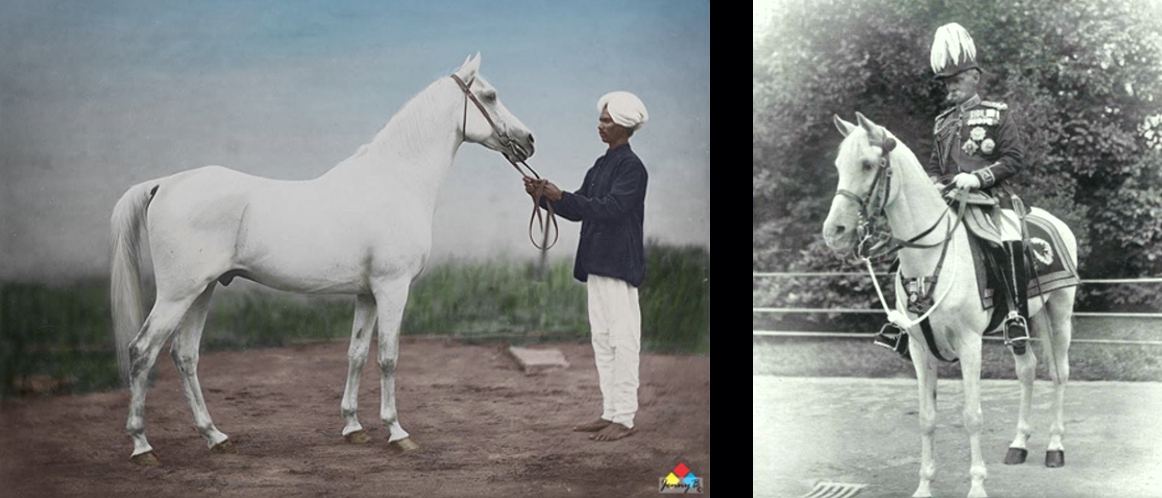
Roberts’ charger Vonolel was named after a Lushai warrior whose descendants Roberts had fought and defeated in 1871. A nimble white Arab horse who carried his master, Lord Roberts, 50,000 miles on military campaigns, Vonolel was awarded three medals for his service. When he died, he was buried at the Royal Hospital at Kilmainham, Ireland with full military honours.
Bokkie
“DE LA REY” by J Meintjes, p233-4.
When the De la Reys returned to Lichtenburg at the beginning of 1903, they stayed in rooms while the house at Elandsfontein was being rebuilt. The famous Bokkie was also brought back and kept in a stable in the village. One day he could not be found. Bokkie had disappeared without trace. For months the family hunted and mourned him and after a year Bokkie suddenly turned up, in a shocking state, his back covered in sores. It was discovered that Bokkie had been stolen and taken to Basutoland. The police, who had also searched for him everywhere, located Bokkie in a garden in Lichtenburg some time after De la Rey had returned from Ceylon. The English put their veterinary surgeon at De la Rey’s disposal and he fixed the horse up beautifully. Six months later Bokkie contracted the dreaded horse-sickness. A veterinary surgeon did all he could for Bokkie, but it was hopeless.
Polly called her father to come and say farewell to Bokkie. De la Rey at once went to see his horse. “Bokkie –“ he said. The animal stirred at the beloved voice, lifted his head slightly, gave a fearful sob – and died. De la Rey withdrew to a small smoking-room, too upset to see anyone. … When Polly brought him coffee, he lamented “Polly, everything I love is taken from me.” The English sent a mule-waggon and Bokkie was buried in the village grounds.
In Plain Sight!
MOUNTED INFANTRY & KAFFRARIAN RIFLES KHAKI-ING WHITE HORSE
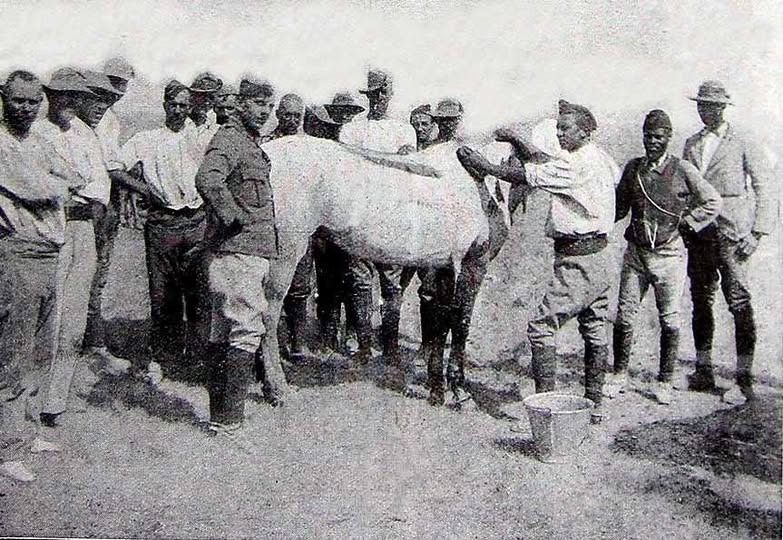
Khaki-ing an officer’s white horse so that it may not be such a conspicuous mark for Boer sharpshooters. -(Black and White Budget – April 28, 1900.

