Nongqai Vol 17 No 9 – (5) Mnr DHC Homfray: Redakteur Nongqai
ENGLISH ABSTRACT
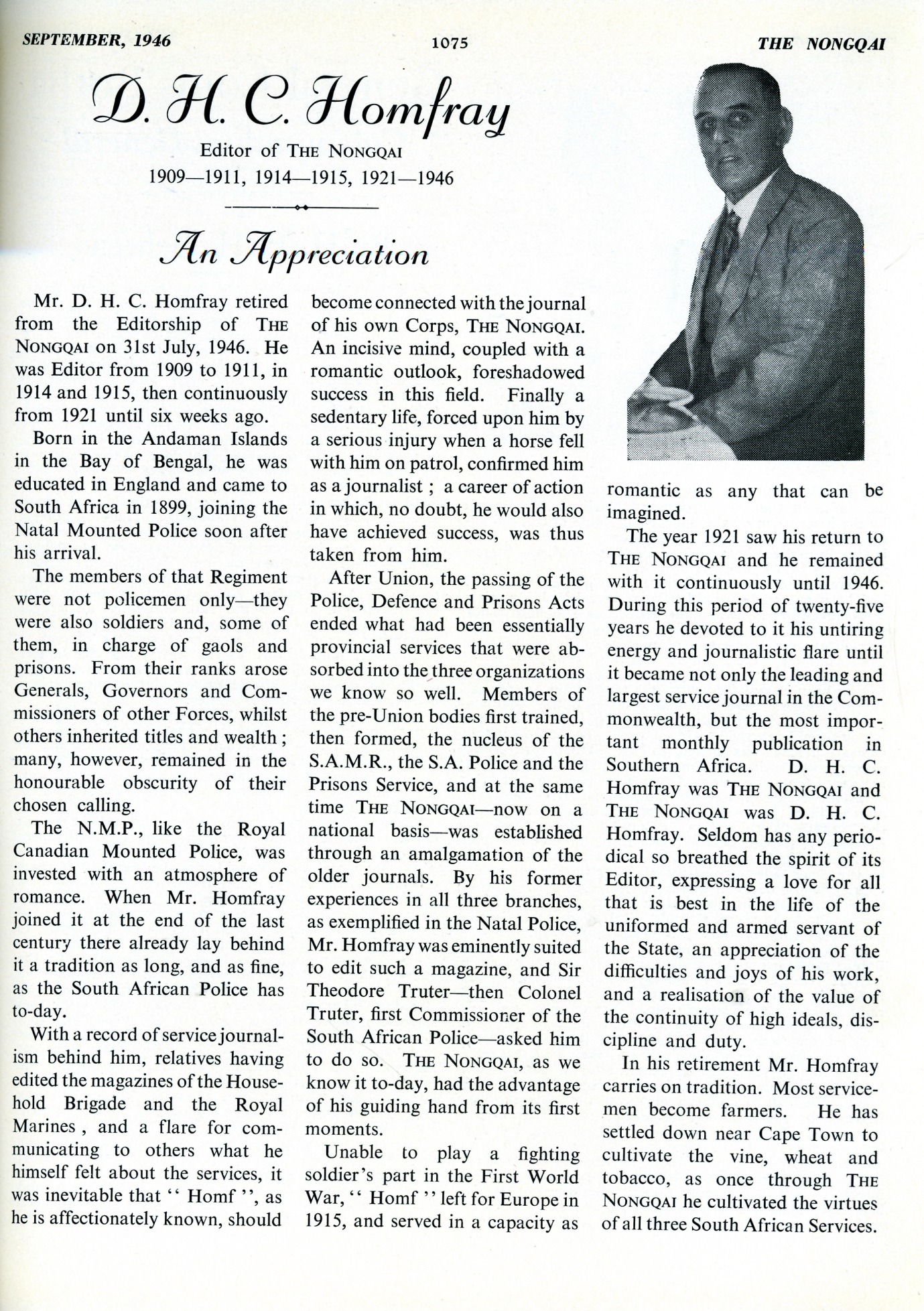
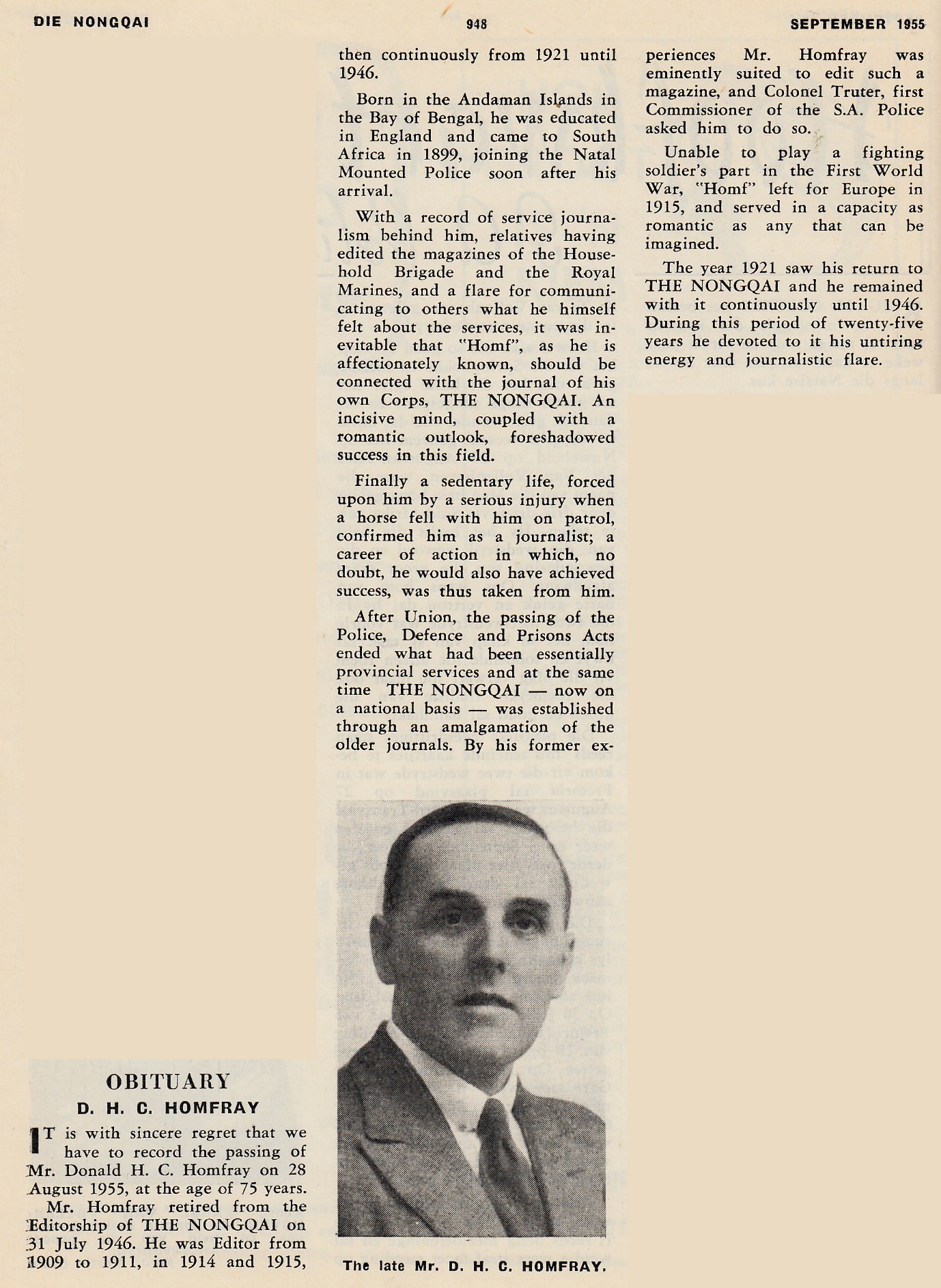
D. H. C. Homfray served as the long‑standing editor of The Nongqai, shaping the journal from its early years into the leading service publication in Southern Africa. Born in the Andaman Islands and trained in England, he joined the Natal Mounted Police in 1899, where his experiences across policing, military duties and prison administration informed his later editorial vision. A severe injury redirected him from active service to journalism, and his tenure as editor — spanning 1909–1911, 1914–1915 and 1921–1946 — gave The Nongqai its distinctive character rooted in tradition, discipline and the ethos of uniformed service. After retiring in 1946, Homfray settled near Cape Town as a farmer, continuing a life shaped by service and dedication.
ENGLISH EXCERPT (short, publishable)
D. H. C. Homfray retired as editor of The Nongqai on 31 July 1946, ending a remarkable association with the journal that stretched over three distinct periods. His background in the Natal Mounted Police, combined with a family tradition of service journalism, made him uniquely suited to guide the publication from its early provincial roots into a national service magazine. Through twenty‑five continuous years of editorship after 1921, Homfray infused The Nongqai with the ideals, discipline and spirit of South Africa’s uniformed services, establishing it as the foremost service journal in the Commonwealth.
KEYWORDS
D. H. C. Homfray, The Nongqai, Natal Mounted Police, South African Police history, service journalism, Commonwealth service publications, police tradition, military heritage, South African Mounted Rifles, pre‑Union police forces, editorial history, uniformed services, 20th‑century policing
AFRIKAANSE OPSOMMING
D. H. C. Homfray, gebore op die Andaman-eilande en opgevoed in Engeland, het in 1899 na Suid-Afrika gekom en by die Natal Mounted Police aangesluit. Sy loopbaan as polisieman, soldaat en gevangenisdiensbeampte het hom gevorm tot ’n man met ’n sterk gevoel vir diens en tradisie. Ná ’n ernstige besering het hy hom tot joernalistiek gewend, waar sy skerp verstand en romantiese ingesteldheid hom ’n natuurlike redakteur van The Nongqai gemaak het.
Hy het die tydskrif oor drie periodes geredigeer — 1909–1911, 1914–1915 en 1921–1946 — en dit opgebou tot die grootste en mees invloedryke regimentstydskrif in die Britse Gemenebes. Homfray se werk het die gees, waardes en ideale van die uniformdiens diep weerspieël. Ná sy aftrede in 1946 het hy naby Kaapstad gaan boer, waar hy voortgegaan het om die tradisie van diens en toewyding te beliggaam.
ENGLISH SUMMARY
D. H. C. Homfray, born in the Andaman Islands and educated in England, arrived in South Africa in 1899 and joined the Natal Mounted Police. His varied service as policeman, soldier and prison official shaped his deep appreciation for duty, tradition and the romance of uniformed service. After a serious injury ended his active career, he turned to journalism, where his incisive mind and romantic outlook made him a natural editor of The Nongqai.
He edited the journal in three periods — 1909–1911, 1914–1915 and 1921–1946 — transforming it into the largest and most influential service publication (regimental magazine) in the British Commonwealth. His work infused the magazine with the spirit, ideals and continuity of South Africa’s uniformed services. After retiring in 1946, he settled near Cape Town as a farmer, continuing the tradition of service in a new form.
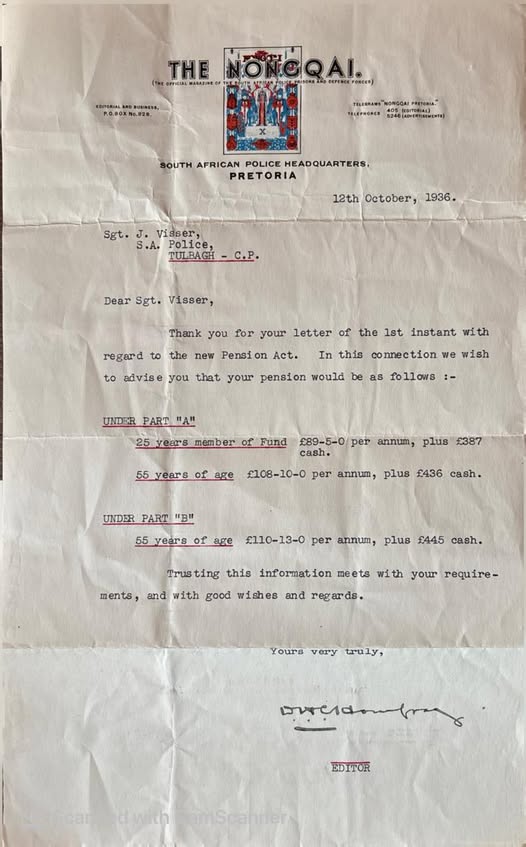
Copy of Mr Homfray’s signature / Afdruk van mnr Homfrey se handtekening.
Dokument verbeter deur Dana Kruger
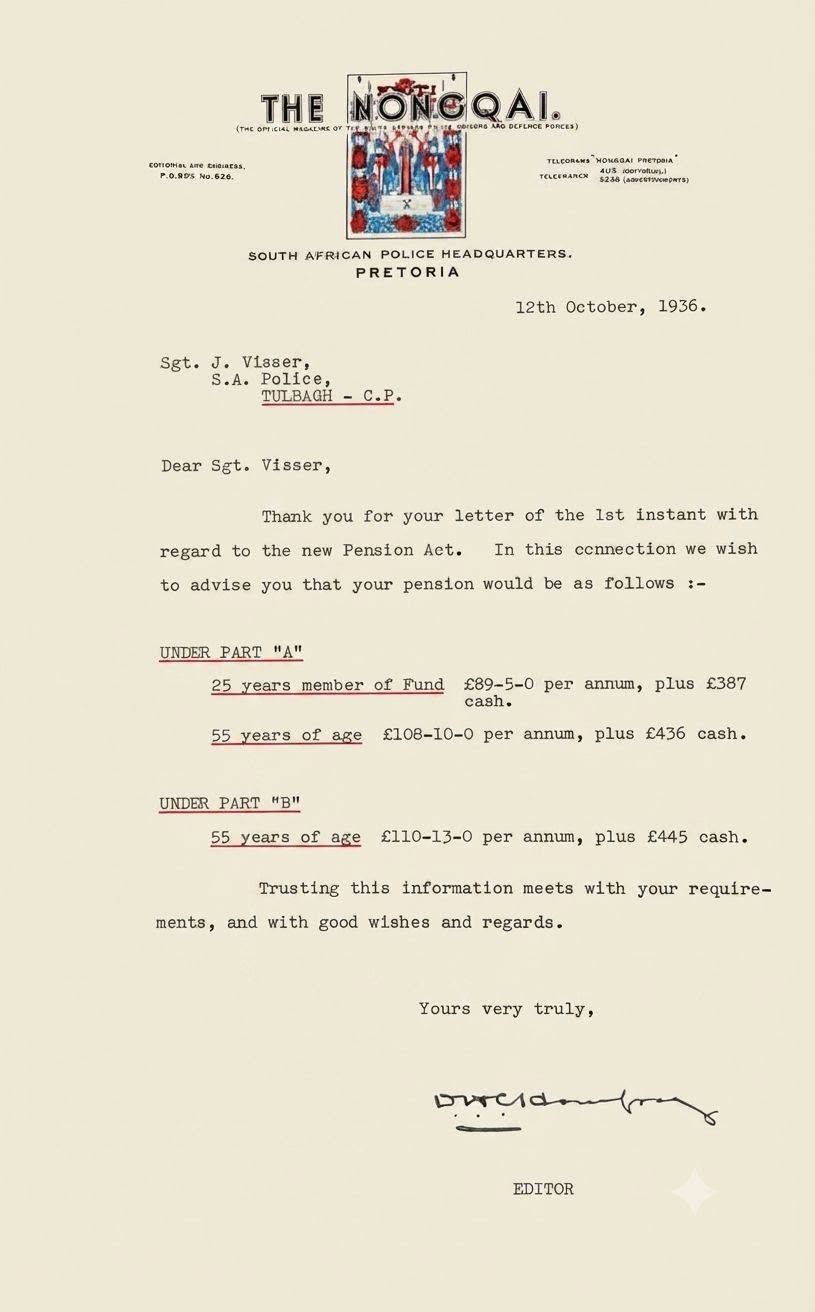
Kommentaar deur Hennie Heymans
’n Pragtige stuk polisiegeskiedenis! Baie dankie — ek sal dit ook in ’n komende uitgawe van die Nongqai publiseer. ’n Mens kan duidelik sien dat mnr Homfray destyds sommer by die Pensioene-afdeling ingestap het en die verhaal direk by die Reken- en Betaalmeester verkry het. Dankie, Rian Visser, vir die waardevolle bydrae. Danki9e ook aan Dana Kruger.
Internasionale Bereik
Dit is welbekend dat die Imperial War Museum in Londen, die Koninklijke Marechaussee in Apeldoorn (Nederland), die BSAP in die voormalige Rhodesië, die Johannesburgse Oorlogsmuseum en die SANW‑argief elk oor versamelings van die Nongqai beskik. Uit persoonlike kennis weet ek dat die voorlopers van die Royal Canadian Mounted Police, asook die polisiemagte van Egipte en Palestina, die Nongqai gelees het. Dit was te danke aan oud‑lede van die SA Constabulary wat later oor die wêreld heen in verskeie magte van die Britse Gemenebes gedien het.

