
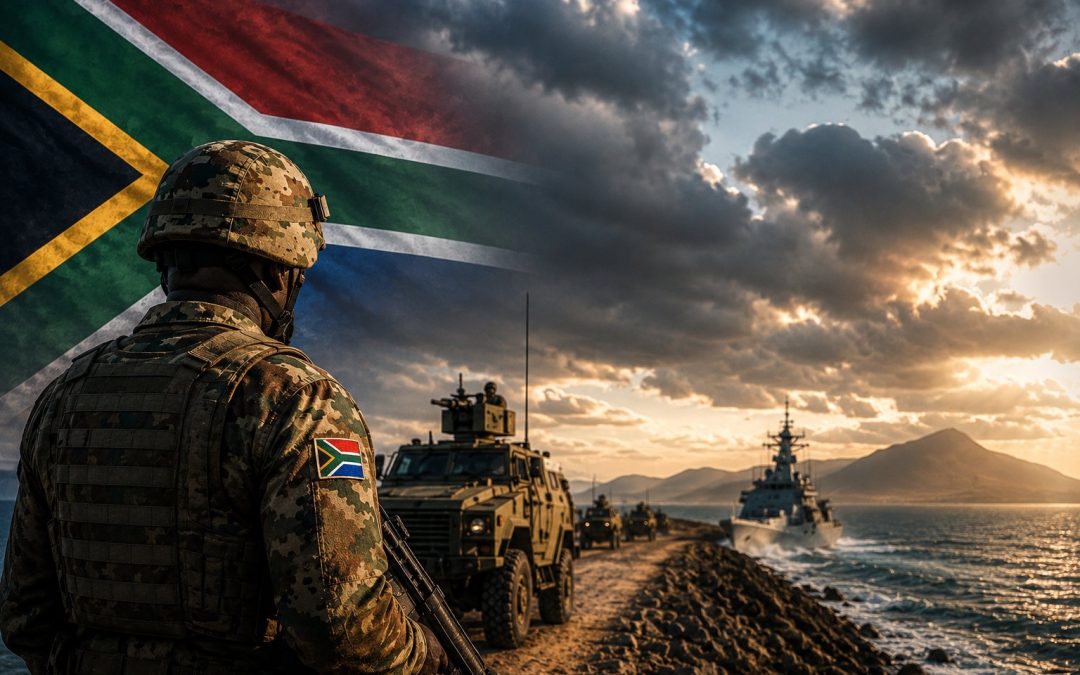
Abstract: South Africa’s defence difficulties are increasingly framed as a budget and personnel problem within the SANDF. This article argues that the deeper challenge is one of strategic coherence. Growing misalignment between political ambition, operational commitments, institutional capability, and changing security realities is weakening South Africa’s national security posture and regional influence within Southern Africa.
Dr Joan Swart
Keywords: SANDF; National Security; Strategic Coherence; SADC; Military Readiness
SOUTH AFRICA’S DEFENCE DILEMMA IN A CHANGING SECURITY ENVIRONMENT
South Africa’s proposed 2026/27 defence budget has once again reignited debate around the declining condition of the South African National Defence Force (SANDF). Predictably, much of the discussion has focused on budgetary pressure, personnel expenditure, and the apparent imbalance between operational capability and salary costs. These concerns are valid. The proposed Vote 23 Defence Budget reflects defence expenditure amounting to less than 0.7% of GDP, while personnel expenditure continues consuming the overwhelming share of projected spending over the medium term.
Yet framing the SANDF’s difficulties primarily as a budget problem risks obscuring a deeper and more dangerous reality.
South Africa’s defence dilemma is increasingly one of strategic coherence.
The SANDF today faces a widening disconnect between political ambition, operational commitments, institutional capability, technological adaptation, and fiscal reality. While official planning documents increasingly recognise the emergence of cyber threats, geopolitical instability, border insecurity, and hybrid conflict environments, the force itself remains constrained by unresolved structural contradictions accumulated over decades.
This disconnect is no longer merely theoretical. It is increasingly manifesting operationally and institutionally.
For much of the post-apartheid era, South Africa occupied a unique position within Southern Africa. The country’s industrial base, defence industry, logistics infrastructure, diplomatic reach, and relative military sophistication collectively positioned Pretoria as the region’s implicit security anchor. Even when South Africa exercised strategic restraint, the SANDF still provided operational depth, deterrent credibility, and institutional weight unavailable elsewhere in the Southern African Development Community (SADC).
That assumption is becoming progressively more difficult to sustain.
Operational Overstretch and Institutional Fragmentation
Modern military effectiveness depends upon far more than equipment inventories or personnel numbers. It depends upon continuity — continuity of leadership, doctrine, logistics, maintenance cycles, operational planning, training standards, intelligence integration, and command structures. Once these systems begin fragmenting, military organisations lose coherence long before they formally lose capability.
The recent difficulties surrounding South Africa’s role in eastern Democratic Republic of Congo (DRC), including the broader instability around Goma and the SADC deployment, illustrate this reality with growing clarity. Eastern DRC represents precisely the type of fragmented operational environment increasingly shaping modern conflict across parts of Africa: overlapping insurgencies, regional interests, illicit economic systems, porous borders, humanitarian crises, and contested sovereignty operating simultaneously within a fluid battlespace.
Such environments punish institutional incoherence very quickly.
The SANDF increasingly finds itself attempting to sustain multiple strategic roles simultaneously while operating under mounting fiscal and operational pressure. Border safeguarding, domestic stabilisation deployments, peace support operations, maritime security, critical infrastructure support, and technological modernisation all compete for limited institutional capacity. The result is not simply overstretch, but growing strategic diffusion.
This is where the current public debate often becomes dangerously simplistic.
The SANDF is undeniably personnel heavy. However, modern defence effectiveness increasingly depends upon the quality, composition, and integration of specialised expertise across complex operational domains. Cyber capability, intelligence fusion, logistics resilience, technical maintenance, operational planning, educational depth, and leadership continuity matter as much as — and often more than — sheer manpower.
Poorly aligned reductions in personnel can therefore accelerate decline rather than reverse it. Once institutional knowledge, technical competence, and leadership pipelines erode, rebuilding them becomes extraordinarily difficult.
The deeper challenge is therefore not simply affordability, but whether the SANDF’s current structure still aligns with the operational realities it is increasingly expected to confront.
The Return of Hard Power Realities
For years, South Africa’s defence assumptions remained heavily shaped by the post-Cold War era. The prevailing belief was that interstate conflict had sufficiently receded for diplomacy, peacekeeping, regional integration, and soft power to replace many traditional hard-power calculations. Defence was progressively deprioritised in favour of urgent developmental and socioeconomic demands — priorities that remain both politically and morally important within South Africa’s broader national context.
Yet many of the assumptions underpinning that strategic environment are steadily eroding. Across the world, the certainties of the unipolar era are fragmenting as strategic competition between major powers intensifies, maritime insecurity expands, hybrid conflict environments proliferate, and critical infrastructure, cyber systems, information domains, and logistics networks become increasingly contested. Across Africa, insurgencies, organised criminal economies, irregular migration pressures, and external geopolitical interests increasingly overlap within fragile governance environments.
Under such conditions, national security and socioeconomic stability become deeply interconnected rather than competing priorities. The erosion of defence capability, border security, institutional resilience, and strategic infrastructure protection can itself intensify developmental pressures and weaken long-term state capacity. Equally, capable defence-industrial sectors can contribute meaningfully to technological innovation, advanced manufacturing, skills development, and broader economic resilience.
Institutionally, however, South Africa’s defence posture still reflects many assumptions inherited from a more permissive geopolitical era. The country continues projecting many of the diplomatic expectations and regional obligations of a middle power while progressively struggling to sustain the institutional foundations required to support that role over the long term.
Southern Africa’s broader security architecture has historically depended, at least partially, upon assumptions of enduring South African capability and leadership capacity. As the SANDF’s operational readiness, deployability, and institutional continuity weaken, the implications extend across the region. Border insecurity, organised criminal economies, maritime threats, insurgencies, and governance failures increasingly spill across state boundaries in interconnected ways.
Strategic Realignment or Managed Decline
South Africa’s defence challenge will not be resolved simply through larger budgets or blunt personnel reductions alone. Both approaches risk treating symptoms while avoiding the deeper strategic problem.
What is required is a far more serious reassessment of South Africa’s national security priorities, regional obligations, force design, and long-term defence posture. The country must determine what strategic role it realistically intends the SANDF to fulfil within Southern Africa and the broader continent, what forms of conflict and instability are most likely to define the future security environment, and what capabilities are genuinely required to respond effectively.
Only once those questions are answered coherently can meaningful decisions be made regarding force composition, procurement priorities, training standards, technological adaptation, educational investment, and defence-industrial alignment.
South Africa still retains important strategic advantages: operational experience across Africa, significant institutional knowledge, geographic depth, and one of the continent’s most sophisticated defence-industrial legacies. Strategic decline is therefore not inevitable.
But institutional drift can become cumulative.
In an increasingly fragmented geopolitical environment, prolonged institutional drift carries growing strategic consequences. The SANDF cannot afford to become merely a symbolic institution caught between political rhetoric, shrinking readiness, and unresolved strategic contradictions.
South Africa still has the capacity to recalibrate its defence posture for a changing era — but doing so will require far greater political clarity, strategic honesty, and institutional alignment than the country has demonstrated for some time.

NONGQAI’S Strategic Security Analyst Dr Joan Swart is a forensic psychologist with an MBA and an MA in Military Studies. Her work focuses on African security, geopolitics, state fragility, substate dynamics, and the intersection between governance, legitimacy, and coercive power. She is the author of several books and regularly publishes long-form analysis and opinion pieces on security and governance issues. Her writing has appeared in outlets including DefenceWeb, Maroela Media, Netwerk24, RSG, Visegrad, and other policy and public-affairs platforms. She has a weekly slot on SAfm The Global Briefing to analyse world affairs. Her work bridges academic research, policy analysis, and applied strategic assessment, and she is currently completing a second PhD at the University of Stellenbosch Military Academy. Follow her on X/Twitter, Substack, and LinkedIn.

