SAP Rhodesia – Nongqai Vol 17 No 5
THE SOUTH AFRICAN POLICE IN RHODESIA, 1960’S & 1970’S
Gerry van Tonder
15 May 2026
(Not for publication)
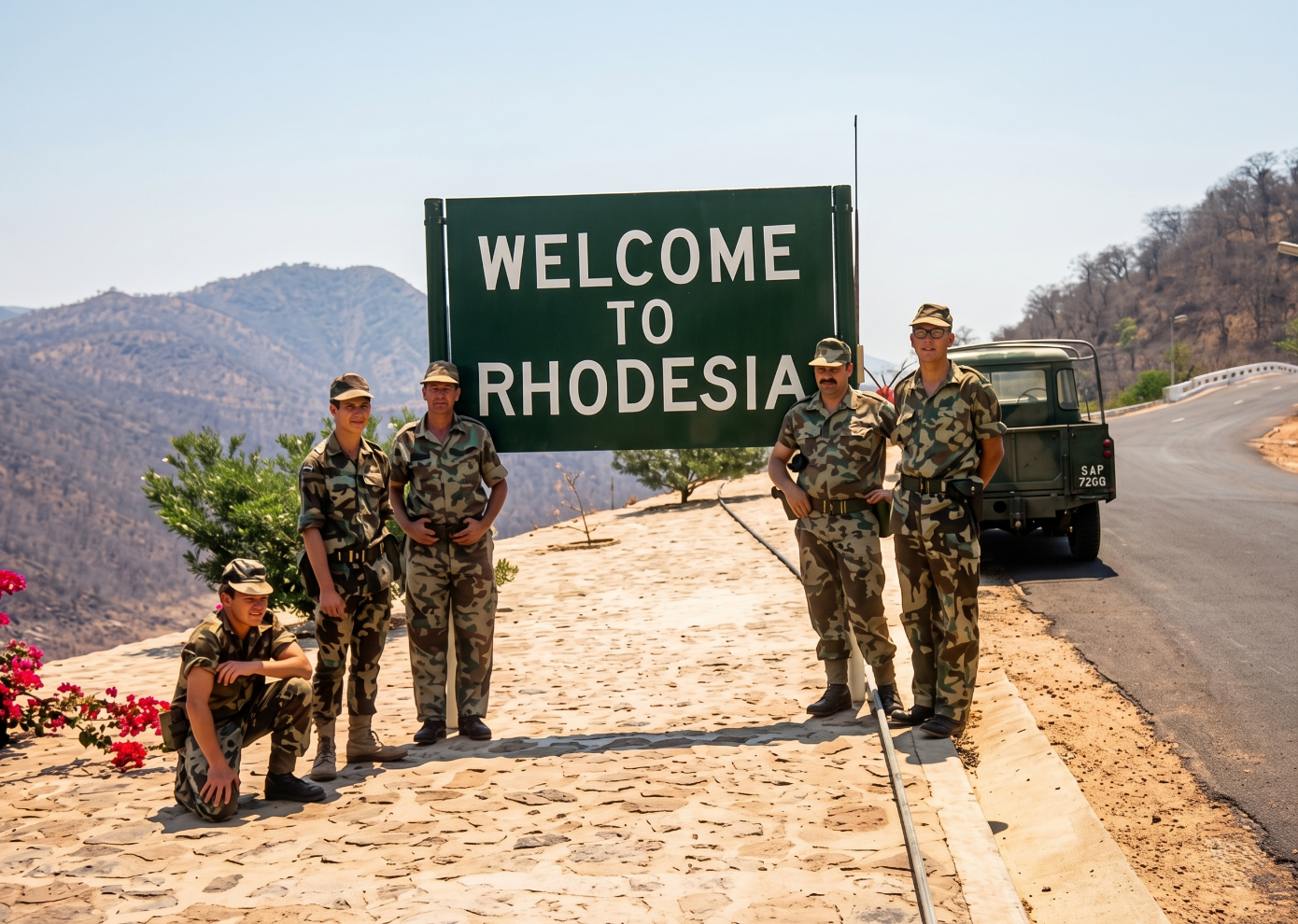
Members of the SAP pose at one of Rhodesia’s formal border crossings with Zambia, either Victoria Falls or Chirundu. Note the SAP Land Rover behind them. Date unknown.
(Original image from Facebook)
In the 1960s and 1970s, when gangs of armed nationalist guerrillas entered Rhodesia to violently overthrow the minority white government in Salisbury (Harare), South African guerrillas also moved through Rhodesia to infiltrate South Africa.
In 1966, the Rhodesians established Joint Operations Centres (JOCs) in strategic towns in the northern operational areas. Served by senior representatives from the army, air force, BSAP and Special Branch, the unit was the command centre for operational activities of all uniformed services in a given area. Internal Affairs (Intaf) would also be represented at the JOC, which met every morning. An SAP representative usually attended JOC meetings.
In the latter half of 1967, a combined insurgency directly resulted in South Africa’s deployment of members of the South African Police (SAP) on to Rhodesia’s northern border with Zambia.
In August 1967 the Rhodesian Security Forces had their first real opportunity for combined military action. A force of 80 ZIPRA (Zimbabwe People’s Liberation Army) and South African National Congress (SAANC) guerrillas sought a southwards route through the Wankie Game Reserve. They had waded across the crocodile-infested Zambezi River upstream from the Victoria Falls and had thus evaded attention, although their presence in the nearby Livingstone area of Zambia had been reported over a period of several weeks.
In a series of engagements code-named “Operation Nickel” the Rhodesian forces had suffered 20 casualties (including 7 dead), killed 30 guerrillas and captured 20. Their commanders in the field reported that the guerrillas’ morale and standard of training was much higher than anything yet encountered in Rhodesia. The guerrillas had fought a military action face to face, with no civilians involved, and were defeated only by the security forces’ air power, mobility and much greater effectiveness in communications and medical services.
The significant outcome of this ZIPRA/SAANC incursion was that it brought South African forces into Rhodesia’s guerrilla war. Within hours of the exchange of intelligence between Rhodesia’s Central Intelligence Organisation (CIO) and South Africa concerning the SAANC presence, General Hendrik van den Bergh, Head of South Africa’s Bureau of State Security (BOSS), telephoned CIO head, Ken Flower, from Pretoria to say that he had arranged through the South African Prime Minister, John Vorster, for a detachment of South African “Riot Police” and helicopters to be sent to share in Rhodesia’s defence of her border with Zambia.
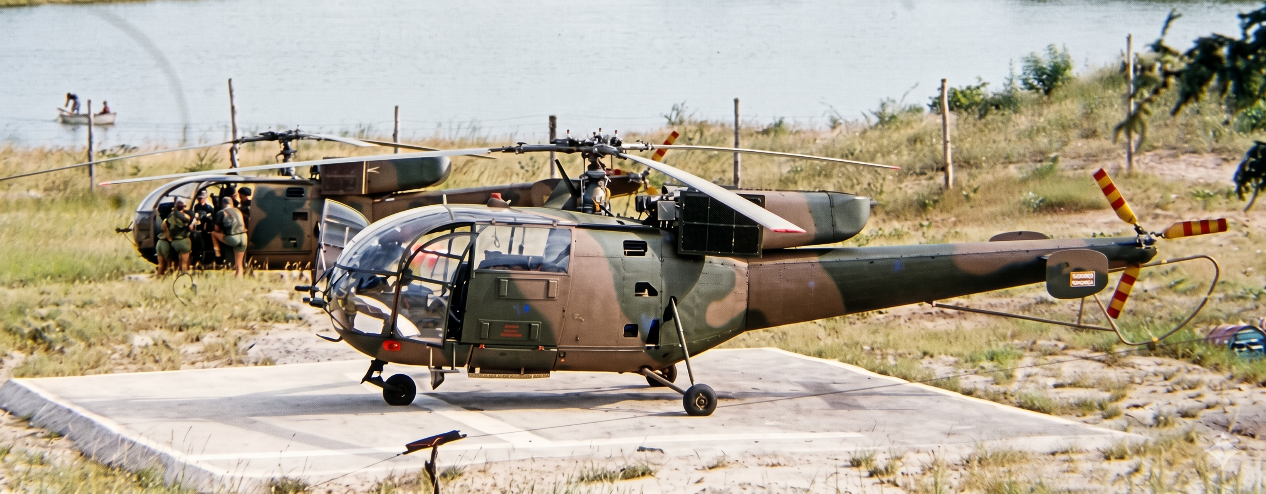
Alouette III helicopters in Rhodesia’s Operation Hurricane sector.
The one at the back with the green camouflage ‘X’ is identifiable as one of those from South Africa.
(Lewis Walter)
Flower reported this to Rhodesian Prime Minister Ian Smith who eagerly accepted the offer. When Flower saw the Rhodesian military commanders at a meeting of the country’s national Operations Coordinating Committee (OCC), however, they rejected the offer of South African aid as unnecessary. Flower returned to Smith to report this. He stated flatly that it was not for the commanders to query what he saw as a most promising political development, adding that he could understand South African Prime Minister John Vorster’s reasons for agreeing to “police” rather than “military” aid. Flower then advised the commanders that it would be better to comply, which they did.
South African aid, whether “police” or “military”, proved to be a mixed blessing politically and militarily. On the political front it gave Vorster the advantage because his offer had been unsolicited, and he later used this advantage when twisting Smith’s arm over settlement by threatening to withdraw South African contingents after they had become part of Rhodesia’s joint defence system.
Officially, records generally reveal that, for purposes of command and control, the SAP were dovetailed into the structure of Rhodesia’s national police force, the British South African Police (BSAP). However, the reality was that more often than not the respective intelligence and Special Branch organs of the two countries, CIO and BOSS, exercised influence and/or control. In the field, their were instances in which SAP unit commanders rejected Rhodesian command.*
(*Gerry van Tonder’s emphasis here and elsewhere in this paper in bold)
On the military front, initially the South African units were a liability. The “Riot Police” had received their training in an urban context and were thus totally inexperienced in the hazards of bush warfare; the Rhodesian forces had to operate as “long stop” to the South Africans in order to plug a gap in the overall defences. This was necessary despite the efforts of the South Africans’ outstanding Commander, Major-General Pat Dillon who, with his own vast experience in Africa, realised only too well that it would take some time to get his men trained and experienced in counter-insurgency.
Ultimately, the involvement of South African units in Rhodesia’s war was of more use to South Africa than Rhodesia in that South Africa used Rhodesia as a training ground, withdrawing units as they became trained and replacing them with untrained ones.
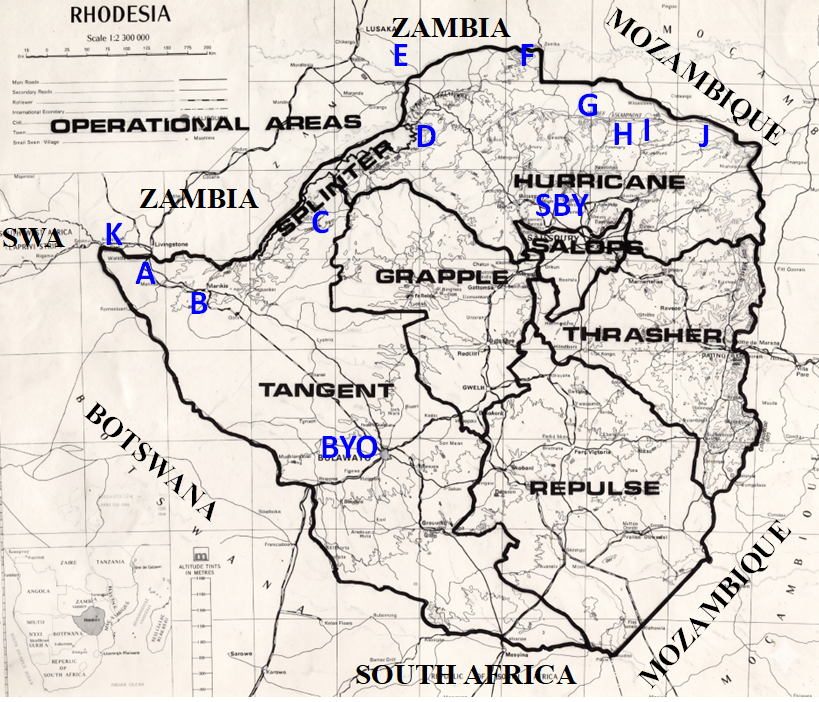
Rhodesia’s operational sectors during the counter-insurgency war 1969–1980, e.g. Operation Hurricane.
The map is annotated in blue with centres that had SAP bases from 1968–1975:
A – Victoria Falls; B – Wankie; C – Binga; D – Kariba; E – Chirundu; F – Kanyemba; G – Gutsa/Chiweshe;
H – Centenary; I – Mount Darwin; J – Rushinga/Rusambo; K – Kazangula.
SBY – Salisbury (Harare); BYO – Bulawayo.
The Dundee Courier (UK), 15 September 1967:
WRONG DIRECTION
The British Government have now received full details of the “intervention” by South African police in Rhodesia to deal with terrorists. It is forecast that the Government will protest to South Africa. They will claim that South Africa isn’t entitled to send police into a British territory without their permission. Legally correct, no doubt, but it is all very well to be fussy about such fine points in the safety of Whitehall, thousands of miles away from the terrorists.
It is a different story when Communist-trained and armed terrorists are on the doorstep intent on murder and violence. Why don’t the Government direct their protests to another quarter? The terrorists are operating from Zambia, They are trained in Tanzania, It is to Zambia and Tanzania and not South Africa that a protest should be sent.
The Belfast News-Letter (UK), 25 September 25, 1967:
BRITISH PROTEST REJECTED
Mr. John Vorster, the South African Prime Minister, publicly rejected, in effect, Britain’s protest against the dispatch of South African police to Rhodesia. He did not mention Britain specifically, but declared that the police, sent to Rhodesia to help combat African Nationalist guerrillas, would remain there as long as was necessary.
On 13 July 1968, 28 ZIPRA insurgents crossed into Rhodesia from Zambia near Lusitu, south of Chirundu. One of the gang got lost and handed himself in at BSAP Chirundu, where he divulged his gang’s crossing point. Under instructions from the BSAP an SAP patrol immediately responded. Also in the area were 3 Commando, Rhodesian Light Infantry (RLI) and E Company, Rhodesian African Rifles (RAR).
Around 10.30 a.m. on the morning of the 18th, in a gully 12 Troop, RLI, commanded by Second-Lieutenant Jerry Strong, came under heavy insurgent rifle, machine-gun and rocket fire. Overhead an armed helicopter provided cover to allow Strong to lead his men out the gully and up a ridge to link up with other RLI men. Here they were joined by the SAP patrol and an RAR platoon.
It is important to note that the SAP patrol, “after a short briefing by Strong. . . moved along the northern ridge, planning to descend into the gully and take the enemy from the eastern end”. (The Saints – see Sources) From this, it is clear that in a live combined combat situation such as this, SAP details involved came under the command and control of Rhodesian forces on the scene.
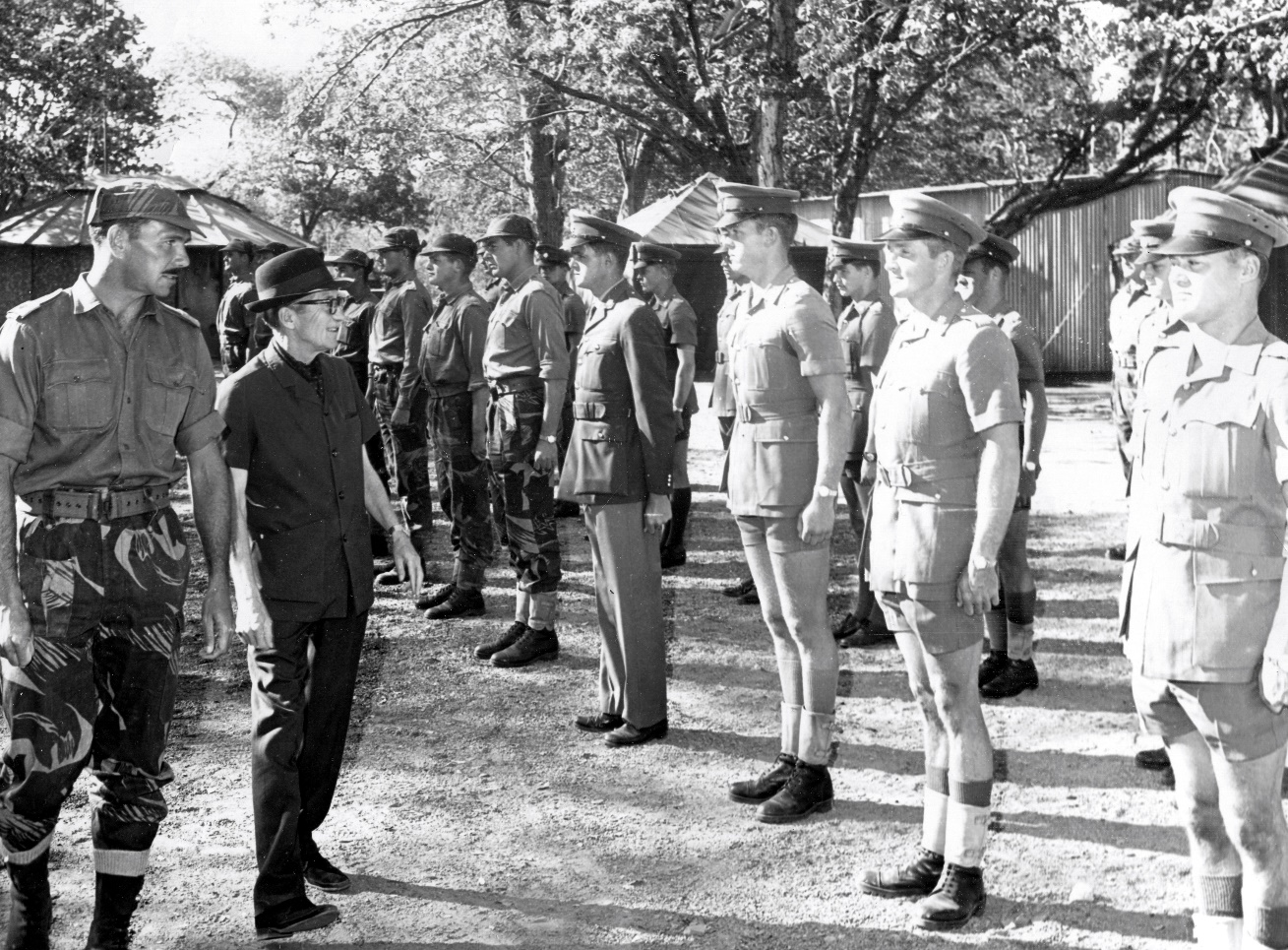
Rhodesian President Clifford Dupont, escorted by an SAP officer, inspects an SAP parade
at an operational basecamp, c.1972. (Gerry van Tonder)
In the 1970s, what was essentially a second deployment of SAP men to Rhodesia took place. This contingent, according to various records, was attached to the BSAP. During the 1970s members of the South African Police were sent up to Rhodesia “to assist the BSAP and also to learn a little of operational conditions. Regrettably many of these young men were untrained”. (The History of the British South Africa Police – see Sources)
On 18 May 1973, further Rhodesian emergency legislation allowed for the compulsory collectivisation or consolidation of the populace of certain Tribal Trust Lands (TTLs), especially where it was felt that insurgent subversion had reached uncontrollable levels. By the end of the year, some 8,000 tribespeople had been moved away from their traditional homes near the border with Mozambique into government facilities in Gutsa in the Zambezi Valley. In April the following year, 200 tribespeople from Madziwa TTL were punished for assisting insurgents by being translocated to the opposite end of the country near Beitbridge.
In the 1950s, the conflict in Malaya saw the introduction by the British of such a programme, the Briggs Plan, which sought to deny Chinese guerrillas access to the peasant population by moving the latter into what were called “protective villages” (PVs). Local people were moved into secure villages guarded by armed personnel, who were also responsible for checking the PV inhabitants in and out at dusk and dawn. The objective, generally successfully achieved, was to deny the insurgents access to food, shelter and information.
The Rhodesian government, drawing on the British experience and knowledge of some of its own officers who had served in counter-insurgency operations in Asia, therefore decided to emulate the Malayan model by the introduction of collective and protected villages. It fell almost exclusively upon Internal Affairs and its agencies to implement, administer and defend the PV programme.
The then Minister of Internal Affairs (Intaf), Jack Mussett, in a parliamentary debate justified the programme as an “operational imperative”, designed to isolate local tribespeople from insurgent influence, while also cutting off the latter’s access to food and supplies. However, he did concede that the exercise would result in major social upheaval and a “traumatic experience” for those affected.
In the winter of 1974, the PV programme commenced in the hotbed of Chiweshe Tribal Trust Land (TTL), under the name Operation Overload. This was followed in Madziwa TTL, just to the east of Chiweshe, by Operation Stronghold.
In this groundbreaking operation, which would be emulated in large parts of Rhodesia in the coming years, a contingent of District Assistants (DAs) – civil servants armed with vintage 303 rifles – under a young white member of Intaf would be allocated to each of the 21 PVs in Chiweshe.
SAP Rhodesia – Nongqai Vol 17 No 5
THE SOUTH AFRICAN POLICE IN RHODESIA, 1960S & 1970S
Gerry van Tonder
15 May 2026
(Not for publication)
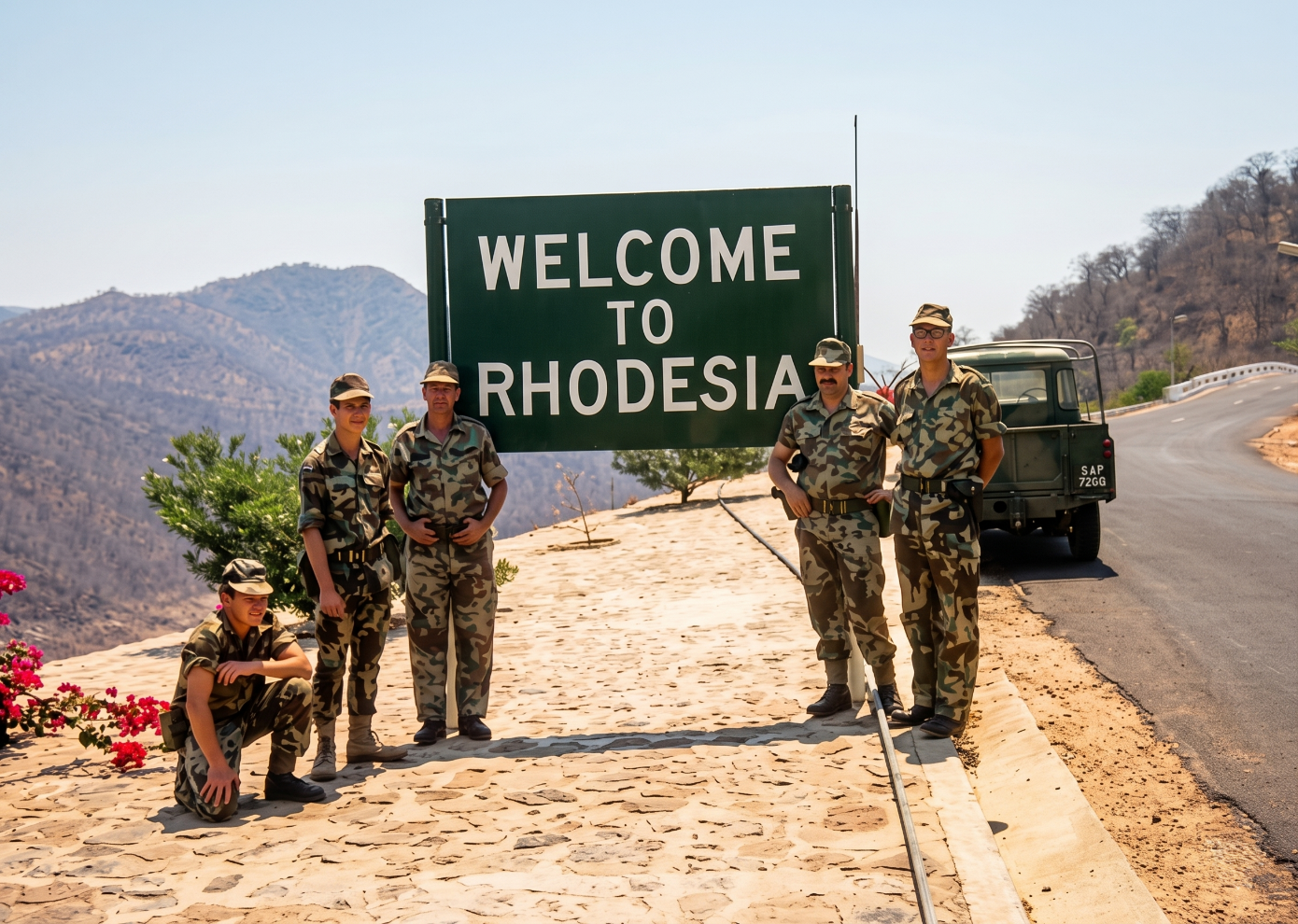
Members of the SAP pose at one of Rhodesia’s formal border crossings with Zambia,
either Victoria Falls or Chirundu. Note the SAP Land Rover behind them. Date unknown.
(Original image from Facebook)
In the 1960s and 1970s, when gangs of armed nationalist guerrillas entered Rhodesia to violently overthrow the minority white government in Salisbury (Harare), South African guerrillas also moved through Rhodesia to infiltrate South Africa.
In 1966, the Rhodesians established Joint Operations Centres (JOCs) in strategic towns in the northern operational areas. Served by senior representatives from the army, air force, BSAP and Special Branch, the unit was the command centre for operational activities of all uniformed services in a given area. Internal Affairs (Intaf) would also be represented at the JOC, which met every morning. An SAP representative usually attended JOC meetings.
In the latter half of 1967, a combined insurgency directly resulted in South Africa’s deployment of members of the South African Police (SAP) on to Rhodesia’s northern border with Zambia.
In August 1967 the Rhodesian Security Forces had their first real opportunity for combined military action. A force of 80 ZIPRA (Zimbabwe People’s Liberation Army) and South African National Congress (SAANC) guerrillas sought a southwards route through the Wankie Game Reserve. They had waded across the crocodile-infested Zambezi River upstream from the Victoria Falls and had thus evaded attention, although their presence in the nearby Livingstone area of Zambia had been reported over a period of several weeks.
In a series of engagements code-named “Operation Nickel” the Rhodesian forces had suffered 20 casualties (including 7 dead), killed 30 guerrillas and captured 20. Their commanders in the field reported that the guerrillas’ morale and standard of training was much higher than anything yet encountered in Rhodesia. The guerrillas had fought a military action face to face, with no civilians involved, and were defeated only by the security forces’ air power, mobility and much greater effectiveness in communications and medical services.
The significant outcome of this ZIPRA/SAANC incursion was that it brought South African forces into Rhodesia’s guerrilla war. Within hours of the exchange of intelligence between Rhodesia’s Central Intelligence Organisation (CIO) and South Africa concerning the SAANC presence, General Hendrik van den Bergh, Head of South Africa’s Bureau of State Security (BOSS), telephoned CIO head, Ken Flower, from Pretoria to say that he had arranged through the South African Prime Minister, John Vorster, for a detachment of South African “Riot Police” and helicopters to be sent to share in Rhodesia’s defence of her border with Zambia.
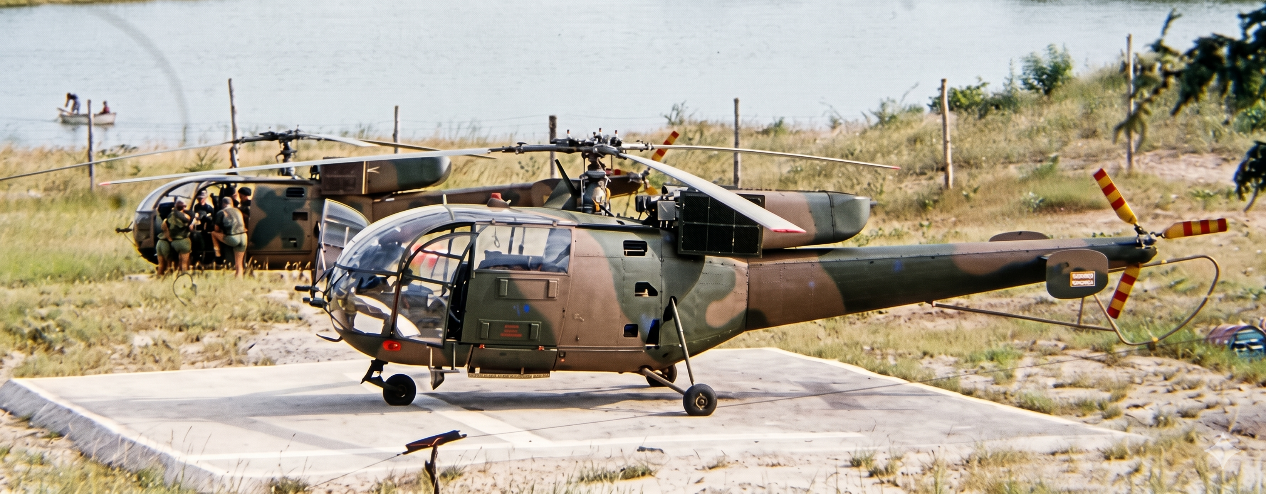
Alouette III helicopters in Rhodesia’s Operation Hurricane sector.
The one at the back with the green camouflage ‘X’ is identifiable as one of those from South Africa.
(Lewis Walter)
Flower reported this to Rhodesian Prime Minister Ian Smith who eagerly accepted the offer. When Flower saw the Rhodesian military commanders at a meeting of the country’s national Operations Coordinating Committee (OCC), however, they rejected the offer of South African aid as unnecessary. Flower returned to Smith to report this. He stated flatly that it was not for the commanders to query what he saw as a most promising political development, adding that he could understand South African Prime Minister John Vorster’s reasons for agreeing to “police” rather than “military” aid. Flower then advised the commanders that it would be better to comply, which they did.
South African aid, whether “police” or “military”, proved to be a mixed blessing politically and militarily. On the political front it gave Vorster the advantage because his offer had been unsolicited, and he later used this advantage when twisting Smith’s arm over settlement by threatening to withdraw South African contingents after they had become part of Rhodesia’s joint defence system.
Officially, records generally reveal that, for purposes of command and control, the SAP were dovetailed into the structure of Rhodesia’s national police force, the British South African Police (BSAP). However, the reality was that more often than not the respective intelligence and Special Branch organs of the two countries, CIO and BOSS, exercised influence and/or control. In the field, their were instances in which SAP unit commanders rejected Rhodesian command.*
(*Gerry van Tonder’s emphasis here and elsewhere in this paper in bold)
On the military front, initially the South African units were a liability. The “Riot Police” had received their training in an urban context and were thus totally inexperienced in the hazards of bush warfare; the Rhodesian forces had to operate as “long stop” to the South Africans in order to plug a gap in the overall defences. This was necessary despite the efforts of the South Africans’ outstanding Commander, Major-General Pat Dillon who, with his own vast experience in Africa, realised only too well that it would take some time to get his men trained and experienced in counter-insurgency.
Ultimately, the involvement of South African units in Rhodesia’s war was of more use to South Africa than Rhodesia in that South Africa used Rhodesia as a training ground, withdrawing units as they became trained and replacing them with untrained ones.
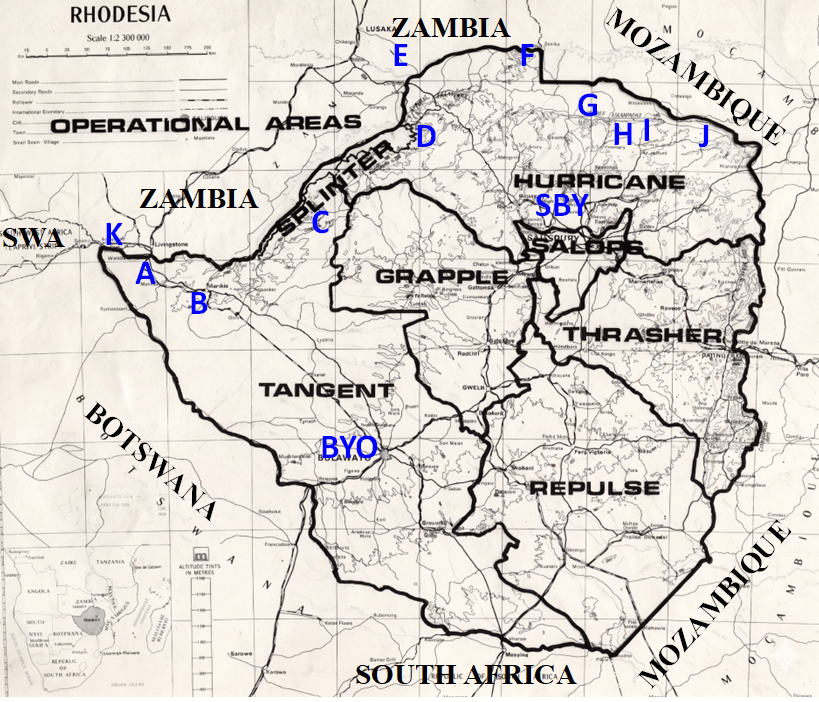
Rhodesia’s operational sectors during the counter-insurgency war 1969–1980, e.g. Operation Hurricane.
The map is annotated in blue with centres that had SAP bases from 1968–1975:
A – Victoria Falls; B – Wankie; C – Binga; D – Kariba; E – Chirundu; F – Kanyemba; G – Gutsa/Chiweshe;
H – Centenary; I – Mount Darwin; J – Rushinga/Rusambo; K – Kazangula.
SBY – Salisbury (Harare); BYO – Bulawayo.
The Dundee Courier (UK), 15 September 1967:
WRONG DIRECTION
The British Government have now received full details of the “intervention” by South African police in Rhodesia to deal with terrorists. It is forecast that the Government will protest to South Africa. They will claim that South Africa isn’t entitled to send police into a British territory without their permission. Legally correct, no doubt, but it is all very well to be fussy about such fine points in the safety of Whitehall, thousands of miles away from the terrorists.
It is a different story when Communist-trained and armed terrorists are on the doorstep intent on murder and violence. Why don’t the Government direct their protests to another quarter? The terrorists are operating from Zambia, They are trained in Tanzania, It is to Zambia and Tanzania and not South Africa that a protest should be sent.
The Belfast News-Letter (UK), 25 September 25, 1967:
BRITISH PROTEST REJECTED
Mr. John Vorster, the South African Prime Minister, publicly rejected, in effect, Britain’s protest against the dispatch of South African police to Rhodesia. He did not mention Britain specifically, but declared that the police, sent to Rhodesia to help combat African Nationalist guerrillas, would remain there as long as was necessary.
On 13 July 1968, 28 ZIPRA insurgents crossed into Rhodesia from Zambia near Lusitu, south of Chirundu. One of the gang got lost and handed himself in at BSAP Chirundu, where he divulged his gang’s crossing point. Under instructions from the BSAP an SAP patrol immediately responded. Also in the area were 3 Commando, Rhodesian Light Infantry (RLI) and E Company, Rhodesian African Rifles (RAR).
Around 10.30 a.m. on the morning of the 18th, in a gully 12 Troop, RLI, commanded by Second-Lieutenant Jerry Strong, came under heavy insurgent rifle, machine-gun and rocket fire. Overhead an armed helicopter provided cover to allow Strong to lead his men out the gully and up a ridge to link up with other RLI men. Here they were joined by the SAP patrol and an RAR platoon.
It is important to note that the SAP patrol, “after a short briefing by Strong. . . moved along the northern ridge, planning to descend into the gully and take the enemy from the eastern end”. (The Saints – see Sources) From this, it is clear that in a live combined combat situation such as this, SAP details involved came under the command and control of Rhodesian forces on the scene.
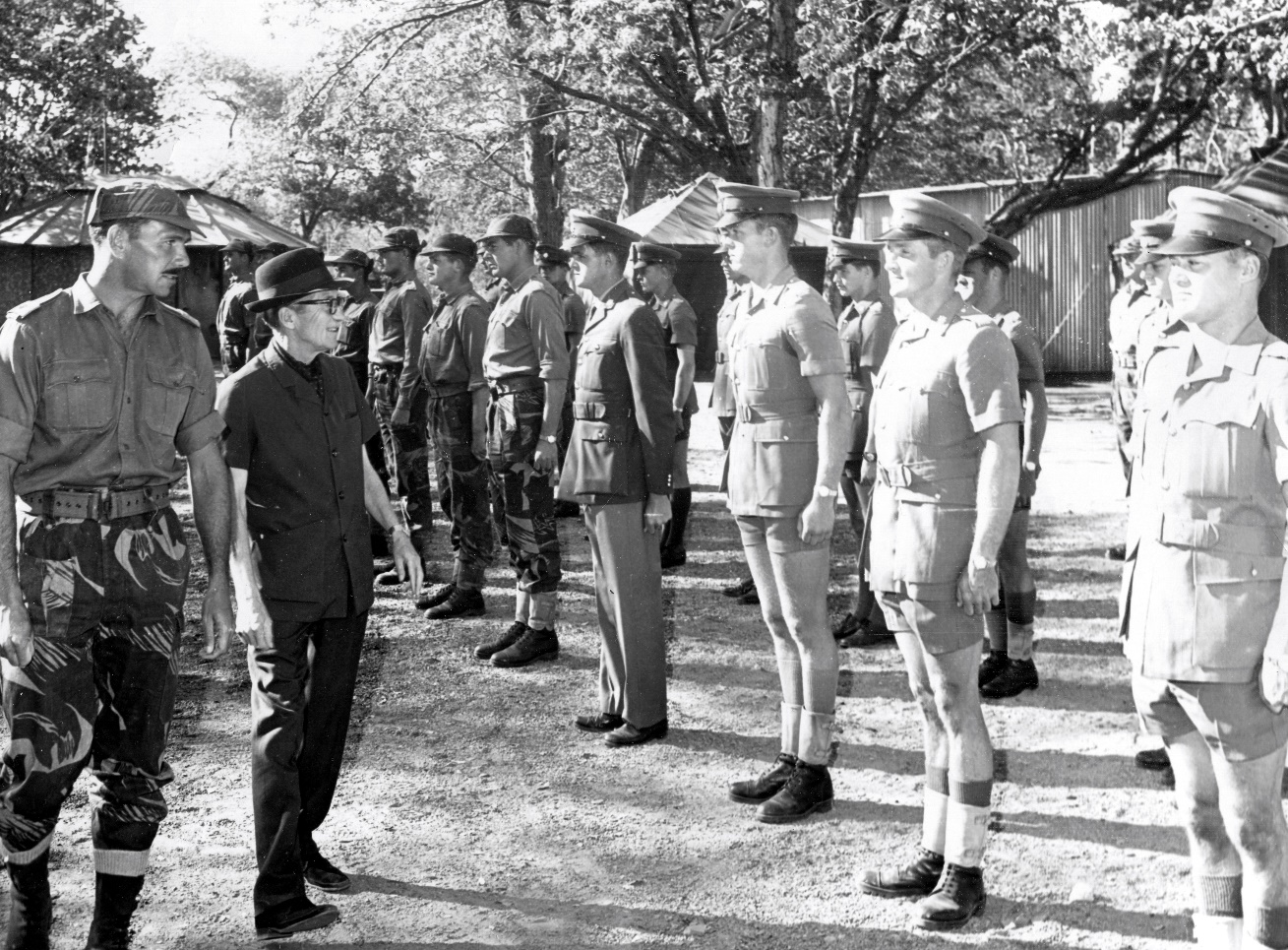
Rhodesian President Clifford Dupont, escorted by an SAP officer, inspects an SAP parade at an operational basecamp, c.1972. (Gerry van Tonder)
In the 1970s, what was essentially a second deployment of SAP men to Rhodesia took place. This contingent, according to various records, was attached to the BSAP. During the 1970s members of the South African Police were sent up to Rhodesia “to assist the BSAP and also to learn a little of operational conditions. Regrettably many of these young men were untrained”. (The History of the British South Africa Police – see Sources)
On 18 May 1973, further Rhodesian emergency legislation allowed for the compulsory collectivisation or consolidation of the populace of certain Tribal Trust Lands (TTLs), especially where it was felt that insurgent subversion had reached uncontrollable levels. By the end of the year, some 8,000 tribespeople had been moved away from their traditional homes near the border with Mozambique into government facilities in Gutsa in the Zambezi Valley. In April the following year, 200 tribespeople from Madziwa TTL were punished for assisting insurgents by being translocated to the opposite end of the country near Beitbridge.
In the 1950s, the conflict in Malaya saw the introduction by the British of such a programme, the Briggs Plan, which sought to deny Chinese guerrillas access to the peasant population by moving the latter into what were called “protective villages” (PVs). Local people were moved into secure villages guarded by armed personnel, who were also responsible for checking the PV inhabitants in and out at dusk and dawn. The objective, generally successfully achieved, was to deny the insurgents access to food, shelter and information.
The Rhodesian government, drawing on the British experience and knowledge of some of its own officers who had served in counter-insurgency operations in Asia, therefore decided to emulate the Malayan model by the introduction of collective and protected villages. It fell almost exclusively upon Internal Affairs and its agencies to implement, administer and defend the PV programme.
The then Minister of Internal Affairs (Intaf), Jack Mussett, in a parliamentary debate justified the programme as an “operational imperative”, designed to isolate local tribespeople from insurgent influence, while also cutting off the latter’s access to food and supplies. However, he did concede that the exercise would result in major social upheaval and a “traumatic experience” for those affected.
In the winter of 1974, the PV programme commenced in the hotbed of Chiweshe Tribal Trust Land (TTL), under the name Operation Overload. This was followed in Madziwa TTL, just to the east of Chiweshe, by Operation Stronghold.
In this groundbreaking operation, which would be emulated in large parts of Rhodesia in the coming years, a contingent of District Assistants (DAs) – civil servants armed with vintage 303 rifles – under a young white member of Intaf would be allocated to each of the 21 PVs in Chiweshe.
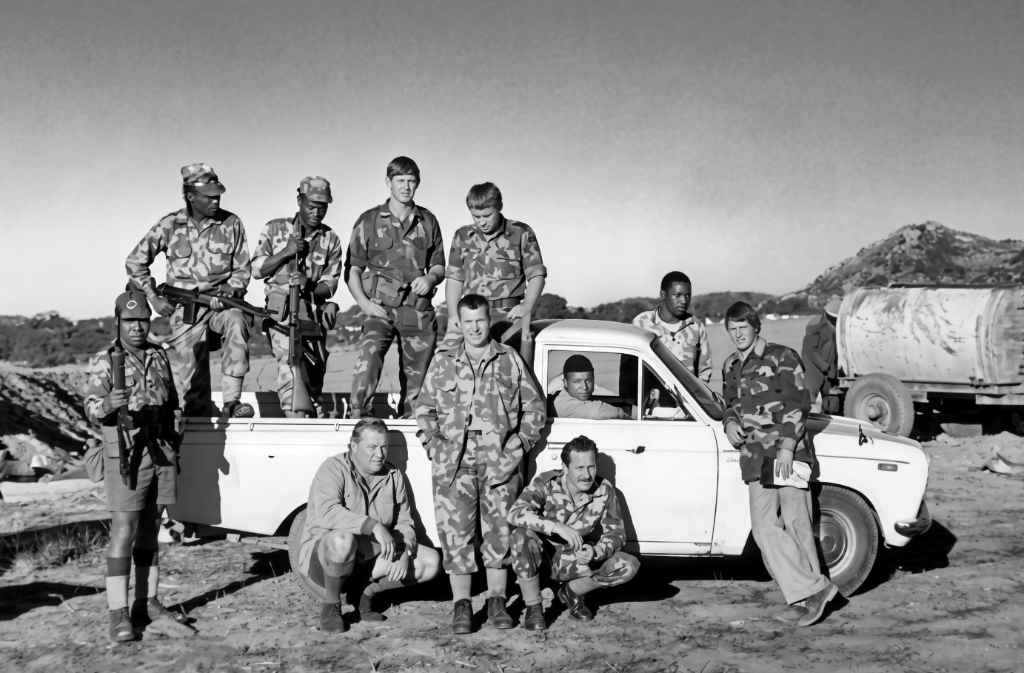
Black and white members of the SAP, part of the PV-programme contingent in Chiweshe in 1974.
In different and darker Rhodesian camo-pattern uniforms are two Rhodesian security forces members.
The bakkie belongs to the SAP. (Nick Baalbergen)
In addition, “a significant contingent of the South African Police (SAP) had been secured and was deployed specifically in support of the initial stages of the operation. Small detachments of Quebec Company, SAP, were posted strategically to PVs throughout Chiweshe”. (Operation Lighthouse, see Sources) Here, they would have fallen under Intaf command, vested with the District Commissioner of the area. They had their own vehicles and tents.
However, “Despite the clear limitations placed on the activities of the SAP [support role] in this operation, Constables Danie Willemse and Solani nevertheless regularly volunteered to accompany Intaf personnel on patrols”. (Operation Lighthouse)
With Vorster’s “detente” initiative in the region from 1974 and increasing pressure from US Secretary of State, Henry Kissinger, the relationship between Rhodesian Prime Minister Ian Smith and his South African counterpart, John Vorster, broke down irreparably at their meeting in Cape Town on 16 February 1975.
South Africa now started pressurising Rhodesia by withholding material aid and hinting at the withdrawal of the SAP, whose morale had suffered through a tragic incident during the ceasefire coinciding with the release of African nationalist leaders in November 1974.
On 23 December six SAP men were stopped on the Mazowe River bridge by apparently peaceful ZANLA whom they presumed to be observing the truce. On request the SAP men put down their arms – and four were promptly murdered in cold blood. Then, to conform with the idea of detente, and to prepare for the Victoria Falls Conference, the withdrawal of the SAP was agreed in principle.
It was shortly translated into action through a bizarre incident in which a Constable Kriel, stationed in the Mount Darwin area, had grabbed a black baby from its mother’s back and slit its throat in what appeared to be a momentary aberration.
The local BSAP (British South Africa Police, Rhodesia’s national police force) arrested Kriel, and they were preparing to prosecute him under Rhodesian law when the Deputy Minister of the SAP, Jimmy Kruger, took Flower to task for the alleged breach of faith between friendly police forces. Kruger appealed to Flower while he was visiting Cape Town to use his influence to arrange for Kriel to be sent back to South Africa. Flower argued that the Rhodesian authorities must go through the formalities of judicial enquiry because the killing was so blatant and had come to public notice. Kruger countered by saying Kriel had a history of mental illness, to which Flower replied by asking why was he therefore serving in the police.
Kruger accused the Rhodesians of never having understood South Africans, adding that they were in Rhodesia trying to help them, yet this was what they were doing to one of their men. He said it was Leander Starr Jameson and the BSAP who started the Boer War with the Jameson Raid, but President Paul Kruger was magnanimity itself in handing back Jameson “to do with as you would.”
South African History Online, 21 March 2011
With respect to Rhodesia, the South African House of Assembly passed the Defence Amendment Bill in March 1973 making it possible for South African forces to be seconded to the Rhodesian forces without loss of seniority or pay.
Truth and Reconciliation Commission Final Report, Vol. 2, Chap. 1, Subsec. 6
From the mid-1960s, the government undertook or authorised a number of defensive and pre-emptive operations outside of South Africa’s borders. The first of these was the establishment of an SAP security police camp in the Caprivi Strip in northern South West Africa in March 1965, under the guise of an engineering company. The camp was under the command of former sabotage squad member, Major Theunis ‘Rooi Rus’ Swanepoel. The role of the camp was to monitor SWAPO activity. Sixteen months later, SAP units were deployed to the area in response to SWAPO’s decision to move its trained cadres into South West Africa. On 26 August 1966, SAP forces attacked SWAPO’s first military base inside South West Africa at Ongulumbashe, marking the beginning of South Africa’s armed intervention in the region.
The first armed campaigns launched by a foreign-based South African liberation movement were the Wankie and Sipolilo [towns in Rhodesia] campaigns of 1967 and 1968 [Rhodesian Operations Nickel and Griffin respectively]. According to the ANC’s second submission to the Commission, its Rhodesian campaigns were launched with the aim of “infiltrating trained MK [uMkhonto weSizwe, paramilitary wing of the SAANC] operatives into South Africa in line with the concept of rural-based guerrilla warfare”. The idea was that MK soldiers would thus create a “corridor” along which to infiltrate guerrillas into South Africa. The campaigns were not a military success and resulted in the death and capture of a number of MK combatants.
In response to this development, SAP units were sent to Rhodesia in September 1967 to assist Rhodesian forces fighting ZIPRA (ZAPU) and MK guerrillas in the north west of the country. In the SANDF’s first submission on the SADF, it was explained that the SAP units were dispatched to Rhodesia “to fight against men who originally came from South Africa and were on their way back to commit terrorism in South Africa”. By 1975, when the police contingent was withdrawn, 2,000 South African policemen were involved in combat operations inside Rhodesia.
Police and Military Counter-Insurgency Operations in Pre-Independence Rhodesia
(Truth and Reconciliation Commission, Vol. 2, Chap. 2)
From the time of the unilateral declaration of independence in Rhodesia in November 1965, the security situation in that country was a major concern of the South African government. With the launch of joint ANC/ZAPU military operations in areas of north-west Rhodesia in August 1967, South African police units were deployed inside Rhodesia where they stayed for the next eight years. As a gesture of support for the 1975 Kissinger diplomatic initiative over Rhodesia, South Africa withdrew its police units but left behind all its equipment, which included helicopters, Dakotas, small arms and ammunition. In addition, the South African government met the costs of 50 per cent of the Rhodesian defence budget for 1975–76. This was followed by [South African] Operation Polo, a secret agreement in terms of which the SADF assisted in the construction of five new military airfields in Rhodesia.
By 1978 the SADF was supplying sophisticated Mirage III fighters and Impala strike planes, as well as Alouette and ‘Huey’ helicopters. It was also secretly deploying troops into southern Rhodesia from bases inside South Africa and sending conscripts to Rhodesia to fight in local uniforms as ‘members’ of Rhodesian army units.
Colonel Craig Williamson told the Commission (3 February 1998) that the South African Security Branch also funded out of its secret account the police counterinsurgency unit, the Selous Scouts [they were not police but special forces], in which numerous SAP members also served.
SAP Special Task Force
In 1967, about 2,000 members of the South African Police were deployed to guard the northern border of Rhodesia (modern day Zimbabwe) to assist the Rhodesian security forces as guerrilla attacks became more frequent during the Rhodesian Bush War. These police members proved to be ill-equipped and ineffective at dealing with guerrilla warfare and terrorism. As a result of these events the Security Branch of the Police began to envision a special police unit to deal with high-risk situations such as hostage situations. Captain J.J. de Swardt of the Security Branch of the Police as well as Sergeant Roelf de Plooy (a counter insurgency (COIN) instructor), both veterans of the deployments in Rhodesia against Zimbabwe African National Union rebels, began a grass roots attempt to form a group of police representatives with a shared vision of formalising a police-based special forces unit. They began to train candidate police officers in survival and bush skills to execute high-risk COIN operations and drastically reduce friendly fatalities.
The members of this ragtag group were required to join the South African Police shooting club in order to acquire R1 battle rifles. Camouflage uniforms were also unofficially acquired. Because this group, who had taken on the name of ‘Bliksems’, was an unofficial group within the Police Force, the normal training facilities were not accessible.
Daily Mirror, 2 August 1975
VORSTER’S MEN QUIT RHODESIA
South Africa is leaving Rhodesian Premier Ian Smith to fight his own battles. Police Minister James Kruger said in Pretoria yesterday that South African police still in Rhodesia were being withdrawn. He added that only 200 were left from the original force of about 2,000. The South African police have been fighting alongside Rhodesian troops against African guerillas since 1972. Eighteen of them have been killed. Premier John Vorster’s regime maintained its men were only in Rhodesia to stop guerillas infiltrating into South Africa. The South Africans now believe that the continued pressure of the police is a stumbling block to the negotiations for a Rhodesian settlement.
CIA [Central Intelligence Agency, USA] Bulletin, 28 August 1973:
A transfer of 800 south African police to Rhodesia in July substantially increases the forces that Pretoria has committed to Rhodesia’s counterinsurgency efforts [redacted]. . . some 1,400 South African special paramilitary police are now serving in Rhodesia.
The transfer of the reinforcements apparently is intended to back up Rhodesia’s counterinsurgency efforts while avoiding open military aid to the breakaway Smith regime that would intensify international pressures against South Africa as well as Rhodesia. Pretoria has long acknowledged that some 250 South African police have been stationed in Rhodesia since 1967 to prevent South African militants who go abroad for subversive training from infiltrating back home via Rhodesia. A quiet build-up of South African police in Rhodesia could go far to offset the shortage of white reservists available for extended duty in the Rhodesian security forces. The. presence of additional South African police probably has enabled the Rhodesians to search out insurgents across the border in Mozambique. There have been indications that Rhodesian units have been operating there regularly for the past few weeks presumably with Portuguese acquiescence.
National Intelligence Bulletin, CIA, 4 January 1975:
On December 24 [23 December 1974], four members of the large South African police contingent serving in Rhodesia were killed while attempting to arrange a cease-fire with a small guerrilla band. A spokesman for the African National Council, which since early December has included the three Rhodesian insurgent organizations, expressed regrets, explaining that cease-fire orders had not yet reached some of the more isolated guerrilla units. Official South African commentary on the killings has been so restrained as to discourage smith from any retaliatory measures that might further disrupt the truce.
National Intelligence Bulletin, CIA, 17 March 1975:
Vorster’s envoys told Smith last January that the South African police who have supported Rhodesian counterinsurgency operations would be gradually withdrawn, regardless of Smith’s claim that they were still needed to counter truce violations. By early March, the South African police in Rhodesia reportedly had been reduced from some 1,600 to 700. Vorster, however, has not yet publicly revised his earlier statements that the police would remain until terrorism ceased, although Pretoria announced last week that they were confined to barracks.
National Intelligence Bulletin, CIA, 6 August 1975:
The South African government’s public acknowledgement on August 1 that all its police forces in Rhodesia are being withdrawn seems intended to underscore Prime Minister Vorster’s impatience with Rhodesian Prime Minister lan Smith’s refusal to begin settlement negotiations with the black Rhodesian nationalists.
South African police had participated actively in Rhodesian counterinsurgency operations until last December, when a truce with black insurgents was arranged by Prime Minister Vorster and four black African presidents. Rhodesian whites are outnumbered by more than 20 to 1, and the shortage of white manpower limits further expansion of the security forces.
Without the South African police, the Rhodesian security forces will be hard pressed if the black nationalists carry out their threat to resume guerrilla warfare unless Smith agrees by October to a settlement conference. The black nationalists insist that the conference take place outside Rhodesia, because several of their exiled leaders might be arrested if they returned there.
Vorster apparently has now come to believe that leaving even a small police contingent in Rhodesia has encouraged Smith to evade meaningful negotiations with the black nationalists.
In their book A Brutal State of Affairs – The Rise & Fall of Rhodesia (see Sources), Ellert and Anderson describe the objectives of the SAP based along the Zambezi River border was to “prevent infiltrations from Zambia.” The first contingent, deployed in September 1967 and commanded by Major van Eck, were based at the Chirundu border where the Otto Beit Bridge straddles the Zambezi River into Zambia.
To mask their true identity the South Africans wore Rhodesian camouflage, especially when in public places, and adopted Rhodesian camouflage livery for their own vehicles. However, Afrikaans, the mother tongue of the majority of the SAP details in Rhodesia, made it near impossible for them to conceal where they were from. Many struggled to even speak English.
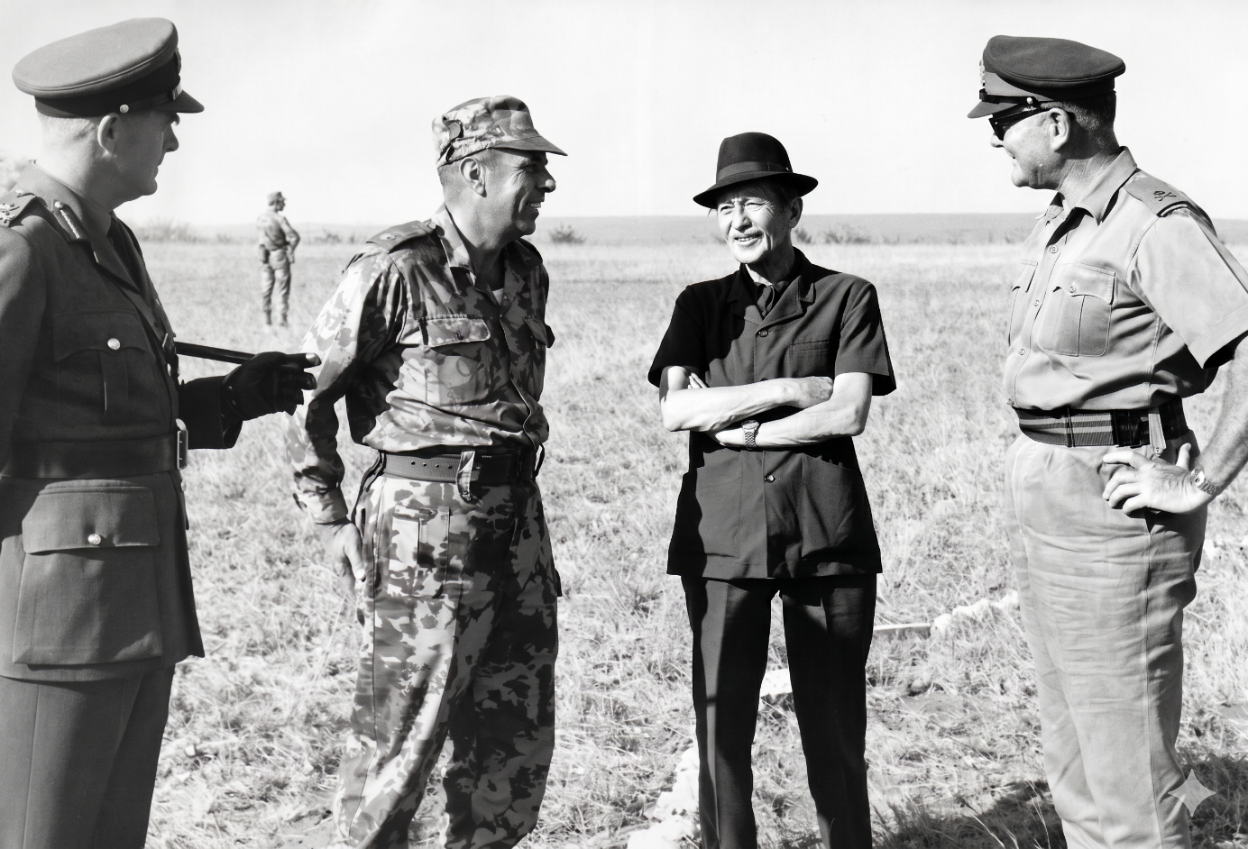
President Dupont visits SAP in a Rhodesian operational sector, c.1972.
L–R: Commissioner of Police Syd Bristow, BSAP; an SAP major; Rhodesian President Clifford Dupont; Lieutenant-General Keith Coster, Commander of the Rhodesian Army.
(Gerry van Tonder)
Sadly, in a short space of time reports of undesirable behaviour by SAP details in Chirundu and Kariba arrived on the senior desks of BSAP General Headquarters in Salisbury. Game, including rhino, was being poached and Rhodesian National Parks and Wildlife Management Department camps vandalised.
When visiting SAP camps, members of the BSAP and Rhodesian Army “found the atmosphere close to that of a holiday camp”. (Ellert and Anderson) At F Camp, a state safari and hunting area in the Zambezi Valley, SAP found that swinging by a rope from a tree branch before dropping into the crocodile-infested Zambezi excellent recreation. In camp the wearing of only underwear and sandals while lounging on canvas stretchers was the order of the day in the oppressive heat.
The areas in which the SAP operated were either very sparsely inhabited by indigenous tribesmen, or state land set aside for wildlife. As a consequence, mind-numbing boredom quickly set in after their arrival from urban stations in South Africa. Their lack of pre-deployment training at home resulted in a lack of military discipline creeping in during their three-month tour of duty, and first-light tracking patrols became random and infrequent and potentially hostile environmental factors were ignored. However, in South Africa greater importance was attached to the experience that the SAP would gain and apply in the defence of their own country. Training, therefore, improved as time went by.
From 1968 on, a bond of mutual cooperation developed between the Rhodesian Special Branch, BSAP, and the South African Security Branch, SAP. Reciprocal clandestine operations in neighbouring countries benefitted both parties.
Throughout 1969, the number of SAP contingents in Rhodesia continued to rise, with dispositions to Kazungula on the Zambia, South West Africa (Caprivi), Botswana border and to Kanyemba, an isolated spot on the Zambezi in the extreme north of Rhodesia.
Inevitably, as greater numbers of Afrikaans-speaking South African policemen came into contact with Rhodesia’s English culture and encountered vastly more experienced guerrilla-warfare Rhodesian troops, in some units the latter developed a strong disdain for the SAP men. “Slopes” and “rocks” became common monikers introduced by them for the South Africans, including by the many Afrikaans-speaking white Rhodesians. The word “slope” was a direct derogatory reference to the sloping forehead of perceived inept Neanderthal man.
Eventually, to restore harmonious relationships between the two country’s forces, the SAP started sending officers that were proficient in the English language. An early officer to “qualify” was Captain “Gruppy” van Tonder from the SAP’s Cape Town Security Branch, whose presence went a long way to rebuilding cultural bridges (Ellert and Anderson). Another who stood out was English-speaking Detective Sergeant Chris Know from Natal, who brought with him considerable experience gained from his time stationed at Rundu, South West Africa, on the Angolan border. (Ellert and Anderson)
Firsthand Accounts
“SA Police in Rhodesian bush war: Gruesome discovery”, Nongqai, 16 January 2024
(By Rhodesian Army Officer, Major Don Price. Kind permission Hennie Heymans)
One of my first deployments at Kariba at the beginning of October 1974 was when Pete Clemence, Stretch Franklin, Hennie Pretorius and I reacted to an attack on some South African policemen deployed in the Zambezi River Valley in the vicinity of ‘C’ Camp downstream from Chirundu. It was still dark when I was summonsed to the Signals Office of 2 (Indep.) Coy. It had sounded urgent so I ran the short distance down the hill from Tracking Wing to find out what the problem was. Major Harry Harvey was waiting to brief me.
“Don, I want you to quickly assemble a tracker team for deployment into the Zambezi Valley. As you know, the SAP lads are deployed down there but the Coy HQ based at Chirundu is unable to make contact with one of its call-signs out on patrol along the river. There have been reports from local fishermen of heavy small-arms fire coming from their general direction so I want you to check it out. A Cyclone 7 (G-car) [No. 7 Squadron, Rhodesian Air Force, Alouette III helicopter] will be up here from FAF 2 [Forward Air Field] in approximately thirty minutes to fetch you guys, so you don’t have much time.”
After giving orders to Rob Johnstone, my WO 2 [Warrant Officer Class II) and 2-i-C, I left him with Pete to continue with the running of the current tracking course and jogged down to the single quarters at the barracks where I briefed Pete, Andre, Stretch and Hennie. We were all ready to go almost immediately. The promised chopper arrived soon after and we emplaned in the parking lot on top of the hill.
Soon we were thundering out of the Army Camp, dropping into the Zambezi River gorge and flying at breakneck speed low level, right on top of the trees. It was not long before the Chirundu Bridge came into view with the SAP Company base clearly visible on top of a small hill.
We crossed the main tar road from Salisbury to Lusaka with the bridge to our left, then we swooped down over the river and on we sped at low level. When we reached the approximate area, the pilot pulled up and as we began a wide orbit, I signalled the lads to look out for the SAP on the ground.
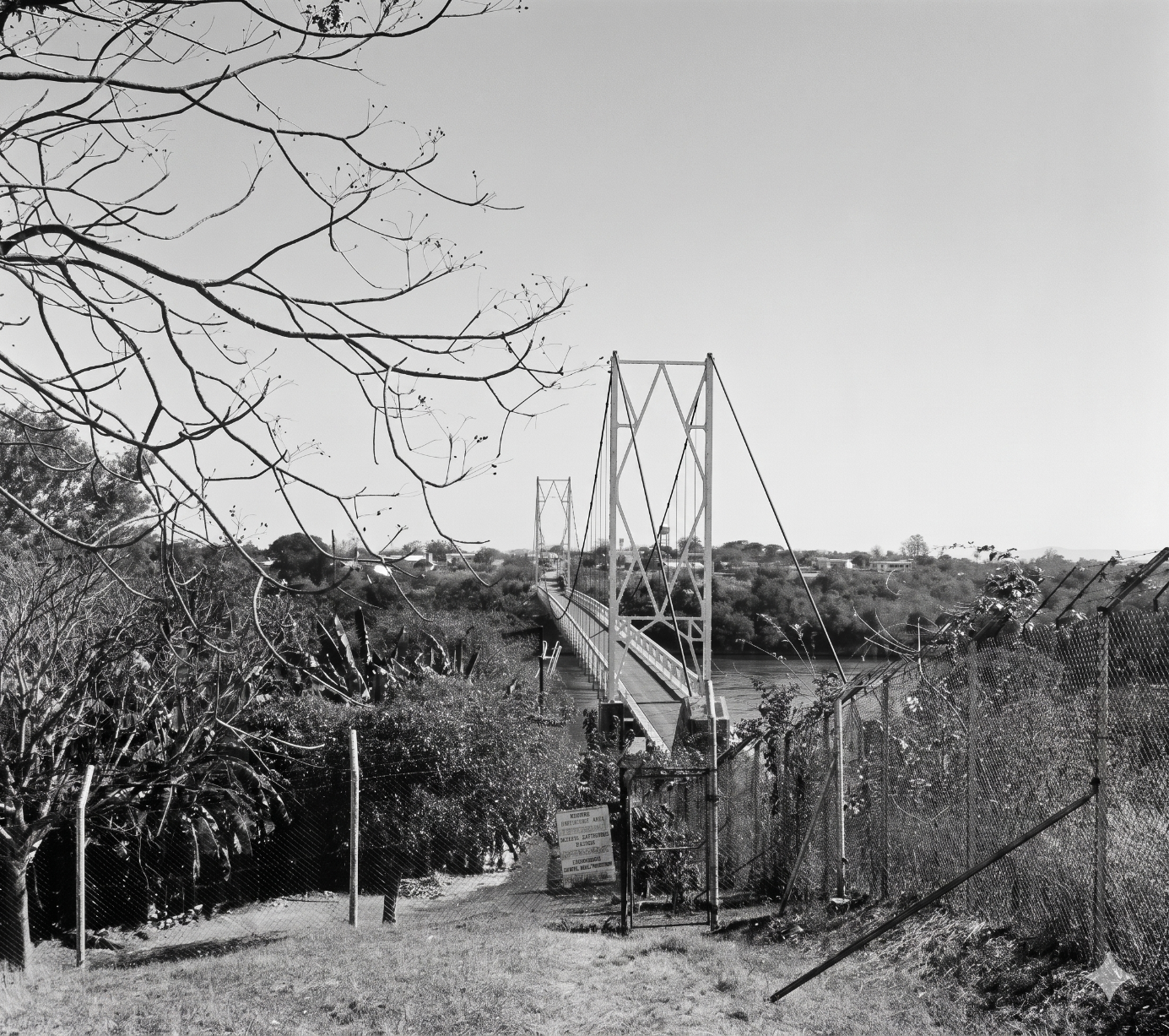
The Otto Beit Bridge spanning the Zambezi River at Chirundu links Zimbabwe with Zambia.
The photo was taken from the BSAP camp. (Gerry van Tonder)
Suddenly the tech yelled, “Over there!” and pointed back towards the Zambezi. “See that burnt out area?” The pilot banked sharply and the blades beat the air making a thudding noise. On high alert now, we scrutinised the bush below which was predominantly mopani woodland with the occasional baobab tree. Sure enough, we could make out a charred area about 100 metres back from the Zambezi River bank.
As we circled the pilot tried to raise the [SAP] call-sign on the ground. Suddenly Andre shouted to me, “Ishe!” [Sir!] and pointed downwards out of the open helicopter towards the burnt area.
I strained my eyes and then, there in amongst the burnt vegetation, I could make out what appeared to be charred and burning bodies. Before landing we circled once again just to make sure the area in close proximity was clear of the enemy.
The chopper flared, and with its nose up we settled in a small clearing, clouds of black dust billowing around us, an aftermath of the fire. Immediately the pilot’s head dropped and he nodded vigorously which was our signal to deplane. We hit the ground running and, with weapons cocked, positioned ourselves a short way from the aircraft all facing outwards in a 360 [degrees]. The chopper then lifted and headed off north to gain altitude and cover the river for us.
The scene that awaited us was not pleasant. We could clearly see where the SAP contingent had bedded down around a small camp fire. They must have taken their clothes off, as naked half-burned bodies twisted in grotesque forms dotted the area and in some cases the brown issue nylon sleeping bags had melted and stuck to their remains. These there were all dead and there appeared to be no survivors.
We scouted the area and picked up where the group, numbering possibly six terrs [terrorists, insurgents] had beached their rubber dinghy a short distance away and approached the sleeping SAP patrol. It was obvious from the empty 7.62mm intermediate cartridge cases found around the bodies that the terrorists had opened up on the SAP men from close range. There was no evidence that any fire had been returned. Their kit and equipment had been looted by the enemy who had got away with weapons, webbing, backpacks and possibly even radios. Items deemed non-essential littered the surrounding area.
I radioed our findings back to the chopper orbiting above. I was contemplating our next move when, pointing northwards Hennie Pretorius called, “Ishe, looks like two SAP men have gapped it [ran] into the bush.” We joined Hennie and sure enough, even though the ground was stony and far from ideal for tracking, we could make out scramble marks, foot prints, with toes splayed, strides wide apart, confirmation that two men had escaped running from the carnage of the surprise attack.
“Okay guys, here’s the plan. I will call for pick-up while you three attempt to track and follow the SAP. It’s imperative you locate them, as by now they must be completely lost and desperate. I’ll help the tech load the bodily remains and we’ll get them back to Chirundu where I’ll refuel and return asap.”
Flying due north on the last known direction as we returned a few hours later it was not long before the chopper radio crackled to life and I received a sitrep [situation report] from Andre. The night of the attack had been extremely dark with no moon and apparently the two surviving SAP had run astride of each other about twenty metres apart. My guys had followed the tracks for about ten kilometres to a point where the two men had become separated.
We soon located the follow-up group from the air and searched ahead in the general direction the SAP must have run. Suddenly the radio burst back to life: “Chopper, chopper. . . kom in, kom in!” [‘come in, come in!’ in Afrikaans] came the frantic shout. “Chopper! Jy moet land!” [‘You must land’]. Amazing they had a radio!
We continued to circle and finally the chopper tech spotted a naked figure huddled next to a tree. We landed and the poor guy was a sight to behold. His body was all scratched up from running through thorn bushes, his bare feet a complete mess, bloody and so swollen that he could hardly hobble to the chopper. The poor guy was extremely traumatized. When the tech covered his shoulders with a red emergency blanket we noticed how badly sunburned he was. His back was one big blister, whilst his neck, arms and torso were crimson and burning hot. He was so dehydrated he couldn’t speak.
It took three more hours for tracker Team Tango to locate the second policeman, who was in a similar state to his mate. The chopper flew the two casevacs [casualty evacuations] to Chirundu whilst we found some shade under a pod mahogany tree and waited for our ride to return. Apparently members of this SAP patrol had been told not to show themselves on the river but they had disobeyed this order and paid the price. The ZIPRA [Zimbabwe People’s Liberation Army] terrorists had watched them from the Zambian side and then when the time was right, crossed over in their rubber raft, walked a short distance and killed them while they slept.
Initially the SAP training was not adequate for the task and the men sent on border duty did not really know what they were getting themselves into. These were city policemen, who had probably never been in the wilds before (fortunately, their training improved as the Rhodesia bush war progressed). Tracking Wing assisted the SAP as trackers on many more incidents in the Zambezi Valley, but thankfully none of the call-outs were ever as bad as finding that lost patrol.
In summing up, it is assumed that in the early hours of Tuesday, 1 October 1974, a ZIPRA gang crossed the Zambezi River 30 kilometres east of Chirundu and staged a hit and run attack on the sleeping South African Police patrol. Their grenades killed two policemen, Constables L.J. Buys and M. Erasmus, and seriously wounded two others as well as setting the area ablaze and charring the bodies. The patrol had not posted sentries. The gang had then crossed back to Zambia.
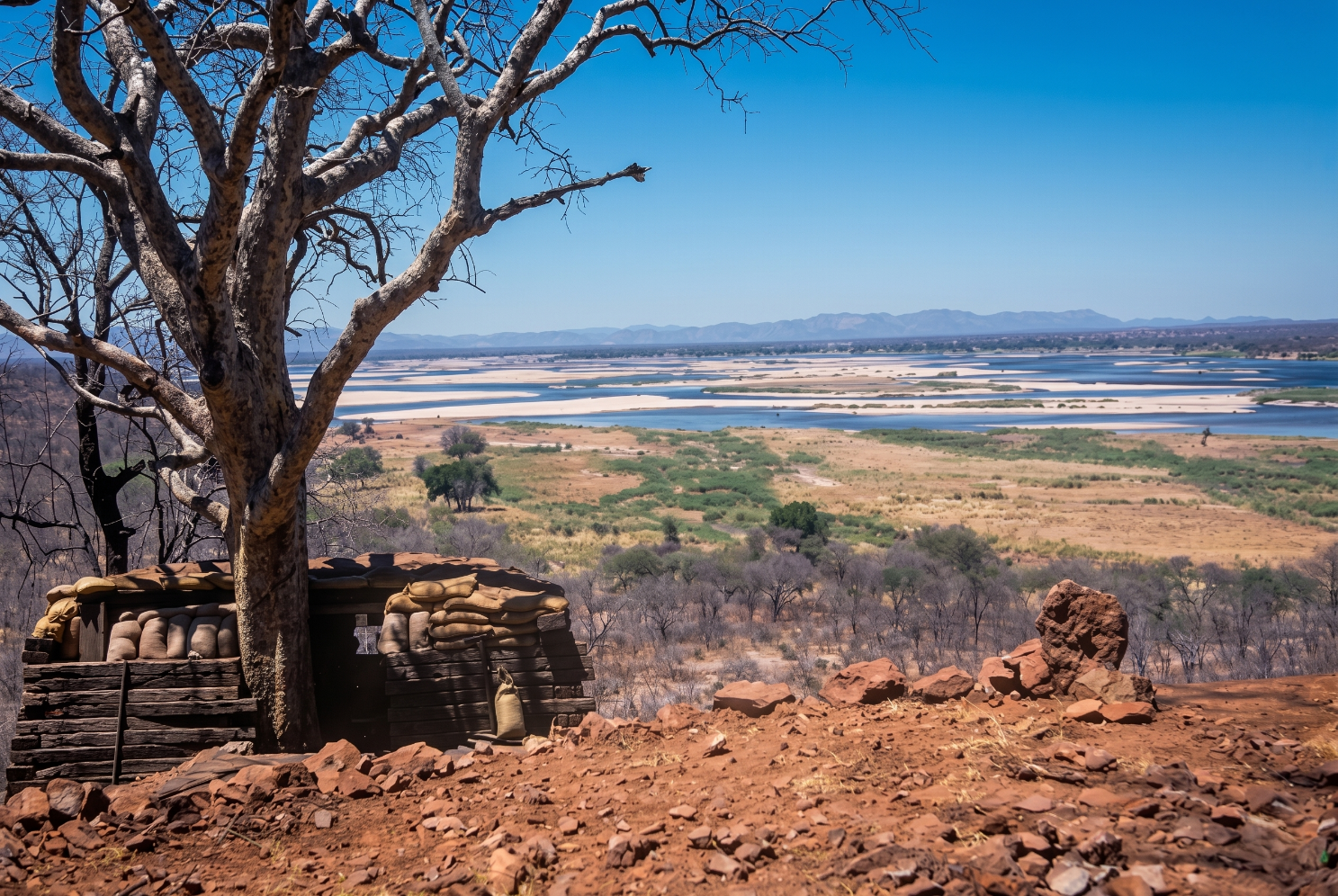
An SAP camp bunker overlooking the Zambezi River floodplain. (Facebook)
Former BSAP member Dave Soper
I was involved with the SAP to a limited extent in 1974. I would think that if they were not under the actual control of the BSAP, then their liaison with the BSAP members would have been very close.
When those four SAP men (and one Support Unit member) were killed by ZANLA man Herbert Shungu and his CT group on the Mazoe Bridge in Rushinga district [23 December 1974], I was deployed to that bridge not long after the deaths of these men. I was a PATU [Police Anti-Terrorist Unit, BSAP] Section Leader, with a Black Group Section deployed out of Bulawayo.
The bodies had been removed by the time I got there, but the fact that I was deployed to the bridge would indicate some degree of cooperation and interaction with the SAP. I cannot now remember the exact reason that I was deployed to the bridge, it may have been possible body recovery for the Support Unit man [Constable Mutasa Mandaza, whose body was never recovered].
I believe that the SAP were either from the same basecamp as we were operating out of (I cannot remember the name of the basecamp), or their camp was very close to ours. I was not familiar with any of the Mashonaland Province bases, I was a Matabeleland Province oke [man].
Following on from the deaths of these five men, I was deployed into the field with an SAP section attached to me and my section. They were under my command, something which they were not particularly happy about. I was a pretty young PATU section leader, so they were probably completely justified in that. Some of the SAP men were probably senior in service to me. This would tend to indicate that they were under overall BSAP control.
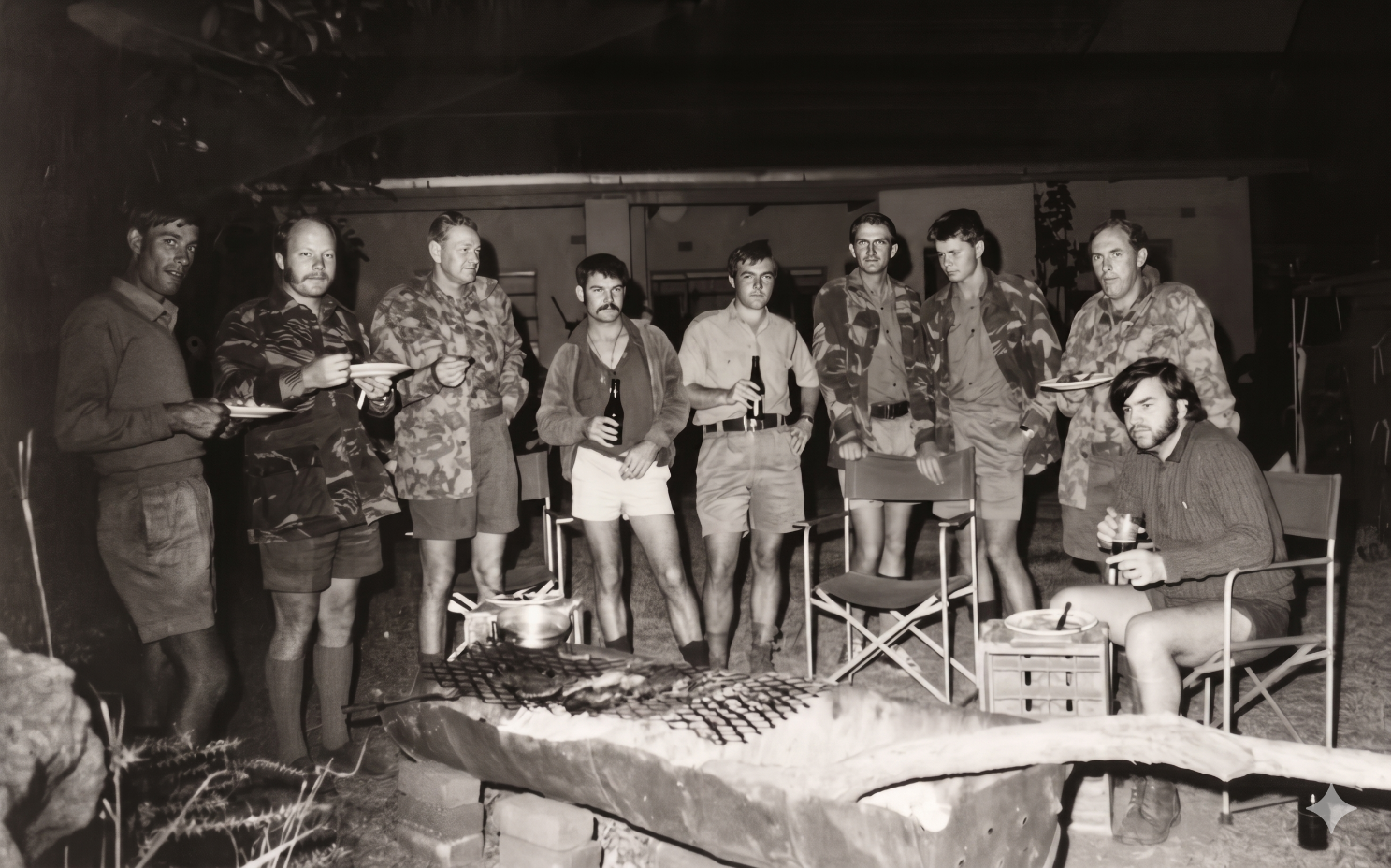
Members of the BSAP and SAP enjoy a braai together at the Rusambo/Rushinga camp.
Two of the SAP details, 3rd and 8th left, latter are wearing combat jackets in the distinct South African camouflage pattern.
(Gerry van Tonder)
During this deployment we walked straight into a well-sited ZANLA ambush, one black civilian walking at my side was shot in the contact. When the firing started the SAP section took off into the bush away from the contact area and took cover in an area some distance from us. When the ZANLA group departed they dropped either some mortars or some RPGs [rockets] towards our position which went over us and landed amongst, or close to, the SAP men. When the firing had stopped the SAP section returned to my location. They then said to me that they were not going to engage in any further patrolling duties. These SAP men had lost a number of their comrades a short while before this, and they were not operating in their own country, so SAP morale was at an all time low.
I then had to communicate their refusal to continue patrolling to whoever was in charge of our basecamp, who would have been a senior BSAP member. We were then allocated to different gomos [kopjes] to get onto, and all of us, SAP and BSAP were put onto OPs [observation points]. We were all on the same BSAP radio channel.
During this time on the OPs there were several SAP callsigns also on OPs, and they communicated their distaste of their situation in conversation over the radios. They were on our BSAP channel. A command was issued that these conversations were to cease, but that did not happen – they continued but without any callsigns being used.
All of what I have written of here would indicate that these SAP men and their deployments were controlled by members of the BSAP. I would think that their logistics (rations, etc) in their base were handled by themselves. I did mention on one of the military groups that one of the main manne for the SAP at this time was a gentleman by the name of de la Rosa (spelling?), so I must have learned his name around the basecamp during this period, so we must have been together or close.
In 1975 I was based at Binga and there was quite a strong SAP presence there. They did have close comms with the BSAP there, but I do not believe that they were under BSAP control. They did liaise closely with BSAP though at this time. I believe that these SAP men were on some kind of radio monitoring operations at this time*. They did have some operational bases in the Binga area, and those would have been operated solely by them.
(*see ‘South African Radio Traffic Interception in Rhodesia’ below)
Former SAP Bert van der Vlugt
When I was deployed doing “Teams”, duty round 74 we had SAP dog handlers operating from our base camp at Rushinga. Rushinga and Rusambo fell under JOC Mt. Darwin at the time. I hit my first land mine sitting on the back of a RL truck travelling between Mt. Darwin and Rusambo.
Former SAP Leon Strauss
1975, we were withdrawn to Centenary East airfield. There were 5 companies there; this was the time a group of SAP troops were stopped and disarmed and then were shot on a bridge on the Ruya/Mazoe river (cant remember, which, sorry, old age), supposed to be a ceasefire in effect, but cowardly terrorists took this opportunity to murder. I was in Bravo Company, we were mightily pissed off, and returned home shortly after. I did 2 tours in Rhodesia, 73/74 and 74/75, 3 months and six months, Juliet Coy at Rushinga and Centenary, Centenary east, 6 months.
South African Mbulelo Baloyi
In the 70s and 80s South African Police would do what was called “Border Duties” and my elder brother often did this when they would do periodical call ups as serving SAP station based members and would be clad in the camouflage uniform now solely used by the SAPS Special Task Force. These so-called Border Duties were nothing but counter insurgency activities against combatants of the liberation movements to stop them from infiltrating into SA.
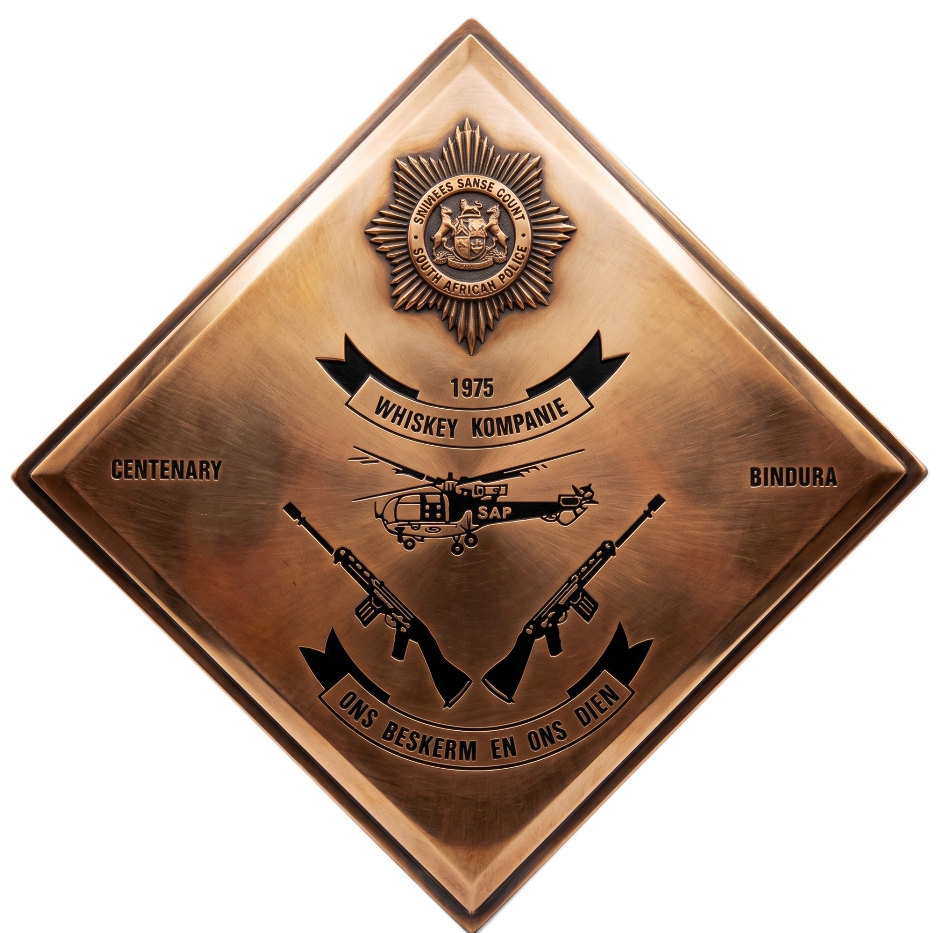
Whiskey Company, SAP, 1975 commemorative plaque of service at Centenary and Bindura, Rhodesia.
Former SAP Al Kennedy
I was SAP Special Branch Mtepatepa, JOC Bindura.
Worked with BSAP SB [Special Branch] Harry Naismith and BSAP GC [Ground Cover] Denbigh Hopkins.
Former SAP Greg Deegan
I was told by a senior BSAP official that we were merely cannon fodder. That jarred, because we lost friends and colleagues in the conflict.
I also acknowledge that there were fools and bad eggs among the SAP contingents. As there were among the Rhodesian forces. As one is apt to find anywhere.
An interesting fact is that about 5000 SAP members served in Rhodesia. Initially, the system was that each Division was told to send a certain number of members for duties every three months. This filtered down to districts and stations. So, who would station commanders send? Not their best workers, of course. So the SAP contingents would be made up of a lot of station rejects. And the good guys amongst them knew that! Even the top brass was aware of this fact, so in 1972 the system was changed to a volunteer system only, on a six or twelve month basis. The quality of members going to Rhodesia greatly improved because the men who went there wanted to be there!
Former SAP/BSAP Derek de Beer
I did three camps 68,69,70 whilst in the SAP. . . moved to Rhodesia in 72 in BSAP, left 76 PATU. In the mid-nineties I made enquires about the SAP Medal for Combating Terrorism, told that all records had been destroyed of SAP service in Rhodesia!
Internal Affairs Assistant District Commissioner Jim Collins
When I moved to Gutsa in 1973, as acting ADC, there was an SAP Company that was represented on a mini-JOC that was chaired by myself. They and I would receive occasional visits from Brigadier Bertie Barnard [Rhodesian Army], then commander for JOC Hurricane.
This worked fine to begin with, but the SAP Companies changed every 3 months, and the CO of the last one, which arrived shortly before I left in April 1974, informed me that he was taking his instructions “from Pretoria”.
They were company strength, led by a Major. When I arrived in August 73, it was Major de Beer. I can’t recall the name of the second Major, partly because his 2-i-c did most of the operational leadership, and he was Lt Nick van Niekerk.
The third Major (Strydom?) was of a different mindset to the first two. We spoke little apart from when he set up a rifle range across the road between the Gutsa airstrip and our Intaf [Internal Affairs] camp at the Gutsa irrigation scheme, which I had to explain to him created safety problems for road users such as myself.
South African Radio Traffic Interception in Rhodesia
In his autobiography, Soldaat en Mens, General Georg Meiring SSA SD SM MMM, the last Chief of the South African Defence Force (SADF) as well as the first Chief of the retitled South African National Defence Force (SANDF), speaks of South Africa’s involvement in Rhodesia.
By the mid-1960s, radio traffic interception now became very important, especially with developments in South Africa’s neighbouring states: Rhodesia, Angola, Mozambique and South West Africa (now Namibia). Rhodesia and the Portuguese in their colonies of Angola and Mozambique found themselves in an ever-increasing fight against armed resistance movements. When the South African government made the decision to deploy the SAP to protect South West Africa’s northern border, it was also later decided to deploy elements of the SAP to Rhodesia to support the Smith government.
Attached to Defence Headquarters (DHQ) Signals Squadron, Corps of Signals officer Major Georg Meiring was appointed to the Project Cactus steering committee for the training of radar engineers in the latest technology for the detection and tracking of aerial targets. The South African Army had a requirement for the acquisition of a mobile air defence system against low-flying aircraft for the protection of formation headquarters in the field. The committee would monitor the project and report progress, while ensuring that operational requirements were met.
Two challenging requirements of Project Cactus was that the system had to be mobile and would be able to accompany a formation in the field. This meant that this highly sophisticated system had to travel where the vehicles of a brigade and/or division did. This therefore meant that the vehicles had to possess adequate all-terrain capabilities, as well as be transferable by air. From the electronics side, the inside of the vehicle had to be like a cabinet, with no protrusions or obstructions. A special electrically powered vehicle was then developed, which would meet all the mechanical and electrical requirements.
Following discussions, first at the corps level and then at the defence forces’ level, and approval by the two governments, the DHQ Signals Squadron received authorisation to set up listening and direction-finding stations in the then Rhodesia (now Zimbabwe). Initially, this was only in the capital Salisbury [now Harare] to strengthen Rhodesia’s capabilities, and also at a Rhodesian army company base at Chirundu, right on the border with Zambia. This was known as Operation Falcon.
According to Meiring, with their deployment in the region, the SAP did not really possess the skills to conduct such operations, so a number of South African Army officers and troops were attached to the SAP. Identifying an opportunity, Meiring received authorisation to go and test the new radio sets at Ondangwa in South West Africa. It was also the headquarters of the police element. Meiring writes,
While we were busy with testing radios, we bumped into a bunch of disgruntled army officers, who seized the opportunity to apprise us of their displeasure over the way they were being treated by the police. I still fail to understand why the top structures did not take cognisance of the fact that the SAP and the SADF operated in different ways and doctrines, and were not capable of working together as an integrated force. I conveyed the grievances of the deployed SADF elements in my report to Army Headquarters, which may have contributed to an improved work split later on.
Apart from the initial problematic support of the SAP, at first the SADF was not involved in border protection. In time, assistance was rendered to the Portuguese from Rundu, especially with air support in the form of Alouette helicopters. An army company was then deployed to Rundu on base protection duties.
However, because of the distances involved, I was unable to reach every spot much more than once a month, but this was sufficient, especially if one grew into the habit of starting each day with a fresh pair of eyes. For example, I started to fly with the Hercules C-130 ‘Vlossie’ (the routine replenishment flight) as far as Rundu, and from there with a Cessna 185 to Katima Mulilo where I would board another Vlossie to the Victoria Falls. From here, with a Rhodesian Air Force Dakota (given the sobriquet of ‘Vomit Comet’, as it would fly at low level and during the heat of the day, with the resultant extreme turbulence tending to cause some to become airsick) to Binga on Lake Kariba. It would then again be with light aircraft, this time to Chirundu on the Zambesi River border with Zambia, and then on to the Rhodesian capital, Salisbury, from where I would catch a commercial South African Airways (SAA) flight back to Jan Smuts International Airport, Johannesburg.
At the time of the operations in the Zambesi Valley, the area was largely unpopulated and was a wonderful refuge for a diversity of wildlife. From the air, one could get breath-taking views of large herds of elephant, buffalo and other animals.
After thorough consideration and in situ investigation, it was decided to also establish a listening station at Binga, on Lake Kariba in Rhodesia. At the time it was also a Rhodesian army company base. With the deployment of South African troops in Rhodesia, for security and logistical reasons they passed through as Rhodesian troops, and not as members of the SAP. However, political exigencies would dictate that, as with the SAP, South Africa’s listening stations at SAP camps were withdrawn, as Meiring relates,
Something that was very difficult for me to comprehend was the decision taken between the governments of South Africa and Rhodesia to withdraw our attempt at electronic warfare in Rhodesia, and to only continue with our presence in Salisbury. As the one who introduced the scheme in the first instance, I had to go to officially terminate the deployment. This was done at a formal function in Salisbury; something which saddened me. Almost like when your children leave home. This took place in June 1976.
During his numerous visits to Rhodesia to inspect electronic warfare stations in the country, Meiring walked about in a Rhodesian Army uniform with the rank of lieutenant-colonel.
A Rhodesia Herald Chronology from 1973–75
1973
8 January: two SAP killed [Cst Owen DURRHEIM, Cst Siegfried MARX] and five injured in a landmine incident on 8 January.
20 January: SAP and Rhodesian security forces fired on by Zambians at Chirundu, the third time in four days.
25 January: three SAP injured in a landmine incident “on the border”.
24 March: one SAP injured in landmine at Chirundu.
28 September: SAP attacked by terrorists in northwest Rhodesia, and in a fierce fight, one SAP wounded.
5 October: one SAP killed [Cst Rudolf OTTO] and four wounded on 3 October.
1974
11 March: five SAP killed [Cst Willem CONRADIE, Cst Zacharias HOUGH, Cst Johan KUHN, Cst Erhard STRYDOM, Cst Robert SWART] 10-12km west of Victoria Falls on 8 March.
11 April: 100 SAP to reinforce those on the border at Victoria Falls.
19 April: one SAP killed [Lt Edward SWART] in northeast on 17 April.
6 August: SAP man [Cst Carl VAN DER MERWE – cause unknown] dies of injuries on 4 August.
6 August: one SAP [Cst Jacobus CLOETE] dies of wounds.
21 September: more SAP on Mozambique border.
3 October: two SAP killed [Cst Louis BUYS, Cst Michael ERASMUS] in Rhodesia in skirmish on Tuesday 1 October near Chirundu.
5 October: Zambians fire on SAP patrol boat near Kazungula.
7 October: on 24 September SAP boat on Zambezi fire on near Kazungula – fire returned, no casualties.
6 November: Vorster denies putting heat on Rhodesia; SAP to remain as long as there is a threat to South Africa.
12 December: Headline: ‘Terror War Over’. Smith agrees to release leaders of banned organisations and constitutional conference without preconditions. SAP to quit when terrorism ends.
27 December: four SAP [W/O Jan DIPPENAAR, Sgt William DU PLESSIS, Cst Lourens ERASMUS, Cst Louis FRANKEN] killed in ambush at Victoria Falls on 23 December.
1975
4 January: one SAP killed [Sgt C. MEYER] and six injured by a landmine.
13 January: one SAP killed [Cst Johannes PETZER] and five injured by a landmine on 3 January.
2 February: some SAP withdrawn following Zambian government undertaking. [first SAP arrived in August 1967]
11 March: SAP kept in camp. Same camp closed pending re-evaluation.
3 April: SAP killed [not known] in Pfungwe.
17 May: SAP out by 31st?
22 July: SAP now confined to camps, no longer active.
2 August: SAP to go home soon.
4 August: SAP withdrawn, reasons: diminished necessity; so as not to upset negotiations; no more South African terrorists coming through Rhodesia.
Sources/Bibliography
- A Brutal State of Affairs – The Rise & Fall of Rhodesia, Ellert, Henrik & Anderson, Dennis Malcolm (Weaver Press, Harare, 2020).
- Bitter Harvest, Smith, Ian (John Blake Publishing, London, 2008).
- British Newspaper Archives.
- Central Intelligence Agency.
- Facebook.
- Former Rhodesian District Commissioner John White, courtesy of his son Rory.
- Nongqai.
- Operation Lighthouse, van Tonder, Gerry & Wall Dudley (self-published, UK, 2017).
- Rhodesia Herald.
- Rhodesian Government Death Notices.
- Soldaat en Mens, Meiring, Generaal Georg (STN Printers, South Africa, 2020). Officially translated into English by Gerry van Tonder for STN Printers.
- Serving Secretly, Flower, Ken (John Murray Publishers, London, 1987).
- The History of the British South Africa Police, Gibbs, Peter & Phillips, Hugh (Something of Value, Australia, 2000).
- The Saints, The Rhodesian Light Infantry, Binda, Alexandre (30º South Publishing, Johannesburg, 2007).
- The Silent War, Shay, reg, & Vermaak, Chris (Galaxie Press, Rhodesia, 1971).
- Truth and Reconciliation Commission Report.
Suggested Possible Additional Sources
Gleaned from the Rhodesian Death Notices of SAP members in Rhodesia, are names of senior personnel who served in Rhodesia. Listed below, their names may insist with further research into the SAP involvement:
- Warrant Officer J.P. Roussouw, SAP, who was based at the Rhodesian Army Headquarters as Liaison Officer in 1974-75
- Lieutenant C.L. van Staden, SAP, based at SAP Victoria Falls in 1969.
- Major C.S.M. Nel, SAP, based at SAP Victoria Falls in 1968.
- CSM William James Rudolph, SAP, from Pietermaritzburg, based at SAP Victoria Falls in 1971.
- Doctor Harold Leith Edward Konig, based at SAP Victoria Falls in 1973.
- Doctor Andre Gerhard Terblanche, from Pretoria, based at SAP Victoria Falls in 1974.
- Medical Officer Gavin Edward Nettleton, SAP, based at BSAP Binga (Kariba) in 1973.
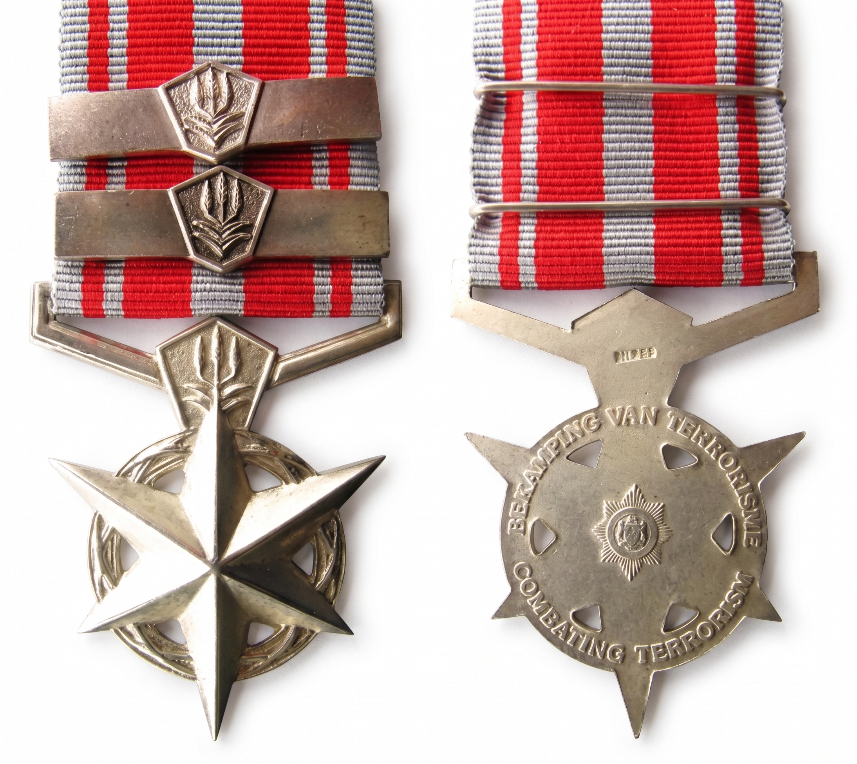
SA Police Medal for Combating Terrorism
Instituted by South Africa in 1974, this medal was awarded to all ranks of the South African Police for service in preventing and combating terrorism after 26 August 1966, by being in combat with terrorists [insurgents], or being injured through terrorist activities, or completing 60 days counter-insurgency duty in a designated area. Clasps were added for additional periods of service. It was also awarded for service against the People’s Liberation Army of Namibia in South-West Africa, or for counter-terrorist operations in Rhodesia during the Rhodesian Bush War.
A rough indication of how many were awarded per year is indicated by the Annual Report of the Commissioner of the South African Police for the Period 1 July 1978 to 30 June 1979. The report states that, “The Medal for Combating Terrorism was awarded to 231 White and 18 Non-White members, while 171 White and four Non-White members received bars.”
Former SAP Fanie Avenant
I was present at our Company HQ in Victoria Falls during 1970 when we received a visit from Mr Clifford Dupont, soon to be Rhodesia’s president, when he informally told us that he would make it his goal to see that we were also considered for the GSM. However the SAP medal was already in the pipeline and gazetted in 1976 after which deserving SAP men started receiving these.
SAP Roll of Honour
Operations in Rhodesia 1967–1975
(Highslide JS)
KEY:
KIA – Killed in Action; KOAS – Killed on Active Service; DOAS – Died on Active Service; MIA – Missing in Action; SAWGP – South Africa War Graves Project; COIN – Counter-Insurgency; CT – Communist Terrorist; ZANLA – Zimbabwe African National Liberation Army; ZIPRA – Zimbabwe Pople’s Liberation Army; RLI – Rhodesian Light Infantry; RAR – Rhodesian Air Force; RAR – Rhodesian African Rifles.
BOSCH, Jacobus Phillippus, 37851, Sergeant, KOAS, 12 August 1970.
Drowned in the Zambezi River downstream from Chirundu Bridge while on COIN duty in Rhodesia. He was washing in the river and it was presumed he was taken by a crocodile. His body was never found. Source: Death Notice and SAWGP.
BOSHOFF, Albertus, W60263R Constable, KIA, 30 December 1974.
Died of a gunshot wound to the chest, Mt Darwin, Op Hurricane. Died aged 22 years, he was from Middleburg, Eastern Cape Province, South Africa. He is buried in South Africa. Sources: Death Notice and SAWGP.
BREYTENBACH, Johannes Petrus, W27654K, Warrant Officer, KOAS, 16 September 1974.
Based at the SAP camp in Binga, he died of an accidental gunshot wound to the head in Chizarira Game Reserve, east of Binga in the Kariba area. He was 45 and is buried in South Africa. Sources: Death Notice and SAWGP.
BUYS, Louis Johannes, W56068K, Constable, KIA, 1 October 1974. (see Don Price account above)
Shot in the head while on COIN duty at Chirundu, Rhodesia, aged 23 years. In South Africa he was stationed at Hattinghspruit in Natal. Buried in the Jacobskop Cemetery, Vereeniging, South Africa. Source: Death Notice and SAWGP.
CALITZ, Wynand Johannes, W56166K, Constable, KIA, 1 March 1974.
Died from a gunshot wound traversing his abdomen and chest, 2km west of Chironga Mission, Mt Darwin, Op Hurricane. He was 22 years old. A member of India Company, he was based at 213 Bravo base. Source: Death Notice. He is buried in the Humansdorp Cemetery, Eastern Cape, South Africa. Source: SAWGP.
CLOETE, Jacobus Wynand, W57177M, Constable, KIA, 6 October 1974.
Died of a gunshot wound to the neck at the SAP base, Kazakili, near Victoria Falls. Buried in the Zandfontein Cemetery, Pretoria, South Africa. Source: SAWGP.
CONRADIE, Willem Johannes, W58344P, Constable, KIA, 8 March 1974.
Died of gunshot wounds near Kandahar Island in the Victoria Falls area. A stick of SAP was surprised by CTs and murdered on the spot. He was 22 years old and is buried in Reddersburg, Orange Free State, South Africa. He was normally based in Empangeni, Zululand, South Africa. Source: SAWGP.
COOPER, Daniel, 48076, Constable, DOAS, 17 January 1969.
Died of cerebral malaria after two days in the Wankie Colliery Hospital. He was based at Victoria Falls, on COIN duty Rhodesia. Daniel was 21 years old, and came from the Cape Province in South Africa. Source: SAWGP and Death Notice.
DIPPENAAR, Jan Paulos, W23924W, Warrant Officer, KIA, 23 December 1974.
During the Rhodesian ceasefire, a ZANLA commander, Herbert Shungu, and 8 CTs stopped two South African Police vehicles which were carrying 6 members of the SAP and a BSAP constable. They were all relieved of the firearms, bundled into one of the trucks and driven down to a bridge over the Mazoe River in Rushinga District (Op Hurricane). They were taken onto the bridge and told to remove their shirts and hats, but sensing real danger, the policemen tried to escape, some by jumping into the river. One of the CTs opened up with his RPD. Jan Dippenaar, William du Plessis, Lourens Erasmus and Louis Franken of the SAP were all killed. Constable Grobbelaar, who was shot and wounded in the river, and Constable Eloff both survived. The body of Constable Mutasa Mandaza of the BSAP was never found and it is presumed he had drowned. Sources: Account related to Al J. Venter by Constable Louis Eloff; Death Notice; Outpost and The Elite by Barbara Cole. Dippenaar was 46 years old and is buried in the Maitland Cemetery, Cape Town, South Africa. Source: SAWGP.
DU PLESSIS, William Alexander, W57512N, Sergeant, KIA, 23 December 1974.
During the Rhodesian ceasefire, a ZANLA commander, Herbert Shungu, and 8 CTs stopped two South African Police vehicles which were carrying 6 members of the SAP and a BSAP constable. They were all relieved of the firearms, bundled into one of the trucks and driven down to a bridge over the Mazoe River in Rushinga District (Op Hurricane). They were taken onto the bridge and told to remove their shirts and hats, but sensing real danger, the policemen tried to escape, some by jumping into the river. One of the CTs opened up with his RPD. Jan Dippenaar, William du Plessis, Lourens Erasmus and Louis Franken of the SAP were all killed. Constable Grobbelaar, who was shot and wounded in the river, and Constable Eloff both survived. The body of Constable Mutasa Mandaza of the BSAP was never found and it is presumed he had drowned. Sources: Account related to Al J. Venter by Constable Louis Eloff; Death Notice; Outpost and The Elite by Barbara Cole. Du Plessis was 22 years old and is buried in South Africa.
DURRHEIM, Owen Winston, W55701P, Constable, KIA, 8 January 1973.
Died in the Victoria Falls National Park of multiple fractures and shock after their vehicle detonated a landmine. Aged 20 years. A South African by birth, he was also buried there. Source: Death Notice and SAWGP.
DU TOIT, Daniel, 44433, Constable, KIA, 18 July 1968.
Died from a gunshot wound to the head, received during a joint RLI, RAR, RhAF and SAP engagement with a large group of ZIPRA in a well-defended position in the Rawamombe Range near Kariba, Operation Griffin, aged 22 years. He was part of a forward sweep when fired on from very close range. Lieutenant J.H. Vorster and Constables A.J. Greunen and Dirk Hattingh were all wounded in the same contact. Du Toit was based in Wentworth, Natal, South Africa and is buried in Port Elizabeth. Listed on the Police Memorials, Union Buildings, Pretoria. Source: The Silent War by Shay and Vermaak, SAWGP, Nongqai and Death Notice.
ERASMUS, Lourens Daniel, W64955H, Constable, KIA, 23 December 1974.
During the Rhodesian ceasefire, a ZANLA commander, Herbert Shungu, and 8 CTs stopped two South African Police vehicles which were carrying 6 members of the SAP and a BSAP constable. They were all relieved of the firearms, bundled into one of the trucks and driven down to a bridge over the Mazoe River in Rushinga District (Op Hurricane). They were taken onto the bridge and told to remove their shirts and hats, but sensing real danger, the policemen tried to escape, some by jumping into the river. One of the CTs opened up with his RPD. Jan Dippenaar, William du Plessis, Lourens Erasmus and Louis Franken of the SAP were all killed. Constable Grobbelaar, who was shot and wounded in the river, and Constable Eloff both survived. The body of Constable Mutasa Mandaza of the BSAP was never found and it is presumed he had drowned. Sources: Account related to Al J. Venter by Constable Louis Eloff; Death Notice; Outpost and The Elite by Barbara Cole. Erasmus was 18 years old and is buried in the Forest Hill Cemetery, Port Elizabeth, South Africa. Source: SAWGP.
ERASMUS, Michael, W60279K, Constable, KIA, 1 October 1974. (see Don Price account above)
Shot in the head and chest at Chirundu while on COIN duty in Rhodesia, aged 20 years. In South Africa he was stationed at Kranskop, Natal. Buried in the Mountain Rise Cemetery, Pietermaritzburg, South Africa. Source: Death Notice and SAWGP.
ERWEE, Sarel Johannes, 48008, Constable, KOAS, 16 May 1968.
Drowned in the Zambezi River Gorge, 19 miles east of Victoria Falls, while on COIN duty in Rhodesia. Aged 20 years, he is buried in South Africa. Source: Death Notice and SAWGP.
FALL, Rodney Graham, 47174, Sergeant, DOAS, 1 Nov ember 1968.
Died from dehydration and exhaustion in Wankie Colliery Hospital, aged 21. At the time he was on COIN duties in the Zambezi Valley, Rhodesia. He was from SAP King’s Rest Station, Durban. He is buried in Cape Town. Listed on the Police Memorials, Union Buildings, Pretoria. He was the eldest son of Mr and Mrs S. Fall, Kirstenbosch, Cape Town. Source: Death Notice, SAWGP and Nongqai.
FRANKEN, Louis Wessel Gerhardus, W61774B, Constable, KIA, 23 December 1974.
During the Rhodesian ceasefire, a ZANLA commander, Herbert Shungu, and 8 CTs stopped two South African Police vehicles which were carrying 6 members of the SAP and a BSAP constable. They were all relieved of the firearms, bundled into one of the trucks and driven down to a bridge over the Mazoe River in Rushinga District (Op Hurricane). They were taken onto the bridge and told to remove their shirts and hats, but sensing real danger, the policemen tried to escape, some by jumping into the river. One of the CTs opened up with his RPD. Jan Dippenaar, William du Plessis, Lourens Erasmus and Louis Franken of the SAP were all killed. Constable Grobbelaar, who was shot and wounded in the river, and Constable Eloff both survived. The body of Constable Mutasa Mandaza of the BSAP was never found and it is presumed he had drowned. Sources: Account related to Al J. Venter by Constable Louis Eloff; Death Notice; Outpost and The Elite by Barbara Cole. Franken was 18 years old and is buried in the Groot Brakrivier Cemetery, Western Cape, in South Africa. Source: SAWGP.
HARMSE, Bartholomeus, W56732P, Constable, KOAS, 19 November 1974.
Died when an expended 60mm flare mortar casing, after having just been fired during a training exercise, struck him in the chest. He died two and a half hours later. He was part of C/S 43, based at the Kadzi River Camp, Dande TTL, Sipolilo, Op Hurricane. Died aged 29 years. He was from Pretoria. Source: Death Notice and SAWGP.
HOUGH, Zacharias Andreas, W56648R, Constable, KIA, 8 March 1974.
Died of gunshot wounds near Kandahar Island in the Victoria Falls area. A stick of SAP were surprised by CTs and murdered on the spot. He was 20 years old and is buried in Usakos, Namibia. He was normally based in Windhoek, South West Africa. Source: SAWGP.
JANSE VAN RENSBURG, Hermanus Cornelius, 49992, Detective Sergeant, KIA, 1 June 1969.
Died of gunshot wounds at Kazangula, Victoria Falls, while on COIN duty in Rhodesia. He was with No. 1 Platoon based at the SAO Kazangula Camp. He was 26 years old and is buried in Pretoria. Source: SAWGP and Death Notice.
KUHN, Johan A., W38424W, Constable, MIA, 8 March 1974.
Kuhn escaped the initial shooting at Kandahar Island but despite a helicopter being dispatched, from No. 7 Squadron, RhAF, to search for him, his body was never found. He is presumed murdered or abducted. Subsequent interrogation of a ZIPRA prisoner revealed that Kuhn had been shot on the Rhodesian side of the Zambezi River, and his body stuffed into an aardvark hole. Source: SAWGP.
LEMKUHL, L.J.H., 44959, Constable, KOAS, 5 May 1969.
Killed on active service while on COIN duty in Rhodesia. Source: SAWGP.
MANCI, M.C., S158792N, Constable, KIA, 29 August 1973.
Died of gunshot wounds received in an ambush at locstat VS630773, Mt Darwin, Op Hurricane. Source: Death Notice and SAWGP.
MARITZ, Johan Hendrik Christophel, 50325, Constable, KOAS, 18 August 1971.
Died in a vehicle accident in the Victoria Falls National Park while on COIN duty in Rhodesia. In South Africa he was stationed at Sishen, Northern Cape. Aged 24, he is buried in the Kuruman New Cemetery, Northern Cape, South Africa. Source: Death Notice and SAWGP.
MARX, Siegfried, W54350W, Constable, KIA, 8 January 1973.
Died in the Victoria Falls National Park of multiple fractures and shock after their vehicle detonated a landmine. Aged 22 years. A South African by birth, he is buried in the Vryheid Cemetery, South Africa. Source: Death Notice and SAWGP.
MEYER, C.C., W48209R, Sergeant, KIA, 4 January 1975.
Killed by a landmine while on COIN duty in Rhodesia. Source: SAWGP.
MINNIE, Louis James, W46494K, Constable, KOAS, 27 June 1973.
Died of a skull fracture and multiple injuries when he fell of a cliff in the Zambezi River Gorge, Kasikili, Victoria Falls. He was based at the SAP Kasikil Camp. He was 26 years old and is buried in Port Elizabeth, South Africa. Source: Death Notice.
MPAHLAWA, Mziwanke, S152074B, Constable, KOAS, 7 October 1974.
Died from injuries sustained in a motor vehicle accident in the Binga area, Kariba. He was 35 and is buried in South Africa. In South Africa he was stationed at the Mdantsane Police Station, Transkei. Source: Death Notice and SAWGP.
NEL, Frederick Johannes, W61799N, Constable, KIA, 11 January 1975.
Died from gunshot wounds to the chest and abdomen, Mana Pools National Park, aged 18 years. In South Africa he was stationed at Orkney, North West Province. He is buried in the New Klerksdorp Cemetery, South Africa. Source: Death Notice and SAWGP.
Oosthuizen, Frederick A., 45916, Sergeant, DOAS, 16 June 70.
Drowned in the Zambezi River while on COIN duty in Rhodesia. He was aged 24 and is buried in Aliwal North, Northern Cape, South Africa. At the time the Wankie magistrate conducted an inquest, and the death was only registered on 27 May 1971. Source: Death Notice and SAWGP.
OTTO, Rudolf Nicolaas, W59968R, Constable, KIA, 3 October 1973.
Died of 70 percent burns in a landmine explosion while en route from Binga to Wankie. Aged 20 years at the time of his death, he came from Sandown in Johannesburg, South Africa. He is buried in the Zandfontein Cemetery, Pretoria. Source: Death Notice and SAWGP.
PETZER, Johannes Frederik, W60327R, Constable, KIA 3 Jan 1975.
Killed by a landmine while on COIN duty in Rhodesia. He is buried in the Stutterheim Cemetery, Eastern Cape, South Africa. Source: SAWGP.
SCHUTTE, Phillipus Johannes Cornelius, W48815B, Detective Sergeant, DOAS, 14 January 1974.
He drowned in the Musengezi River, near Gutsa in the Zambezi Valley, Centenary, Op Hurricane. He was 29 years old and came from Brakpan, South Africa, where he is buried. Source: Death Notice.
STEENKAMP, Lambert Hendrik, W52421F, Constable, DOAS, 4 March 1973.
Died after drinking poisoned water while on COIN duty in Rhodesia. Source: SAWGP.
STRYDOM, Erhard Francois, W46430T, Constable, KIA, 8 March 1974.
Died of gunshot wounds near Kandahar Island in the Victoria Falls area. A stick of SAP was surprised by CTs and murdered on the spot. He was 35 and is buried in Barbeton, Transvaal, South Africa, which was where he was normally based. Source: SAWGP.
SWART, Edward Peter, W39784R, Lieutenant, KIA, 17 April 1974.
Died from gunshot wounds in an ambush 6km west of Rushinga Army Base, Op Hurricane, aged 28 years. He came from Queenstown in the Cape Province, South Africa. He is also buried there. In a letter dated 22 April 1974 to the DC in Mt Darwin, DC Bindura, C. Green, states that “members of the S.A.P. who are killed in action are not to be dealt with in the same manner as our Security Forces – they are recorded in the death register as if they were ordinary Civilians.” An aircraft from South Africa was due to collect the body before all the formalities had been completed. Sources: Death Notice and photocopy of original letter lodged with the Death Notice. Source: Death Notice and SAWGP.
SWART, Robert Andrew, W35163M, Constable, KIA, 8 March 1974.
Died of gunshot wounds near Kandahar Island in the Victoria Falls area. A stick of SAP was surprised by CTs and murdered on the spot. He was 33 years old and is buried in Hermanus, Western Province, South Africa, which was also where he was normally based. Source: Death Notice and SAWGP.
VAN DER MERWE, Carl Lodewyk, W60899P, Constable, KOAS, 4 August 1974.
Died in Salisbury General Hospital (Andrew Fleming) from head injuries sustained in Mt Darwin, Op Hurricane. He was 19 years old. A magistrate’s inquiry was undertaken behind the circumstances of his death, and a second Death Notice issued on 29 November 1974. The outcome of the inquiry is not known. Usually stationed in Pretoria, he was buried in Potchefstroom, South Africa. Source: Death Notice.
VAN HEERDEN, Johannes Hendrik, 694758619PE, Pilot/Flight Sergeant, South African Air Force, KOAS, 7 January 1969.
Killed in an air accident while he was flying a South African Police Cessna 185, No. 734, at Katanga Range near Que Que. He tried to perform a low-level barrel roll (illegal in a C185) and struck the ground. He was 25 years old and his body was flown back to South Africa for burial in Pretoria. Flight Lieutenant Donald Annandale of the RhAF subsequently died in Que Que hospital of burns received in the same crash. Sources: Death Notice and B. Salt.
[This death is included as it is proof the SAP had their own fixed-wing aircraft, in addition to Alouette III helicopters, in Rhodesia.]
Official Rhodesian Government Death Notices of SAP Fatalities
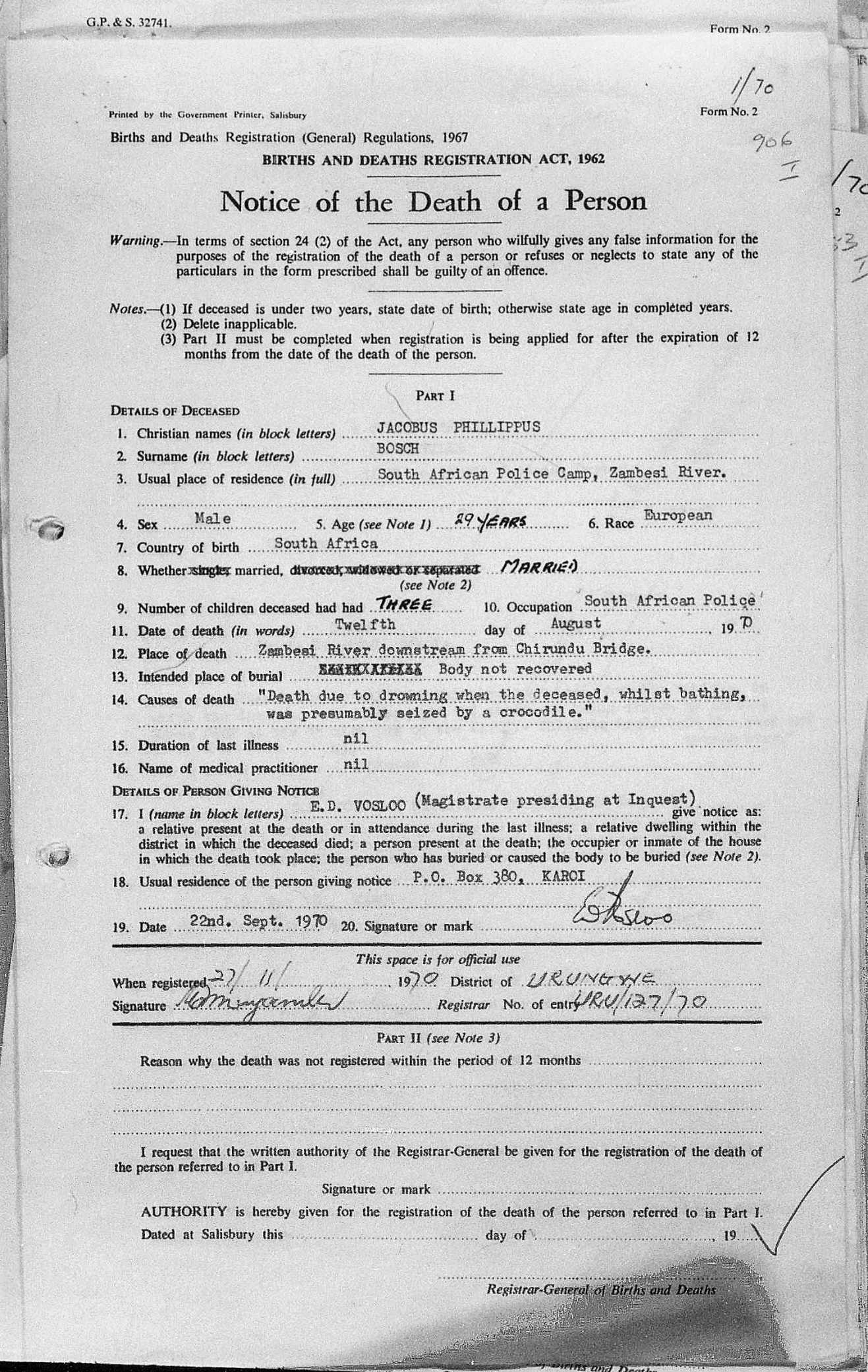
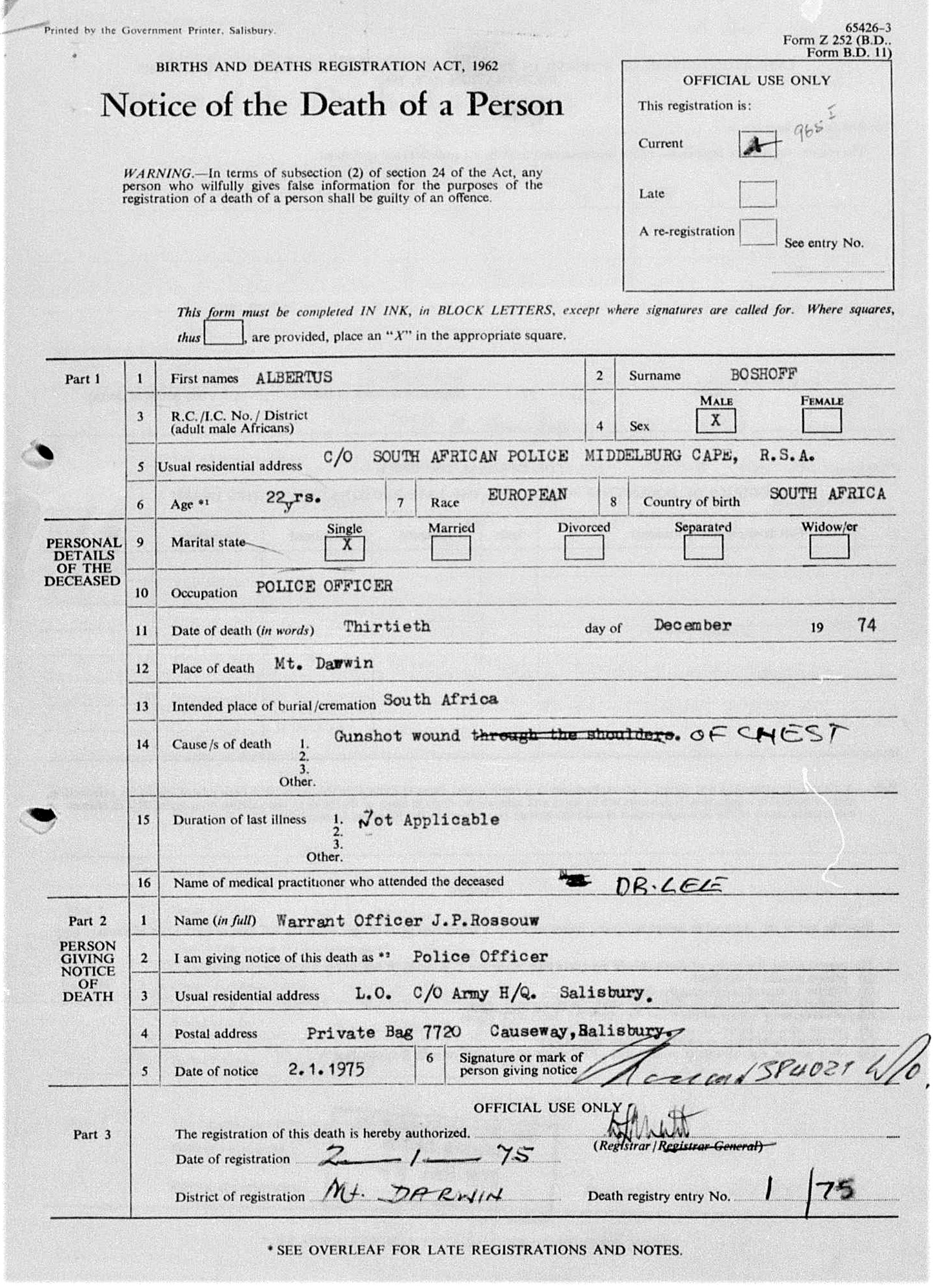
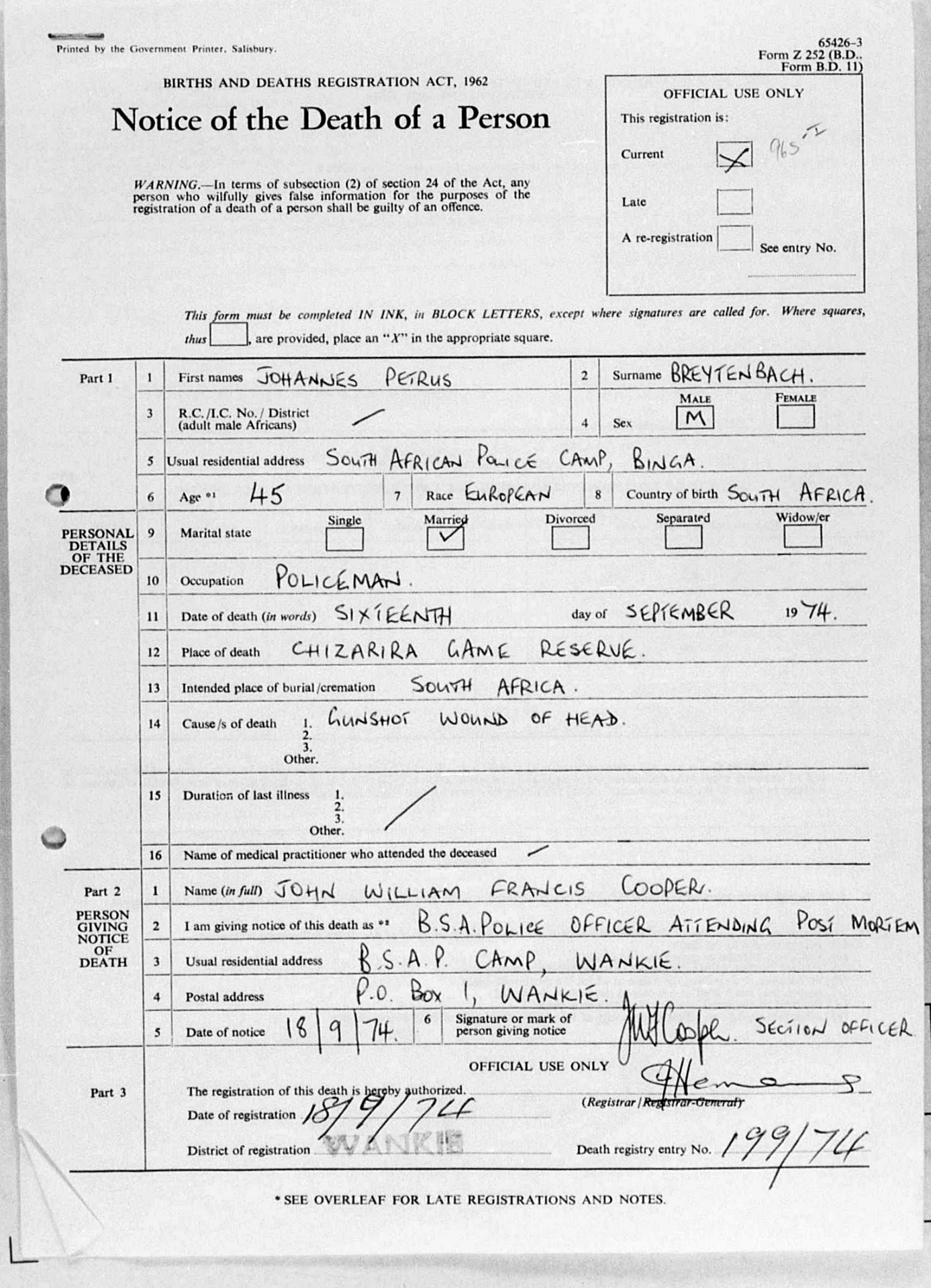
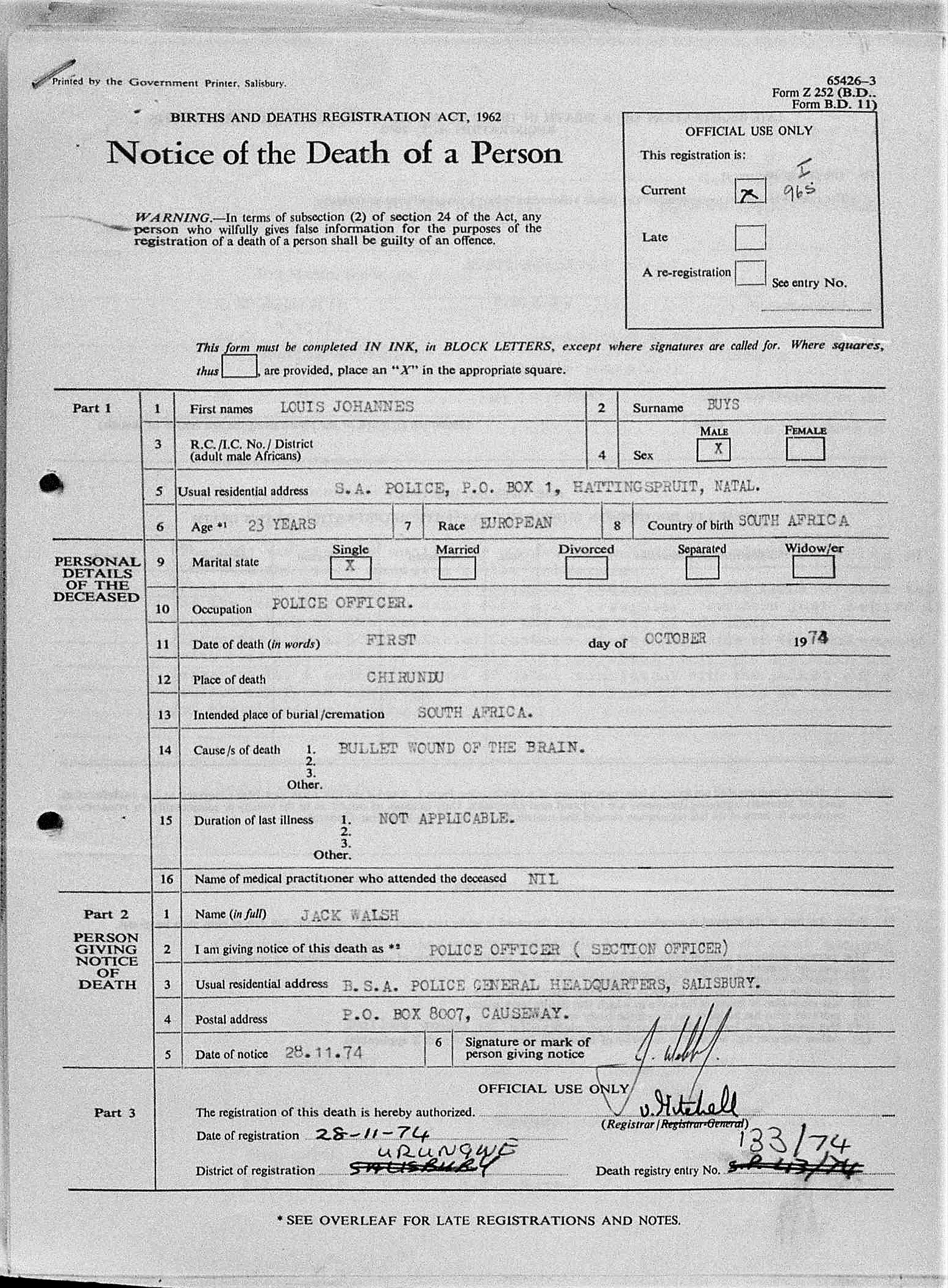
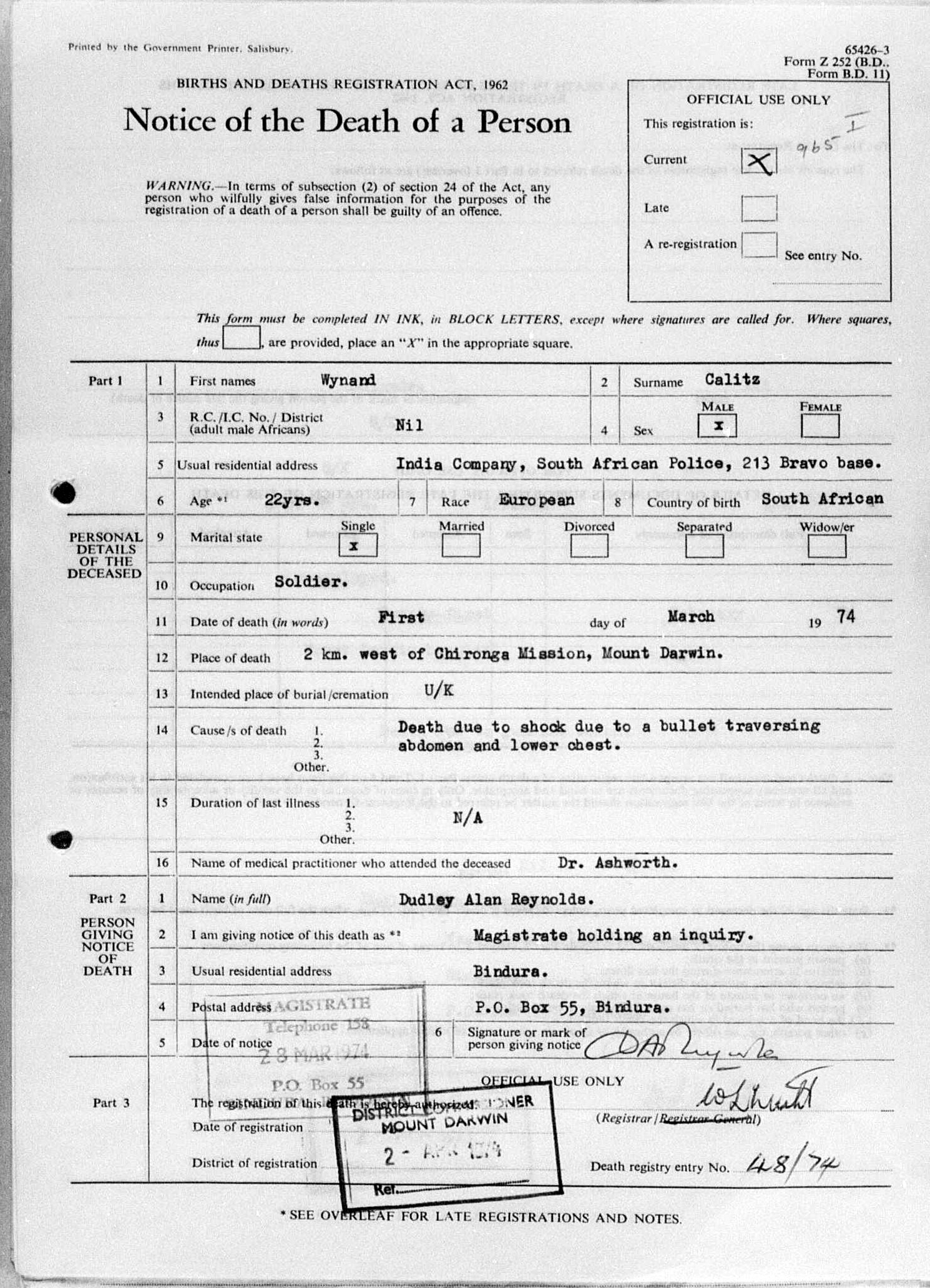
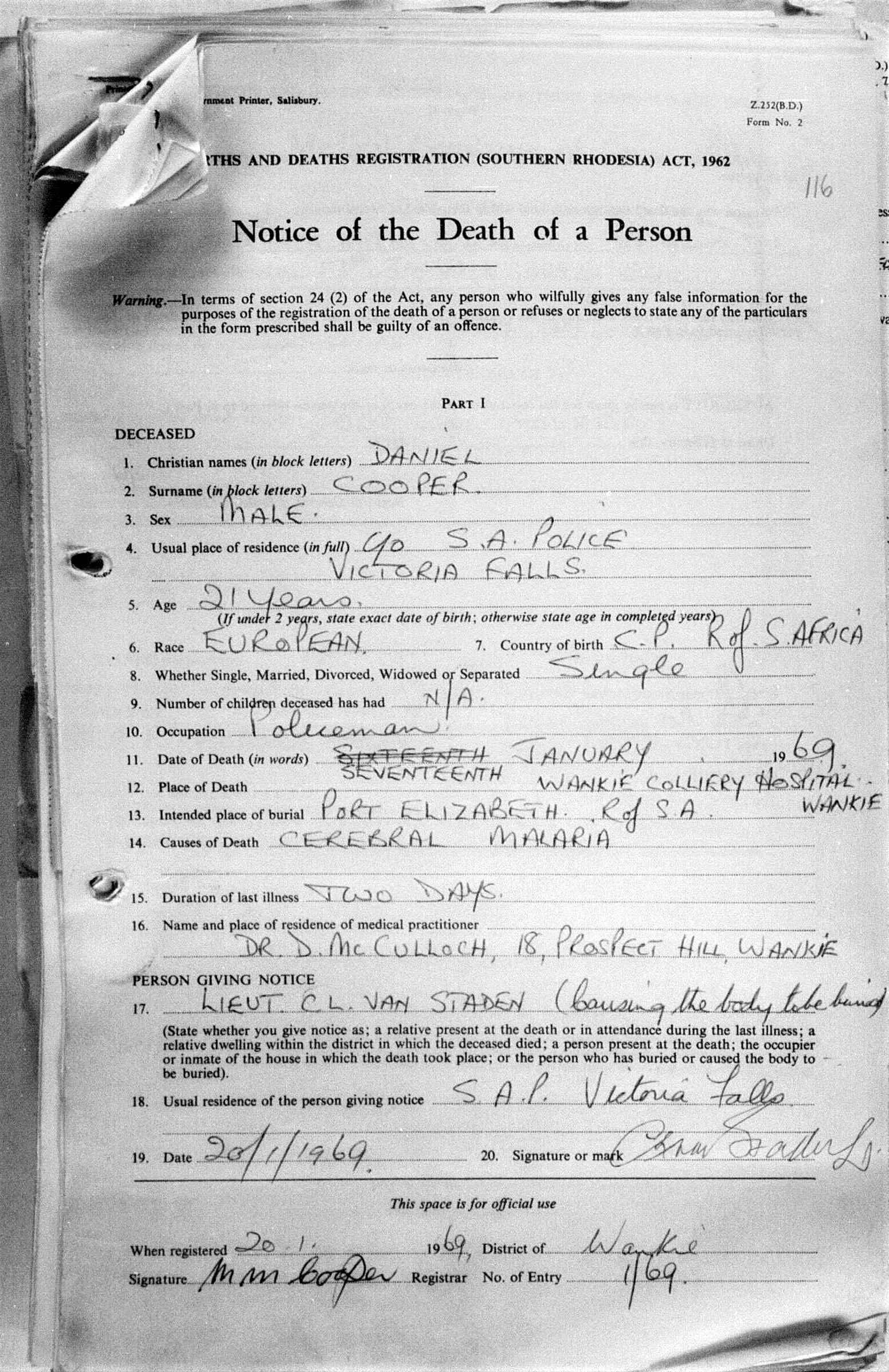
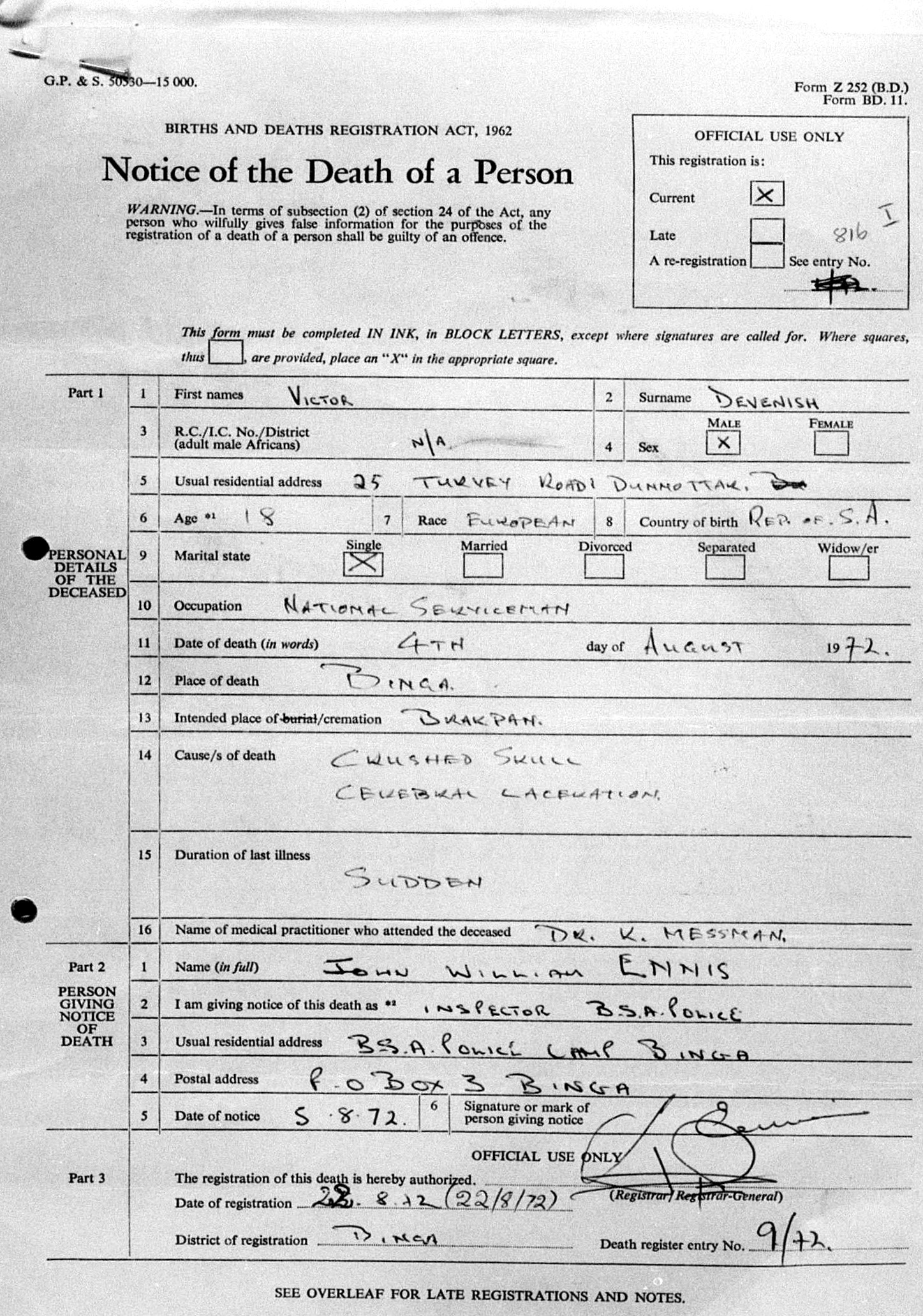
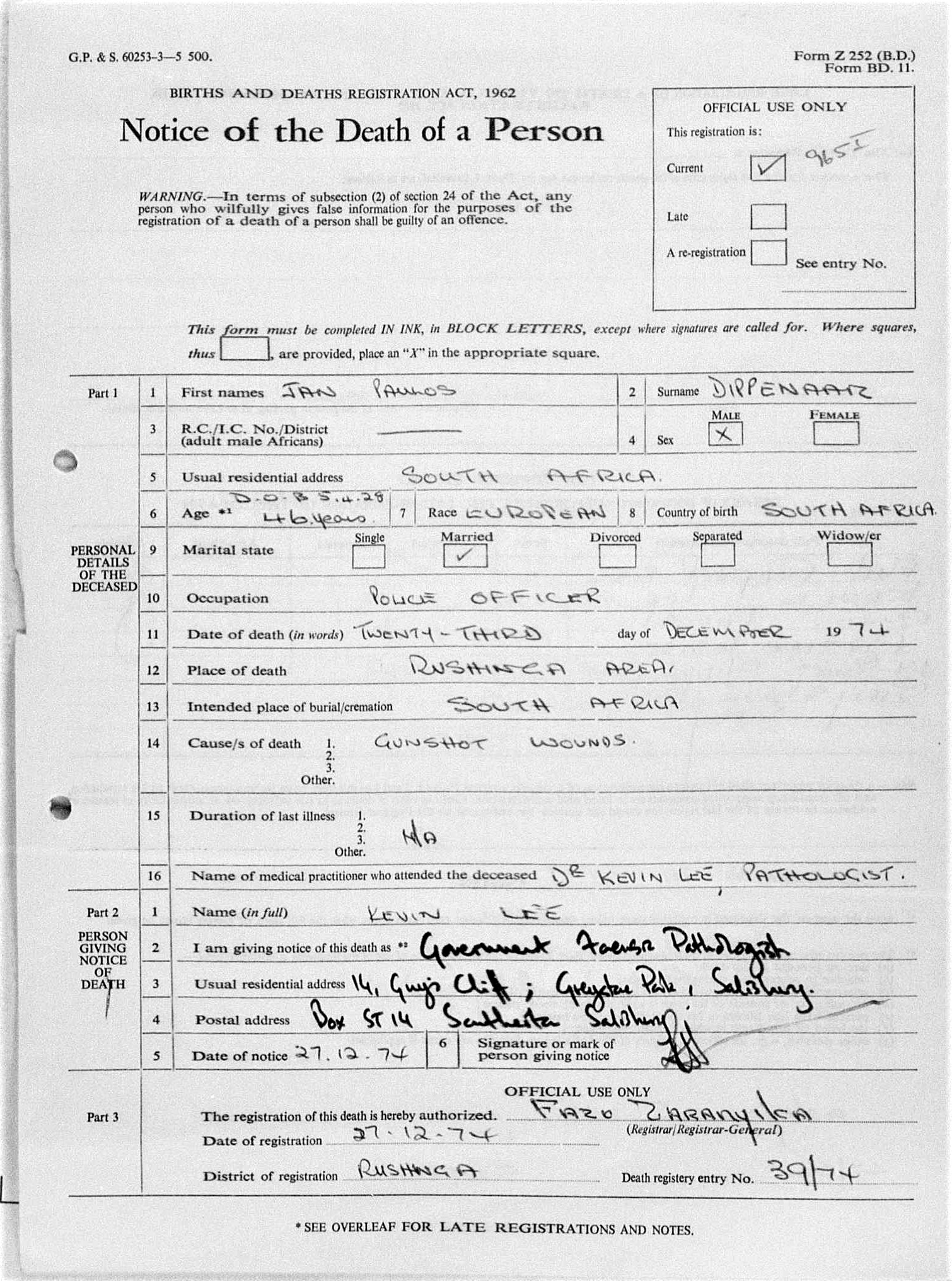
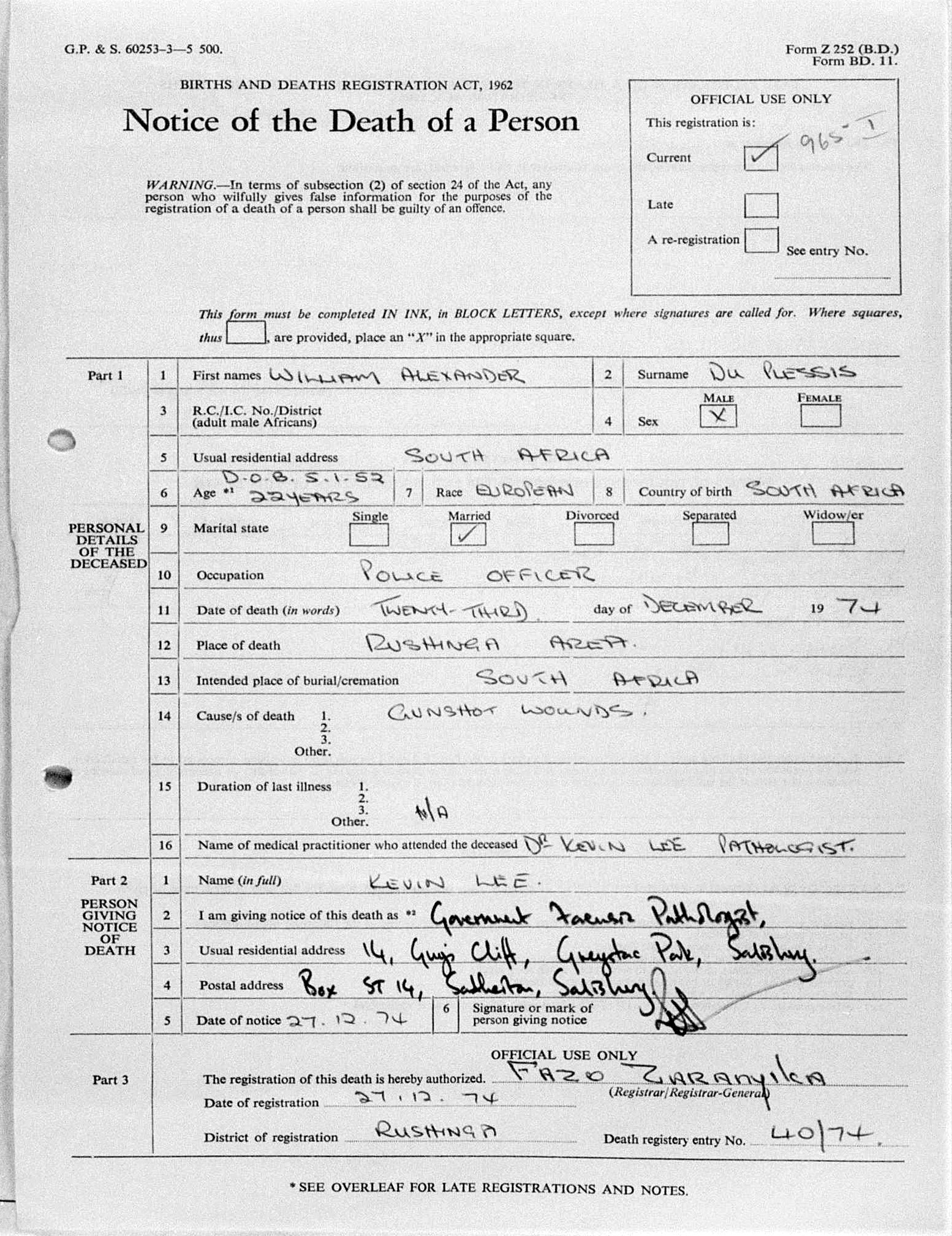
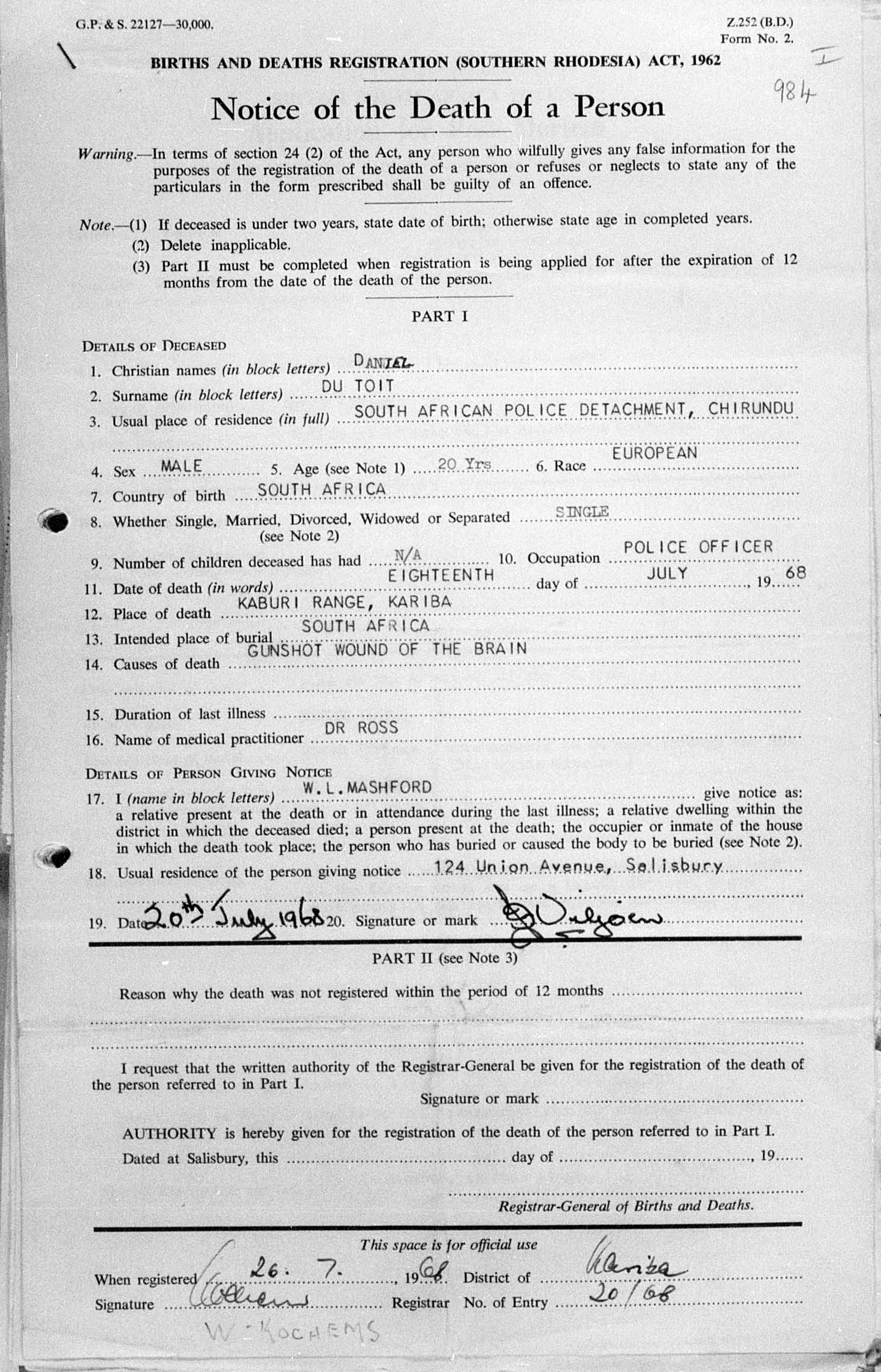
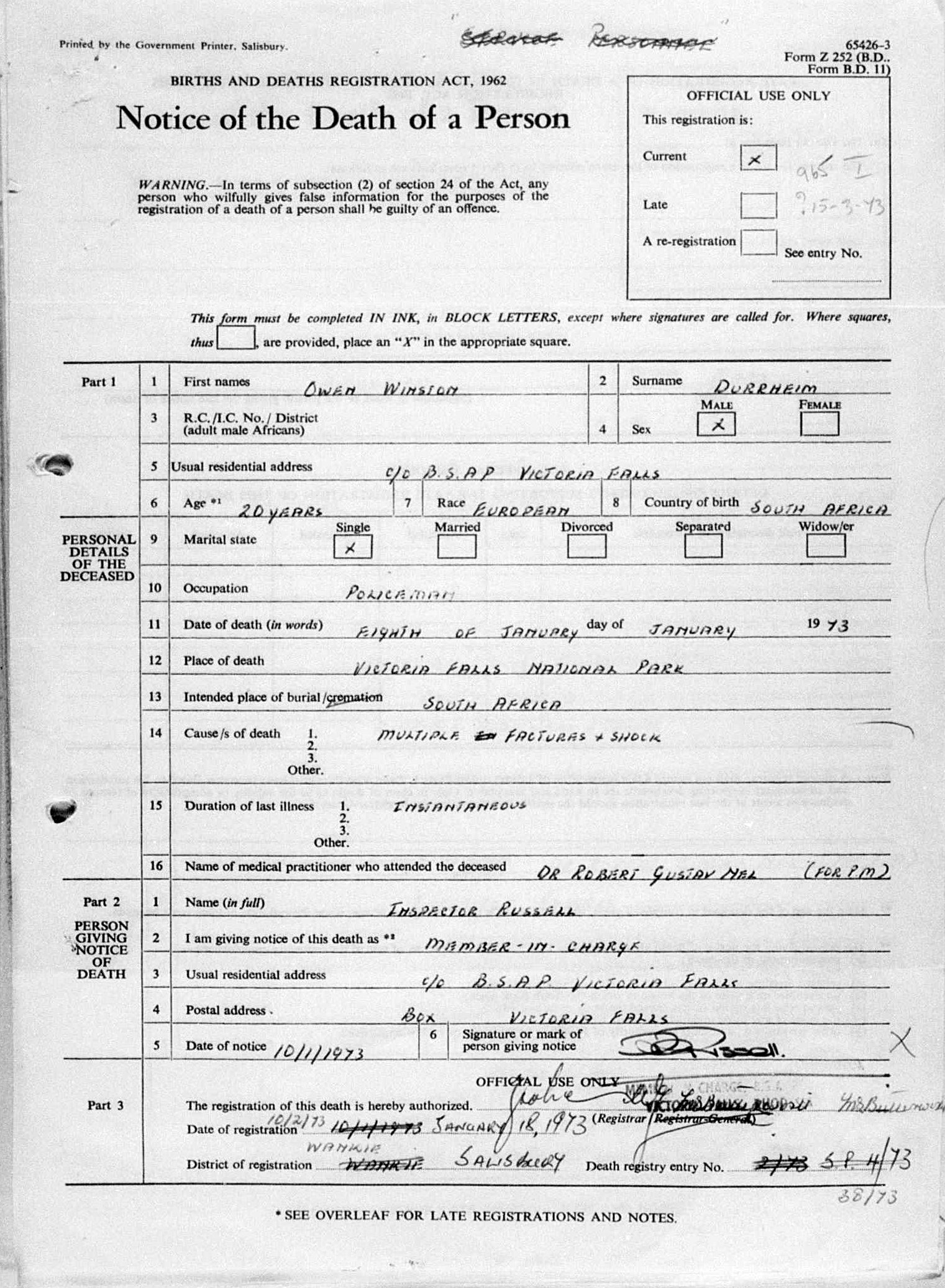
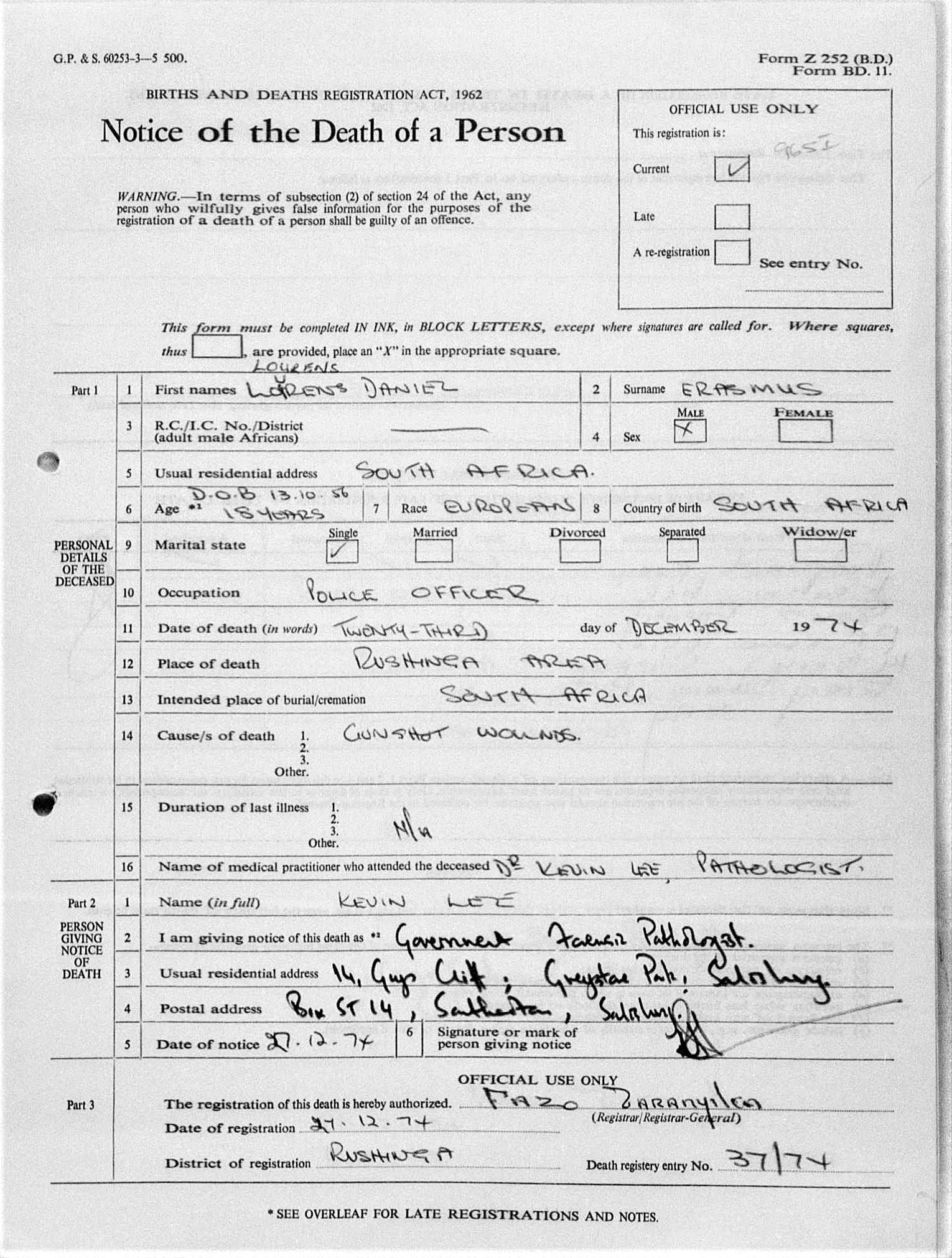
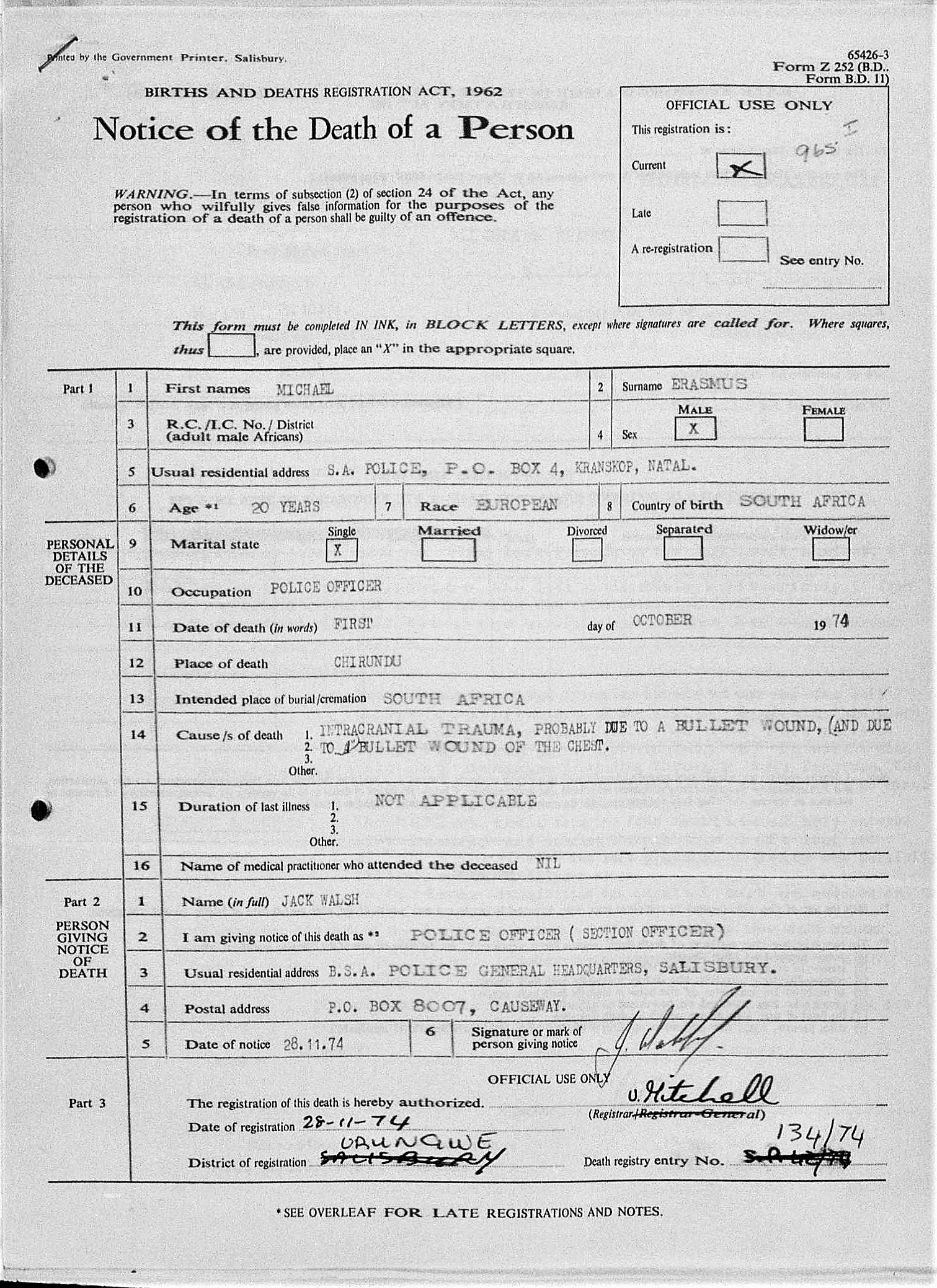
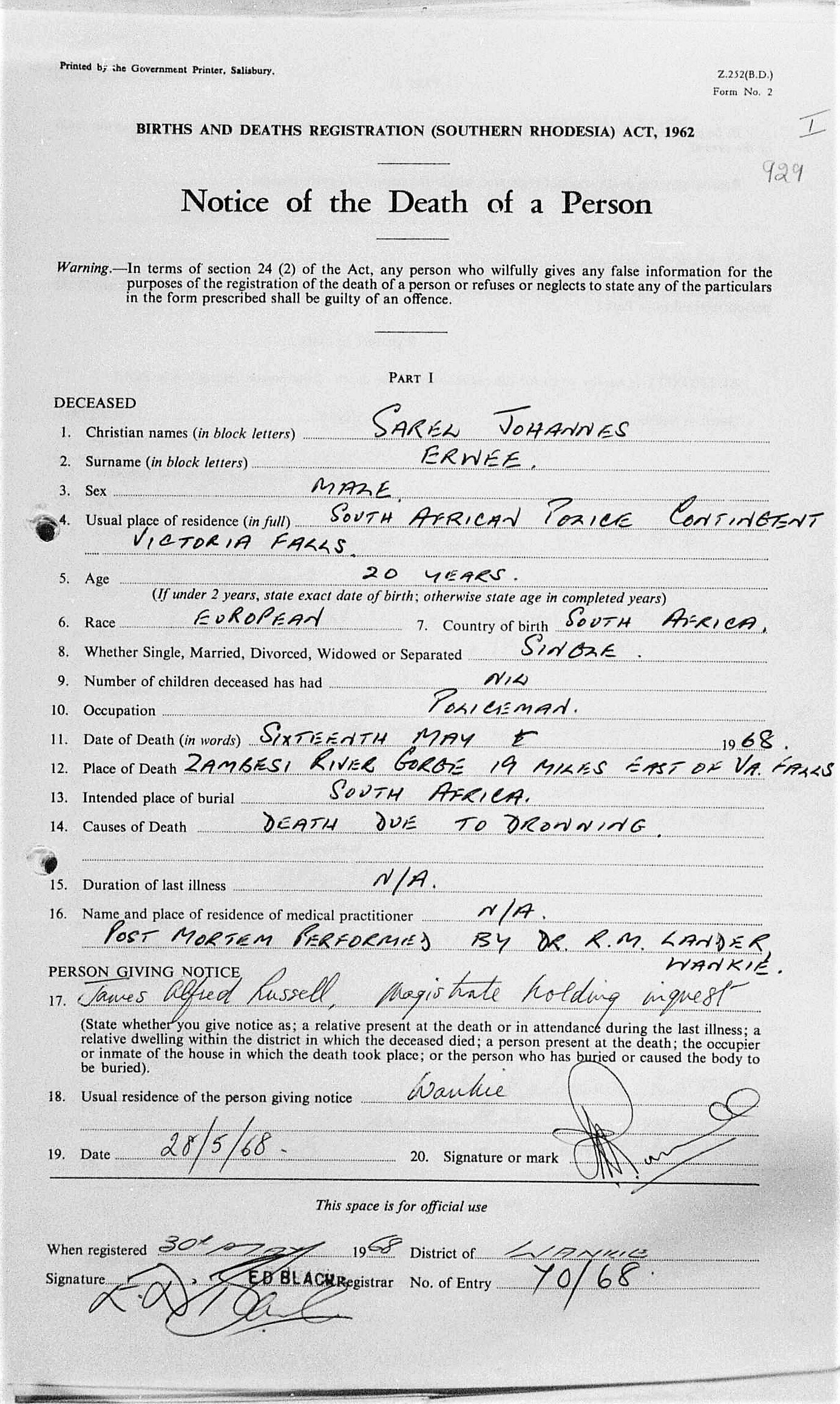
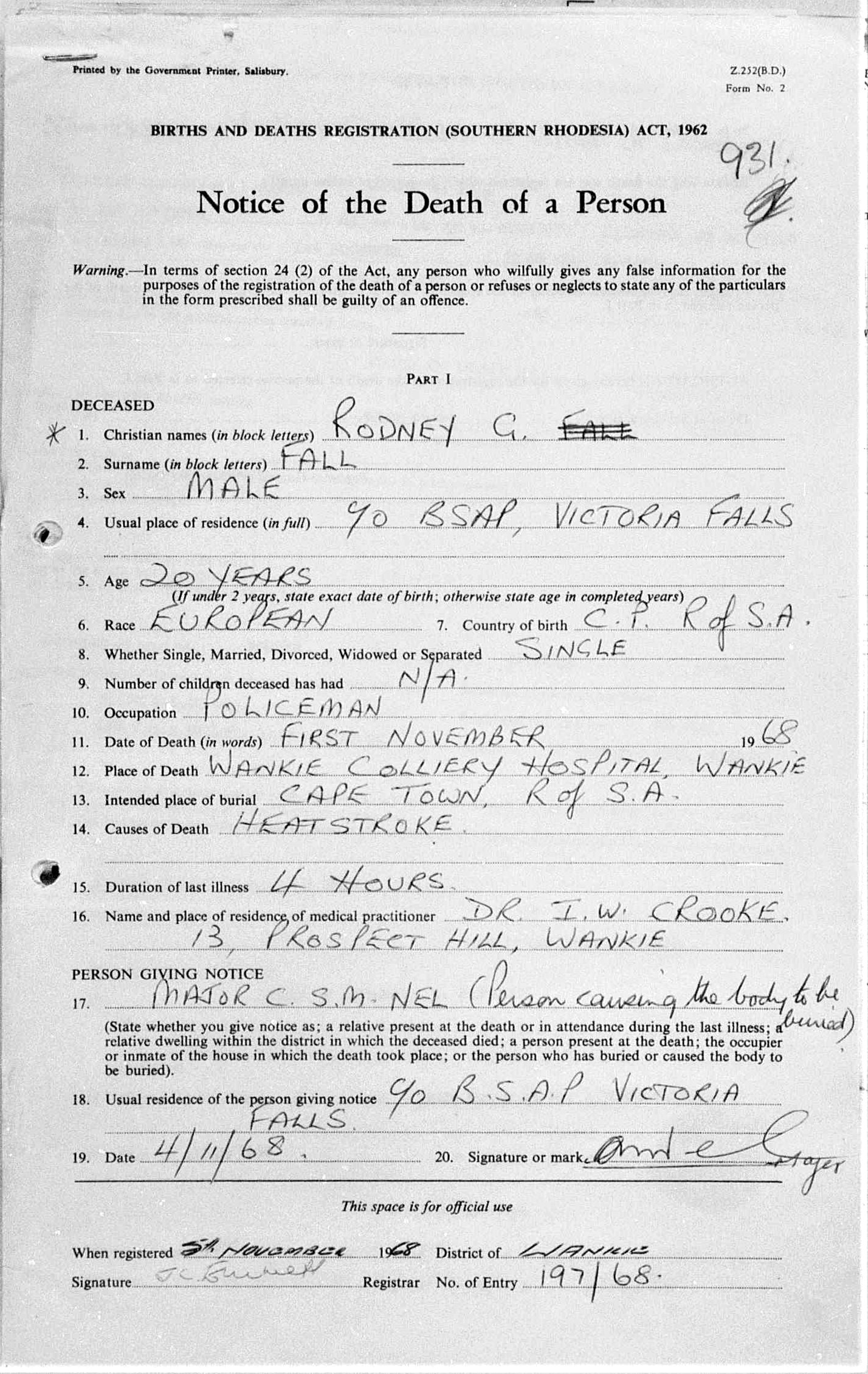
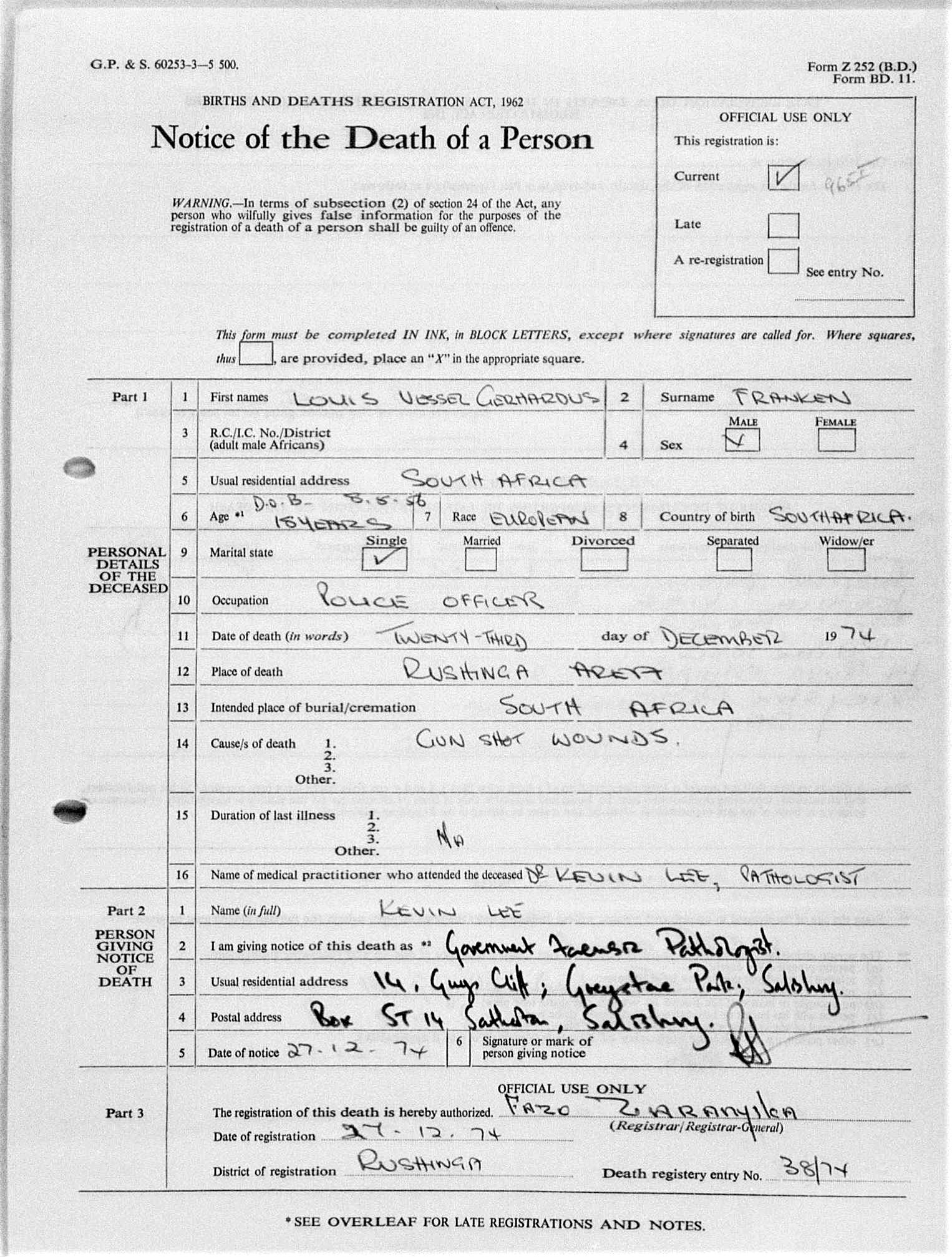
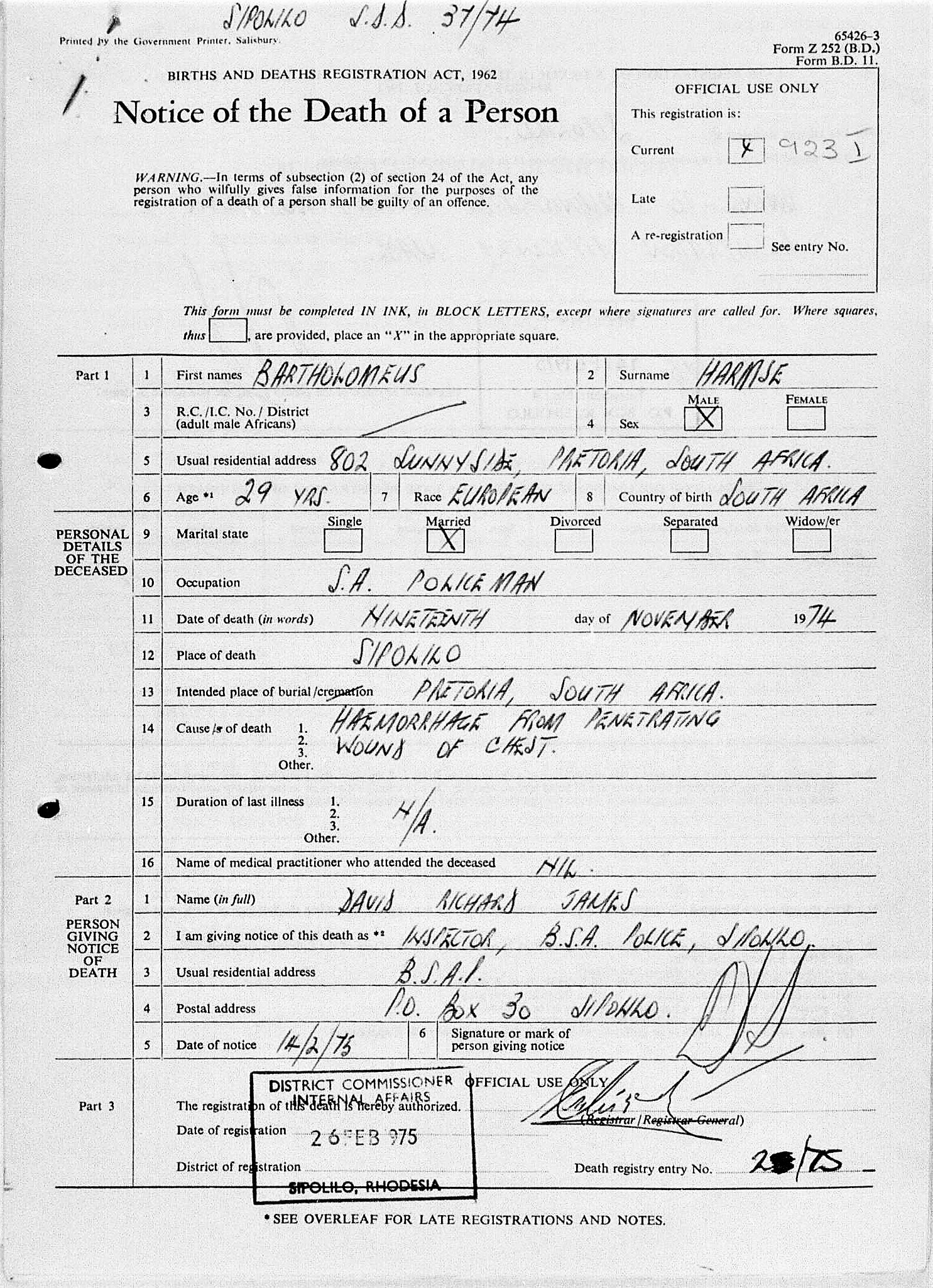
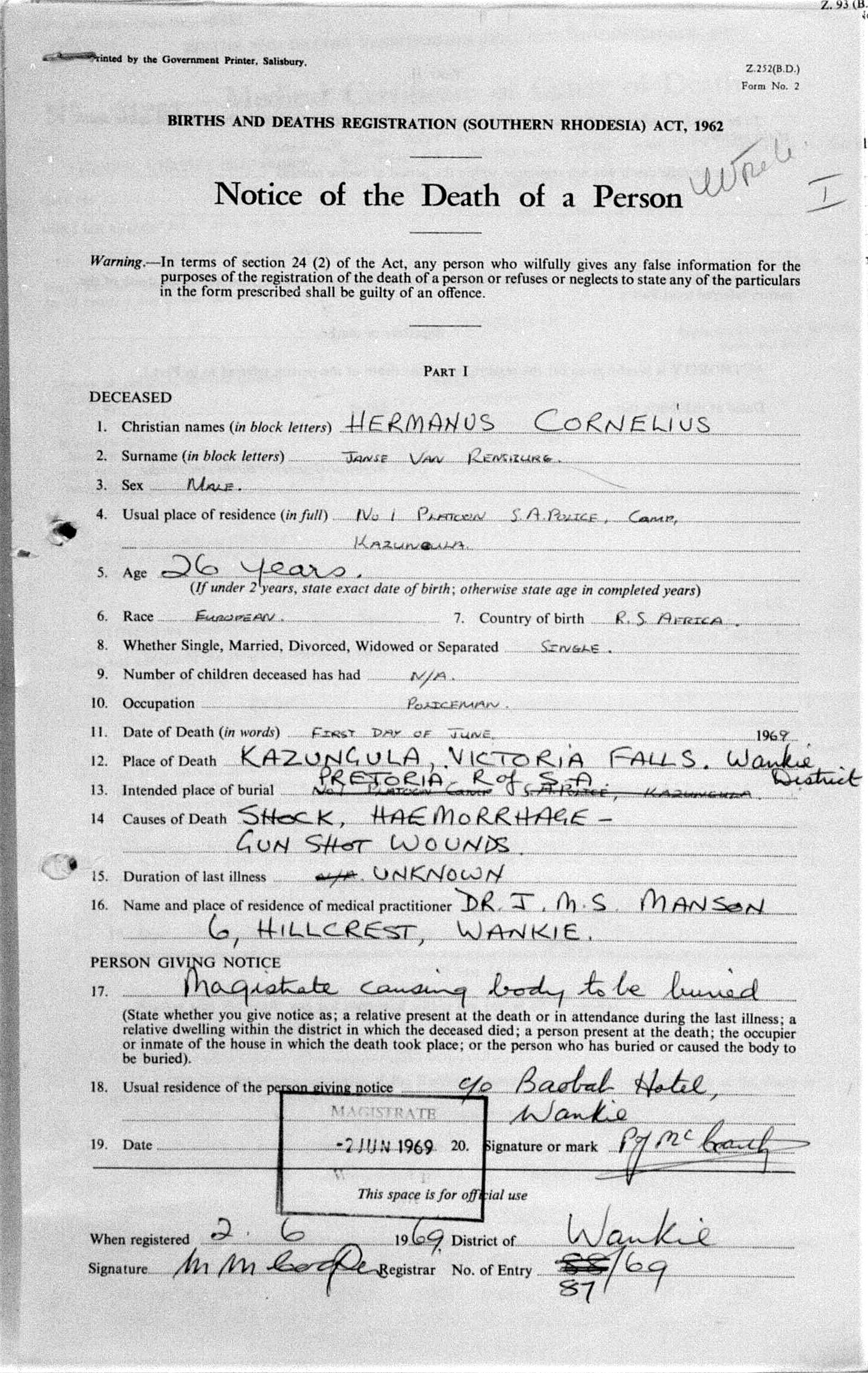
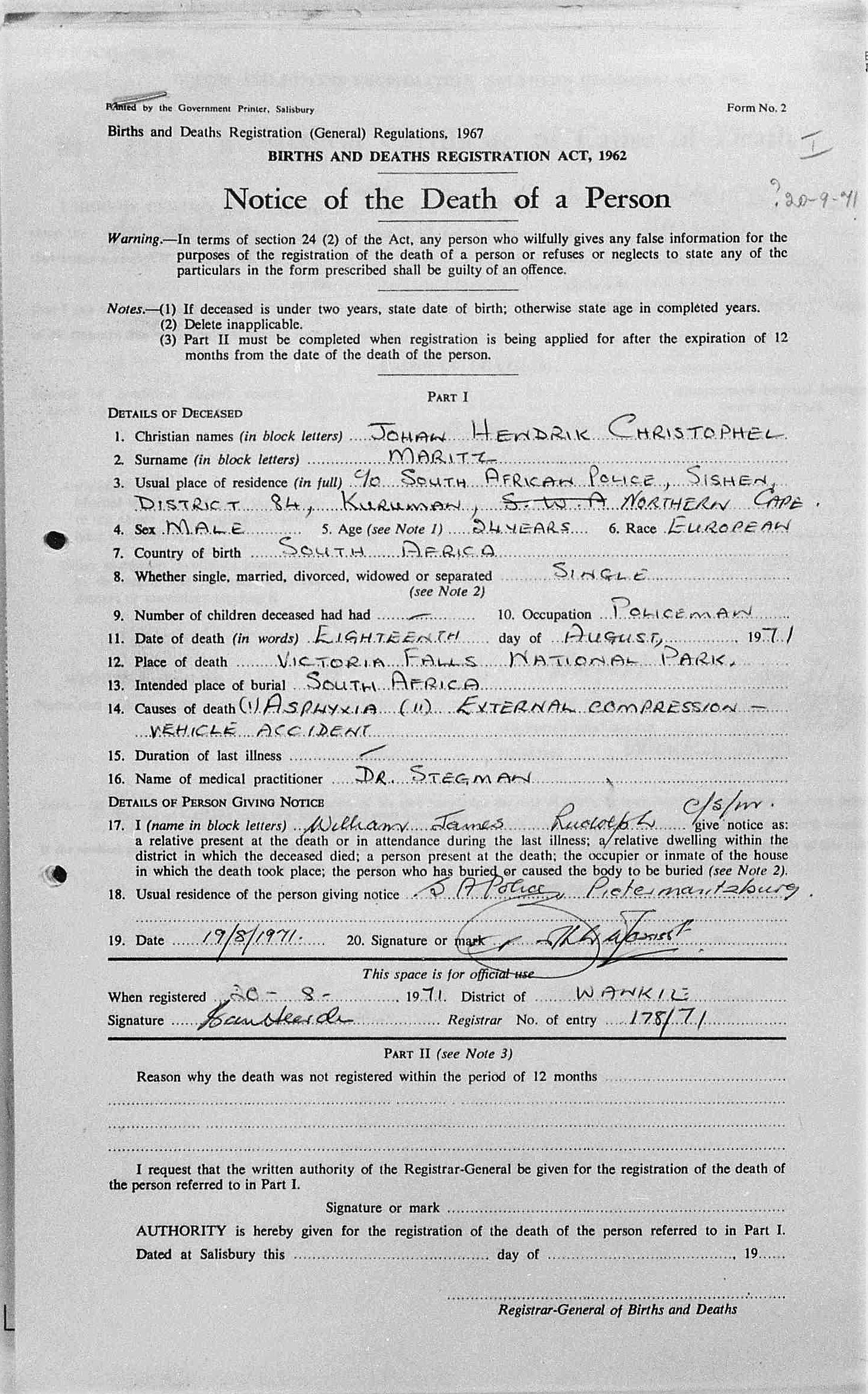
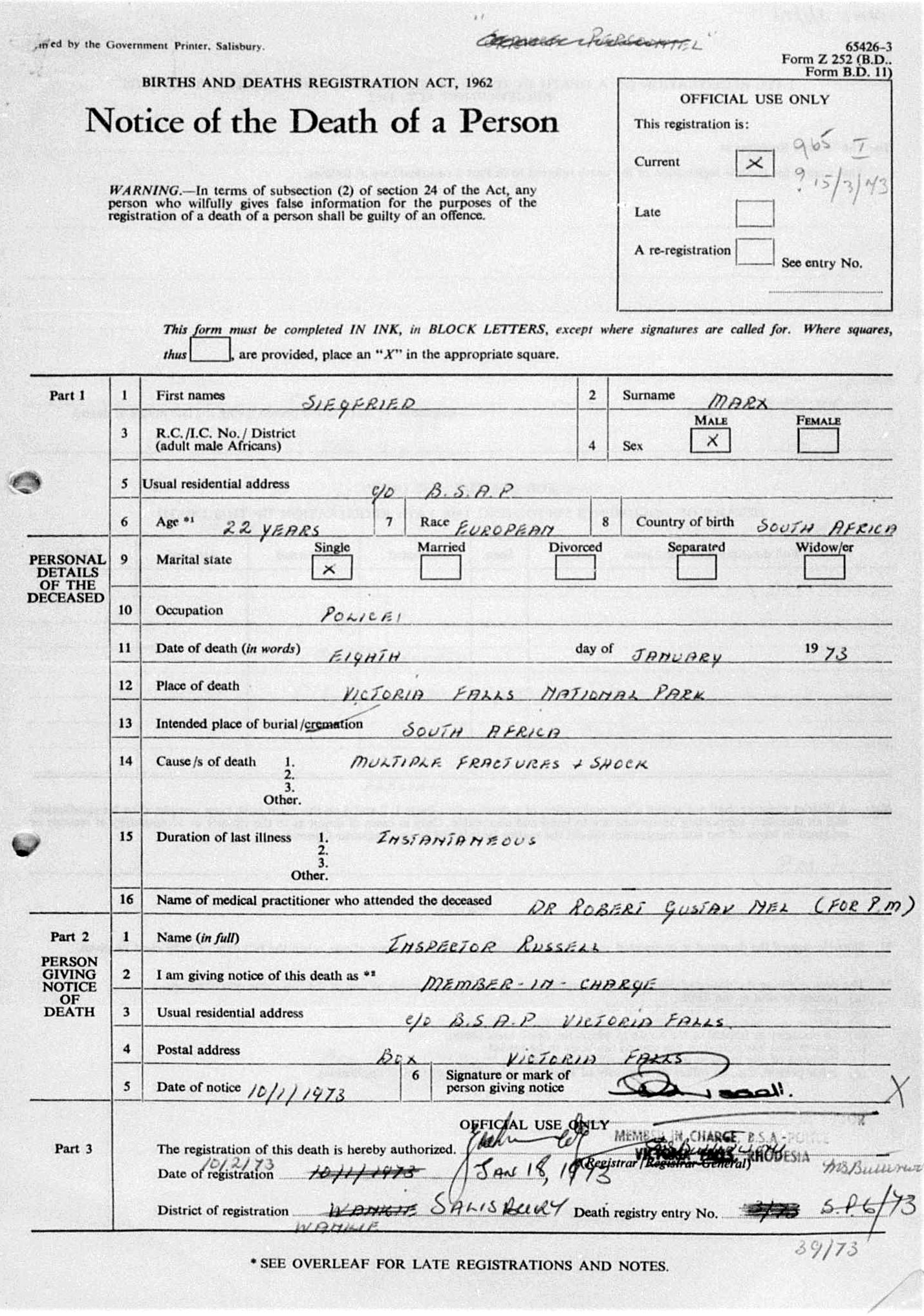
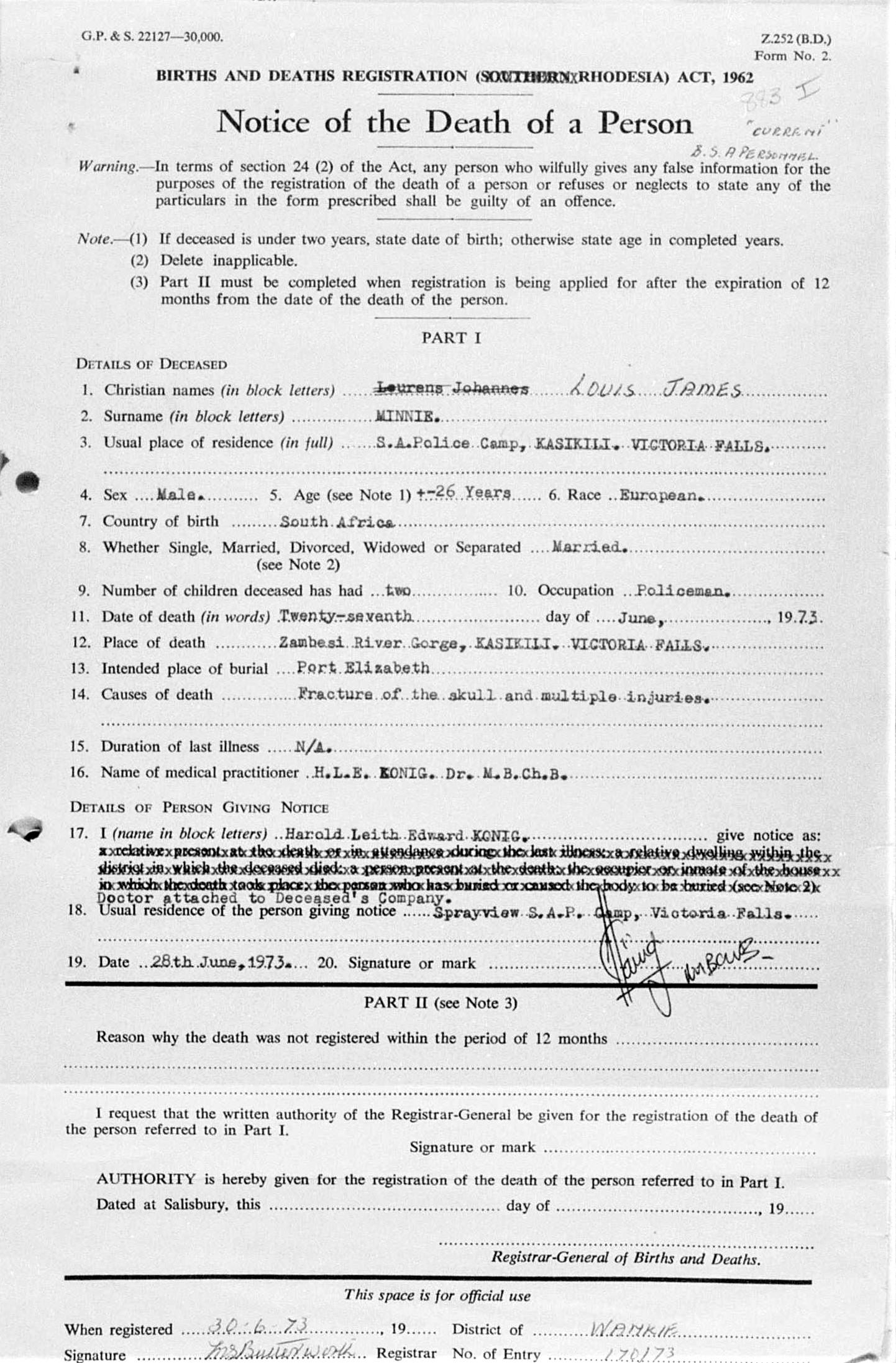
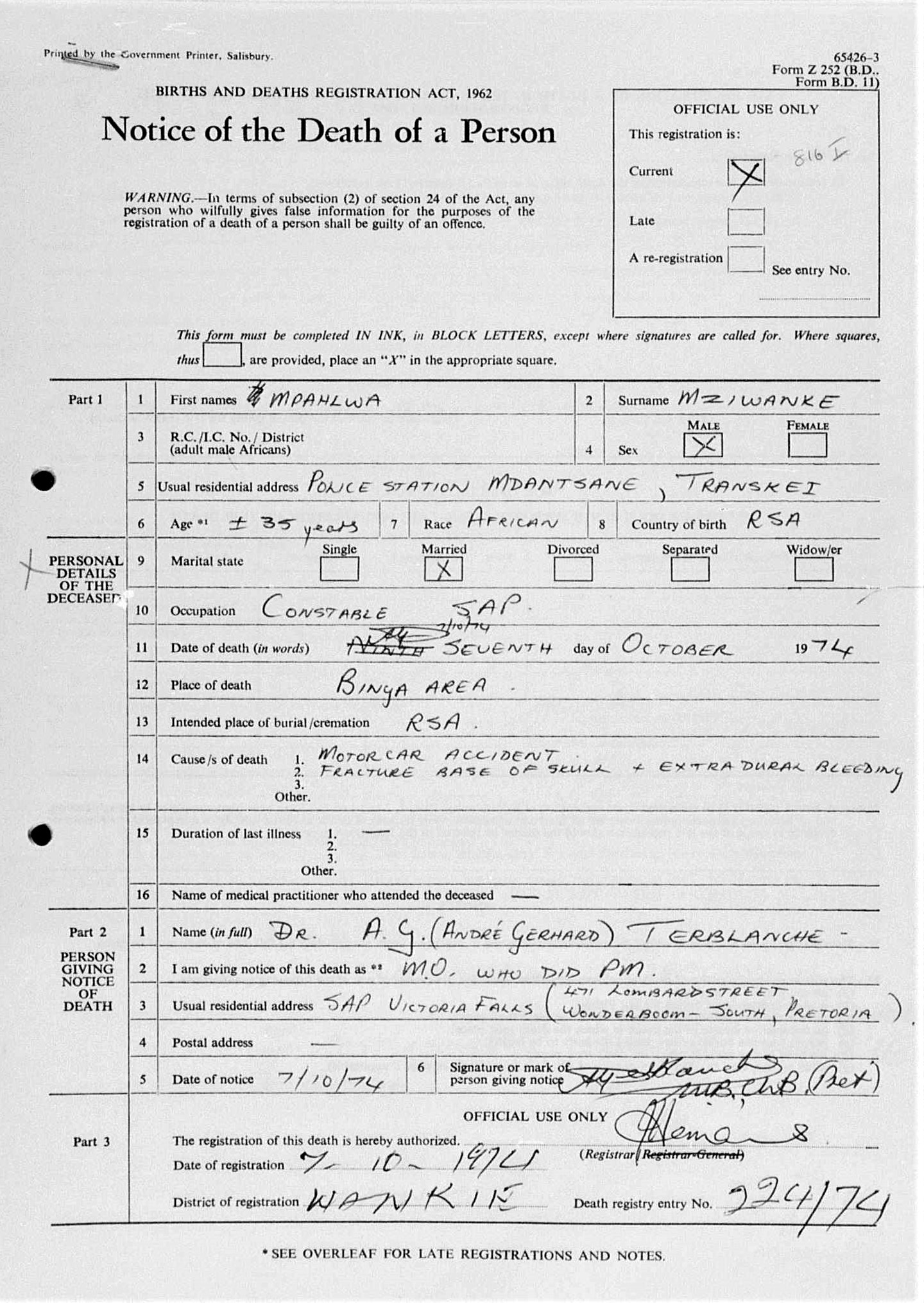
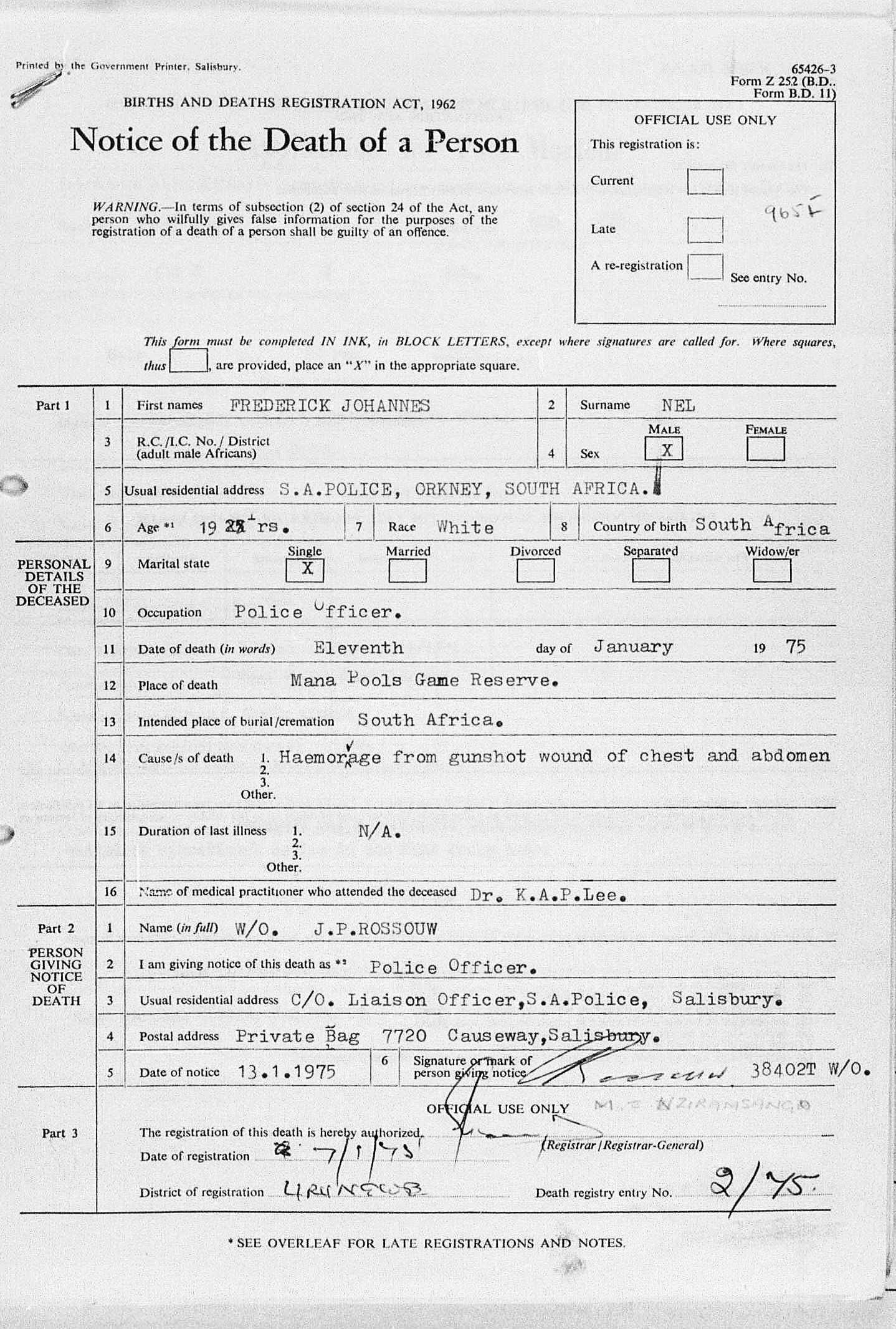
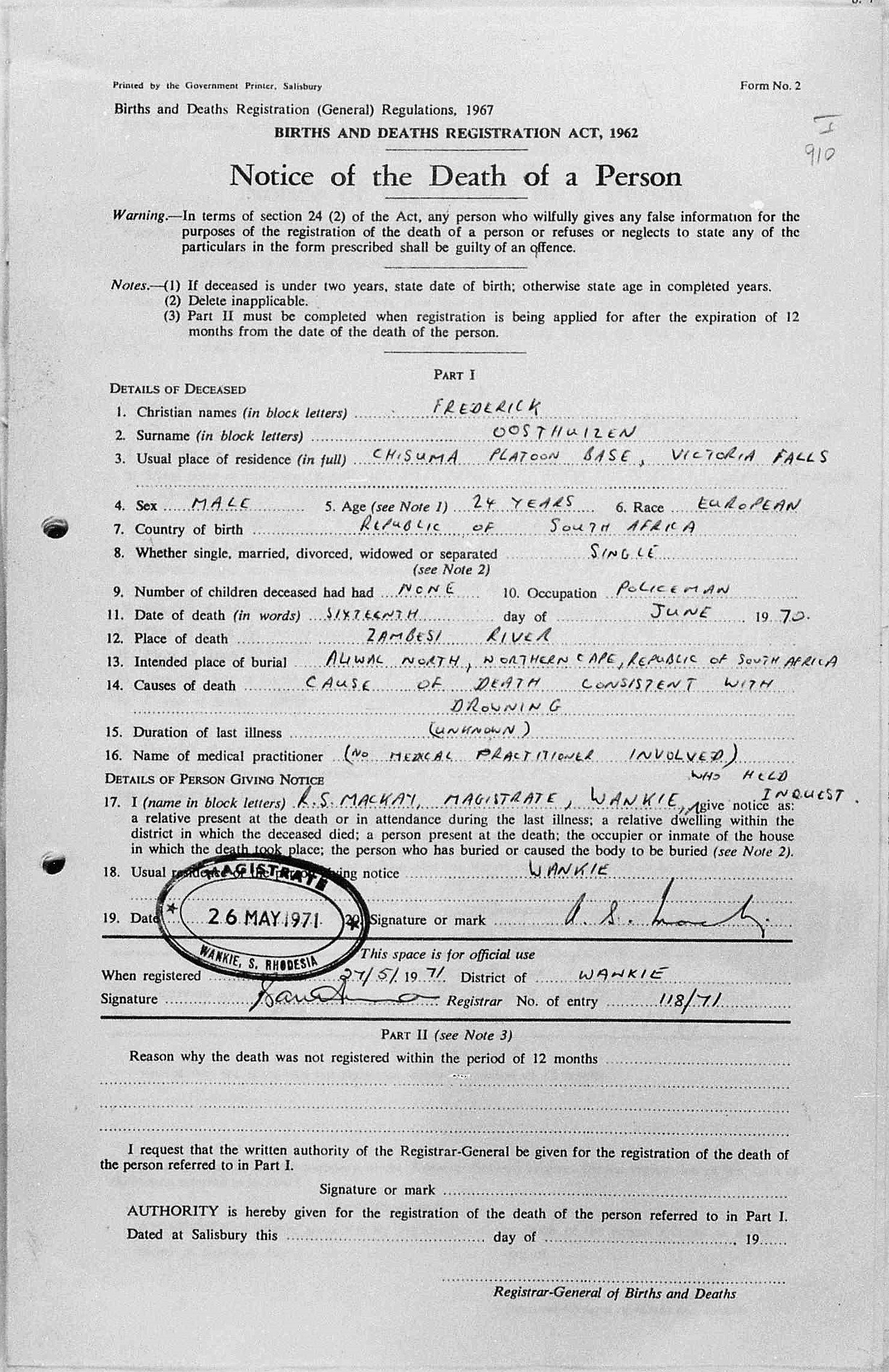
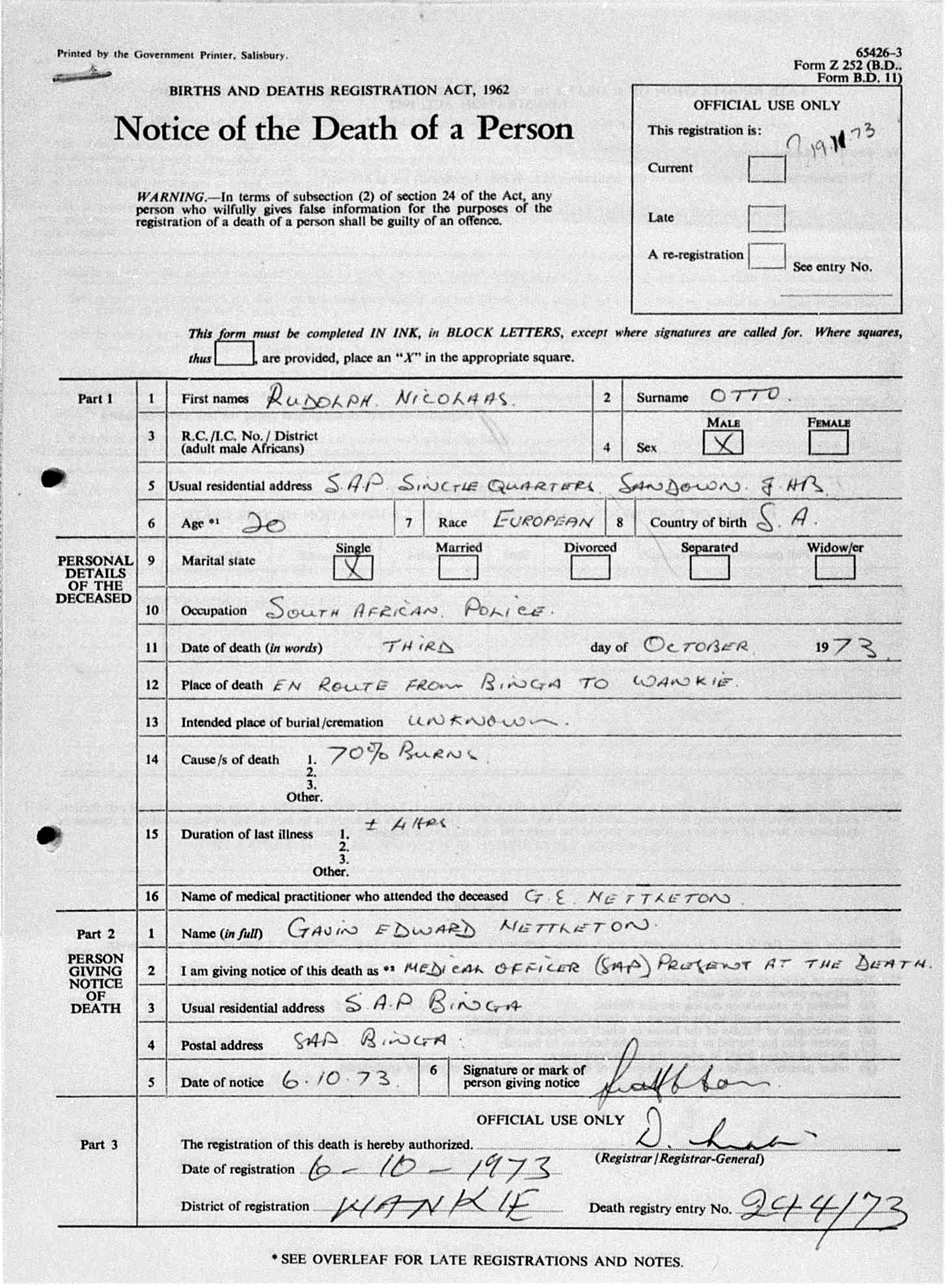
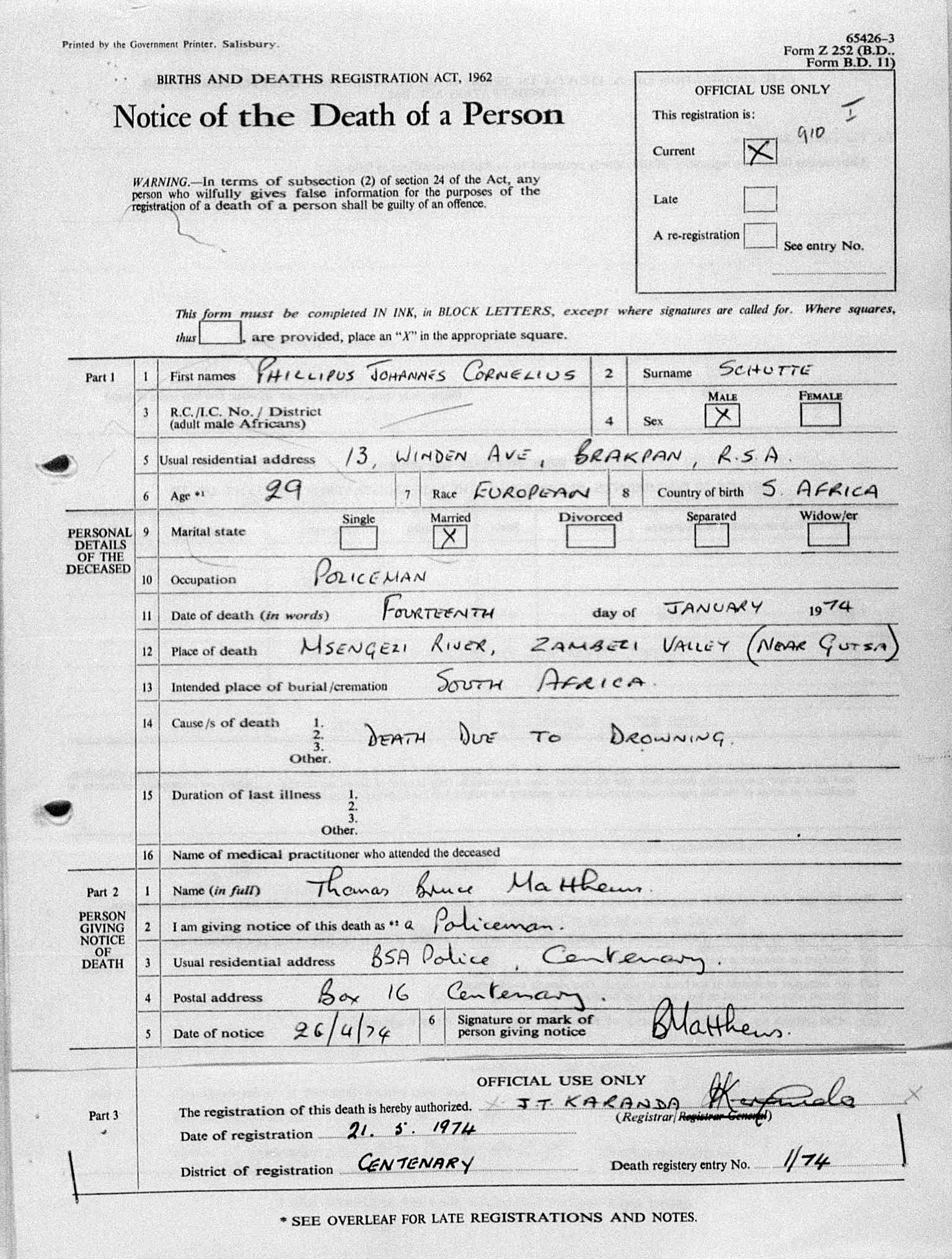
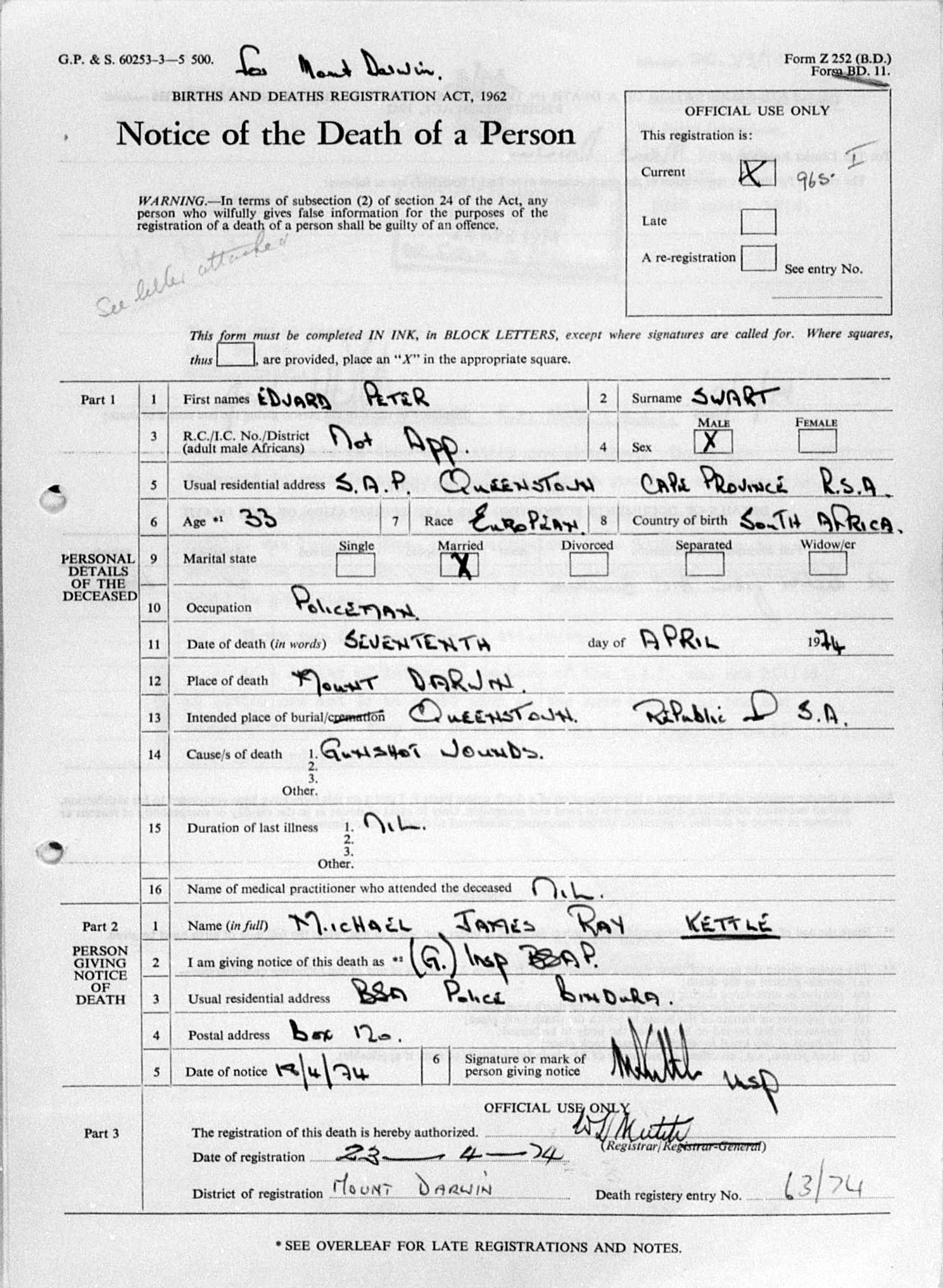
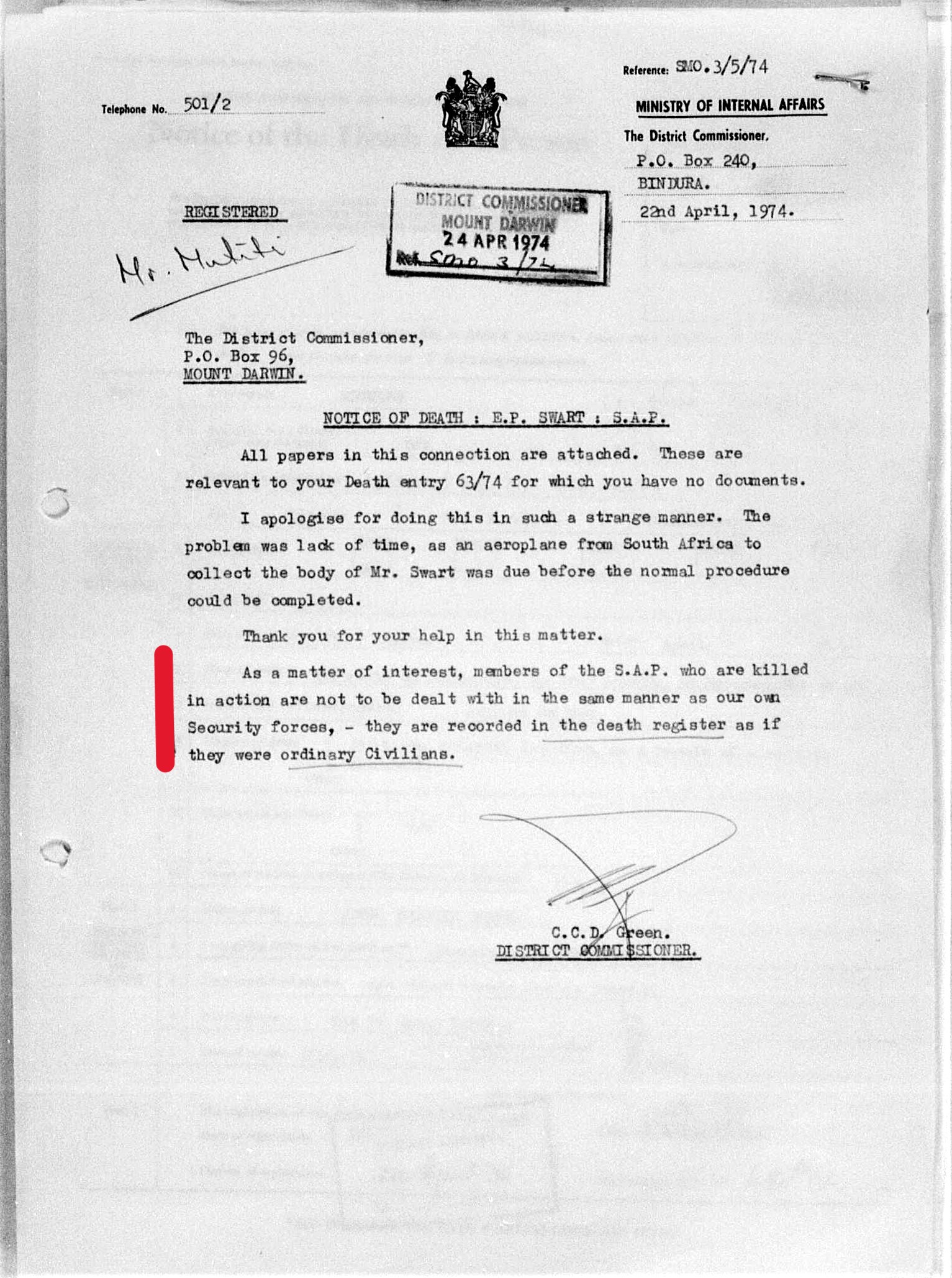
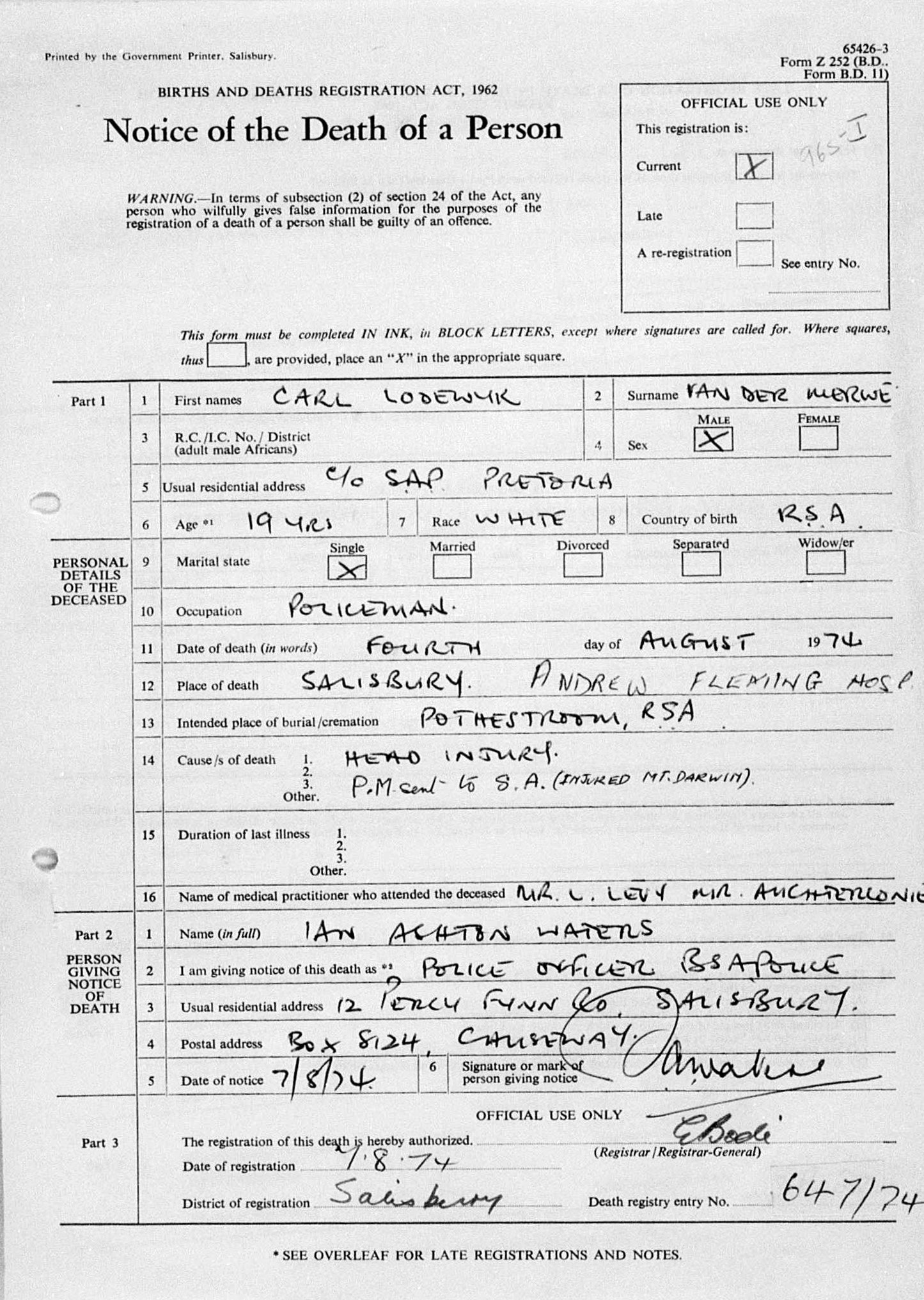
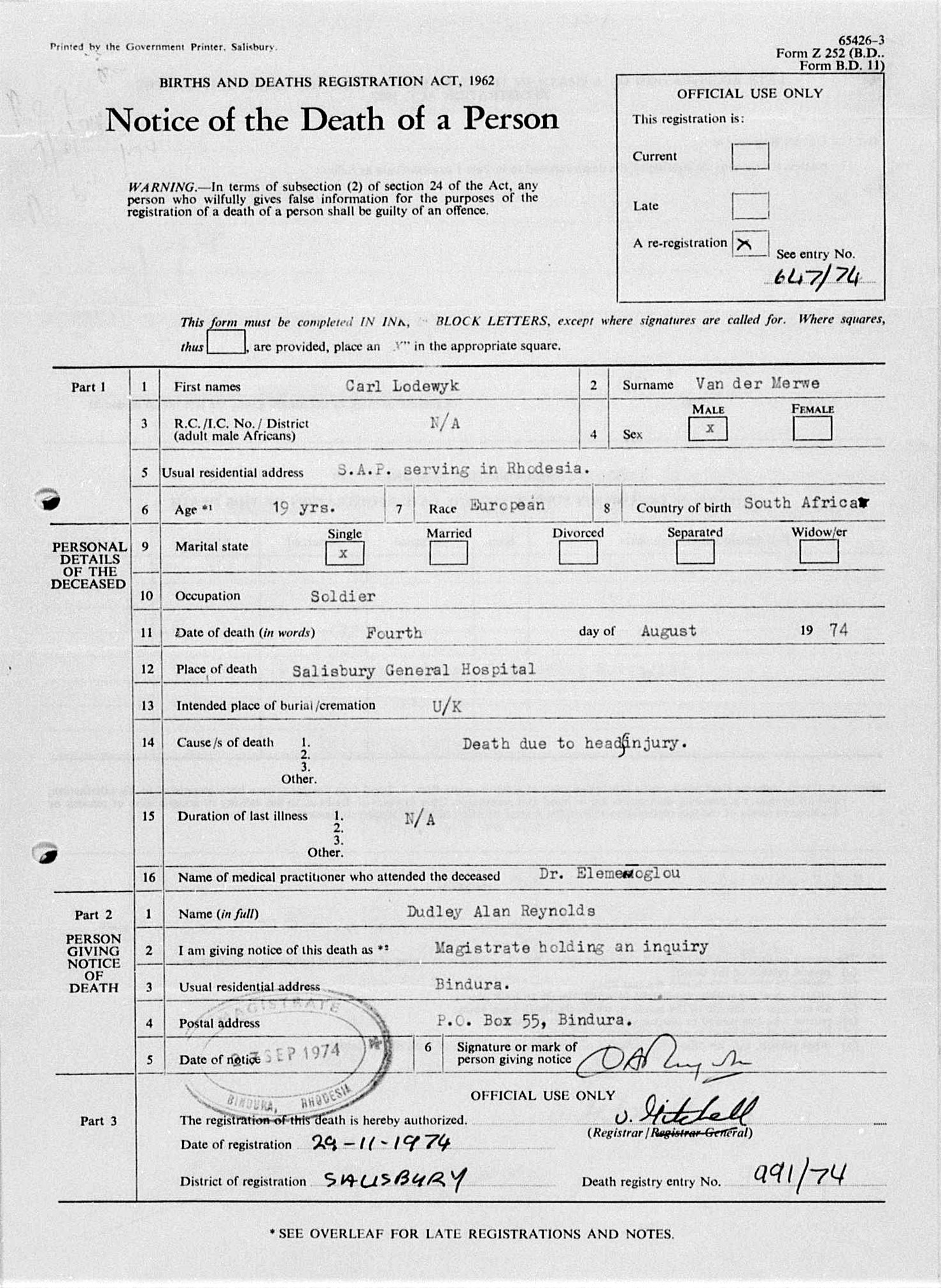
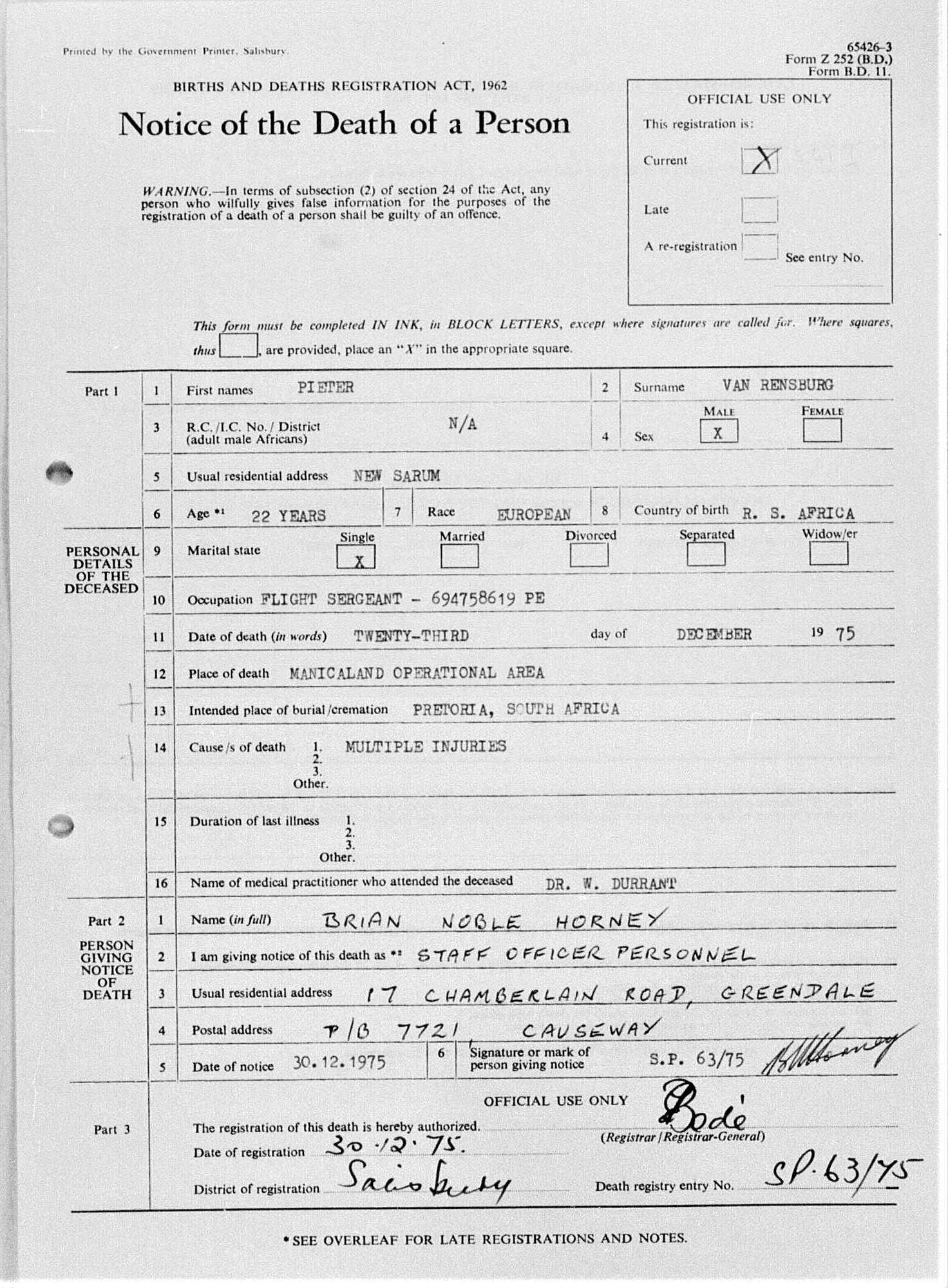
Black and white members of the SAP, part of the PV-programme contingent in Chiweshe in 1974.
In different and darker Rhodesian camo-pattern uniforms are two Rhodesian security forces members.
The bakkie belongs to the SAP. (Nick Baalbergen)
In addition, “a significant contingent of the South African Police (SAP) had been secured and was deployed specifically in support of the initial stages of the operation. Small detachments of Quebec Company, SAP, were posted strategically to PVs throughout Chiweshe”. (Operation Lighthouse, see Sources) Here, they would have fallen under Intaf command, vested with the District Commissioner of the area. They had their own vehicles and tents.
However, “Despite the clear limitations placed on the activities of the SAP [support role] in this operation, Constables Danie Willemse and Solani nevertheless regularly volunteered to accompany Intaf personnel on patrols”. (Operation Lighthouse)
With Vorster’s “detente” initiative in the region from 1974 and increasing pressure from US Secretary of State, Henry Kissinger, the relationship between Rhodesian Prime Minister Ian Smith and his South African counterpart, John Vorster, broke down irreparably at their meeting in Cape Town on 16 February 1975.
South Africa now started pressurising Rhodesia by withholding material aid and hinting at the withdrawal of the SAP, whose morale had suffered through a tragic incident during the ceasefire coinciding with the release of African nationalist leaders in November 1974.
On 23 December six SAP men were stopped on the Mazowe River bridge by apparently peaceful ZANLA whom they presumed to be observing the truce. On request the SAP men put down their arms – and four were promptly murdered in cold blood. Then, to conform with the idea of detente, and to prepare for the Victoria Falls Conference, the withdrawal of the SAP was agreed in principle.
It was shortly translated into action through a bizarre incident in which a Constable Kriel, stationed in the Mount Darwin area, had grabbed a black baby from its mother’s back and slit its throat in what appeared to be a momentary aberration.
The local BSAP (British South Africa Police, Rhodesia’s national police force) arrested Kriel, and they were preparing to prosecute him under Rhodesian law when the Deputy Minister of the SAP, Jimmy Kruger, took Flower to task for the alleged breach of faith between friendly police forces. Kruger appealed to Flower while he was visiting Cape Town to use his influence to arrange for Kriel to be sent back to South Africa. Flower argued that the Rhodesian authorities must go through the formalities of judicial enquiry because the killing was so blatant and had come to public notice. Kruger countered by saying Kriel had a history of mental illness, to which Flower replied by asking why was he therefore serving in the police.
Kruger accused the Rhodesians of never having understood South Africans, adding that they were in Rhodesia trying to help them, yet this was what they were doing to one of their men. He said it was Leander Starr Jameson and the BSAP who started the Boer War with the Jameson Raid, but President Paul Kruger was magnanimity itself in handing back Jameson “to do with as you would.”
South African History Online, 21 March 2011
With respect to Rhodesia, the South African House of Assembly passed the Defence Amendment Bill in March 1973 making it possible for South African forces to be seconded to the Rhodesian forces without loss of seniority or pay.
Truth and Reconciliation Commission Final Report, Vol. 2, Chap. 1, Subsec. 6
From the mid-1960s, the government undertook or authorised a number of defensive and pre-emptive operations outside of South Africa’s borders. The first of these was the establishment of an SAP security police camp in the Caprivi Strip in northern South West Africa in March 1965, under the guise of an engineering company. The camp was under the command of former sabotage squad member, Major Theunis ‘Rooi Rus’ Swanepoel. The role of the camp was to monitor SWAPO activity. Sixteen months later, SAP units were deployed to the area in response to SWAPO’s decision to move its trained cadres into South West Africa. On 26 August 1966, SAP forces attacked SWAPO’s first military base inside South West Africa at Ongulumbashe, marking the beginning of South Africa’s armed intervention in the region.
The first armed campaigns launched by a foreign-based South African liberation movement were the Wankie and Sipolilo [towns in Rhodesia] campaigns of 1967 and 1968 [Rhodesian Operations Nickel and Griffin respectively]. According to the ANC’s second submission to the Commission, its Rhodesian campaigns were launched with the aim of “infiltrating trained MK [uMkhonto weSizwe, paramilitary wing of the SAANC] operatives into South Africa in line with the concept of rural-based guerrilla warfare”. The idea was that MK soldiers would thus create a “corridor” along which to infiltrate guerrillas into South Africa. The campaigns were not a military success and resulted in the death and capture of a number of MK combatants.
In response to this development, SAP units were sent to Rhodesia in September 1967 to assist Rhodesian forces fighting ZIPRA (ZAPU) and MK guerrillas in the north west of the country. In the SANDF’s first submission on the SADF, it was explained that the SAP units were dispatched to Rhodesia “to fight against men who originally came from South Africa and were on their way back to commit terrorism in South Africa”. By 1975, when the police contingent was withdrawn, 2,000 South African policemen were involved in combat operations inside Rhodesia.
Police and Military Counter-Insurgency Operations in Pre-Independence Rhodesia
(Truth and Reconciliation Commission, Vol. 2, Chap. 2)
From the time of the unilateral declaration of independence in Rhodesia in November 1965, the security situation in that country was a major concern of the South African government. With the launch of joint ANC/ZAPU military operations in areas of north-west Rhodesia in August 1967, South African police units were deployed inside Rhodesia where they stayed for the next eight years. As a gesture of support for the 1975 Kissinger diplomatic initiative over Rhodesia, South Africa withdrew its police units but left behind all its equipment, which included helicopters, Dakotas, small arms and ammunition. In addition, the South African government met the costs of 50 per cent of the Rhodesian defence budget for 1975–76. This was followed by [South African] Operation Polo, a secret agreement in terms of which the SADF assisted in the construction of five new military airfields in Rhodesia.
By 1978 the SADF was supplying sophisticated Mirage III fighters and Impala strike planes, as well as Alouette and ‘Huey’ helicopters. It was also secretly deploying troops into southern Rhodesia from bases inside South Africa and sending conscripts to Rhodesia to fight in local uniforms as ‘members’ of Rhodesian army units.
Colonel Craig Williamson told the Commission (3 February 1998) that the South African Security Branch also funded out of its secret account the police counterinsurgency unit, the Selous Scouts [they were not police but special forces], in which numerous SAP members also served.
SAP Special Task Force
In 1967, about 2,000 members of the South African Police were deployed to guard the northern border of Rhodesia (modern day Zimbabwe) to assist the Rhodesian security forces as guerrilla attacks became more frequent during the Rhodesian Bush War. These police members proved to be ill-equipped and ineffective at dealing with guerrilla warfare and terrorism. As a result of these events the Security Branch of the Police began to envision a special police unit to deal with high-risk situations such as hostage situations. Captain J.J. de Swardt of the Security Branch of the Police as well as Sergeant Roelf de Plooy (a counter insurgency (COIN) instructor), both veterans of the deployments in Rhodesia against Zimbabwe African National Union rebels, began a grass roots attempt to form a group of police representatives with a shared vision of formalising a police-based special forces unit. They began to train candidate police officers in survival and bush skills to execute high-risk COIN operations and drastically reduce friendly fatalities.
The members of this ragtag group were required to join the South African Police shooting club in order to acquire R1 battle rifles. Camouflage uniforms were also unofficially acquired. Because this group, who had taken on the name of ‘Bliksems’, was an unofficial group within the Police Force, the normal training facilities were not accessible.
Daily Mirror, 2 August 1975
VORSTER’S MEN QUIT RHODESIA
South Africa is leaving Rhodesian Premier Ian Smith to fight his own battles. Police Minister James Kruger said in Pretoria yesterday that South African police still in Rhodesia were being withdrawn. He added that only 200 were left from the original force of about 2,000. The South African police have been fighting alongside Rhodesian troops against African guerillas since 1972. Eighteen of them have been killed. Premier John Vorster’s regime maintained its men were only in Rhodesia to stop guerillas infiltrating into South Africa. The South Africans now believe that the continued pressure of the police is a stumbling block to the negotiations for a Rhodesian settlement.
CIA [Central Intelligence Agency, USA] Bulletin, 28 August 1973:
A transfer of 800 south African police to Rhodesia in July substantially increases the forces that Pretoria has committed to Rhodesia’s counterinsurgency efforts [redacted]. . . some 1,400 South African special paramilitary police are now serving in Rhodesia.
The transfer of the reinforcements apparently is intended to back up Rhodesia’s counterinsurgency efforts while avoiding open military aid to the breakaway Smith regime that would intensify international pressures against South Africa as well as Rhodesia. Pretoria has long acknowledged that some 250 South African police have been stationed in Rhodesia since 1967 to prevent South African militants who go abroad for subversive training from infiltrating back home via Rhodesia. A quiet build-up of South African police in Rhodesia could go far to offset the shortage of white reservists available for extended duty in the Rhodesian security forces. The. presence of additional South African police probably has enabled the Rhodesians to search out insurgents across the border in Mozambique. There have been indications that Rhodesian units have been operating there regularly for the past few weeks presumably with Portuguese acquiescence.
National Intelligence Bulletin, CIA, 4 January 1975:
On December 24 [23 December 1974], four members of the large South African police contingent serving in Rhodesia were killed while attempting to arrange a cease-fire with a small guerrilla band. A spokesman for the African National Council, which since early December has included the three Rhodesian insurgent organizations, expressed regrets, explaining that cease-fire orders had not yet reached some of the more isolated guerrilla units. Official South African commentary on the killings has been so restrained as to discourage smith from any retaliatory measures that might further disrupt the truce.
National Intelligence Bulletin, CIA, 17 March 1975:
Vorster’s envoys told Smith last January that the South African police who have supported Rhodesian counterinsurgency operations would be gradually withdrawn, regardless of Smith’s claim that they were still needed to counter truce violations. By early March, the South African police in Rhodesia reportedly had been reduced from some 1,600 to 700. Vorster, however, has not yet publicly revised his earlier statements that the police would remain until terrorism ceased, although Pretoria announced last week that they were confined to barracks.
National Intelligence Bulletin, CIA, 6 August 1975:
The South African government’s public acknowledgement on August 1 that all its police forces in Rhodesia are being withdrawn seems intended to underscore Prime Minister Vorster’s impatience with Rhodesian Prime Minister lan Smith’s refusal to begin settlement negotiations with the black Rhodesian nationalists.
South African police had participated actively in Rhodesian counterinsurgency operations until last December, when a truce with black insurgents was arranged by Prime Minister Vorster and four black African presidents. Rhodesian whites are outnumbered by more than 20 to 1, and the shortage of white manpower limits further expansion of the security forces.
Without the South African police, the Rhodesian security forces will be hard pressed if the black nationalists carry out their threat to resume guerrilla warfare unless Smith agrees by October to a settlement conference. The black nationalists insist that the conference take place outside Rhodesia, because several of their exiled leaders might be arrested if they returned there.
Vorster apparently has now come to believe that leaving even a small police contingent in Rhodesia has encouraged Smith to evade meaningful negotiations with the black nationalists.
In their book A Brutal State of Affairs – The Rise & Fall of Rhodesia (see Sources), Ellert and Anderson describe the objectives of the SAP based along the Zambezi River border was to “prevent infiltrations from Zambia.” The first contingent, deployed in September 1967 and commanded by Major van Eck, were based at the Chirundu border where the Otto Beit Bridge straddles the Zambezi River into Zambia.
To mask their true identity the South Africans wore Rhodesian camouflage, especially when in public places, and adopted Rhodesian camouflage livery for their own vehicles. However, Afrikaans, the mother tongue of the majority of the SAP details in Rhodesia, made it near impossible for them to conceal where they were from. Many struggled to even speak English.
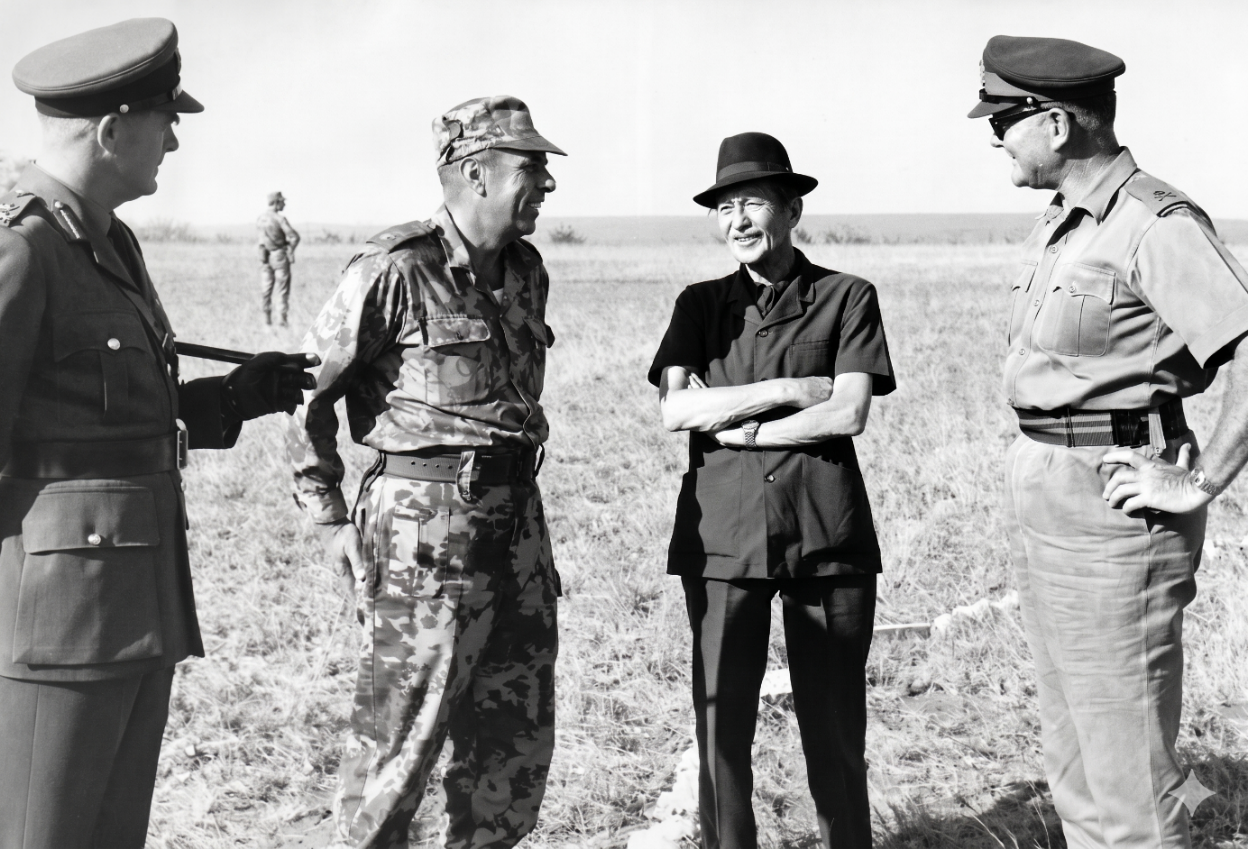
President Dupont visits SAP in a Rhodesian operational sector, c.1972.
L–R: Commissioner of Police Syd Bristow, BSAP; an SAP major; Rhodesian President Clifford Dupont;
Lieutenant-General Keith Coster, Commander of the Rhodesian Army.
(Gerry van Tonder)
Sadly, in a short space of time reports of undesirable behaviour by SAP details in Chirundu and Kariba arrived on the senior desks of BSAP General Headquarters in Salisbury. Game, including rhino, was being poached and Rhodesian National Parks and Wildlife Management Department camps vandalised.
When visiting SAP camps, members of the BSAP and Rhodesian Army “found the atmosphere close to that of a holiday camp”. (Ellert and Anderson) At F Camp, a state safari and hunting area in the Zambezi Valley, SAP found that swinging by a rope from a tree branch before dropping into the crocodile-infested Zambezi excellent recreation. In camp the wearing of only underwear and sandals while lounging on canvas stretchers was the order of the day in the oppressive heat.
The areas in which the SAP operated were either very sparsely inhabited by indigenous tribesmen, or state land set aside for wildlife. As a consequence, mind-numbing boredom quickly set in after their arrival from urban stations in South Africa. Their lack of pre-deployment training at home resulted in a lack of military discipline creeping in during their three-month tour of duty, and first-light tracking patrols became random and infrequent and potentially hostile environmental factors were ignored. However, in South Africa greater importance was attached to the experience that the SAP would gain and apply in the defence of their own country. Training, therefore, improved as time went by.
From 1968 on, a bond of mutual cooperation developed between the Rhodesian Special Branch, BSAP, and the South African Security Branch, SAP. Reciprocal clandestine operations in neighbouring countries benefitted both parties.
Throughout 1969, the number of SAP contingents in Rhodesia continued to rise, with dispositions to Kazungula on the Zambia, South West Africa (Caprivi), Botswana border and to Kanyemba, an isolated spot on the Zambezi in the extreme north of Rhodesia.
Inevitably, as greater numbers of Afrikaans-speaking South African policemen came into contact with Rhodesia’s English culture and encountered vastly more experienced guerrilla-warfare Rhodesian troops, in some units the latter developed a strong disdain for the SAP men. “Slopes” and “rocks” became common monikers introduced by them for the South Africans, including by the many Afrikaans-speaking white Rhodesians. The word “slope” was a direct derogatory reference to the sloping forehead of perceived inept Neanderthal man.
Eventually, to restore harmonious relationships between the two country’s forces, the SAP started sending officers that were proficient in the English language. An early officer to “qualify” was Captain “Gruppy” van Tonder from the SAP’s Cape Town Security Branch, whose presence went a long way to rebuilding cultural bridges (Ellert and Anderson). Another who stood out was English-speaking Detective Sergeant Chris Know from Natal, who brought with him considerable experience gained from his time stationed at Rundu, South West Africa, on the Angolan border. (Ellert and Anderson)
Firsthand Accounts
“SA Police in Rhodesian bush war: Gruesome discovery”, Nongqai, 16 January 2024
(By Rhodesian Army Officer, Major Don Price. Kind permission Hennie Heymans)
One of my first deployments at Kariba at the beginning of October 1974 was when Pete Clemence, Stretch Franklin, Hennie Pretorius and I reacted to an attack on some South African policemen deployed in the Zambezi River Valley in the vicinity of ‘C’ Camp downstream from Chirundu. It was still dark when I was summonsed to the Signals Office of 2 (Indep.) Coy. It had sounded urgent so I ran the short distance down the hill from Tracking Wing to find out what the problem was. Major Harry Harvey was waiting to brief me.
“Don, I want you to quickly assemble a tracker team for deployment into the Zambezi Valley. As you know, the SAP lads are deployed down there but the Coy HQ based at Chirundu is unable to make contact with one of its call-signs out on patrol along the river. There have been reports from local fishermen of heavy small-arms fire coming from their general direction so I want you to check it out. A Cyclone 7 (G-car) [No. 7 Squadron, Rhodesian Air Force, Alouette III helicopter] will be up here from FAF 2 [Forward Air Field] in approximately thirty minutes to fetch you guys, so you don’t have much time.”
After giving orders to Rob Johnstone, my WO 2 [Warrant Officer Class II) and 2-i-C, I left him with Pete to continue with the running of the current tracking course and jogged down to the single quarters at the barracks where I briefed Pete, Andre, Stretch and Hennie. We were all ready to go almost immediately. The promised chopper arrived soon after and we emplaned in the parking lot on top of the hill.
Soon we were thundering out of the Army Camp, dropping into the Zambezi River gorge and flying at breakneck speed low level, right on top of the trees. It was not long before the Chirundu Bridge came into view with the SAP Company base clearly visible on top of a small hill.
We crossed the main tar road from Salisbury to Lusaka with the bridge to our left, then we swooped down over the river and on we sped at low level. When we reached the approximate area, the pilot pulled up and as we began a wide orbit, I signalled the lads to look out for the SAP on the ground.
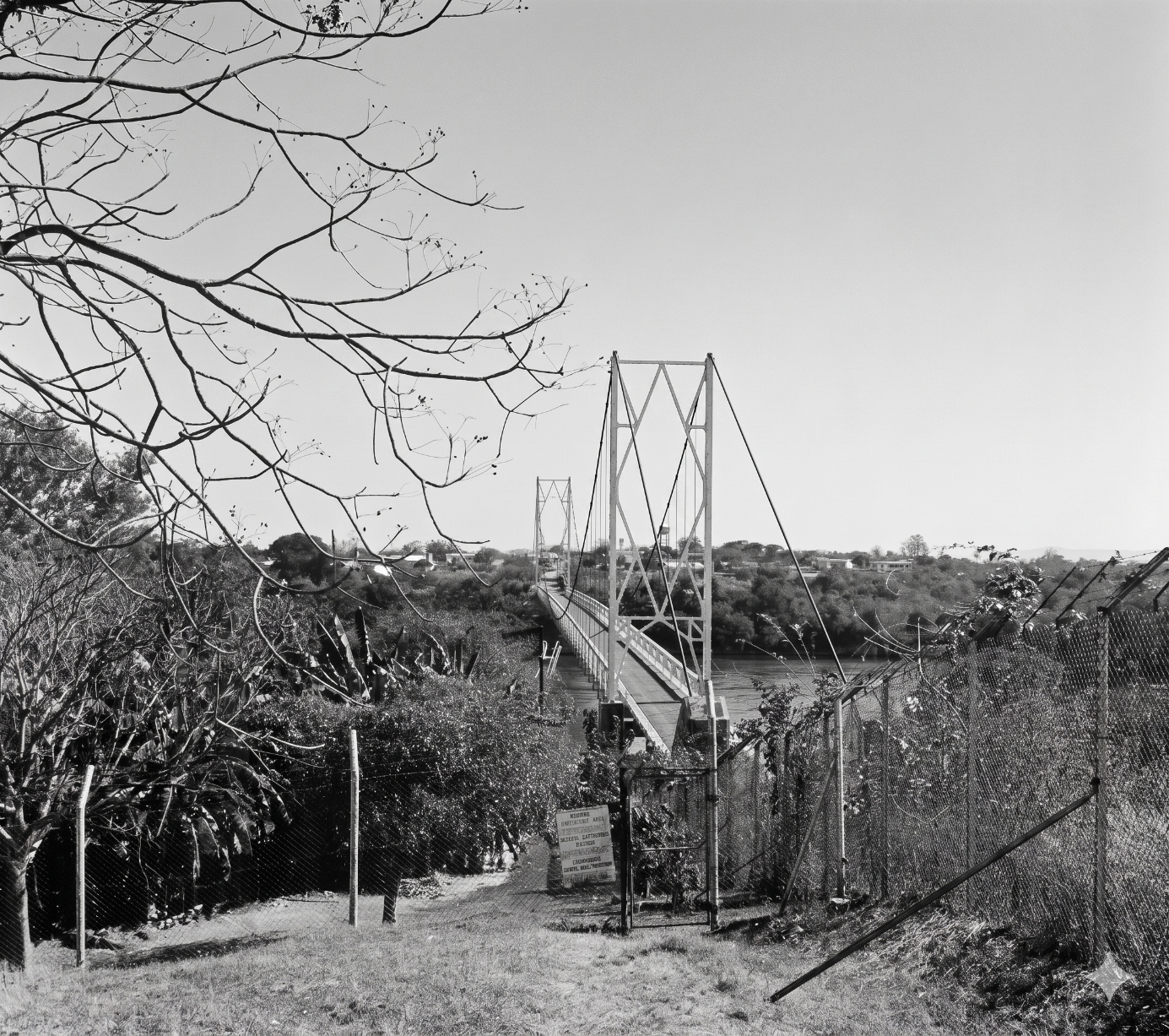
The Otto Beit Bridge spanning the Zambezi River at Chirundu links Zimbabwe with Zambia.
The photo was taken from the BSAP camp. (Gerry van Tonder)
Suddenly the tech yelled, “Over there!” and pointed back towards the Zambezi. “See that burnt out area?” The pilot banked sharply and the blades beat the air making a thudding noise. On high alert now, we scrutinised the bush below which was predominantly mopani woodland with the occasional baobab tree. Sure enough, we could make out a charred area about 100 metres back from the Zambezi River bank.
As we circled the pilot tried to raise the [SAP] call-sign on the ground. Suddenly Andre shouted to me, “Ishe!” [Sir!] and pointed downwards out of the open helicopter towards the burnt area.
I strained my eyes and then, there in amongst the burnt vegetation, I could make out what appeared to be charred and burning bodies. Before landing we circled once again just to make sure the area in close proximity was clear of the enemy.
The chopper flared, and with its nose up we settled in a small clearing, clouds of black dust billowing around us, an aftermath of the fire. Immediately the pilot’s head dropped and he nodded vigorously which was our signal to deplane. We hit the ground running and, with weapons cocked, positioned ourselves a short way from the aircraft all facing outwards in a 360 [degrees]. The chopper then lifted and headed off north to gain altitude and cover the river for us.
The scene that awaited us was not pleasant. We could clearly see where the SAP contingent had bedded down around a small camp fire. They must have taken their clothes off, as naked half-burned bodies twisted in grotesque forms dotted the area and in some cases the brown issue nylon sleeping bags had melted and stuck to their remains. These there were all dead and there appeared to be no survivors.
We scouted the area and picked up where the group, numbering possibly six terrs [terrorists, insurgents] had beached their rubber dinghy a short distance away and approached the sleeping SAP patrol. It was obvious from the empty 7.62mm intermediate cartridge cases found around the bodies that the terrorists had opened up on the SAP men from close range. There was no evidence that any fire had been returned. Their kit and equipment had been looted by the enemy who had got away with weapons, webbing, backpacks and possibly even radios. Items deemed non-essential littered the surrounding area.
I radioed our findings back to the chopper orbiting above. I was contemplating our next move when, pointing northwards Hennie Pretorius called, “Ishe, looks like two SAP men have gapped it [ran] into the bush.” We joined Hennie and sure enough, even though the ground was stony and far from ideal for tracking, we could make out scramble marks, foot prints, with toes splayed, strides wide apart, confirmation that two men had escaped running from the carnage of the surprise attack.
“Okay guys, here’s the plan. I will call for pick-up while you three attempt to track and follow the SAP. It’s imperative you locate them, as by now they must be completely lost and desperate. I’ll help the tech load the bodily remains and we’ll get them back to Chirundu where I’ll refuel and return asap.”
Flying due north on the last known direction as we returned a few hours later it was not long before the chopper radio crackled to life and I received a sitrep [situation report] from Andre. The night of the attack had been extremely dark with no moon and apparently the two surviving SAP had run astride of each other about twenty metres apart. My guys had followed the tracks for about ten kilometres to a point where the two men had become separated.
We soon located the follow-up group from the air and searched ahead in the general direction the SAP must have run. Suddenly the radio burst back to life: “Chopper, chopper. . . kom in, kom in!” [‘come in, come in!’ in Afrikaans] came the frantic shout. “Chopper! Jy moet land!” [‘You must land’]. Amazing they had a radio!
We continued to circle and finally the chopper tech spotted a naked figure huddled next to a tree. We landed and the poor guy was a sight to behold. His body was all scratched up from running through thorn bushes, his bare feet a complete mess, bloody and so swollen that he could hardly hobble to the chopper. The poor guy was extremely traumatized. When the tech covered his shoulders with a red emergency blanket we noticed how badly sunburned he was. His back was one big blister, whilst his neck, arms and torso were crimson and burning hot. He was so dehydrated he couldn’t speak.
It took three more hours for tracker Team Tango to locate the second policeman, who was in a similar state to his mate. The chopper flew the two casevacs [casualty evacuations] to Chirundu whilst we found some shade under a pod mahogany tree and waited for our ride to return. Apparently members of this SAP patrol had been told not to show themselves on the river but they had disobeyed this order and paid the price. The ZIPRA [Zimbabwe People’s Liberation Army] terrorists had watched them from the Zambian side and then when the time was right, crossed over in their rubber raft, walked a short distance and killed them while they slept.
Initially the SAP training was not adequate for the task and the men sent on border duty did not really know what they were getting themselves into. These were city policemen, who had probably never been in the wilds before (fortunately, their training improved as the Rhodesia bush war progressed). Tracking Wing assisted the SAP as trackers on many more incidents in the Zambezi Valley, but thankfully none of the call-outs were ever as bad as finding that lost patrol.
In summing up, it is assumed that in the early hours of Tuesday, 1 October 1974, a ZIPRA gang crossed the Zambezi River 30 kilometres east of Chirundu and staged a hit and run attack on the sleeping South African Police patrol. Their grenades killed two policemen, Constables L.J. Buys and M. Erasmus, and seriously wounded two others as well as setting the area ablaze and charring the bodies. The patrol had not posted sentries. The gang had then crossed back to Zambia.
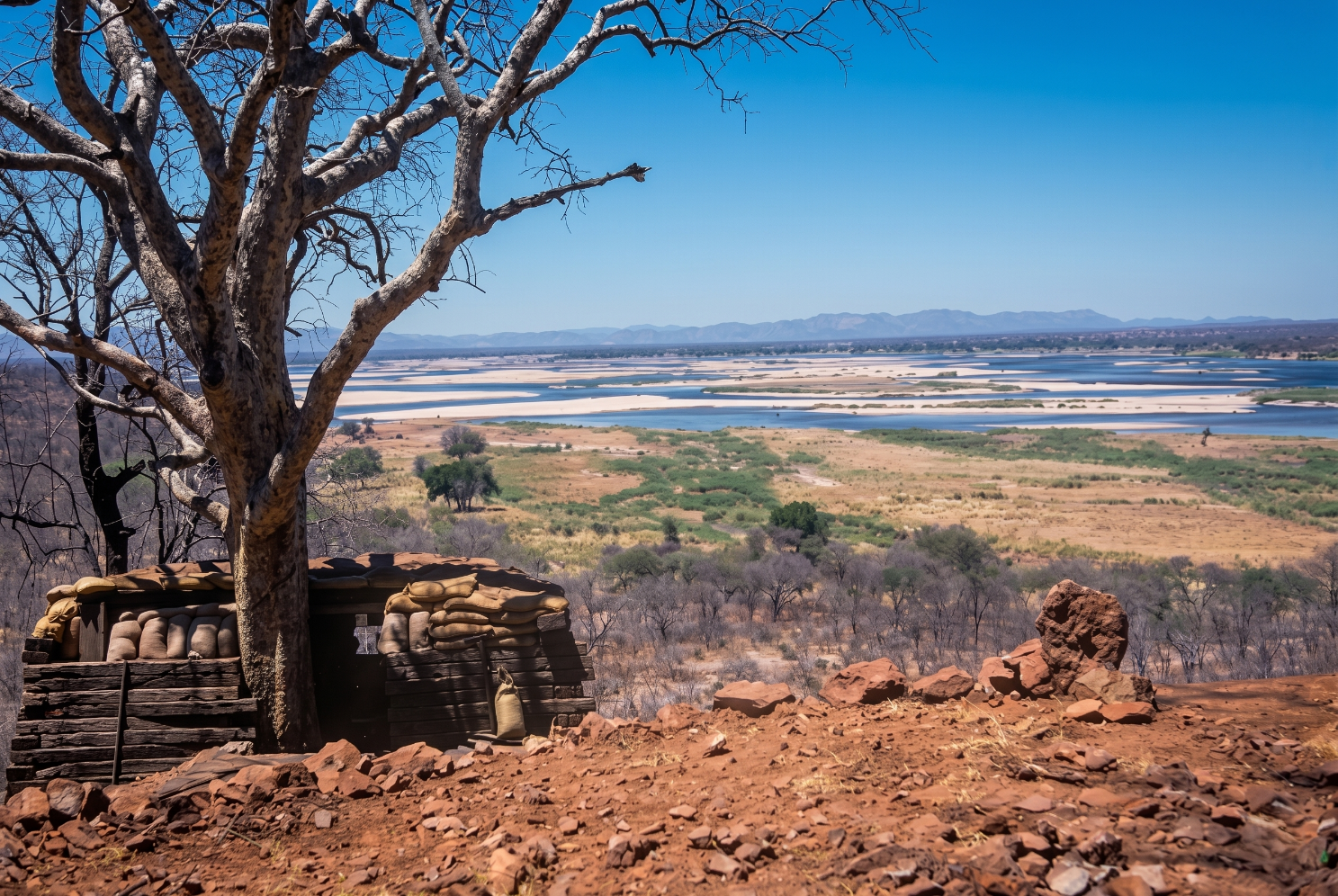
An SAP camp bunker overlooking the Zambezi River floodplain. (Facebook)
Former BSAP member Dave Soper
I was involved with the SAP to a limited extent in 1974. I would think that if they were not under the actual control of the BSAP, then their liaison with the BSAP members would have been very close.
When those four SAP men (and one Support Unit member) were killed by ZANLA man Herbert Shungu and his CT group on the Mazoe Bridge in Rushinga district [23 December 1974], I was deployed to that bridge not long after the deaths of these men. I was a PATU [Police Anti-Terrorist Unit, BSAP] Section Leader, with a Black Group Section deployed out of Bulawayo.
The bodies had been removed by the time I got there, but the fact that I was deployed to the bridge would indicate some degree of cooperation and interaction with the SAP. I cannot now remember the exact reason that I was deployed to the bridge, it may have been possible body recovery for the Support Unit man [Constable Mutasa Mandaza, whose body was never recovered].
I believe that the SAP were either from the same basecamp as we were operating out of (I cannot remember the name of the basecamp), or their camp was very close to ours. I was not familiar with any of the Mashonaland Province bases, I was a Matabeleland Province oke [man].
Following on from the deaths of these five men, I was deployed into the field with an SAP section attached to me and my section. They were under my command, something which they were not particularly happy about. I was a pretty young PATU section leader, so they were probably completely justified in that. Some of the SAP men were probably senior in service to me. This would tend to indicate that they were under overall BSAP control.
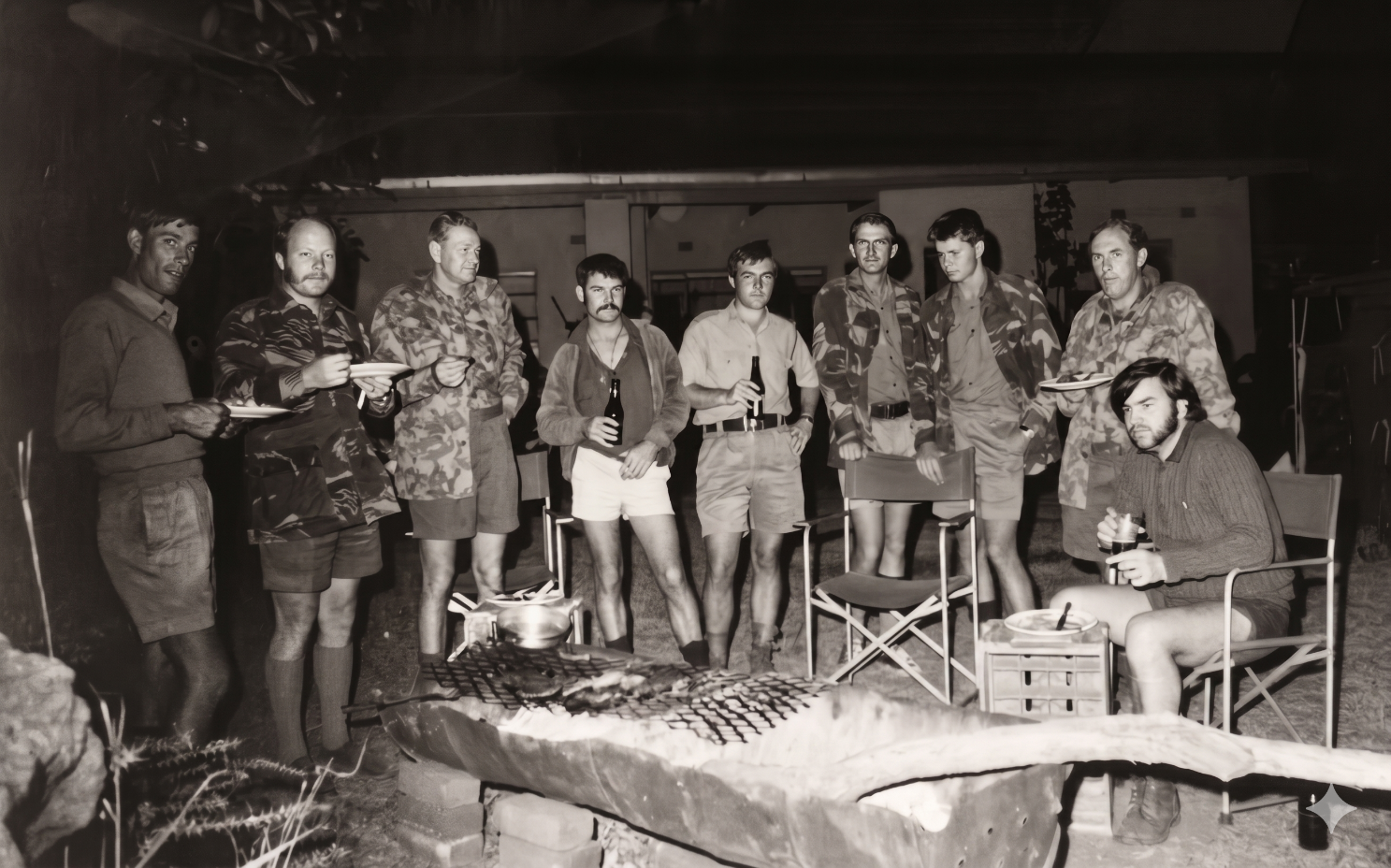
Members of the BSAP and SAP enjoy a braai together at the Rusambo/Rushinga camp.
Two of the SAP details, 3rd and 8th left, latter are wearing combat jackets in the distinct
South African camouflage pattern.
(Gerry van Tonder)
During this deployment we walked straight into a well-sited ZANLA ambush, one black civilian walking at my side was shot in the contact. When the firing started the SAP section took off into the bush away from the contact area and took cover in an area some distance from us. When the ZANLA group departed they dropped either some mortars or some RPGs [rockets] towards our position which went over us and landed amongst, or close to, the SAP men. When the firing had stopped the SAP section returned to my location. They then said to me that they were not going to engage in any further patrolling duties. These SAP men had lost a number of their comrades a short while before this, and they were not operating in their own country, so SAP morale was at an all time low.
I then had to communicate their refusal to continue patrolling to whoever was in charge of our basecamp, who would have been a senior BSAP member. We were then allocated to different gomos [kopjes] to get onto, and all of us, SAP and BSAP were put onto OPs [observation points]. We were all on the same BSAP radio channel.
During this time on the OPs there were several SAP callsigns also on OPs, and they communicated their distaste of their situation in conversation over the radios. They were on our BSAP channel. A command was issued that these conversations were to cease, but that did not happen – they continued but without any callsigns being used.
All of what I have written of here would indicate that these SAP men and their deployments were controlled by members of the BSAP. I would think that their logistics (rations, etc) in their base were handled by themselves. I did mention on one of the military groups that one of the main manne for the SAP at this time was a gentleman by the name of de la Rosa (spelling?), so I must have learned his name around the basecamp during this period, so we must have been together or close.
In 1975 I was based at Binga and there was quite a strong SAP presence there. They did have close comms with the BSAP there, but I do not believe that they were under BSAP control. They did liaise closely with BSAP though at this time. I believe that these SAP men were on some kind of radio monitoring operations at this time*. They did have some operational bases in the Binga area, and those would have been operated solely by them.
(*see ‘South African Radio Traffic Interception in Rhodesia’ below)
Former SAP Bert van der Vlugt
When I was deployed doing “Teams”, duty round 74 we had SAP dog handlers operating from our base camp at Rushinga. Rushinga and Rusambo fell under JOC Mt. Darwin at the time. I hit my first land mine sitting on the back of a RL truck travelling between Mt. Darwin and Rusambo.
Former SAP Leon Strauss
1975, we were withdrawn to Centenary East airfield. There were 5 companies there; this was the time a group of SAP troops were stopped and disarmed and then were shot on a bridge on the Ruya/Mazoe river (cant remember, which, sorry, old age), supposed to be a ceasefire in effect, but cowardly terrorists took this opportunity to murder. I was in Bravo Company, we were mightily pissed off, and returned home shortly after. I did 2 tours in Rhodesia, 73/74 and 74/75, 3 months and six months, Juliet Coy at Rushinga and Centenary, Centenary east, 6 months.
South African Mbulelo Baloyi
In the 70s and 80s South African Police would do what was called “Border Duties” and my elder brother often did this when they would do periodical call ups as serving SAP station based members and would be clad in the camouflage uniform now solely used by the SAPS Special Task Force. These so-called Border Duties were nothing but counter insurgency activities against combatants of the liberation movements to stop them from infiltrating into SA.
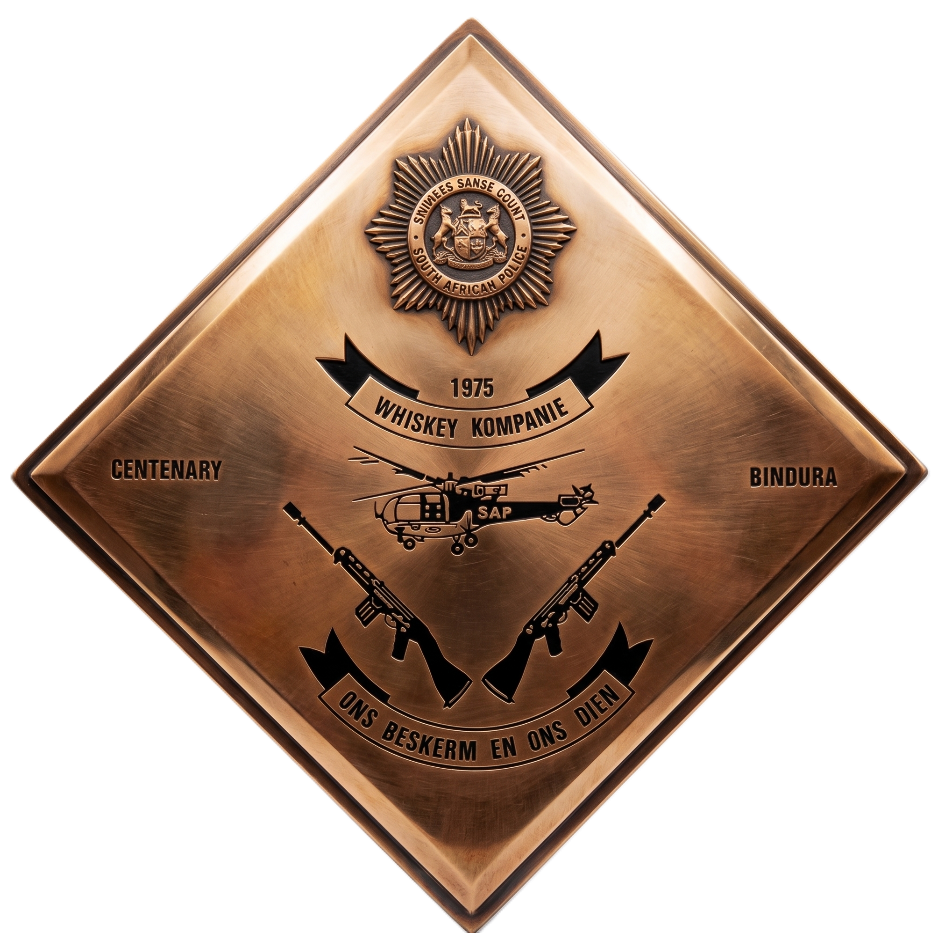
Whiskey Company, SAP, 1975 commemorative plaque of service at Centenary and Bindura, Rhodesia.
Former SAP Al Kennedy
I was SAP Special Branch Mtepatepa, JOC Bindura.
Worked with BSAP SB [Special Branch] Harry Naismith and BSAP GC [Ground Cover] Denbigh Hopkins.
Former SAP Greg Deegan
I was told by a senior BSAP official that we were merely cannon fodder. That jarred, because we lost friends and colleagues in the conflict.
I also acknowledge that there were fools and bad eggs among the SAP contingents. As there were among the Rhodesian forces. As one is apt to find anywhere.
An interesting fact is that about 5000 SAP members served in Rhodesia. Initially, the system was that each Division was told to send a certain number of members for duties every three months. This filtered down to districts and stations. So, who would station commanders send? Not their best workers, of course. So the SAP contingents would be made up of a lot of station rejects. And the good guys amongst them knew that! Even the top brass was aware of this fact, so in 1972 the system was changed to a volunteer system only, on a six or twelve month basis. The quality of members going to Rhodesia greatly improved because the men who went there wanted to be there!
Former SAP/BSAP Derek de Beer
I did three camps 68,69,70 whilst in the SAP. . . moved to Rhodesia in 72 in BSAP, left 76 PATU. In the mid-nineties I made enquires about the SAP Medal for Combating Terrorism, told that all records had been destroyed of SAP service in Rhodesia!
Internal Affairs Assistant District Commissioner Jim Collins
When I moved to Gutsa in 1973, as acting ADC, there was an SAP Company that was represented on a mini-JOC that was chaired by myself. They and I would receive occasional visits from Brigadier Bertie Barnard [Rhodesian Army], then commander for JOC Hurricane.
This worked fine to begin with, but the SAP Companies changed every 3 months, and the CO of the last one, which arrived shortly before I left in April 1974, informed me that he was taking his instructions “from Pretoria”.
They were company strength, led by a Major. When I arrived in August 73, it was Major de Beer. I can’t recall the name of the second Major, partly because his 2-i-c did most of the operational leadership, and he was Lt Nick van Niekerk.
The third Major (Strydom?) was of a different mindset to the first two. We spoke little apart from when he set up a rifle range across the road between the Gutsa airstrip and our Intaf [Internal Affairs] camp at the Gutsa irrigation scheme, which I had to explain to him created safety problems for road users such as myself.
South African Radio Traffic Interception in Rhodesia
In his autobiography, Soldaat en Mens, General Georg Meiring SSA SD SM MMM, the last Chief of the South African Defence Force (SADF) as well as the first Chief of the retitled South African National Defence Force (SANDF), speaks of South Africa’s involvement in Rhodesia.
By the mid-1960s, radio traffic interception now became very important, especially with developments in South Africa’s neighbouring states: Rhodesia, Angola, Mozambique and South West Africa (now Namibia). Rhodesia and the Portuguese in their colonies of Angola and Mozambique found themselves in an ever-increasing fight against armed resistance movements. When the South African government made the decision to deploy the SAP to protect South West Africa’s northern border, it was also later decided to deploy elements of the SAP to Rhodesia to support the Smith government.
Attached to Defence Headquarters (DHQ) Signals Squadron, Corps of Signals officer Major Georg Meiring was appointed to the Project Cactus steering committee for the training of radar engineers in the latest technology for the detection and tracking of aerial targets. The South African Army had a requirement for the acquisition of a mobile air defence system against low-flying aircraft for the protection of formation headquarters in the field. The committee would monitor the project and report progress, while ensuring that operational requirements were met.
Two challenging requirements of Project Cactus was that the system had to be mobile and would be able to accompany a formation in the field. This meant that this highly sophisticated system had to travel where the vehicles of a brigade and/or division did. This therefore meant that the vehicles had to possess adequate all-terrain capabilities, as well as be transferable by air. From the electronics side, the inside of the vehicle had to be like a cabinet, with no protrusions or obstructions. A special electrically powered vehicle was then developed, which would meet all the mechanical and electrical requirements.
Following discussions, first at the corps level and then at the defence forces’ level, and approval by the two governments, the DHQ Signals Squadron received authorisation to set up listening and direction-finding stations in the then Rhodesia (now Zimbabwe). Initially, this was only in the capital Salisbury [now Harare] to strengthen Rhodesia’s capabilities, and also at a Rhodesian army company base at Chirundu, right on the border with Zambia. This was known as Operation Falcon.
According to Meiring, with their deployment in the region, the SAP did not really possess the skills to conduct such operations, so a number of South African Army officers and troops were attached to the SAP. Identifying an opportunity, Meiring received authorisation to go and test the new radio sets at Ondangwa in South West Africa. It was also the headquarters of the police element. Meiring writes,
While we were busy with testing radios, we bumped into a bunch of disgruntled army officers, who seized the opportunity to apprise us of their displeasure over the way they were being treated by the police. I still fail to understand why the top structures did not take cognisance of the fact that the SAP and the SADF operated in different ways and doctrines, and were not capable of working together as an integrated force. I conveyed the grievances of the deployed SADF elements in my report to Army Headquarters, which may have contributed to an improved work split later on.
Apart from the initial problematic support of the SAP, at first the SADF was not involved in border protection. In time, assistance was rendered to the Portuguese from Rundu, especially with air support in the form of Alouette helicopters. An army company was then deployed to Rundu on base protection duties.
However, because of the distances involved, I was unable to reach every spot much more than once a month, but this was sufficient, especially if one grew into the habit of starting each day with a fresh pair of eyes. For example, I started to fly with the Hercules C-130 ‘Vlossie’ (the routine replenishment flight) as far as Rundu, and from there with a Cessna 185 to Katima Mulilo where I would board another Vlossie to the Victoria Falls. From here, with a Rhodesian Air Force Dakota (given the sobriquet of ‘Vomit Comet’, as it would fly at low level and during the heat of the day, with the resultant extreme turbulence tending to cause some to become airsick) to Binga on Lake Kariba. It would then again be with light aircraft, this time to Chirundu on the Zambesi River border with Zambia, and then on to the Rhodesian capital, Salisbury, from where I would catch a commercial South African Airways (SAA) flight back to Jan Smuts International Airport, Johannesburg.
At the time of the operations in the Zambesi Valley, the area was largely unpopulated and was a wonderful refuge for a diversity of wildlife. From the air, one could get breath-taking views of large herds of elephant, buffalo and other animals.
After thorough consideration and in situ investigation, it was decided to also establish a listening station at Binga, on Lake Kariba in Rhodesia. At the time it was also a Rhodesian army company base. With the deployment of South African troops in Rhodesia, for security and logistical reasons they passed through as Rhodesian troops, and not as members of the SAP. However, political exigencies would dictate that, as with the SAP, South Africa’s listening stations at SAP camps were withdrawn, as Meiring relates,
Something that was very difficult for me to comprehend was the decision taken between the governments of South Africa and Rhodesia to withdraw our attempt at electronic warfare in Rhodesia, and to only continue with our presence in Salisbury. As the one who introduced the scheme in the first instance, I had to go to officially terminate the deployment. This was done at a formal function in Salisbury; something which saddened me. Almost like when your children leave home. This took place in June 1976.
During his numerous visits to Rhodesia to inspect electronic warfare stations in the country, Meiring walked about in a Rhodesian Army uniform with the rank of lieutenant-colonel.
A Rhodesia Herald Chronology from 1973–75
1973
8 January: two SAP killed [Cst Owen DURRHEIM, Cst Siegfried MARX] and five injured in a landmine incident on 8 January.
20 January: SAP and Rhodesian security forces fired on by Zambians at Chirundu, the third time in four days.
25 January: three SAP injured in a landmine incident “on the border”.
24 March: one SAP injured in landmine at Chirundu.
28 September: SAP attacked by terrorists in northwest Rhodesia, and in a fierce fight, one SAP wounded.
5 October: one SAP killed [Cst Rudolf OTTO] and four wounded on 3 October.
1974
11 March: five SAP killed [Cst Willem CONRADIE, Cst Zacharias HOUGH, Cst Johan KUHN, Cst Erhard STRYDOM, Cst Robert SWART] 10-12km west of Victoria Falls on 8 March.
11 April: 100 SAP to reinforce those on the border at Victoria Falls.
19 April: one SAP killed [Lt Edward SWART] in northeast on 17 April.
6 August: SAP man [Cst Carl VAN DER MERWE – cause unknown] dies of injuries on 4 August.
6 August: one SAP [Cst Jacobus CLOETE] dies of wounds.
21 September: more SAP on Mozambique border.
3 October: two SAP killed [Cst Louis BUYS, Cst Michael ERASMUS] in Rhodesia in skirmish on Tuesday 1 October near Chirundu.
5 October: Zambians fire on SAP patrol boat near Kazungula.
7 October: on 24 September SAP boat on Zambezi fire on near Kazungula – fire returned, no casualties.
6 November: Vorster denies putting heat on Rhodesia; SAP to remain as long as there is a threat to South Africa.
12 December: Headline: ‘Terror War Over’. Smith agrees to release leaders of banned organisations and constitutional conference without preconditions. SAP to quit when terrorism ends.
27 December: four SAP [W/O Jan DIPPENAAR, Sgt William DU PLESSIS, Cst Lourens ERASMUS, Cst Louis FRANKEN] killed in ambush at Victoria Falls on 23 December.
1975
4 January: one SAP killed [Sgt C. MEYER] and six injured by a landmine.
13 January: one SAP killed [Cst Johannes PETZER] and five injured by a landmine on 3 January.
2 February: some SAP withdrawn following Zambian government undertaking. [first SAP arrived in August 1967]
11 March: SAP kept in camp. Same camp closed pending re-evaluation.
3 April: SAP killed [not known] in Pfungwe.
17 May: SAP out by 31st?
22 July: SAP now confined to camps, no longer active.
2 August: SAP to go home soon.
4 August: SAP withdrawn, reasons: diminished necessity; so as not to upset negotiations; no more South African terrorists coming through Rhodesia.
Sources/Bibliography
- A Brutal State of Affairs – The Rise & Fall of Rhodesia, Ellert, Henrik & Anderson, Dennis Malcolm (Weaver Press, Harare, 2020).
- Bitter Harvest, Smith, Ian (John Blake Publishing, London, 2008).
- British Newspaper Archives.
- Central Intelligence Agency.
- Facebook.
- Former Rhodesian District Commissioner John White, courtesy of his son Rory.
- Nongqai.
- Operation Lighthouse, van Tonder, Gerry & Wall Dudley (self-published, UK, 2017).
- Rhodesia Herald.
- Rhodesian Government Death Notices.
- Soldaat en Mens, Meiring, Generaal Georg (STN Printers, South Africa, 2020). Officially translated into English by Gerry van Tonder for STN Printers.
- Serving Secretly, Flower, Ken (John Murray Publishers, London, 1987).
- The History of the British South Africa Police, Gibbs, Peter & Phillips, Hugh (Something of Value, Australia, 2000).
- The Saints, The Rhodesian Light Infantry, Binda, Alexandre (30º South Publishing, Johannesburg, 2007).
- The Silent War, Shay, reg, & Vermaak, Chris (Galaxie Press, Rhodesia, 1971).
- Truth and Reconciliation Commission Report.
Suggested Possible Additional Sources
Gleaned from the Rhodesian Death Notices of SAP members in Rhodesia, are names of senior personnel who served in Rhodesia. Listed below, their names may insist with further research into the SAP involvement:
- Warrant Officer J.P. Roussouw, SAP, who was based at the Rhodesian Army Headquarters as Liaison Officer in 1974-75
- Lieutenant C.L. van Staden, SAP, based at SAP Victoria Falls in 1969.
- Major C.S.M. Nel, SAP, based at SAP Victoria Falls in 1968.
- CSM William James Rudolph, SAP, from Pietermaritzburg, based at SAP Victoria Falls in 1971.
- Doctor Harold Leith Edward Konig, based at SAP Victoria Falls in 1973.
- Doctor Andre Gerhard Terblanche, from Pretoria, based at SAP Victoria Falls in 1974.
- Medical Officer Gavin Edward Nettleton, SAP, based at BSAP Binga (Kariba) in 1973.
SA Police Medal for Combating Terrorism
Instituted by South Africa in 1974, this medal was awarded to all ranks of the South African Police for service in preventing and combating terrorism after 26 August 1966, by being in combat with terrorists [insurgents], or being injured through terrorist activities, or completing 60 days counter-insurgency duty in a designated area. Clasps were added for additional periods of service. It was also awarded for service against the People’s Liberation Army of Namibia in South-West Africa, or for counter-terrorist operations in Rhodesia during the Rhodesian Bush War.
A rough indication of how many were awarded per year is indicated by the Annual Report of the Commissioner of the South African Police for the Period 1 July 1978 to 30 June 1979. The report states that, “The Medal for Combating Terrorism was awarded to 231 White and 18 Non-White members, while 171 White and four Non-White members received bars.”
Former SAP Fanie Avenant
I was present at our Company HQ in Victoria Falls during 1970 when we received a visit from Mr Clifford Dupont, soon to be Rhodesia’s president, when he informally told us that he would make it his goal to see that we were also considered for the GSM. However the SAP medal was already in the pipeline and gazetted in 1976 after which deserving SAP men started receiving these.
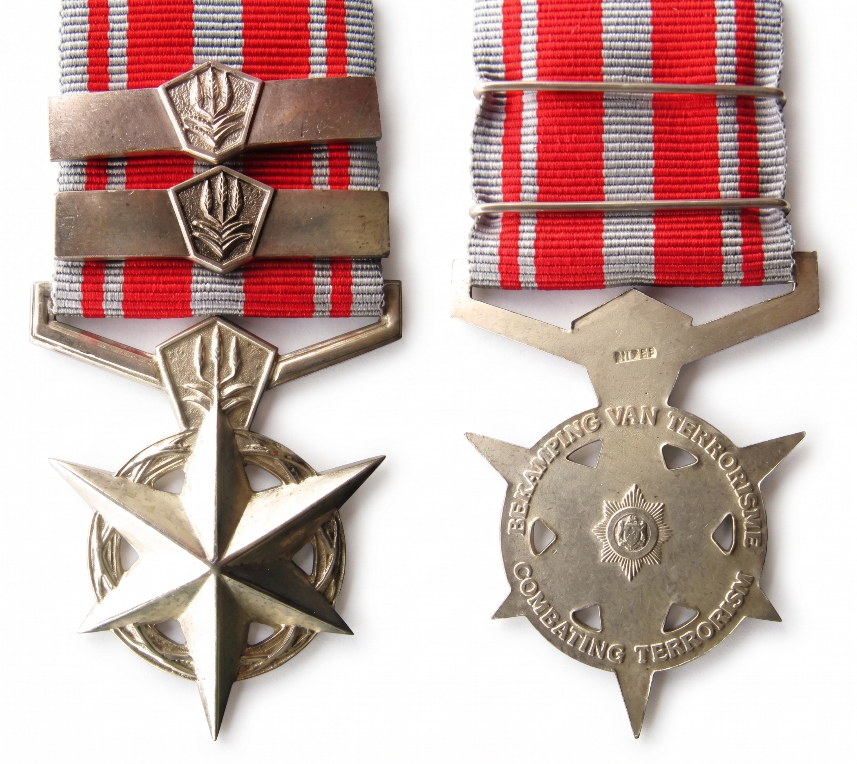
SAP Roll of Honour
Operations in Rhodesia 1967–1975
(Highslide JS)
KEY:
KIA – Killed in Action; KOAS – Killed on Active Service; DOAS – Died on Active Service; MIA – Missing in Action; SAWGP – South Africa War Graves Project; COIN – Counter-Insurgency; CT – Communist Terrorist; ZANLA – Zimbabwe African National Liberation Army; ZIPRA – Zimbabwe Pople’s Liberation Army; RLI – Rhodesian Light Infantry; RAR – Rhodesian Air Force; RAR – Rhodesian African Rifles.
BOSCH, Jacobus Phillippus, 37851, Sergeant, KOAS, 12 August 1970.
Drowned in the Zambezi River downstream from Chirundu Bridge while on COIN duty in Rhodesia. He was washing in the river and it was presumed he was taken by a crocodile. His body was never found. Source: Death Notice and SAWGP.
BOSHOFF, Albertus, W60263R Constable, KIA, 30 December 1974.
Died of a gunshot wound to the chest, Mt Darwin, Op Hurricane. Died aged 22 years, he was from Middleburg, Eastern Cape Province, South Africa. He is buried in South Africa. Sources: Death Notice and SAWGP.
BREYTENBACH, Johannes Petrus, W27654K, Warrant Officer, KOAS, 16 September 1974.
Based at the SAP camp in Binga, he died of an accidental gunshot wound to the head in Chizarira Game Reserve, east of Binga in the Kariba area. He was 45 and is buried in South Africa. Sources: Death Notice and SAWGP.
BUYS, Louis Johannes, W56068K, Constable, KIA, 1 October 1974. (see Don Price account above)
Shot in the head while on COIN duty at Chirundu, Rhodesia, aged 23 years. In South Africa he was stationed at Hattinghspruit in Natal. Buried in the Jacobskop Cemetery, Vereeniging, South Africa. Source: Death Notice and SAWGP.
CALITZ, Wynand Johannes, W56166K, Constable, KIA, 1 March 1974.
Died from a gunshot wound traversing his abdomen and chest, 2km west of Chironga Mission, Mt Darwin, Op Hurricane. He was 22 years old. A member of India Company, he was based at 213 Bravo base. Source: Death Notice. He is buried in the Humansdorp Cemetery, Eastern Cape, South Africa. Source: SAWGP.
CLOETE, Jacobus Wynand, W57177M, Constable, KIA, 6 October 1974.
Died of a gunshot wound to the neck at the SAP base, Kazakili, near Victoria Falls. Buried in the Zandfontein Cemetery, Pretoria, South Africa. Source: SAWGP.
CONRADIE, Willem Johannes, W58344P, Constable, KIA, 8 March 1974.
Died of gunshot wounds near Kandahar Island in the Victoria Falls area. A stick of SAP was surprised by CTs and murdered on the spot. He was 22 years old and is buried in Reddersburg, Orange Free State, South Africa. He was normally based in Empangeni, Zululand, South Africa. Source: SAWGP.
COOPER, Daniel, 48076, Constable, DOAS, 17 January 1969.
Died of cerebral malaria after two days in the Wankie Colliery Hospital. He was based at Victoria Falls, on COIN duty Rhodesia. Daniel was 21 years old, and came from the Cape Province in South Africa. Source: SAWGP and Death Notice.
DIPPENAAR, Jan Paulos, W23924W, Warrant Officer, KIA, 23 December 1974.
During the Rhodesian ceasefire, a ZANLA commander, Herbert Shungu, and 8 CTs stopped two South African Police vehicles which were carrying 6 members of the SAP and a BSAP constable. They were all relieved of the firearms, bundled into one of the trucks and driven down to a bridge over the Mazoe River in Rushinga District (Op Hurricane). They were taken onto the bridge and told to remove their shirts and hats, but sensing real danger, the policemen tried to escape, some by jumping into the river. One of the CTs opened up with his RPD. Jan Dippenaar, William du Plessis, Lourens Erasmus and Louis Franken of the SAP were all killed. Constable Grobbelaar, who was shot and wounded in the river, and Constable Eloff both survived. The body of Constable Mutasa Mandaza of the BSAP was never found and it is presumed he had drowned. Sources: Account related to Al J. Venter by Constable Louis Eloff; Death Notice; Outpost and The Elite by Barbara Cole. Dippenaar was 46 years old and is buried in the Maitland Cemetery, Cape Town, South Africa. Source: SAWGP.
DU PLESSIS, William Alexander, W57512N, Sergeant, KIA, 23 December 1974.
During the Rhodesian ceasefire, a ZANLA commander, Herbert Shungu, and 8 CTs stopped two South African Police vehicles which were carrying 6 members of the SAP and a BSAP constable. They were all relieved of the firearms, bundled into one of the trucks and driven down to a bridge over the Mazoe River in Rushinga District (Op Hurricane). They were taken onto the bridge and told to remove their shirts and hats, but sensing real danger, the policemen tried to escape, some by jumping into the river. One of the CTs opened up with his RPD. Jan Dippenaar, William du Plessis, Lourens Erasmus and Louis Franken of the SAP were all killed. Constable Grobbelaar, who was shot and wounded in the river, and Constable Eloff both survived. The body of Constable Mutasa Mandaza of the BSAP was never found and it is presumed he had drowned. Sources: Account related to Al J. Venter by Constable Louis Eloff; Death Notice; Outpost and The Elite by Barbara Cole. Du Plessis was 22 years old and is buried in South Africa.
DURRHEIM, Owen Winston, W55701P, Constable, KIA, 8 January 1973.
Died in the Victoria Falls National Park of multiple fractures and shock after their vehicle detonated a landmine. Aged 20 years. A South African by birth, he was also buried there. Source: Death Notice and SAWGP.
DU TOIT, Daniel, 44433, Constable, KIA, 18 July 1968.
Died from a gunshot wound to the head, received during a joint RLI, RAR, RhAF and SAP engagement with a large group of ZIPRA in a well-defended position in the Rawamombe Range near Kariba, Operation Griffin, aged 22 years. He was part of a forward sweep when fired on from very close range. Lieutenant J.H. Vorster and Constables A.J. Greunen and Dirk Hattingh were all wounded in the same contact. Du Toit was based in Wentworth, Natal, South Africa and is buried in Port Elizabeth. Listed on the Police Memorials, Union Buildings, Pretoria. Source: The Silent War by Shay and Vermaak, SAWGP, Nongqai and Death Notice.
ERASMUS, Lourens Daniel, W64955H, Constable, KIA, 23 December 1974.
During the Rhodesian ceasefire, a ZANLA commander, Herbert Shungu, and 8 CTs stopped two South African Police vehicles which were carrying 6 members of the SAP and a BSAP constable. They were all relieved of the firearms, bundled into one of the trucks and driven down to a bridge over the Mazoe River in Rushinga District (Op Hurricane). They were taken onto the bridge and told to remove their shirts and hats, but sensing real danger, the policemen tried to escape, some by jumping into the river. One of the CTs opened up with his RPD. Jan Dippenaar, William du Plessis, Lourens Erasmus and Louis Franken of the SAP were all killed. Constable Grobbelaar, who was shot and wounded in the river, and Constable Eloff both survived. The body of Constable Mutasa Mandaza of the BSAP was never found and it is presumed he had drowned. Sources: Account related to Al J. Venter by Constable Louis Eloff; Death Notice; Outpost and The Elite by Barbara Cole. Erasmus was 18 years old and is buried in the Forest Hill Cemetery, Port Elizabeth, South Africa. Source: SAWGP.
ERASMUS, Michael, W60279K, Constable, KIA, 1 October 1974. (see Don Price account above)
Shot in the head and chest at Chirundu while on COIN duty in Rhodesia, aged 20 years. In South Africa he was stationed at Kranskop, Natal. Buried in the Mountain Rise Cemetery, Pietermaritzburg, South Africa. Source: Death Notice and SAWGP.
ERWEE, Sarel Johannes, 48008, Constable, KOAS, 16 May 1968.
Drowned in the Zambezi River Gorge, 19 miles east of Victoria Falls, while on COIN duty in Rhodesia. Aged 20 years, he is buried in South Africa. Source: Death Notice and SAWGP.
FALL, Rodney Graham, 47174, Sergeant, DOAS, 1 Nov ember 1968.
Died from dehydration and exhaustion in Wankie Colliery Hospital, aged 21. At the time he was on COIN duties in the Zambezi Valley, Rhodesia. He was from SAP King’s Rest Station, Durban. He is buried in Cape Town. Listed on the Police Memorials, Union Buildings, Pretoria. He was the eldest son of Mr and Mrs S. Fall, Kirstenbosch, Cape Town. Source: Death Notice, SAWGP and Nongqai.
FRANKEN, Louis Wessel Gerhardus, W61774B, Constable, KIA, 23 December 1974.
During the Rhodesian ceasefire, a ZANLA commander, Herbert Shungu, and 8 CTs stopped two South African Police vehicles which were carrying 6 members of the SAP and a BSAP constable. They were all relieved of the firearms, bundled into one of the trucks and driven down to a bridge over the Mazoe River in Rushinga District (Op Hurricane). They were taken onto the bridge and told to remove their shirts and hats, but sensing real danger, the policemen tried to escape, some by jumping into the river. One of the CTs opened up with his RPD. Jan Dippenaar, William du Plessis, Lourens Erasmus and Louis Franken of the SAP were all killed. Constable Grobbelaar, who was shot and wounded in the river, and Constable Eloff both survived. The body of Constable Mutasa Mandaza of the BSAP was never found and it is presumed he had drowned. Sources: Account related to Al J. Venter by Constable Louis Eloff; Death Notice; Outpost and The Elite by Barbara Cole. Franken was 18 years old and is buried in the Groot Brakrivier Cemetery, Western Cape, in South Africa. Source: SAWGP.
HARMSE, Bartholomeus, W56732P, Constable, KOAS, 19 November 1974.
Died when an expended 60mm flare mortar casing, after having just been fired during a training exercise, struck him in the chest. He died two and a half hours later. He was part of C/S 43, based at the Kadzi River Camp, Dande TTL, Sipolilo, Op Hurricane. Died aged 29 years. He was from Pretoria. Source: Death Notice and SAWGP.
HOUGH, Zacharias Andreas, W56648R, Constable, KIA, 8 March 1974.
Died of gunshot wounds near Kandahar Island in the Victoria Falls area. A stick of SAP were surprised by CTs and murdered on the spot. He was 20 years old and is buried in Usakos, Namibia. He was normally based in Windhoek, South West Africa. Source: SAWGP.
JANSE VAN RENSBURG, Hermanus Cornelius, 49992, Detective Sergeant, KIA, 1 June 1969.
Died of gunshot wounds at Kazangula, Victoria Falls, while on COIN duty in Rhodesia. He was with No. 1 Platoon based at the SAO Kazangula Camp. He was 26 years old and is buried in Pretoria. Source: SAWGP and Death Notice.
KUHN, Johan A., W38424W, Constable, MIA, 8 March 1974.
Kuhn escaped the initial shooting at Kandahar Island but despite a helicopter being dispatched, from No. 7 Squadron, RhAF, to search for him, his body was never found. He is presumed murdered or abducted. Subsequent interrogation of a ZIPRA prisoner revealed that Kuhn had been shot on the Rhodesian side of the Zambezi River, and his body stuffed into an aardvark hole. Source: SAWGP.
LEMKUHL, L.J.H., 44959, Constable, KOAS, 5 May 1969.
Killed on active service while on COIN duty in Rhodesia. Source: SAWGP.
MANCI, M.C., S158792N, Constable, KIA, 29 August 1973.
Died of gunshot wounds received in an ambush at locstat VS630773, Mt Darwin, Op Hurricane. Source: Death Notice and SAWGP.
MARITZ, Johan Hendrik Christophel, 50325, Constable, KOAS, 18 August 1971.
Died in a vehicle accident in the Victoria Falls National Park while on COIN duty in Rhodesia. In South Africa he was stationed at Sishen, Northern Cape. Aged 24, he is buried in the Kuruman New Cemetery, Northern Cape, South Africa. Source: Death Notice and SAWGP.
MARX, Siegfried, W54350W, Constable, KIA, 8 January 1973.
Died in the Victoria Falls National Park of multiple fractures and shock after their vehicle detonated a landmine. Aged 22 years. A South African by birth, he is buried in the Vryheid Cemetery, South Africa. Source: Death Notice and SAWGP.
MEYER, C.C., W48209R, Sergeant, KIA, 4 January 1975.
Killed by a landmine while on COIN duty in Rhodesia. Source: SAWGP.
MINNIE, Louis James, W46494K, Constable, KOAS, 27 June 1973.
Died of a skull fracture and multiple injuries when he fell of a cliff in the Zambezi River Gorge, Kasikili, Victoria Falls. He was based at the SAP Kasikil Camp. He was 26 years old and is buried in Port Elizabeth, South Africa. Source: Death Notice.
MPAHLAWA, Mziwanke, S152074B, Constable, KOAS, 7 October 1974.
Died from injuries sustained in a motor vehicle accident in the Binga area, Kariba. He was 35 and is buried in South Africa. In South Africa he was stationed at the Mdantsane Police Station, Transkei. Source: Death Notice and SAWGP.
NEL, Frederick Johannes, W61799N, Constable, KIA, 11 January 1975.
Died from gunshot wounds to the chest and abdomen, Mana Pools National Park, aged 18 years. In South Africa he was stationed at Orkney, North West Province. He is buried in the New Klerksdorp Cemetery, South Africa. Source: Death Notice and SAWGP.
Oosthuizen, Frederick A., 45916, Sergeant, DOAS, 16 June 70.
Drowned in the Zambezi River while on COIN duty in Rhodesia. He was aged 24 and is buried in Aliwal North, Northern Cape, South Africa. At the time the Wankie magistrate conducted an inquest, and the death was only registered on 27 May 1971. Source: Death Notice and SAWGP.
OTTO, Rudolf Nicolaas, W59968R, Constable, KIA, 3 October 1973.
Died of 70 percent burns in a landmine explosion while en route from Binga to Wankie. Aged 20 years at the time of his death, he came from Sandown in Johannesburg, South Africa. He is buried in the Zandfontein Cemetery, Pretoria. Source: Death Notice and SAWGP.
PETZER, Johannes Frederik, W60327R, Constable, KIA 3 Jan 1975.
Killed by a landmine while on COIN duty in Rhodesia. He is buried in the Stutterheim Cemetery, Eastern Cape, South Africa. Source: SAWGP.
SCHUTTE, Phillipus Johannes Cornelius, W48815B, Detective Sergeant, DOAS, 14 January 1974.
He drowned in the Musengezi River, near Gutsa in the Zambezi Valley, Centenary, Op Hurricane. He was 29 years old and came from Brakpan, South Africa, where he is buried. Source: Death Notice.
STEENKAMP, Lambert Hendrik, W52421F, Constable, DOAS, 4 March 1973.
Died after drinking poisoned water while on COIN duty in Rhodesia. Source: SAWGP.
STRYDOM, Erhard Francois, W46430T, Constable, KIA, 8 March 1974.
Died of gunshot wounds near Kandahar Island in the Victoria Falls area. A stick of SAP was surprised by CTs and murdered on the spot. He was 35 and is buried in Barbeton, Transvaal, South Africa, which was where he was normally based. Source: SAWGP.
SWART, Edward Peter, W39784R, Lieutenant, KIA, 17 April 1974.
Died from gunshot wounds in an ambush 6km west of Rushinga Army Base, Op Hurricane, aged 28 years. He came from Queenstown in the Cape Province, South Africa. He is also buried there. In a letter dated 22 April 1974 to the DC in Mt Darwin, DC Bindura, C. Green, states that “members of the S.A.P. who are killed in action are not to be dealt with in the same manner as our Security Forces – they are recorded in the death register as if they were ordinary Civilians.” An aircraft from South Africa was due to collect the body before all the formalities had been completed. Sources: Death Notice and photocopy of original letter lodged with the Death Notice. Source: Death Notice and SAWGP.
SWART, Robert Andrew, W35163M, Constable, KIA, 8 March 1974.
Died of gunshot wounds near Kandahar Island in the Victoria Falls area. A stick of SAP was surprised by CTs and murdered on the spot. He was 33 years old and is buried in Hermanus, Western Province, South Africa, which was also where he was normally based. Source: Death Notice and SAWGP.
VAN DER MERWE, Carl Lodewyk, W60899P, Constable, KOAS, 4 August 1974.
Died in Salisbury General Hospital (Andrew Fleming) from head injuries sustained in Mt Darwin, Op Hurricane. He was 19 years old. A magistrate’s inquiry was undertaken behind the circumstances of his death, and a second Death Notice issued on 29 November 1974. The outcome of the inquiry is not known. Usually stationed in Pretoria, he was buried in Potchefstroom, South Africa. Source: Death Notice.
VAN HEERDEN, Johannes Hendrik, 694758619PE, Pilot/Flight Sergeant, South African Air Force, KOAS, 7 January 1969.
Killed in an air accident while he was flying a South African Police Cessna 185, No. 734, at Katanga Range near Que Que. He tried to perform a low-level barrel roll (illegal in a C185) and struck the ground. He was 25 years old and his body was flown back to South Africa for burial in Pretoria. Flight Lieutenant Donald Annandale of the RhAF subsequently died in Que Que hospital of burns received in the same crash. Sources: Death Notice and B. Salt.
[This death is included as it is proof the SAP had their own fixed-wing aircraft, in addition to Alouette III helicopters, in Rhodesia.]
Official Rhodesian Government Death Notices of SAP Fatalities
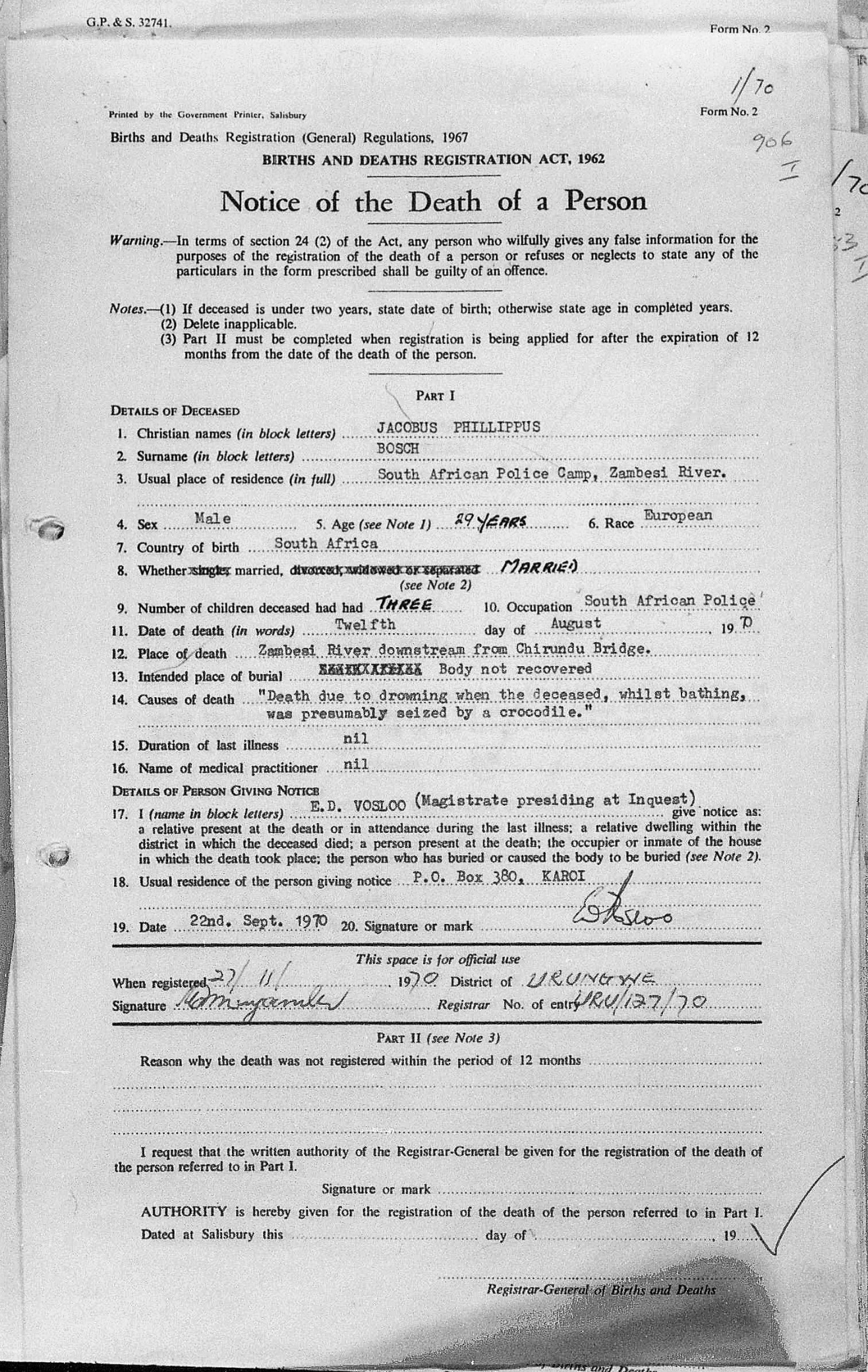
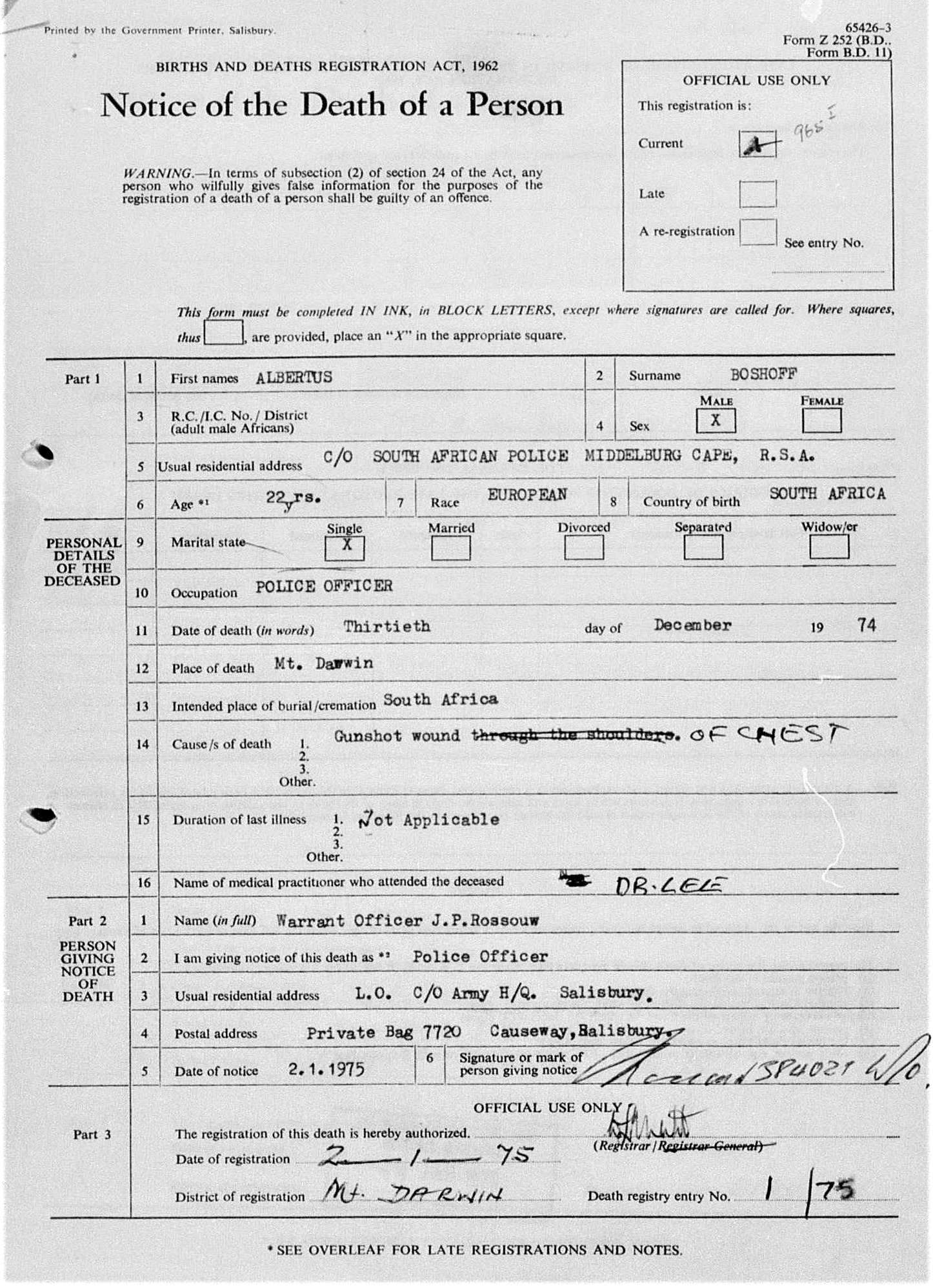
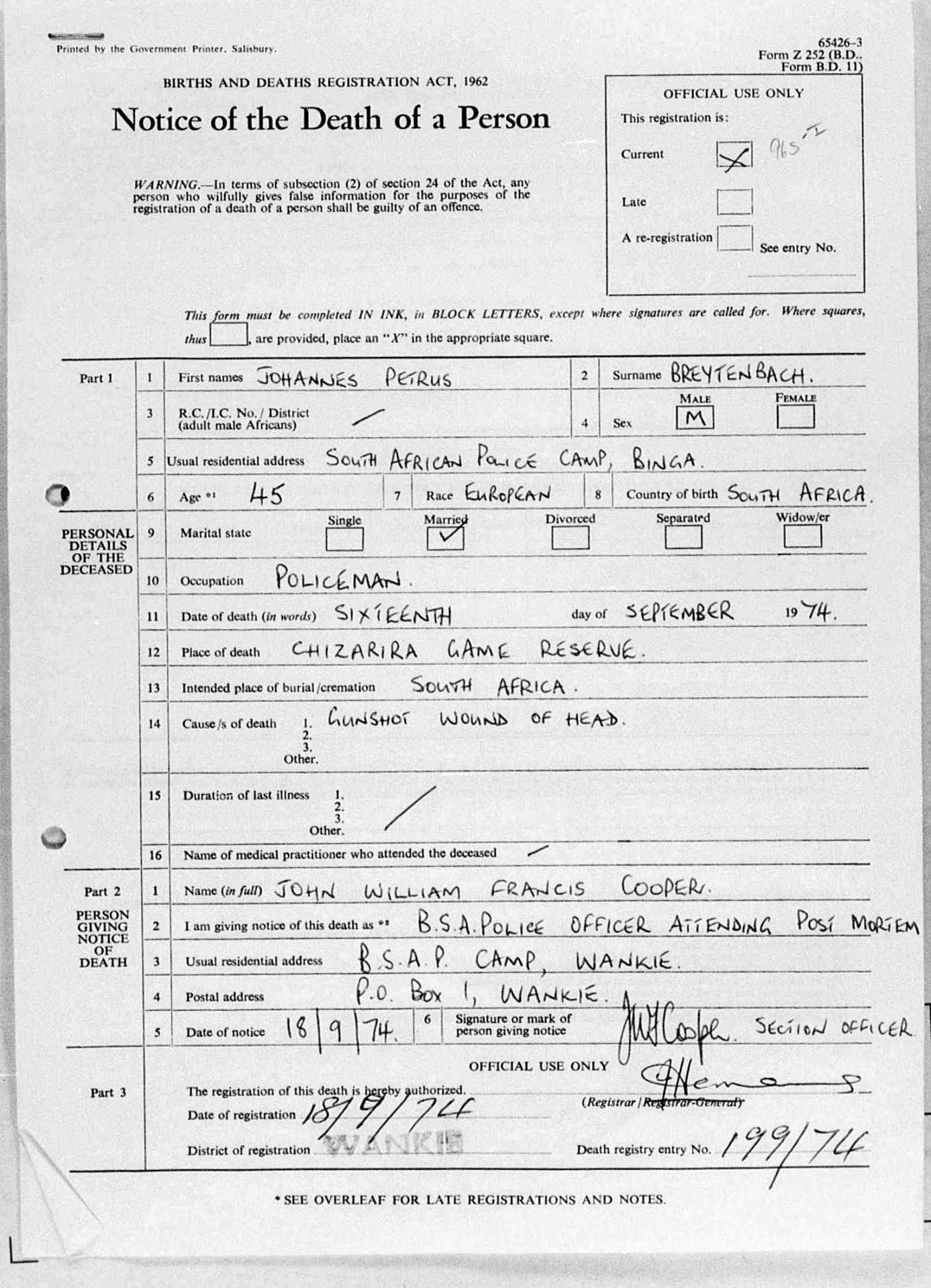
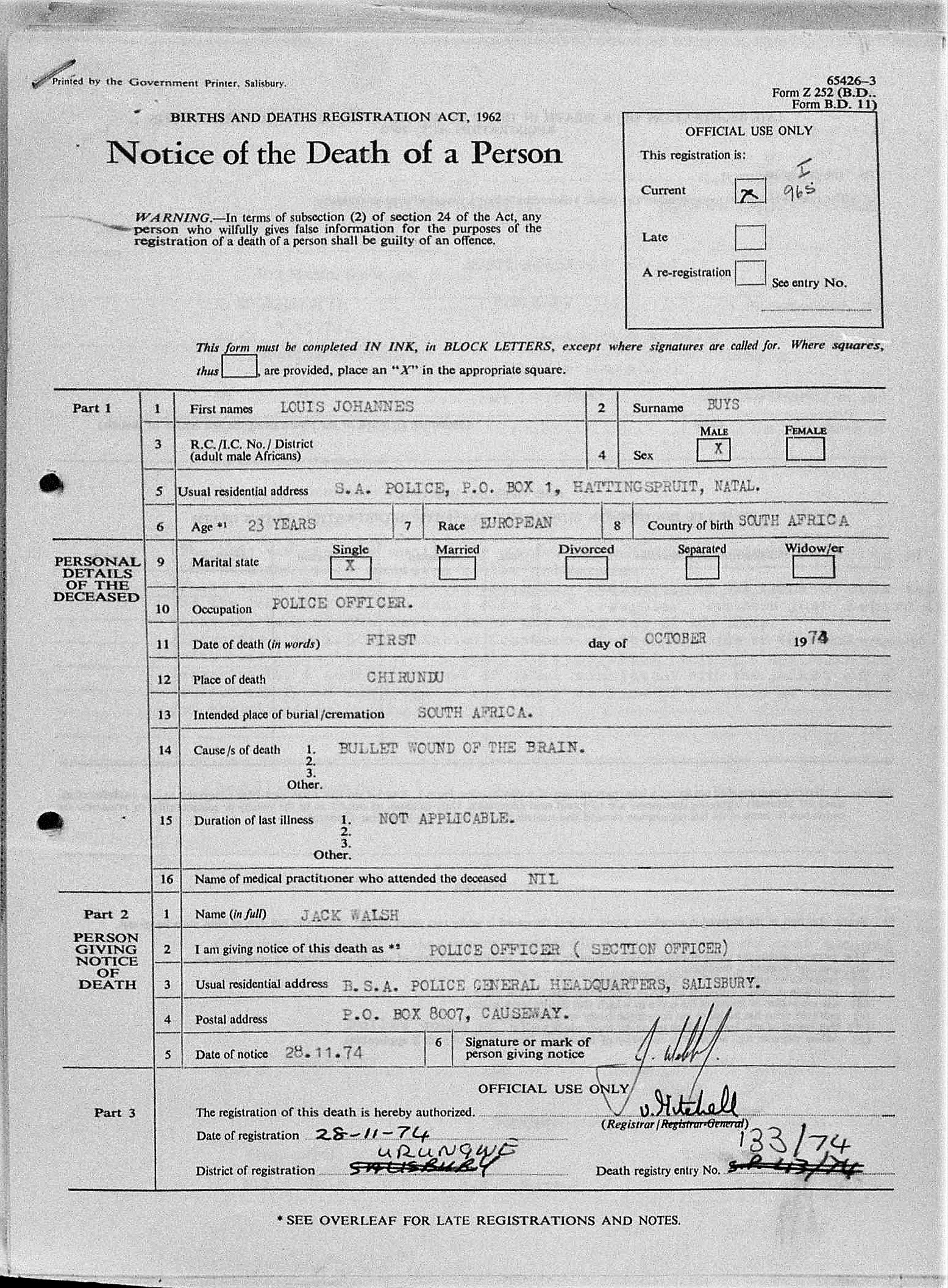
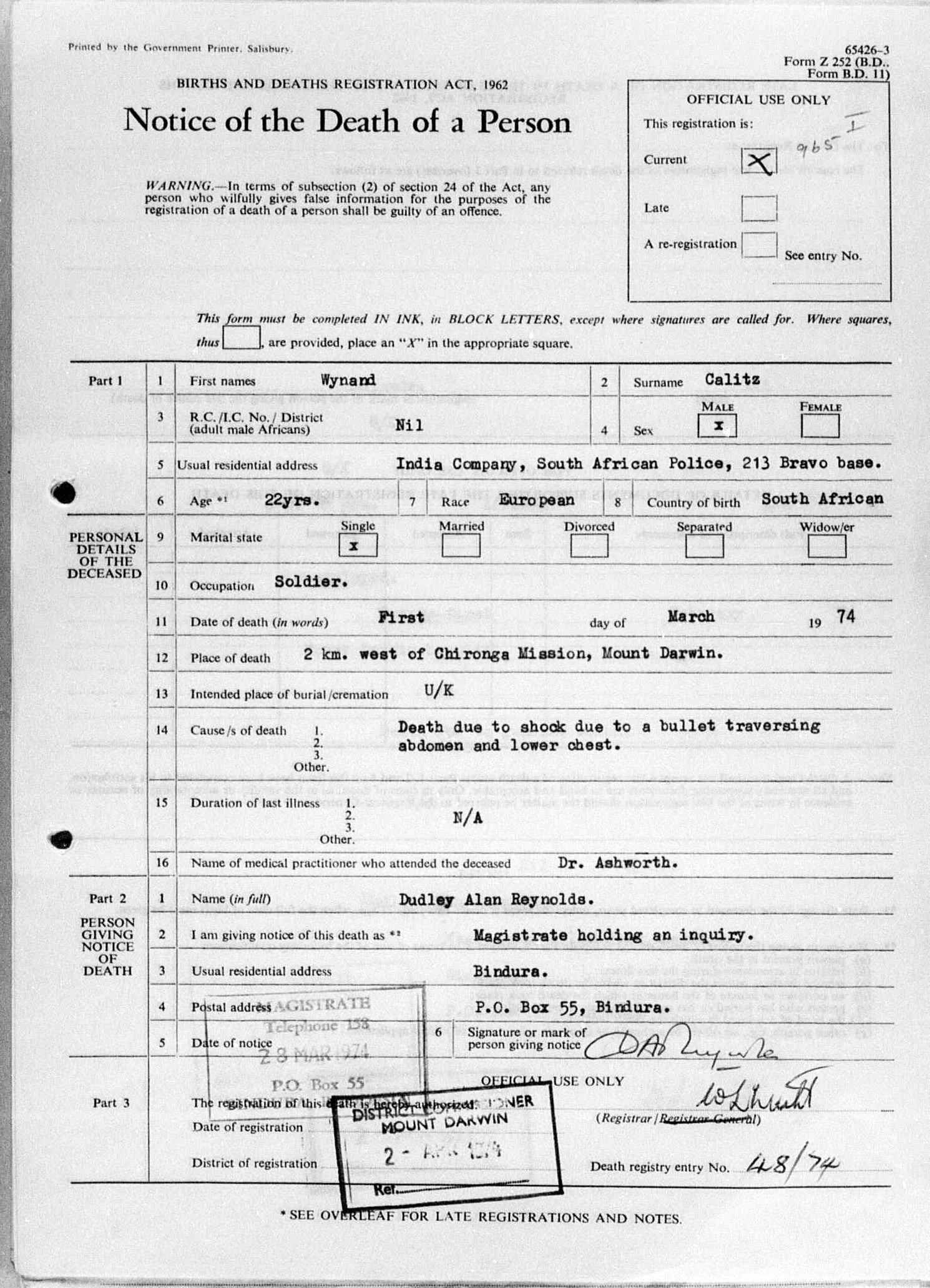
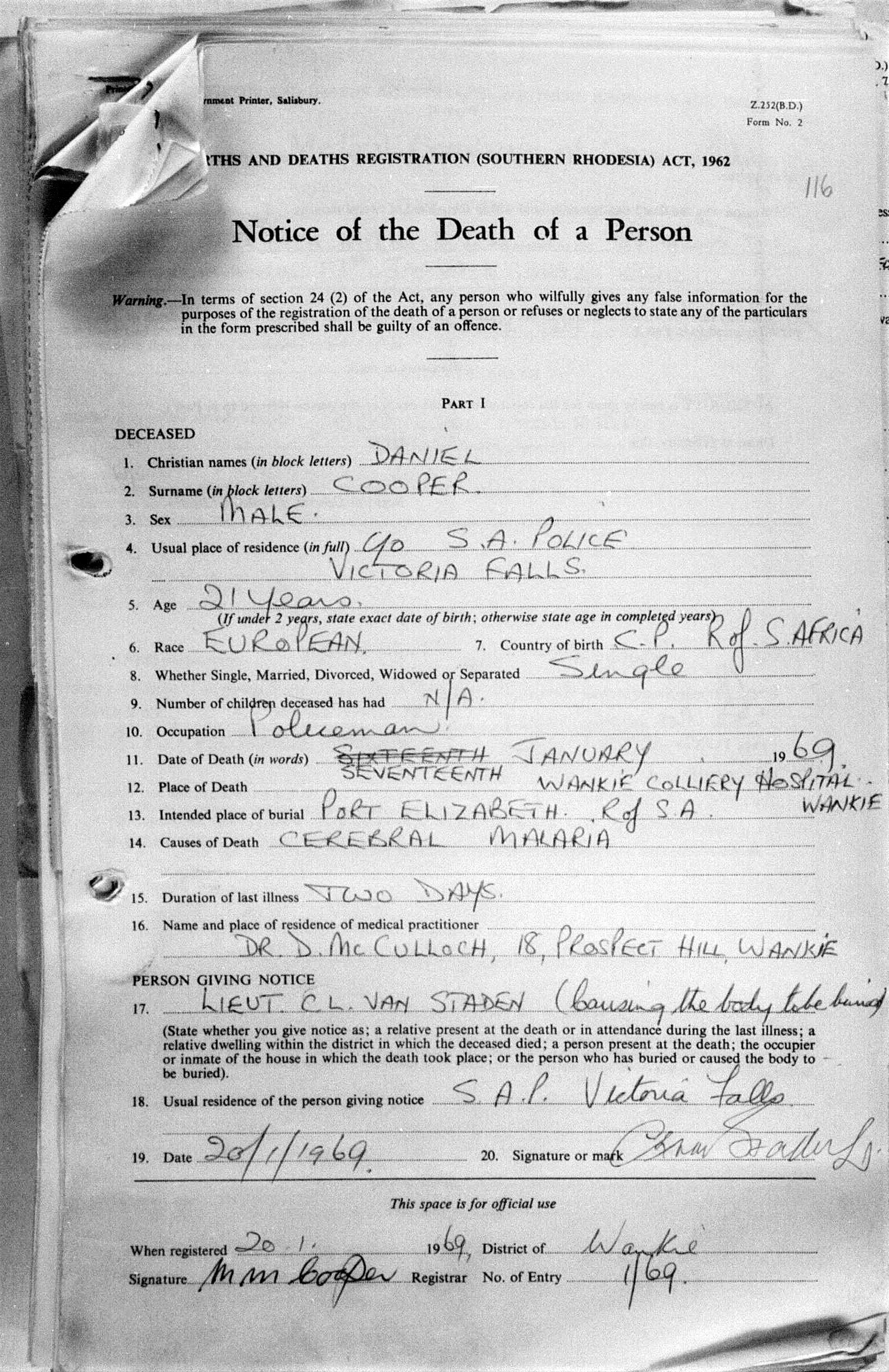
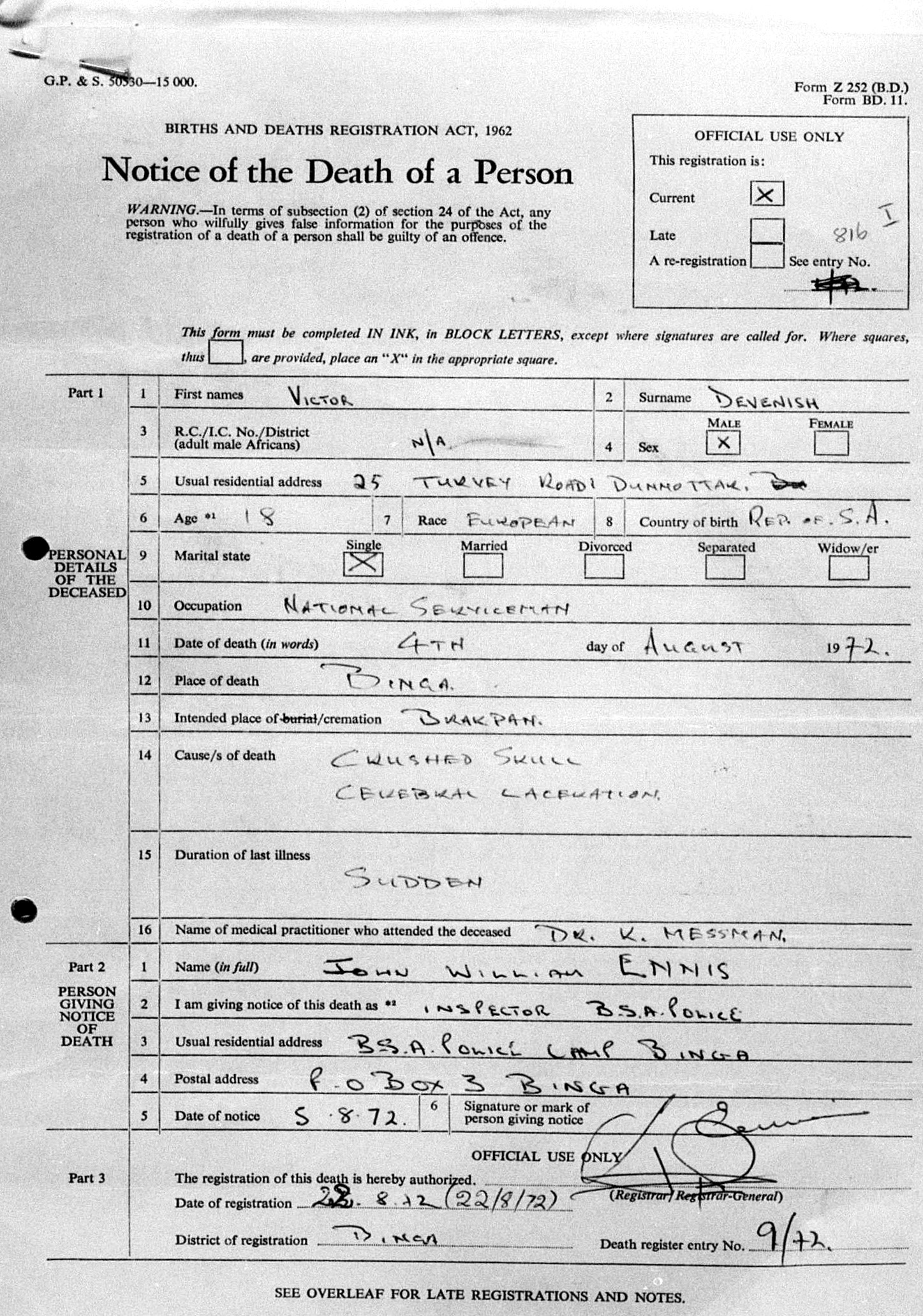
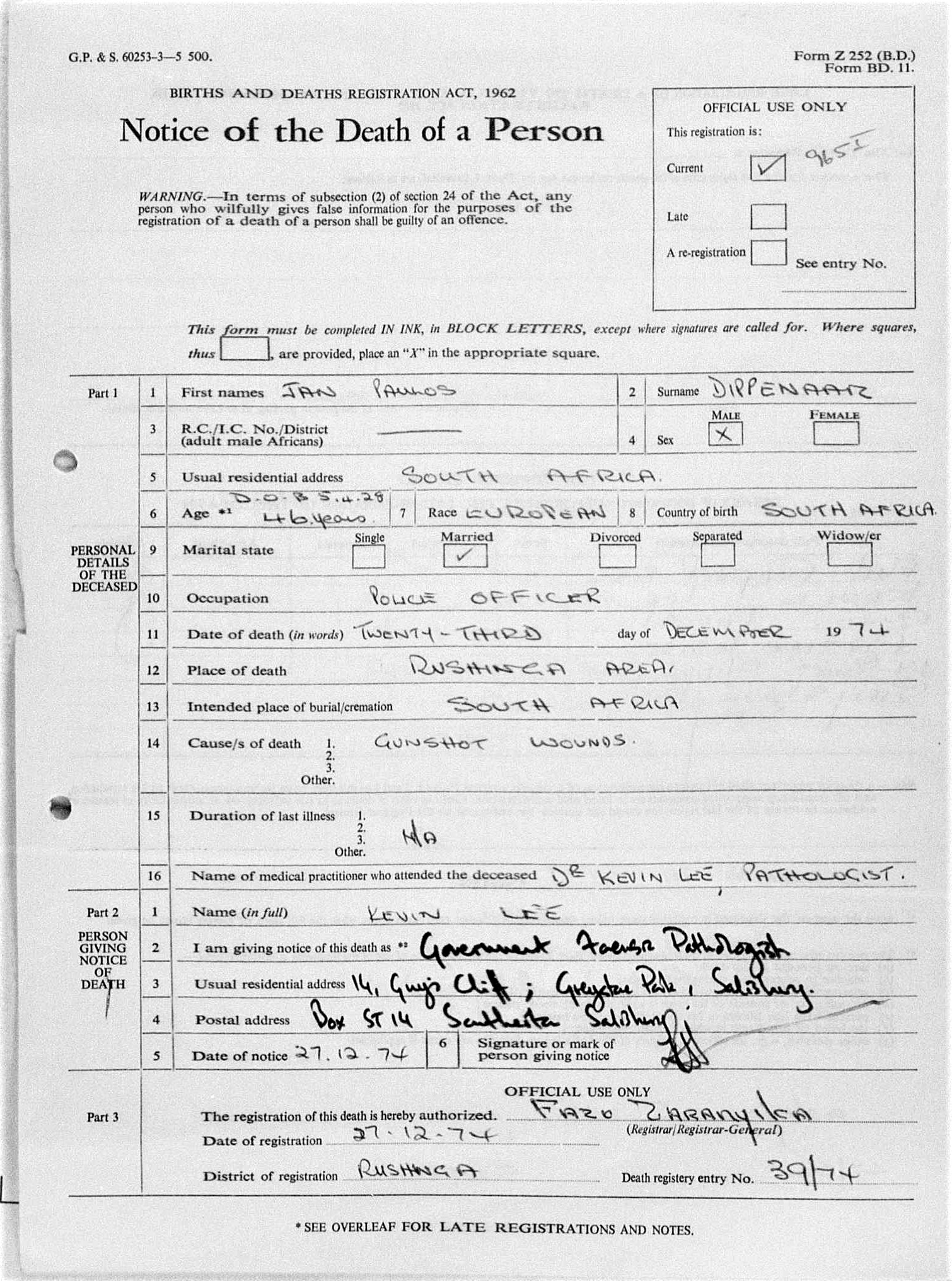
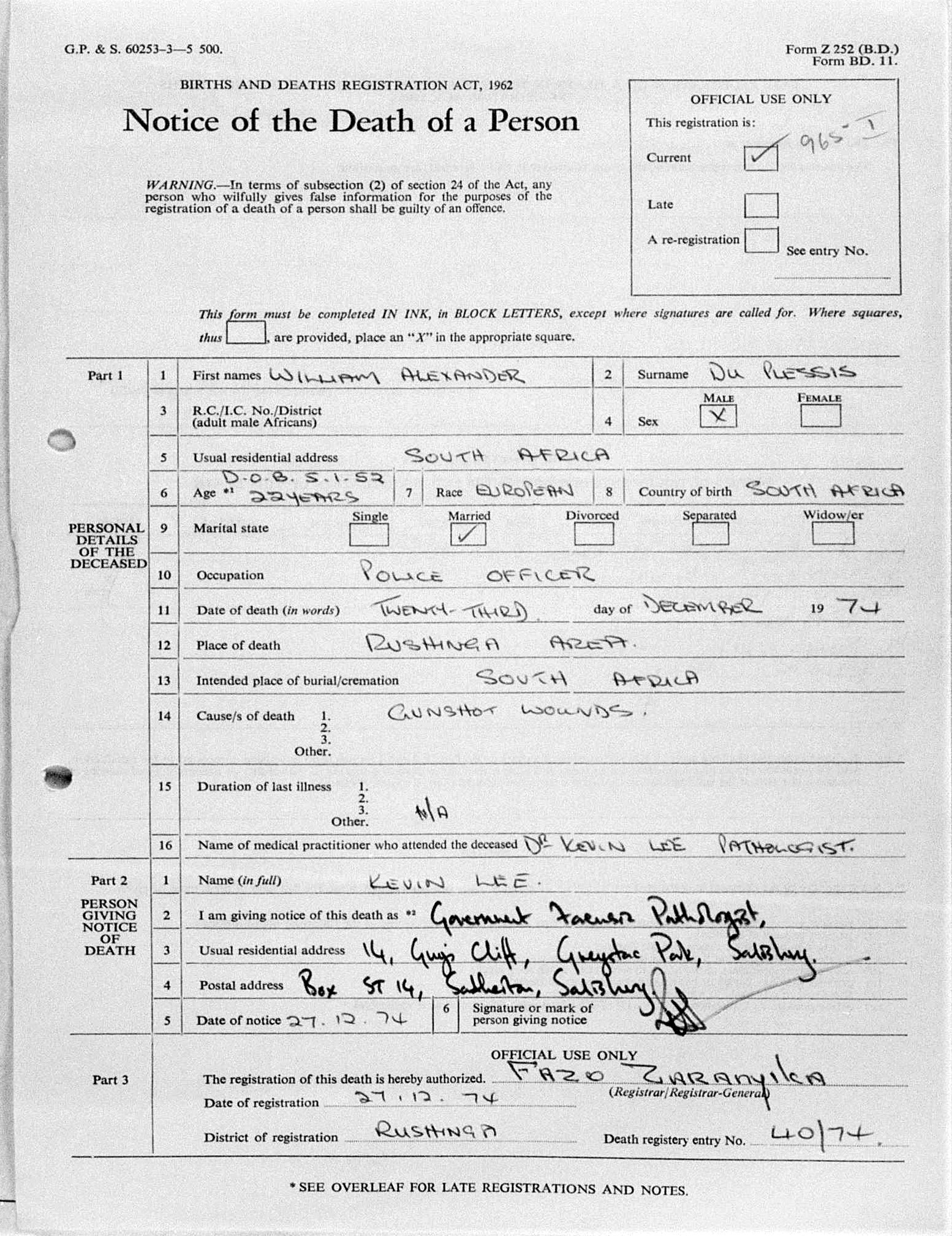
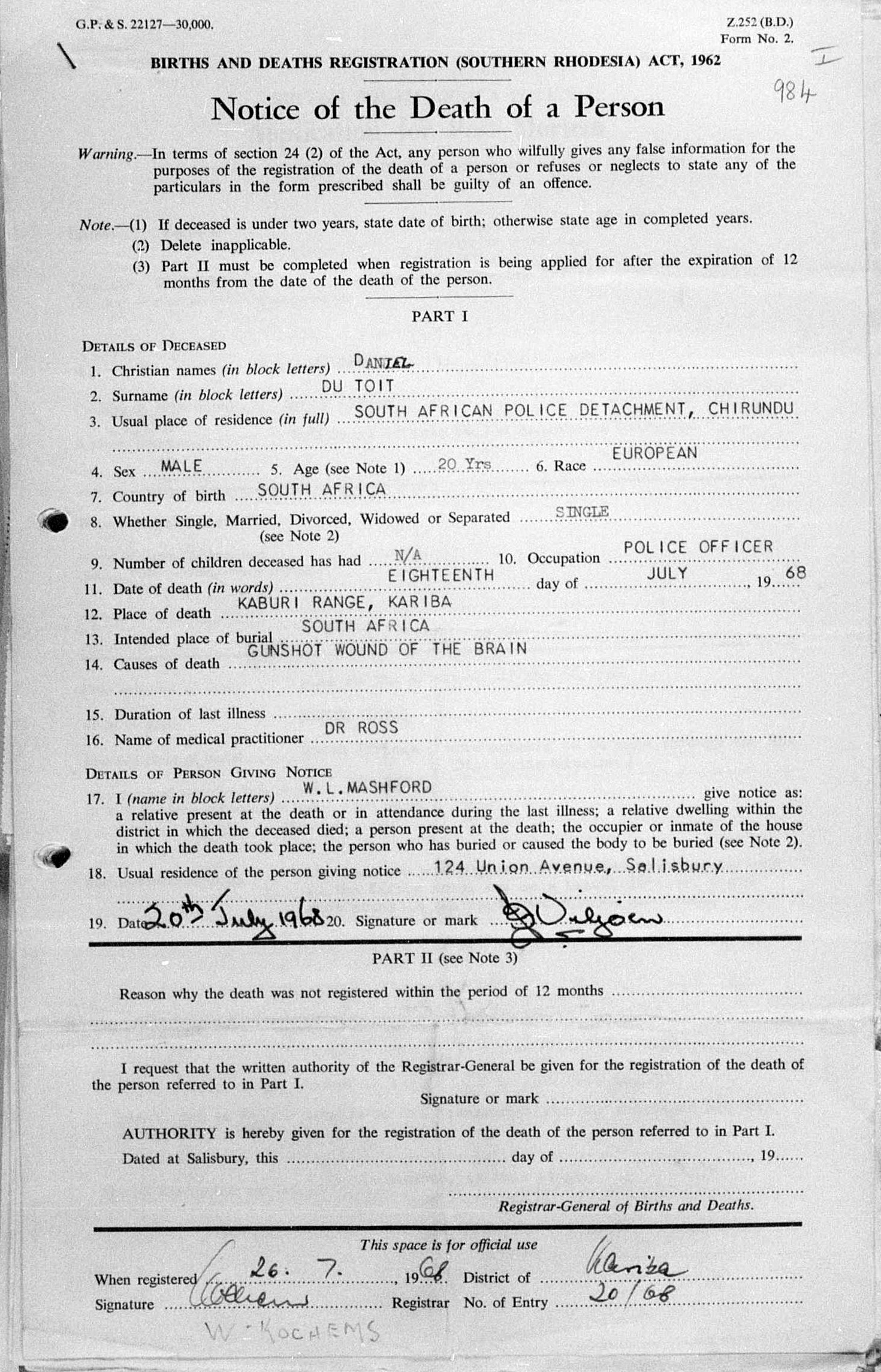
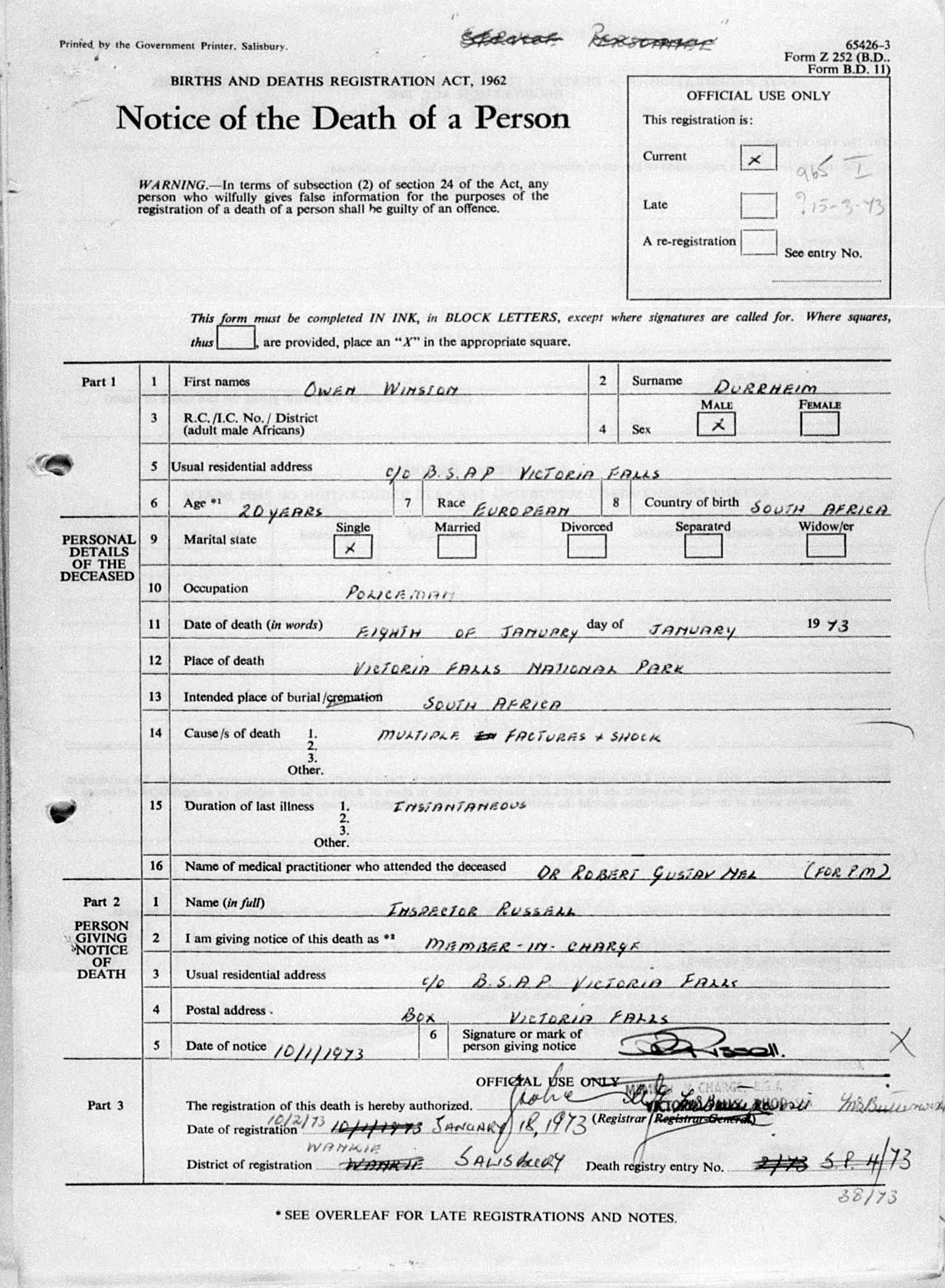
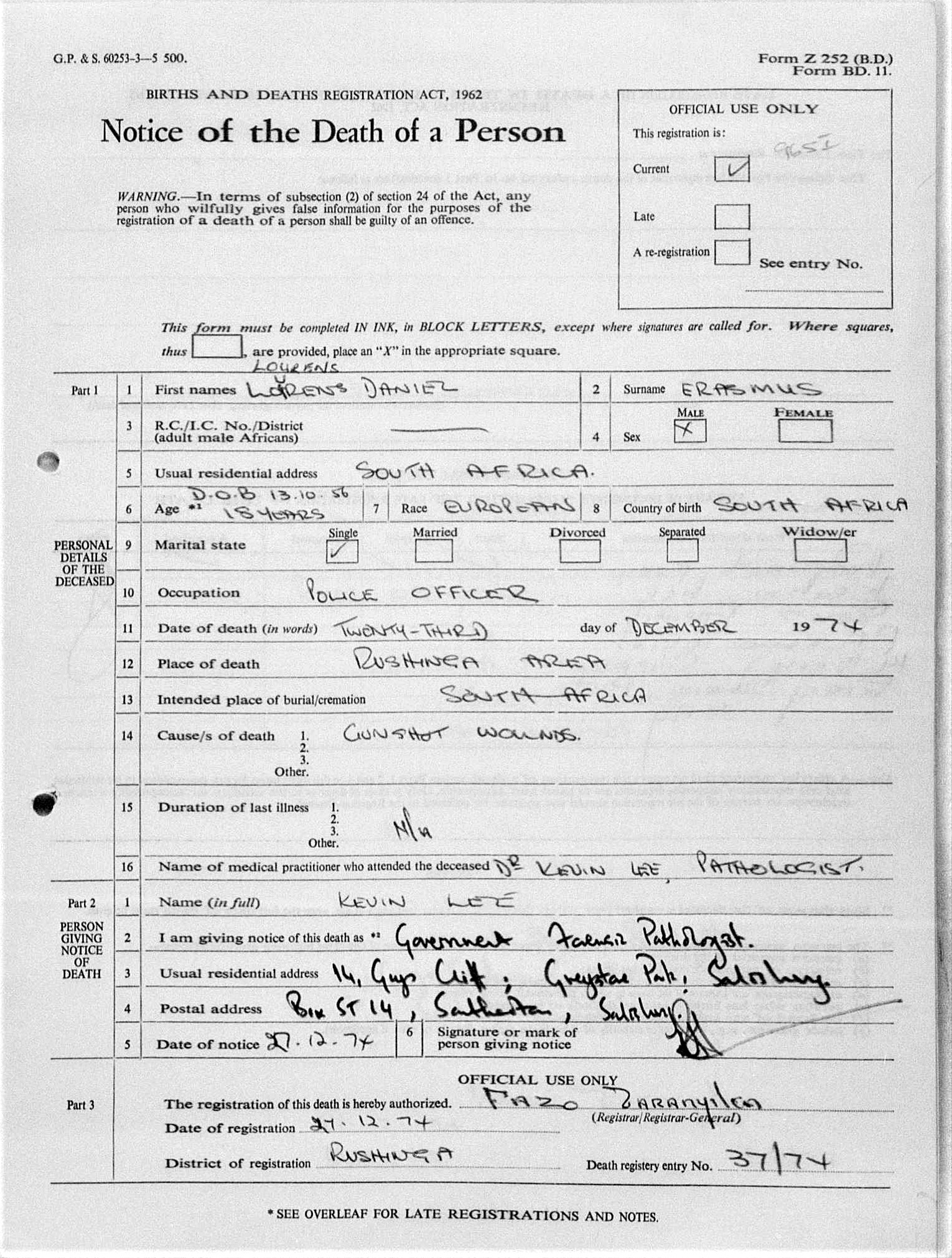
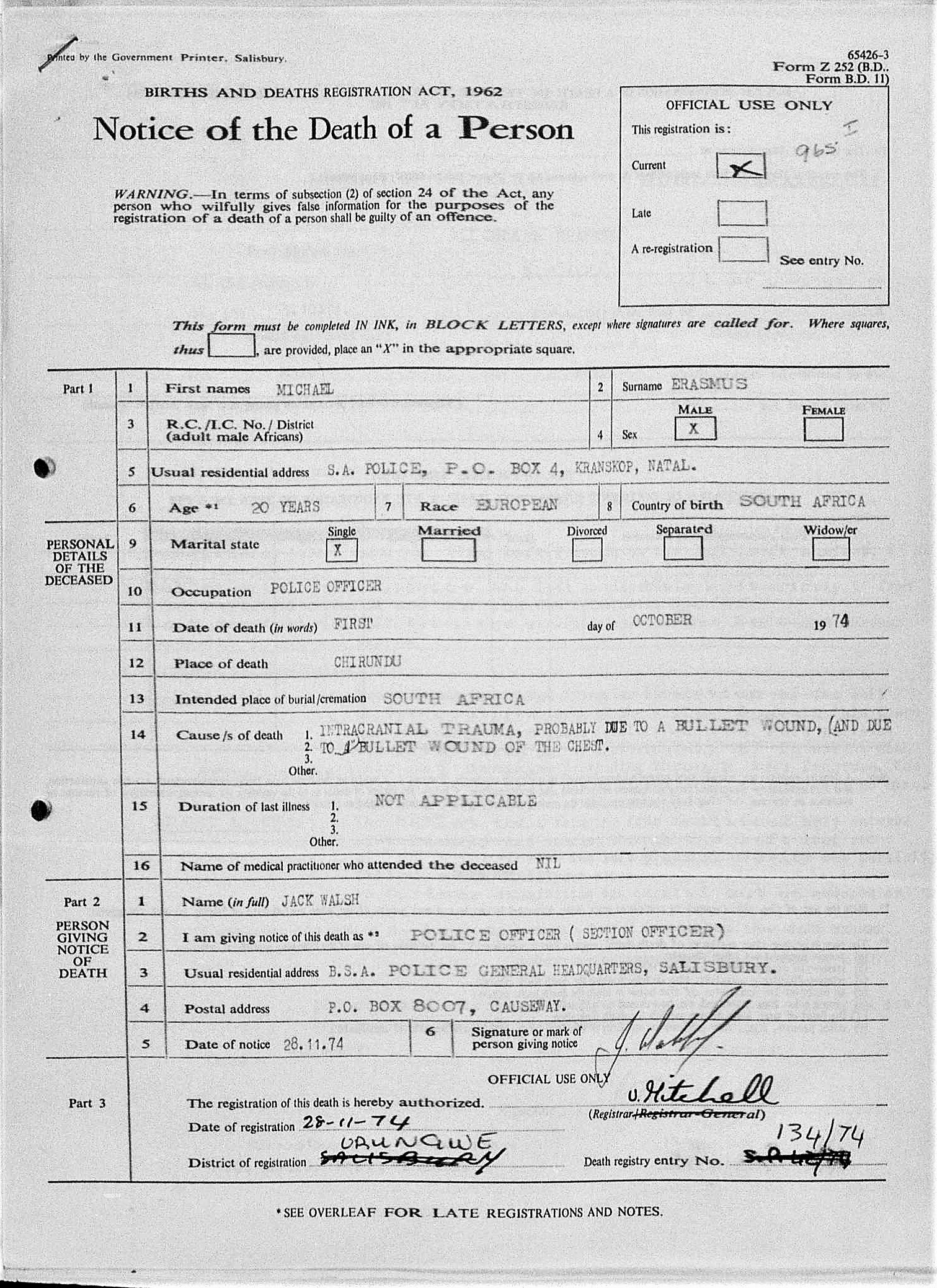
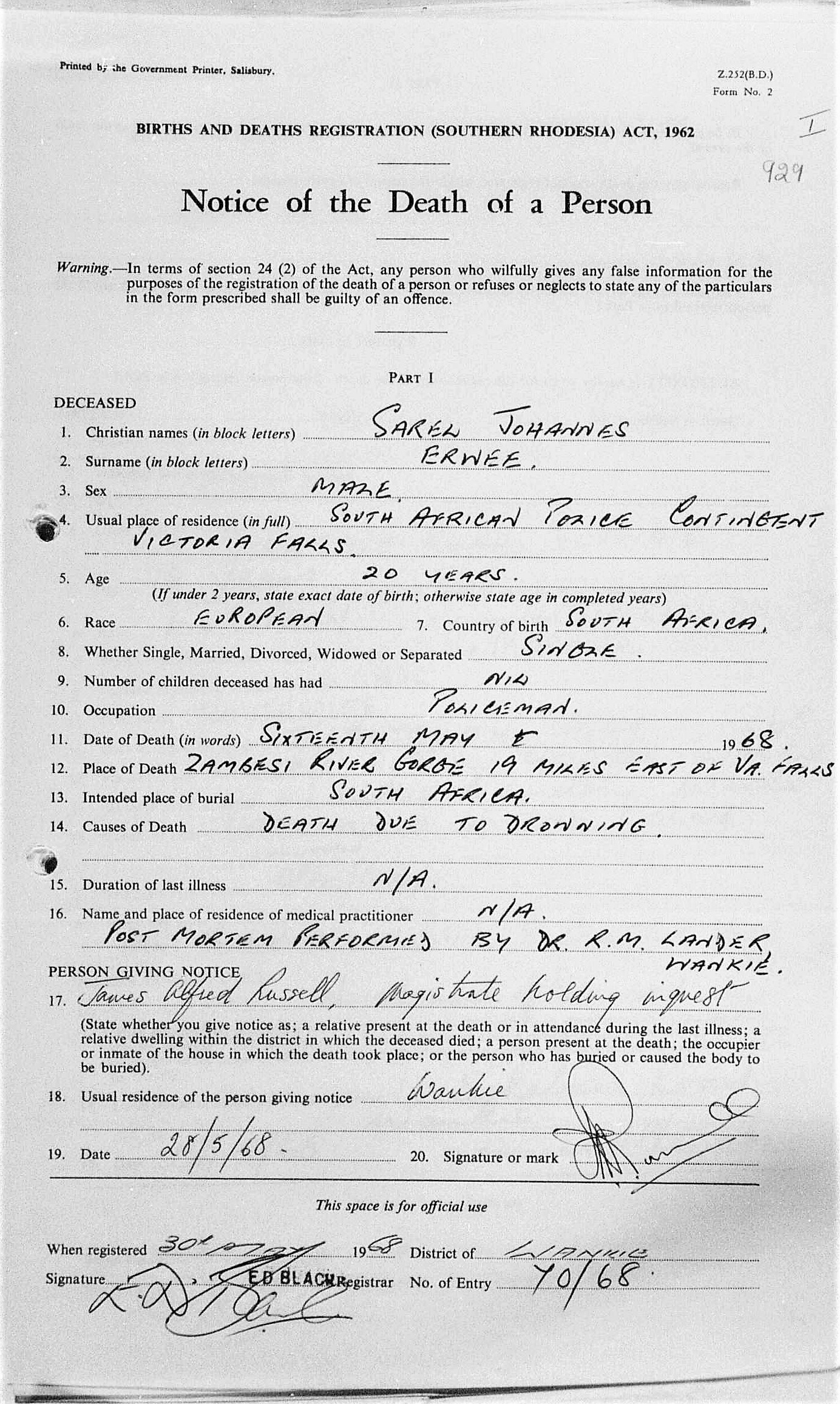
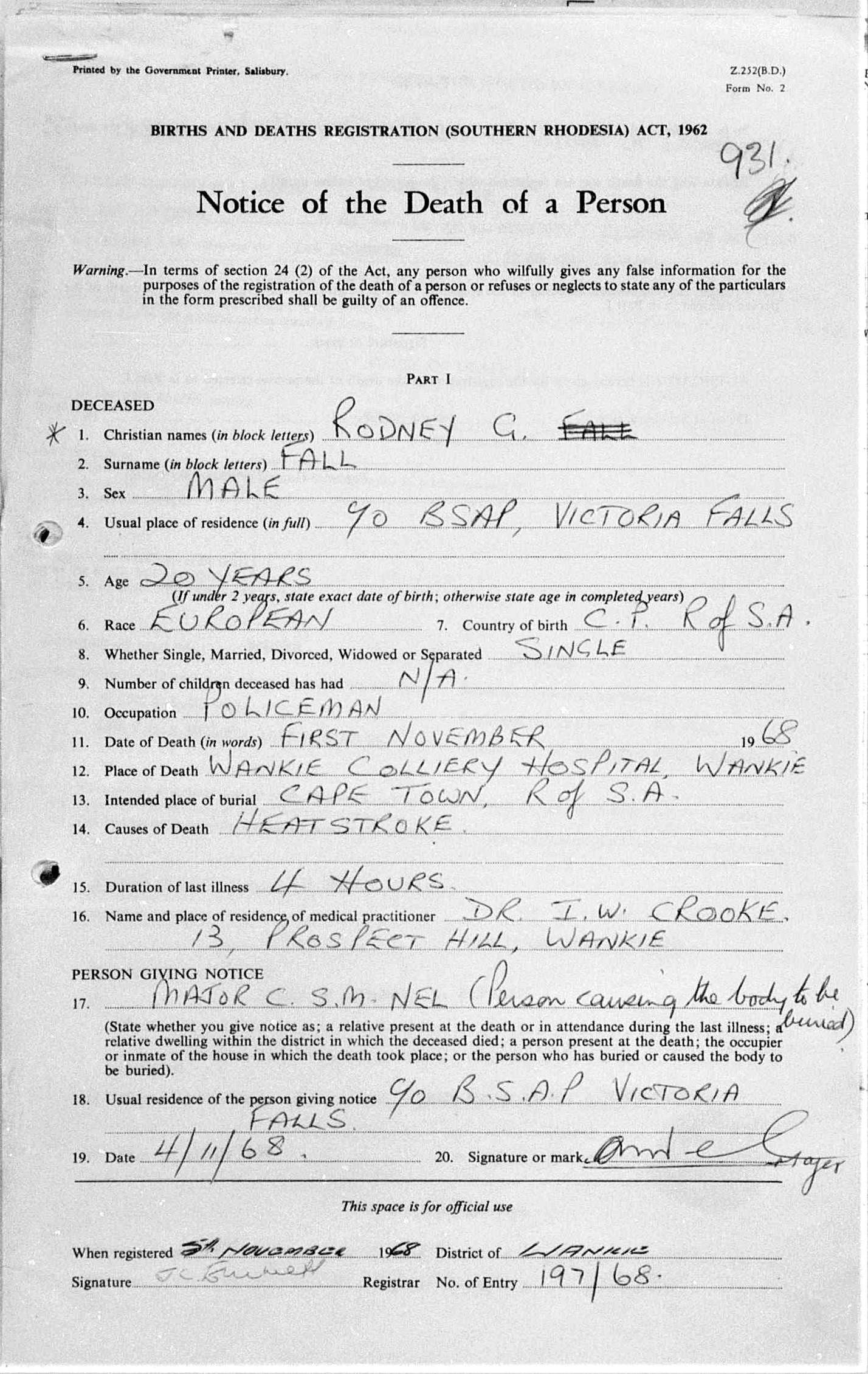
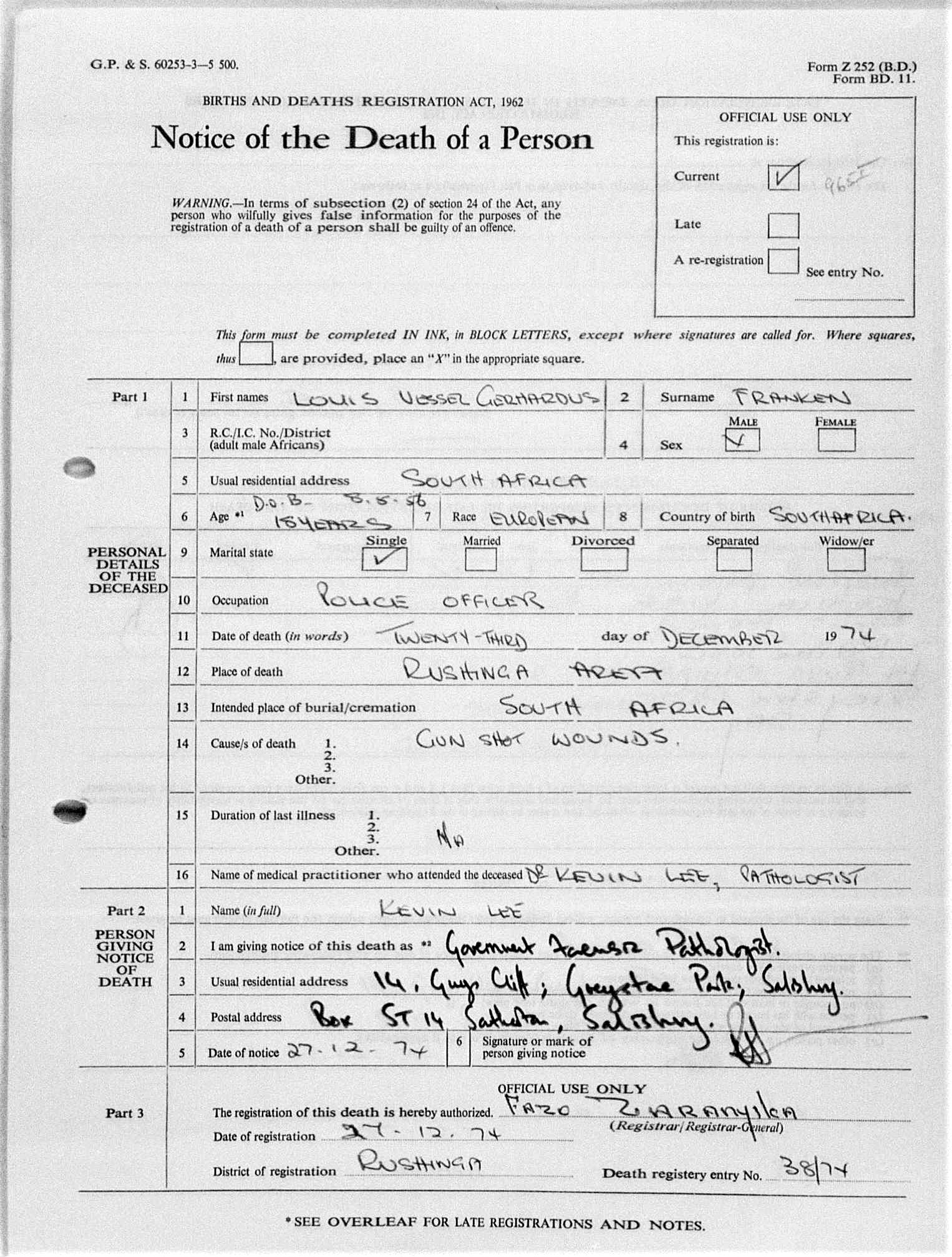
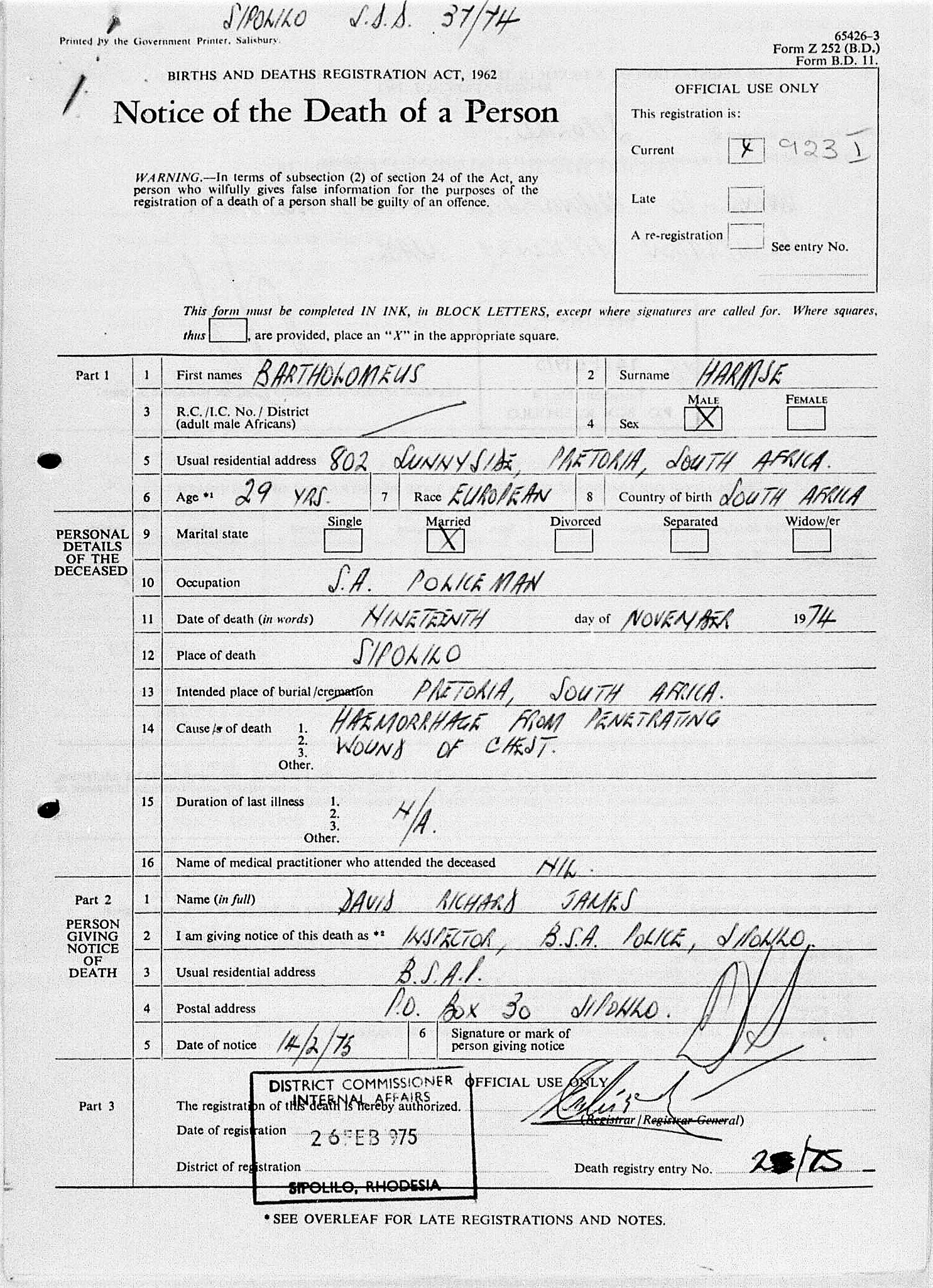
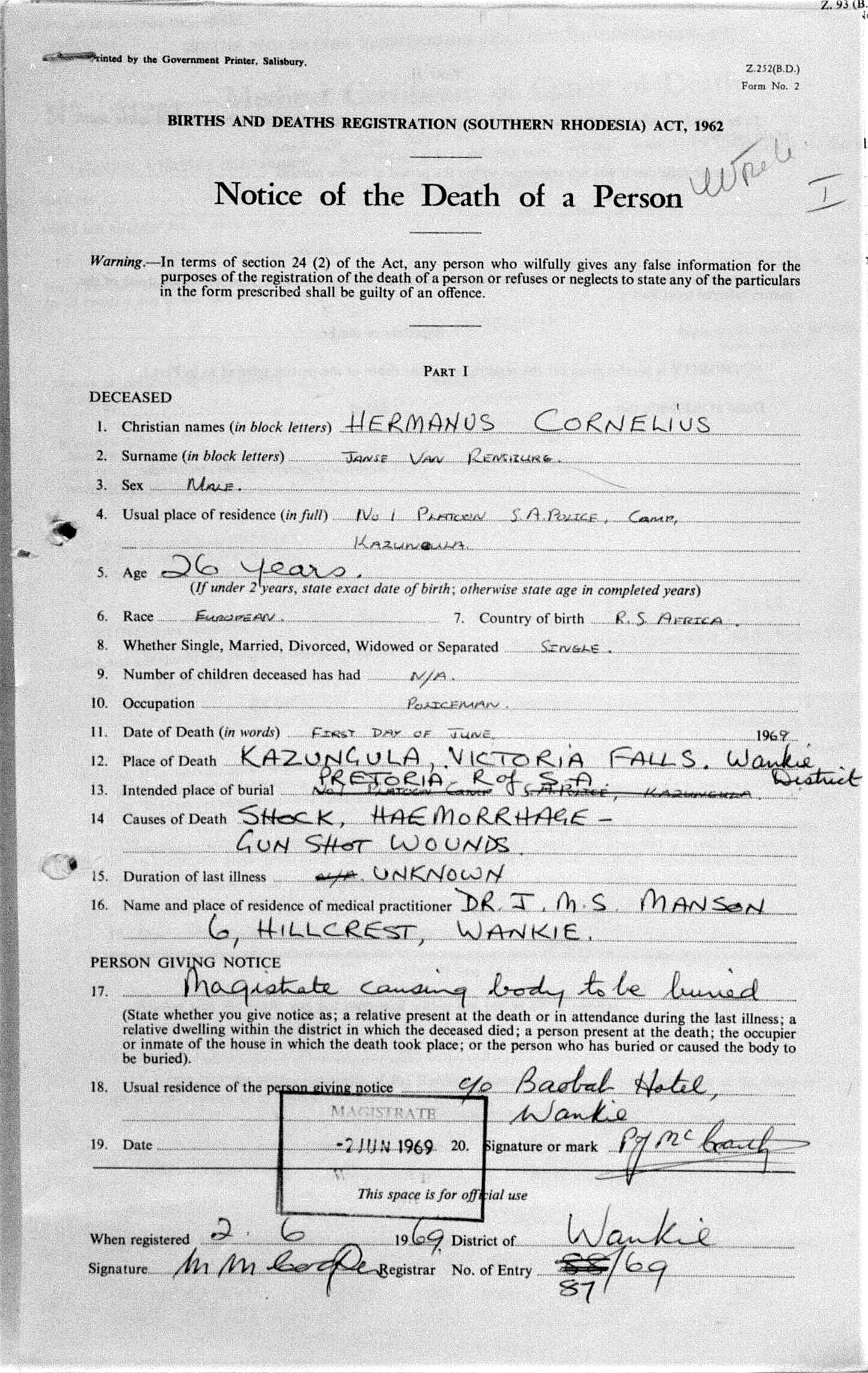
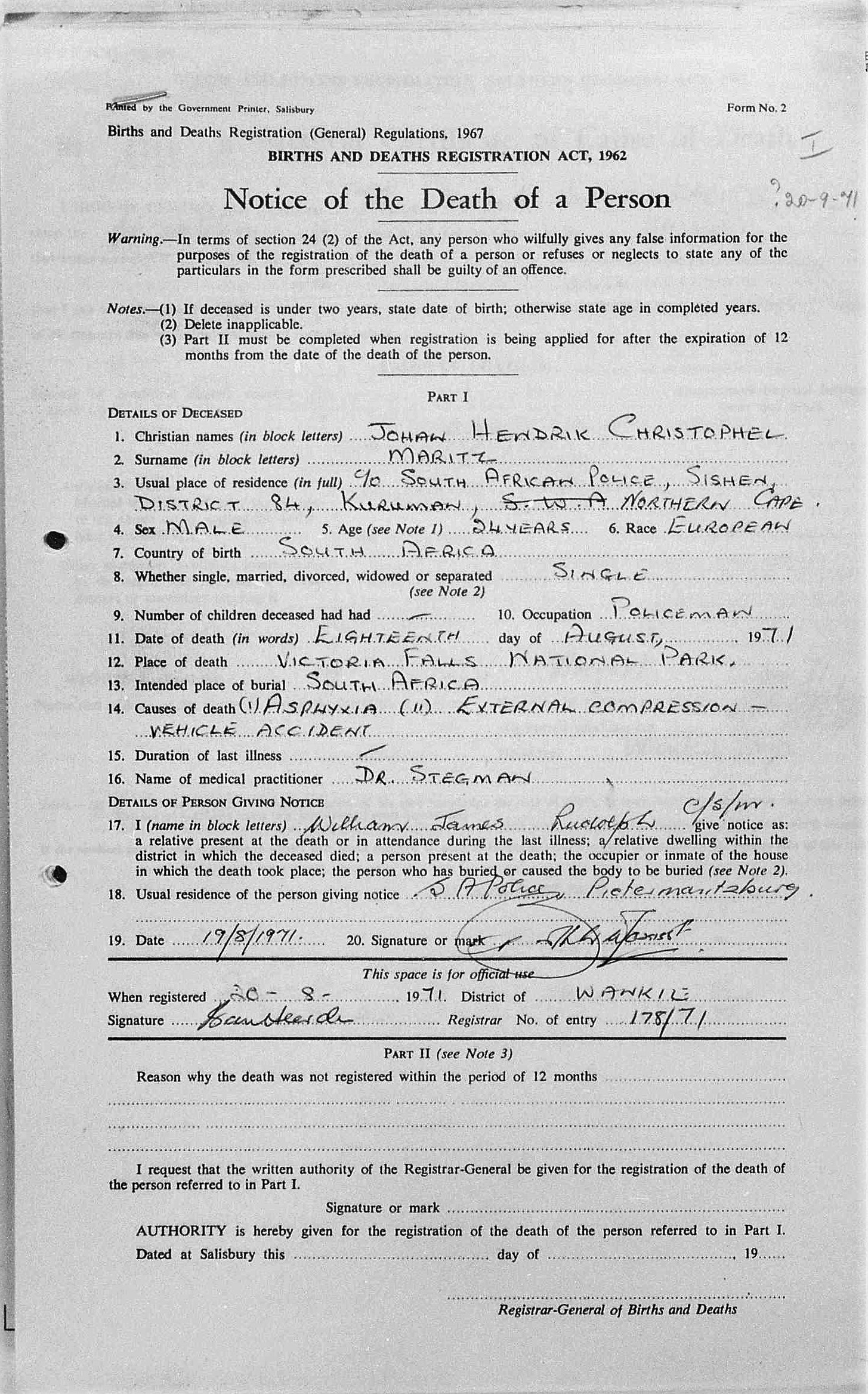
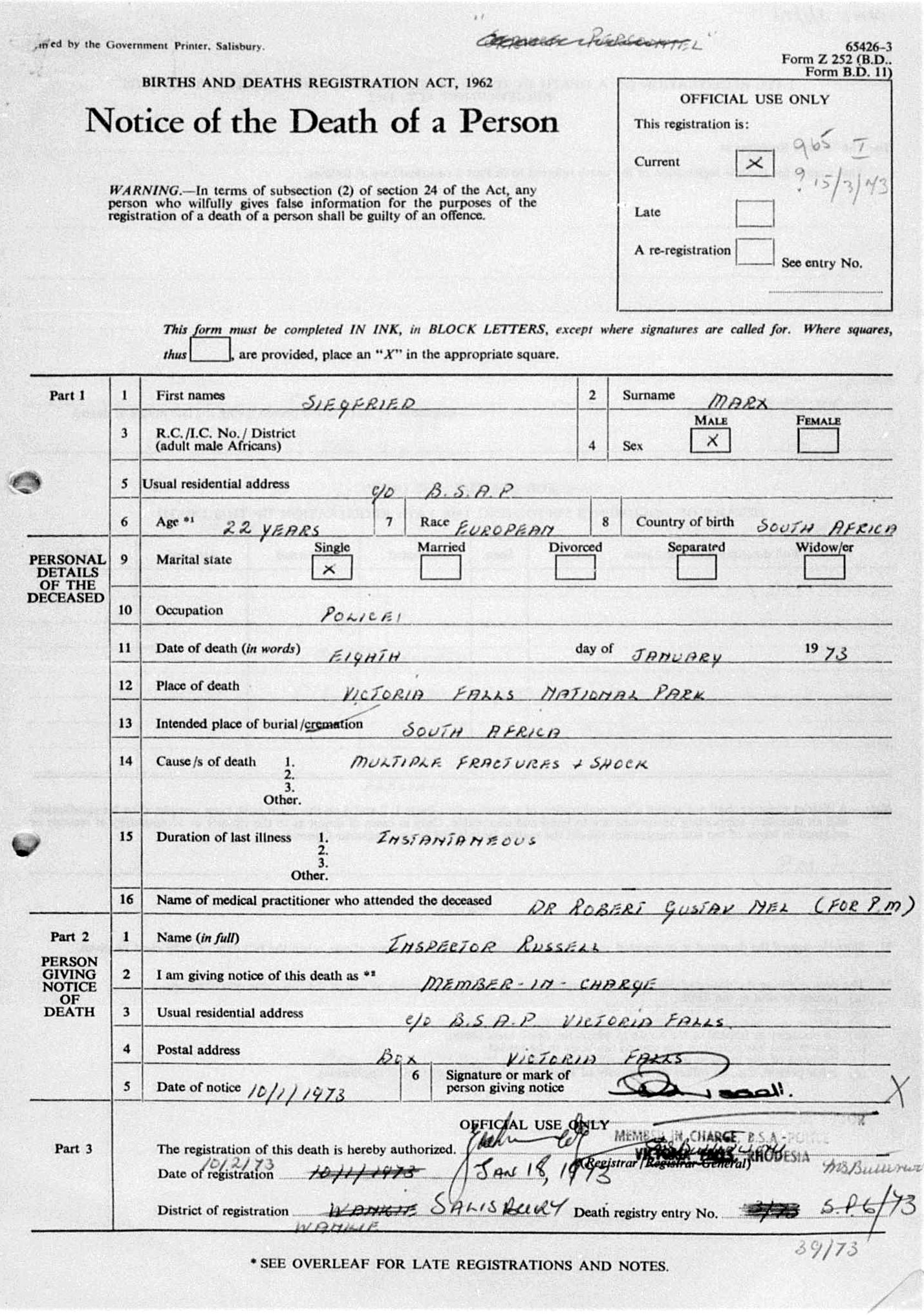
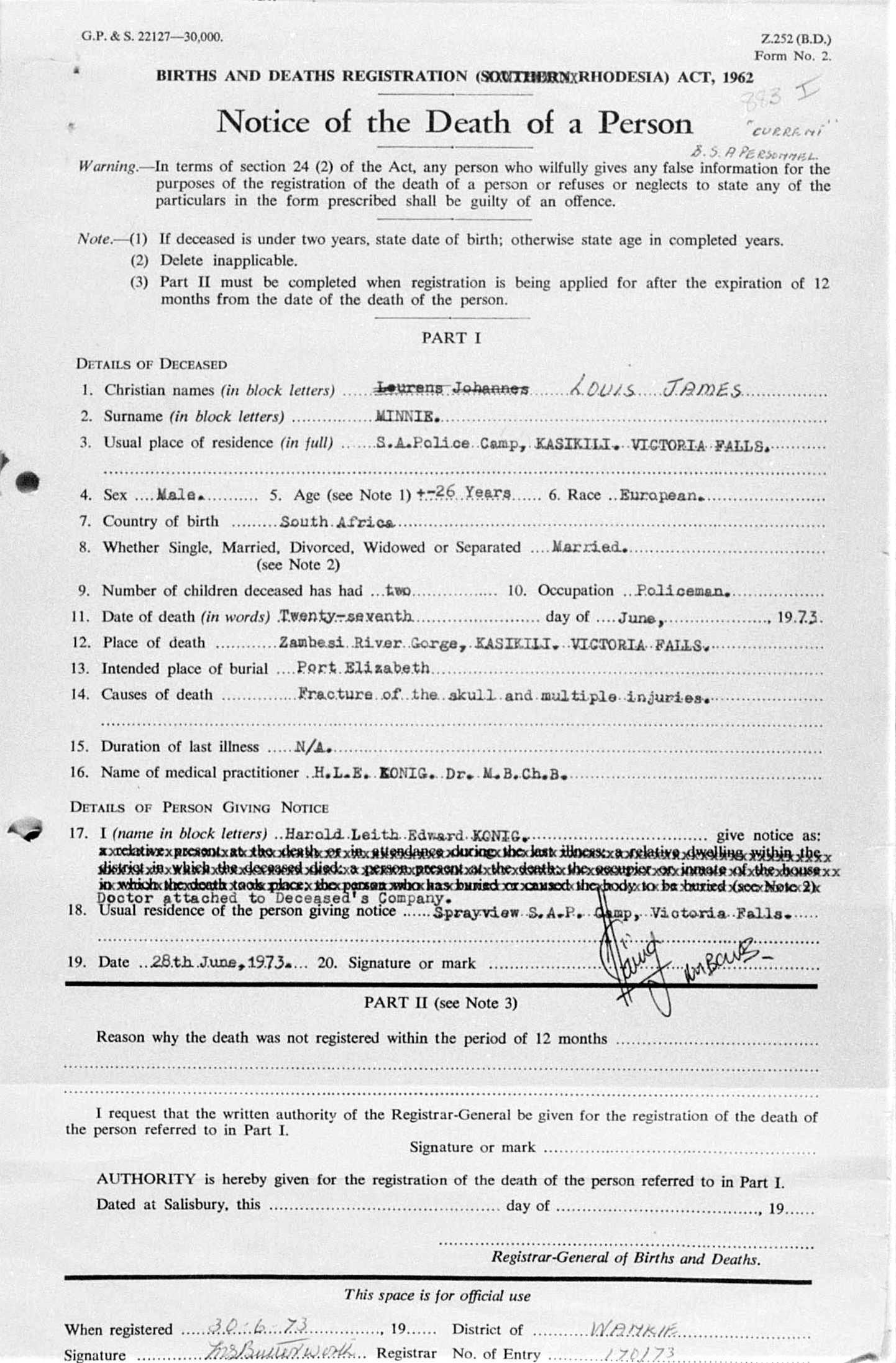
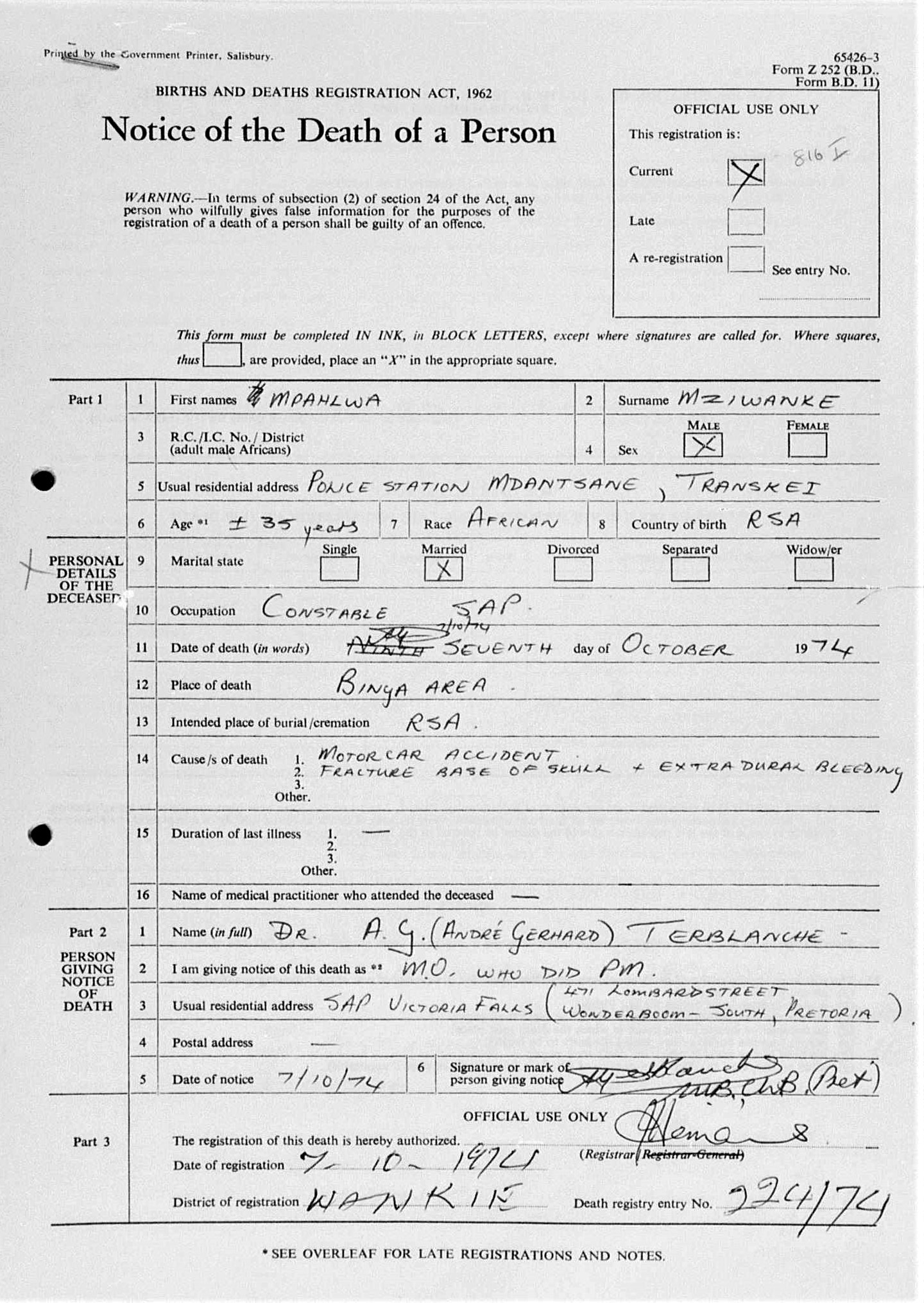
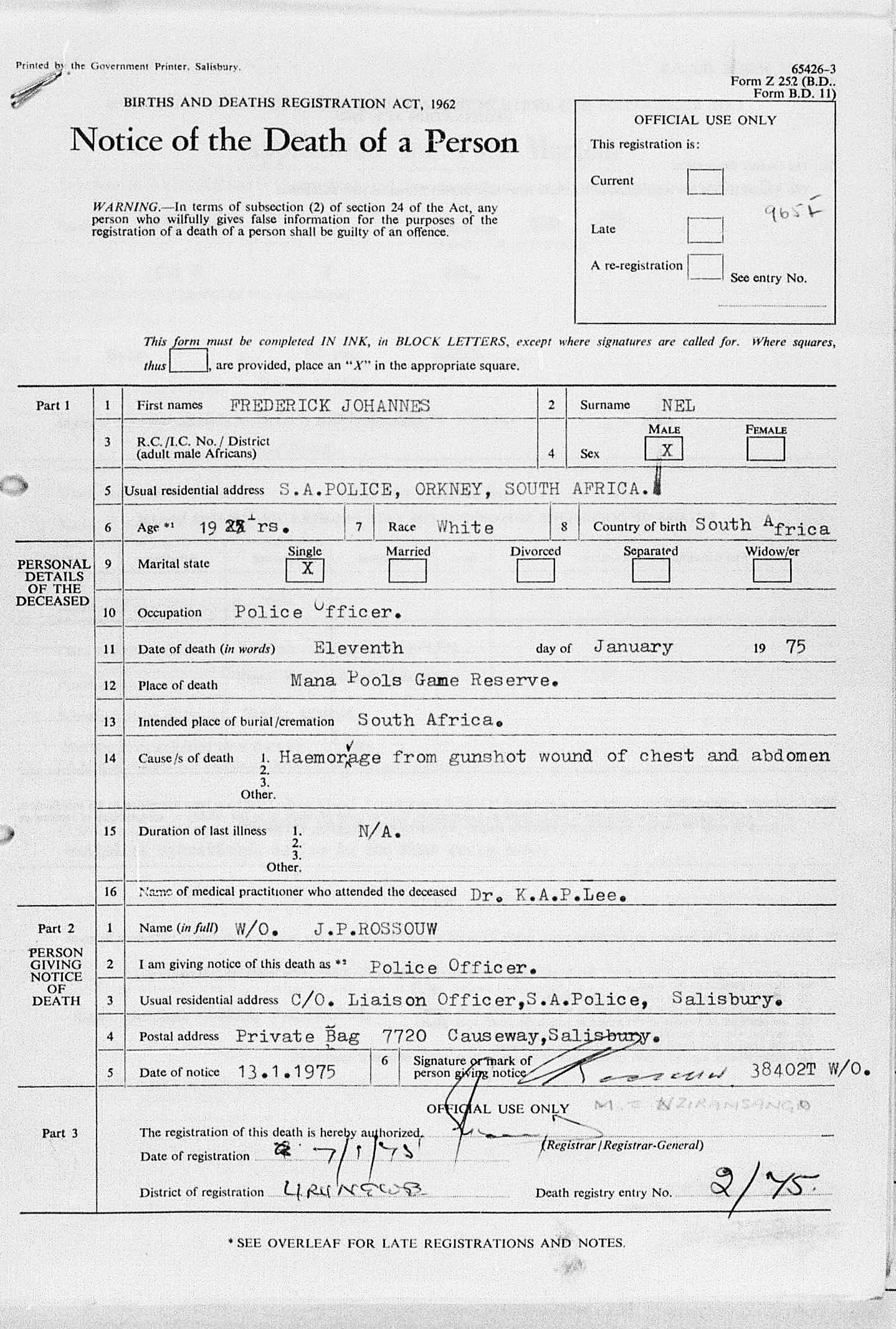
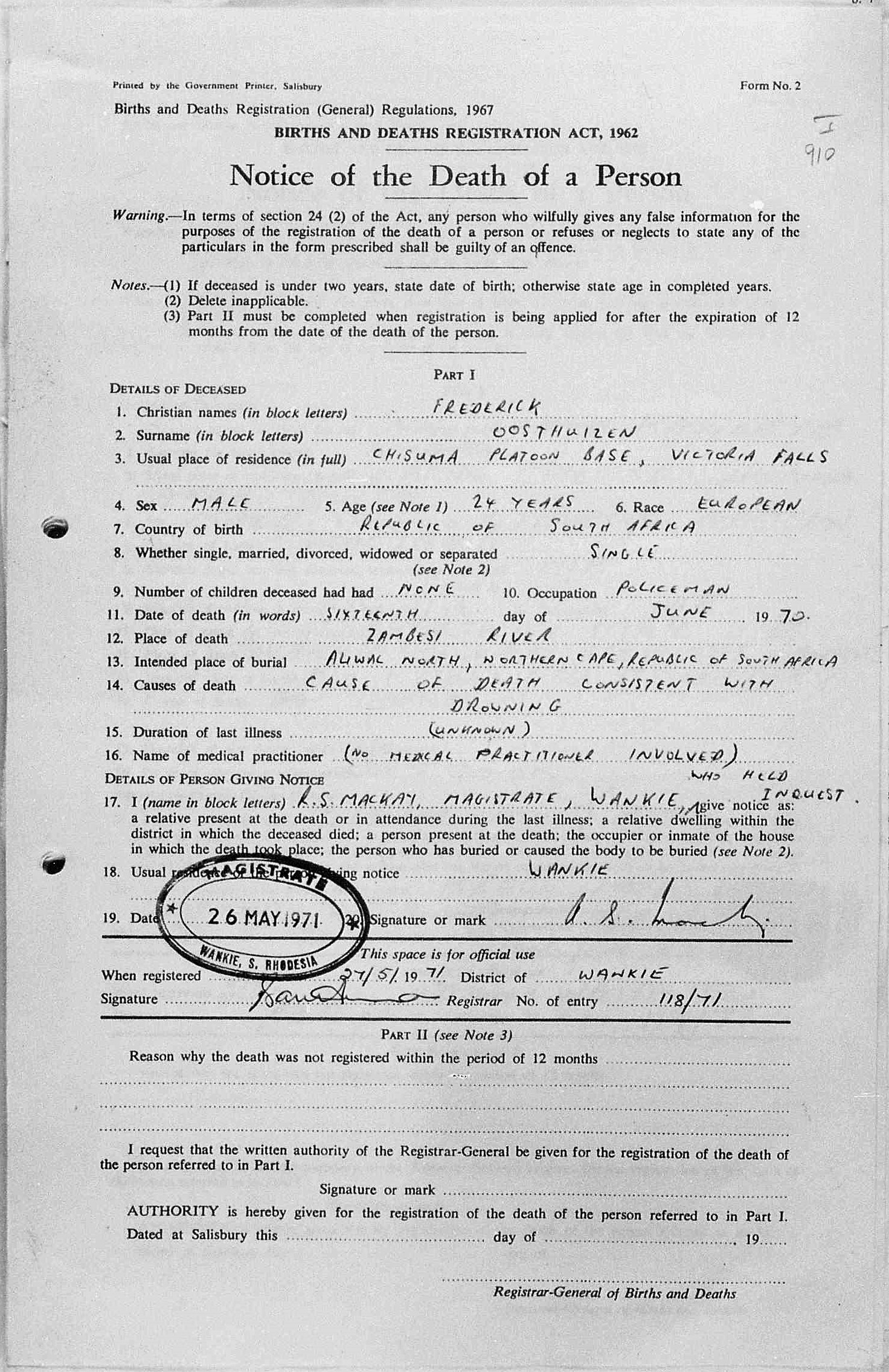
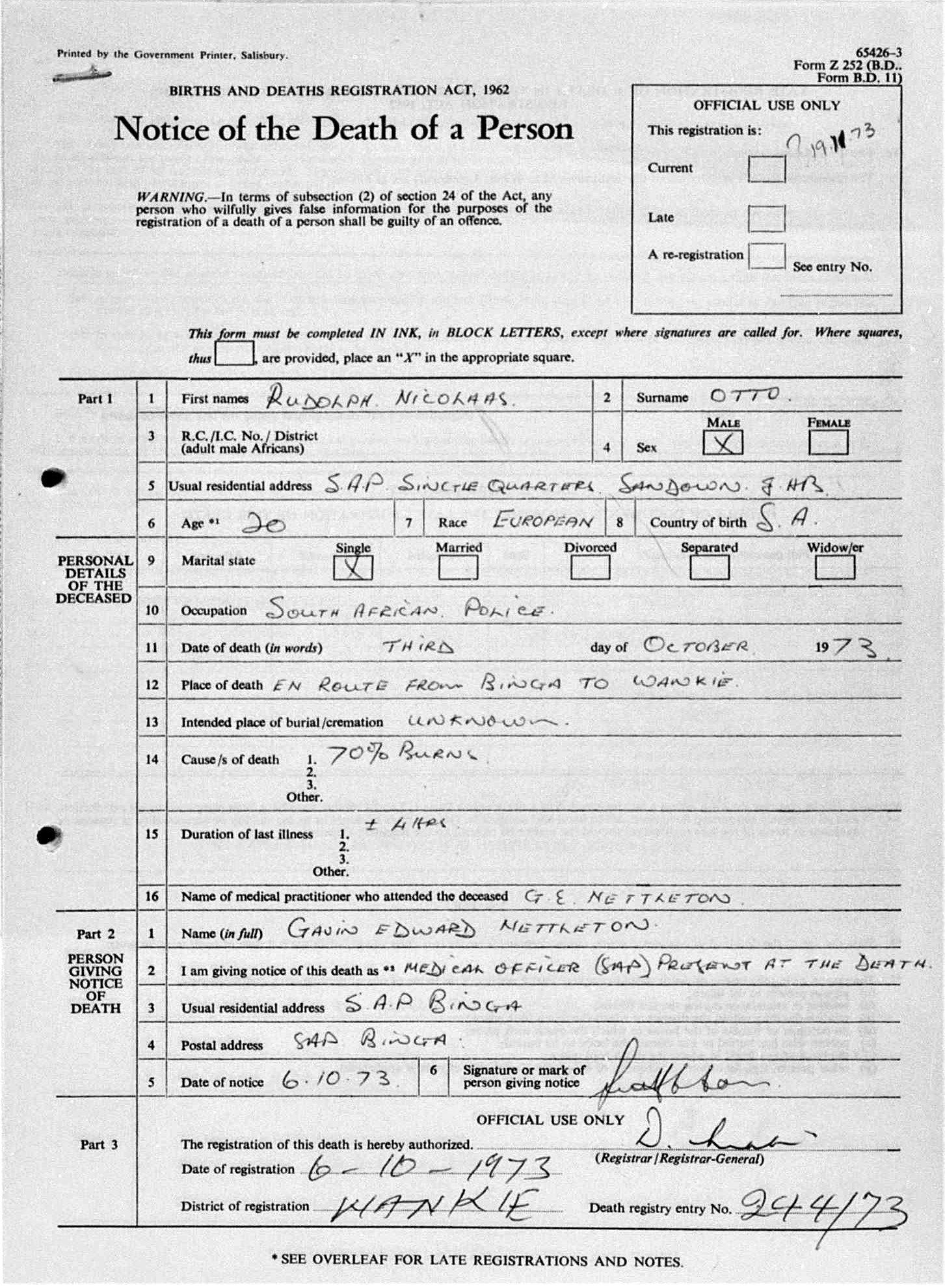
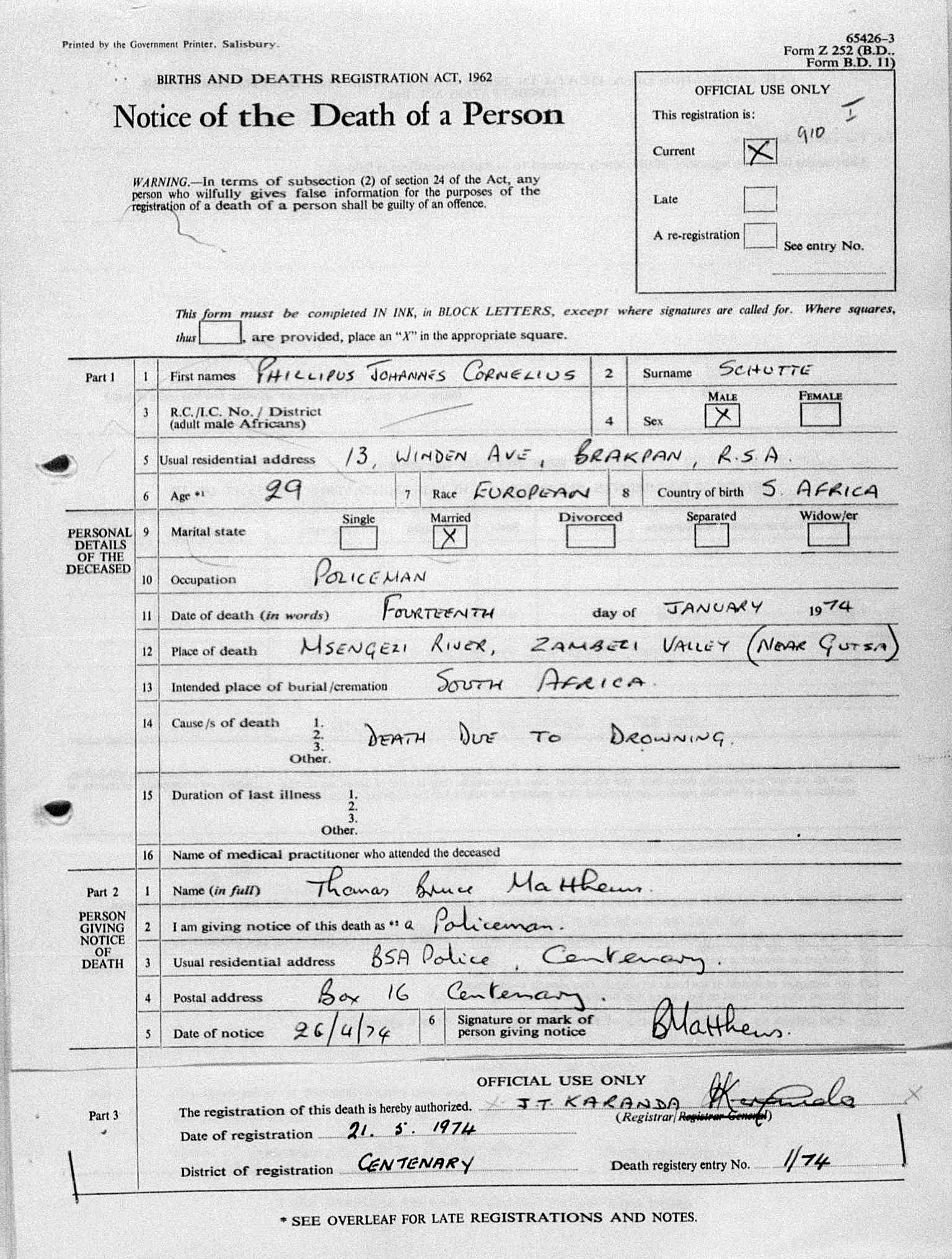
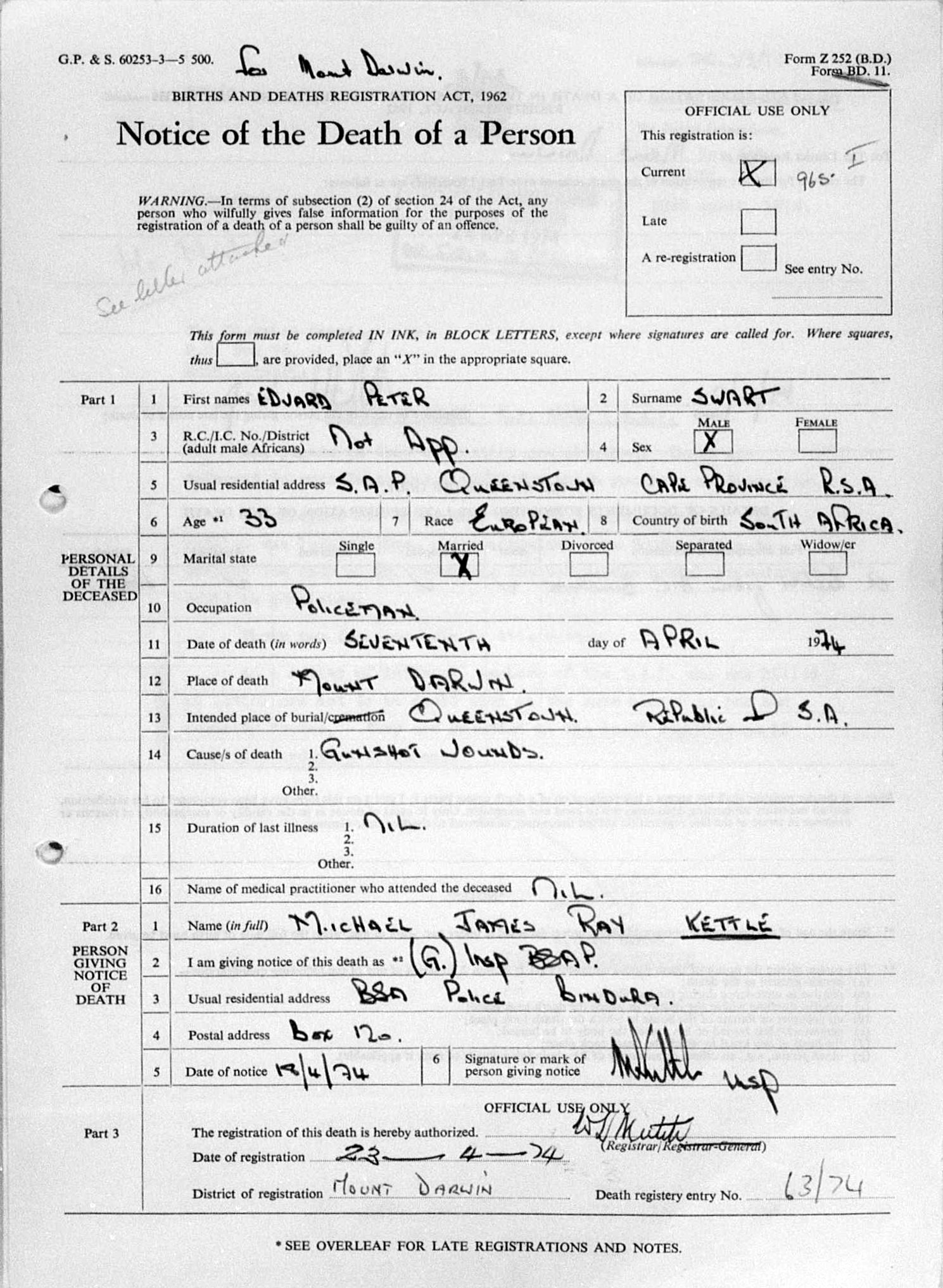
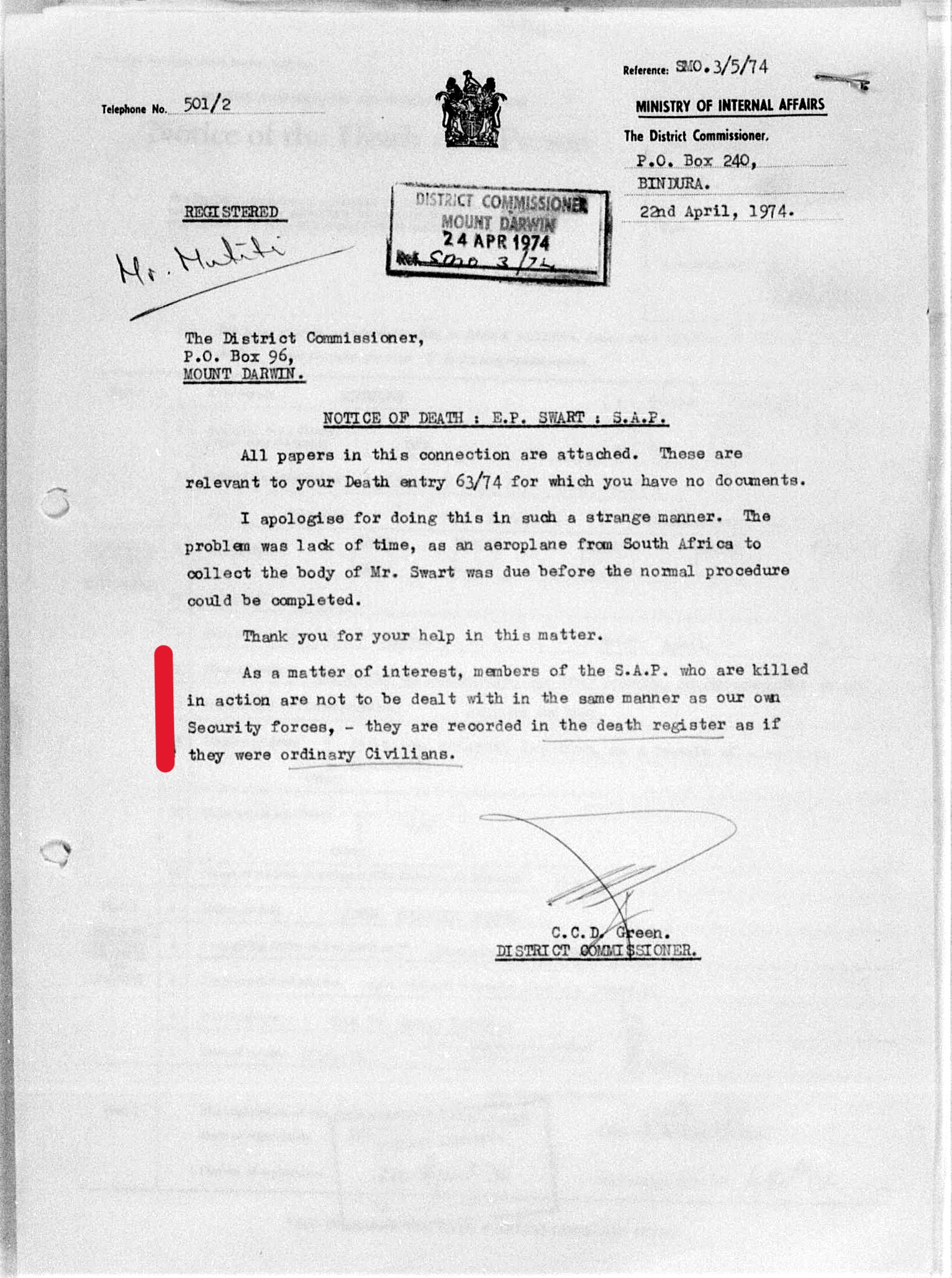
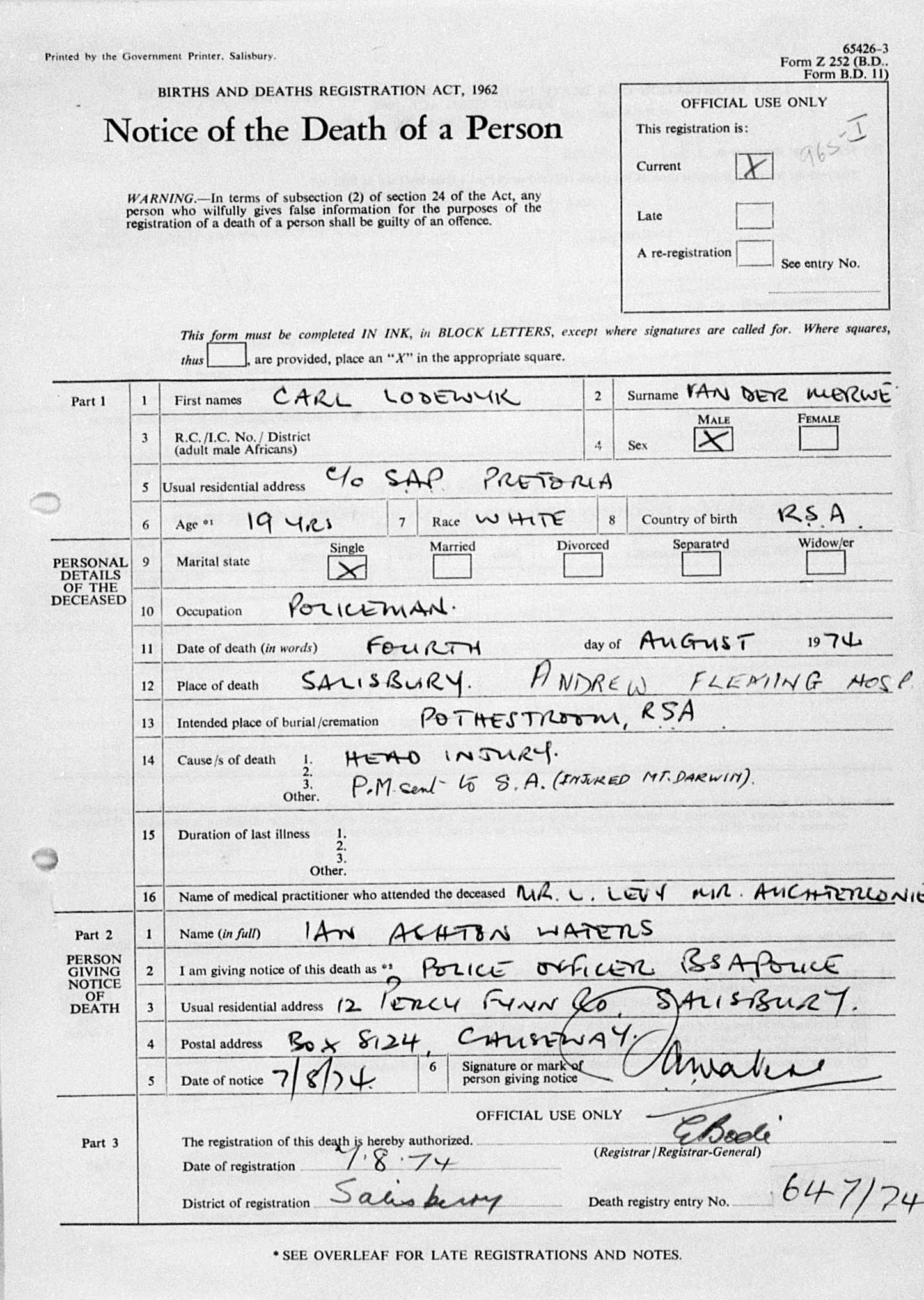
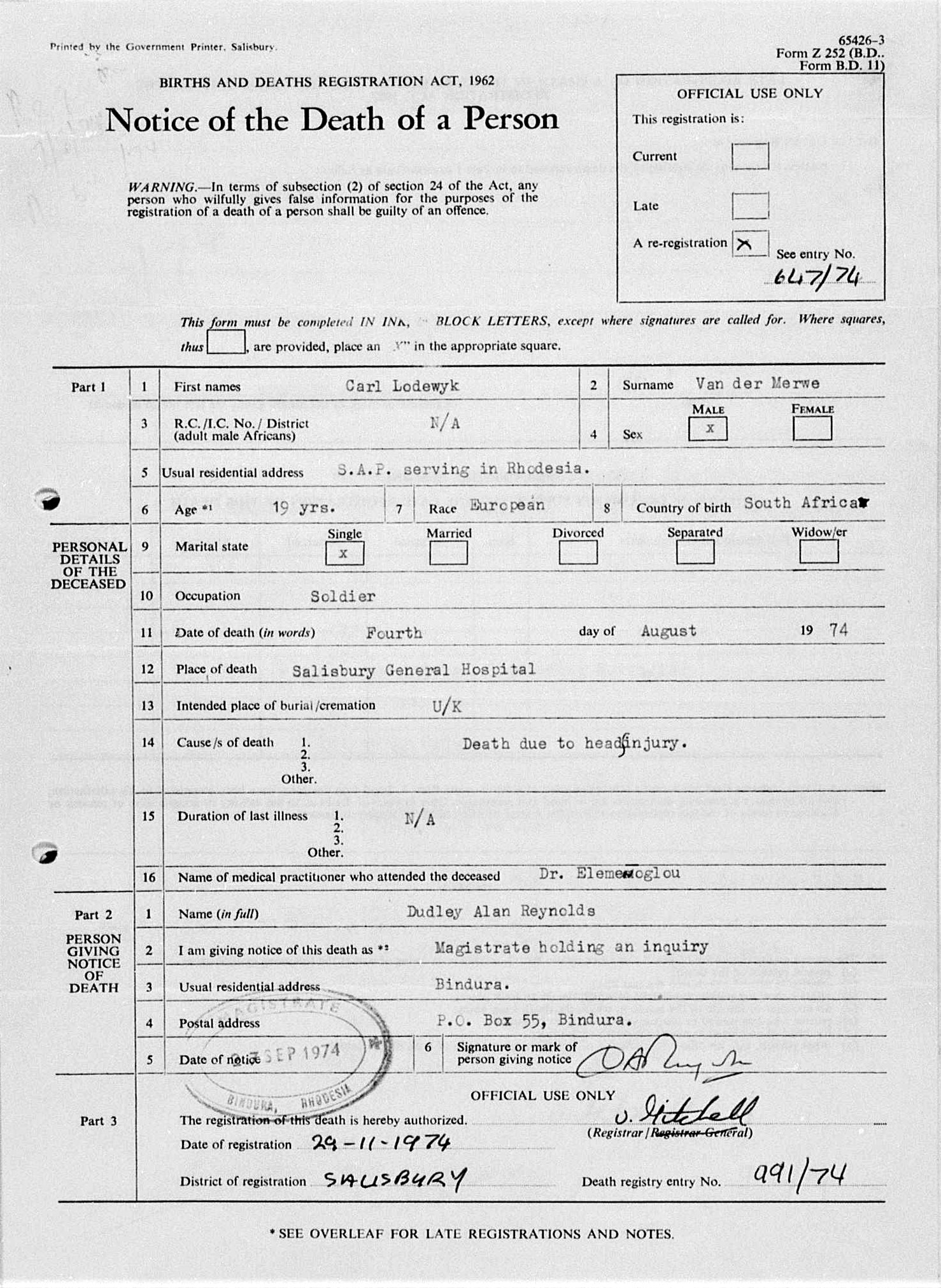
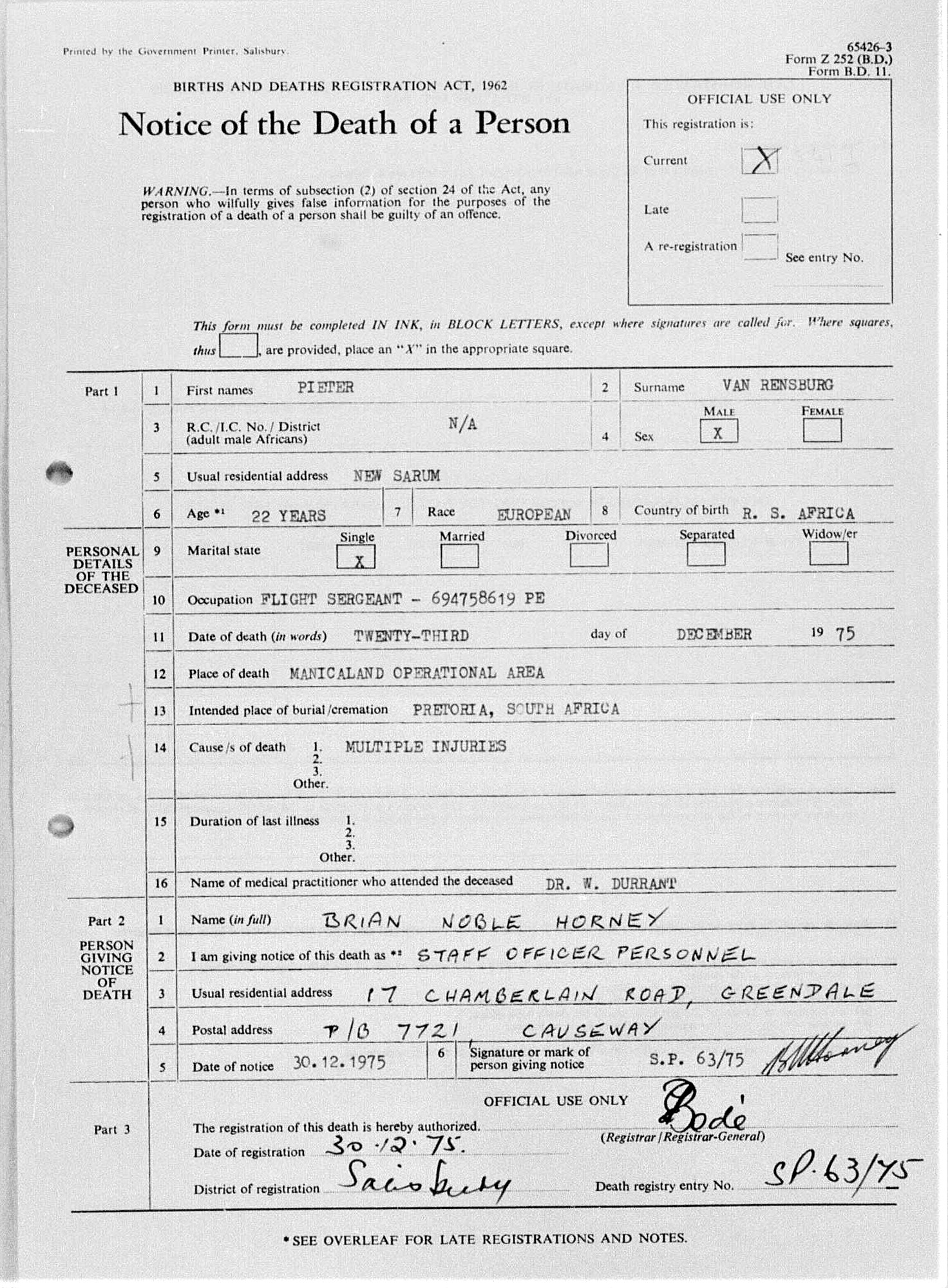


Lt-genl JG le Roux Stemmet verskyn op die eerste foto – hy is die man met die bril. Die foto kom uit sy versameling.
Die SAP kommissaris wat die saluut neem in genl HG “Hennie” de Witt.
De la Rosa genoem in die artikel is lt-genl AF “Adriaan” de la Rosa.
Uitkenning van persone op foto’s sal waardeer word.
Ek dink met leedwese aan mense van my stasie (sers Rodney Fall) en buurstasie (Danie du Toit) wat in Rhodesië gesneuwel het. Een van my offisiersmaats is ook in ‘n skermutseling geskiet. Ons eer hul nagedagtenis – saluut!