Dr Myburgh on Violent Crime – Nongqai Vol 17 No 5
THE NIGHTMARE FROM WHICH WE HAVE YET TO AWAKE (I)
WHEN VIOLENT CRIME FIRST EXPLODED (II)
THE DAY THE MIRACLE DIED (III)
Dr James Myburgh
Republished with permission by Dr James Myburgh of PoliticsWeb.
Abstract and key words by Nongqai.
ABSTRACT — Chapter 1
This chapter examines the political and social roots of late‑apartheid violence and the emergence of post‑1994 criminality by tracing the evolution of conflict from township‑based insurrection to the failed attempt to extend revolutionary violence into white suburban and farming areas. It outlines how the ANC’s ideological framework, rooted in The Road to South African Freedom, shaped the People’s War strategy of the 1980s, including the mobilisation of township youth, the covert role of MK cadres, and the use of deniable mass violence against perceived collaborators. While political killings surged dramatically between 1984 and 1986, the chapter shows that the ANC largely failed to penetrate white areas despite explicit calls by leaders such as Tambo and Hani. Crime statistics from the late 1980s reveal that white South Africans remained comparatively insulated from direct violence, even as political conflict escalated in regions such as Natal. The chapter concludes that the revolutionary violence of the 1980s did not directly translate into widespread attacks on white civilians, raising the central question of why formerly safe white areas became highly vulnerable to violent crime only after the political transition.
Key Words
• People’s War
• MK cadres
• Political violence
• ANC strategy
• Township insurrection
• Inkatha conflict
• Apartheid-era crime
• Revolutionary mobilisation
• White suburban security
• Natal violence
• Counter‑insurgency
ABSTRACT — Chapter 2
This chapter analyses the dramatic escalation of political and criminal violence during South Africa’s transition from apartheid (1989–1994), a period often remembered internationally as peaceful but which, in reality, approached the level of an undeclared civil war. It traces how the unbanning of the ANC, the exposure of Operation Vula, and the intensifying conflict between ANC and Inkatha structures produced a surge in armed clashes, assassinations, and covert operations by both state and non‑state actors. The chapter shows how MK and APLA rebuilt internal armed capacity under the cover of negotiations, with Self‑Defence Units (SDUs) and “repossession units” conducting politically framed robberies, farm attacks, and targeted killings. Simultaneously, elements of the apartheid security forces, often acting autonomously, armed Inkatha and engaged in pseudo‑operations that further destabilised the country. Between 1990 and 1994, murder rates, farm attacks, and armed robberies rose to unprecedented levels, blurring the line between political and criminal violence. The assassination of Chris Hani in 1993 nearly triggered racial war, but Mandela’s intervention stabilised the situation long enough for the 1994 election to proceed. The chapter concludes by showing how political violence declined sharply after April 1994, even as the structural conditions for South Africa’s later crime epidemic had already been firmly established.
Key Words
• Political transition
• Third Force
• MK and APLA operations
• Self‑Defence Units (SDUs)
• Inkatha conflict
• Operation Vula
• Farm attacks
• Armed robbery
• Transitional violence
• Hani assassination
• 1994 election
Abstract — Chapter 3
This chapter examines the collapse of South Africa’s post‑apartheid “miracle” through the lens of violent crime, institutional decay, and the ANC’s strategic turn away from reconciliation between 1994 and 2002. While political violence declined sharply after the 1994 election, violent criminality surged, driven in large part by former MK, SDU, and APLA cadres who had been militarised during the transition and often ideologically primed to view robbery as a form of “affirmative repossession.” The ANC’s dual strategy — reassuring white officials to secure a peaceful transfer of power while simultaneously embedding thousands of liberation‑movement combatants into the security services — produced a police force increasingly compromised by political loyalties, criminal infiltration, and the absence of vetting.
From 1997 onward, the ANC leadership embarked on a systematic purge of experienced detectives and specialised units, culminating in the destruction of the Murder and Robbery Units, SANAB, the Anti‑Corruption Unit, and other elite investigative bodies under Commissioners Fivaz and Selebi. This dismantling coincided with a dramatic second surge in violent crime: aggravated robberies rose by nearly 90% between 1996 and 2003, farm attacks doubled compared to the early 1990s, and carjackings and truck hijackings reached unprecedented levels.
The chapter also exposes the political culture that trivialised or racially reframed crime victims’ concerns, with senior government figures dismissing rising violence as “white whining” and responding to community protests with hostility. By 2003, the combined effect of cadre deployment, political–criminal networks, and the destruction of professional policing had rendered the state incapable of containing violent crime. The “miracle” of 1994 thus gave way to a new era defined not by reconciliation, but by institutional hollowing‑out and the entrenchment of a pervasive, militarised criminal economy.
Key Words
• Post‑apartheid crime
• SDUs and MK criminality
• Police transformation
• Specialised unit dismantling
• Jackie Selebi
• Aggravated robbery surge
• Farm attacks
• Political–criminal networks
• Cadre deployment
• Institutional decay
• Affirmative repossession
• End of the “miracle”
THE NIGHTMARE FROM WHICH WE HAVE YET TO AWAKE (I)
James Myburgh examines the political roots of post-apartheid crime and violence
“The past is not dead. It is not even past.” – William Faulkner
Introduction
It is not all that difficult to understand the African National Congress. For one thing, its core ideology was laid down in the Road to South African Freedom, drafted some sixty years ago, as was the programme it has been seeking to realise to this day, in the form of the “immediate proposals” of the National Democratic Revolution.
If the government suddenly lurches to adopt some destructive piece of legislation, you know that it thinks it has spotted a gap to finally realise another of the ultra-nationalist objectives laid out in this founding document.
There have been periods, particularly in the late 1980s and early 1990s, when the ANC leadership had to obfuscate both its objectives and its nature, but such pretences were discarded very soon after it had consolidated its hold over political power.
Beyond that point, senior leaders often sounded conciliatory when addressing international or business audiences, but their speeches to party congresses seldom deviated from the line laid out in the Road to South African Freedom, which remains the lodestar guiding this country to disaster.
Much of this is of course lost on foreign observers who remain attached to the many comforting myths and illusions which have been spun around the ANC by its well-meaning sympathisers over decades.
As a result, there are many questions from the past that have never been properly asked or answered. One of the most central of these is why did once safe commercial farming and suburban areas in the eastern half of South Africa become so insecure in the 1990s, and why have they remained so to this day? What happened to the guardrails that were meant to protect citizens from criminal predation, and when and why were they removed?
As soon as one illusion starts to fade or become untenable in South Africa another rolls in from across the sea until the fog is so thick that one cannot see one’s own feet. We are now confidently assured by numerous authorities – from the New York Times to the BBC – that those living on farms and small holdings (let alone suburbanites) are at no special risk of being attacked at all. Indeed, it is now commonly accepted in such circles that the wave of violent crime that white South Africans believed they were experiencing post-apartheid was largely a figment of their imaginations.
There have recently been a number of books published to acclaim abroad dealing with South Africa and its dark past. One of these is Jonny Steinberg’s Nelson And Winnie, an account of the Mandela’s troubled marriage. (See Rian Malan’s review here.) Another important book is Justice Malala’s The Plot to Save South Africa: The Week Mandela Averted Civil War and Forged a New Nation, which deals with Nelson Mandela’s adept leadership in the aftermath of the assassination of Chris Hani in April 1993.
A third book, and one which is likely to prove highly influential in shaping American perceptions of South Africa, is “The Inheritors: An Intimate Portrait of a Brave and Bewildered Nation” by journalist Eve Fairbanks. Twelve years in the making, The Inheritors features an extraordinary account of the lives and times of Dipuo Mahlatsi, one of the ‘young lions’ of the mid-1980s uprising, and her daughter Malaika, a prodigiously talented writer and Fallist radical.
Each of these books provides, at points, flashes of insight which illuminate important aspects of our dark past. Each, in their own way, also obscure our understanding of the past by leaving certain illusions untouched, introducing new ones, or just by ignoring certain realities entirely (for instance, none mention the National Democratic Revolution).
Talking of his book Jonny Steinberg recently commented that “I’m not sure that South Africa has yet reckoned with how horrible the violence of the 1980s and the early 1990s was, before democracy in 1994. It’s too ghastly to look in the eye. But you can certainly try to get close to it by telling Winnie’s and Nelson’s story.”
Facing up to the past in this way is important not just for its own sake, but because it is critical for understanding the violence that took place downstream of February 1990, when Mandela’s release signalled the coming of turbulent change. Often horrific in its own right, the criminal violence that South Africans have lived with since then exhibits highly abnormal characteristics, and yet has somehow just been accepted as part of the nature of things.
The differing insights in these books can advance our understanding of South Africa’s violent past (and present) as long as one can avoid getting lost and disorientated by the myths and illusions which continue to swirl through them. And this can be done by using one hand to hold very tightly to primary historical sources as one makes one’s way through such stretches of fog.
In this, the first article in a series, we deal with the crime and political violence of the late apartheid period.
The old apartheid pattern 1948-1984
The traditional pattern of crime and violence, under first segregation and then apartheid, was one where unsettled black areas in and around Johannesburg often had extraordinarily rates of inter-personal violence and murder, often related to drunken brawling, with wage-earners preyed upon and terrorised by the tsotsis (young thugs) who dominated the streets.
The tsotsis, as Jonny Steinberg describes them, were young men born and raised in and around Johannesburg, but who refused point-blank to do the backbreaking manual work people from the countryside were coming to the city to perform. Their “aspirations were sophisticated and thoroughly middle-class” he writes, but they were confined to the streets by a lack of formal education and their distaste for blue-collar work.
Even Nelson Mandela was a target for their predation. Shortly after arriving in Johannesburg in 1941, he had moved into a backyard shack in Alexandra. There was a gang in his area notorious for cleaning out the houses of their victims. One of his vivid memories of that period was being awoken by voices outside and hearing two men “arguing over whether to break down his door. One voice was pleading for Nelson: ‘No, man, this chap has no money, nothing, he’s just a student.’ But the other voice was insistent. Nelson listened intently, awaiting news of his fate. The voice of reason finally won out; the aggressive one reluctantly conceded that there was probably little to steal. He was so angry he had lost the argument that he gave Nelson’s door a furious kick. The bolt snapped and the door gaped open.”
Under apartheid the white areas were largely shielded from such violence, even if property crimes such as burglary were quite common. For example, between July 1978 and June 1979 there were 648 murders reported to police in Soweto – about one in ten of those reported in the country – a murder rate of around 75 per 100 000. During the same period 218 murders of white South Africans were reported in the whole of the country – 128 of which were white-on-white killings – giving a murder rate of 4,8 per 100 000.
Dipuo, one of the main subjects of Fairbanks’ book, grew up in Meadowlands, Soweto, the daughter of a single mother who supported her children by working in “the kitchens” in the white areas of Johannesburg. Fairbanks relates that as a child, Dipuo looked up to the tsotsi element in the township. The thugs were the ones who wore the fancy things, who would look after and protect you, if you dated one of them, and make sure you wore beautiful clothes. “Since nobody could easily leave the township, the thugs mostly robbed other black people,” Fairbanks writes – raiding schools and parties, and preying on commuters on trains. Although they were loathed by working adults, Dipuo for one admired their disregard for the rules in a system where the rules were discriminatory and unjust.
While Soweto may have been under-policed it was not unpoliced. In 1978/1979 there were 2 549 robberies reported to police – a rate of around 255 per 100 000 residents – with 1 175 cases brought to trial. In 1982 1 141 murders were reported to police, a rate of over 100 per 100 000, with 497 murder cases brought to court. The clearance rate thus hovered between forty and fifty percent.
Years of insurrection 1984 to 1986
In the mid-1980s Dipuo was one of the thousands of young comrades who joined the mass national insurrection that broke out in September 1984 in response to National Party leader PW Botha’s inadequate attempts to reform South Africa politically.
The ANC leadership had either been imprisoned or exiled for two decades and by this stage, Fairbanks relates, “the ANC had started to seem like a group of ancient gods – prayed to, but no longer expected to show up in real life.” Dipuo and a group of fellow youth listened intently to the commandments handed down over Radio Freedom, the ANC’s radio station in exile which broadcast from Zambia.
The most golden of these gods was Chris Hani, the Political Commissar of the ANC’s armed wing Umkhonto we Sizwe (MK). He was described by white leftists who knew him as “absolutely confident”, “highly intelligent”, “fearless” and a “hugely compelling revolutionary”. As Justice Malala writes in his book, if his generation of young black South Africans – the so-called lost generation – “had a hero, it was this man. Charismatic, energetic, articulate, he had built a reputation as a brave guerrilla fighter during his twenty-seven years in exile.”
The commandments issued over Radio Freedom were, in line with the first stage of the ANC’s People’s War strategy, for the “fighting youth” to organise themselves into small “combat units”, to arm themselves by any means possible, and to “eliminate” all “collaborators from our nation”. This was a call for the killing of black security policemen, suspected informers, ordinary policemen, municipal councillors and those participating in the homeland system, notably Mangosuthu Buthelezi’s Inkatha movement. In September 1986 Buthelezi reported that more than 100 Inkatha officials and members had been killed in attacks by pro-ANC activists since 1984.
“The whole country must go up in flames”, was the exhortation transmitted over Radio Freedom. Dipuo, who took the nom de guerre “Stalin”, headed one of the “people’s committees” set up at the behest of the ANC. It did such work as enforcing consumer boycotts by grabbing the bags of shoppers and dumping their contents into the dirt. Wrongly suspecting that the black businessman who owned their local store was an informer, her group burned his building to the ground.
Her group also invaded to the house of a woman rumoured to be an impimpi. Dipuo dragged her out of bed into the yard where they “pelted her with stones”. What followed appears to have been one of the four hundred-odd “necklacings” that occurred between mid-1985 and the end of 1986 whereby victims had tyres put around their necks, were drenched with petrol or diesel and then burned alive. Fairbanks relates that “Dipuo didn’t say how the woman she stoned in Soweto ultimately died. But when I asked her whether she ever participated in a necklacing, she just looked down and was silent.”
The role of the MK cadre
An enduring but fatal misconception is that the central role of the MK cadre was to carry out armed guerrilla attacks on designated targets. Such “armed propaganda” was certainly important; among other purposes it was meant to enthuse the masses and show that the ANC was the most formidable revolutionary opponent of white rule. Such actions were by their nature high risk and they were intended to advertise the movement and its courage in confronting white power.
If an MK operation went too far, however, it risked causing serious blowback against the organisation. The ANC thus avoided directly ordering guerrilla attacks on white civilian targets and when they did so, as when white farmers were made a formal target for armed attack in mid-1985, they came up with a contrived rationale that recast such farmers as a legitimate military objective (on the grounds that males of a certain age were integrated into the commando system.)
The ANC was notably less restrained when it came to the sort of violence that it sought to unleash at one remove, as evident from its calls to action transmitted over Radio Freedom, and where lines of responsibility were far less clear, and culpability harder to pin on the leadership.
The critical role of MK cadres in People’s War was, as Chris Hani described it at the time, to converge with, and supply weapons, training, indoctrination and direction to, the fighting youth “to teach them the skills of warfare, to impart to them the tactics of fighting, to impart them the skill of fighting, the skills of ambushing the enemy, the skills of raiding for weapons in order to capture them, the skills of fighting in small groups, the skills of fighting and camouflaging, the skills of attacking when the enemy least expects you.”
In this role the MK cadre operated in the shadows. He would use a combat name, keep in the background, and when his work was done, disappear. The violence that the ANC could potentially orchestrate in this manner was more pervasive and, cumulatively, more deadly, than overt guerrilla actions, and it could be directed covertly. It would often prove impossible to distinguish such politically motivated attacks from murders or robberies committed by ordinary criminals.
Taking the struggle to the white areas
The first phase of People’s War strategy, as applied in South Africa, was to render the state ‘blind and deaf’ within black areas by eliminating representatives of state authority and eradicating informer networks, by whatever means necessary. Once this was accomplished, the next phase involved taking the fight to the main enemy.
In August 1985 Oliver Tambo, speaking on behalf of the ANC’s NEC on Radio Freedom, instructed his followers to take the struggle “into the white areas of South Africa.” Among those leaders who took up and repeated this call within South Africa was Steve Tshwete, a United Democratic Front leader in the Eastern Cape. As the New York Times reported, “At funeral rallies in the restive Eastern Cape, [Tshwete] has urged that the unrest of the townships be carried into white areas.”
This was meant to involve not just armed actions by MK, but mass popular violence of the type that had made the townships ungovernable as well. The “arena of battle” would now expand from the townships into leafy suburbs, such as Lower Houghton in Johannesburg, “where our white compatriots are being safely kept away from knowing what is happening in their own country”.
Tambo concluded the January 8th statement of the ANC NEC in 1986 by calling on the movement’s supporters in South Africa to turn every corner of the country “into a battlefield! … Every patriot a combatant: every combatant a patriot!”
In broadcasts from early 1986 Chris Hani described what the ANC intended to do next. It was difficult at the time to smuggle weapons into the country and get them into the hands of the fighting youth, so “our people” need to go out and grab weapons: “Not only from the police and army … but every white home has got a weapon, every farm has got a weapon, every black policeman has got a weapon, every black and white soldier, they have got weapons, every white businessman has got weapons.” This was a call, in other words, for young comrades to go out and target every white farm, every white business, and every white household in the country, for robbery.
The fighting youth, Hani declared, should then use these weapons against the enemy. “Our people,” he said, “must begin to deal with the ruling class,” which inescapably meant whites. “So what we are saying is that the struggle should be intensified to destroy all those who are oppressing our people.” (Emphasis added).
“Nothing,” he concluded, “will save those who are primarily responsible for the misery of our people from the same wrath of our people that we see now consuming the stooges and the puppets.” A narrow bridge to salvation was however always kept open to those who became “white democrats” – those whites who submitted themselves to the ANC’s revolutionary cause – and it would become an ever-more crowded one.
Fairbanks relates that Dipuo took such rhetoric from Hani, Tambo and others to mean that “everyone” – white people and their black collaborators – must be made to violently suffer for what apartheid had done to the black majority. Her mission was to “kill every white person I saw,” she told Fairbanks. “I hated whites. I would have killed any white person if I had seen one. They deserved to die. If you threatened our freedom, you did not deserve to live.” It was not easy for Dipuo to give effect to this aspiration, however, as the state security forces could and did seal off the township areas. As Fairbanks puts it: “Imprisoned in Soweto, she almost never saw white people”.
MK’s plans to breach this cordon failed, partly because MK’s forces were marooned in bases in far- off Angola and elsewhere, but also because it was riddled with state informers. As previously mentioned, it was enormously difficult to infiltrate armed cadres into South Africa, and those who made it across the border would soon find themselves relentlessly harried by the Security Police and its askaris.
The insurrection fails
By 1987 the state had managed through severe repression – including, not least, mass detentions without trial – to put the lid back on the cauldron and the revolutionary violence receded. Despite the ferment of the period, the security situation had been temporarily stabilised.
Some 616 deaths were attributed to political violence in 1987 by the South African Institute of Race Relations (SAIRR), down from 1 298 the year before. In 1985 there had been 67 necklace murders, rising to 306 in 1986 at the height of the insurrection. There were only 19 in 1987, at which point the ANC leadership belatedly told its supporters to cease with this method of eliminating the enemy within.
In this period, covert units in the police and military increasingly acted outside of the law, assassinating rather than arresting their revolutionary adversaries. There were also a series of gruesome extra-judicial killings of young ANC-supporting comrades by the Security Police. Though National Party ministers could “plausibly deny” responsibility for these deaths, the ANC’s supporters knew well enough where responsibility lay, and such unpunished killings served only to sharpen the sense of injustice, and bring yet further international opprobrium onto the white state. Such actions also had the effect of compromising the state from within as not only had capital crimes been committed by its own agents, but they also now had to be covered up, sometimes by further murders. In such cases policemen were no longer enforcing the law but subverting it from within.
If one turns to the crime situation from that era 9 800 murders were recorded by the South African Police in 1987, down slightly from the 9 913 recorded the year before. Of these, 313 victims were white. In total, 5 972 of reported murders had been solved by the following year (a clearance rate of 60%). The total incidents of robbery recorded by the SAP increased by about a quarter between 1984 and 1986, from 39 302 to 48 533.
But here too the situation seems to have been stabilised by 1987, with the number of robberies reported falling to 46 288. Of these just over half, 25 957, were categorised as robberies committed under aggravating circumstances – meaning the perpetrators had been armed with dangerous weapons and/or had inflicted or threatened to inflict grievous bodily harm on their victims.
These statistics did not, it is important to note, cover the whole of the country. From the mid-1970s to early 1980s four Bantustans (Transkei, Venda, Bophuthatswana and Ciskei) acquired “independence,” which meant their crime figures were no longer included in SAP statistics but reported separately if at all. On the other hand, SAP statistics did cover the urban areas most seriously affected by crime, along with the entire territory once known as “white South Africa”.
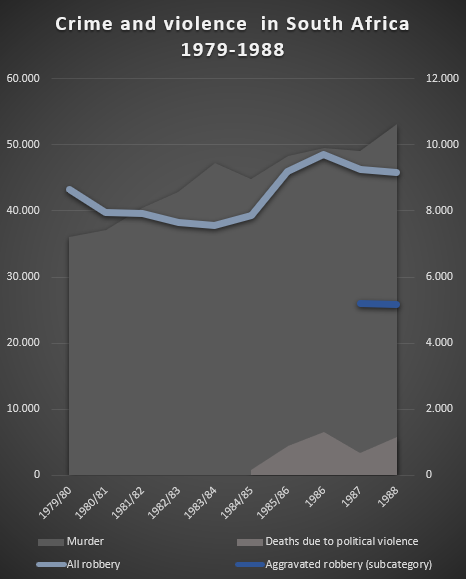
Sources: SAP statistics (which exclude ‘independent’ homelands), and figures compiled by the SAIRR.
Aftermath of the insurrection
Despite the failure of the ANC’s attempted insurrection, the shock caused by its force and fury had caused a fracture to develop within the state machinery. Hardliners within the security services sought to prevent a Rhodesian-style black-on-white revolutionary war by keeping political violence on a ‘black-on-black’ track. This was done by training and arming the ANC’s traditionalist adversaries in the black community, most notably Inkatha.
The soft-liners within the state led by the National Intelligence Service (NIS) also sought to avoid a Rhodesian-style scenario, but by pursuing a negotiated settlement from a position of strength, and before the security situation had completely deteriorated, as it had done in the 1970s under Ian Smith.
President PW Botha had ridden both horses, encouraging the police and the military to “take the gloves off” in the fight against the ANC while simultaneously allowing the NIS to explore the possibility of a negotiated settlement, an effort that included extensive discussions with Nelson Mandela in prison and informal contacts with the ANC in exile.
The ANC also pursued a dual-track strategy as the prospect of a negotiated settlement opened up. ANC leaders would set about charming a succession of white interlocutors, claiming that their movement’s struggle was only against “the system”. The ANC also pulled back from the racial violence it had previously tried to unleash, suspending its landmine campaign against white farmers after numerous civilian deaths, both black and white. At the same time, it sought to quietly build up the ANC’s underground presence within South Africa through Operation Vula, which involved extensive gun running and stockpiling in preparation for a future resumption of a full-scale insurrection.
In 1987 Hani was appointed MK Chief of Staff, the number two position in the organisation. He ensured that the position he vacated, Political Commissar of MK, was filled by his close friend and comrade, Steve Tshwete, who had fled into exile some time before.
In early June 1988 the journalist John Battersby conducted an extensive interview with Hani and Tshwete in Lusaka for an article for the New York Times. Hani was quite blunt that it was still ANC policy to “eliminate” all black collaborators. He also said that it was MK policy to recruit and train local operatives in Natal, and to provide them with small weapons with which to assassinate Inkatha leaders.
If it was ANC policy to kill black people who collaborated with the enemy, what was the attitude to the enemy itself? Hani and Tshwete were somewhat less forthright when asked whether it was MK policy to go after white civilians. Both men denied such a policy but suggested that it would be no bad thing if white South Africans were put in fear of their lives by the armed actions of MK.
As Tshwete put it: “It must be driven into their minds – by the termination of the good life in their midst – that there is a struggle going on in South Africa.” MK actions in white areas, Hani commented, even if not too indiscriminate, would show whites that it was too “dangerous to hang around the Carlton Centre” anymore and “so the best thing is to move and barricade myself in my nice house in Lower Houghton”.
On 2 July 1988 a special operations unit of MK, under Hani’s direction, detonated a car bomb outside Ellis Park stadium, following the Transvaal-Orange Free State rugby game. Two civilians were killed and thirty-seven injured. This attack attracted serious criticism from the ANC’s moderate supporters within South Africa. The following month the ANC National Executive Committee formally distanced itself from such attacks on civilian targets, and shifted Tshwete out of his position as Political Commissar of MK and onto the NEC.
| All robbery | Aggravated robbery (subcategory) | Murder | Deaths due to political violence | Killings of policemen | |
| 1979/80 | 43.250 | 7.220 | |||
| 1980/81 | 39.816 | 7.434 | |||
| 1981/82 | 39.626 | 8.084 | |||
| 1982/83 | 38.229 | 8.573 | |||
| 1983/84 | 37.755 | 9.462 | 48 | ||
| 1984/85 | 39.302 | 8.959 | 149 | 39 | |
| 1985/86 | 45.935 | 9.665 | 879 | 68 | |
| 1986 | 48.533 | 9.913 | 1.298 | 29 | |
| 1987 | 46.288 | 25.957 | 9.800 | 661 | 67 |
| 1988 | 45.857 | 25.951 | 10.631 | 1.149 | 80 |
Crime at the end of apartheid
The table above offers a snapshot of crime in apartheid’s final decade, before the political transition was set in motion in 1989. As you see, it features a marked emergence of deaths related to political violence in the second half of the 1980s, and this drove up the overall murder numbers.
The jump in political killings in 1988 was largely a regional phenomenon, driven by the escalating conflict between Inkatha and ANC supporters in the townships around Pietermaritzburg and Durban in Natal. According to the SAIRR, 912 (79%) of 1 149 deaths resulting from political violence in this year took place in this region.
The violence in Natal drove overall murders to a new high in 1988 while obscuring a telling fact – only 302 of 10 631 murder victims nationally were white, according to the SAP – a murder rate of 6 per 100 000 people. The number of robberies also declined slightly from 1987.
Lack of completeness notwithstanding, these SAP figures tell us something important: despite incendiary calls to action by Hani, Tambo and others, and the resonance that this had for Dipuo and others, the ANC had for the most part failed to take the struggle into the white areas.
For the most part, the revolutionary violence that swept through the townships between 1984 and 1986 had reached whites in the suburbs and farms only as an ominous echo.
This article first appeared on Konsequent.

WHEN VIOLENT CRIME FIRST EXPLODED (II)
James Myburgh on the political and criminal violence during SA’s transition from apartheid (1989-1994)
The NIGHTMARE FROM WHICH WE ARE STILL TRYING TO AWAKE (II)
Note to readers: this series was sparked in part by revelations and claims in three recent books about South Africa – Jonny Steinberg’s “Winnie & Nelson,” Justice Malala’s “The Plot to Save South Africa,” and Eve Fairbanks’ “The Inheritors”. Quotes attributed to these authors are derived from the works aforementioned.
This article is the second in the series.
Introduction
The first article in this series on the curse of violent crime in South Africa traced the situation in South Africa through the last decade of PW Botha’s presidency and apartheid proper.
Under segregation and apartheid white South Africans had been largely shielded from the violent criminal predation that afflicted many black urban communities. Through the national insurrection of the mid-1980s, and despite an explicit effort by the African National Congress to take the struggle into the ‘white areas’ from late 1985 onwards, this pattern had held up until 1988.
The shock caused by the force and fury of this insurrection, South Africa’s growing isolation, and the knowledge that the relative position of the white minority would only deteriorate further over time – combined with the retreat of the Communist threat – led significant factions of the white ruling establishment to start exploring the possibility of a negotiated settlement with the ANC.
This article picks up the narrative in 1989, the year that the political transition from apartheid and white rule was set in motion.
Liquidating the firm
In 1989 FW de Klerk replaced PW Botha as leader of the National Party and then President of South Africa. After winning the last whites-only elections in September 1989, De Klerk charted a course towards political transition, or the “liquidation of the firm” as NP insiders sometimes put it. The Rivonia trialists (other than Mandela himself) were released October, and a moratorium placed upon capital punishment. From the ANC side the second half of the year saw a marked decrease in MK guerrilla activity.
It was in 1989 too that General Bantu Holomisa formally unbanned the liberation movements in the Transkei homeland and released MK operatives held in Transkei prisons, along with those of the Azanian People’s Liberation Army (Apla), armed wing of the Pan Africanist Congress.
The escalating conflict between the ANC and Inkatha in Natal continued to push up political fatalities which increased in that province from 912 in 1988 to 1279 in 1989 – 92% of the 1 403 political fatalities counted that year by the SAIRR. There was a slight deterioration in the overall crime situation, with robberies up 10,4% to 50 636 and murders up 9,5% to 11 750, an increase again driven by the rise in political violence. But only 305 of these murder victims nationally were white, signalling that white areas were still largely untouched by the violence that was wracking other parts of the country.
In February 1990 De Klerk followed Holomisa’s example, announcing the release of Nelson Mandela and all remaining political prisoners and the unbanning of the ANC, SACP and PAC. In the same speech, he declared his intention to abolish all remaining security and apartheid laws and lift the state of emergency.
De Klerk’s move failed to bring down the temperature of the conflict in Natal. There were 695 political fatalities counted by the SAIRR in Natal in the first three months of 1990, more than double the number of the equivalent period of the year before. Elements within the security services continued to run guns to Inkatha in early 1990, while the ANC policy of providing young comrades with weapons to take out Inkatha members seems to have carried on unimpeded, as did Operation Vula, the ANC’s secret attempt to reestablish key leaders and stockpile arms inside South Africa.
The goal of Operation Vula was for MK to quietly reestablish itself in the country and take command of, recruit for, train, arm, and then direct the combat and self-defence units of the fighting youth. In this way MK would summon into existence, and form the core of, a “revolutionary army of the people”. A high priority was also the formation of combat units to carry out operations in cities and on white-owned farms. The activity of such units would be guided by the needs of the political struggle, but the groundwork would be steadily laid for a return to full-scale insurrection, should the right moment present itself.
In early July the Security Police, acting on a tip off, raided two Vula safe houses and uncovered the ANC’s secret plans. This led to seizure of a huge quantity of weaponry and the arrest of several ANC and SACP figures involved in the operation. Ronnie Kasrils had to go back underground, while MK Chief of Staff Chris Hani sought refuge in the Transkei under Holomisa’s protection.
Embarrassed by these developments and eager to avoid a wholesale clampdown, the ANC agreed, in terms of the Pretoria Minute signed on 6th August 1990, to “suspend all armed actions with immediate effect.” As of that date, therefore, all main armed actors in the conflict – the ANC, the NP government and Inkatha – were formally committed to peaceful resolutions. As we shall see, however, this did not mean the end of political violence; only that violence would henceforth proceed along covert and “deniable” lines.
The apartheid state’s dirty war
In his book Days of the Generals the journalist Hilton Hamman claims that covert units in De Klerk’s police and military were instructed by their political superiors to “disrupt” the returning ANC, an order he suggests was interpreted with “the broadest possible latitude.” These units, it seems, continued to conduct covert operations, with some elements in the SADF’s spesmagte (special forces) later conducting pseudo-operations, while others continued their practice of simply assassinating the enemy. There would also be extensive gun running to proxies within the black population who were willing to fight the ANC. Most such activities remain shrouded in secrecy, but Eugene de Kock later confirmed that he armed Inkatha warriors during his tenure as commander of the Vlakplaas counter-insurgency unit. This would come to be characterised as “third force” activity.
Within days of the exposure of Operation Vula in July 1990, political violence between the ANC and Inkatha spread from Natal to areas around Johannesburg. The proximate cause, Jonny Steinberg writes in Winnie & Nelson, was the effort to launch Inkatha as a national rival to the ANC. The ensuing war never engulfed the whole city, with the violence in Alexandra, Kagiso, Jeppe, and Soweto, remaining sporadic and fairly low-key. “But in two townships to the east of the city, Thokoza and Katlehong, the war was bitter and endless and shockingly bloody.”
In The Inheritors Eve Fairbanks describes the nightmarish political violence around Johannesburg through a focus on Katlehong. It was here that 32 Battalion to which Christo, another of the subjects of her book, was attached and was first deployed, with uniformed units of the military now expected to step in and restore order. Fairbanks also describes the fury that the journalist Wally Mbhele felt at FW de Klerk personally, as he covered the violence for the Weekly Mail, over the “hidden hand” that he believed lay behind this horrific mayhem.
A characteristic of De Klerk’s leadership through the transition, however, was his reluctance to decisively control and exercise state power. Instead, he kept the military and the police, and later even the National Intelligence Service (NIS), at a safe political distance. Responsibility for keeping a check on state malfeasance was meanwhile outsourced to various commissions and counter-intelligence investigations.
The Vula plan continues
Steinberg writes that as the violence exploded around Johannesburg in late 1990, Nelson Mandela “grew very angry with De Klerk” whom, he believed, “either was allowing his security forces to inflame the conflict or was too afraid to stop them”. In response, Mandela secretly authorized the procurement “of large stocks of AK-47 assault rifles, Makarov pistols and grenades” to be distributed to the members of the ANC’s “Self-Defence Units” (SDUs) in the areas in and around Johannesburg.
Although these units had initially emerged in a spontaneous manner – or so the story went – MK operatives would now be formally deployed to both train and command them. Among those at the heart of the operation, Steinberg writes, was Ronnie Kasrils, a senior figure in MK. He was a fugitive when the violence erupted, thanks to his Vula involvement, with “the police on his tail” even as he began his work with SDUs. “Years later,” Steinberg continues, “(Kasrils) recalled a secret meeting with Nelson and the ANC’s treasurer, Thomas Nkobi, who quite literally handed Kasrils bags of cash to buy weapons, while Nelson grimly looked on.” Winnie Mandela was also deeply involved in the supply of weapons to SDUs engaged in township battles against Inkatha, something which did not necessarily please Nelson.
The suspicion that state elements were fomenting the violence around Johannesburg was widely shared by the press, foreign diplomats, and the NIS itself. This made it easier for the ANC to continue critical aspects of the Vula plan without being criticized for its failure to truly abandon the armed struggle.
As explained in Part I of this series, MK had tried and failed in 1986 to “plunge itself into the country, train and arm our people” with the goal, at the time, of taking its People’s War into white areas. This time around, MK members could freely enter and move around the country, link up with the young comrades, organise them into combat units (now rebranded as SDUs), and supply them with weapons training and arms. They would also be taught how to surveille and then attack targets.
While ANC talked peace, love and understanding to Western journalists and diplomats, its township recruits were being taught struggle songs that celebrated violence against black “sell-outs” and the “Boers”. These included ‘Shaya maBunu’ (smash the Boers), ‘Dubul’ ibhunu’ (shoot the Boers), and MK’s anthem ‘Hamba kahle, Mkhonto’, which contains the line, ‘We, the people of MK, are determined to kill these Boers.’
These factors –sinister Third Force operations, inflamed Zulu nationalism and the ANC’s implementation of its plan to reconstitute, train, and arm its combat units – resulted in a huge increase in politically-related fatalities in Transvaal province, which jumped from 54 in 1989 to 1 547 in 1990, according to the SAIRR. Overall political fatalities increased year-on-year by 163% to 3 699. The number of murders recorded by the SAP increased by 3 359 (28,6%) to 15 109 in 1990, largely driven by the rise in “black-on-black” violence.
In September 1991 the ANC secured further operational space for the SDUs when the National Peace Accord gave them semi-official status, stating that all individuals had the legal right to “establish voluntary associations or self-protection units in any neighbourhood to prevent crime and to prevent any invasion of the lawful rights of such communities. This shall include the right to bear licensed arms and to use them in legitimate and lawful self-defence.”
Elements of the Vula operation that evaded detection by the Security Police in July 1990 would carry on running firearms and other weapons to the SDUs until the end of 1993.
Hani and Holomisa
In the early 1990s, as Mandela pursued the objective of a peaceful transfer of power, Chris Hani would continue “conscientizing” the masses. In her book Eve Fairbanks uses the recollections of her subject Dipuo to contrast Mandela’s “forgiving attitude” with Hani’s militant radicalism. Dipuo, she writes, remembered Hani’s attitude as being “’these people [whites] must go. They must go back to Europe!’ She let out a warm, nostalgic laugh. But in the early ’90s, ‘Nobody could say Mandela was wrong,’ she said.”
In reality Hani’s approach and Mandela’s were complementary rather than contradictory. In its seminal 1962 programme The Road to South African Freedom the SACP had theorised that white rule would be ended either through “insurrection” or “peaceful transition”. The illusion that the white minority could continue governing in perpetuity would ultimately crumble, it stated, “before the reality of an armed and determined people”. Once that happened, “the crisis in the country, and the contradictions in the ranks of the ruling class, will deepen. The possibility would be opened of a peaceful and negotiated transfer of power to the representatives of the oppressed majority of the people.”
When the imprisoned Mandela took the personal initiative to pursue negotiations, he was acting in total accordance with this foundational party doctrine, which clearly envisions talks taking place alongside moves to arm “the people” and deploy firebrands like Hani to steel their resolve. The more armed and determined “the people”, the weaker the negotiating position of the white minority, and the more likely its capitulation to ANC demands.
The writings of both Steinberg and Malala reveal that Mandela and Hani were personally and politically closer than previously known. It was Hani, Steinberg suggests, whom Mandela relied upon to run the operation to spirit key state witnesses out of the country, thereby effectively scuppering the prosecution case against Winnie for her involvement in the kidnapping, assault, and murder of Stompie Seipei.
Malala writes that Hani was far more like Mandela than people assumed, given the contrasting myths that enveloped their respective personas. “The most striking similarity was that both were masters at studying their enemies before seducing them.” Hani was quite capable of providing reassurances to the white minority when the situation required it. In a Newsweek interview in March 1993, cited by Malala, Hani even spoke in favour of some temporary power sharing arrangement with the white minority, adding that “We want to convince whites that democracy is better than apartheid, that… they will continue having a better life and a more normal life. They won’t fear the Blacks they’ve feared for years.”
Mandela, for his part, had great affection for Hani. He saw his younger self in the MK Chief-of-Staff. They would meet at least once a week and, according to Malala, Mandela “pointedly asked his aides to include Hani on his trips and meetings whenever the younger man was available. He recognised Hani as the great hero of the country’s angry and impatient youth. But his desire to keep Hani close went beyond practical considerations: he loved him like a son.”
The third person in this triangle was General Bantu Holomisa, the military leader of the Transkei. Malala describes Hani as a close friend and confidant of Holomisa, with the two men meeting regularly, and working closely together. Holomisa had also become a favourite of Mandela’s from their first meeting in 1990.
As his authorised biographer relates, in 1990 Holomisa opened up the Transkei as “a place of refuge and a transit territory for MK and APLA. They were welcomed almost unconditionally”, and free to do as they pleased, as long as they did not fight each other and avoided “using Transkei as a springboard to launch attacks against South Africa”. This last instruction would, over time, become increasingly honoured in the breach.
While MK and Apla had been pushed back to bases in Uganda and Tanzania by the end of the 1980s, from 1990 onwards they had a safe haven from which to operate in the heart of South Africa itself. It had been a dream of MK since the 1960s to establish bases in the Transkei, and now this had been realised, with the arsenal of the TDF also at their disposal.
MK and/or Apla would soon be using the homeland as a springboard for armed attacks into southern Natal and the Midlands, the Orange Free State and the Eastern Cape. These operations would eventually extend to targets in Cape Town, Johannesburg and elsewhere. Transkei Defence Force weapons would be used in many of these operations.
An undeclared civil war
In March 1992 De Klerk defeated the right wing politically when over two-thirds of white voters endorsed in a referendum the continuation of his reform process “which is aimed at a new Constitution through negotiation”. He followed this up by forcing the retirement of a number of senior police and military officers in the second half of the year; and in an effort to get the negotiations re-started, side-lined Inkatha in the negotiation process, and acceded to a series of critical demands from the ANC.
In his 1998 journal article on the “Third Force” political scientist Stephen Ellis noted that the types of attack “most characteristic” of covert state units seemingly “declined after mid-1992”. This did not mean the end of the activities of covert operatives but rather their “privatisation,” with De Kock, for one, joining and supplying a great quantity of arms to Inkatha after he had been pensioned off from the police in early 1993.
“Many senior military and police officers by this time”, Ellis notes, “had utter contempt for De Klerk and his ministers.” There was an effort by the former securocrats to build an anti-ANC alliance, incorporating Inkatha, the Afrikaner right wing, and some of the homeland governments. The ex-generals remained in close contact “not only with each other but with former colleagues who were still serving in the security services.”
There was also now a convergence in approach between the two sides in this conflict. Inkatha sought to emulate the ANC model by setting up its own combat units – named “Self-Protection Units” in line with the strictures of the National Peace Accord – by providing weapons training to Zulu youth at Mlaba adjacent to Umfolozi Game Reserve. Inkatha also shifted away from spectacular massed assaults of before to less conspicuous operations.
In 1991 there were 14 693 murders reported to the SAP, with SAIRR attributing 2 706 of those to political violence. In 1992 the number of murders reported by the SAP was up to 16 067, with the number of politically related deaths up to 3 347.
The use of covert and pseudo-operations to fight this undeclared war, as well as the intense propaganda campaigns that clouded around it, means our understanding of it remains limited. An assessment that may be true of one time and place in the conflict, may be misleading for another.
In his 2012 book External Mission: The ANC in exile Ellis made the point that all “institutional organisers” of political violence of the early 1990s “claimed that they were simply helping people defend themselves against the other side. In the present state of research, it remains unclear which of them was on the offensive at any given moment, and how high up the political hierarchy the responsibility went.”
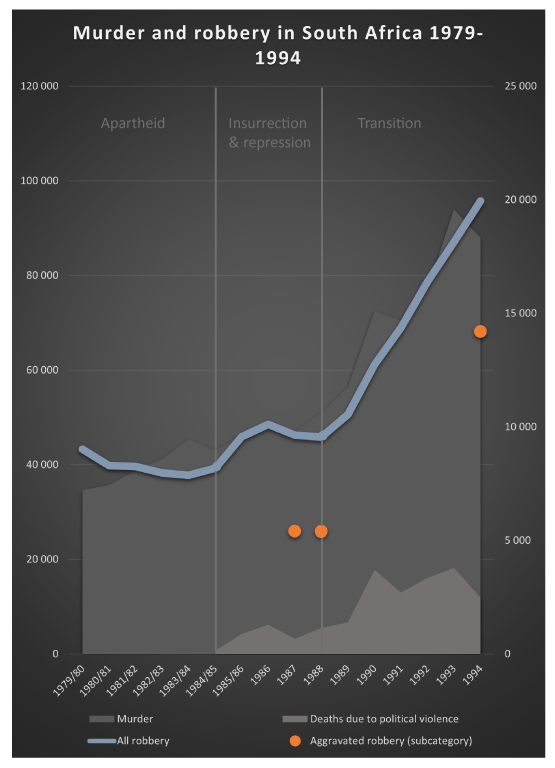
Sources: SAP, SAIRR. Murder and robbery figures exclude TVBC states.
The criminal, the racial, and the political
If one turns to the SAP’s statistics and other sources, there was a noticeable deterioration in the crime situation in 1990. The number of reported robberies rose by 20,7% from the year before, to 61 132 nationally. The number of whites murdered, also jumped by 48,5% to 453 in 1990. This was also the last year the police in South Africa provided such a racial breakdown of murder and crime victims.
In 1990 the number of policemen – black and white – killed on active duty rose to 107, up from 80 in 1989, and 67 in 1988. The number further increased to 137 in 1991. From late May to early July 1990 there was extensive reporting on a spate of murders and attacks by “armed bands” in white, Coloured and Indian farming communities in the once tranquil Midlands region of Natal, notably in areas around Ixopo, Eston and Richmond.
The following year there were reports of similar outbreaks of this kind of violence in rural areas of the Cape province bordering the Transkei, as well as in the OFS, in areas close to the Transkei (Sterkspruit) and the Lesotho border. From 1991 onwards the South African Agricultural Union would start counting farm attacks across the country and the many murders that resulted.
The political mayhem of the early 1990s led to a broader breakdown of law and order, and the further decay of state authority, which criminal elements exploited. A great deal of the “criminal” violence of the early 1990s occurred in the murky intersection between the political and the criminal. The state, revolutionary and counter-revolutionary violence of the mid-1980s led to the destruction of old moral certainties as well as the authority of elders, tearing apart the moral and social fabric of many township communities.
The ANC and PAC policy of recruiting young men inclined to violence, organising them into armed bands, and providing them with guns was asking for trouble when it came to violent crime. Indeed, from the start many of the ANC’s self-defence units were, Ellis noted, notoriously “ill disciplined, and some were indistinguishable from criminal gangs”.
There was also a strong political and ideological impetus behind this turn to criminality. It was the PAC’s view that the land and its resources had been violently usurped by the white minority. It was Apla’s responsibility therefore “to repossess what rightfully belonged to the oppressed and dispossessed” of the black African majority. This did not make them robbers, however, as robbers were “those who steal and defraud and not those who repossess what rightfully belongs to them”. Apla cadres were trained in how to conduct armed robberies in their camps in Tanzania. Once back within South Africa’s borders and operating from the safe haven provided by the Transkei, Apla “repossession units” would pursue racialised armed robberies across the country in the early 1990s.
MK’s approach was far less explicit, given the political sensitivities of the early 1990s, but not wholly dissimilar. Ideologically, MK cadres had long been taught that all their sacrifices for the struggle would be redeemed following the forcible seizure of power when all the wealth “stolen” by the whites – including the farms, the mines, and the factories – would be “returned to the people”. As noted in the first article in this series, Hani, as Political Commissar, incited MK’s auxiliaries in 1986 to rob white homeowners, businesspeople and farmers of their weapons and turn these on the “enemy”.
After the downfall of Communism in 1990, MK struggled to replace the money and weapons previously provided by its East Germany and Soviet allies. To be sure, the ANC continued to receive substantial donations from Western countries, but these were not intended for military purposes, especially not in a period when the armed struggle had supposedly been suspended. A highly consequential decision appears to have been quietly taken at some point in 1991 that MK and the SDUs should use armed robbery to secure weapons and funds for their operations inside the country.
In TRC amnesty hearings three senior MK commanders, based in different parts of the country, related that Hani, who had served as MK Chief-of-Staff up until the end of 1991, had told them to use their own “initiative” to secure weapons from policemen and farmers, and money from wealthy whites.
In 1992 a senior MK commander in Umtata, Phumlani Kubukeli – who reported directly to Hani and also served as his personal bodyguard and assassin – was arrested and convicted for robbing Wiers Cash and Carry in Engcobo, Transkei. As the amnesty committee related in its decision:
“As part of his functions, the applicant had to train recruits in the use of weapons and was also responsible for providing food for the recruits during training. It seems that the Umtata division of MK had budget constraints and the required training was being stifled because of a lack of funds needed to purchase firearms and food for the process. As a result of the precarious financial position, the matter was discussed with the chief of MK [Hani] and it was decided that alternative means, including robbery, in order to obtain the required finance, should be employed. The proviso was that there should be no loss of life and the target should be that of rich white people.”
It was clear, the amnesty committee concluded, that the robbery and related offences “were committed for political reasons” and amnesty was granted to Kubukeli and his accomplices.
There were so many such similar cases that the TRC was forced to rule on the subject in Vol 6 of its Final Report, which states that “while robbery remained contrary to ANC policy, the ANC turned something of a blind eye to acts of robbery for operational purposes – that is, robberies to secure weapons or money for logistics.”
This all made it difficult or impossible for the ordinary observer to tell whether a particular robbery or murder was political or criminal. Confusing the matter further its status could change over time, depending on the political circumstances. An MK or SDU commander may have been given the green light to use robbery in the early 1990s. If he had the bad luck to be caught the ANC would disown his actions as stemming from “ill-discipline”. But when applying for amnesty post-1994 it would be quietly conceded that “yes, this was allowed” and amnesty could then be granted on this basis.
Alongside policemen farmers were historically at the top of the target list for MK and Apla. They owned weapons, they were enforcers and beneficiaries of the existing system, and their elimination would steadily expand the “space” in which combat units could freely operate.
There was a huge escalation of attacks and murders on farms from early 1990 onwards and by 1992 these had already reached epidemic proportions, with the Orange Free State particularly hard hit. The ANC disowned responsibility for attacks on white farmers both then and before the TRC but in several cases, members of its combat units sought – and were granted — amnesty for farm attacks, mostly based upon the informal instruction they had received to use robbery to secure weapons and funds.
Apla for its part would freely admit to a policy of using terror to drive white farmers off the land in the early 1990s. These operations were mostly launched across either the Lesotho or Transkei borders. In his memoirs the Apla commander Letlapa Mphahlele reminisces about the success of this campaign:
“As Apla mounted attacks on fertile and rich farmlands occupied by European settlers, farms lost their value and some farmers hastily sold to wealthy Africans. A farm that was once owned by a white man with an Afrikaans or English name now displayed a freshly painted African name. This development complicated the planning of operations by Apla cadres, because their orders were to attack white farms and spare those owned by Africans.”
The amnesty committee of the TRC would later receive “a total of twenty-seven applications from PAC and APLA members for attacks on farms, all committed between 1990 and 1993. A total of twelve people were killed and thirteen injured in these attacks. The Amnesty Committee granted all but four of the applications.” It is important to note that Apla and MK amnesty applications did not cover all such incidents, but generally only those where the culprits had already been linked by police to the crime, and usually were in jail for it.
1992 saw a further escalation in these forms of criminal violence. All told, 226 policemen were killed that year, and the number of robberies reported to the police increased to 78 664, up from 61 132 in 1990. The number of cases of people being attacked in their homes increased from 1 133 in 1991 to 1 688 in 1992, an almost fifty percent increase, and over three times the number recorded by the SAP in 1987.
In late 1992 Apla operatives, often based in the Transkei and armed with weapons provided by Transkei’s army or special forces, became far more aggressive in taking the war into white areas. Operatives targeted gatherings of white civilians such as in the attack on the King William’s Town Golf Club on 28 November 1992 in which four civilians were killed and seventeen injured.
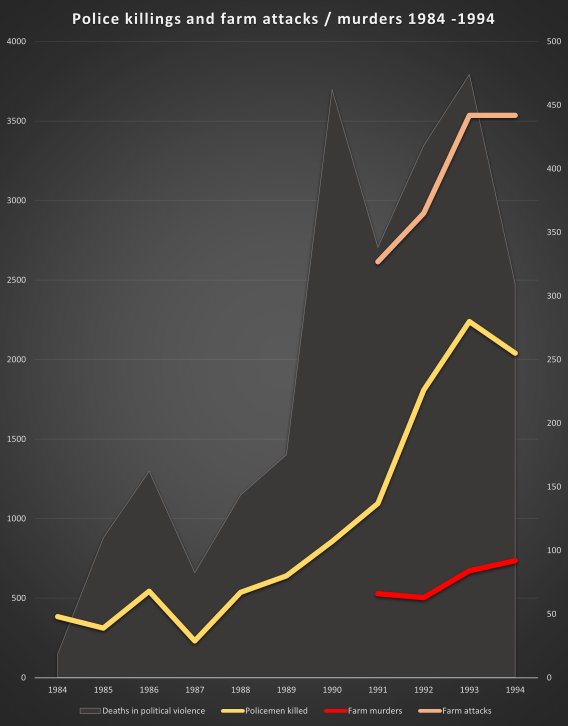
Sources: SAIRR, SAP and SAAU. Figures for farm murders and attacks were compiled from 1991 onwards. Before 1990 these were few and far between. There had, however, been an earlier spike in MK, combat unit, and criminal attacks on farms between 1985 and 1987.
Hani’s assassination
The assassination of Hani by the fanatical Polish anti-communist Janus Walus in April 1993 was intended to provoke outright racial war, but this was avoided through exceptional leadership from Nelson Mandela. This was the moment that, as Malala recounts, authority over South Africa and the ability to determine its future would pass decisively from FW de Klerk to Nelson Mandela.
The message delivered by Mandela to the nation, broadcast on SABC, was that we “must not permit ourselves to be provoked by those who seek to deny us the very freedom Chris Hani gave his life for… Let us respond with dignity and in a disciplined fashion.” By not directly retaliating the ANC avoided the escalation that some in the right wing had hoped for. Instead, it used this moment of crisis – and the NP’s panicked fear of full-scale insurrection – to secure an election date, and ultimately push through a political settlement on terms that would allow it to have the decisive say over the drafting of the final constitution.
Though Malala’s book is subtitled “the week Mandela averted civil war,” the reality was that the following year would see a sharp escalation in political carnage. The armed wings of all political factions – Afrikaner right wing, the dying apartheid state, Inkatha, ANC and Apla – redoubled their bloody efforts to block or speed up the transition. Apla further escalated its operations, massacring civilians in St. James Church in Kenilworth Cape Town, on 25 July 1993, and the Heidelberg Tavern in Observatory Cape Town on 31 December that year. They also started conducting guerrilla attacks against state and strategic targets with weapons provided by MK. There were also indiscriminate terrorist attacks by Afrikaner right wingers against the black population.
Between May 1993 and April 1994, 4 627 politically linked fatalities were counted by the SAIRR. These killings formed a subset of the 19 853 murders recorded that year by the SAP (so excluding the homeland areas), the most ever – and double that of 1987. The completeness of these murder numbers is open to question, given the mayhem of the period, but it seems safe to assume that the SAP was able to count its own casualties: 280 policemen were killed in 1993, a number four times higher than in 1988. The SAAU recorded 84 farm murders, up from perhaps a handful in 1988, that had resulted from 442 attacks. The number of recorded robberies reached 87 102 in 1993, close to double the 1988 figure. 68 150-armed robberies were recorded in 1994, a figure two-and-a-half times higher than in 1988.
The centre reasserts itself
In the run up to 27th April 1994 election the ANC leadership, with Thabo Mbeki playing the key role, really did narrowly avert an imminent civil war as they cut a series of separate deals with the South African Defence Force, the military men of the Afrikaner right wing, led by General Constand Viljoen, and with Inkatha; by the time the election was held all these actors had been drawn into the political process.
The ANC secured 62,65% of the vote, giving it an overwhelming democratic mandate, and ushering in three-decades of electoral dominance. It was joined in the Government of National Unity by the NP which won 20,39% of the vote, and the IFP which secured 10,54%, as well as a majority of the vote in KwaZulu-Natal. The Afrikaner right wing were represented in parliament by the Freedom Front led by General Viljoen after it won 2,17% of the vote. The PAC meanwhile secured a mere 1,25% of the vote.
Following the election there was a dramatic fall off in political violence, as reflected in the SAIRR’s count of political fatalities. These were running at 367 per month in the first four months of 1994, but then fell to an average of only 125 per month for the rest of the year. The number of reported murders fell back to 18 312. As Fairbanks observes through Dipuo’s experience this would be reflected in a dramatic fall off in violence in areas like Katlehong. “For the first time in her life”, Fairbanks writes, “Dipuo felt comfortable walking down Khumalo street, Katlehong’s main drag.”
Having stared into the abyss each side now pulled back from the brink. The commanders of the right-wing military faction, whom the ANC probably feared most of all, told their men to stand down. Mbeki, newly elected Deputy President and Mandela’s heir apparent, sought to send a similar message to the liberation movement’s more disordered and ill-disciplined forces.
In an August 1994 discussion document he wrote that “It is imperative that we deal firmly and decisively with violence originating from within our ranks whether directed against competing political parties or other members and supporters of the movement… We must move away from the pretence that such violence does not occur or that it is so insignificant that we should not be concerned about it.”
The war between ANC and Inkatha in KwaZulu-Natal persisted but gradually wound down in the second half of the 1990s, before Mbeki was finally able to put an end to it. Mbeki would also engineer the expulsion of Holomisa from the ANC in 1996.
When it came to the concerns of the white minority the ANC tread softly in the 1993 to 1995 period as it sought to ward off the threat of counter-revolution and get its hands firmly onto the levers of state power. Serving members of the civil service and security forces were reassured, by Mbeki and others, that their skills and expertise were needed and valued by the new government.
There was a reassertion too of the rule of law when it came to state perpetrators of wrongdoing. The long running counter-intelligence investigations approved by FW de Klerk into wrongdoing by covert units of the police and the military now culminated in prosecutions being brought by the Transvaal Attorney General’s office against Eugene de Kock, Wouter Basson, Magnus Malan, and others.
This was the famous period of the “political miracle” and the “birth of the Rainbow nation”. It was at this happy point that Western audiences turned off the television set and stopped paying much attention to developments in South Africa.
What happened afterwards is dimly remembered and now highly contested.
This will be the subject of the next instalment.
This article first appeared on the Konsequent Substack.

THE DAY THE MIRACLE DIED (III)
James Myburgh writes on violent crime and the ANC’s turn away from reconciliation (1994-2002)
Note to readers: this series was sparked in part by revelations and claims in three recent books about South Africa – Jonny Steinberg’s “Winnie & Nelson,” Justice Malala’s “The Plot to Save South Africa,” and Eve Fairbanks’ “The Inheritors”. Quotes attributed to these authors are derived from the works aforementioned. This article is the third in the series. The second article can be read here, and the first article can be read here.
Introduction
The previous article in this series dealt with the escalating political and criminal violence through the transition from apartheid and white rule (1989 to 1994). The political conflict between liberation movement forces and those opposed to them drove a doubling of the number of murders recorded by the South African Police between 1987 and 1993, the peak year of the conflict. There was also a dramatic increase in the number of armed robberies in this period.
In 1994 the main armed actors drew back from the brink. There was a large drop off in political violence after the April 1994 elections, and President Nelson Mandela’s graceful leadership through the transfer of power saw the threat of counter-revolution evaporate. It was also at this point that the Western world started rapidly losing interest in developments within the country. The subsequent under-reporting and non-reporting of developments has left a significant gap in the Western and particularly American understanding of South Africa.
Eve Fairbanks’ book The Inheritors: An Intimate Portrait of a Brave and Bewildered Nation is perhaps the most important recent effort to fill that void. This book was commissioned and published by Simon & Schuster, one of the most prestigious publishing houses in the United States. It is the product of over a decade of research, starting in 2009, and is very much a report back to the American elite on the progress of the post-apartheid project. A summary version of her findings was published as an essay in the Atlantic Magazine.
There is much in this book that is revealing and insightful. Yet there is a recurring argument around violent crime that is deeply questionable. It is important to critically examine this for, if inaccurate and left uncontested, it is likely to be accepted as authoritative by its American readership.
The great white imagining
One of the major themes of Fairbanks’ book is that “white people suffer because they deserve punishment and didn’t get it.” She thus questions the press focus on violent crime post-apartheid – and novels where home invasions provided pivotal scenes, such as J.M. Coetzee’s Disgrace (1999) – taking the view that such depictions were at odds with the documented reality, if not fictions conjured up by the guilt-ridden white subconscious.
Fairbanks writes that while the police had “logged an uptick in robberies, especially in white-dominated farming areas” under Mandela, self-reported “victimisation rates – the number of crimes people told academic surveys they’d experienced – didn’t rise nearly as much, suggesting a lot of the increase in crime represented South Africans’ new willingness to report incidents” to a newly legitimate police force. “By the end of the ‘90s,” she continues, “the police were recording only half as many incidents of crime as they did in the early ‘90s, despite a population growth of nearly 40 percent.”
Having convinced herself that concerns about ever-rising crime were vastly exaggerated, Fairbanks takes white South Africans to task for “starting to talk as if the country was already falling apart”. The white suburbs of Johannesburg and elsewhere remained as safe as “anywhere in Western Europe”, implying that fear-driven reactions to the contrary were wrong if not deranged.
She expresses disappointment in the “New York Times” (actually the New Republic) for reporting on a white “suburb dweller” who constantly “visualized a vivid scenario in which she faces black gunmen” in a car hijacking. Fairbanks says the “paper reported this concern as if it was totally legitimate” while apparently ignoring countervailing statistics showing a dramatic decline in crime. SABC TV – “still white-run” at the time, we are told – is similarly excoriated for reporting the results of a poll finding that a majority of whites “believed they were ‘very unsafe at night’.” (Fairbanks’ emphasis.)
Worst of all was Anne Paton, the 71-year-old widow of Alan Paton, author of Cry the Beloved Country, who wrote an open letter explaining that crime was driving her to leave her home just north of Durban for the United Kingdom. Paton’s concerns, Fairbanks suggests, were delusional and racially insulting to boot. “Black South Africans barely had a year or two to right things”, she states, “yet the letter was passed around as evidence they wouldn’t.”
In her essay in The Atlantic Fairbanks summarises her claim as follows: “Concerns about crime dominated the news in the years following apartheid. But the rates of violent crime were only half as high by the end of the 1990s as they had been before apartheid ended.”
Fairbanks makes a few missteps here. Firstly, there was not a 40% jump in the size of the population in the 1990s. It increased by 16% between 1990 and 1999 – and by only 7% between 1994 and 1999. Secondly, it is not possible to track crime trends in this period using crime victimisation surveys as there was only a single such survey conducted by the state statistical agency, in 1997. The source for the claim that formerly white suburbs were as safe as anywhere in Western Europe relates to the 2014/15 period, and its validity will be examined in the next article in this series. So, this leaves us to contemplate Fairbanks’ claim that police were recording half as many incidents of violent crime in 1999 as they had in the early 1990s.
As previously noted, four “independent” Bantustans rejoined South Africa in 1994. The reformed South African Police Service (SAPS) started producing crime statistics for the unified country from 1996 onwards, simultaneously compiling estimates for 1994 and 1995 as well. If one updates the murder and robbery graph accordingly this is what emerges:
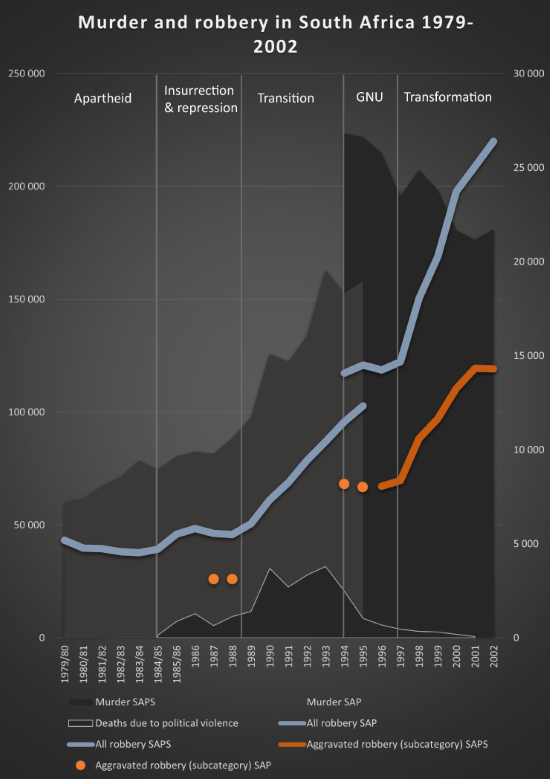
Evidently, the number of murders peaked in the 1993 to 1994 period at the height of the political carnage in South Africa, at about twice what it had been in 1987. Thus, according to the SAPS series, there were an estimated 26 832 murders in the whole of the country in 1994, and 26 637 in 1995. After stabilising at this high level, they gradually trended downwards as political tensions declined.
If one looks at the number of reported robberies, there is also a period of stabilisation between 1994 and 1997 followed by … a completely different development to that proclaimed by Fairbanks.
To get a sense of what happened here one needs to follow the thread through from the beginning.
The people’s army
In exile, Stephen Ellis notes in External Mission, ANC officials had become “deeply involved in smuggling Mandrax, diamonds and cars”. As operatives of the security services sought to penetrate the ANC’s networks, they too entered this underworld and were sometimes corrupted by it. Among the criminal practices sanctioned by the ANC was armed robbery. The message quietly communicated to MK cadres was that – as one operative later related to the TRC – when they infiltrated back into South Africa, “you know that the ANC has limited resources. Those resources in the country are your resources. You are being deprived of your resources. So don’t be over moralistic. Be realistic. You need it, it is there, you’re justified to get it.”
The previous article in this series described how, after the formal suspension of the armed struggle in August 1990, the ANC persisted with the major thrust of its prior people’s war strategy by forming and arming “Self-Defence Units” (SDUs). The PAC’s armed wing Apla was also highly active in the 1992 to 1993 period, launching numerous offensive operations from its sanctuary in the Transkei homeland. Both the PAC and ANC allowed for the recruitment of criminals into their armed units, though in the latter case they were meant to be “reformed” ones.
While Apla unashamedly approved of armed robbery as an instrument of racial “repossession” the ANC too quietly instructed its SDUs to “use their own initiative” to secure weapons and funds. This was done in a manner that enabled the leadership to plausibly deny responsibility; the SDUs “knew” that approval for this practice came from the very top but nothing was written down or formally documented. This all contributed, alongside the general breakdown in law and order and the increasing availability of illegal firearms, to the surge of armed robberies, and attacks on policemen and farming communities, recorded in the early 1990s.
The declared intention of the ANC was that the SDUs would, when combined with MK, form the basis of a future “people’s army and police force”. By the time of the transition the ranks of this armed force had swollen to the tens of thousands. Though this was not the sum of it, 42 100 individuals were eventually entered into the Certified Personnel Register for either integration into the new South African National Defence Force (SANDF), or demobilisation. Of these, 32 800 came from MK/SDUs and 9 300 from Apla.
Those from the MK/SDU forces also formed a powerful political component of the ANC itself, with commissars and commanders taking up senior positions in government and the security services, post-1994. These revolutionary networks, and their capacity to conduct covert operations and orchestrate violence, did not magically vanish in a puff of smoke on 27 April 1994.
Threading the needle through the transition
The ANC’s chief challenge in the negotiations was to provide the white minority – and particularly officers of the security forces – with sufficient reassurance that they peacefully surrendered power; while ensuring that the terms of this settlement placed no long-term obstacle to the pursuit of goals that the liberation movement regarded as inviolable. This was not a question of just ideology, it was more akin to a sacred covenant. The promise used to summon the movement into existence and motivate it through all the decades of struggle was that all the immense sacrifices of the present would ultimately be redeemed following the seizure of power, when all the wealth of the country would be “given back” to “the people” from whom it had been “stolen”.
The ANC reconciled itself internally to the compromises of the transition on the basis that while these goals remained sacrosanct, the more sensitive ones would be deferred (not discarded), allowing the national revolution to be pursued incrementally and through stages.
The ANC would achieve its medium-term goals with regard to the state with subtlety and sophistication. It agreed in 1993 that serving officers in the police and the army would retain their positions and that their career paths would be protected. These guarantees were written into the interim constitution. Such officials were solemnly assured that their skills and experience were deeply valued by the incoming ANC government. The ANC was however always careful to ensure that the “representivity” principle was included in every agreement it signed.
At the same time thousands of members of the “people’s army” were integrated into the military, intelligence services and, to a lesser extent, the police. The equally solemn assurance was issued that these comrades were leaving their old political allegiances at the door and entering non-partisan service in the state.
During the integration and amalgamation processes the ANC insisted that no security clearances or vetting be done on their people. As a result, a considerable number of compromised and criminalised individuals acquired key positions in the security services.
One of the preferred placements for former MK/SDU members was the police’s VIP Protection Services where such individuals could continue serving as the armed guards of their former commissars. In response to a parliamentary question in 1997 it was disclosed that 121 members of the VIP Protection Service, at national level, had criminal records, including for attempted murder, robbery and assault. Even more strikingly, 198 members were currently facing criminal charges, 22 for murder, 18 for attempted murder, 22 for pointing a firearm, and four for robbery. A similar question put to the Minister of Intelligence in 1999 brought forth the revelation that 155 members of the intelligence services had faced misconduct charges since amalgamation in 1995, for offences ranging from insubordination, fraud and theft to armed robbery, attempted murder (eight cases), and murder (five cases). Few of these matters had been finalised and only ten officers had been discharged.
By the end of 1995 the ANC’s people were on the inside. In 1996 the final Constitution was adopted, with the ANC carefully gutting the section guarding the professionalism of the public service. FW de Klerk withdrew the National Party from the government of national unity at this point as well. The ANC now embarked upon a campaign against “old order” officials, labelling them as obstacles to transformation. The message was that “demographic representivity” was the ANC’s holy grail; the merit system was being scrapped, and white officials would have minimal prospects of advancement in the future. The affected officers were then invited to take generous severance packages. With this process well underway the ANC moved to implement a formal policy of cadre deployment. As the existing incumbents departed, state institutions were to be largely composed of and entirely led by “trusted representatives of the people”.
The period between 1994 and the early 2000s was thus a transitional period where the liberation movement was infiltrating its members into the security services, and expanding their influence, but had yet to gain complete control.
SDUs and criminality
Although ANC SDUs remained on a war footing against Inkatha in KwaZulu-Natal, political fatalities declined through the second half of the 1990s, falling from 2 476 in 1994 to 1 044 in 1995, 683 in 1996, 470 in 1997, 356 in 1998, and 325 in 1999. It is noticeable, however, that the killings of policemen barely declined post 1994, while attacks on farming communities picked up. After shooting up like a rocket through the early 1990s the number of reported robberies flatlined between 1994 and 1997 – at around 120 000 per year – at a level over twice that of 1988.
Of the 42 000 MK/SDU and Apla members on the central personnel register in 1994, 14 500 of the former and 3 600 of the latter did not end up reporting for either integration or demobilisation by the time the process closed in late 1997. One of the MK members who had been signed up for but then skipped integration into the SANDF was Collin Chauke. Chauke had been a late joining member of MK, receiving his military training in the Transkei in 1991 after returning from a brief period in exile. He had been elected to the executive committee of the ANC branch in Winterveld outside Pretoria in March 1992. He was first arrested by the police later that year after being caught driving a stolen BMW in the Johannesburg northern suburbs. Sentenced to four years in prison in September 1993 he somehow managed to walk out of jail.
In 1995 he was elected an ANC councillor and continued living a high life funded in part by crimes such as vehicle hijacking. He was investigated by the Rosslyn vehicle theft unit, which arrested him in May 1995 while driving another stolen BMW. A series of charges were then brought against him, including car theft, two cash in transit heists and an armed robbery at the Morula Sun Casino. These charges were however dropped, and Chauke was “set free on the orders of a senior cop who claims Chauke has ‘powerful connections in government’.” (City Press, 24 January 1999)
Chauke would be arrested again in December 1997 for his involvement in a SBV heist in Pretoria in which R18m was stolen. The gang network of which Chauke formed part was linked to 17 cash-in-transit heists in which R100m (R400 million in today’s rand values) had been stolen and 30 people murdered.
Chauke then proceeded to bust out of prison and, while on the run, hobnobbed with senior ANC politicians, before finally being arrested at his girlfriend’s townhouse by detectives of the Nelspruit Murder and Robbery Unit in early 1999. After his recapture, Chauke was sentenced to fifteen years for his involvement in the SBV heist. He died in prison in 2003 at the age of 33 – probably from AIDS related causes.
One “senior government official” told Wally Mbhele of the Mail & Guardian that those behind these violent heists were mostly former SDU members who had been given quick and dirty military training in the early 1990s, and who had then been integrated into the SANDF before dropping out again. The official said that “the modus operandi used in highway robberies mirrors the methods of military training the self-defence units were given on how, for instance, to ambush police or vehicles.” The motive was not political, the official suggested, “They look at people they used to struggle with who all drive flashy cars while they remain poor and they want to be rich too.”
It was not just the SANDF dropouts who were involved in crime, however. There were numerous cases from this period of former MK/SDU or Apla cadres carrying out armed robberies while in the employ of the police, the intelligence agencies, or the SANDF. The involvement of former MK, SDU and Apla combatants in violent crime was widely discussed and acknowledged. What was not properly understood was how complicit the ANC and MK leadership had been – and therefore potentially still was – in such criminality.
Last year of the miracle
The political violence of the early 1990s had left a difficult legacy – especially in the form of a cohort of armed, ill-educated and brutalised youth – but by 1997 it seemed that the security forces were finally regaining a handle on the situation, with the levels of violent crime having at last stabilised. For this President Mandela credited “better co-ordination among all arms of the security services: the police, the intelligence services and the defence force, as well as co-operation across Southern Africa.”
It was at this hopeful moment that the ANC set about its bloodless purge of the security forces, with top police, defence force and intelligence officers pressured by their political overlords into taking the severance packages on offer. A senior police officer told the Saturday Star in April 1997 that “it is the experienced policemen with expertise, the role models” who were leaving in the thousands. “While the total number leaving is a problem, the real issue is the number of quality, top-calibre policemen who are going…. The best people are leaving the police because they can get jobs elsewhere, and it’s those who cannot who stay behind.” The impact on policing in Gauteng was likely to be particularly severe, the newspaper predicted, with critical units (such as the anti-hijacking unit) losing their leading detectives.
The top ANC leadership itself also now set out to harvest some of expected but delayed rewards of liberation through the arms deal. Beyond this point, the sort of independent investigative units necessary to keep any ruling class (or society) honest would be regarded as a mortal threat, requiring them to be either disbanded or placed under tight political control.
In December 1997 Thabo Mbeki was elected unopposed as ANC President at the party’s national conference in Mafikeng. It was here too that Mandela abandoned his former reconciliatory posture and reemphasised the movement’s historic racial nationalist commitments. The ANC was planning to “transform our country, fundamentally” Mandela stated in his political report to the conference. “The accomplishment of this task requires that we should all be made in the metal of revolutionaries.” Mandela went on to bewail the “massive propaganda campaign that has been conducted on the issue of crime” and disparaged whites for propounding the transparently absurd notion that “merely to walk in the streets in these white areas is to invite death and that this has been the case since 1994”.
In its resolution on the “transformation of the SAPS” the conference complained that some police functionaries were still resisting “transformation” and “change” and that the “distribution of police resources is still skewed in favour of mainly white communities”. It complained too that “The special units of the SAPS (the Child Protection Unit, Murder and Robbery Unit, Stock Theft Unit, etc.) are not accessible to all communities” and the SAPS “is still not reflective of the demography of South Africa, more especially at a managerial level”. It resolved to do whatever was necessary, up to and including changing the constitution, to “enable the acceleration of the process of transformation”.
The second surge
The ANC NEC’s January 8th statement of 1998 – the document that traditionally gave the movement its marching orders for the year – echoed earlier calls to action from the mid-1980s, declaring:
“The fundamental transformation of our society requires an enormous effort of popular mobilisation which should even surpass what we achieved during the struggle to end the system of white minority rule.
We should aim to ensure that every citizen becomes a patriot and that every patriot should be engaged in the struggle for social transformation. Only in this way will we be able to carry out our historic responsibility of speedily wiping out the apartheid legacy and bringing about the changes which all of us yearn for.
This gigantic task of sustained mobilisation will pose a special challenge to all the structures of our organisation, from the branch upwards, to be in dynamic contact with the masses of the people on a daily basis.”
It is not entirely clear how the two were related, but the ANC’s return to revolutionary fundamentals was followed by a renewed surge in violent crime. The number of aggravated robberies recorded by the SAPS leapt 21% year-on-year – from 69 691 in 1997 to 88 319 in 1998. The increase from 1997/98 (April to March) to 1998/1999 was even more marked, rising 26% – from 73 053 to 92 630. Carjackings rose 20% to 15 773 in 1998/99, and truck hijackings by a third, to 6 134. There was also a striking increase in the numbers of attacks on farming communities. According to police figures, 142 people were killed in 769 attacks on farms and smallholdings in 1998. Forty-two of these murders, stemming from 164 attacks, occurred in KwaZulu-Natal.
It was in the midst of this period that the Sunday Times (London) published the article by Anne Paton about her decision to leave South Africa – the one Fairbanks felt was was tainted by exaggeration and racist conspiracy theory. Paton wrote that among her friends, and friends of friends, she knew of nine people who had been murdered in the past four years. She herself had been carjacked a few years before and been attacked twice in her home in 1998. In the first incident she was throttled, gagged, tied up and thrown into the guest room, while the robbers ransacked the property. In the second the aspirant robbers had continued to try and smash their way into her house, despite her seeing them and setting off the burglar alarm.
The 1998 crime wave also coincided with a systematic effort by the ANC to neutralise any remaining independent centres of power within the state, and extend its control over “all levers of power: the army, the police, the bureaucracy, intelligence structures, the judiciary, parastatals, and agencies such as regulatory bodies, the public broadcaster, the central bank and so on.” With the establishment of the National Prosecuting Authority in 1998, and the deployment of ANC cadres to run it, the liberation movement achieved ultimate control over every prosecution in the country.
Dipuo and Godfrey
Despite her belief in the unreliability of white perceptions on the matter, Fairbanks’ account does nonetheless provide a rare and striking insight into the attitudes underlying the violent criminality of the late 1990s.
For Dipuo M, one of Fairbanks’ subjects, the compromises agreed to by the ANC in 1993 were a bitter pill to swallow. As a loyal ANC activist, Dipuo “expected a substantial turn toward economic redistribution” after apartheid. “Like many black South African activists,” Fairbanks writes, “she considered herself a socialist.” After giving birth to her daughter, Malaika, in 1991, Dipuo returned to high school at night and after successfully matriculating secured a “a job at an American-supported NGO in Pretoria… Foreigners and their money were pouring into South Africa, and she bought herself a fridge and a long table like the ones she remembered from the white people’s dining rooms in which her mother worked.”
The white middle-class lifestyle remained elusive, however, and the material situation of Dipuo and Malaika remained highly precarious. It was different though with Godfrey, Dipuo’s brother and Malaika’s favourite uncle. As Fairbanks relates through the eyes of Malaika, Godfrey’s job meant he was away a lot of the time. But he was always immaculately dressed and when he returned to the family home in Soweto he always brought back “incredible things” – food, sweets, jewellery, pretty furniture.
Godfrey’s “job”, it turned out, was robbing homes and carjacking vehicles of “white people in neighbourhoods like the suburb where [his mother] had toiled in ‘the kitchens’.” The family disguised his identity when the police came looking for him in March 1999, after an informer fingered him for the murder of a policeman – one of the 204 such killings that occurred that year.
Although Dipuo knew that Godfrey’s actions were “wrong”, Fairbanks relates, “she privately celebrated her thug brother. She and Godfrey would joke that he was ‘liberating’ cars and TVs from their ‘colonial masters.’… She and Godfrey referred to his crime sprees as ‘affirmative repossession’.” He seemingly acted with impunity until late 1999, when he was shot by security guards in a Sowetan mall after he and an accomplice had tried to rob them of their weapons for a heist they were planning. He died in hospital of his wounds.
“Dooming the fight against crime”
In the elections held on 2nd June 1999 the ANC increased its share of the vote, falling just short of a two-thirds majority in parliament. President Thabo Mbeki now appointed the former MK Political Commissar, Steve Tshwete, as Minister of Safety & Security. The ANC had allowed the police to remain Afrikaner-led up until 1999, under national commissioner George Fivaz. In an internal party discussion document drawn up in 1999, which assessed the ANC’s success in seizing control of the state machinery, the party complained that the “transformation of the police has been hampered in part by the lack of personnel to occupy key positions”. It called for an improvement of the liberation movement’s “capacity to introduce major changes in the police – whether through regulation, legislation or deployment”.
After 1994 there was what Stephen Ellis called “reconciliation of a special type”, as criminally inclined ANC security and intelligence men discovered that there were few sources of friction between themselves and less scrupulous ‘old guard’ operatives and officials and they, and the shady businessmen now flocking around the new administration, could do business together. Conversely those with a strong sense of integrity and duty, be they ex-MK or ex-Pretoria, found themselves on slippery ground when their actions brought them into conflict with powerful political-criminal networks.
In October 1999 cabinet announced the appointment of former ANC NEC member, and serving Foreign Affairs Director-General, Jackie Selebi, as the new national commissioner of police. Before he had even settled into office in January 2000 Selebi found his will being frustrated by serving officials in the SAPS. Both Tshwete and Selebi were house friends of the Pakistani-born businessman, Rehan Syed, who had been a benefactor of leading ANC politicians from the time of their days in exile in Zambia. Syed had been under police investigation since 1998 for his alleged involvement in the international trade in stolen vehicles and narcotics.
The police’s anti-corruption unit meanwhile had intruded into the businessman’s affairs after busting a policeman for issuing false clearance certificates for stolen vehicles that had been smuggled into South Africa, inadvertently seizing a Mercedes Benz of Syed’s in the process. The ACU was able to establish that the vehicle had been stolen from its owner in London. To his frustration and fury Selebi was, despite his status as national police chief, unable to secure the return of the car to his friend. (Sayed was deported in 2001).
A month after he began work as national commissioner Selebi signalled that he intended to centralise control over the police’s many elite specialised units. By late November the SAPS had finalised a plan for these units to be broken up. The news that these units were to be closed – with murder and robbery units in and around Johannesburg among the first on the chopping block – caused an outcry. In a press statement on 29 November 2000 the Democratic Alliance described this decision as “inexplicable” and one that would have far-reaching consequences for combating crime in South Africa. It noted, “The majority of specialist units were extremely successful in their fight against crime and shutting them down does not make any sense at all.”
In January 2001 Selebi nonetheless pushed ahead with the plan. On 12 January he sent out a letter to his provincial subordinates ordering them to immediately close 200 of the police’s 503 specialised units. Among the first to be dissolved was the Brixton Murder and Robbery Unit, the unit responsible for investigating armed robberies in Johannesburg. The detectives from this, and the many other murder and robbery units being shut down around the country, would be scattered around the police stations that they had previously supported.
The commander of the Brixton unit, Superintendent Tienie van der Linden, told The Star newspaper that its closure would spell doom for the fight against crime. The clearance rate of his unit was 65%, compared to the 15% achieve by detectives based in police stations. He also pointed out that there had been seven cases of heists, bank robberies and other serious crimes in the previous month. His unit solved all of them, arresting 17 suspects.
White fright, ANC indifference
In his memoir on his time as a special advisor in the Presidency of Thabo Mbeki Tony Heard writes that public concerns over high crime were met with the same sort of nonchalance in the higher reaches of government that Dipuo had exhibited over Godfrey’s exploits. He writes, “‘It’s mainly privileged whites who are complaining,’ was a refrain I heard at advisers’ meetings from the justice, crime prevention and security (JCPS) cabinet cluster.”
Heard’s meetings were private, but government could be sneeringly dismissive in public as well. In 2000 the number of aggravated robberies reported to the SAPS rose to 110 590, a figure 58% higher than in 1997, and four times that of 1987. One of the groups hardest hit by this type of crime was the Portuguese community around Johannesburg. This was a typical immigrant community of small businessmen and shopkeepers, paid mostly in cash, and so a tempting target. Many members of this community (or their parents) had earlier been dispossessed and driven out of Mozambique after the revolution of 1975.
On 15 November 2000 members of this community marched to the Union Buildings in Pretoria and delivered a memorandum calling on President Thabo Mbeki to do something about crime. “There is no doubt that the African dream, or renaissance, has become a lifetime nightmare for many of our people, as the criminals continue to impose their brand of injustice on all levels of society,” it stated. Among the protestors, the Pretoria News reported the following day, was Kyle de Castro, 11. He held a placard stating: “I hate crime. It killed my mom.” His mother Ana, 29, had been gunned down in the family’s bottle store. Another child at the march was Dino Baptista, also eleven. His father Jose, 40, had been shot dead when gunmen had robbed his shop in Sandton. Then there was Rita dos Santos who had been widowed when her husband Manuel, 37, had been shot dead during a robbery of his fast-food restaurant in Boksburg.
On 12 February 2001 the government released a five-page reply to the memorandum. Signed by Tshwete, the text contained many of Mbeki’s distinctive turns of phrase. Noting that many of the protestors had fled Mozambique and Angola in the mid-1970s it accused them of coming to South Africa because “they knew that the colour of their skin would entitle them to join ‘the master race’, to participate in the oppression and exploitation of the black majority and to enjoy the benefits of white minority domination.” It then added ominously:
“You are aware that our government was elected by an overwhelming majority of our people. These masses do not share the contempt you have for our government and President. They remain confident that the government they freely elected will, working together with them, succeed to eradicate the legacy of apartheid, which you seek to blame on our government. These masses need to know about your view of their government. We will therefore take the necessary steps so to inform them.”
On the same day this letter was released Tshwete confirmed at a press briefing that government was proceeding with the dissolution of “specialised units such as SANAB, Vehicle Crime, Commercial Branch and Stock Theft Units” and the “Murder and Robbery, Family Violence, Child Protection and Sexual Offences and Taxi Violence units.” The detectives involved were either transferred to newly established overarching units, where political control could be exercised over them, or to local police stations, where they lost most of their effectiveness.
After Tshwete died at the end of April 2002 Charles Nqakula, a former Operation Vula commander, became Minister of Safety & Security. One of the few elite units still surviving at this point was the Anti-Corruption Unit that had frustrated the return of Selebi’s friend’s stolen Mercedes. Established in 1995 to counter the growing problem of corruption in police ranks, it had earned an exemplary reputation for successfully investigating wrongdoing by cops. (It was not, however, allowed to investigate the VIP protection units). In October 2002 Selebi ordered that it too be dissolved, a decision given full effect the following year. Its members were not readily accepted back in police stations or other units, given the nature of their work, and many left the police for good. In January 2003 the SA Narcotics Bureau was also informed that it was finally to be shut down in July.
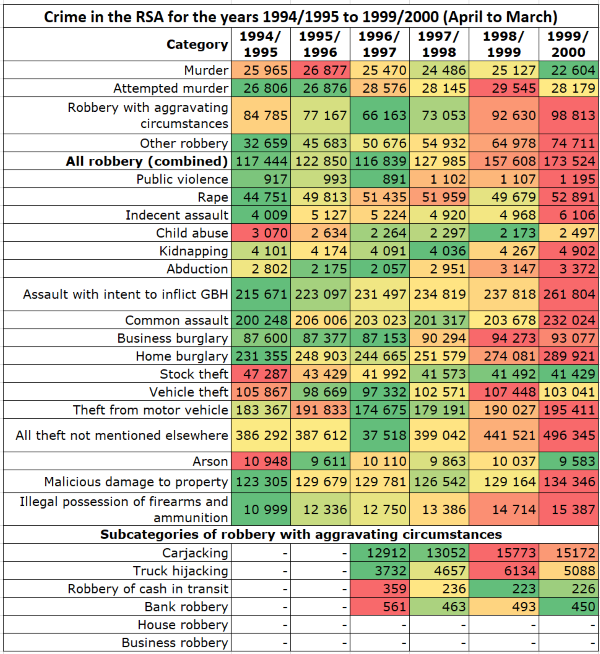
A heat map of SAPS crime statistics for property and violent crime from April 1994 to March 2000. The 1994 and 1995 figures, for the entire country, were compiled retrospectively and only released in 1997. Some of the numbers for this earlier period, especially the figures for armed robbery, should be approached with caution.
Five years of people’s violence
Let us now return to Eve Fairbanks’ claim that there was a halving of the incidents (or rates) of crime by the late 1990s – whether from 1990 or, more plausibly, 1994. Either way, this is clearly not right. To be sure, the overall murder tally declined along with political violence and its aftershocks, but there were increases in most other categories of crime through the second half of the 1990s, especially after 1997.
The 1998 to 2003 period was particularly dismaying, with the number of robberies with aggravating circumstances rising relentlessly upwards year-on-year, from an already high base. The peak was finally reached in 2003/4 with 133,658 such robberies reported – double the number of 1996, and five times the number reported to the SAP in 1988. Adjusting for population growth the aggravated robbery rate per 100 000 people rose from 148,1 in 1996 to 277,9 in 2003, an 87,6% increase. Between 1998 and 2003 farm attacks ran at twice the level recorded in the early 1990s, at the height of Apla and SDU activities in such areas. The rise in most other categories of crime was less dramatic, but the peak in the number of reported incidents would generally be reached in the early 2000s.
For Fairbanks to then claim that there had been a halving of the incidents (or rates) of violent crime through the 1990s is not just wrong, but the converse of what happened. Yet even more strikingly none of her readers, reviewers or editors thought fit to check this claim.
How this error was made, and the remarkably changed pattern of violent crime that emerged in the 2000s, will be the subject of the next article in this series.
This article first appeared on the Konsequent substack.

