WA Clews (Natal Police)
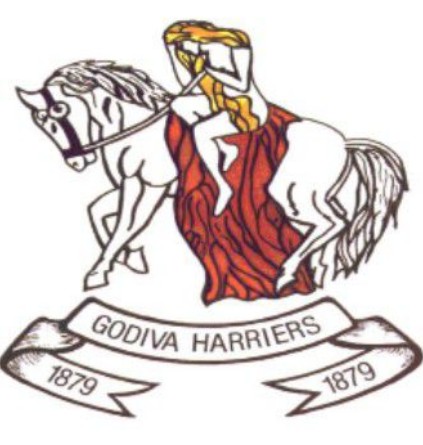
From the Godiva Harriers in (of course) Coventry, to the Natal Police
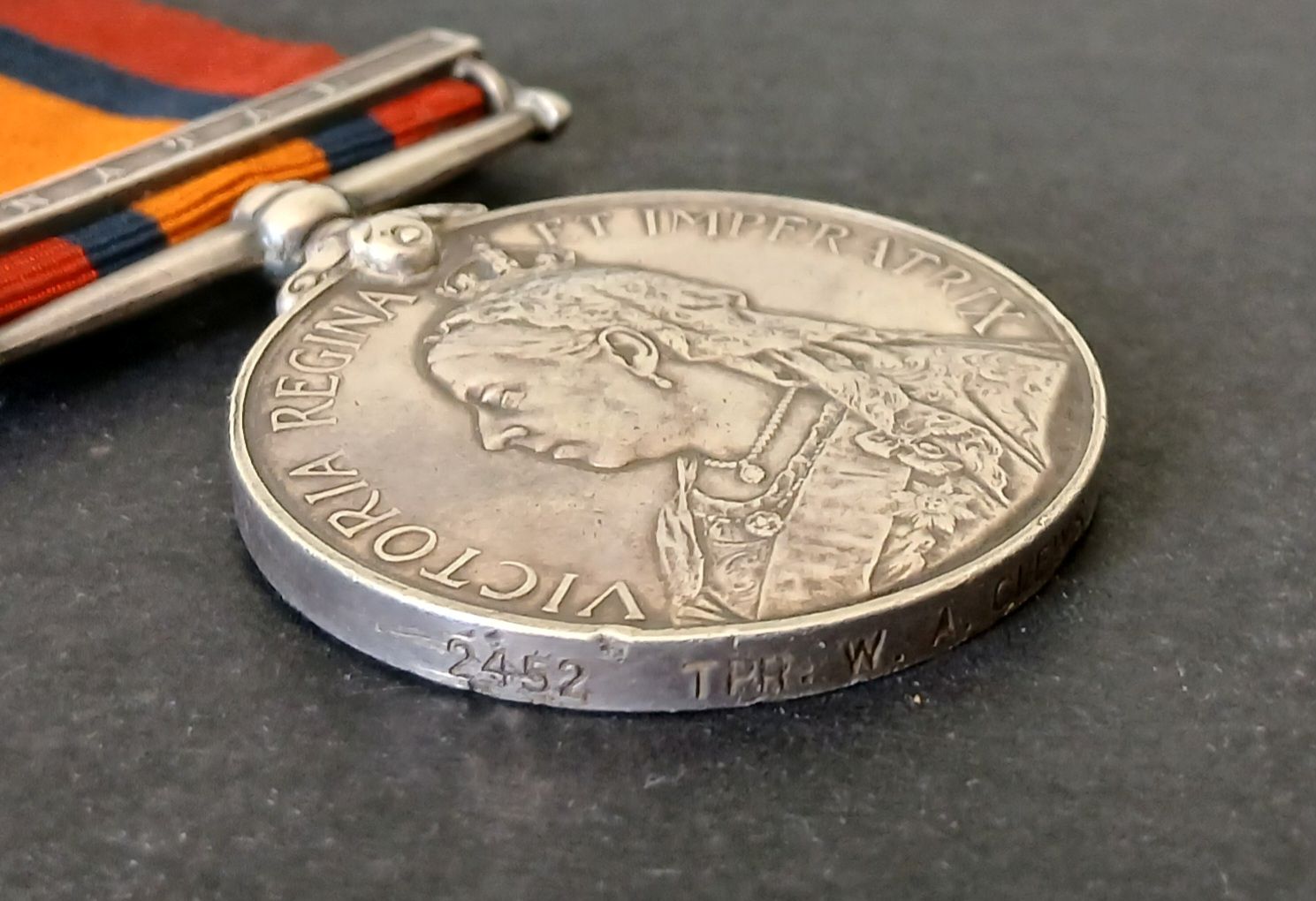
NO. 2452 TROOPER WILLIAM ARTHUR CLEWS, NATAL POLICE: ANGLO BOER WAR: QUEENS SOUTH AFRICA MEDAL
Rory P Reynolds
William Clews was born in Stoke, Warwickshire on 28 September 1878 the son of Arthur Stoke, a Grazier by trade and his wife Sarah Ann. According to the 1881 England census, a 1-year-old William was at home with his parents at 2 South Street in Stoke. He had an older sister, Amy Louisa (6).
For reasons known only to themselves, William’s parents waited until 25 April 1884 before he was baptised in the parish church. Our next glimpse of William comes courtesy of the 1891 England census. On this occasion the family were living in Stoke Row. Mr Clews was now a Farmer and William a 11-year-old schoolboy. There had been an addition to the family with the advent of Florence May (6). In lodgings with the Clews family was John Denis O’ Callaghan, a 31-year-old Civil Service Officer with the Inland Revenue.
As the 19th century ended the belligerence between the two Boer Republics in South Africa and Great Britain reached a climax, culminating in a declaration of war between the parties on 11 October 1899. Boer Commandos crossed over their borders into the British colonies of the Cape and Natal the next day and, over the course of the next few weeks, made great strides in upsetting the undermanned British military in the region.
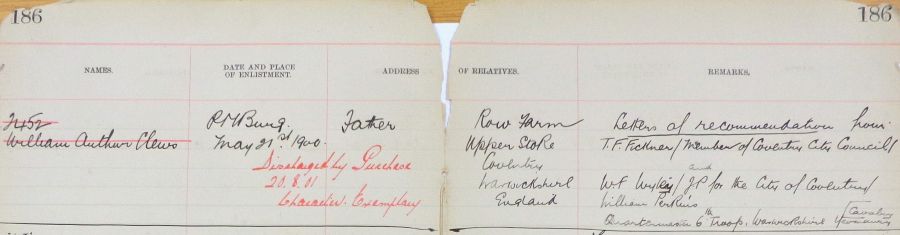
Whether or not Clews’ patriotic fervour was aroused or he was in search of adventure, he boarded the “Umvoti” at London for a 40-day voyage to South Africa. Arriving on 20 April 1900 – when the war was already six months old – he made for the Alexandra Road Headquarters of the Natal Police in Pietermaritzburg, Natal where, on 21 May 1900, he attested for service. Armed with letters of recommendation from T.F. Fickner, a Member of the Coventry City Council, W.F. Wyley, J.P. for the City of Coventry and William Perkins, Quartermaster of the 6th Troop of Warwickshire Yeomanry (Cavalry), he provided his father of Row Farm, Upper Stoke, Coventry as his next of kin.
Assigned No. 2452 and the rank of Trooper, Clews took to the field. By the time he arrived on the scene the war in Natal was, for the time being, all but over. Ladysmith had been besieged and relieved and the Boers were being systematically driven over the border and out of Natal by Buller’s Natal Field Force.
To Clews and other recruits who had signed on for the regulatory three years now lay the task of policing the countryside and ensuring that the natives didn’t become restless and that the Boers didn’t make a reappearance. This might have seemed like monotonous work, but the Boers were always apt to spring the odd surprise, and one had to be watchful and vigilant as one went about one’s day. On 21 May 1901 the N.P. H.Q. announced that, after completing one years’ service in the Corps, he was promoted to the rank and pay of 1st Class Trooper.
Fortunately for the reader Clews was a bit of a correspondent. A letter home appeared in the Country Evening Telegraph of 27 June 1901 which, under the banner, “An Old Godiva Harrier at Some Natal Sports”, gave us a glimpse into what his life was like at this time:
“Mr William A. Clews, son of Mr A. Clews, of Stoke, a member of the Natal Mounted Police (sic), and formerly the captain of the Coventry Godiva Harriers, writes from Natal to his parents the following letter which is dated May 29th: “I went down to Durban on Saturday afternoon. A friend and I went round the Botanic Gardens, and also to the hospital to see a young man there who has broken his leg, and inflammation setting in we are afraid he will have to lose his limb. The next day the sports came on. I was on my mark in the quarter-mile race. I won that race easily and also the half mile. The police, our men, then carried me shoulder high. The prize for the quarter mile is a splendid diamond pin; and three diamonds and one ruby for the half. I have now got seven firsts and one second prize since my arrival in South Africa, and I am running in the championships on the 29th of June at Durban.” Mr Clews sends a paper – “The Natal Mercury” – which gives an account of the sports.”
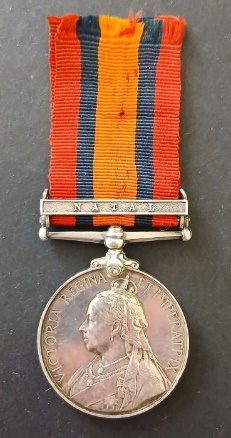
For his efforts on the military front Clews was awarded the Queens Medal with Natal clasp off the roll dated at Pietermaritzburg on 8 September 1901. His South Africa odyssey was almost at an end with an entry appearing in the Natal Police Order Book on 4 September 1901 to the effect that “No. 2452 Tpr Clews, having been discharged at his own request by purchase on the 20th August 1901 is struck off the strength of the Force from that date.”
Making his way back to England and all things familiar, he entered the marital estate with Rosa Ethel Wareham in Coventry on 7 April 1907. The couple settled down to married life with daughter, Phyllis May being born to them in 1909. At the time of the 1911 England census Clews was described as being a Dairyman for his own account, living in a five-roomed house at 47 Clements Street.
Not long after this he seems to have made the decision to become a Publican or Licenced Victualler – something that was to make him relatively famous in his neck of the woods. The role was, as can be imagined where the imbibing of alcohol is concerned, a perilous one fraught with conflict. One such incident was published in the Coventry Herald of 17 October 1913 – under the heading “Dismissal Follows Conflicting Evidence” it read:
“Ernest Boileau, 20, Mayfield Road, and Charles Evans, Warwick Street, were summoned for being disorderly and refusing to quit the Earlsdon Cottage on the night of Sunday, October 5. Mr WH Cleland appeared to prosecute for the Licenced Victualler’s Association.
William Arthur Clews, the licensee, said that when he returned to the house shortly after nine o’ clock, having been to the post, he found defendants in the house creating a disturbance. He refused to serve them, and asked them to go, but they declined, and Boileau wanted to fight him. He went for a Police Constable, who persuaded defendants to leave, but they returned in about half an hour.
He again asked them to go, and they began to hiss and boo outside. He sent for a constable again, but they went away before he arrived. A month previously defendants were concerned in a disturbance which occurred in the bar of the house, and he told them that he should refuse to serve them in future. In reply to Mr Maddocks, he admitted that on the second occasion there was no disorderly conduct in the house.
Corroborative evidence was given by the barman and William Henry Bass who was in the house. P.C. Essam said that when he arrived on the first occasion defendants were in the passage. Boileau was drunk and Evans had been drinking but was not drunk. They were arguing with the landlord, who asked them to leave. As soon as he saw them, Boileau said “Come on, Charlie. Here’s Mr Essam. We will not have a bother with him.” During the conversation Boileau said to the landlord “I wish I had got you in a ___ field. I would soon show you what you are. You are not half a man.”
Mr Maddocks for the defence said this was the thinnest case of disorderly conduct he had ever defended. Evans stated that on this day they had a fifteen-mile drive with a friend and on returning they called in the Earlsdon Cottage. The landlord’s wife refused to serve him while he was with the other two. He was never asked to leave, and when the landlord came back in, he made the remark “If you don’t go I’ll ____ kick you out.”
Boileau said they were just leaving when the landlord came in very excited and threatened to kick him out. He said, “If that’s your game, come out and have a fight.” Mrs Boileau, wife of defendant, said that as soon as Clews saw her husband, he took hold of him and threw him out. They had all had some drink, but were not drunk.
The Bench, having deliberated, did not think the case sufficiently strong for a conviction and dismissed the case”
The 1921 England census showed that Clews was still a Licenced Victualler attached to Wilford & Co., Coventry. Now aged 41 he was at home at 24 Warwick Street, Earlsdon along with his wife and 13-year-old daughter. There was a servant in attendance in the form of Olive Nellie Hayward.
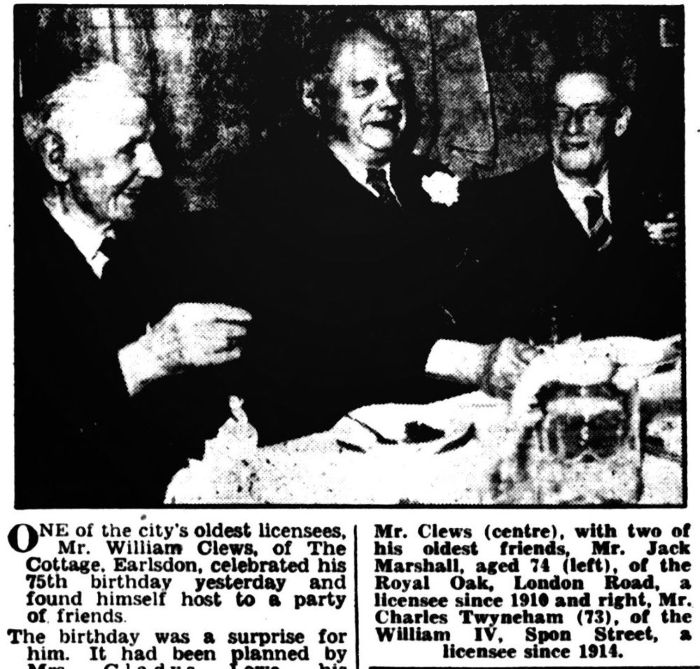
Clews was next sighted in the 1939 Register where, on the eve of WWII, he was still at the above address but, sadly, widowed (Rosa had died in 1936). The only other person on the premises was 39-year-old Manageress Gladys Hilda Lowe. He continued to feature in the local press with the Coventry Evening Telegraph of 29 September 1954 carrying a photo-feature of him under the heading “Party Was A Surprise” it read as follows:
“One of the city’s oldest licensees, Mr William Clews, of The Cottage, Earlsdon, celebrated his 75th birthday yesterday and found himself host to a party of friends. The birthday was a surprise for him. It had been planned by Mrs Gladys Lowe, his manageress, and his son-in-law and daughter Mr and Mrs P Mercer.
The guests included Mr Jack Marshall, licensee of the Royal Oak, and Mr Charles Twyneham, of the William IV, Coventry. Mr Clews has been at The Cottage, except for a short break, since 1913. He was on Coventry Victuallers Committee for many years and was once captain of Godiva Harriers.”
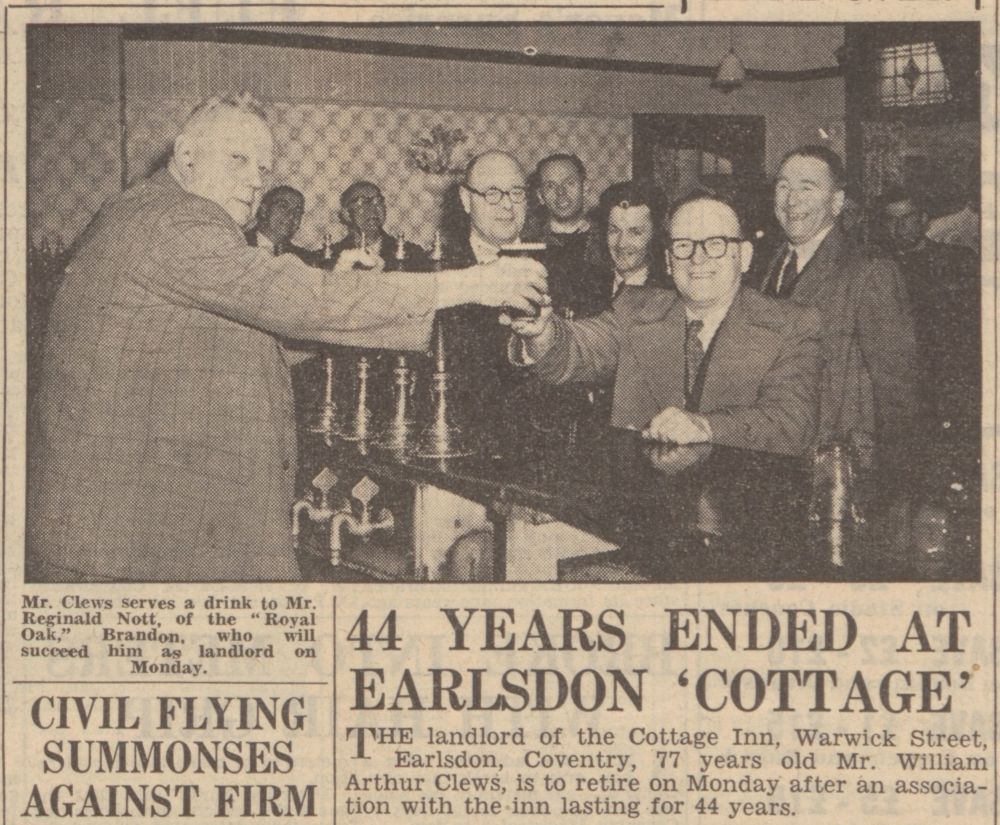
The same publication, on 10 January 1957, under the heading “Hand-Over” carried the following tribute to Clews:
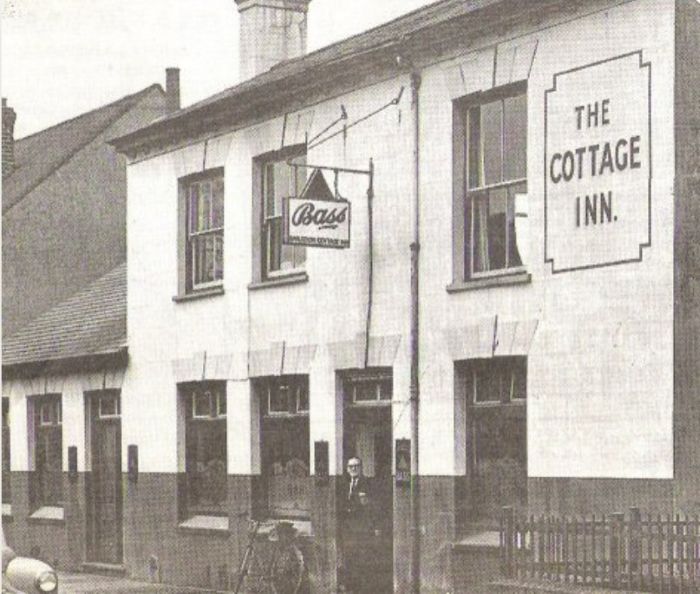
“44 Years Ended at Earlsdon ‘Cottage’ – The landlord of the Cottage Inn, Warwick Street, Earlsdon, Coventry, 77 year old Mr William Arthur Clews, is to retire on Monday after an association with the Inn lasting for 44 years. Mr Clews first came to the “Cottage” in 1913 and served as manager to Mr P. Bishop for over nine years, apart from his army service in the 1914-18 war. (No trace of any service could be found)
In 1929 he moved to the Nursery Tavern in Chapelfields, Coventry, but returned to the “Cottage” as landlord in 1929. Mr Clews is a widower with one married daughter living in Coventry, with whom he is to stay during his retirement.
In the Boer War, Mr Clews served for five years as a member of the Natal Mounted Police in South Africa, and in the First World War he served throughout with the rank of Sergeant – in the Royal Army Service Corps. In his younger days Mr Clews was a keen runner and captained the Godiva Harriers for four years during the early 1900’s.
Immediately after Coventry’s biggest air raid in the last war the Cottage Inn was serving customers as usual despite the fact that all the windows had been blown out.”
William Arthur Clews, Policeman, Athlete and Publican, passed away on 28 October 1960 at 24 Hartington Crescent, Coventry. His probate of £6426 went to his only child, Phyllis May Mercer.
Photo Album
Acknowledgements:
– Coventry Evening Telegraph – various editions quoted in the text
– Natal Police Service Register – Natal Archives Pietermaritzburg
– Natal Police Minute/Order Books – Anglo Boer War Forum website
– Ancestry and FMP for birth, census, probate and medal roll details
