
An Analysis of Military Posture and Strategic Behaviour in a New Multipolar World Order, by Strategic Security Analyst Dr Joan Swart, in Nongqai Magazine 26 March 2026.
Military Posture and Strategic Behaviour in Africa: A 3D Framework
Dr Joan Swart
Key Words: Military Posture, Strategic Behaviour and Strategy in Africa, a new multipolar world order, Dr Joan Swart, Nongqai 2026.
Africa’s security landscape is often described in terms of limitation. Military capability is typically assessed through budgets, equipment inventories, or force size, reinforcing a perception of relative weakness when compared to major global powers. While these measures are not without value, they obscure a more important question: how states actually use the military power they possess.
What matters in practice is not only capability, but the relationship between capability, doctrine, and political will. These three variables shape military posture and determine whether states act defensively, regionally, or as projection actors beyond their borders. Understanding this interaction provides a more accurate and useful framework for analysing security dynamics across Africa and its surrounding strategic environment.
Doctrine, Capability, and Political Will
Military capability, in this context, should not be understood as a simple reflection of material resources. It is better conceived as effective capability, meaning the ability to translate resources into operational outcomes. This includes training, command and control, logistical systems, doctrinal integration, and combat experience. States with advanced platforms and high levels of expenditure do not necessarily achieve effective outcomes, while others with fewer resources may demonstrate greater operational coherence and adaptability.
Doctrine defines how a state intends to use force. At one end of the spectrum are territorial defence models, focused on sovereignty, border protection, and internal stability. At the other are expeditionary doctrines, where states actively deploy force beyond their borders to shape regional or external environments. Political will determines whether these capabilities and doctrines are actually employed. It reflects leadership decisions, risk tolerance, and the broader strategic culture within which military force is considered.
Taken together, these variables form a three-dimensional (3D) model of military posture. States with similar levels of capability may behave very differently depending on how doctrine and political will align with their material means. This relationship can be visualised in the framework below:
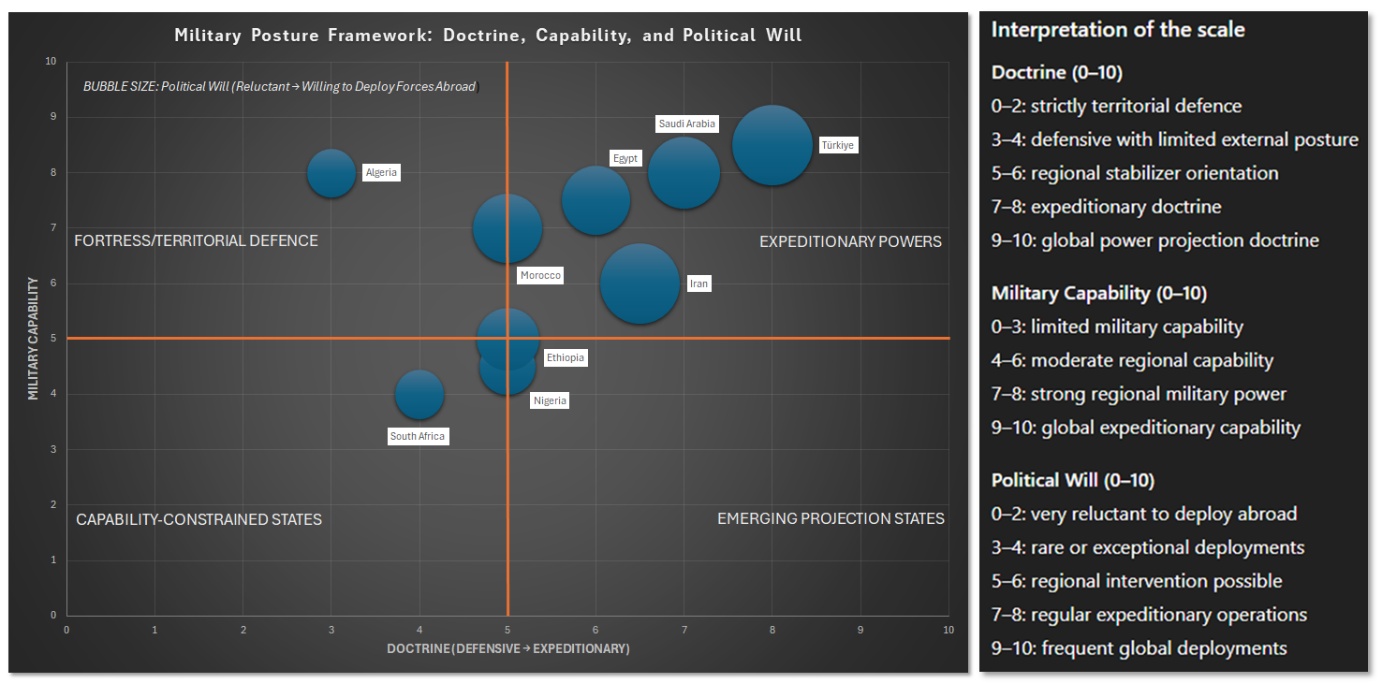
Figure 1: Military posture framework illustrating the interaction between doctrine, capability, and political will
This framework is not purely conceptual. It has direct implications for security analysis, force planning, and regional stability assessments. Understanding how doctrine, capability, and political will interact allows for more accurate assessments of which states are likely to act, where they may intervene, and how they are likely to behave in crisis environments.
Divergent Military Postures in Africa
When viewed through a regional lens, Africa presents a differentiated strategic landscape. North Africa, West Africa, Central Africa, East Africa, the Horn of Africa, and Southern Africa each exhibit distinct patterns of military posture shaped by geography, threat environments, and external engagement. This reinforces the need to assess military behaviour within regional contexts rather than treating the continent as a uniform security space.
This becomes particularly clear when comparing states within North Africa and the broader Middle East. Algeria, for example, maintains relatively high military capability but remains firmly anchored in a doctrine of territorial defence. Its strategic posture is shaped by a long-standing emphasis on sovereignty and non-intervention, resulting in limited external deployment despite significant resources.
Egypt occupies a different position. It possesses substantial conventional capability and plays a stabilising role within its immediate region, yet its external posture remains measured and selective. Morocco, by contrast, has increasingly moved toward a more outward-oriented posture, reflecting both doctrinal evolution and growing willingness to engage in regional security dynamics.
The distinction becomes even more pronounced when examining external comparators. Türkiye represents a clear example of a state where capability, doctrine, and political will are closely aligned. Its military operations in Syria, Libya, and elsewhere reflect a coherent expeditionary posture supported by integrated command structures, a developing defence industry, and sustained political commitment.
Saudi Arabia presents a more complex case. On paper, it possesses one of the most advanced and well-funded militaries in the region. However, its experience in Yemen has highlighted the challenges of translating material capability into effective operational outcomes. Reliance on external support, coordination limitations, and uneven battlefield performance suggest a gap between nominal capability and effective capability.
Iran, by contrast, operates with more constrained conventional resources but demonstrates a high degree of operational integration and strategic coherence. Its use of asymmetric capabilities, proxy networks, and long-range strike systems reflects an approach that is both adaptive and aligned with its broader doctrine of forward defence. While its posture remains rooted in deterrence and regime security, its ability to operate beyond its borders is evident in practice.
This framework is equally instructive when applied to Sub-Saharan Africa. Nigeria demonstrates a degree of political willingness to engage in regional security operations, yet its effectiveness is constrained by logistical, organisational, and institutional challenges. Ethiopia has shown the capacity for sustained military operations within its region, but its posture remains largely focused on internal and near-border dynamics.
South Africa presents a different trajectory. Once capable of limited external deployment and regional stabilisation roles, its military capability has declined relative to earlier decades. Combined with a cautious political posture, this has resulted in a more restrained and inward-oriented security position. The issue is not the absence of capability, but the erosion of effective capability and a widening gap between capability and operational effectiveness.
Across these cases, a consistent pattern emerges. States do not move along a single continuum of strength or weakness. Instead, they occupy distinct positions shaped by the interaction of doctrine, capability, and political will. Some maintain strong territorial defence postures, others act as regional stabilisers, and a smaller number operate as projection actors with the ability to shape environments beyond their immediate borders.
Strategic Implications for African Security
This framework has important implications for how African security is understood. External analysis often treats the continent as a relatively uniform space characterised by limited capacity. In reality, it is a differentiated strategic environment in which states adopt varied postures based on their internal dynamics, external relationships, and strategic cultures.
It also suggests that changes in military behaviour are not driven solely by increases in capability. Shifts in doctrine or political will can be equally significant. A state may possess the means to act but choose restraint, or it may operate actively despite limited resources by aligning doctrine and execution more effectively.
Recent global developments, including disruptions to energy systems and evolving geopolitical alignments, reinforce this point. External shocks may affect state capacity, but they do not determine how states respond. Those responses remain shaped by underlying doctrine and political decision-making.
Understanding military posture through this three-dimensional framework allows for more precise assessments of both current dynamics and future trajectories. It provides a structured way to evaluate how states are likely to behave under pressure, where they may expand their roles, and where constraints will limit action. In an increasingly complex and contested strategic environment, such frameworks are essential for informed security analysis.
- Dr Joan Swart

Dr Joan Swart is a forensic psychologist and security analyst with an MBA and an MA in Military Studies. Her work focuses on African security, geopolitics, state fragility, substate dynamics, and the intersection between governance, legitimacy, and coercive power. She is the author of several books and regularly publishes long-form analysis and opinion pieces on security and governance issues. Her writing has appeared in outlets including DefenceWeb, Maroela Media, Netwerk24, RSG, Visegrad, and other policy and public-affairs platforms. Her work bridges academic research, policy analysis, and applied strategic assessment, and she is currently completing a second PhD at the University of Stellenbosch Military Academy.
*

An excellent, in-depth Analysis of Military Posture and Strategic Behaviour in a New Multipolar World Order, with a focus on African strategic and regional military conduct. This article is written by Strategic Security Analyst Dr Joan Swart, in Nongqai Magazine 26 March 2026.