Roché Vermaak – Nongqai Vol 17 No 5
VETERAN: ROCHÉ VERMAAK
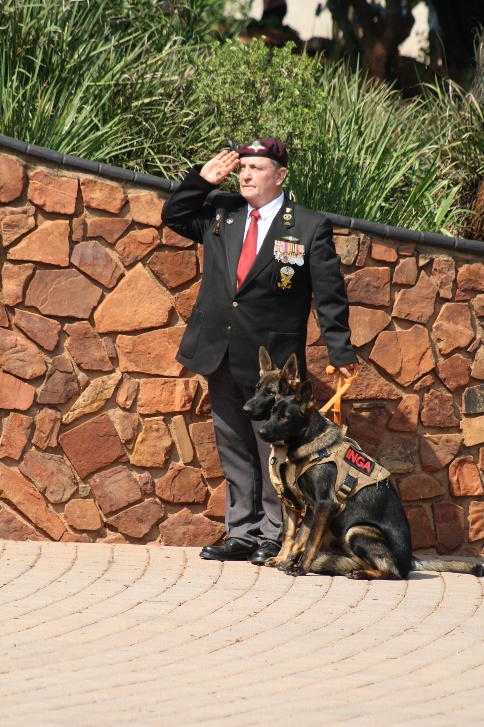
From Paratrooper to Police Dog handler, founder of the Armscor/Denel Special Dog/Reaction Unit, initiator of the SAP Dog Memorial, and founder of the Animals in War Memorial”
Compiled by Wolfgang Witschas
Introduction
Life in South Africa during the 1960s to 1980s shaped an entire generation, a generation that was patriotic towards the Republic and obedient towards authority. Unwittingly it influenced every sphere of what it was to be a proud South African, from childhood to adult.
Roché Vermaak was one of a million plus of young persons that grew up in this era. Born to an ordinary Afrikaner working class Family with strong religious values, discipline, but also unavoidable domestic problems. His devotion to religion is the most important pillars of strength in Roché’s life. He kept his Bible he received in the military in 1979 and still reads from this Bible daily. When times at home were rough in his younger days their dogs “Snoep” and Rusty” comforted him when both slept on his bed with him at night.
Unwittingly this might have triggered to developed a soft spot for animals which later became part of his life.
He strongly believes that it was the time he spent in the South African Defence Force (SADF) and his religious believes, that gives direction to his life to this day.
Personal Background:
Name: Roché
Surname: Vermaak
Date of Birth: 1960-07-09
Place of Birth: Johannesburg
Parents:
Father: Christopher Johan “Chris” Vermaak –
Well known journalist, war correspondent and writer.
Books:
The Silent War -The Fight for Southern Africa (Rhodesian War): Co-authored with Reg Shay
The Man with two Faces – Braam Fischer
Loon van die Sonde – Ware Suid Afrikaanse Misdaad Verhale
Manskap Nr. 7801
The Red Trap
Born: 05 June 1935
Place of Birth: Beau Fort West, Central Karoo
Western Cape, South Africa
Death: 04 January 2009, Hertzogville,
Lejwleputswa District
Municipality, Free State
Mother: Maria Catarina Elizabeth
Vermaak (First wife)
Rachel Elizabeth Vermaak née Erasmus
Occupation: Registered Nurse her whole life, worked till she was near her 80’s
Family: Married with two daughter’s and grand children
Wife: Nanette Vermaak (Registered ICU Nurse)
Oldest Daughter: Mauriza Groenewald (Teacher in Milnerton Cape Town ) mother of two boys
Second Daughter : Minique Meyer (Teacher Kimberley Northern Cape ) mother of a boy and daughter
I currently reside at 676, 21st Avenue, Rietfontein, Pretoria.
Current occupation:
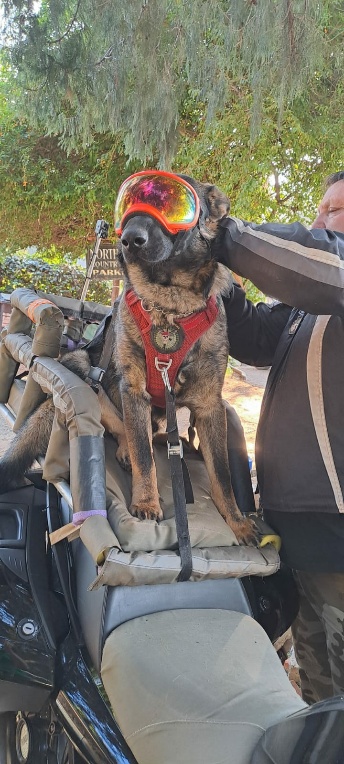
I became a pensioner during December 2024. I am currently Involved with training Dogs, neighbourhood watch with AfriForum Groter Moot Area , travelling with my motorbike and dog and keeping fit by walking daily with my dog kids
Early years:
I grew up in my parent’s home in Linden, Johannesburg.
School years:
Primary School: l attended the Louw Geldenhuys Primary School in Linden and attended the Linden High, were I matriculated. I was active in Sport, Rugby and Athletics and also in the then compulsory Cadets.
After Matric:
After Matric I received a Sport Bursary from Goudstad Teachers College (Gerrie Germishuys) but decided to go and join the Army.
In 1979 I was called up to report to 1 Special Service Battalion (1SSB) in Bloemfontein for my national service (1979-1980). 1 Parachute Battalion came around and requested volunteers. I passed the fitness test and that is how my two years in Parabats Started.
Border duty:
Did Border duty in Rhodesia end of 1979. We were the last of the South African Units supporting the Rhodesians at that stage. Involved in few “contacts” valuable experience gained from these veteran soldiers . We moved then to Ovamboland to do Fire Force at Ondangwa. In 1980 we were involved in the following operations – Sceptic (Attacks on insurgent bases-South Angola) -Hamer (Search and Destroy-South Angola)-Loodvoet (Search and destroy Mutuanjamba South Angola) – Operations with Koevoet from Ongandjera base (Capt. Adams/ Lt De Kok and AO Conradie)
After National Service:
I joined the South African Police (SAP) in 1981, and was sworn in at John Vorster Square with the idea to join SAP Dog Unit as a Dog Handler.
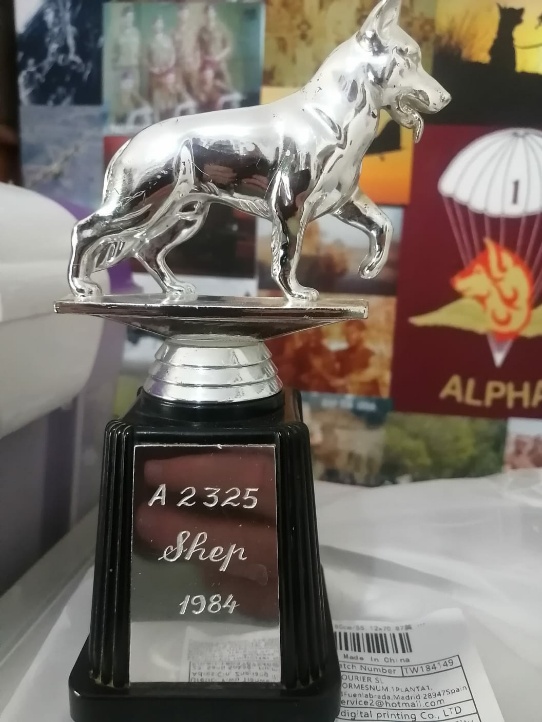
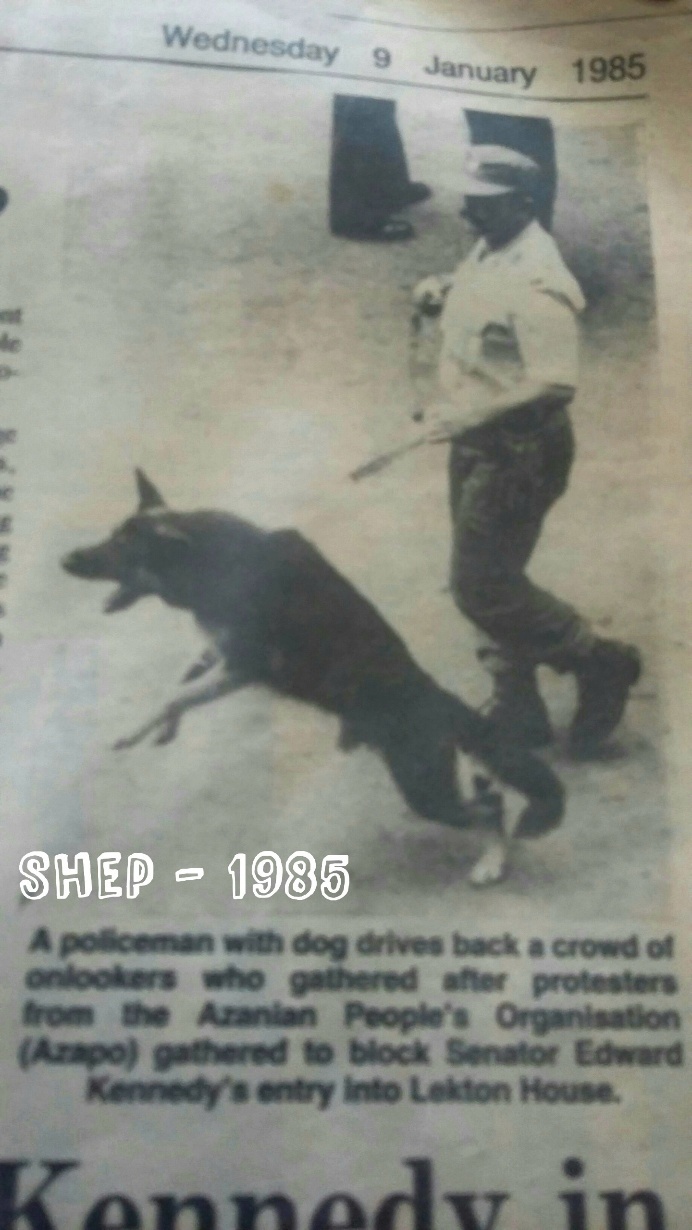
After a short three month basic training course at the SAP College in Pretoria I was transferred to John Vorster Square Uniform Investigation Branch. 1982 I requested a transfer to the Dog Unit at Langlaagte under the command of Captain C Schoeman) and did my Patrol Dog Course. In 1983 Explosion Detection Course with the German Shepherd dog Shep. In 1984 and the next years would be very volatile years for SAPS including our unis. In 1984 Shep indicated a positive bomb in the new Sandton Mall Parking area . He saved my life during a called out in Parktown by apprehending the suspect after he hit me with pair of wire cutters from behind. Shep also received the Unit trophy that year for the dog with the most apprehensions(tackles) for serious offenses (see photo trophy). In1985 I was transferred to the Wingfield Dog Unit in Cape Town. During 1985/86 I was called out on many bomb related incidents one being at the then DF Malan Airport “ Airport limpet mine” in a toilet and Shep finding the Limpet mine at the feet of a fire fighter at the 1st explosion in Cape Town Technicon. Working Closely with Major Dolf Odendal (Anti Terrorist Police Unit), Murder and Robbery Units and Radio Control.
Border Duty:
Did my first “Border Trip” with the SAP COIN Unit in 1982 at Mahamba Border Post. During this time involved in the 1st ever contact on SA Border at Piet Retief when three terrorists were killed during this contact with the insurgents.
My next “Border” was at Oshoek Border Post with Eswatini (former Swaziland) in 1985 were I was called up for three months and stayed for six months due to SA Military taking over borders from SAPS and the delay there off . During this trip my police dog Shep during a foot patrol at the border line warned us of unknown insurgents crossing the border and apprehended (tackle) one running away later to find Tokarev pistol in his possession. In 1987
Shep was knifed by a drug seller in Elsies
River in Cape Town while apprehending him when he ran away at a search. Shep had to be hospitalized but thankfully recovered.
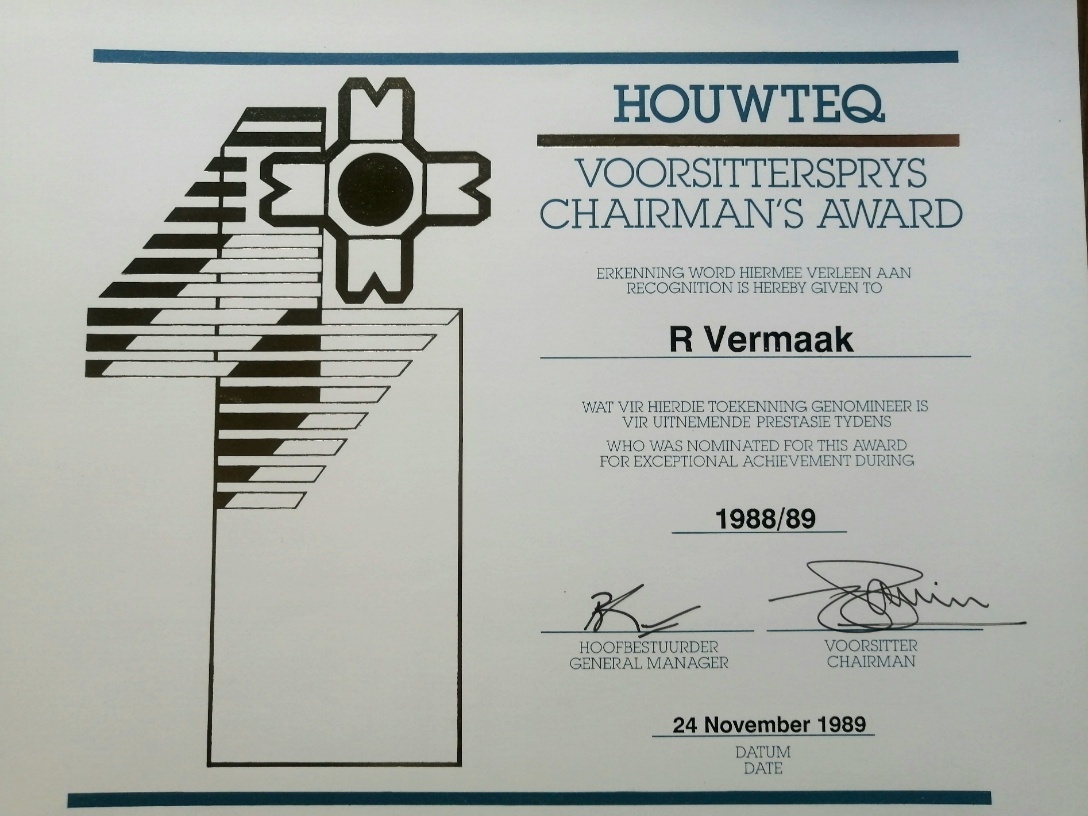
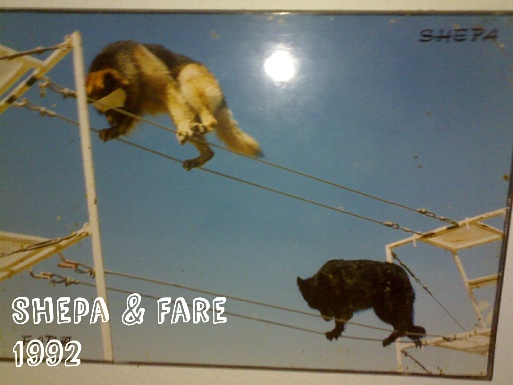
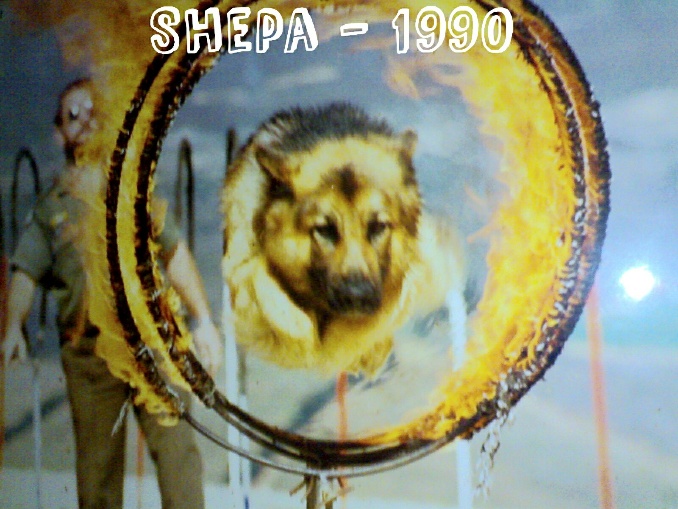
In 1988 I was approached by Armscor/Denel (later) to start a Special Dog/Reaction Unit at Houwteq Grabouw Western Cape. This was a highly classified project at that time and very few people still know about it. The project started at Palmiet Pump Station near Grabouw and we were housed in the old Water Affairs Asbestos Offices till the Houwteq Buildings at Haasvlakte Grabouw were finished. We had passed a top secret clearance before commencing. In1989 I was sent to Israel for a specialized course (Canine anti-terror actions/Urban Terrorism) . Our job was to insure that Houwteq is protected against infiltration , possible armed attack , escorting material and equipment l between Grabouw and Bredasdorp (OTB ) Reaction Unit had Fire Vehicles (Mercedes Benz Unimogs) – Riot Training and Equipment – Armoury – Explosive Detection Dogs, Patrol Dogs and Drug Detection Dogs (Contractors during building phase) and very famous Dog Display Unit. (see photos attached). In 1989 I receive the Voorsitters (Chairman’s) Prize for my work at Houwteq.
After Denel :
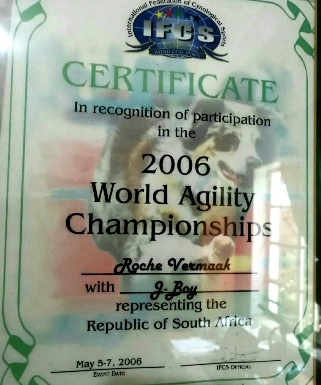
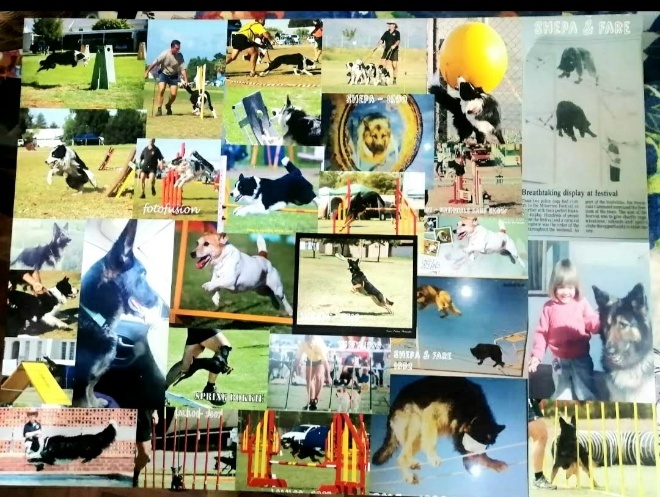
1994 the writing was on the wall and we knew at that time that the Government was not going to fund the Satellite Project anymore. I had prepared myself for this and got a study bursary from Armscor the previous years to finish my Diploma/Higher Diploma and later B Tech in Safety Management. My new career started with Power Engineers in Epping and later Bokomo and Pioneer Foods where I would be responsible for Safety/Health/Environment/ Security and Fire Protection at various sites over the years all over South Africa. My first love and always priority in my life, my dogs were then done privately and in my off time where I had Dog Clubs in Paarl, Wellington, Robertson and Worcester and compete in KUSA Workings Trials, Agility, Fly ball and Obedience Competions earning over 25 Champion Status with my Dogs. Competing in 2006 in the World Agility Championship Oosterhout Holland for the SA Team with Jack Russel J Boy.
Animals in War:
After Shep’s death it was clear to me that I had to honour this special dog who gave so much and never asked anything back but to be at my side. His ashes were placed in the Wall of Remembrance at Houwteq Denel with the other dogs that died during my time at Houwteq. The idea of a special place always remained with me, and I had to wait until 2014. In this year I joined SAP COIN Veterans League. The Leagues’ Memorial Wall was planned to be build on a private property in Dooringpoort in the north of Pretoria. The Chairman Captain (Ret) Martin Loubser and his management gave me the permission to start the project of ensuring that all SAP Dogs that were killed during operation service on the borders and served are placed on the wall. At last I could keep my promise to Shep and insure he and other dogs are remembered. It did not end there ……
Roché Vermaak
“I made a promise to myself to erect this memorial wall after the loss of my police dog Shep in 1987 and dogs ambassador Marcus in 2023”
The “Animal at War” project and the creation of the memorial
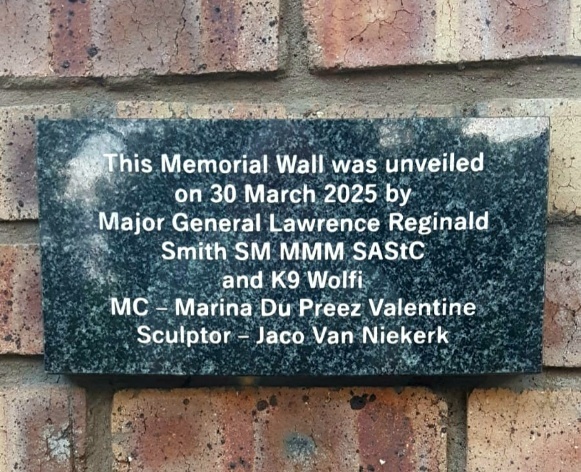
In 2023 I met Lt Col Renaud Booysen. Veteran of Operation Savanna .During this Operation the first Military Dog was killed with his Handler. The idea of a Wall for All Animals In War the project started to grow and in August 2024 we began the building of this wall at the Voortrekker Monument. We had to cross quite a few hurdles to get it off the ground. And thanks to much input from Major General Lawrence Smith the Inaugural Memorial Service took place 30 March 2025.
One Memorial Wall for all the animals i.e. horses, dogs of the South African Defence Force (SADF), South African Police (SAP), Rhodesian British South Africa Police (BSAP), Rhodesian Grey’s Scouts, Portuguese Dragoons in Angola and Mozambique. The Pigeons of WWI and WWII. The other war animals like Sam the Cat, Magawa the mine rat, Jackie the Baboon, Nancy the Spingbok, and many more .
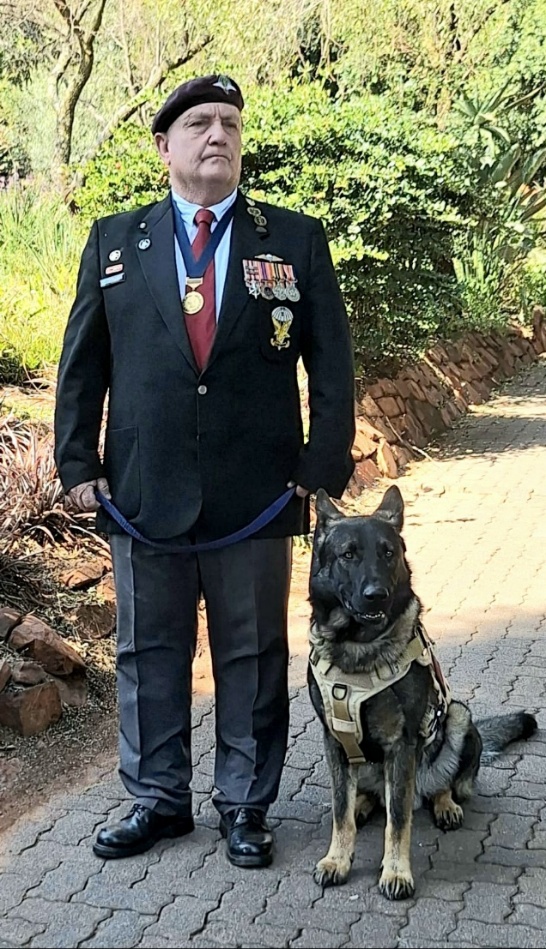
To ensure we keep the memory of these War Animals alive at Memorial Services, Military Festivals and other venues, the idea of the “Animals in War” Ambassadors were created. In 2014. K9 Wilkia (German Shepherd dog) being the first. K9 Markus followed and in 2023 K9 Wolfi and Inga became part of this special group of dogs .
Veterans Leagues/Association membership:
I am a member of the following Veterans League/ Associations:
· Paratroopers “Parabat” Veterans League
· SAP COIN Veterans League
Memorial wall in honour of animals that paid the highest price during wars unveiled at the Voortrekker Monument
“The memorial wall is the life’s work of renowned veteran Roché Vermaak, who emphasised during the inauguration that animals in war are often the unsung heroes of the battlefield. Vermaak regularly attends military parades with his dogs, Inga and Wolfi, to lay wreaths at memorial services on behalf of animals as war workers. According to him, horses, dogs, cats, pigeons, a baboon, and even a springbok have bravely served alongside soldiers in various wars and battles”
Citizen/Record: 30 March 2025: Elize Parker
Introduction
On Sunday, 30 March 2025, a unique memorial wall honouring animals that died in wars, “Animals in War Memorial”, was inaugurated at the Voortrekker Monument in Pretoria.
When you think of wars, you believe it’s only people, i.e., soldiers and civilians, who are victims, but forget that animals were used for military purposes and kept as good luck charms by soldiers during wars. These are horses used as mounted units, as draft animals along with donkeys and mules, dogs for tracking/protection, and pigeons as a means of communication.
In the Southern African war history of the First Anglo Boer War (1880-1881), Second Anglo Boer War (1899-1902), WWI (1914-1918), WWII (1939-1945), the Bush War in SWA (1966-1989), the Bush War in Rhodesia (1961-1979), and the wars in Angola and Mozambique (1960-1975); animals played a significant role in these military conflicts.
Background to the Memorial Wall:
Rochê Vermaak, a former SA Defence Force (SADF) paratrooper and SA Police (SAP) dog handler, is the driving force behind the creation of the memorial wall. The idea began in 1988 when he lost his police dog, Shep, and later his ambassadors, Markus and Wilka, in 2023.
The organization founded by Vermaak is called “Animals in War”. It includes units like
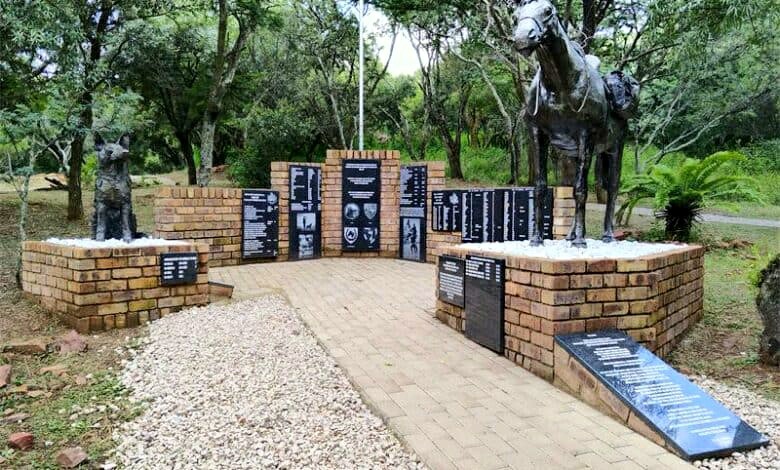 Animals in War Memorial Wall
SAP Dog Unit (K9), SADF Dog Unit (K9), SADF Mounted Unit in Potchefstroom, and the Rhodesian Grey Scouts (Mounted).
The memorial wall is divided into areas, with the focus point as the center, including units as mentioned. The central area is dedicated to the former Rhodesian Grey’s Scouts (Mounted) and the Rhodesia Dog Unit. The memorial wall is also unique in its kind and is the “home” of the Grey’s Scouts. There are 38 confirmed cases of dogs that died during conflicts.
During Operation Savannah (1975–1976), the first large-scale land operation of the SADF since WWII, rifleman Adam Schönfeldt and his tracking dog, Rinty, were killed in action in southern Angola. It was the first dog of the SADF to die. On Thursday, 30 March 1972, the first SAP patrol dog, Leeu, and his handler Sergeant “Tjaart” JF Riekert were killed in a landmine explosion near Singalamwe in Eastern Caprivi while riding on the back of an SAP Ford F100 police bakkie during a counter-insurgency patrol. It was the first SAP dog to die during the SWA Bush War.
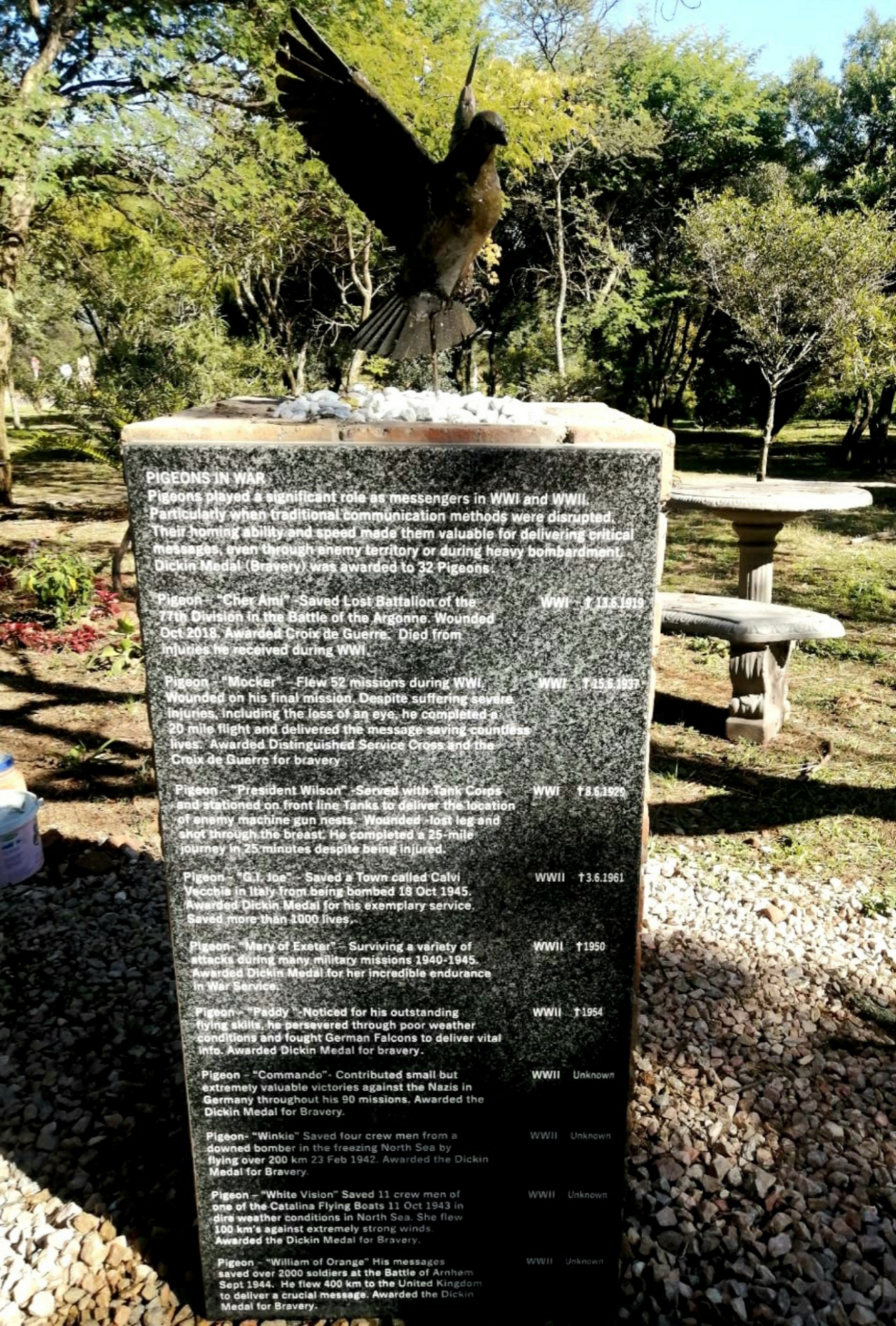
The Pigeons
The Pigeons section is dedicated to pigeons (messengers) with 32 confirmed cases. There are also other animals used in WWI and WWII, such as mascots, including cats, a bear, a baboon, a springbok, and a rat.
Lucky Charms
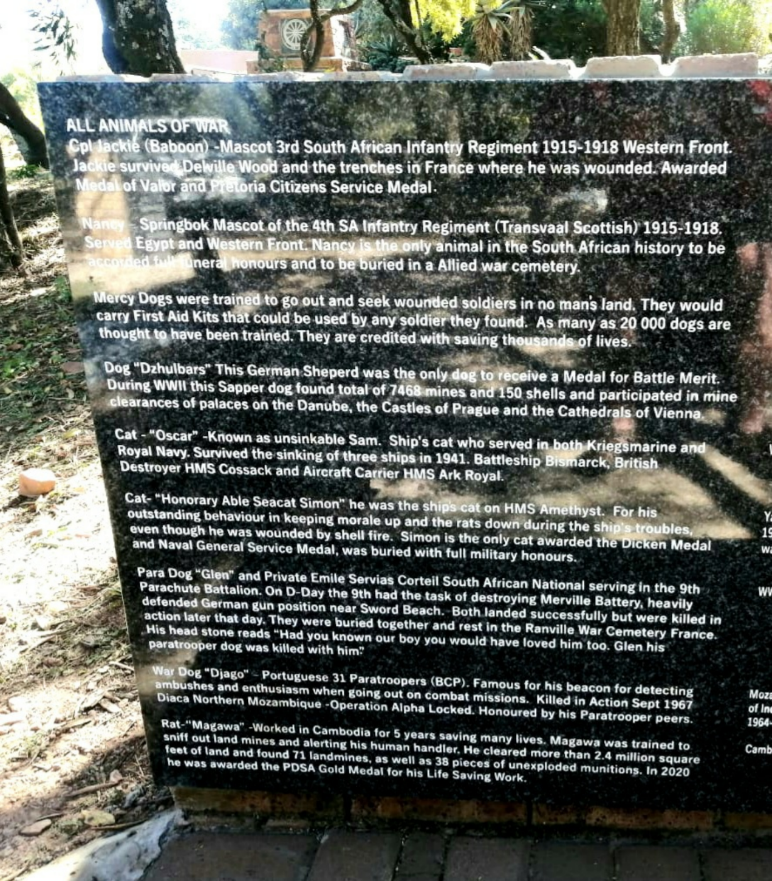
Jackie the Baboon
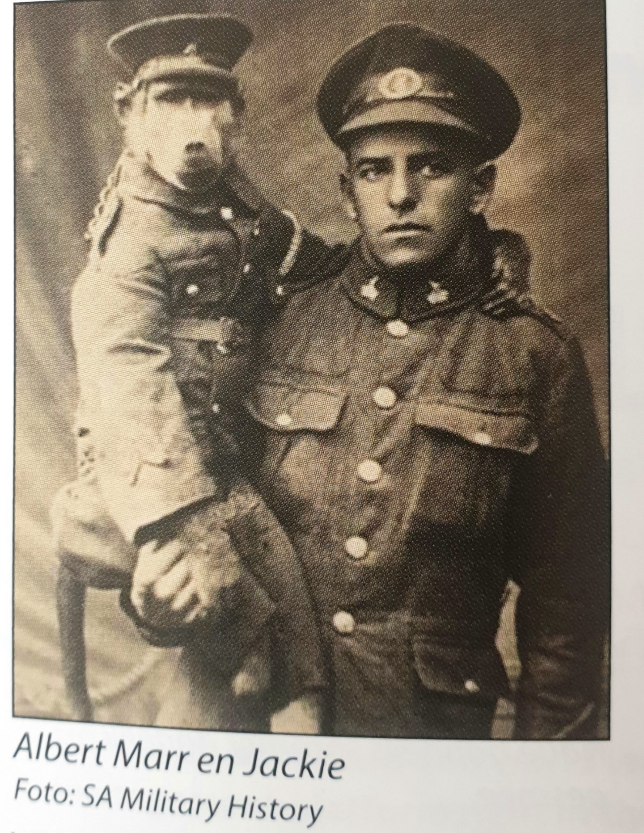
Jackie, a baboon, was found by Albert Marr in 1910 on his farm Cheshire, now Villeria in Pretoria. He was treated like a family member, given clothes, and taught table manners. When Albert was drafted into the Third Transvaal Infantry Regiment in 1915, he got permission to take Jackie along to France. Jackie was treated like a soldier, receiving a uniform, rations, and a paybook. He participated in battles, including the Senussi campaign in Libya (1916) and the Western Front in France (1916-1918). In April 1918, Jackie was wounded, and his right leg was amputated. He survived and was promoted to Corporal for bravery. Jackie passed away in May 1921, possibly due to a fire or a severe thunderstorm.
Nancy the Springbok
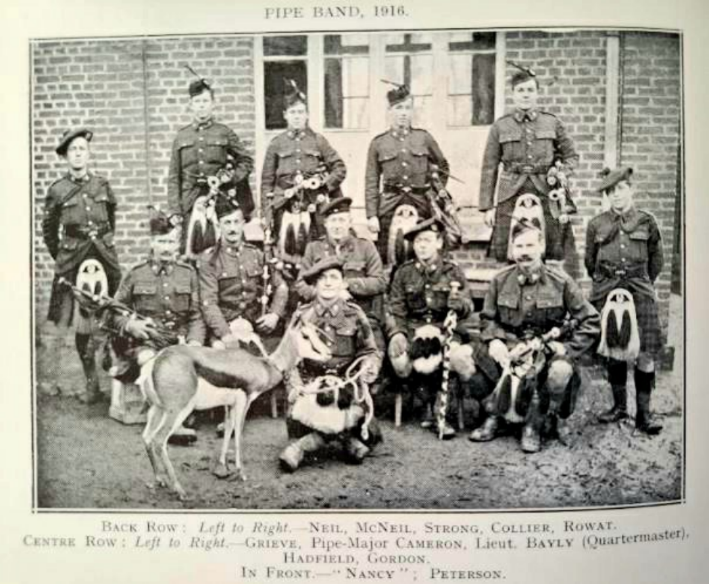
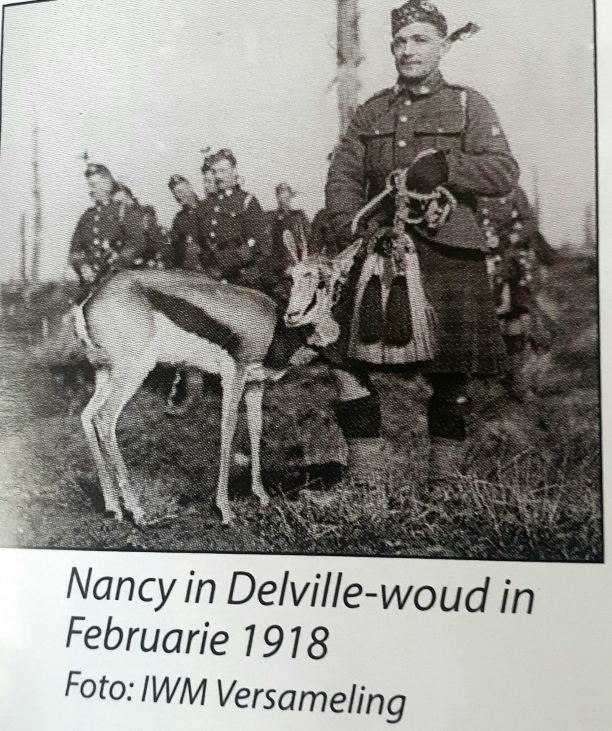
Nancy the Springbok: Nancy the springbok ended up at the [South African Military Museum] due to her original owner, Mrs. MacLaren Kennedy from the farm Vierfontein in the Free State. She wrote a letter to General Lukin mentioning that she would be the ideal mascot for the Regiment, which was heading to Egypt/Palestine in 1916 for the campaign against German SWA 1914-1915. In 1917, the Brigade was transferred to France and fought in the Battle of Delville Wood. Nancy, however, died of pneumonia on 26 November 1918. She was buried with full military honours in an Allied war cemetery. Her head and skin were sent to Sir William Dalrymple, a Witwatersrand mine owner and founder of the regiment. He had Nancy mounted. In 2015, she was restored by a Bronberg, Pretoria taxidermist and proudly displayed in the officer’s mess of the Transvaal Scottish Regiment’s headquarters for years. She was donated to the Ditsong Military Museum in 1958.
The unveiling of the memorial wall was attended by a large number of Military Veteran Associations, Police Veteran Associations, French Military Attaché, Heritage Foundation, representatives of cultural organisations, City of Tshwane, and the Tshwane Society for the Prevention of Cruelty to Animals (SPCA). An annual memorial service will be held at the end of March at this memorial wall. This memorial wall is unique in that it commemorates all animals that were involved in wars. There are numerous monuments throughout the country that commemorate individual animals, especially horses. The most well-known is the “Horse Memorial” in Port Elizabeth on the corner of Russell and Cape Road. The monument was erected in honour of horses that died during the Second Anglo Boer War.
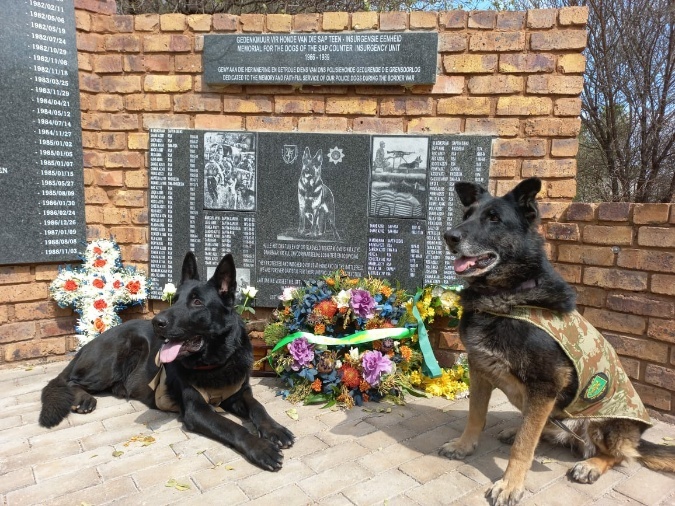
SAP Dog Memorial at the SAP COIN
Veterans League Memorial wall
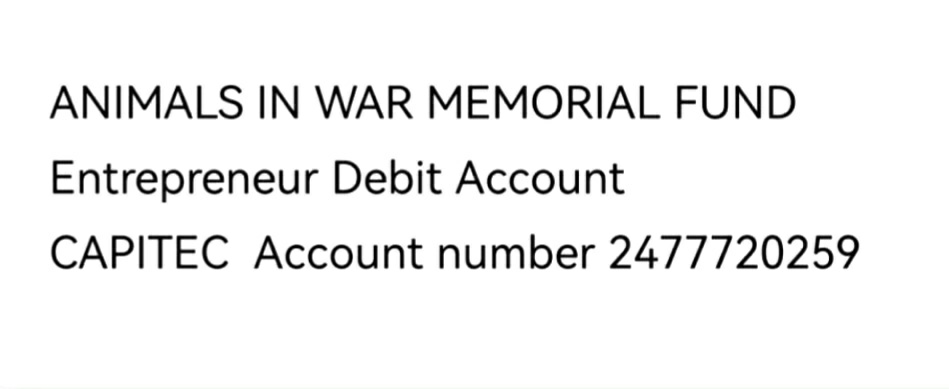
Donations:
Donations for the “Animals at War Memorial Fund” can be paid into the following account:
References
Roché Vermaak
Citizen/Record: 30 March 2025: Elize Parker
SABC News: 30 March 2025: Janet Szabo
Maroela Media: 31 March 2025: Janice du Plessis
Tshwane SPCA
Photos:
Roché Vermaak
Elize Parker
Tshwane SPCA

