
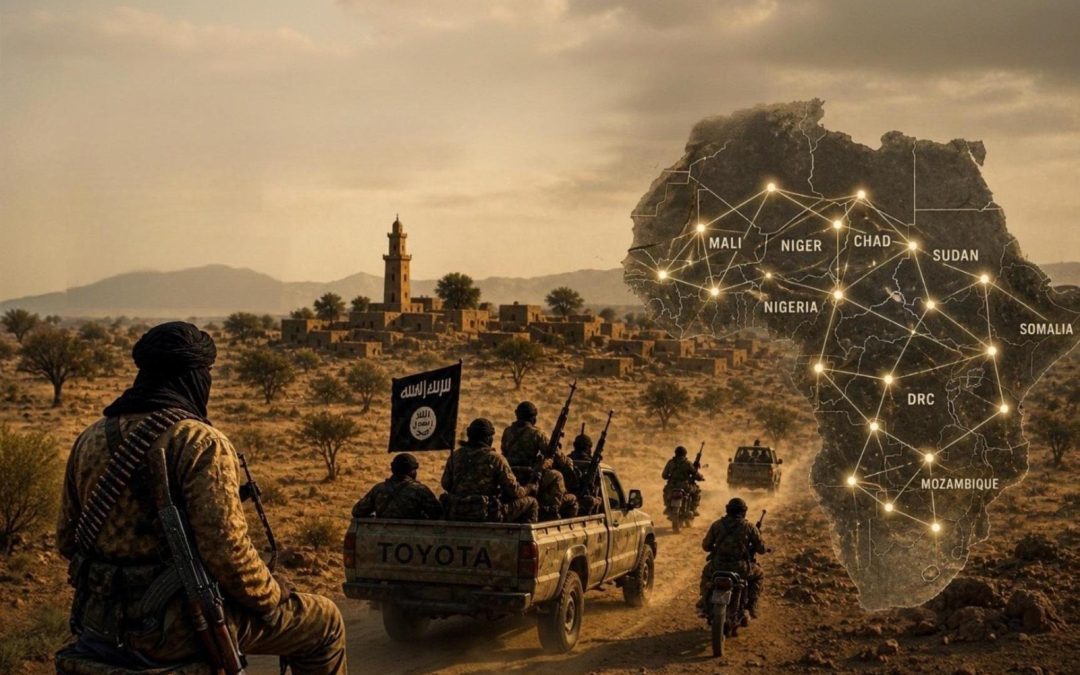

Abstract: In Nongqai Vol.17 No 5, Strategic Security Analyst Dr Joan Swart examines why, how and where Jihadist movements operate in Africa. Why do Jihadist movements survive and thrive, despite the countermeasures African governments take against them?
Dr Joan Swart
Key Words: Dr Joan Swart, Nongqai May 2026, STARLINK, Jihadism, Jihadist movements, Jihadism in Africa, Al-Qaeda, ISIS.
WHY JIHADIST NETWORKS ENDURE IN AFRICA
Two decades after the peak visibility of al-Qaeda-linked movements, and nearly a decade after the territorial defeat of Islamic State in Iraq and Syria, jihadist networks remain active across parts of Africa. In some regions, particularly the Sahel, the Lake Chad basin, and areas of East and Southern Africa, their presence appears persistent and, at times, expanding. This has led to a common assumption that these movements are resurging. A more accurate interpretation is that they have adapted.
Al-Qaeda has long operated through decentralised structures, building affiliated networks that retain local autonomy while aligning with a broader ideological framework. Islamic State, by contrast, initially pursued a highly centralised model based on territorial control. Following its losses in the Middle East, it has increasingly adopted a more distributed approach. In both cases, what has emerged is not a return to earlier forms, but a convergence around network-based organisation.
Jihadist networks can fragment, reconstitute and relocate
This shift matters because it changes how persistence is generated. Networks do not require continuous territorial control. They do not depend on a single centre of gravity. They can fragment, reconstitute, and relocate. In environments where authority is layered, mobility is high, and state presence is uneven, this form of organisation aligns with the operating conditions.
Africa is not uniformly conducive to such movements. Large parts of the continent, including most of Southern Africa, do not exhibit the conditions that have enabled their persistence elsewhere. Where these networks endure, it is typically in specific environments characterised by cross-border mobility, localised disputes over resources or authority, and governance systems that are negotiated rather than uniformly applied. These are not simply “ungoverned spaces”, but areas in which multiple forms of authority coexist.
On the ground, these movements function less as isolated organisations than as part of broader ecosystems. Insurgent groups, local militias, criminal networks, and community structures often intersect. Alliances shift. Individuals move between roles. The same routes that sustain trade can also support armed movement. In this context, coordination does not always imply centralised command, and capability does not necessarily reflect a single source of funding.
Recruitment to Jihadist networks is (frequently) transactional
This has implications for how recruitment is understood. While ideology remains important at the level of leadership and narrative, participation at the local level is often shaped by more immediate considerations. Access to income, protection, or status can be decisive. In areas where economic opportunities are limited and insecurity is persistent, the threshold for participation is lowered. Recruitment, in such contexts, is frequently transactional.
Financing follows a similar pattern. Rather than relying on a single external sponsor, these networks draw on a mix of local and transnational sources. Revenue may be generated through taxation or extortion, control of or access to local resources such as artisanal mining, and participation in or facilitation of illicit trade. Kidnapping for ransom, while not universal, remains a source of income in certain areas. External links can provide support, but day-to-day sustainability is often locally generated. This diversification contributes to resilience.
Fatalities are rising
Recent data underscores the scale and persistence of this dynamic. According to the Armed Conflict Location & Event Data (ACLED), militant Islamist violence in Africa has increased markedly over the past decade, with roughly 8,000–8,500 such violent events recorded in 2025 alone, resulting in nearly 24,000 fatalities. This represents a significant rise from the mid-2010s and reflects not only increased intensity, but also geographic expansion beyond traditional hotspots. The trend suggests not episodic surges, but the consolidation of a sustained, decentralised conflict system operating across multiple regions.
The scale and coordination of some recent attacks have raised questions about whether such operations can be locally sustained. While external support cannot be ruled out in specific cases, it is not always required to generate significant capability. Networked structures allow for coordination across semi-autonomous units, often supported by pre-existing logistical arrangements and local knowledge. The result can appear more centralised than it is.
External actors have attempted to respond to these dynamics through a range of approaches. French operations in the Sahel were built around a model of expeditionary counterterrorism aimed at restoring state control through targeted operations. The United States, through AFRICOM, has focused on training, advising, and enabling partner forces. More recently, Russian-linked formations such as Africa Corps have prioritised regime security and direct support to host governments. The Alliance of Sahel States represents an effort to regionalise security responses and align them more closely with cross-border threat dynamics.
Each of these approaches reflects different assumptions about how control is established and maintained. What they share is a tendency to engage with the problem at the level of the state. Yet the movements they are attempting to counter operate through decentralised systems that are embedded within local environments. This creates a persistent mismatch. Tactical successes do not always translate into sustained control, and disruption does not necessarily produce collapse.
This is not to suggest that these interventions have no effect. They have altered operational dynamics, disrupted networks, and, at times, reduced violence in specific areas. However, they have not eliminated the underlying conditions that enable persistence. As long as networks can draw on local incentives, operate across borders, and adapt to pressure, they retain the ability to endure.
The tendency to interpret this persistence as a sign of growing strength can be misleading. These movements do not need to dominate in order to remain relevant. Their objective is not always to hold territory, but to sustain presence, influence, and operational capacity over time. In this sense, endurance is itself a form of success.
Understanding this requires a shift in perspective. If these networks are assessed primarily through indicators such as territorial control or centralised command, their resilience will continue to be underestimated. A more accurate assessment would focus on their ability to adapt, embed, and regenerate within specific environments.
The question is not only why these movements endure, but why they are so difficult to displace. The answer lies not in a single factor, but in the alignment between organisational form and operating environment. These are systems designed for persistence, operating in conditions that allow it.
They endure not because they are universally strong, but because, in certain contexts, they are structurally well adapted.

NONGQAI’S Strategic Security Analist Dr Joan Swart is a forensic psychologist with an MBA and an MA in Military Studies. Her work focuses on African security, geopolitics, state fragility, substate dynamics, and the intersection between governance, legitimacy, and coercive power. She is the author of several books and regularly publishes long-form analysis and opinion pieces on security and governance issues. Her writing has appeared in outlets including DefenceWeb, Maroela Media, Netwerk24, RSG, Visegrad, and other policy and public-affairs platforms. Her work bridges academic research, policy analysis, and applied strategic assessment, and she is currently completing a second PhD at the University of Stellenbosch Military Academy.
*
