
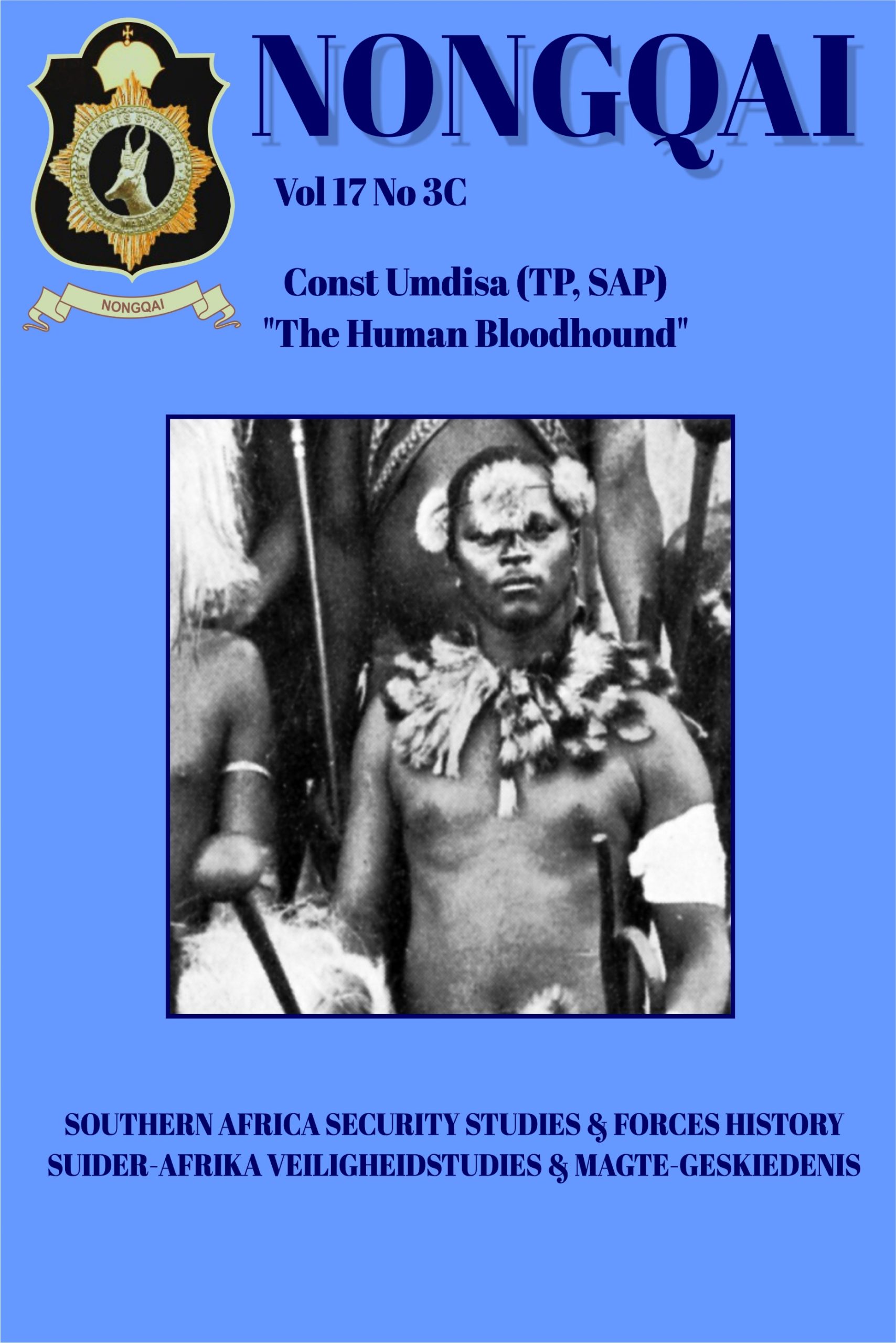

Umdisa
NONGQAI VOL 17 NO 3C
In two parts: English + Afrikaans
Col HF Trew & Brig HB Heymans
FOREWORD
In recent times, the media has confronted us with commissions of inquiry, police corruption, and police incompetence. Yet, against this bleak backdrop, one remarkable and unique case stands out: that of Constable Umdisa of the Pretoria Police, who more than a century ago investigated an extraordinary murder case — with outstanding results.
The message conveyed by his conduct was clear and powerful: We protect and we serve. According to available evidence, Constable Umdisa was a son of KwaZulu, a man with limited formal schooling, yet a policeman and detective to the core.
One cannot help but feel respect for his purposeful action and the successful conclusion of the case entrusted to him.
Just as the (Wolraad) Woltemade Decoration honours bravery, the authorities could well consider establishing an Umdisa Decoration for all exceptional investigative officers.
In my eyes, Constable Umdisa is a true hero — and I am certain you will agree.
The remarkable story of Constable Umdisa
The Human Bloodhound
-
- A true saga of dedication, alacrity and dedication
- From Pretoria to Mafeking on foot
- From the Limpopo to Pretoria on Foot
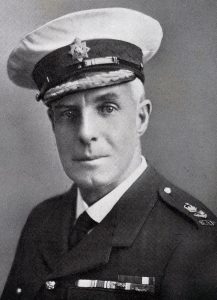
That famous, but now forgotten, old raconteur, Colonel HF ‘Harry’ Trew (photo), a former deputy commissioner of the SA Police told and wrote many a true story and has left with us with a rich heritage of personal history dating from the Anglo-Boer War right up to the early 1920’s.
After reading this true saga of Constable Umdisa one would at once think the story is far-fetched or untrue! This story reminds one of De Quincey’s then famous theories in his essay Murder Considered as one of the Fine Arts, viz. that it’s the safest place, from the murderer’s point of view, to murder a person before a crowd.
The bare facts of the murder were that on a bright sunny morning in Pretoria a loyal school janitor was murdered in a schoolyard in full view of the classrooms, facing which were about 50 children doing their lessons. Not one person saw the murder or the murderer or heard anything!
In the schoolyard opposite the classrooms was the room that the school’s cleaner and caretaker occupied. He was a Zulu gentleman called Mr M’panki (sic). The door of his room faced the school. On the morning of the murder, at about 10am, a scholar informed his teacher that Mr M’panki might be ill, as he was lying on the step-in front of his room. On investigation, to their horror the school discovered that he was murdered, and the Police were immediately called for.
A detective and police photographer reported at the scene to investigate. The deceased had evidently been sitting on the top step with his back towards the interior of the room. He had been hit on the head by an axe. It was a fearful blow as the scull had split in two. A strong man had evidently delivered the blow.
The murder weapon, a small American axe was found on the scene. Blurred fingerprints were found on the handle but fortunately a clear thumbprint, for identification purposes was found on the axe. Enquiries elicited the fact that the axe belonged to the dead man. His thumbprint had to be taken for identification purposes. To the delight of the investigation officer the prints did not belong to the deceased. The inference was drawn that the prints belonged to the murderer. The print, at that stage, did not serve to identify the murderer as it was then seen as an impossible task to search thousands of records for a single print.
Mr Henry, later Sir Edward Henry, later Commissioner of the London Metropolitan Police, made an intensive study of fingerprints while a commissioner of the Indian Police. In the India and China thumbprints were used on documents as a signature but there was no system to of classifying them. Mr Henry then studied fingerprints and started to classify fingerprints in India. He later came to South Africa during 1902 and established our present fingerprint system. After his sojourn in South Africa, he went to the United Kingdom.
The investigating officer discovered other leads. First, he establishes a motive. Mr M’pianki was not only the school’s janitor but also being a respectable man, a traditional African Banker. His mattress was the bank, and this was ripped open! There was no cash left. As a ledger he used an array small of sticks with cut nicks representing the names of clients and amounts. A strange stick[1] was found in his room. As his friends turned up, they declared that the stick was not the deceased’s stick.
The police took possession of the stick, and it was shown to thousands of African men in and around Pretoria. A young man came forward and identified the stick as the property of one Mr Joseph Sopela. He said he spent many hours in Sopela’s company while the latter was carving it. The detective immediately went to the Pretoria Fingerprint Bureau and asked whether Sopela had a record. His record soon turned up showing that he was a former convict and perpetrator of violent crime.
The facts were simple: Mr M’piaki had been killed between 0930 and 1000 that morning. A large sum of money in his possession had disappeared. The thumbprint found on the axe was that of one Joseph Sopela, a well-known criminal. No evidence could be obtained that Sopela knew the deceased or how Sopela got into Mr M’piaki’s room or knew where the money was hidden. However, Sopela’s wonderfully carved stick was found in the deceased’s room. Little did Sopela know that by carving his beautiful stick he in fact was carving his own death warrant. A warrant for his arrest was immediately issued; his photograph and description were circulated to all concerned.
For a week nothing was heard of Sopela until Trew reached his office one morning hearing his Head Constable[2] ranting and raving. When Trew asked him what the matter was, he replied: Those fools at Daaspoort[3] (sic) arrested Sopela last night on a charge of fowl theft. A patrol caught him in the act. They failed to recognize whom they had got, and at midnight sent him in to Pretoria under escort of a constable. He was handcuffed, but in crossing the Aapies[4] (sic) River, which was in flood after a heavy thunderstorm, he pushed the constable into the river; the latter in falling grabbed the prisoner and they both fell in. The constable was nearly drowned before he succeeded in climbing out. At daylight this morning they searched the river, but no sign of the prisoner could be found. They took the fingerprints of the man they arrested last night and brought them in this morning. I sent them to the bureau, and they have just telephoned to me that they are Sopela’s prints.
Trew, as the then district commandant of Pretoria, gave instructions that the constable who let Sopela escape should be paraded before him. This is how Trew describes the constable who appeared before him: he was a fine-looking man, stood at least six feet two inches, and was broad in proportion. He had a particularly fierce pair of eyes, which glared out as though the whole world were his enemy. Trew discovered later that constable came of the Zulu Royal House and was a descendant of King Cetewayo.
The following conversation took place between Trew and the Constable:
What is your name?
Umdisa, Inkosi[5].
What do you mean by letting Sopela escape from you?
Inkosi, I did not know it was Sopela. I was on patrol with the corporal. The storm-god was angry, and the heaven was a blaze of light, and the rain fell down. I heard some fowls cackling in a yard, and I crept up and caught a man killing a fowl and putting it in a sack. I handcuffed him and took him to the corporal, who made marks with his fingers on the white paper.
The corporal then said I must take the man to the charge office[6], because we have no safe place to keep him. The prisoner walked in front of me, and still the heaven blazed, and the rain fell. When we came to the river I could tell by the noise that the river was raging. In the middle of the small bridge across the river, the prisoner pushed me with his shoulder. I fell, but I said to him ‘If I die in the waters, then you die too,’ and I pulled him in with me. Inkosi, the water was so strong that I had to let him go. I took off my big coat and swam out. In the dark and rain, I could not find him. That is all.”
What! You call yourself a Zulu and you let a dog like Sopela fool you; I will send you back to your kraal in Zululand and the women will laugh at you. You are not a man; you ought to be sent to herd the goats with the children.[7]
Inkosi, I am a man, let me go after Sopela, and I promise you I will find him and bring him back even if it takes many moons.
All right. Go, but I never want to see you again unless you bring Sopela, and then Trew admits he rather foolishly added the following: I want Sopela dead or alive.
Umdisa gave the Zulu salute, and said: It is settled, Inkosi! And with those parting words he walked out of Trew’s office.
A week later Trew received a telegram from the police at Brakfontein, in the Rustenburg District, informing him that: Constable Umdisa reported here with prisoner Joseph Sopela. Am keeping prisoner in cell here tonight and will forward under escort tomorrow.
The following morning Trew received a disappointing telegram from the Brakfontein police announcing that Sopela had, during the night, dug his way out under the wall of the cell and Sopela had escaped. Constable Umdisa was again in pursuit.
For two weeks nothing more was heard of the chase when Trew received a telegram from the police at Mafeking (now Mafekeng). The police informed him that Constable Umdisa had reported at Mafeking. The police had now discovered that Sopela had enlisted with a group of mineworkers to go and work at the Bush Tick mine, in Rhodesia (Zimbabwe). The group had left by train. Constable Umdisa desired the police at Mafeking to send him after Sopela by train. The local police requested Trew’s authority.
Naturally Trew gave the necessary permission and he also telegraphed the British South Africa. Police (BSAP – now the Zimbabwe Republican Police (ZRP)) at Bulawayo to give Constable Umdisa all possible assistance he may require.
Consequently, the BSAP then informed Trew in Pretoria that Constable Umdisa had arrived at the Bush Tick mine only to find that Sopela had deserted and fled the previous evening. They said that Constable Umdisa had left in pursuit.
For the next two months nothing was heard from Constable Umdisa. At the end of six weeks Trew had Constable Umdisa struck off the strength in the Force Orders declaring him a deserter! This Trew did with a sad heart for he had judged Constable Umdisa to be a loyal, faithful fellow. Trew hated it to think that he had been deceived.
Fortunately, a telegram was received from a lonely Bushveld police station to say that a trooper on patrol in the bush had found the body of a dead African. The corpse was much decomposed and had been torn by wild animals. The deceased had evidently been killed in a fight. A broken assegai lay under the body. The hands of the corpse were missing so it was impossible to take fingerprints. One arm had certain tattoo marks. These marks exactly resembled those described on the arm of one Sopela, wanted by the Police for murder.
Surprisingly a week later at District Head Quarters Trew’s Head Constable reported: Constable Umdisa wishes to see you, sir.
The police constable was brought before Trew. It was certainly Constable Umdisa, but according to Trew not the same Constable Umdisa who had left his office some three months before. Constable Umdisa seemed to have shrunk to half his previous size. He and he looked battered and worn, but still held himself proudly erect, although sunk far back in his head, his fierce eyes still blazed. Throwing up his hand in salute he said to Trew: Inkosi, it is finished. Sopela will trouble us no more. I am but as one of the lice in the King’s blanket, but I will not go to herd goats with the children, nor can the women laugh at me, for my assegai has drunk blood.
Trew replied: You old devil, you killed Sopela!
Constable Umdisa answered: Well, you my father, said ‘ dead or alive ‘, but I would have arrested Sopela if I could, but the dog nearly killed me; look here, and here, and here, Inkosi,” Before Trew could stop him, Constable Umdisa had thrown off his clothing and showed the great weal’s of wounds newly healed. Trew doubted if any white man could have suffered such grievous wounds and lived to tell the tale!
Trew filled his pipe, lit it and said: Now, Umdisa, tell me the whole story from the beginning. The Zulus are a wonderful nation of taletellers and Trew thought it possible that Constable Umdisa must have been one of their stars! Constable Umdisa not only told the whole story, but acted parts of it, particularly when it came to the fight with Sopela; he showed every feint, every thrust, so that when he finished Trew felt inclined to clap his hands as one would do in a theatre.
This is Constable Umdisa’s as he told it to Trew:
Inkosi, when I walked out of your office that morning, I had no fear and I knew that I would catch Sopela. I meant to follow him as a dog would follow a wounded buck, until I ran him down. I went to the Apies River and followed far down its banks making inquiries. At last, a local lady told me that she had seen a man with handcuffs on walking towards a kraal. I went to the kraal, but they denied having seen such a man! However, I knew they were lying. One of the men had a little forge. He was the blacksmith of the kraal. I threatened him a little and at last he confessed. He admitted that he had filed the handcuffs off Sopela.
I followed the directions they had given me at the kraal. For seven days I was close behind him. Then one day I came to a kraal and asked the people about him, but they also lied and pretended they had not seen him. I let them think they had fooled me. I left and went off as though satisfied. When I got in the bush, I worked myself round the kraal and got onto a hill. From there I could watch the kraal. After a time, I saw a man come out of the bush and walk into the kraal. I was sure it was Sopela. I waited until the sun was right over my head and it was very hot. All had retired to their huts. I then crept down to the kraal. I heard Sopela’s voice in one of the huts, so I dashed in and had the handcuffs on him before he could stand up.
Then he said to me: Someday, policeman, I am going to kill you!
The locals showed me the way to the nearest police camp[8], which was at Brakfontein. The sergeant locked Sopela up in a cell for the night. I slept hard that night, but early in the morning I went to see that Sopela was safe. The door of the cell was fast, but when I walked to the back of the cell there was a heap of earth and a hole under the wall. The jackal had escaped! I woke the sergeant, who came running and unlocked the door. Sopela had pulled the handle off the night bucket and had used that to dig down through the floor. The sergeant gave me food and I followed Sopela again.
Sopela had always gone towards where the sun went down. So, I started that way, and that night I came to a farm where he had called when the sun was high and had asked for food.
At long last, following him every day, I came to a town called Mafeking[9]. I went to the police and showed them the Sopela’s photograph and in a little while they came back and said that he had gone by train with other workers to Bulawayo. He was set to work on the Bush Tick mine in Rhodesia[10]. I asked the police for a ticket and some money that I might go and catch him. This they gave me.
I went to Bulawayo where I found that the people could understand Zulu. The local police gave me an African Constable, and we walked to Bush Tick mine. When we got there, we found that Sopela had deserted the night before. A jackal always goes back to his old hole, so I thought he would go back to the Transvaal[11]. I told the African Policeman to go back to Bulawayo and tell his superiors to speak to you over the iron wires and to say I had gone after him again.
I went through bush and high grass until I came to a big river[12] but I could not find Sopela. Then I walked along the river till I came to the camp of a smous[13] and his workers told me that Sopela had come there to ask for food. I followed the river until I found his spoor in the mud where he had crossed. He wore sandals, and on the left foot two little pieces of iron. His left foot when he walked, he turned out like that of a duck. I am not a Bushman who can make a spoor talk, but when I saw that spoor, I knew always that Sopela was in front of me.
I was frightened of the Limpopo; it was running hard and there were crocodiles in it. I thought to myself that if he can cross, then can a Zulu also cross. So, I tied my bundle on my head and took my assegai in my mouth and swam across the river.
That night I slept near some big trees and while I was sitting by my fire a lion breathed on my neck. I threw fire sticks at the lion. I then climbed a tree where I stayed all night.
Sometimes I would find a kraal where I got news of Sopela. The locals told me that Sopela now had armed himself with an assegai. I realised that unless I caught him asleep there would be a deadly fight.
I thought he might creep back at night when I was asleep at my fire and kill me. So, every night after that, I would make a big fire. When it got dark, I would then creep away and sleep elsewhere. Then for two days I lost him; there were no kraals where I could ask about his whereabouts. So I walked straight ahead very fast and came to big mountains with great krantzes and kloofs, and full of bushbuck. That day I found where a leopard had killed a bushbuck and dragged the body up into a tree, so I climbed up the tree and got the buck and ate enough meat to last me for some days.
It was night when I came to the top of a mountain. I looked down for the light of Sopela’s fire. Then at last, far below me and to one side, I saw a small fire. I tried to get down the mountainside in the dark, but I fell. I then camped there with no fire and left early in the morning. When I came to where I had seen the fire and saw that a man had pulled grass and slept there, but the ground was hard and there was no spoor. I followed a footpath down the berg until it came to a spruit and there again was the spoor of the man who walked like a duck!
I must tell you Inkosi that when I came to a kraal I told them I was a Zulu and I was the Government[14]. The inhabitants then gave me food and sometimes a place to sleep.
Then I came to another river, where there were lots of wildebeestand I found a camp with two white men. They had a Cape cart and four mules. They were foolish men from Johannesburg. They had come to hunt but they had got drunk and beaten their driver who then had absconded. They had tried to inspan the mules but had got the harness all twisted up and a mule had kicked one of them. They were afraid to knee-halter the mules in case they also ran away so they led them about by the reins to graze and tied the mules up to the cart at night.
Sopela had met them and had promised to inspan the mules and drive them next day, but he had stolen a bottle of whisky and a blanket from them during the night and had vanished. I got the harness straight and inspanned the mules and they wanted me to drive but I said: No, I must go after Sopela.
They could not drive. So, I made the one man sit in the cart and hold the reins while the other man leads the mules with a trek-tow. I told them to follow the path along the river until they came to a kraal where they could hire a man to drive and inspan for them. Truly they were helpless in the veld, and they should stay in the big town. They told me that Sopela was lame and he had got a poisoned foot from a thorn. This raised my spirit, so I hoped to catch him soon.
Late in the evening I saw the light of a fire, and I thought it must be Sopela. I crept up quietly to catch him as he sat but it was a young man from a farm looking for lost oxen. He had seen Sopela when the sun was overhead; he was very lame and looked very tired. He also said that in front was a big koppie; it was called Mamba Kop, and the snakes were very fierce there!
The local police commandant had been shooting near there one day and had wounded a duiker which had run into the kop. The Africans with him had told him not to go on to the kop. They had refused to go with him. He had gone with his dog and presently they had heard some shots, and the commandant had come back very white to say the dog was dead and the kop full of devils!
So, when I saw the kop in the morning, I kept far away from it and in the evening just when it was getting dark, I saw Sopela in front of me very far away. I ran but he saw me and then ran as well, and I unfortunately lost him in the dark.
For three days I could not find him or his spoor. Nor had the locals seen him. I thought he had turned back like the cunning jackal, and I nearly went back but my ‘snake’ talked to me that night and I knew that I must go on!
I came then to a farm, and I showed the farmer my police badge, and the picture of Sopela. The farmer said he had not seen Sopela, but he asked his workers and the shepherd said that he had spoken to Sopela that morning so I knew I was on the spoor. That night I saw Sopela again in the distance but this time I did not run after him, and he did not see me.
My plan was to let him make his camp and sleep and then in the very early morning, before the morning star rose, I would creep up and catch him asleep. That night I when I camped, I made no fire. However I could smell the smoke of fire Sopela made, so I knew he was close. It was thorn bush country with lots of small rocky kopjes. In the very early morning, when it was still dark and cold, I left my blanket and sandals and taking only my assegai crept along in the direction Sopela had gone.
At last, I could smell the fire very close, so I sat and waited for more light. Then I crept round the side of a small kopje and through the bush I could see the few live ashes of the fire. There was a dark figure lying near the fire and putting my assegai between my teeth I crept on my hands and knees forward so that I could feel if there were any sticks I might break in my path.
Sopela’s camp was in a small open space and when I stood up, I could clearly see the figure wrapped in a blanket. Then my ‘snake’ must have looked my way for suddenly, although I heard nothing, I felt there was someone behind me. I flung myself to one side and doing so Sopela’s assegai missed my heart but tore into my side, under my right arm.
As I fell, I turned round and struck out blindly. My ‘snake’ helped again, for the assegai struck Sopela in his thigh! He wrenched the assegai out of my hand. Then he laughed! But he laughed too soon. As he struck down, I rolled for his feet, the assegai tore my left shoulder, but I got him round the legs and pulled him down. We rolled over and over, he trying to get the assegai in his hand to stab me.
The blood was draining out of me, but I caught his wrist and twisted it until he dropped the assegai. Once he got his thumb in my eyeball and I thought my eye was gone but I jerked my head to one side and we rolled apart for we were both weak from our wounds and we had no more breath.
We stood on our feet and swayed backwards and forwards trying to get breath. Then we circled round, each looking for a death grip. He then jumped at me with his head down. I brought my knee up in his face and as his head jerked up, I got my left arm behind his neck and my right hand on his chin. Then I pressed, oh, so hard on his chin until it went up and to one side. Something went ‘crack!’ His neck and his body went all-soft in my arms. I let him slip to the ground and fell on top of him. I felt I was going to die, but it was a good fight! Remember I had promised the Inkosi ‘dead or alive’.
For a long time, I knew nothing and when I woke the sun was up. Sopela was dead. The Jackal must have known that I was close for he had stuffed his blanket with grass to make it look like a man lying there. Near the dead fire was a bottle with water. I crawled to it and drank it all. My wounds were burning like fire. I plucked grass and stuffed it in the assegai wounds. The night before I had heard the drums going for an African dance and I knew there must be a kraal nearby. Crawling through the bush I came on a path. Presently two women came along with basins on their heads. They cried out when they saw me and ran back shouting, and in a little while the men came and carried me to the kraal. The herbalist made muti[15] [umuthi – Zulu] for my wounds but for a long time I did not know night from day. Then I got better and came to tell the Inkosi and now my story is finished. I will now go to the barracks for I am very tired!”
Umdisa was given a small money reward for all his trouble. Trew says he would like to be able to tell us that that Constable Umdisa worked hard and got his promotion to sergeant; but the truth is he became very lazy and was always being defaulted.
Trew I sent for him one day and asked him what he wanted to do. He said he was ‘tired’ he that he had saved money and wanted to go back to his kraal and buy a wife. Trew gave him his discharge and Trew expected that, like the Inkosi, Umdisa is getting old and grey, but Trew says he could picture Umdisa sitting in his hut at night telling Mrs. Umdisa, for the hundredth time, the story of his Odyssey, and she, for the hundredth time, saying: ” Well, dear, I think you are simply wonderful!” or words to that effect!
The story does not end here. Servamus spoke to a psychologist who reports as follows on Constable Umdisa’s later behaviour:
Dr Elaine Bing, a Pretoria psychologist, renders her expert opinion regarding Constable Umdisa’s strange behaviour after his epic journey and battle to death, as follows:
Without the opportunity to question him about his experiences, we must resort to conjecture. It was a battle to the death and Trew was surprised that he had ‘lived to tell the tale’.
He was afterwards described as ‘lazy’ and was always being defaulted. This may refer to avoidance behaviour or / and poor concentration. He describes himself as ‘tired’ and one wonders how well he slept – did he have nightmares of his dangerous journey and its subsequent end?
He may also be describing a feeling of depression or a loss of interest in things. Therefore, a psychologist would investigate the possibility of posttraumatic stress disorder and / or depression.
UMDISA DECORATION
Constable Umdisa might have been one of the earliest victims of Post Traumatic Stress syndrome. Nevertheless, his memory should be cherished by all members of the police especially investigators and therefore it is proudly suggested that a decoration – UMDISA DECORATION – be instituted for all investigators that excel in detective work and criminal intelligence including the Scorpions. It will be a fitting memorial and reward to a early South African crime buster!
What a remarkable and dedicated man!
Bibliography:
Trew, Lieut-Col HF: African Manhunts, Blackie & Co, London, 1938.
SA Multi-Language Dictionary and Phrase Book, Reader’s Digest, Cape Town 1991.
Photo Album / Fotoalbum
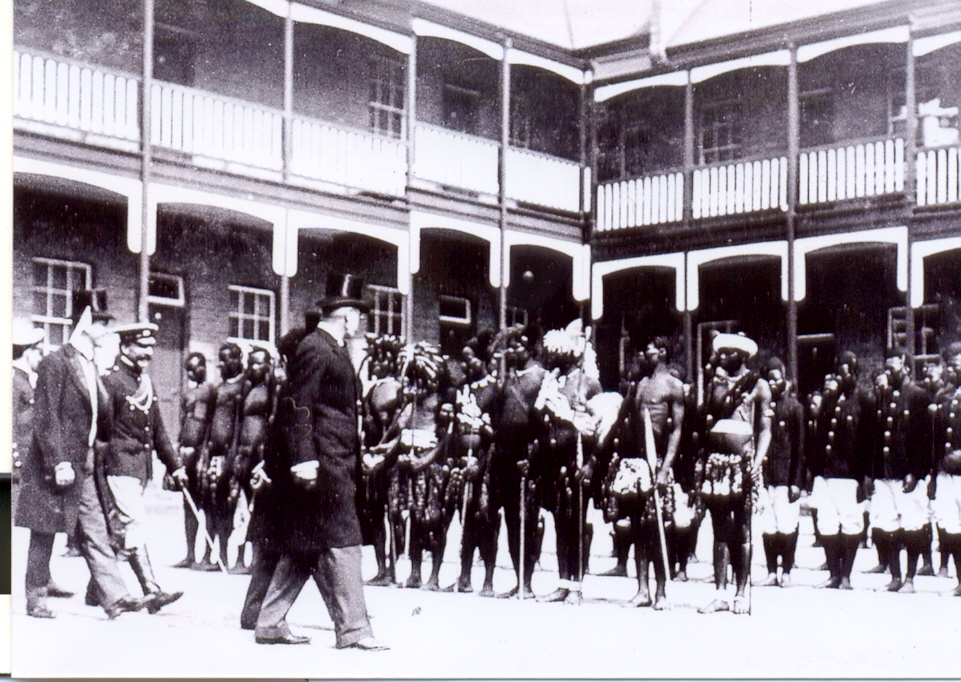
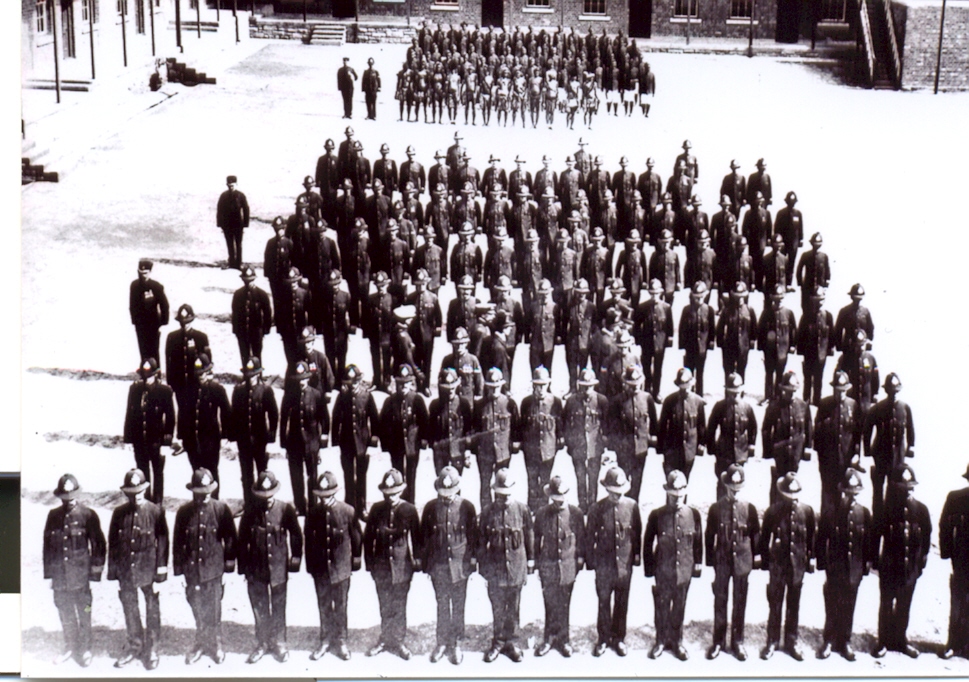
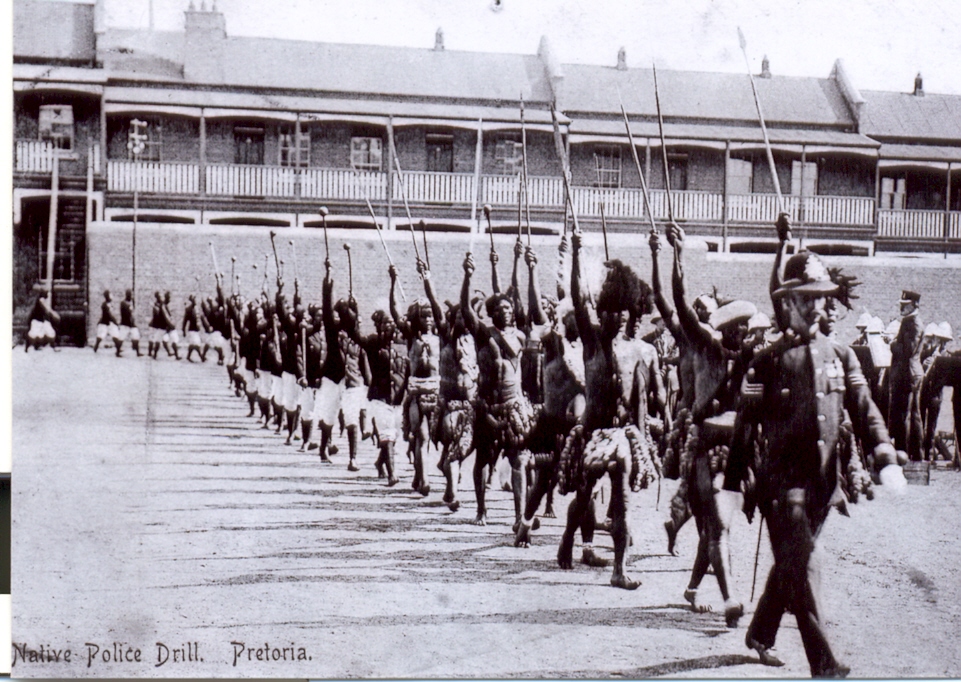
Native Police drill – old Pretoria Central.
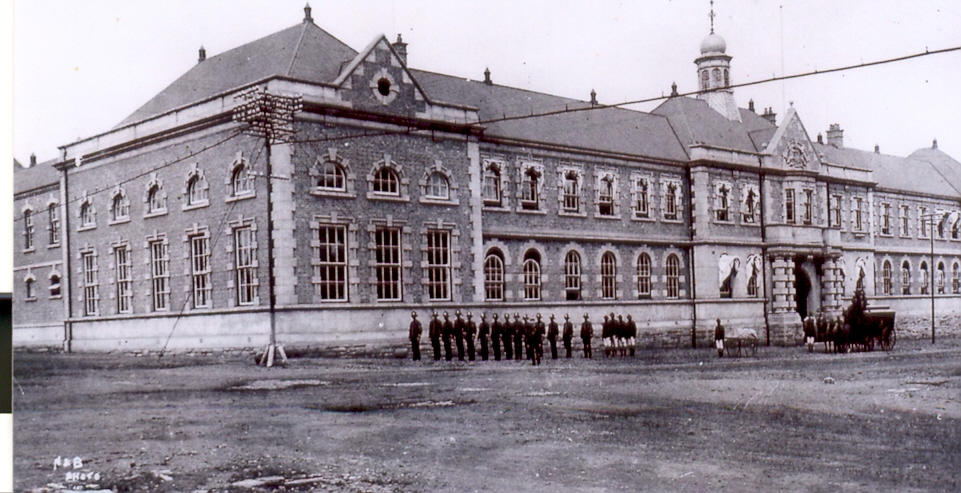
Old Pretoria Central
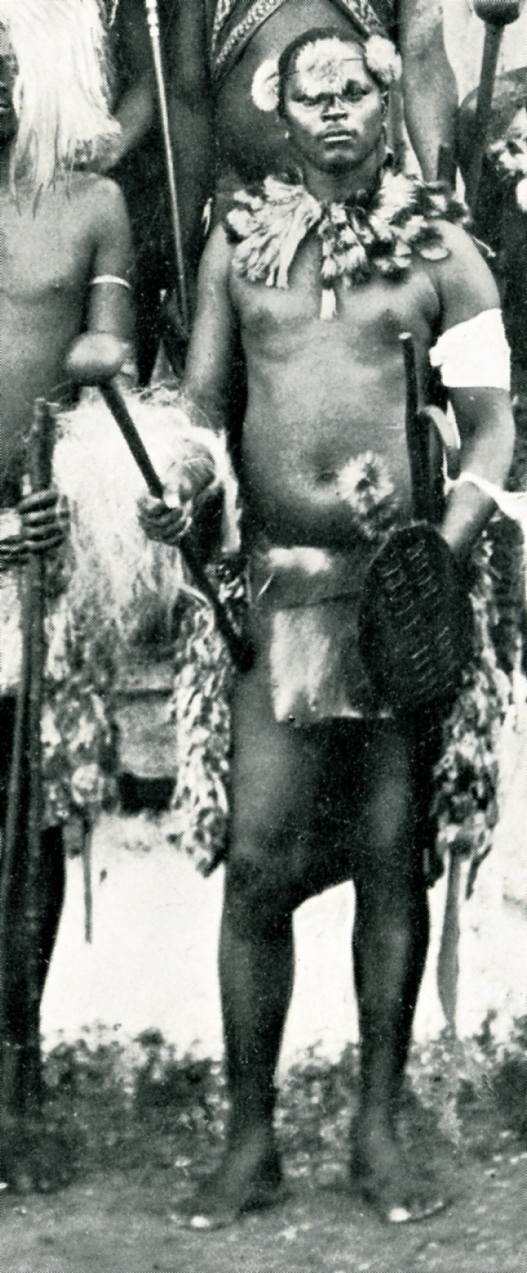
Const Umdisa
Voorwoord
Ons is die laaste tyd in die media gekonfronteer met kommissies van ondersoek, polisie‑korrupsie en polisie‑onbevoegdheid. Teen hierdie donker agtergrond staan daar egter ’n interessante en unieke geval uit: dié van konstabel Umdisa van die Pretoria‑polisie, wat ’n buitengewone moordsaak meer as ‘n eeu gelede ondersoek het — met uitmuntende resultate.
Die boodskap wat sy optrede en vernuf uitgestuur het, was eenvoudig en kragtig: Ons beskerm en ons dien. Volgens beskikbare getuienis was konstabel Umdisa ’n boorling van KwaZulu, ’n man met beperkte formele skoling, maar ’n polisieman en speurder in murg en been.
Onwillekeurig kry ’n mens respek vir sy doelgerigte optrede en die suksesvolle afhandeling van die saak wat aan hom toevertrou is.
Soos die Wolraad Woltemade‑dekorasie, kan die owerhede gerus oorweeg om ’n Umdisa‑dekorasie in te stel vir alle uitmuntende ondersoekbeamptes.
Konstabel Umdisa is in my oë ’n ware held — en ek is seker u sal saamstem.
Konstabel Umdisa – Die Zulu Bloedhond van Pretoria Sentraal – merkwaardige verhaal van durf en daad.
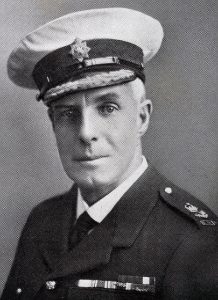
Gedurende die begin jare van die vorige eeu was luitenant-kolonel Harry Trew (foto), as kaptein die distrikskommandant van polisie in Pretoria. Hy vertel ‘n merkwaardige verhaal van vernuf en inspanning en wat dit alles verg om ‘n goeie polisieman te wees.
Dit het alles met ‘n moord by ‘n skool in Pretoria begin. Die skool was vol leerlinge en die skoonmaker van die skool is tydens skoolure om ongeveer 10:0 vm vermoor. ‘n Leerder het opgemerk dat die skoonmaker voor sy kamer lê en ‘n onderwyser verwittig. Die onderwyser het vasgestel dat die skoonmaker vermoor is. Niemand het iets gehoor of gesien nie.
Die polisie is ontbied en ‘n vingerafdrukdeskundige en ‘n polisiefotograaf het die toneel van die moord besoek. Foto’s is geneem en ‘n duimafdruk is op die moordwapen, ‘n byl, gevind. Die destydse kriminele buro is gedurende 1902 deur sir Edward Henry ingerig en Suid-Afrika was al in die tyd ‘n leier op die gebied van vingerafdrukke. (Om oor ‘n duimafdruk te beskik en dit met duisende vingerafdrukvorms te probeer vergelyk was destyds ‘n onbegonne taak.)
Ander getuienis het gelei tot die identifikasie van die moordenaar, Joseph Sopela. Die speurder is toe die duimafdruk na die kriminele buro waar Sopela se rekord getrek is. Die duimafdruk is positief met Sopela se vingerafdrukvorm verbind. Die polisie het toe aansoek om ‘n lasbrief vir Sopela se inhegtenisname gedoen.
Sopela se persoonlike besonderhede en foto is na alle stasies versend. Een oggend kom die hoofkonstabel ontsteld by Trew in sy kantoor aan. Trew vra die hoofkonstabel waarom hy so ontsteld is. Laasgenoemde sê: “ Die idiote by Daaspoort (sic) het Sopela gisteraand gearresteer vir hoenderdiefstal. Hy is gevang terwyl hy steel. Hulle het hom nie as Sopela herken nie. Vanoggend om middernag is hy met ene konstabel Umdisa te voet na Pretoria-Sentraal gestuur. Sopela was geboei. By die Apiesrivier het Sopela die konstabel in die sterk vloeiende Apies ingestamp. Die konstabel het Sopela saam ingetrek. Die konstabel het amper verdink voordat hy uit die rivier kon kom. Die beskuldigde is net weg!
Gisteraand het hulle sy vingerafdrukke geneem en dit nou na ons ingebring. Ek het hulle dadelik na die kriminele buro gestuur. Die buro het pas laat weet dat die ontsnapte hoenderdief identies is met Sopela wat ons op klagte van moord soek!
Trew gee toe opdrag dat die betrokke konstabel voor hom geparadeer moes word. Later die dag word die konstabel voor Trew gebring. Trew beskryf die konstabel as iemand wat 6’ 2’’ lank is, fors gebou wat die trots van ‘n Zulu kryger uitstraal Sy oë het mens deurboor. Trew het vasgestel dat die konstabel lid van die koninklike familie in Zululand is.
Trew, kenner van manne en krygers voer toe die volgende onderhoud met die konstabel:
Wat is jou naam?
Umdisa, inkôsie!
Waarom laat jy die gevangene, Sopela, ontsnap?
Inkôsie ek het nie geweet dat dit Sopela was nie. Die korporaal en ek was gisteraand op patrollie. Die reent was hard en weer was hewig. Ek het hoenders verskrik hoor raas. Ek het nader gekruip en die hoenderdief gevang toe hy ‘n hoender in ‘n sak sit. Ek het die dief geboei. Ek het hom na die korporaal geneem wat toe die dief se vingerafdrukke geneem het. Die korporaal het my toe beveel om hom na die aanklagkantoor te neem omdat ons nie plek gehad het om die dief aan te hou nie. Sopela het voor geloop en ek agter. Die storm het steeds gewoed. Toe ons die rivier nader kon ek hoor die rivier afkom en dat die rivier vol water is. Toe ons oor die klein bruggie gaan, toe stamp die dief my met sy skouer en ek val. Met die val gryp ek vinnig na hom en ons albei val in die rivier. Terwyl ons val sê ek toe vir hom, as ek in die water moet sterf, gaan jy ook in die water sterf! Die rivier het sterk afgekom en ek het hom laat los. Ek het my warmjas uitgetrek en uitgeswem, van die dief, in die donker, was daar geen spoor nie. Ek het tevergeefs gesoek en hom nie gevind nie. Inkôsie dis al.
Wat! Jy noem jouself ‘n Zulu en laat so ‘n dwase man wegkom! Ek beter jou terugstuur na Zululand waar die vroue vir jou sal lag! Jy is geen man nie, maar behoort saam met die seuntjies eerder bokke op te pas.
Inkosi, ek is ‘n man. Stuur my om Sopela te vang. Ek beloof om hom te vang al duur dit baie maande.
Reg, gaan vang hom. Gaan! Maar ek wil jou nooit weer sien, indien jy hom nie kan vang nie! Trew sê hy voeg die volgende, ietwat dommerig by: Ek wil Sopela hê, dood of lewendig!
Umdisa het salueer en vertrek met die woorde: Dit sal so wees!
Na die verloop van ‘n week ontvang Trew ‘n telegram van die polisie te Brakfontein, in die Rustenburg-distrik, met die strekking dat Umdisa daar aangemeld het met ‘n beskuldigde, ene Joseph Sopela. Die beskuldigde word aangehou en sal die volgende dag onder geleide na Pretoria gebring word.
Tot Trew se ontnugtering ontvang hy ‘n tweede telegram met die strekking dat die beskuldigde ontsnap het deur ‘n gat in die vloer onderdeur die sel se muur te grawe en dat Umdisa weer op sy spoor is.
Twee weke het verloop voordat Trew weer iets gehoor het. Die polisie in Mafikeng het hom ‘n telegram gestuur en verwittig dat Umdisa daar aangekom het. Sopela het by ‘n groep mynwerkers aangesluit en het die Unie per trein verlaat. Verder is versoek dat Umdisa toestemming verleen word om hom agterna te sit.
Trew het toestemming verleen en het met die BSAP in Bulawayo, Rhodesië, geskakel en hulle versoek om Umdisa hulp te verleen.
Die BSAP het berig dat Umdisa daar aangekom het en die beskuldigde by die Bush Tick Mine opgespoor het net om uit te vind dat Sopela die dag voor Umdisa se aankoms by die myn gedros het. Umdisa is weer op die gesoekte misdadiger se spoor.
Vir twee maande het Trew geen taal of tyding van Umdisa of Sopela gehoor nie. Na ses weke het Trew besluit om Umdisa van die nominale rol van polisiebeamptes as droster uit die mag te skraap. Die handeling het hy met ‘n treurige hart uitgevoer.
Na verloop van tyd het nog ‘n telegram by Trew uitgekom. Die boodskap het gelui dat ‘n lyk in die Bosveld gevind is. Die man se klere was verskeur en ‘n gebreekte assegaai was onder die oorskot gevind. Die lyk se hande was weg gevolglik kon geen vingerafdrukke geneem word nie. Sekere tatoeëermerke op die liggaam is positief met die van Sopela verbind.
‘n Week hierna word Trew by sy kantoor verwittig dat Umdisa daar was om hom te sien. Die man wat voor hom gebring was, was nie diè Umdisa wat hy drie maande gelede geken het nie. Hierdie man was ineengetrek en ietwat korter. Hy het verwese en uitgeput voorgekom. Sy oë was steeds vol vlamme maar diep in hul oogkasse geset. Umdisa heet sy hande in die lug gegooi en uitgeroep: Inkôsie, dit is volbring! Sopela sal u nie weer pla nie. Ek is soos een van die luise op die koning se kombers. Ek hoef nie bokke saam met die kinders op te pas nie! Nog minder sal die vroue vir my lag, want my assegaai het bloed gedrink.
Die volgende gesprek het toe tussen hulle plaasgevind: Jou ou duiwel, jy het toe vir Sopela vermoor?
Wel, u my vader, het beveel dat ek hom dood of lewendig voor u moes bring! Ek sou hom lewendig in gebring het maar die hond het my amper vermoor! Kyk hier! En hier! En hier! Terwyl hy sy wonde uitwys. Hy het intussen sy klere van sy liggaam laat val. Trew het die wonde bekyk en getwyfel of enige ander mense sulke ontberings en wonde sou kon oorleef.
Trew het sy pyp opgesteek, agteroor gesit en Umdisa genooi om sy verhaal te vertel. Die sonderlinge verhaal van deursettingsvermoë, speurvernuf en volharding wat in die stryd om lewe en dood gewikkel was, het Trew se verbeelding aangeryp. Dit sal ook enige mens ontroer. Umdisa se soektog het oor drie lande geloop.
Hy is vereer met ‘n bonus. Sy werk vermoëns as polisieman het afgeneem en hy was altyd laat en het gekla dat hy moes is en nie lekker slaap nie. Umdisa het na ‘n rukkie eerder gaan afgetree en in die groen weivelde en heuwels van Zululand tussen sy vroue en beeste.
Na ‘n gesprek met ‘n sielkundige oor waarom Umdisa van ‘n skitterende polisieman verander het tot ‘n probleem geval is dat hy moontlik ‘n slagoffer van post traumatiese stres sindroom geword het. Angs kan tot slaap versteurings lei.
Umdisa Dekorasie
Om hierdie lid te nagedagtenis te eer, kan ‘n spesiale dekorasie, iets soos die Umdisa Dekorasie, vir ondersoekers ingestel word.
Voorwaar ‘n mooi storie!
Bibliografie
- Trew, Lieut-Col HF: African Manhunts, Blackie & Co, London, 1938.
- SA Multi-Language Dictionary and Phrase Book, Reader’s Digest, Cape Town 1991.

- Afrikaans – kierie; isiZulu – induku ↑
- Head Constable equal to the former rank of Warrant Officer (SAP) and Inspector (SAPS). He was probably the District Clerk. ↑
- The area today policed by Hercules Police Station. ↑
- Pretoria’s famous Apies River ↑
- Literally ‘King’ but used rather in the context of Chief or Captain ↑
- Pretoria Central ↑
- This is an insult because young boys usually herd goats, the older boys herding the cattle. ↑
- Rural police stations usually had a paddock for the horses. The station was usually referred to as the police camp. ↑
- Mafekeng in the North-West Province – then Northern Cape. ↑
- Now Zimbabwe. ↑
- Now the Limpopo Province. ↑
- The Limpopo River. ↑
- A travelling peddler. ↑
- Even during the 1960’s Zulu members of the Police referred to themselves as being ‘The Government’ i.e. being from the Police. ↑
- Tribal medicine or the medicine of a traditional healer (inyanga yamakhambi – Zulu). ↑

Enigiemand wat die nagedagtenis van konstabel Umdisa nie respekteer en bewonder nie is sag gestel klein geestelik dis skandalig dat daar nie n’ Umdisa dekorasie bestaan nie.
Dankie Ben! Ek dink hierdie is ‘n puik voorbeeld van goeie speurvernuf…. Dankie vir jou kommentaar. Wat dink ons ander lesers – veral as ons dink wat vandag aangaan?