
Abstract: In Nongqai Vol.17 No 4, Strategic Security Analyst Dr Joan Swart examines how and why observers, policymakers, and analysts interpret the same events in sharply divergent ways, sometimes arriving at conclusions that seem not merely different, but incompatible.
Dr Joan Swart
Key Words: Dr Joan Swart, Nongqai 2026, Conflict Analysis, New Warfare Technologies, Accurate Force Deployment, Strategic Security Feedback Loops, Strategic Power, Measured Deterrence, Conflict Escalation.
Narrative Coherence and Strategic Power in Modern Conflict
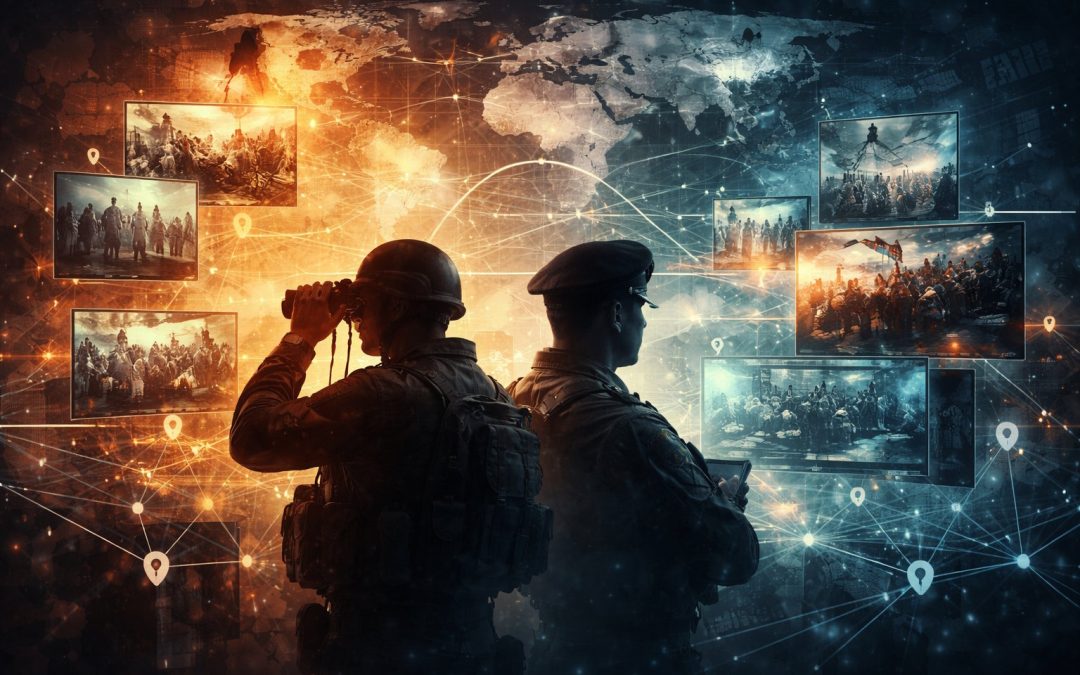
In modern conflict, actors are often not responding to the same reality, but to different interpretations of it. This has become increasingly difficult to ignore in recent years.
Observers, policymakers, and analysts often interpret the same events in sharply divergent ways, sometimes arriving at conclusions that seem not merely different, but incompatible. What one side presents as measured deterrence, another sees as escalation. What is described as stability in one narrative appears as stagnation or decline in another.
This divergence is not incidental. It reflects deeper structural factors—historical, institutional, and cultural—that shape how reality is interpreted.
According to Carl von Clausewitz, war is not only a contest of force but also a contest of perception, shaped by uncertainty, friction, and the subjective interpretation of events. In On War, he emphasised that decision-making in conflict is always mediated by incomplete information and the mental frameworks of those interpreting it. Strategy, therefore, is never purely objective, but filtered through perception.
This insight has been extended in modern strategic thought. Thomas Schelling, in his work on coercion and deterrence, argued that the power to influence an adversary lies not only in material capability, but in the ability to shape expectations and perceptions. Strategy, in this sense, operates as much in the psychological domain as in the physical. What matters is not only what is done, but how it is understood.
Similarly, John Boyd introduced the concept of the OODA loop—observe, orient, decide, act—as a model of decision-making under competitive conditions. While often interpreted as a framework for speed and adaptability, Boyd placed particular emphasis on the “orientation” phase, where cultural, experiential, and cognitive factors shape how information is processed. It is here that reality is interpreted, rather than simply observed.
Taken together, these perspectives point to a central insight: in conflict, perception is not secondary to strategy. It is integral to it.
In modern warfare, this has evolved into something more structured. Narrative coherence—the ability to produce and sustain a consistent interpretation of events across military, political, and public domains—has become a form of strategic power in its own right.
This does not mean that narratives determine reality. It means that they shape how reality is understood, and therefore how actors respond to it.
In contested environments, credibility often emerges from coherence rather than from verification.
This dynamic is increasingly visible in contemporary conflicts. In the ongoing confrontation between Iran and the United States, the informational dimension has become a central arena of competition. Iranian-linked media ecosystems have demonstrated a high degree of consistency across official messaging, affiliated networks, and public-facing content. This has included the use of stylised and accessible formats, such as simplified animated videos, designed to engage broad audiences while reinforcing a recognisable narrative frame. By contrast, communication environments characterised by competing institutional voices, reactive messaging, or shifting framing can produce fragmentation, reducing clarity and, at times, perceived credibility. This has, at times, been visible in Western policy communication, where unconventional and competing messaging, particularly during the administration of Donald Trump, contributed to uncertainty within institutions regarding strategic intent, including in relation to Iran. The contrast does not determine which narrative is more accurate, but it does shape how each is received and interpreted.
Once established, such frames tend to reinforce themselves. Actions are interpreted in ways that align with the existing narrative, while contradictory information is discounted or reinterpreted. Over time, this narrows the range of acceptable interpretations and stabilises a particular understanding of the conflict.
This is not a new phenomenon. Historical examples illustrate how narrative coherence—or the lack of it—can shape strategic outcomes.
During the Vietnam War, the Tet Offensive of 1968 represented a significant military effort by North Vietnamese and Viet Cong forces. While costly for those forces, its psychological and narrative impact was profound. The offensive contradicted prevailing narratives of progress and control presented to the American public, contributing to a shift in perception that had far-reaching strategic consequences. The divergence between official messaging and observable reality undermined credibility, not because of a single event, but because of a breakdown in narrative coherence.
A similar pattern emerged in the early stages of the Iraq War in 2003. The framing of the conflict around weapons of mass destruction and immediate threat established a narrative foundation for intervention. When these claims proved difficult to substantiate, the erosion of credibility had lasting effects, shaping both domestic and international perceptions of the conflict and its legitimacy.
Non-state actors have also demonstrated a sophisticated understanding of narrative as a strategic tool. Groups such as ISIS and Al-Qaeda invested heavily in structured communication platforms, including publications like Dabiq and Inspire. These were not merely propaganda outlets, but vehicles for constructing a coherent worldview—one that linked ideology, identity, and action into a single narrative framework. Through consistency and repetition, these narratives created a sense of meaning and legitimacy that extended beyond the battlefield.
In each of these cases, the effectiveness of the narrative did not depend solely on its factual accuracy, but on its coherence, consistency, and alignment across different levels of communication.
This is where narrative intersects with the feedback loops that shape strategic behaviour more broadly. Decision-makers act based on their understanding of reality. Observers—media, analysts, and external actors—interpret those actions and construct narratives that can reinforce or challenge that understanding. Where these narratives align, they create powerful feedback loops that sustain particular strategic paths. Where they diverge, they can generate friction, misperception, and instability.
For Africa, these dynamics carry particular significance. African security environments are often interpreted through external frameworks that emphasise instability, weakness, or institutional failure. While such elements may exist, these interpretations can obscure the adaptive strategies that emerge under conditions of constraint. What appears externally as inconsistency may reflect deliberate forms of risk management, while what is labelled fragility may involve decentralised forms of control.
When external narratives fail to capture these dynamics, policy responses—whether in the form of intervention, partnership, or disengagement—may become misaligned with realities on the ground. These misalignments can then reinforce the very perceptions that produced them, creating a cycle in which narrative and policy sustain one another.
In an increasingly multipolar world, the ability to shape narrative coherence becomes more consequential. As power diffuses and the number of actors increases, so too does the diversity of interpretive frameworks. Strategic interaction is no longer defined solely by material capability, but by the ability to influence how actions are perceived across multiple audiences.
This does not eliminate the importance of military or economic power. It reframes it.
The challenge for strategists is therefore not only to act effectively, but to ensure that those actions are interpreted in ways that support broader objectives. This requires an awareness of how narratives are constructed, how they are sustained, and how they interact with existing beliefs and assumptions.
It also requires recognising that narrative coherence can become a constraint. Systems that prioritise consistency may resist adaptation, particularly when new information challenges established interpretations. In such cases, the very coherence that sustains credibility can limit strategic flexibility. The challenge, therefore, lies in sustaining coherence while preserving the capacity to adapt when conditions change.
The question is not whether narratives matter—they always have—but how they are produced, maintained, and contested in an environment where information is abundant, fragmented, and continuously interpreted.
In this context, strategic advantage may depend less on controlling events than on influencing how those events are understood.
The battlefield may be shared. The reality of the conflict is not.
Dr Joan Swart

NONGQAI’S Strategic Security Analist Dr Joan Swart is a forensic psychologist with an MBA and an MA in Military Studies. Her work focuses on African security, geopolitics, state fragility, substate dynamics, and the intersection between governance, legitimacy, and coercive power. She is the author of several books and regularly publishes long-form analysis and opinion pieces on security and governance issues. Her writing has appeared in outlets including DefenceWeb, Maroela Media, Netwerk24, RSG, Visegrad, and other policy and public-affairs platforms. Her work bridges academic research, policy analysis, and applied strategic assessment, and she is currently completing a second PhD at the University of Stellenbosch Military Academy.
*

That’s a really interesting point about how interpretations shape conflict – it’s so easy for different perspectives to lead to completely opposing views.