
Dr Joan Swart
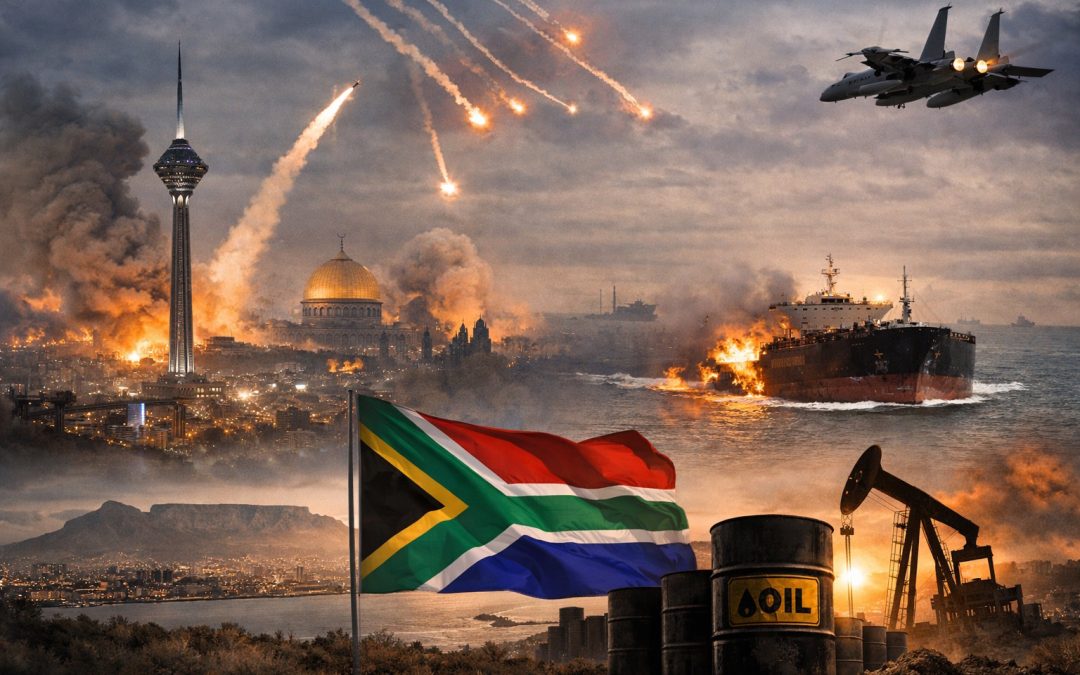
Iran War 2.0: Strategic Implications for African and South African Security
Key Words: Iran, Iran War 2.0, Trump’s War on Iran, Iran Radical Islam
Abstract: Iran War 2.0: Strategic Implications of Trump’s War on Iran, Strategic Implications of the Iran War 2026
The joint military offensive launched by Israel and the United States against Iran on 28 February 2026 represents a dramatic escalation in Middle Eastern hostilities with far-reaching global consequences. The campaign involved coordinated air and missile strikes on Iranian military infrastructure, framed as degrading Tehran’s nuclear and missile capabilities. Within 24 hours, Iranian state media confirmed the death of Supreme Leader Ayatollah Ali Khamenei, triggering a 40-day national mourning period and vows of retaliation.
What distinguishes this crisis from previous episodes — notably the limited 12-day conflict in June 2025 — is not simply the scale of force employed but the intensity of political messaging, the depth of regional involvement, and the immediacy of international market reactions.
The Evolving Theatre of Conflict
In previous exchanges between Iran and Israel, including the 2025 confrontation, hostilities were intense but geographically contained. Air strikes were directed at specific military targets, and retaliatory missile exchanges remained calibrated, with Iran seeking to demonstrate capability without provoking full-scale war.
This time, the dynamics are different. The initial air assault targeted not only nuclear-linked facilities and missile infrastructure but also, reportedly, the supreme leadership’s secure compounds — a move that both symbolised and operationalised regime decapitation. Iranian governing bodies quickly mobilised succession mechanisms, reflecting both institutional resilience and the gravity of the strike.
Iran’s response unfolded on multiple fronts. Shortly after the initial strikes, Tehran launched missile and drone salvos toward Israeli and U.S. bases in the Gulf, signalling a willingness to engage across symmetrical and asymmetrical axes. Meanwhile, allied non-state actors, including the Houthi movement in Yemen, pronounced renewed attacks against commercial shipping in the Red Sea — a statement that has already worsened maritime security for global trade.
These simultaneous vectors of conflict — direct Iranian retaliation, proxy mobilisation and threats to strategic chokepoints like the Strait of Hormuz — underscore an essential feature of the current confrontation: escalation is multi-domain rather than episodic. For now, international responses have largely remained rhetorical and diplomatic, with no additional major power signalling intent for direct kinetic involvement.
What Is Different from the 2025 Conflict
This confrontation differs materially from the limited June 2025 exchange. First, the targeting of political leadership — including the confirmed killing of Khamenei — elevates the conflict from punitive military action to existential political confrontation. Although Iran’s succession mechanisms functioned quickly, the symbolic shock reinforces regime-survival framing within Iran’s strategic culture.
Second, Tehran’s regional network — particularly Iraqi and Yemeni aligned actors — signalled mobilisation from the outset. Escalation transcended direct state-to-state exchange earlier than in 2025, incorporating maritime and proxy theatres.
Finally, the global environment is more fragile. Energy buffers are thinner, shipping routes already strained and geopolitical alignments more rigid.
Early Market Signals and Global Price Indicators
Energy markets reacted quickly to the outbreak of hostilities. Prior to the weekend close, Brent crude had already risen to multi-month highs at approximately $72–$73 per barrel amid escalating Middle Eastern tensions. Following the strikes, industry reporting indicated that several oil majors and trading houses temporarily suspended or reassessed shipments through the Strait of Hormuz, reflecting heightened commercial risk sensitivity. Even perceived instability in Hormuz introduces a geopolitical premium into oil pricing.
Financial analysts have noted that prolonged disruption to Gulf export routes would likely sustain upward pressure on crude benchmarks. The early elevation in energy pricing and tanker caution signals that markets are incorporating a conflict risk premium into global trade flows. At the Monday open, Brent crude briefly spiked by up to 12% before retracing to trade roughly 5% higher, while the rand weakened marginally against the U.S. dollar — a pattern consistent with orderly risk repricing rather than systemic market stress.
Scenarios of Trajectory
This conflict has already crossed into existential framing for Tehran. The targeting of supreme leadership, combined with public rhetoric indicating regime dismantlement objectives, rapidly produced an intense, multi-layered confrontation.
The central strategic question now is not whether the war will continue, but how long either side can sustain high-tempo exchanges of fire.
On the Iranian side, missile inventories remain significant, but launcher survivability and sortie rate determine practical endurance. Tehran appears to be spacing missile salvos and utilising older stock first — a rational sequencing if planning for sustained engagement. Iran’s doctrine historically favours endurance and layered cost imposition rather than decisive conventional victory. The integration of asymmetric actors, maritime pressure and proxy activation expands the battlefield without exhausting core missile infrastructure prematurely.
On the Israeli and U.S. side, air superiority and precision strike capacity are substantial, yet defensive interceptor inventories are finite. Sustained exchanges become contests of stockpile depth and industrial replenishment. If interceptors are consumed faster than they can be replaced, operational tempo may be affected.
Domestic political cohesion represents a second major variable. Initial indications suggest public sentiment within Iran is hardening in support of the government following leadership decapitation. Historically, external attack has tended to consolidate rather than fracture internal cohesion. While anti-government mobilisation cannot be excluded, there is presently no identifiable alternative power centre capable of territorial control or organised transition. The regime’s institutional architecture appears intact.
In the United States, the variable operates differently. A prolonged conflict with visible casualties, rising energy prices or expanding theatres could generate domestic political friction. Congressional pressure, electoral considerations and public fatigue have historically influenced the sustainability of extended military operations.
External state involvement constitutes another uncertainty. Russia and China are unlikely to intervene directly, but indirect support may reinforce Iran’s capacity to endure. Most regional militaries lack readiness for sustained high-intensity engagement, though their territory may become operational space.
Finally, the effectiveness of pro-Iran asymmetric actors will significantly shape trajectory. Sustained disruption in the Red Sea or Strait of Hormuz would multiply economic cost beyond the immediate battlefield. Maritime harassment, proxy rocket campaigns and cyber operations can impose cumulative pressure disproportionate to their tactical scale.
Taken together, the trajectory is best understood not as branching alternatives, but as a sustained confrontation whose duration and intensity will be determined by stockpile endurance, industrial replenishment, domestic cohesion and the scope of asymmetric disruption.
Implications for Africa and South Africa
Africa is not a battlefield in this war, but it is not insulated from its structural consequences. The primary transmission channels are energy pricing, maritime risk and capital volatility. Most African states are net importers of refined petroleum products; sustained oil premiums will tighten fiscal space, increase subsidy burdens and constrain developmental expenditure. In fragile economies, inflationary pressure quickly becomes political pressure.
Maritime disruption in either Hormuz or Bab el-Mandeb would elevate freight and insurance costs while rerouting around the Cape of Good Hope reflects global inefficiency and higher logistics costs.
Currency volatility presents an additional layer of vulnerability. A stronger dollar environment increases debt-servicing burdens across African sovereigns already operating with narrow fiscal margins. Fuel inflation, currency depreciation and debt burdens compress policy flexibility.
Over the next one to two years, this conflict may subtly reshape African political and budgetary cycles. Governments facing energy shocks and fiscal tightening will be compelled to make harder trade-offs between social spending, security expenditure and infrastructure investment. Diplomatic space may narrow as global blocs harden, increasing pressure on African states to clarify alignments.
For South Africa specifically, the exposure is both economic and strategic. Fuel-driven inflation intersects with already constrained growth and fiscal consolidation efforts. At the same time, gold price appreciation may provide partial offset through export earnings. Strategically, Pretoria will be tested in its non-alignment posture. The lesson is not ideological positioning but institutional resilience: diversified energy sourcing, fiscal prudence, maritime awareness and pragmatic external engagement.
Agency derives from internal strength. Sound governance, economic growth and disciplined fiscal management are not abstract ideals; they are buffers against external shock. In an increasingly securitised global system, strategic autonomy is sustained not by rhetoric, but by resilience.
Dr Joan Swart

Dr Joan Swart is a forensic psychologist and security analyst with an MBA and an MA in Military Studies. Her work focuses on African security, geopolitics, state fragility, substate dynamics, and the intersection between governance, legitimacy, and coercive power. She is the author of several books and regularly publishes long-form analysis and opinion pieces on security and governance issues. Her writing has appeared in outlets including DefenceWeb, Maroela Media, Netwerk24, RSG, Visegrad, and other policy and public-affairs platforms. Dr Swart is a director of CapeXit NPO, where she conducts research and analysis on self-determination, regional governance, and security risk in Southern Africa. Her work bridges academic research, policy analysis, and applied strategic assessment.

IRAN WAR 2.0 – Updated