
IN THE CAPITAL OF SPIES – THE DEUTSCHES SPIONAGEMUSEUM
LYDIA VON WIELLIGH-STEYN
Intelligence activities are usually conducted discreetly, carefully shielded from prying eyes. However, on an octagonal square in Berlin, a museum opens its doors to history lovers, families, tech enthusiasts and officials intrigued by the shadowy world of espionage. The Deutsches Spionagemuseum is situated on Leipziger Platz – an area steeped in poignant history. This square used to form part of a no man’s land during the Cold War period. During the night of 12 August 1961, East German security forces began erecting a barbed wire fence through Berlin, blocking off all access points to the Western sectors. Soldiers ripped up streets to create ditches and installed concrete barriers. Even the subway and tram lines were cut where they crossed the border. Almost overnight, the city was split in two. A key feature was the so-called no man’s land or death strip between the outer and inner walls where guards would shoot anyone trying to escape. Over the Berlin wall’s existence from 1961 to 1989, at least 140 people were killed trying to cross from East to West Berlin.
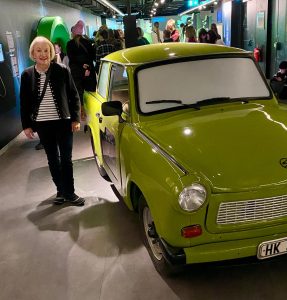
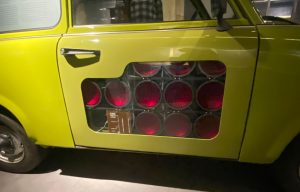
A Trabant vehicle with concealed infrared lights
THE DEUTSCHES SPIONAGEMUSEUM, ON LEIPZIGER PLATZ
On a cold winter’s day in February, I walked through the glass doors of the museum, not quite sure what to expect. The atmosphere outside was crisp and grey, fitting for a topic so often associated with tension. As I entered, a delegation of naval officers in uniform was making its way out, while a couple of families with eager children were lining up to enter.
The museum opened in 2015 and occupies approximately 3 000 square metres of exhibition space devoted to what is sometimes described, tongue-in-cheek, as the second oldest profession in the world. The interactive, multimedia exhibition traces the evolution of espionage through the ages, from ancient civilisations to contemporary cyber espionage. However, the focus falls on the Cold War period, when Berlin was rightly known as “the capital of spies”.
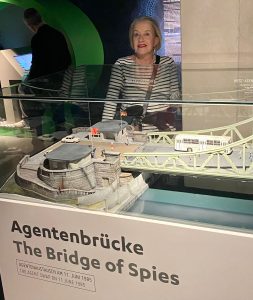
A Model of the Glienicker Brűcke
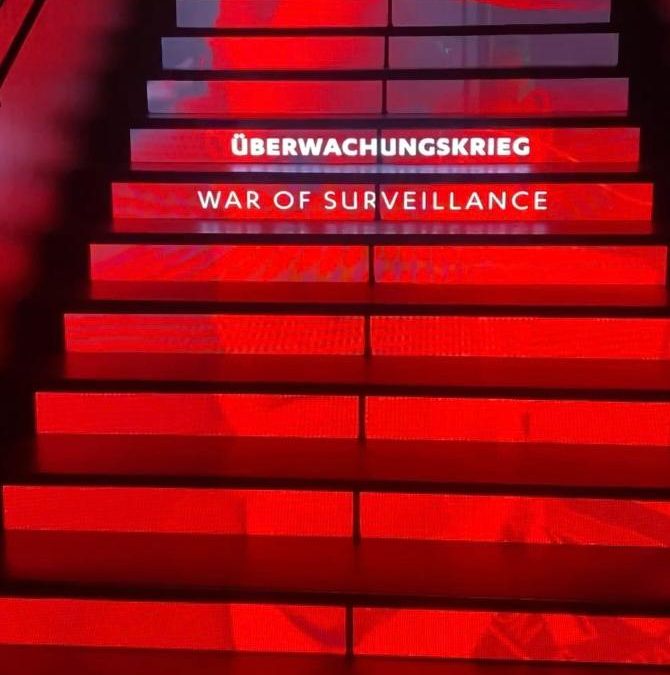
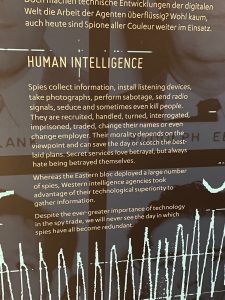
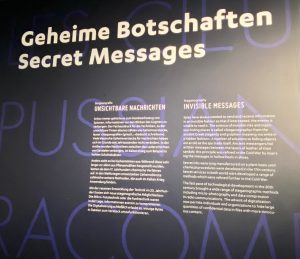
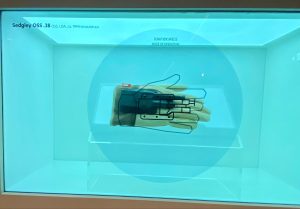
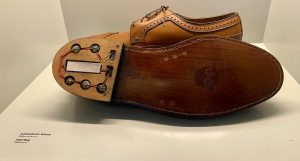
The scene is set when you approach the staircase, illuminated by dramatic colours and intriguing slogans about “atomic espionage”, “war of surveillance”, “spies and agents”, etc depicted on the stairs. There are interactive maps, showing where secret service offices were based during the Cold War. You can watch and listen to interviews with real-life secret agents and historians relating important events during this era. More than 600 original surveillance instruments are displayed. There are lighters containing mini-cameras, a lipstick holder camera used by KGB agents, a “bra camera”, explanations about coding and clandestine communications, as well as stories about famous spies like George Blake, Kim Philby and Aldrich Aymes.
THE ENIGMA CODING MACHINE AND OTHER EXHIBITS
Certain items on display definitely stand out. Firstly, there is the exhibition about the Enigma coding machine, used by the Germans during the Second World War. By 1940, the Allies (first Polish and then UK technicians) had managed to decipher the code, gaining crucial advantages in various battles of the war.
Another interesting item on display, is a Trabant vehicle with concealed, infrared lights behind a modified, translucent passenger door. This vehicle was used by the Stasi (the former East German state security service) to take nighttime surveillance photos of individuals. The cameras inside the car produced clear images, even in crowds or during drive-by shootings, without the target realising that he or she was being filmed.
The museum also addresses more recent events, such as the Skripal case. Sergei Skripal was a double agent who moved to the UK after a 2010 spy swap. He initially worked for the Russian GRU military intelligence service, but also provided information to the British MI6 during the 1990s and early 2000s. In 2018, he and his daughter were the victims of an assassination attempt by a team of GRU military intelligence officers. In March 2018, he was found, along with his daughter Yulia, slumped on a park bench in the town of Salisbury after the nerve agent Novichok had been applied to the front door handle of their home. The name Novichok means “newcomer” in Russian, and applies to a group of nerve agents developed by the USSR in the 1970s and 1980s. Novichoks were designed to be more toxic than other chemical weapons, so some versions take effect rapidly – between 30 seconds to two minutes. Exposure takes place through inhalation or ingestion, and the agent can also be absorbed through the skin. The Skripals eventually recovered and went into hiding after the event, following the UK’s expulsion of 23 Russian diplomats.
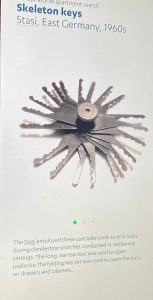
THE STASI – STAATSSICHERHEIT (1950-1990)
A fascinating way of identifying individuals, was the Stasi’s gathering of odour samples. These were collected during secret house searches, taken from cars, or lifted from crime scenes. Suspects brought in for questioning were seated on chairs equipped with sterile cloths to absorb their scent. Such an odour sample could not be used as evidence in court, but the archive was used as a tool to establish the identity of political opponents.
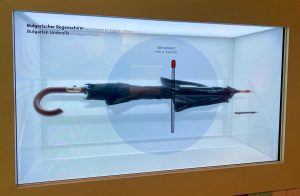
And then, of course, there is the famous Bulgarian umbrella! On 7 September 1978, the KGB used an umbrella, that was modified to fire a tiny pellet filled with poison, to assassinate Bulgarian dissident Georgi Markov in London. With this weapon, the operative approaches the target from behind and stabs him in the back of the leg with a needle-tipped umbrella. Squeezing a trigger on the umbrella handle triggers a compressed air cylinder which fires a small, poisoned pellet under the skin of the target.
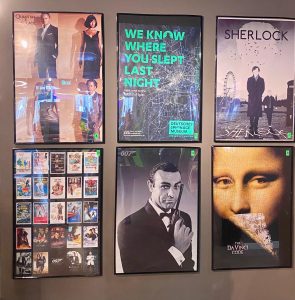
For the more adventurous visitors, there are interactive displays where you can try your luck at navigating a laser maze, encrypting messages, doing a lie detector test or unlocking a safe. There are even original props available from certain James Bond movies!
Approximately 400 000 people visit the museum on an annual basis. By bringing clandestine history into the open, it invites visitors to reflect on how espionage shapes political outcomes. If you are interested in learning more about how secret services work, a visit to the Deutsches Spionagemuseum is a definite must. There is even a shop offering “spy” T-shirts, “Top Secret” rubber stamps, books, and posters – a playful nod to a very serious subject!
Deutsches Spionagemuseum / German Spy Museum Berlin
Leipziger Platz 9, 10117 Berlin
Phone: 030 398200451
Opening hours: Monday to Sunday 10am – 8pm
https://www.deutsches-spionagemuseum.de/en
*
LYDIA VON WIELLIGH-STEYN and Nic von Wielligh are the authors of THE BOMB – South Africa’s Nuclear Weapons Programme. Available on Amazon.com. (Kindle version), and at Exclusive Books and Wordsworth.
*

The article is like a summary of the activities of the former East German (DDR) Intelligence Service, The Ministerium für Staatssicherheit or the Stasi’s activities during the hight of the Cold War. Factual one of the best I as a former CE investigator have read.
Baie interessant en wetenswaardig! Dankie vir die artikel!
Dankie vir die terugvoer. Lydia von Wielligh-Steyn is mede-outeur van die belangwekkende boek THE BOMB wat by boekwinkels soos Exclusive Books en Wordsworth beskikbaar is, ook op Amazon.com (Kindle-weergawe).