Abstract: From Posture to Trajectory: A Strategic Framework for Understanding Military Change. Military Science article written by Strategic Security Analyst Dr Joan Swart, in Nongqai Magazine 04 April 2026.
Dr Joan Swart
Key Words: Military Posture, Strategic Behaviour and Strategy in Africa, a new multipolar world order, Dr Joan Swart, Nongqai 2026.
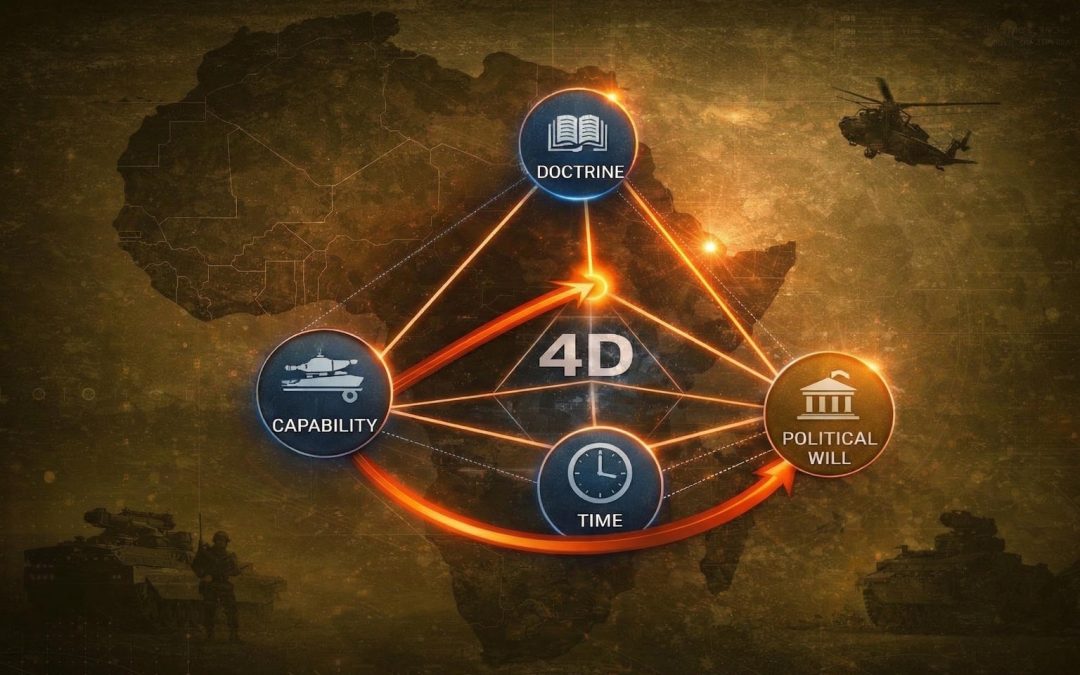
4 D MODEL FROM POSTURE TRAJECTORY: A Strategic Framework for Understanding Military Change
Military power is often assessed through static indicators: defence budgets, force size, and equipment inventories. While these measures provide useful benchmarks, they offer only a partial understanding of how states actually use force. More importantly, they fail to explain why states with similar capabilities behave differently, or why their behaviour changes over time.
A more useful approach is to view military posture as the interaction between three core elements: strategic orientation, capability, and political will. Strategic orientation reflects how a state conceptualises the use of force; capability reflects what it can realistically sustain and employ; and political will determines whether force is used in practice. Together, these elements provide a structured way to assess military posture at a given moment. However, such an assessment remains incomplete if it does not account for change over time.
From Static Assessment to Strategic Reality
Traditional assessments of military power tend to assume that posture is relatively fixed. In reality, it is dynamic. States do not simply accumulate or lose capability; they adjust their strategic orientation, recalibrate political priorities, and adapt to internal and external pressures.
Introducing time as a fourth dimension transforms the framework previously outlined. It shifts the analysis from a static description of posture to a dynamic understanding of trajectory. What matters is not only where a state is positioned, but how it moves within that space. This movement reflects the cumulative effects of policy decisions, operational experience, resource constraints, and strategic adaptation.
Strategic Orientation, Capability, and Political Will as a System
These three elements are not independent variables but components of an interacting system. Strategic orientation tends to be the most stable, shaped by geography, history, and strategic culture. Capability evolves more gradually—dependent on resources, institutional capacity, and sustained investment. Political will is the most volatile, influenced by leadership, domestic pressures, and immediate security concerns.
The effectiveness of military posture depends on alignment between these elements. Where alignment exists, states are able to translate intent into coherent action. Where it does not, predictable distortions emerge.
Capability without clear strategic orientation results in incoherent or ineffective force employment. Strategic orientation without sufficient capability leads to constrained or symbolic action. A further risk arises when strategic intent is not grounded in operational reality—when objectives assume capabilities or conditions that do not exist. In such cases, strategy becomes aspirational rather than executable. As the adage suggests, hope is not a strategy.
Misalignment does not only reduce effectiveness; it can actively generate strategic risk. States that overestimate their ability to translate intent into outcomes may become prone to overextension, entering engagements they are structurally ill-prepared to sustain. Conversely, states with latent capability but weak political will may fail to act when conditions are favourable, eroding deterrence credibility over time.
In both cases, the problem is not simply capability or intent in isolation, but the failure to align them within a coherent strategic framework.
Trajectory as a Strategic Indicator
Understanding movement over time reveals patterns that static analysis obscures. Military power does not evolve along a single continuum. States may strengthen without changing their posture, decline despite maintaining strategic intent, or adapt in ways that produce new forms of power projection.
Trajectory, therefore, becomes a critical analytical indicator. It captures not only change in capability, but shifts in how force is conceptualised and employed. It also reflects the interaction between success, failure, and external pressure. Operational outcomes reinforce or undermine political will, expose capability gaps, and, over time, reshape strategic orientation.
Trajectory also introduces a temporal dimension to strategic assessment that is often overlooked in conventional analysis. A state’s current position may conceal whether it is consolidating, stagnating, or eroding beneath the surface. Two states occupying similar positions on the model may, in reality, be moving in opposite directions—one building sustainable capability and coherence, the other experiencing institutional decay masked by legacy systems.
For planners and analysts, this distinction is critical. Strategic surprise is less often the result of unknown capabilities than of misunderstood trajectories.
Examples of such trajectories are illustrated in Figure 1.
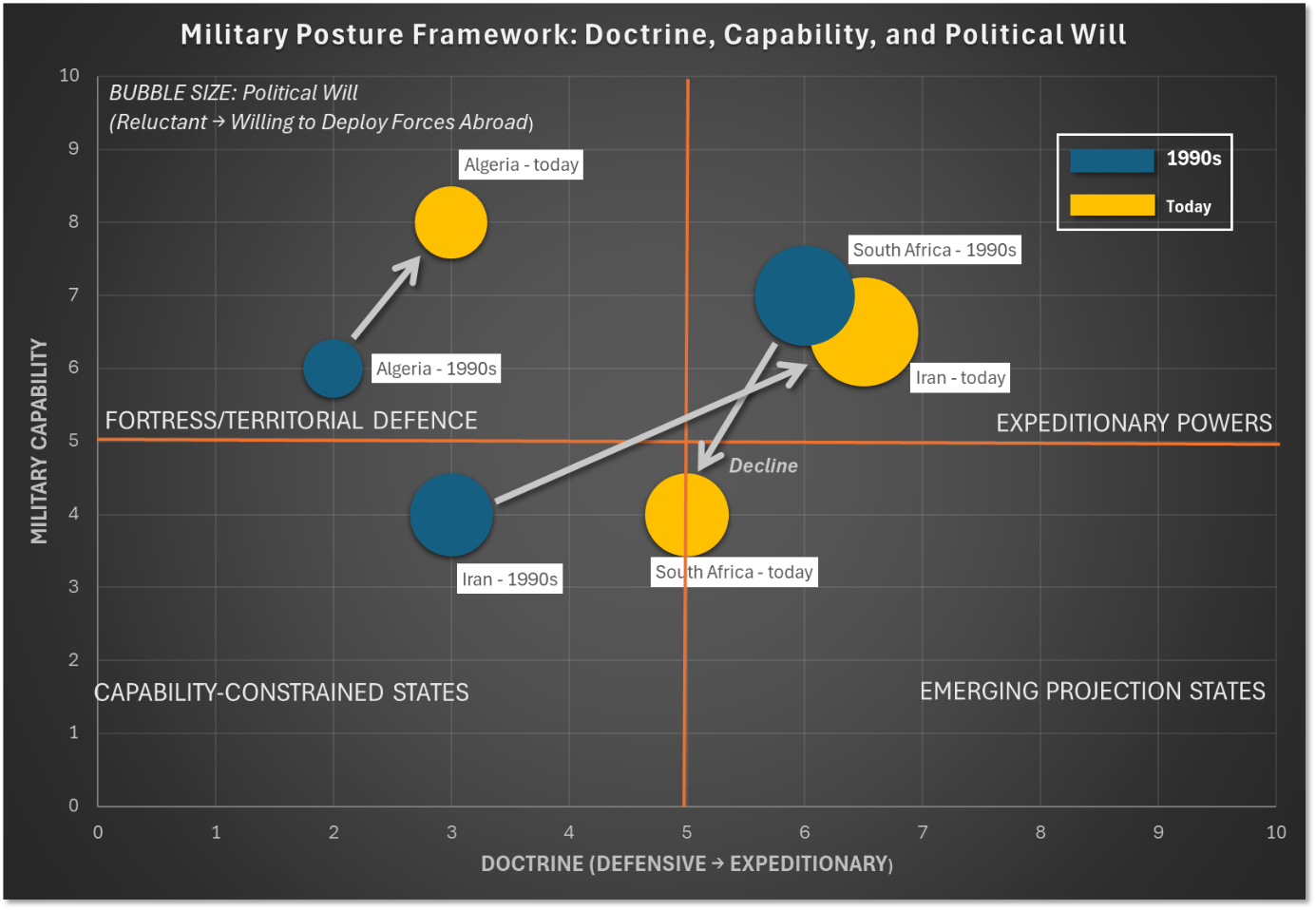
Figure 1: Military posture trajectories (1990s–present) across doctrine, capability, and political will
Divergent Strategic Paths: Algeria, South Africa, and Iran
The trajectories of Algeria, South Africa, and Iran over the past three decades illustrate three distinct patterns: stability, decline, and adaptation.
Algeria represents a case of controlled modernisation. In the 1990s, its military posture was shaped by internal conflict and regime security, with a strong emphasis on territorial defence. Since then, Algeria has significantly enhanced its military capability, emerging as one of the most capable forces on the continent. However, its strategic orientation and political will have remained largely unchanged. The result is a state that is materially stronger but strategically consistent. Its trajectory is primarily vertical—capability increases without a corresponding shift toward external force projection.
South Africa demonstrates a contrasting pattern of contraction. In the early post-apartheid period, it combined relatively strong capability with a strategic orientation toward regional stabilisation and the political will to support peacekeeping and external deployments.
Over time, this alignment has weakened. Declining budgets, institutional challenges, and competing domestic priorities have reduced effective capability. Political will has followed, becoming more cautious and constrained. While the underlying strategic orientation has not fundamentally shifted, its practical expression has narrowed. The result is a downward trajectory across all three elements—a contraction of military posture driven by reduced sustainability rather than a deliberate change in ambition.
This distinction is important. The erosion of capability without a corresponding recalibration of strategic orientation can create a widening gap between expectation and execution. Over time, this risks undermining both operational effectiveness and strategic credibility, particularly in regional contexts where South Africa has historically played a stabilising role.
Iran illustrates adaptive transformation. In the 1990s, its posture was primarily defensive, shaped by the legacy of the Iran–Iraq War. Capability was limited, and external engagement cautious.
Over time, Iran has reconfigured its approach, developing what is often described as forward defence: projecting deterrence beyond its borders through proxies, missile systems, and asymmetric capabilities. This evolution has been accompanied by an increase in effective capability and a greater willingness to act externally. Importantly, this does not reflect a shift toward conventional expeditionary warfare, but rather the externalisation of defence.
This model allows Iran to operate below the threshold of conventional interstate warfare while still shaping regional dynamics in its favour. It reduces direct exposure while maintaining strategic pressure, effectively compensating for conventional limitations.
However, it also introduces complexity and risk, as indirect methods depend on network cohesion, partner reliability, and calibrated escalation. The effectiveness of this approach lies not only in its design, but in the degree to which it aligns with Iran’s political objectives and tolerance for risk.
Its trajectory is diagonal—combining doctrinal adaptation with expanded means and increased political will.
Taken together, these cases demonstrate that military power evolves in different directions. It is not simply a matter of becoming stronger or weaker. Some states consolidate, others contract, and others adapt.
For military strategists and policymakers, the implication is clear.
Assessing military power as a static quantity risks misinterpretation. States that appear similar at a given moment may be on fundamentally different trajectories—one strengthening, another declining, and another transforming. The critical task is not only to locate a state within the framework, but to understand the direction and sustainability of its movement.
Military power is therefore best understood not as a fixed attribute, but as a dynamic process shaped by the continuous interaction of intent, means, and decision.
The most important differences are not where states are, but how—and how sustainably—they move.
Dr Joan Swart

Dr Joan Swart is a forensic psychologist and security analyst with an MBA and an MA in Military Studies. Her work focuses on African security, geopolitics, state fragility, substate dynamics, and the intersection between governance, legitimacy, and coercive power. She is the author of several books and regularly publishes long-form analysis and opinion pieces on security and governance issues. Her writing has appeared in outlets including DefenceWeb, Maroela Media, Netwerk24, RSG, Visegrad, and other policy and public-affairs platforms. Her work bridges academic research, policy analysis, and applied strategic assessment, and she is currently completing a second PhD at the University of Stellenbosch Military Academy.
*
