
THE IRAN WAR AS A STRATEGIC TEST FOR BRICS
Alignment Pressure in a Multipolar System – Dr Joan Swart
Abstract: How the Iran War is affecting Brics and Africa: an Analysis by Strategic Security Analyst Dr Joan Swant, in Nongqai Magazine 20 March 2026.
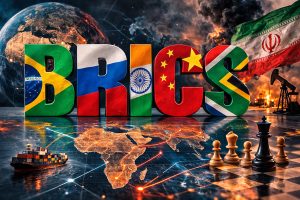
The expanding war around Iran is rapidly evolving into a geopolitical event with consequences far beyond the Middle East. While most attention has focused on the immediate military exchanges and the risk of regional escalation, the conflict is also exerting pressure on the broader structure of the international system. These operations — including long-range strike exchanges, missile defence saturation attempts and attacks on strategic infrastructure — illustrate how rapidly regional confrontations can intersect with global strategic systems.
In particular, it may become the first real strategic stress test for BRICS as an emerging coordination platform among major non-Western powers.
For more than a decade, BRICS has functioned primarily as a framework for economic cooperation among large emerging economies. Its members have sought greater influence over global financial governance, expanded South–South trade, and developed institutions intended to complement Western-dominated structures. Importantly, however, BRICS has never required geopolitical alignment among its members. Its flexibility has been one of its defining characteristics.
The Challenge and Test for BRICS
The Iran war may now test the limits of that flexibility in practice.
Major geopolitical crises tend to compress the international system. When military conflict intersects with economic shocks, energy security, constrained trade access and intensified great-power competition, the pressure on states to clarify their political positions increases. Strategic ambiguity becomes more difficult to sustain when core economic and security interests are directly affected.
In this environment, BRICS faces a structural challenge. The bloc includes countries with very different security relationships and foreign policy traditions. Russia and China have openly criticised the military escalation against Iran, framing it as a violation of international norms and a destabilising development for the region. India, by contrast, has adopted a more strategically selective position that departs from the broader tone within BRICS. Its close strategic ties with both the United States and Israel, combined with its dependence on Middle Eastern energy supplies, place it in a more delicate strategic balancing situation.
This divergence highlights a broader reality about BRICS. Despite frequent descriptions of the bloc as a counterweight to Western influence, many of its members maintain deep economic and security relationships with Western partners. Rather than functioning as a unified geopolitical alliance, BRICS has historically operated as a network of states seeking greater strategic flexibility within a fragmented international order.
The Iran conflict therefore raises an important structural question: whether such a flexible model can endure during periods of intensified geopolitical pressure.
From a strategic perspective, crises of this nature often produce two simultaneous dynamics. On the one hand, they expose internal divergences within loose political groupings. On the other hand, they can accelerate cooperation in areas where shared vulnerabilities become more visible.
The Iran war is already highlighting vulnerabilities within the existing global system. Disruptions to energy markets, threats to maritime shipping routes, and the continued use of sanctions as instruments of economic coercion are reinforcing longstanding concerns among emerging economies. These concerns centre on the concentration of financial and logistical power in Western-dominated systems.
Within this context, BRICS members may find renewed incentives to deepen cooperation in areas that enhance strategic autonomy. Expanded use of local currencies in trade, strengthened development finance mechanisms, and the gradual construction of alternative financial settlement systems are all initiatives that could gain momentum if geopolitical tensions persist.
Trade and logistics represent another area where structural pressures may drive greater coordination. The war’s potential impact on shipping routes through the Red Sea and the Strait of Hormuz underscores the degree to which global commerce depends on a small number of maritime chokepoints. For military planners, these corridors represent not only economic lifelines but also operational theatres where naval presence, air defence coverage and anti-access capabilities shape the strategic balance. Ensuring the resilience of trade routes, diversifying logistical networks, and strengthening ISR capabilities and technological integration may therefore become shared strategic priorities among major emerging economies.
These same corridors also highlight a broader transformation in the character of power projection. As former U.S. Marine Corps Commandant General David Berger warned in his 2019 Commandant’s Planning Guidance, modern precision strike capabilities and distributed surveillance systems are increasingly challenging the traditional assumption that large naval formations can operate freely in contested environments. Long-range fires, unmanned systems, and layered anti-access capabilities have begun to erode the security of concentrated platforms and fixed infrastructure.
In this environment, maritime power can no longer be understood in isolation; it must operate alongside evolving doctrine, distributed technologies and broader instruments of statecraft, including diplomacy and economic resilience.
For Africa, these dynamics carry particular significance.
The inclusion of Egypt and Ethiopia in the expanded BRICS framework has already increased the continent’s presence within the bloc. Egypt controls the Suez Canal, one of the most critical maritime corridors in global trade. Any disruption to shipping through this route immediately affects supply chains linking Europe, Asia and Africa. Ethiopia, meanwhile, sits near the Bab el-Mandeb strait at the southern entrance to the Red Sea, another key strategic passage connecting the Mediterranean to the Indian Ocean.
Should Nigeria eventually join the grouping, BRICS would also gain deeper representation from one of Africa’s most important energy producers and economic centres.
These developments illustrate both the geographic expansion and the internal diversity of the bloc. None of these African states are abandoning their existing relationships with Western partners. Instead, they are pursuing strategies of diversification, seeking broader economic and diplomatic options while maintaining established security ties.
This pattern reflects a wider trend across much of the Global South. Many emerging states are not attempting to replace one system of dependency with another. Rather, they are seeking to expand their strategic room for manoeuvre in an increasingly distributed global order.
From an African security perspective, this shift carries both opportunities and risks.
On the one hand, a more diversified international environment may increase the strategic agency of African states. Access to multiple economic and diplomatic partnerships can reduce vulnerability to external pressure and create additional options for development and security cooperation.
On the other hand, intensifying competition among major powers can also transform African regions into arenas of geopolitical contestation. Strategic corridors such as the Red Sea, the Indian Ocean, the Cape Sea Route, and key energy routes are already becoming areas where global power dynamics intersect with regional security challenges. Increased great-power naval deployments, together with the growing use of asymmetric and stand-off capabilities by regional and middle powers, could therefore become a defining feature of the evolving strategic environment around Africa.
In this sense, the Iran war may represent more than a regional conflict. It may also signal the beginning of a period in which global geopolitical competition increasingly shapes the strategic environment surrounding Africa.
For BRICS, the conflict may ultimately prove to be a defining test.
If tensions continue to escalate, the bloc may face growing pressure to develop stronger mechanisms of political coordination, even if it stops short of becoming a formal alliance.
Such evolution would not, however, transform BRICS into a military bloc comparable to NATO. The diversity of its members’ strategic interests makes such an outcome unlikely. More regular strategic consultations, deeper economic coordination and limited security dialogue would already represent a significant shift from its original conception.
Whether this transformation occurs will depend on how the current conflict unfolds. If the Iran war remains contained, BRICS may continue to operate primarily as an economic forum. If the conflict contributes to a broader geopolitical realignment, however, the bloc may gradually assume a more strategic role within the emerging multipolar order.
The Iran war may therefore determine whether BRICS remains a flexible forum — or evolves into a more strategic actor in a contested global order.
- Dr Joan Swart

Dr Joan Swart is a forensic psychologist and security analyst with an MBA and an MA in Military Studies. Her work focuses on African security, geopolitics, state fragility, substate dynamics, and the intersection between governance, legitimacy, and coercive power. She is the author of several books and regularly publishes long-form analysis and opinion pieces on security and governance issues. Her writing has appeared in outlets including DefenceWeb, Maroela Media, Netwerk24, RSG, Visegrad, and other policy and public-affairs platforms. Her work bridges academic research, policy analysis, and applied strategic assessment, and she is currently completing a second PhD at the University of Stellenbosch Military Academy.