Irregular Forces: Informal, Commercial, and Criminal
Helmoed Römer Heitman
Key Words: Helmoed Romer Heitman, Irregular Forces, Guerilla Forces, Protection Forces, Self-armed Forces
In addition to the classic guerrilla forces, whether fully irregular or government supported, there are also entirely informal paramilitary groups in Africa. Some groups with essentially economic motives, and criminal groups that have developed serious paramilitary capabilities.
Protection Forces
There are informal local protection forces in many African countries, some accepted and even armed and supported by their governments, others entirely outside the government envelope. These are mostly local protection groups armed mainly with shotguns or some hunting rifles and even home-made guns. While hardly formidable, they do present a real risk to guerrillas, who cannot risk casualties, lacking a means to treat all but the lightest wounds and injuries and lacking a means of quick evacuation. That gives armed villagers a level of deterrence as long as their village is not critical to the guerrillas’ plans.
Self-armed Forces
Other groups include those protecting artisanal mines and cattle herders who have learned that government forces cannot protect them against well-armed rustlers, and who have accordingly armed themselves. That sometimes despite government efforts to disarm such civilian groups, simply because of necessity. The situation in northern Kenya along the borders with Uganda, South Sudan and Somalia is one example. Another example of armed groups clashing with each other is to be seen in the north of the DRC, between the pastoralist Hema and the Lendu farmers.
Commercial Forces
Armed groups with an essentially commercial interest include those protecting illegal logging and mining operations and some protecting such operations authorized by a government that lacks the ability to protect them. An extreme example might be the Russian Wagner Group, meanwhile metamorphosed into the Russian Africa Corps. Dressed up as military assistance to governments facing insurgency or other rebellion, their primary role seems instead to have been and still to be the protection of mining interests shared by Russians and local political elites.
Forces with paramilitary capabilities
Potentially far more dangerous are armed criminal groups, some of which have developed what can only be considered paramilitary capabilities. The obvious example was the cooperation – almost a merger – between the cocaine groups in Colombia and the Revolutionary Armed Forces of Colombia (FARC) guerrillas, a combination that saddled Colombia with a serious guerrilla and terrorism problem for decades that is still not entirely resolved. Similar cooperation exists in the Sahel among guerrillas and smugglers moving cocaine from West Africa to the Mediterranean coast as well as other products and dabbling in people trafficking. The attack on the gas plant at Amenas in Algeria in 2013 was reportedly handled by a smuggling syndicate led by Mokhtar Belmokhtar under contract from the guerrilla groups involved in operations in Mali as a distraction to secure their rear areas in Algeria. Belmokhtar himself evolved from soldier to Islamist guerrilla to successful smuggler still active in Islamist actions.
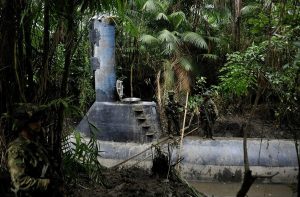
A Colombian Narco Submarine
Narco Paramilitary Forces
The narcotics groups in Mexico also developed into a paramilitary threat, dominating parts of the country and presenting a challenge well beyond the capabilities of the normal police. They also developed imaginative tactics – armoured vehicles to move product, trebuchets to throw packages over the border, tunnels under the border, a sort of land version of the ‘go fast’ boats, perhaps best described as an off-road dragster to run at high speed through a gap in the border fence to where the product could be dropped off, microlights and more recently drones. Several narcotics groups have long used aircraft to move product into the United States and across the Atlantic to Africa – even a Boeing 727 then abandoned in Mali. Such groups can also smuggle guerrillas or terrorists and their supplies.
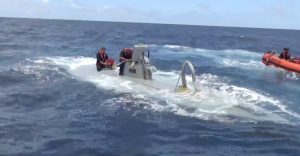
Colombian low-profile boat / semi-submirsible
But perhaps the greatest potential threat lies in the semi-submersible ‘low-profile boats’ and small submarines used by Colombian groups to move product to Mexico and the US and even across the Atlantic. Considering the damage miniature submarines caused in World War 2 and success of Ukraine’s explosive motorboats, such small submersibles in the hands of a guerrilla or terrorist group would present a considerable and not easily countered threat. Consider the damage to USS Cole at Aden in 2000, and ponder how much worse it would have been if the charge had detonated under rather than next to her.
Modern Piracy
Related to that is the threat that has been presented by modern pirates, particularly in the Gulf of Guinea and previously off Somalia, but also in Asia and elsewhere. In Nigeria there seems to have been a merging of piracy, oil theft and guerrilla actions by the Niger Delta Avengers and previously the Movement for the Emancipation of the Niger Delta (MEND), including seizing offshore platforms.
Banditry
Finally, there is common banditry. Some of these groups developed paramilitary capability, to the extent that Cameroon, for instance, had to establish a rapid intervention force specifically to counter rural banditry. Not surprisingly, that force, the Bataillon d’Intervention Rapide has since found itself involved in counter-insurgency operations against Boko Haram who, in turn, like other guerrilla groups active in the Sahel, rely on bandits and smugglers for their skills in ensuring a steady flow of supplies and often on banditry or smuggling to raise funds for their operations.
*

The Nongqai National Security Correspondent and Columnist Helmoed Römer Heitman has written and lectured on defence since 1978. He served in the SA Army reserve from 1970 to 1996, finally at the Long-Term Planning Division at Defence Headquarters. He has consulted to the Ministry of Defence, the Defence Force, political parties and defence industry companies, worked with the non-statutory forces and political parties in 1991/94 and during the 1995/96 Defence White Paper drafting and served on a work group of the 1997/98 Defence Review. He participated in Army Vision 2020 and doctrine development for the Rooivalk attack helicopter in 2005/06, drew up an airlift study for the Ministry of Defence in 2009, served on the Defence Review Committee in 2011/13, worked on through-life capability management in 2015/17, helped edit the Defence Acquisition Handbook and drafted the defence industry strategy in 2017, an intervention plan in 2019 and parts of the Aerospace and Defence Industry Master Plan in 2020.
He has also briefed work sessions of the Security Cluster Directors General, the Chief of the Defence Force, the GOC Special Forces, the Standing Maritime Committee of the Inter-State Defence and Security Committee, the French Ministry of Defence and the German Army Combat Reconnaissance School. Helmoed Heitman holds economics and public administration degrees (University of Cape Town), an MA (War Studies; King’s College, University of London) and management diplomas (Stellenbosch University Graduate School of Business) and passed the junior staff course of the SA Army College.
*
A must read by Africa’s foremost journalist and writer on national security and military affairs; Helmoed Romer Heitman. In this third part of his series on Irregular Forces in Afica, Romer Heitman turns the spotlight on Informal, Commercial and Criminal paramilitary forces.