
Spotty Dog Roadhouse
Abstract
The Spotty Dog Roadhouse in Retreat, Cape Town, is a whimsical and much‑loved landmark whose origins trace back to 1937–1938, when musician Ralph Barnes and his wife Enid created South Africa’s first dog‑shaped roadside restaurant. Designed with the help of an architect and built in secrecy, the two‑storey white dog with black spots quickly became a popular stop between Wynberg and Muizenberg, serving simple roadhouse fare and attracting families, sailors, and local farm communities. Its hollow cement‑and‑wire head, later the subject of wartime spy rumours, added to its mystique, while decades of pranks, repairs, and weather damage shaped its evolving appearance.
After Ralph’s death in 1947, Enid managed the business until selling it in 1963. The original structure deteriorated and was nearly destroyed in 1972 when a runaway lorry crashed into it, leaving only memories and fragments cherished by local children. In 1988, Andrew Louw of Cape Concrete built a smaller ferro‑cement replica as a nostalgic tribute, later joined briefly by a “puppy” statue. Today, the 2.5‑metre replica still stands outside BUCO on Honeywell Road as a non‑functional but iconic symbol of local heritage. Maintained by Louw’s daughter, it remains a beloved reminder of Cape Town’s quirky roadside history, complete with enduring legends of wartime espionage.
SPOTTY DOG ROADHOUSE
Via Fanie Avenant
Ek het hier naby grootgeword en ken vir Spotty van kleins af. Hiermee ‘n bietjie geskiedenis wat ek bymekaar gemaak het:
“The Spotty Dog Roadhouse, often simply called Spotty or the Spotted Dog, is a quirky historical landmark located at the intersection of Main Road, Pollsmoor Road, and Honeywell Road in Retreat, Cape Town. Its story dates to the late 1930s, when Manchester-born musician Ralph Barnes and his Canadian wife, Enid, immigrated to South Africa.
Ralph initially worked as a violinist with the Cape Town Symphony Orchestra, but after a failed recording venture, he turned to a new project.
In 1937, Barnes partnered with an architect—sources variously name him as Ben van Niekerk (from Clovelly, who had studied in America) or Leslie Smith—to construct a unique structure behind a veil of hessian fabric to keep it secret, sparking local rumours that it might be an elephant-shaped building.
Materials were sourced from Cape Concrete Works in Retreat, and Barnes ferried them to the site himself.
The structure was unveiled in 1938 as a two-storey-high white dog with black spots, functioning as the Spotted Dog Roadhouse—the first canine-shaped roadside restaurant in South Africa and the only food stop in the then-bushy area between Wynberg and Muizenberg (long before developments like the Blue Route Mall).
It served simple fare like hot dogs, hamburgers, bacon-and-egg sandwiches, cheese-and-tomato items, ice cream (dispensed from a door between the dog’s legs), and coffee, quickly becoming a popular weekend spot for families and locals.
A kennel-shaped extension was added behind it for additional catering space.
The dog’s head was hollow, constructed from chicken wire plastered with cement and whitewashed, and Barnes maintained it diligently to protect against rust from winter rains.
During World War II, its proximity to Pollsmoor (then a military area) fuelled rumours that the hollow head was used as a spy hideout to monitor troops.
It also attracted pranks from soldiers, who painted over its spots or reportedly its nose red.
The roadhouse remained popular with British sailors, Pollsmoor Farm families (from areas like Kirstenhof and Tokai), and others, with waiter Willie Phillips serving there for 28 years.
Ralph Barnes died in 1947, leaving Enid to manage it with help from Di van Ryneveldt while raising their children, Joe (aged 2) and Jane (about 7).
The family briefly moved to Canada around 1950 before returning, and Enid sold the business in 1963.
Over time, the structure faced wear: A storm caused the jaw to fall off, altering its cheeky expression upon repair, and a hot-water cylinder installed in the head earned it the nickname “Dog with the Hot Head.”
Its uses evolved from a full restaurant to a vegetable and fruit stand.
Tragedy struck in 1972 when a runaway lorry (crashed into it during maintenance, nearly demolishing it beyond repair despite public petitions to save it. Children collected pieces as souvenirs, and it faded into memory for many heading to Muizenberg.
In 1988, Andrew Louw of Cape Concrete, who had purchased the land (which later hosted businesses like an auto shop, Penny Pinchers, and now BUCO hardware), rebuilt a 2.5-meter-high replica using ferro-cement (reinforced mortar over metal mesh) as a tribute, positioning it 50 meters closer to the road.
A smaller puppy statue once accompanied it but was relocated to Dreyersdal Road due to vandalism.
Louw, who grew up on Dreyersdal Farm, saw it as a nod to local nostalgia.
As of 2025, the replica still stands as a non-functional landmark and statue outside the BUCO hardware store at 5 Honeywell Road, Retreat, maintained by Louw’s daughter, Daryl Ann Gowar.
It no longer operates as a takeaway or restaurant but serves as a beloved nostalgic symbol for Capetonians, with no indications of recent changes or closures in available records up to early 2026. During the COVID-19 pandemic, it even wore a face mask to promote public health awareness.
Wartime espionage rumours persist in local lore, tying it to German networks in Cape Town from 1938–1945, though these remain unconfirmed”.
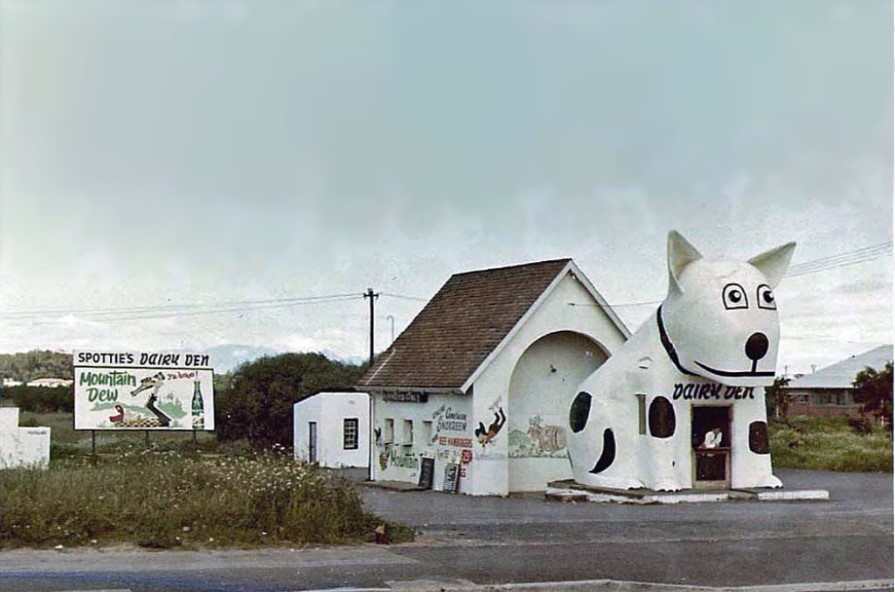
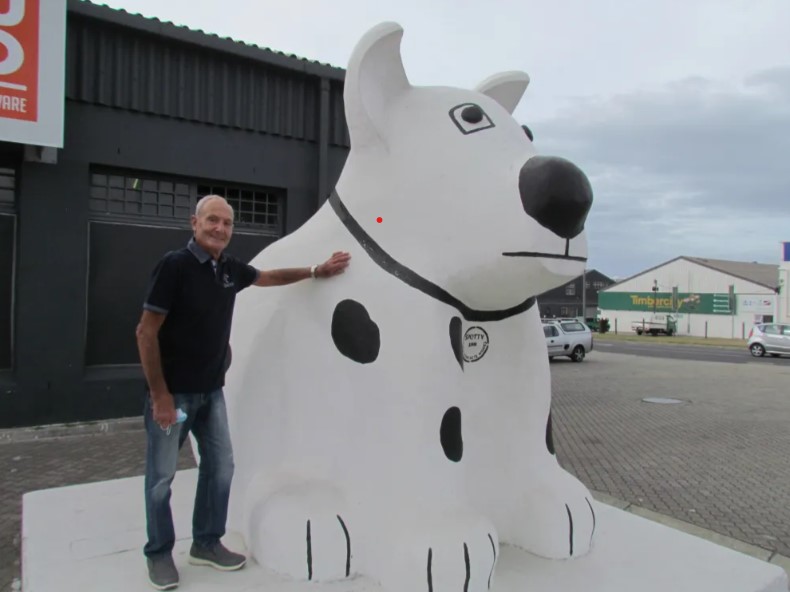
Pictures attached of the original roadhouse in its heyday (Spotty 1) and the current replica (Spotty 2) as it appears today. (Photos Constantiaberg Bulletin)
Foto’s afkomstig van die Constantiaberg Bulletin. Dis lekker om so af en toe speurder-speurder te speel…
