
 Nongqai Vol 17 No 3A
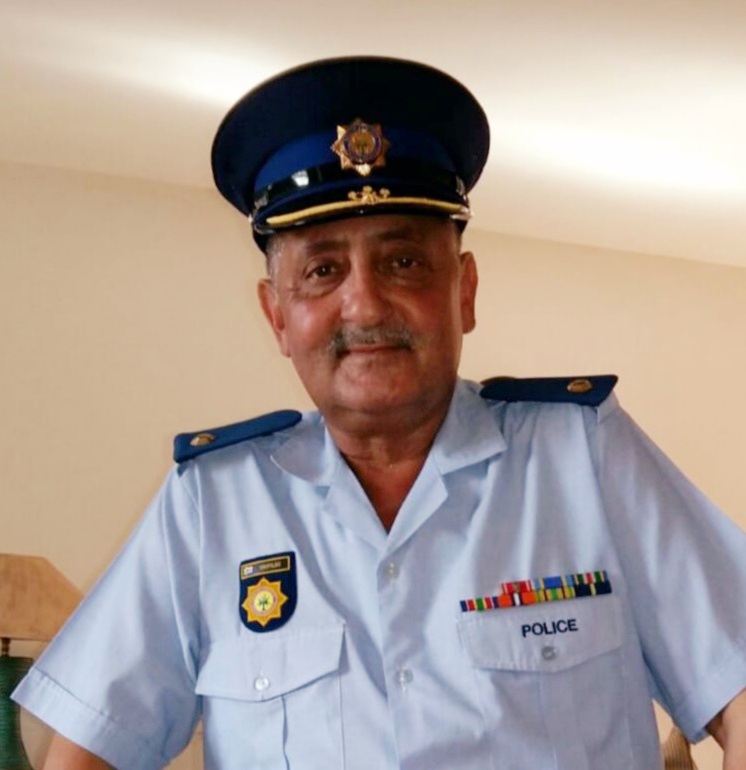
Lieutenant-Colonel Pipes Yusuf A Haffajee
Abstract
Lieutenant-Colonel Yusuf A Haffajee is acknowledged and honoured for more than 42 years of loyal and distinguished service to the South African Police Service. Born in Durban, he joined the South African Police in 1974 and served in several divisions, including Crime Prevention, Administration, Tracing and Detective Services. Throughout his career, he demonstrated professionalism, courage and strong dedication to justice.
He became widely respected as a skilled investigator, known for solving complex and sensitive cases, often involving vulnerable members of the community. His calm and patient approach earned the trust of victims, colleagues and even suspects. Rather than relying on force, he believed in respectful discussion and careful investigation.
Lieutenant-Colonel Haffajee also served at the border and received several medals for loyal and exemplary service. However, beyond his awards, it is his honesty, humility and compassion that truly define his legacy. His career stands as an example of honourable service, strong leadership and commitment to the people of South Africa.
Key Words
Lieutenant-Colonel Yusuf A Haffajee;
South African Police Service;
Loyal service;
Investigation;
Leadership;
Crime prevention;
Justice;
Integrity;
Community Service;
Professionalism.
FOREWORD
It is a great privilege to write this foreword in honour of Lieutenant-Colonel Yusuf A Haffajee, a highly experienced police officer who has given more than 42 years of loyal and dedicated service to the South African Police. Throughout his long career, he has shown commitment, bravery and strong dedication to his duty.
I have known him personally since 1979, when I served as a Reservist at SA Police, Mountain Rise. Even in those early years, he stood out as a disciplined and reliable member who carried out every task with care and dedication. He earned the respect of his colleagues, the community and even prisoners through his honesty and hard work. In every unit where he served, he performed his duties with distinction.
In 1987, while I was Station Commander at Mountain Rise, we received many complaints from the community about serious crime in the Pietermaritzburg city centre. Although the area was outside our direct policing precinct, I suggested to the Assistant District Commandant, Colonel Stan E Gillham, that we create a joint Crime Prevention Team for District 45 to deal with the problem. I was given the responsibility of choosing the team members, and Lieutenant-Colonel Haffajee was one of those selected. He performed exceptionally well, and later was transferred to Mountain Rise by mutual agreement.
During his career, he worked in many departments, including Crime Prevention, Administration, Tracing and Detective Services. He showed great ability and steadily rose through the ranks. He also served his country at the border, where he was awarded the South African Police Border Medal and an additional bar for further service. He became widely respected as an investigator, known for solving serious and complex cases, often involving vulnerable members of the community. His work brought justice to many victims and their families.
Lieutenant-Colonel Haffajee combined professional skill with humility and compassion. He is truly an officer and a gentleman, with a good sense of humour. He believed in calm discussion rather than force, understanding that respect and patience were powerful tools in finding the truth. This approach earned him the trust of both victims and colleagues. He often worked late into the night and over weekends to make sure justice was done.
His many medals and awards show a career marked by loyalty, excellence and outstanding conduct. However, beyond the medals, it is his character – his honesty, courage and humanity – that truly defines his service.
As Calvin Coolidge once said, “The nation which forgets its defenders will itself be forgotten.” We remember and honour Lieutenant-Colonel Haffajee not only for his achievements, but for the values he stood for and the many lives he touched through his service. I salute you, Sir!
Logan Govender – [LG]
SOUTH AFRICAN POLICE
LIEUTENANT-COLONEL PIPES YUSUF ABBAS HAFFAJEE
A LEGACY OF SERVICE AND A DISTINGUISHED POLICE CAREER

Headlines in The Witness
The dedication, commitment, and distinguished 40-year police career of top Detective Lieutenant-Colonel Pipes Yusuf A Haffajee was widely celebrated by many media houses in KwaZulu-Natal. Billboards across the province proudly marked his retirement, honouring his remarkable service.
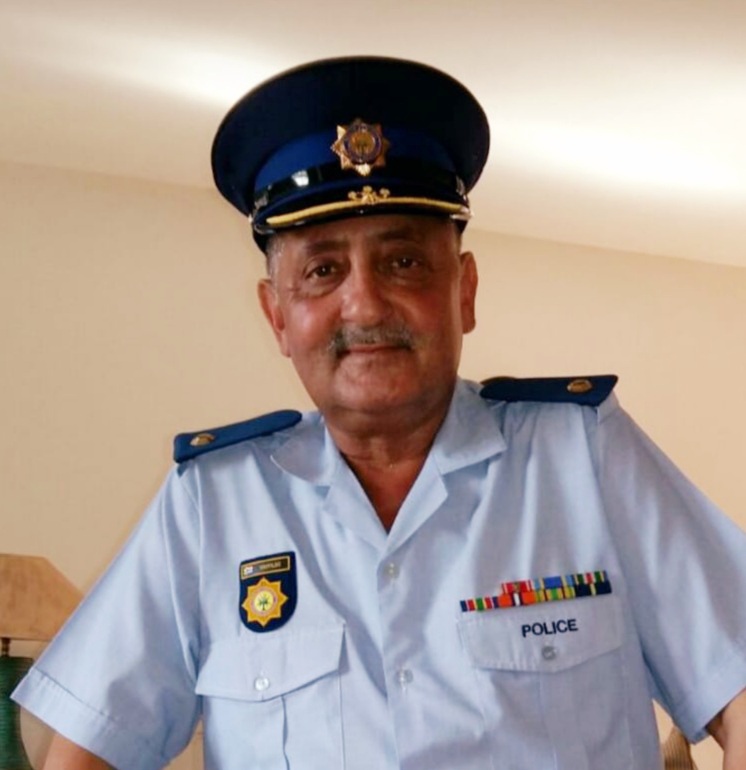
Major Pipes Yusuf A Haffajee
Authored, researched, compiled, edited, and submitted for publication by Logan Govender [LG], drawing on information provided by Lieutenant-Colonel Pipes Yusuf A Haffajee, as well as various sources, police personnel, and other contributors.
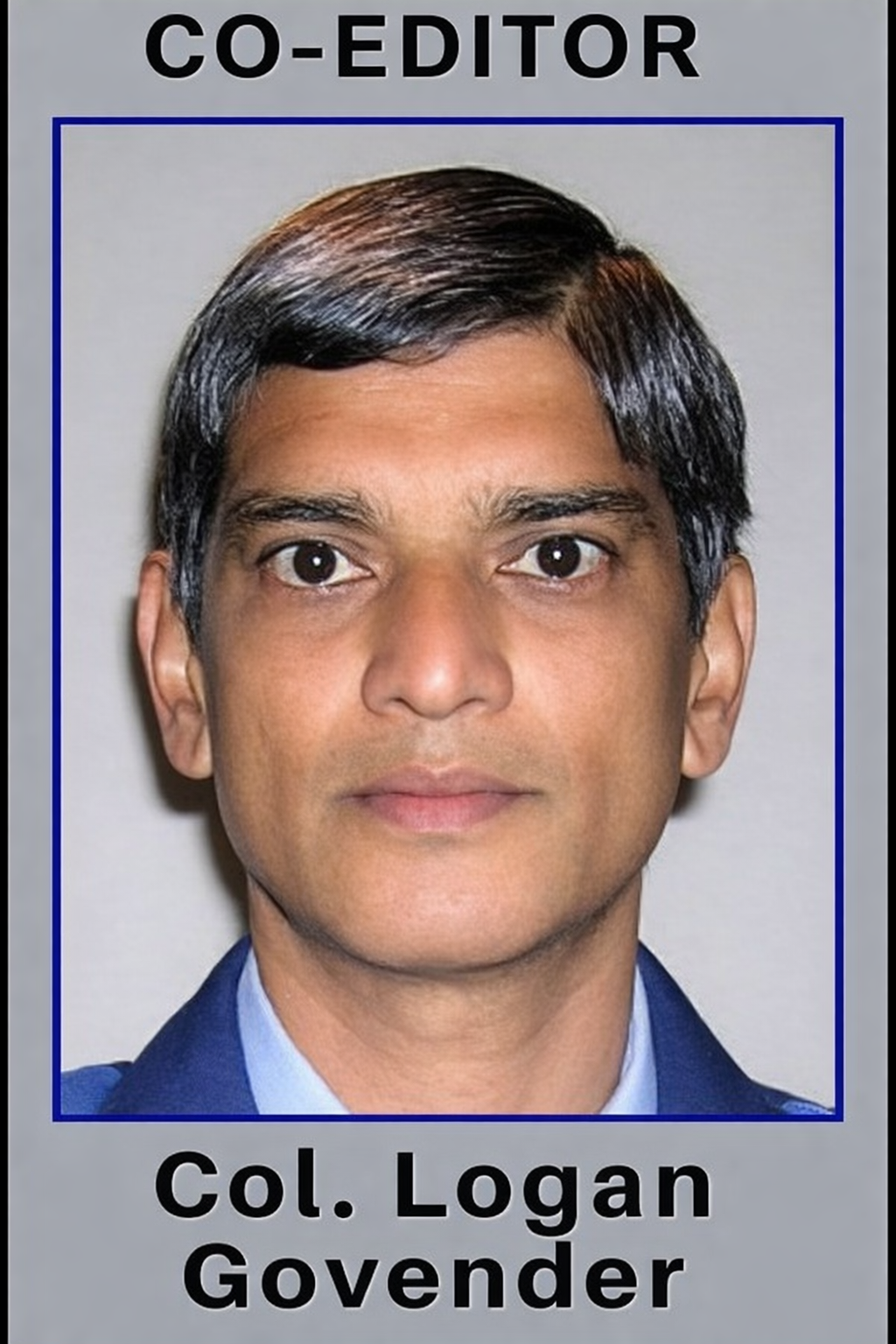
[LG]
AUTHOR’S NOTE
“The Nation which forgets its defenders will itself be forgotten” – Calvin Coolidge
Lieutenant-Colonel Yusuf A Haffajee is recognised for more than 40 years of loyal and outstanding service to the South African Police Service and the communities he protected. Over an impressive 42-year career, he showed the true values of policing by his courage, professionalism, honesty, care for others, and strong dedication.
He was born and raised in Durban and joined the South African Police on 10th July 1974 in Pietermaritzburg. During his career, he worked in several units, including Crime Prevention, Administration, Tracing, and Detective Services. His ability, commitment, and strong sense for finding the truth quickly set him apart as a highly skilled investigator. Colleagues across the province relied on his sharp thinking, creative methods, and determination to solve even very difficult cases.
Major Haffajee offered more than just technical skill. He was known for being humble and for his dry sense of humour. He treated victims, families, suspects, and fellow officers with respect and kindness. Instead of using force, he preferred a calm and understanding approach to interviews and questioning. This helped people trust him and often led to successful outcome of cases, giving closure to many victims and families.
Among his achievements, he is a border veteran, he solved difficult and emotional cases, including finding a murder suspect who had evaded arrest for seven years and handling serious crimes involving vulnerable people. He often worked long hours, including nights and over weekends, showing his deep commitment to justice.
His colleagues called him a “Super Cop,” as well as a leader and mentor who stayed steady during challenges. He received a number of medals and awards for his excellent service, showing the positive impact, he had on policing in KwaZulu-Natal and beyond.
Major Haffajee leaves a legacy of caring, policing, strong leadership, and dedicated service to the people of South Africa. His honesty, compassion, and commitment will continue to inspire future members of the SAPS.
[LG]
The service medals awarded to him in order of precedence
- 1987-11-15 The South African Police Border Medal;
- 1989 One bar was awarded to him for an additional stint at the border;
- 2013-04-01 The South African Police Service Centenary Medal 1913 to 2013;
- 1988-04-01 The South African Police Seventy Fifth Anniversary Medal;
- 1994 The South African Police Amalgamation Medal;
- 2005-01-27 The South African Police Service Ten Year Commemoration Medal;
- 2012-08-31 The South African Police Service Soccer World Cup 2010 Support Medal;
- 2014-07-10 The South African Police Service Forty Year for Loyal Service Medal;
- 2004-07-10 The South African Police Service Thirty Year Medal for Loyal Service and Exemplary conduct;
- 1994-07-10 The South African Police Service Twenty Year Service Medal for Merit and Exemplary conduct;
- 1988-07-10 The South African Police Service Ten Year Faithful Service Medal for Long service and Exemplary conduct.
Yusuf A Haffajee’s Dad, AAC Haffajee was a Police Reservist at Durban Central during the 1960’s. A few years later his work caused him to relocate to Pietermaritzburg, and he chose to perform duties at SA Police, Mountain Rise in Pietermaritzburg.
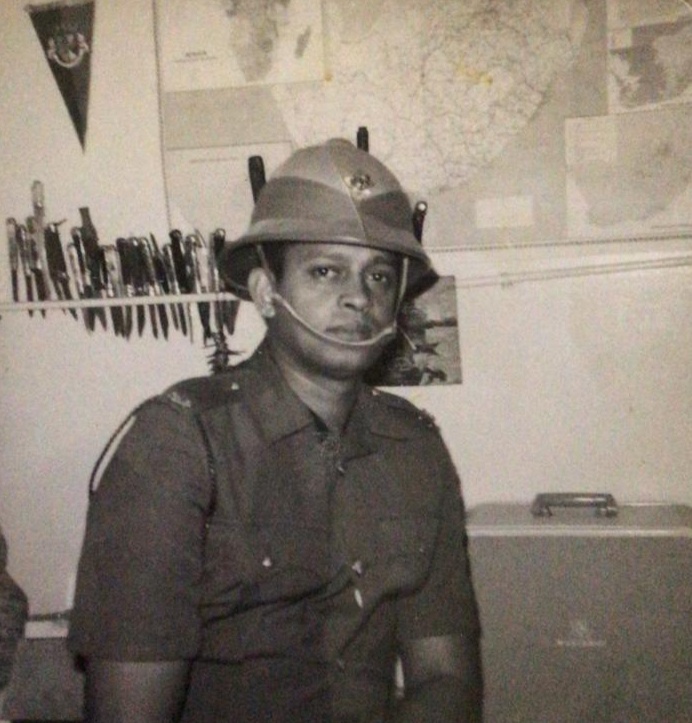
YA Haffajee’s Dad, Reserve Warrant Officer AAC Haffajee
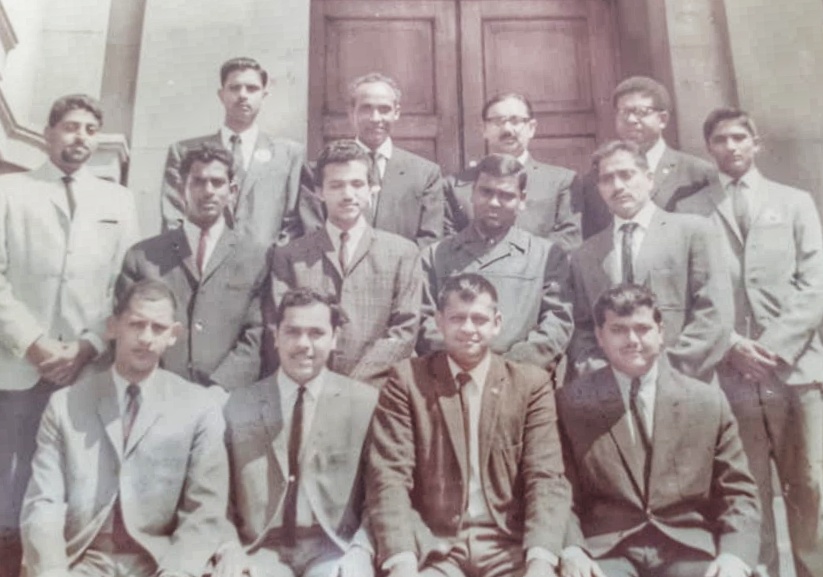
A group of Durban Indian Businessmen that served at Durban Central as reservists during the 1960’s seated outside the Supreme Court Buildings in Mangrove, Durban
Front row, seated, 3rd, AAC Haffajee
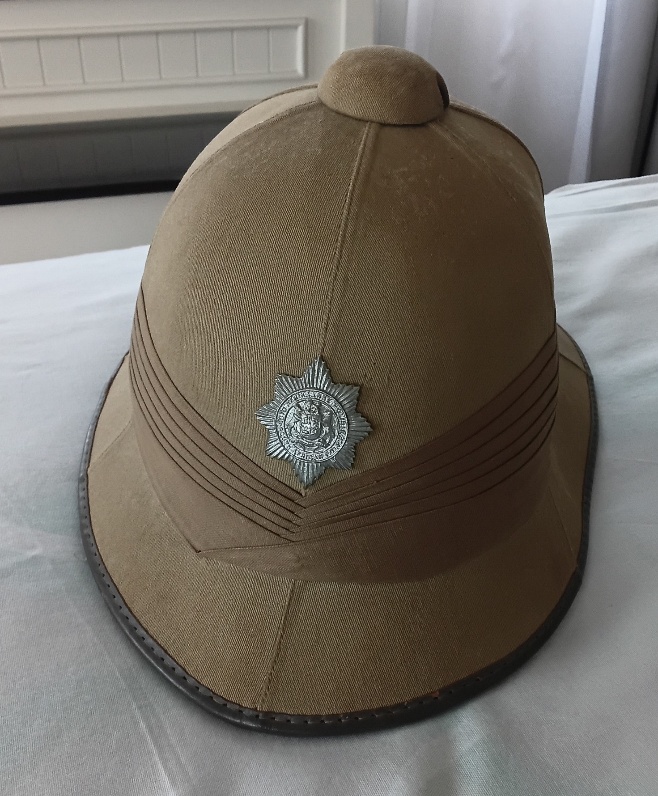
Original helmet of YA Haffajee’s Dad, Warrant Officer AAC Haffajee
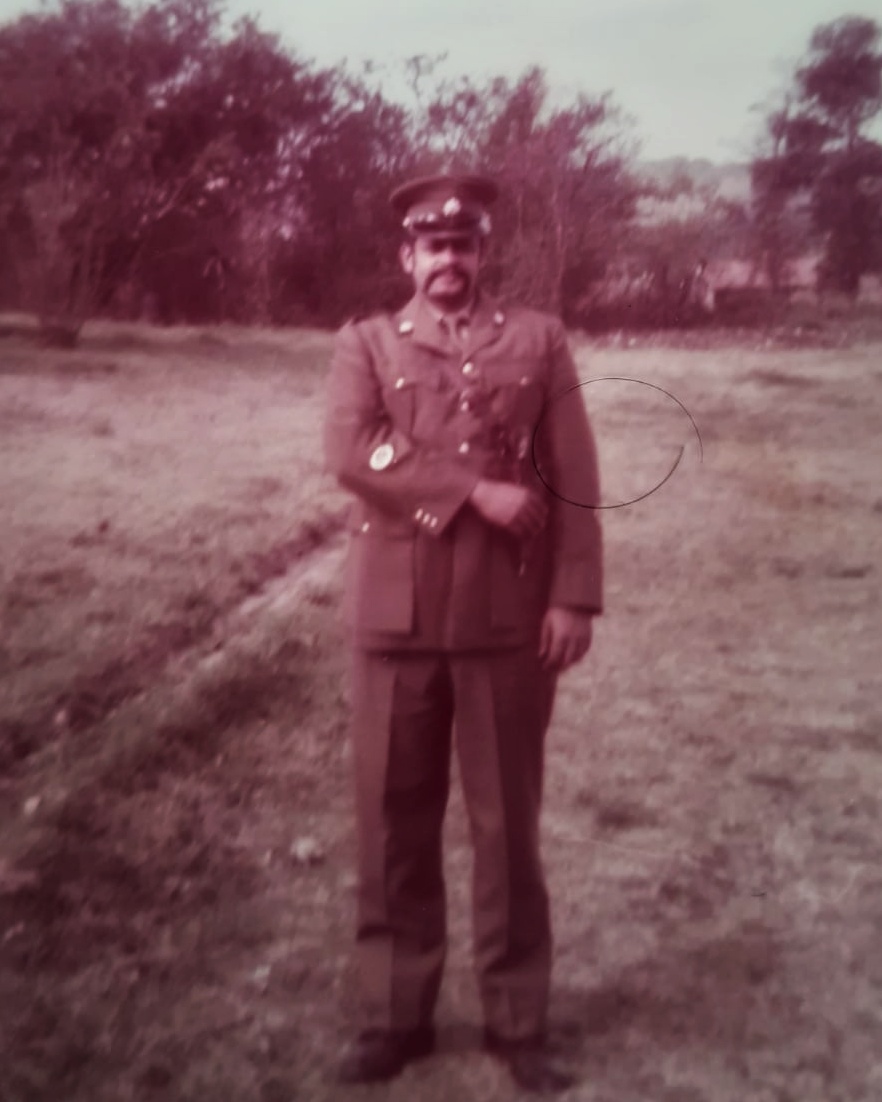
Reserve Warrant Officer AAC Haffajee
He is reported to be one of the first Indians to be promoted to the rank of Warrant Officer in the SA Police during 1971/2. (He was apparently promoted to the rank of Warrant Officer above many other Senior Sergeants of the time. – [LG])
Yusuf A Haffajee’s elder brother HASSEN ABBAS HAFFAJEE followed his Dad’s footsteps and joined the SA Police in Pietermaritzburg on 25th May 1973 and was posted to Mountain Rise. He underwent basic police training at the SA Police, Training College, Wentworth, and was placed in Platoon 19 of 1973 from July – December 1973. This platoon consisted of the highest recorded number of students from Pietermaritzburg.
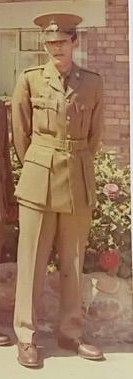
Warrant Officer HA Haffajee elder brother of YA Haffajee
SOUTH AFRICAN POLICE,
INDIAN TRAINING COLLEGE,
WENTWORTH, DURBAN
PLATOON 19 OF 1973
July – December 1973
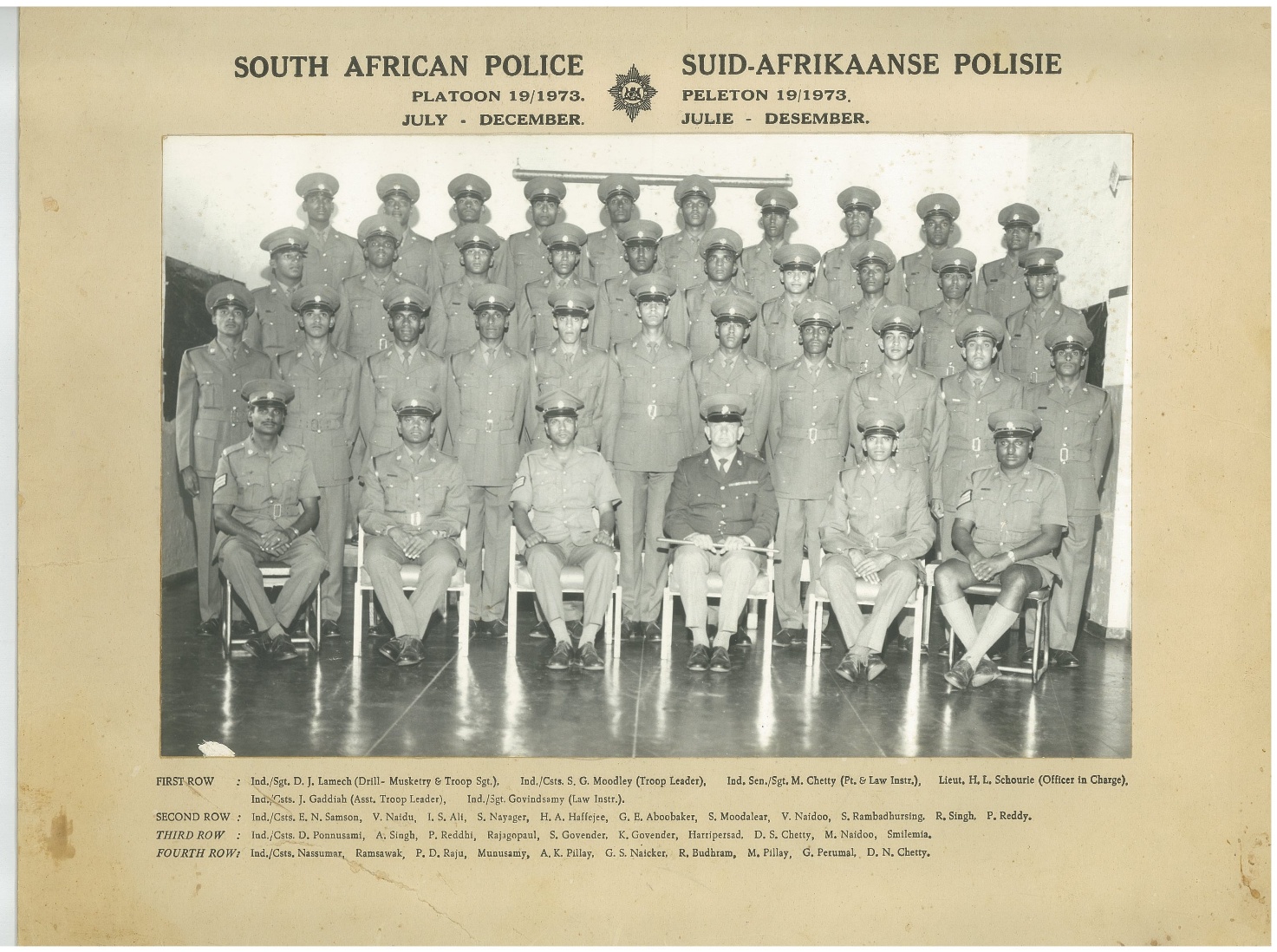
2nd row, HA Haffajee, 5th from left
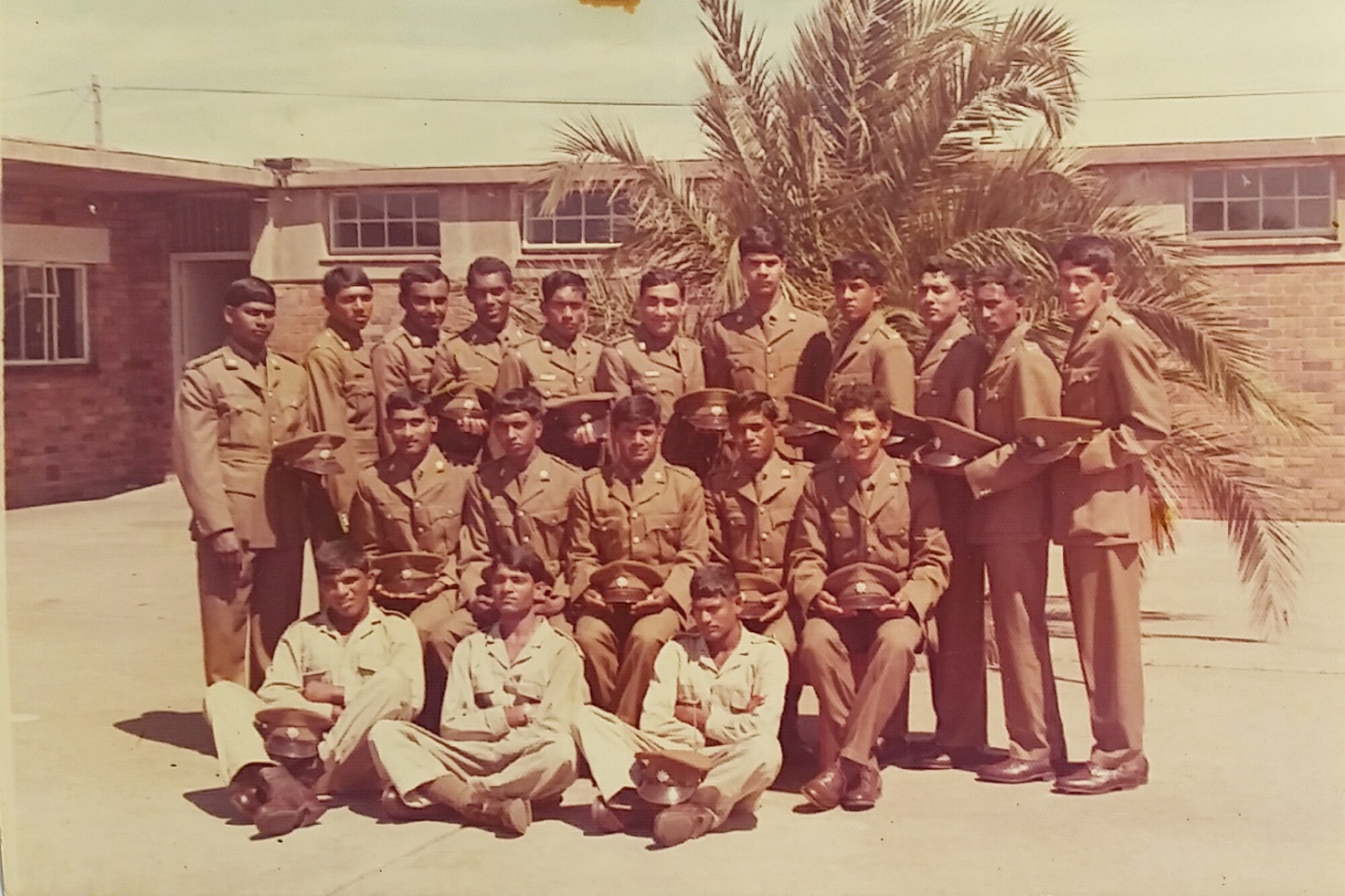
Group of students from Pietermaritzburg
Rear row, standing, HA Haffajee, 1st on right
Yusuf Abbas Haffajee the second son was born at Carlisle Street, Durban on 7th June 1956. A part occupied by the Durban Indian business community.
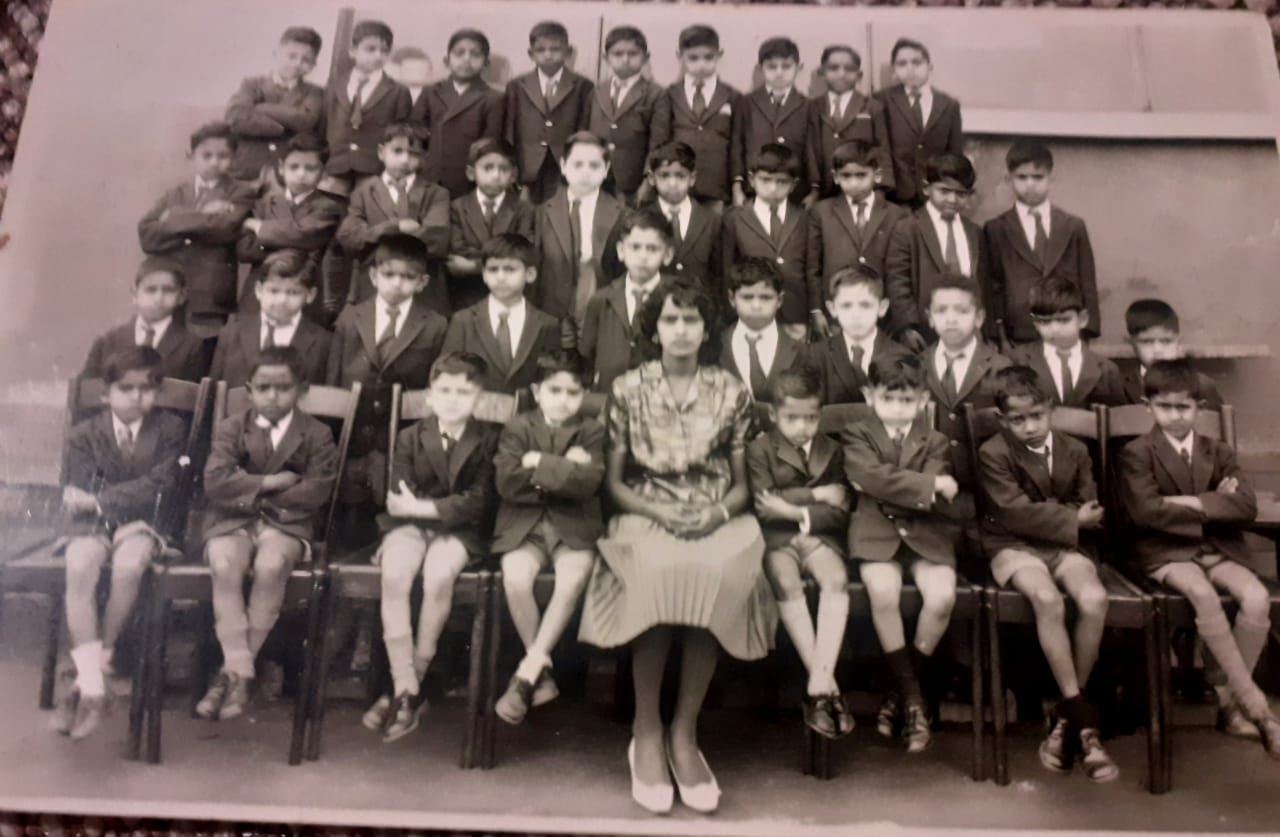 Hindu Tamil state aided school. Durban, Haffajee’s Primary School
Second row, standing, 7th from left, YA Haffajee
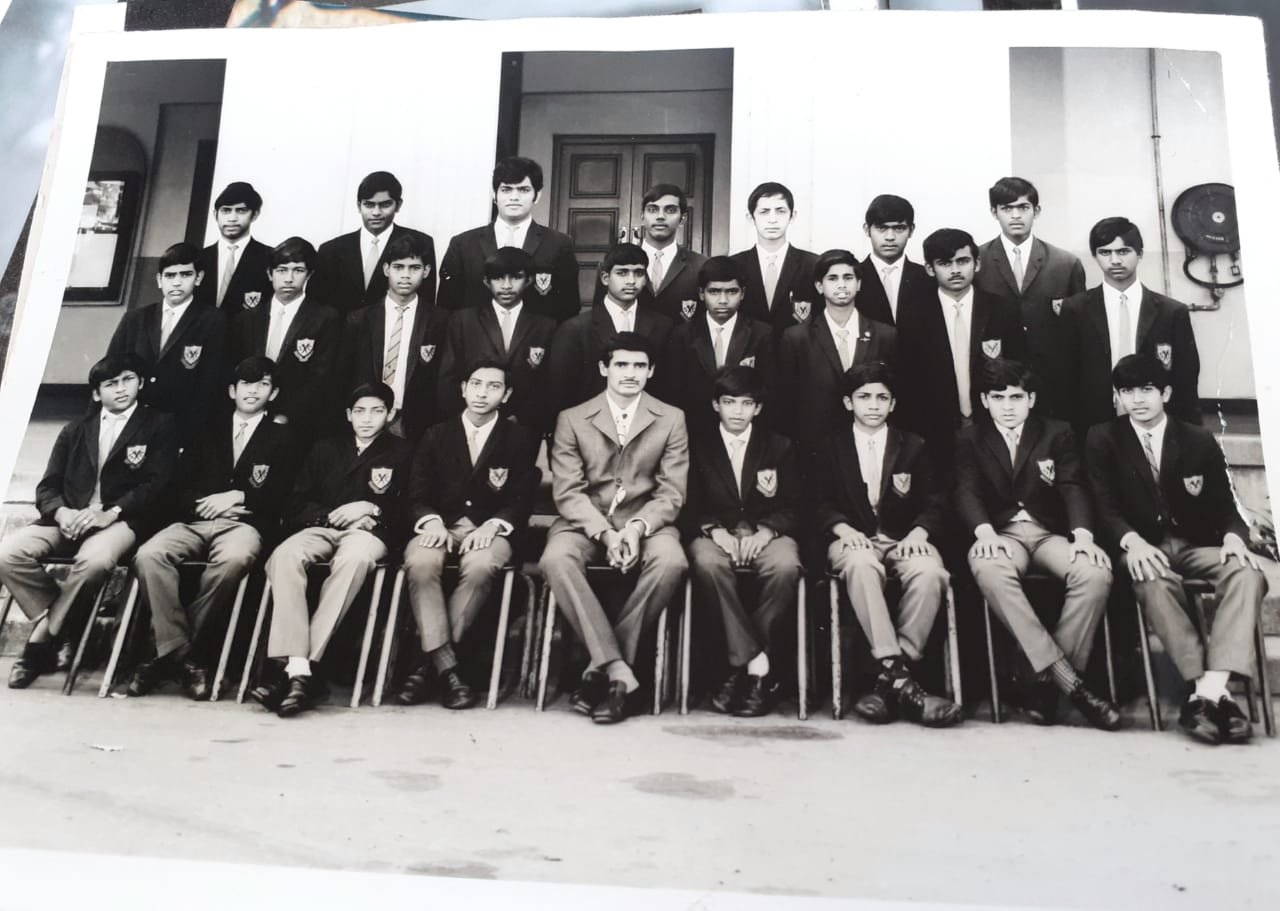
Sastri College, Haffajee’s High School
Rear row, 5th from left, YA Haffajee
His youngest brother SA Haffajee followed the family tradition and joined the SA Police Service during 2002
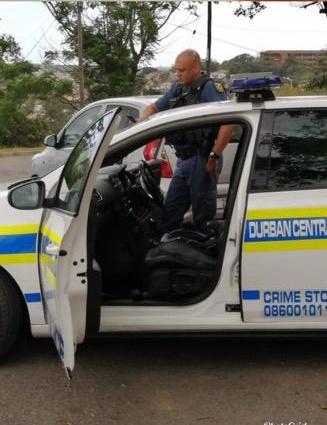
SA Haffajee, the youngest brother
SOUTH AFRICAN POLICE SERVICE
TRAINING COLLEGE
PRETORIA
2002
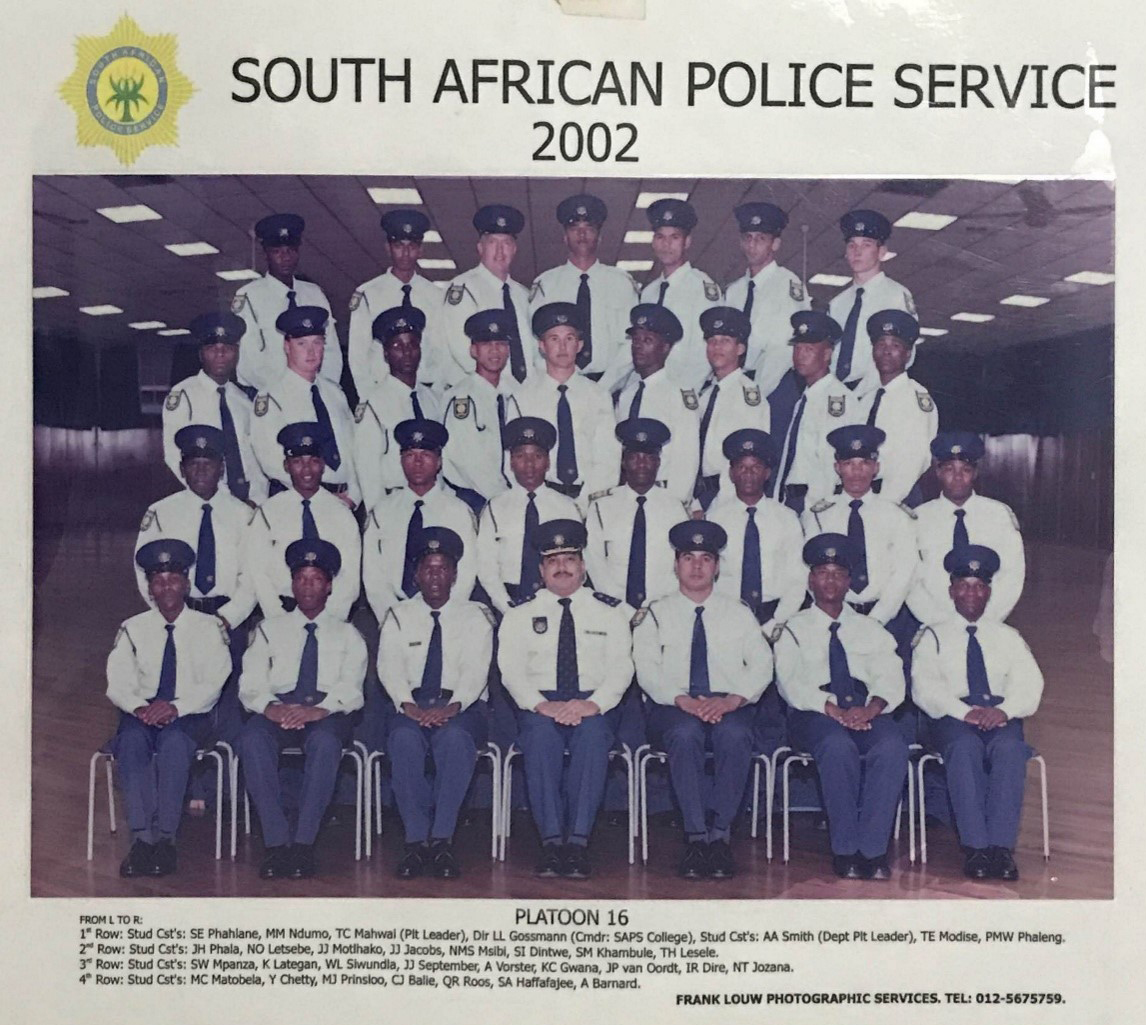
4th row, 6th SA Haffajee
PIPES YA HAFFAJEE ENLISTMENT INTO THE SA POLICE
With two serving members in the South African Police, it was no surprise that the younger brother, YA Haffajee, followed in their footsteps a year later. He joined the SA Police, following his father and eldest brother.
After his attestation at District Headquarters in Pietermaritzburg on 10th July 1974, he was told to collect his personal belongings and wait outside the Museum next to the Pietermaritzburg Central Police Station in Loop Street (now Jabu Ndlovu Street). From there, he would be transported to Kimberley in the Northern Cape, as that was where he was being posted.
This news shocked and demoralised the young Haffajee, as Kimberley was far from his family. While he was walking down the stairs, the member who had attested him called out that there was a change of plans. He would now remain in Pietermaritzburg and assist with administrative duties at the Divisional Headquarters, Natal Midlands, on the third floor.
He worked there until the office moved to new premises in the Trust Bank Building (Davis Alexandra House) in Church Street, Pietermaritzburg. He was pleased to leave the old office behind, especially as he no longer had to share it with pigeons and deal daily with their constant cooing and droppings.
After moving to the new building, he was instructed to report to Mountain Rise Police Station. The Station Commander was Captain Walker, with Lieutenant T Nel as his second in command. Other senior members at the station included Warrant Officer JR David, Senior Sergeant Bob Sewpersad, Sergeant Bosman, Constable Pretorious, and Sergeants Bala Naidoo and Johnny Govender, among others.
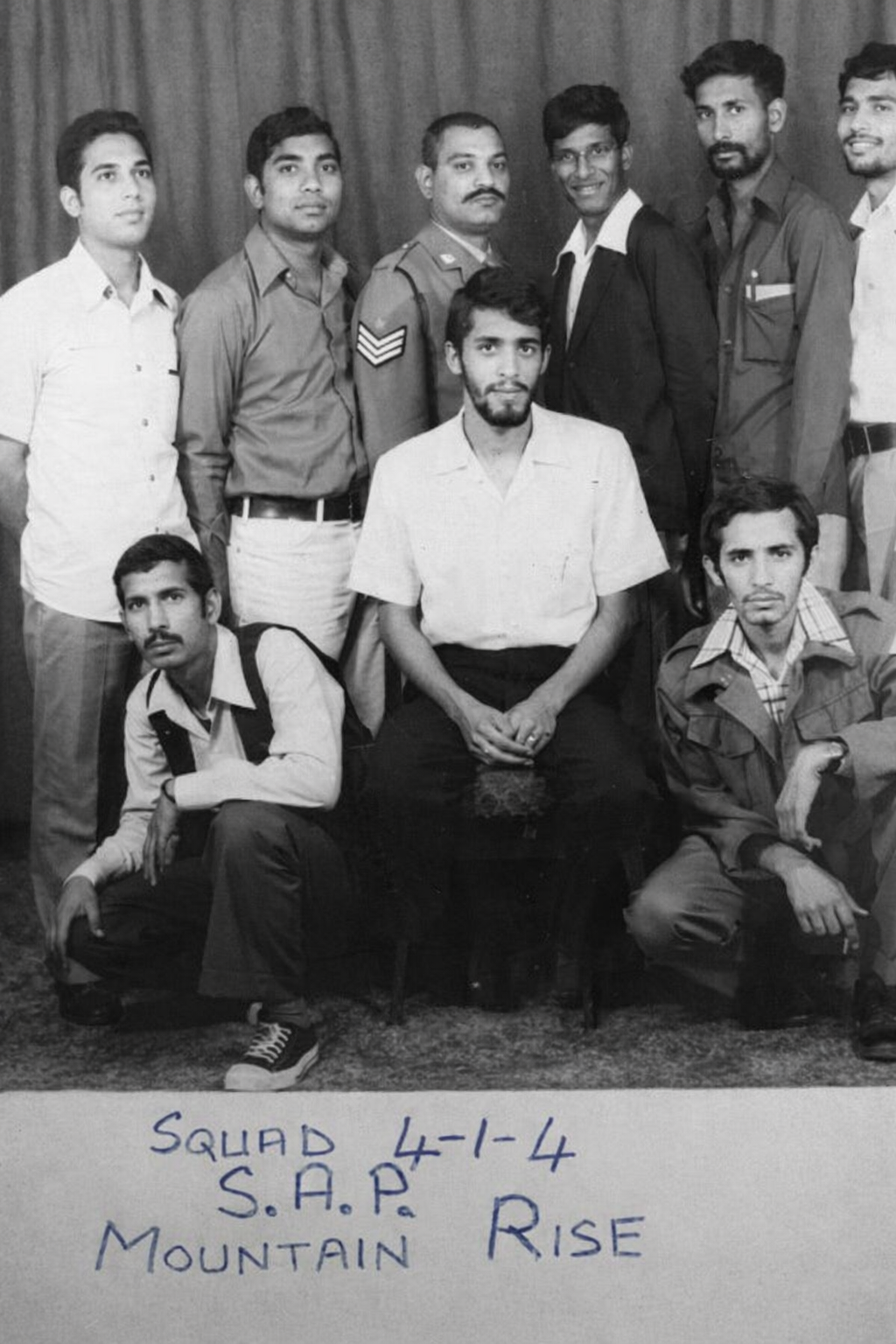
POC Squad 4-1-4 of SA Police, Mountain Rise in 1974
Front row, L-R, Maurice Raman; HA Haffajee (Zulu); YA Haffajee (Pipes)
Rear row, L-R, Y Moodley; Bala Naidoo; Mariappa; Vincent Peters; Anand K Pillay; EN Samson
SA POLICE, TRAINING COLLEGE, WENTWORTH
After a few months of working with the Crime Prevention Unit, under the supervision of Sergeant Bala Naidoo, Haffajee was called up to undergo basic police training at South African Police, Training College, Wentworth. He was placed in Platoon 22 in 1975. The duration of the training was from January 1975 to July 1975.
SOUTH AFRICAN POLICE
TRAINING COLLEGE
WENTWORTH, DURBAN
PLATOON 22 / 1975
January to July
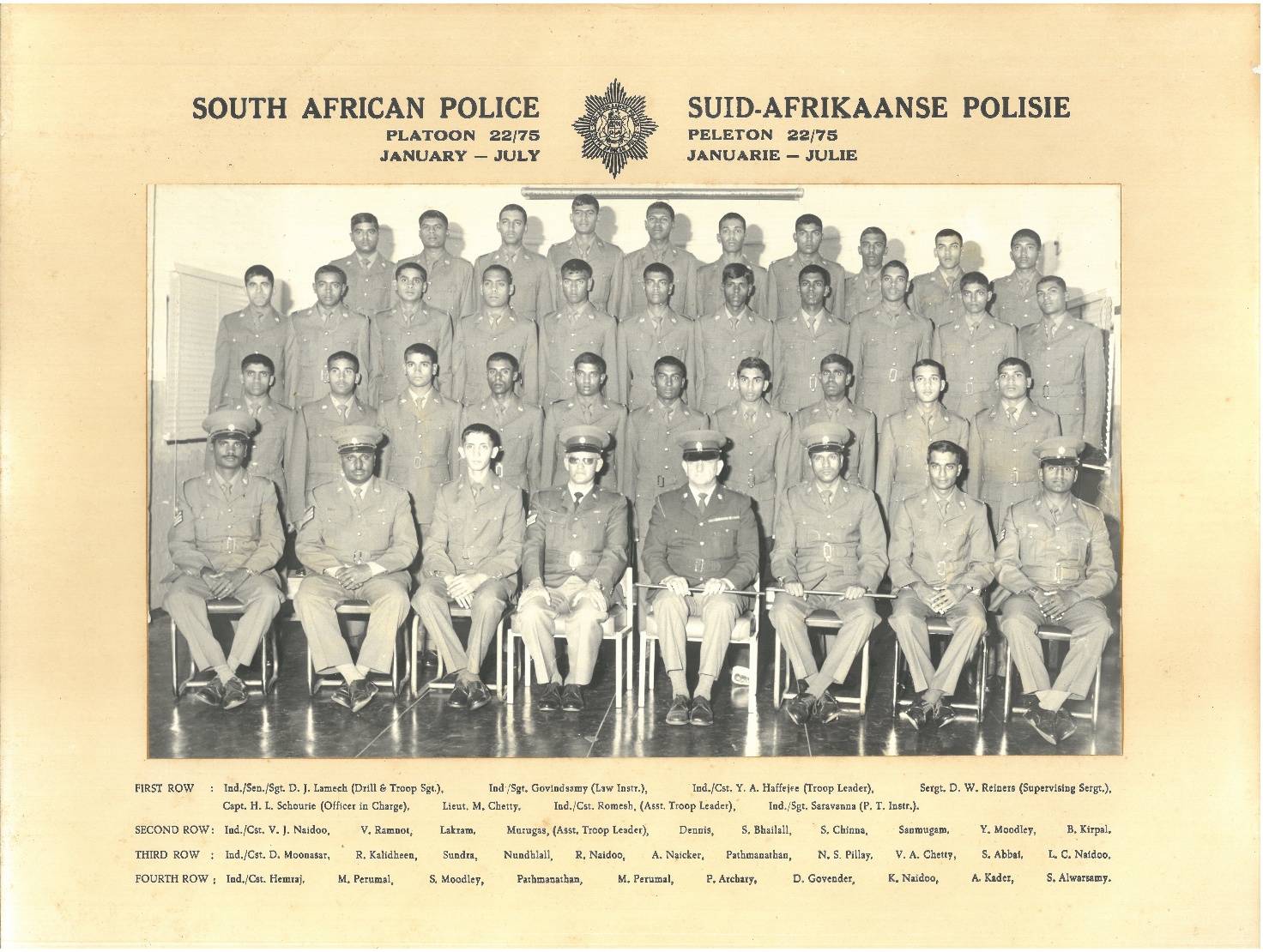
Front row, seat, L-R, 3rd YA Haffajee (Troop Leader)
The following members of this Troop became senior Officers 4th row, L-R, 8th Bob Naidoo (Major General); 2nd row, 10th Raj Ramsaroop (Major General); Todd Somaru (Brigadier); and 4th row, Selva Mogambury Perumal (Colonel)
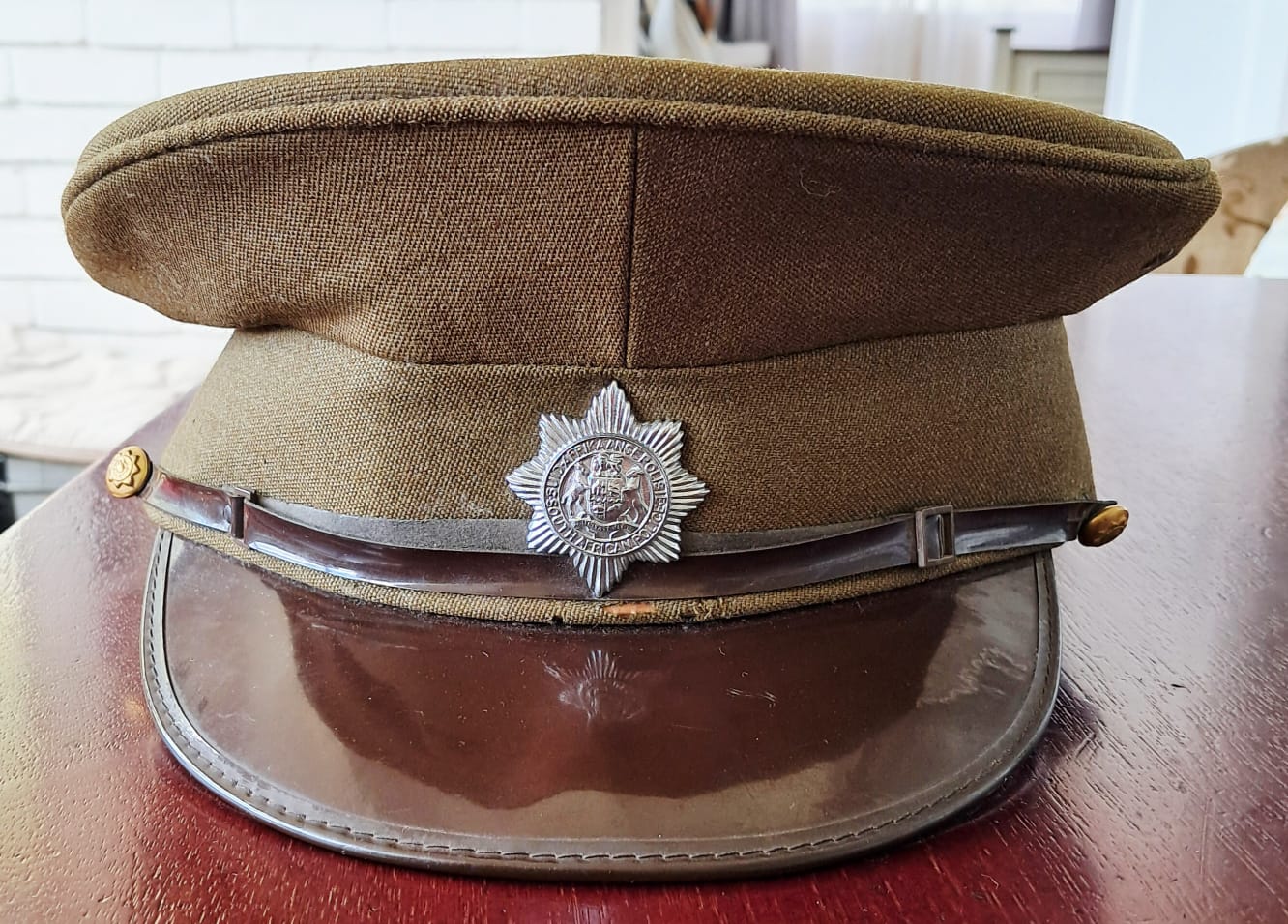
His original first issue of the police cap
NB – Two weeks before the Passing Out Parade the PT Instructor, Warrant Officer Morgan Chetty was promoted to the rank of Lieutenant. He had arrived from a Candidate Officer’s as a Warrant Officer earlier but was only promoted two weeks prior to the parade. – [YAH]
Their Passing Out Parade was held at Unit 3 in Chatsworth. The officiating dignitary was the District Commandant, (No 76), Durban South District, Colonel BJ Horak. The then recently promoted, Lieutenant Morgan Chetty was the Parade Commander.
SA POLICE, MOUNTAIN RISE, PIETERMARITZBURG
After completing his basic police training, he was posted back to SA Police, Mountain Rise to serve in the Prevention of Crime Unit, where they dealt mostly with petty offences such as gambling, loitering, and drinking in public. In September 1975, after receiving his first small bonus (R100 for single members), he was abruptly mobilized late that night for riot duty.
Unprepared and dressed still in his summer uniform, he and other non-white members were transported in the back of Land Rovers, segregation practised by individual White members prohibited them from sitting in front, to Newcastle, where a bus boycott had escalated. Equipment was issued along racial lines – white members received firearms whilst Indian members were given pick handles, and African members were given assegais. The long, cold trip took almost three hours.
They were stationed in Newcastle for two weeks under difficult conditions. As tensions worsened, reinforcements arrived from other regions, but the untrained members were largely ineffective. Eventually, Pretoria’s specialized Anti-Terrorist Unit (PATU) arrived, and the original group was relieved. He returned to Mountain Rise on 14 October 1975 and resumed work in the Prevention of Crime Unit under Sergeants Bala Naidoo, GV Govender, and Dudley Maharaj.
Resources were limited, the Enquiry staff shared one vehicle and often travelled on foot or used public buses to reach complainants, witnesses, and suspects. In the day uniformed police rode buses free of charge, while off-duty policemen used their appointment certificates for free travel. Their work focused on traffic violations and minor crimes, while another enquiry member served summonses and warrants.
One notable operation involved thefts of oranges from farms along a remote bus route near Claridge and Pete’s Lake. Officers disguised themselves, rode the early morning bus, and arrested offenders for theft of property suspected to be stolen (Oranges) from the numerous farms. After arrests, they completed the full bus route before disembarking with suspects and walking them back to Mountain Rise station. The bus service was ultimately shutdown.
During the mid 1970s, both Prevention of Crime (POC) and Enquiry members were required to attend riot training at the Alexandra Road Riot Unit. They learned to use revolvers, shotguns, and R1 rifles under the command of Colonel Joubert and Major MFR Otto. Training intensified in 1976 during the school riots, expanding to include shields and stopper guns. Senior non-white officers, including Lieutenant VC Shanmugham, were incorporated into the unit as the unrest grew.
PREVENTION OF CRIME WITH WARRANT OFFICER CECIL LOUIS EBENEZER STONE
In 1978, Haffajee was assigned to work under Warrant Officer Cecil Louis Ebenezer Stone, alongside Constable Krish Mahadeo and later Luckram Myasur. Stone was widely respected for his investigative skills and strong informer network.
In 1979, a female Bible Institute student was raped and robbed while walking from Claridge to Woodlands. The victim was too traumatised to be interviewed immediately. Stone activated his informer network, which led to a suspect located within a week. Stone and his team arrested the suspect at Barron’s Farm after overnight surveillance in heavy rain. Stolen clothing was recovered, and the suspect confessed and identified an accomplice. Both men were arrested, convicted of rape and robbery, and sentenced to lengthy prison terms.
In the 1980s, after Haffajee’s promotion to Sergeant, Stone requested assistance after discovering a body on Haythorne’s Hill near Woodlands. Further searches revealed multiple murdered women. Detective Sergeant Dan Njilo took over the case. Stone later arrested the serial killer, who had lured victims by pretending to sell cheap groceries. The accused was tried in the Pietermaritzburg Supreme Court, convicted and sentenced.
Haffajee described Stone as a relentless and fearless investigator who worked in difficult terrain and harsh conditions. Working with Stone was regarded as an honour and provided invaluable experience for all members involved.
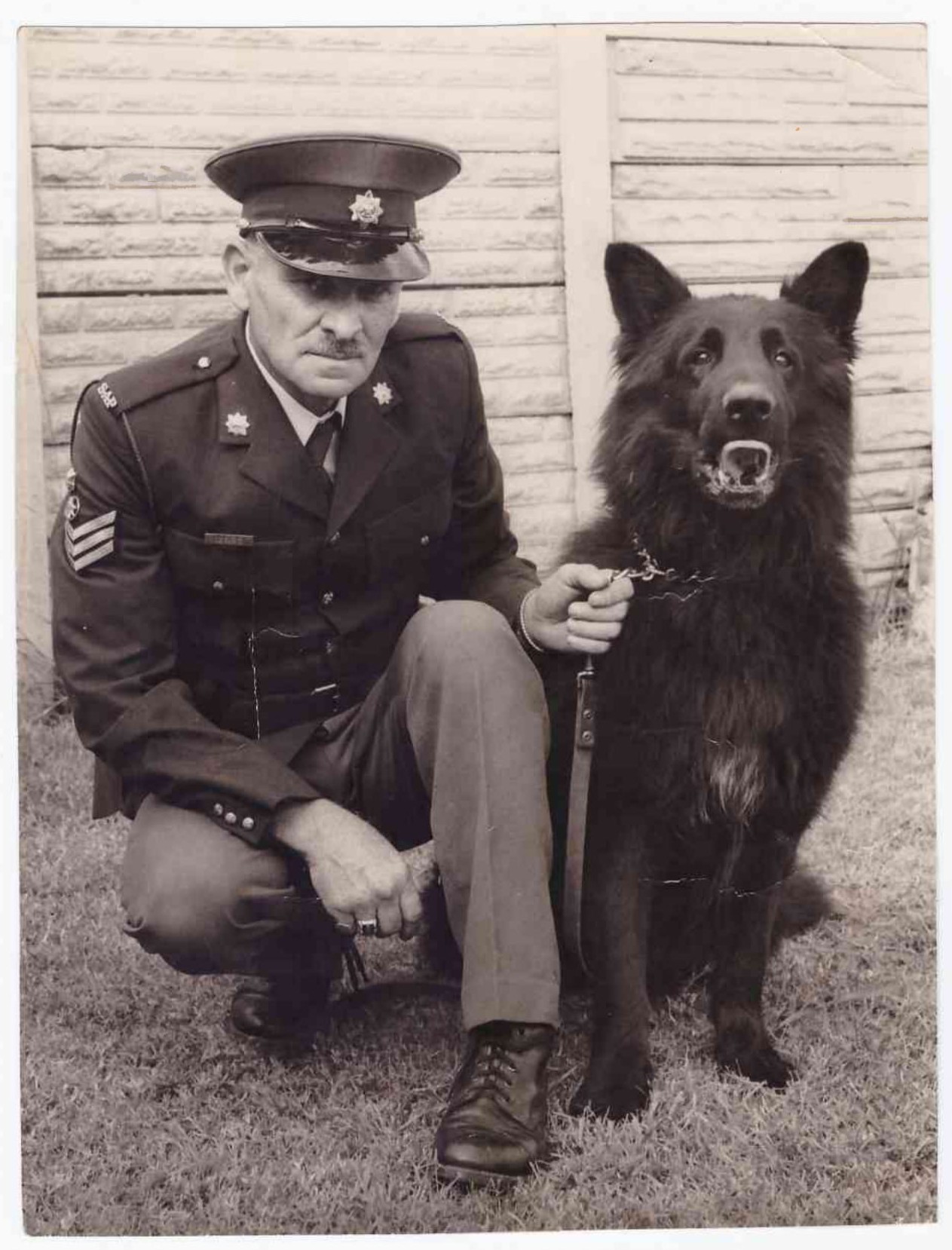
Warrant Officer CLE Stone with his dagga dog Lobo
PROMOTION TO THE RANK OF SERGEANT
In 1980 he was promoted to the rank of Sergeant. He recalls that Sergeant Johnny Govender (Colonel) encouraged him to write. After his promotion he was appointed as a Relief Commander in the charge office. His duties entailed supervision and control over one of the teams.
COURSE AT MECHANICAL SCHOOL BENONI
In 1981 he was nominated for a Mechanical Course in Benoni for 6 weeks. The course involved tuition, theoretical and practical instruction in the driving, care, handling and maintenance of police vehicles. In those years the duration of the course was 6 weeks considering it was an advanced and Intensive course to promote safety of both humans and preservation of State-owned property.
SOUTH AFRICAN POLICE
MECHANICAL SCHOOL
BENONI
Group 1 march to April 1981
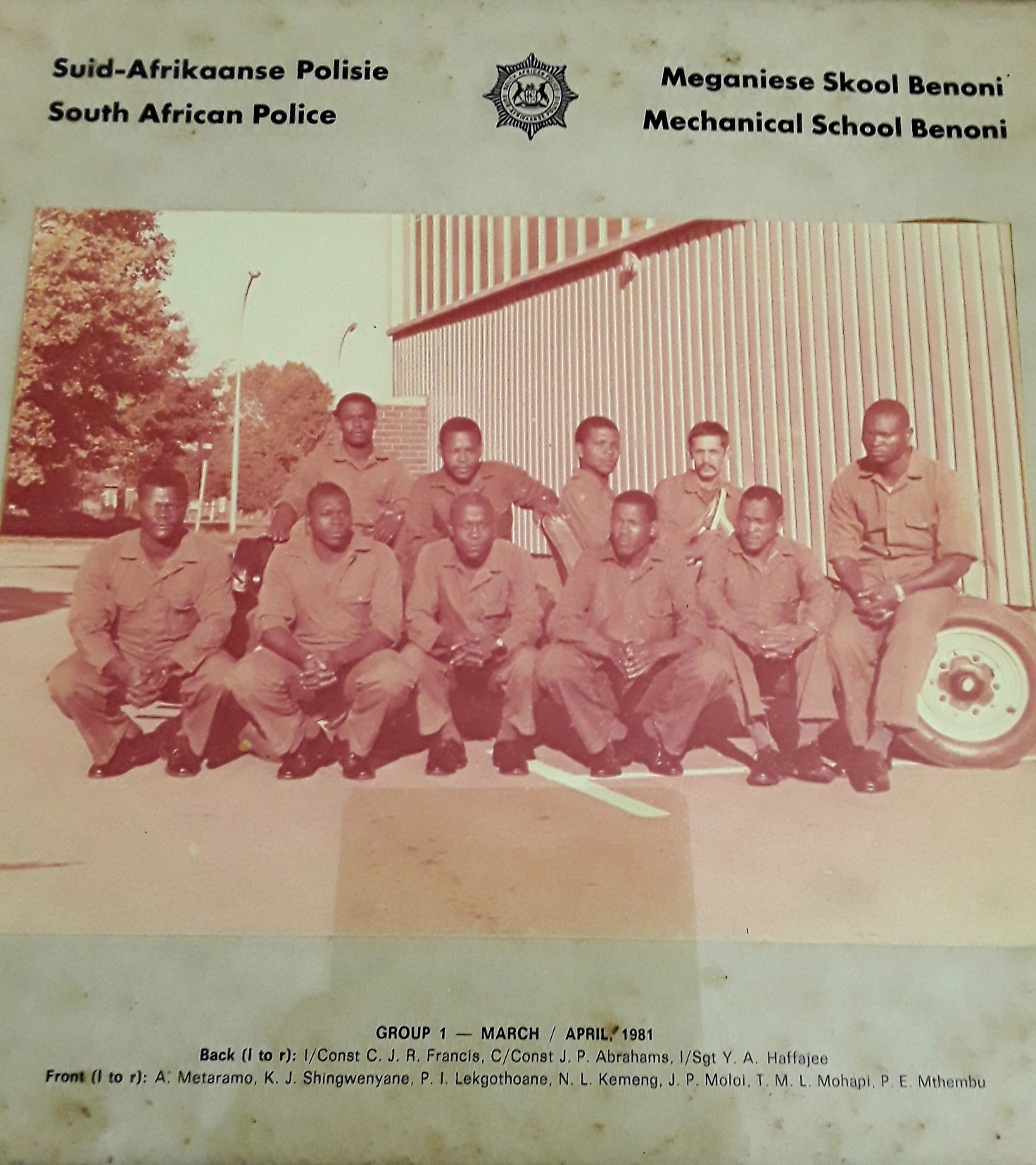
Back row – 1st from right – I/Sergeant YA Haffajee
After successful completion of the course in 1981 he returned to the station where he was permitted to drive State Motor Vehicles. He was posted to the charge office as a van driver, attending complaints, motor vehicle accidents, etc
During 1982 he was appointed to take charge of the Prevention of Crime Unit.
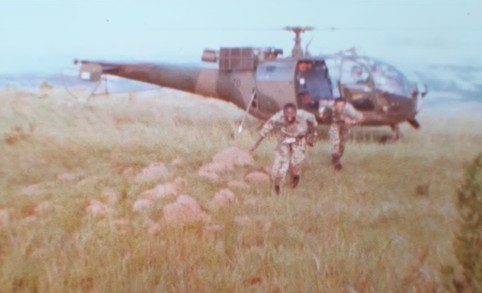
Tugela Ferry faction fight 1983
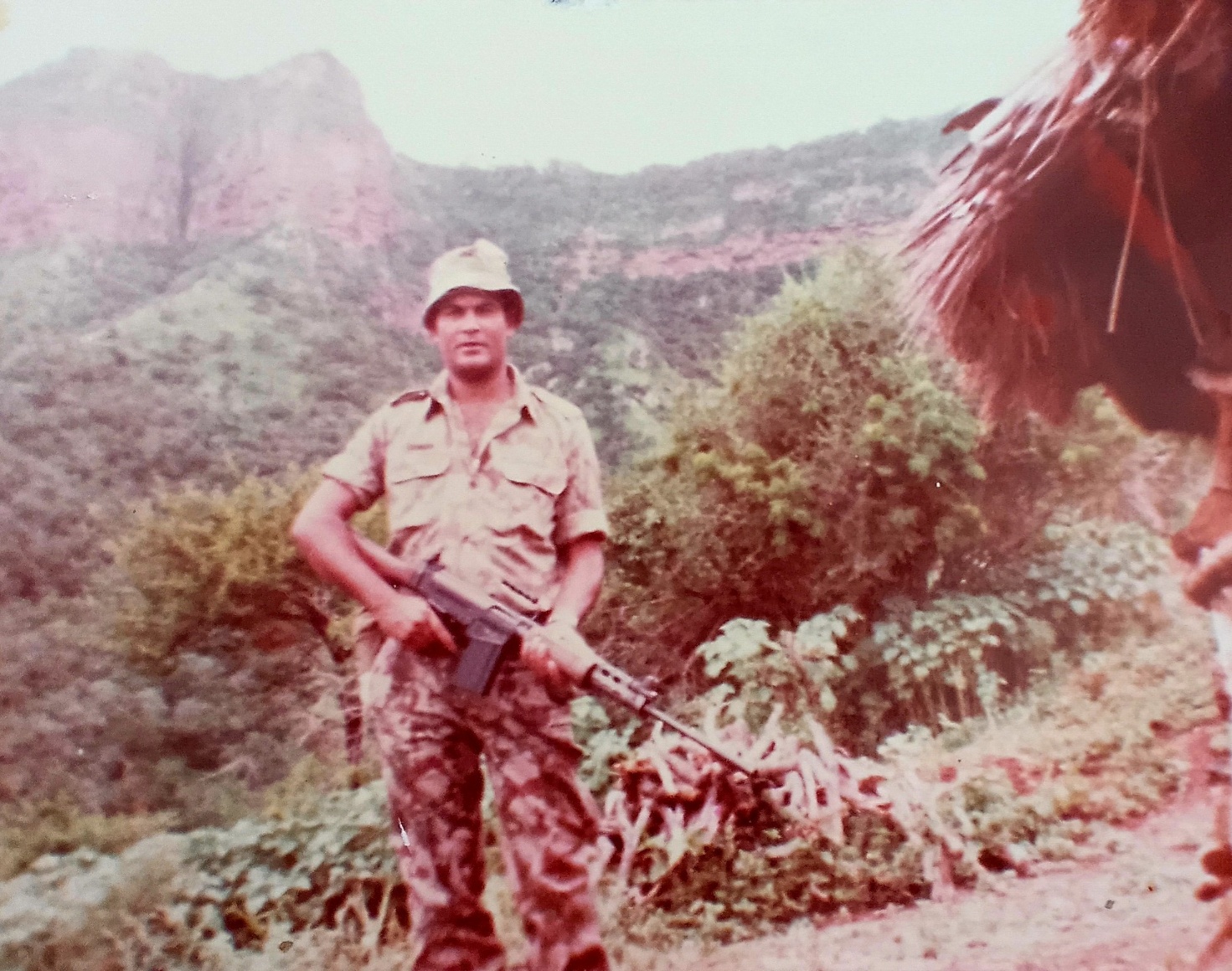
Constable Jack Gounden, with an R1 rifle in Tugela Ferry
During 1984 he was nominated to attend a Counter Insurgency Course in Maleoskop, Groblersdal. At the time of his training the new building was under construction. After successful completion of the course, he was sent back to the station of his origin, Mountain Rise.
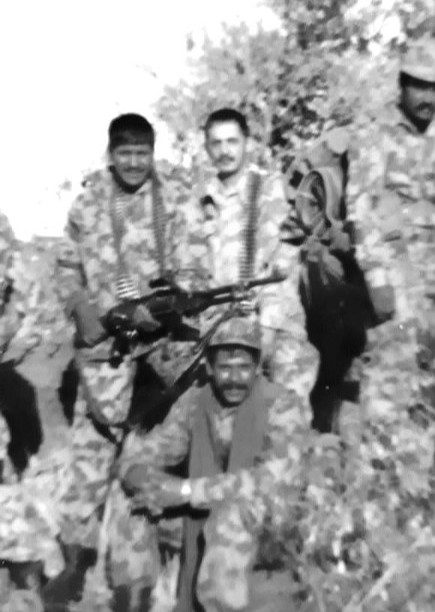
Haffajee with other members at Maleoskop in 1984
At the station he was posted back to the prevention of crime unit.
SA POLICE, PRESTBURY
During 1985 he was transferred to Prestbury where he worked in the charge office and the prevention of crime unit.
During 1987 he was appointed second in command at Prestbury.
BORDER DUTY, STAFFORD KWAZULU NATAL
During 1987 he was nominated in the same year to perform border duties at Stafford, border of Mozambique/ Swaziland. No contact with insurgents recorded. The company did patrols in Caspers. Once a week they performed duties at the border post itself. There was no Electricity or Running Water available at this base. Power generators were used and fresh water was brought in by a water tanker weekly.
He returned to his station at Prestbury on 3 December 1987 and was posted to perform Prevention of Crime duties.
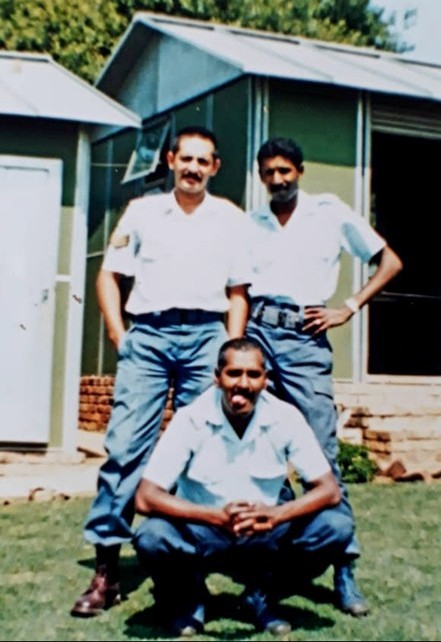
At the Stafford border post during 1987
Squatting, Constable KP Heeralal
Standing, Sergeant YA Haffajee; Constable Freedom Pillay
DISTRICT PREVENTION OF CRIME SQUAD
He was later transferred to Mountain Rise, where a combined Prevention of Crime Squad was established with members drawn from across the district. The Assistant District Commandant, Colonel Stan Gillham (Brigadier), founded and commanded the unit at the height of the conflict between the United Democratic Front (UDF) and the Inkatha Freedom Party (IFP). During this period, the Pietermaritzburg City Centre had become dangerous for ordinary citizens, who were frequently attacked, robbed of handbags, wallets, and cash, and in some cases assaulted without provocation.
The squad comprised a group of fearless officers. While he coordinated their daily functions, overall command rested with Colonel Gillham, who often patrolled the streets alongside the men to experience their challenges firsthand. Captain Kercy Pillay served as field commander, supported by the brothers, Sergeants Zulu HA and Pipes YA Haffajee.
The unit was consistently praised in local newspapers for its effectiveness in curbing crime in the city and surrounding areas. Their efforts restored confidence among residents, who could once again shop, work, and visit the City Centre without fear. The team was also deployed to other suburbs when crime trends required extra policing.
Among the unit’s many successes were the dismantling of the Kombi Syndicate operating in Eastwood from Marianhill. Numerous stolen vehicles were recovered, and the entire gang was arrested.
MARRIAGE
In January 1989 he married Captain (f) Ronel Nehal who was also stationed at Mountain Rise.
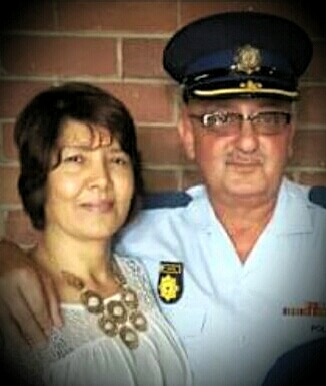
Lieutenant-Colonel Yusuf “Pipes” and Captain (f) Ronel Haffajee
SOUTH AFRICAN POLICE
TRAINING COLLEGE
WENTWORTH, DURBAN
PLATOON 3 / 1984
July 1983 to January 1984
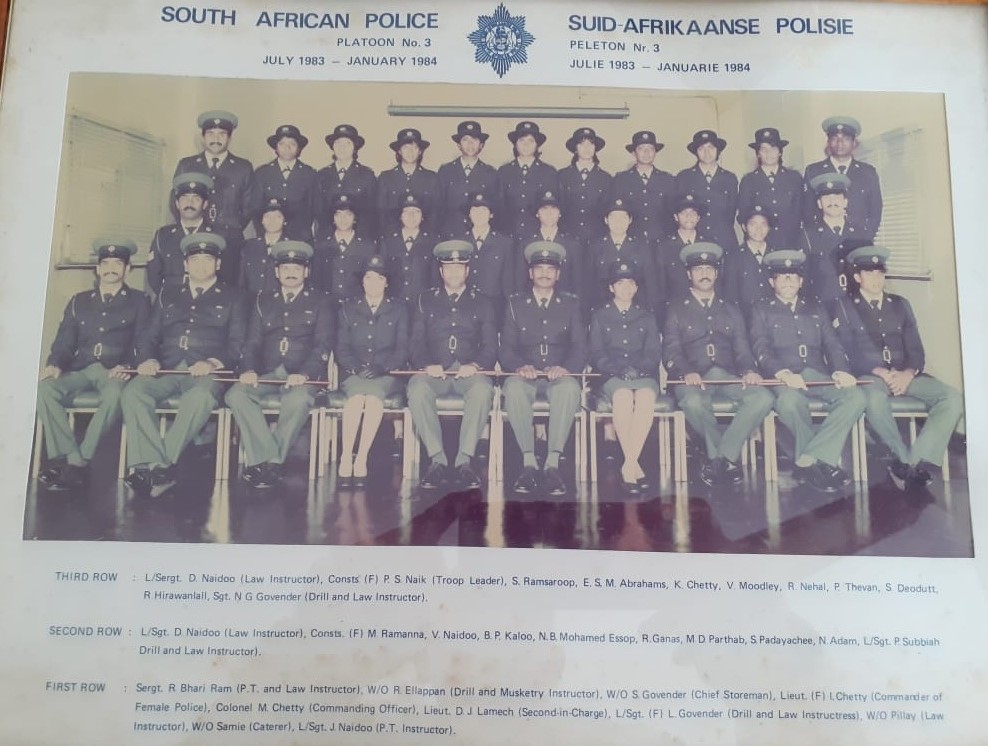
Third row, L-R, 7th Ronel Nehal
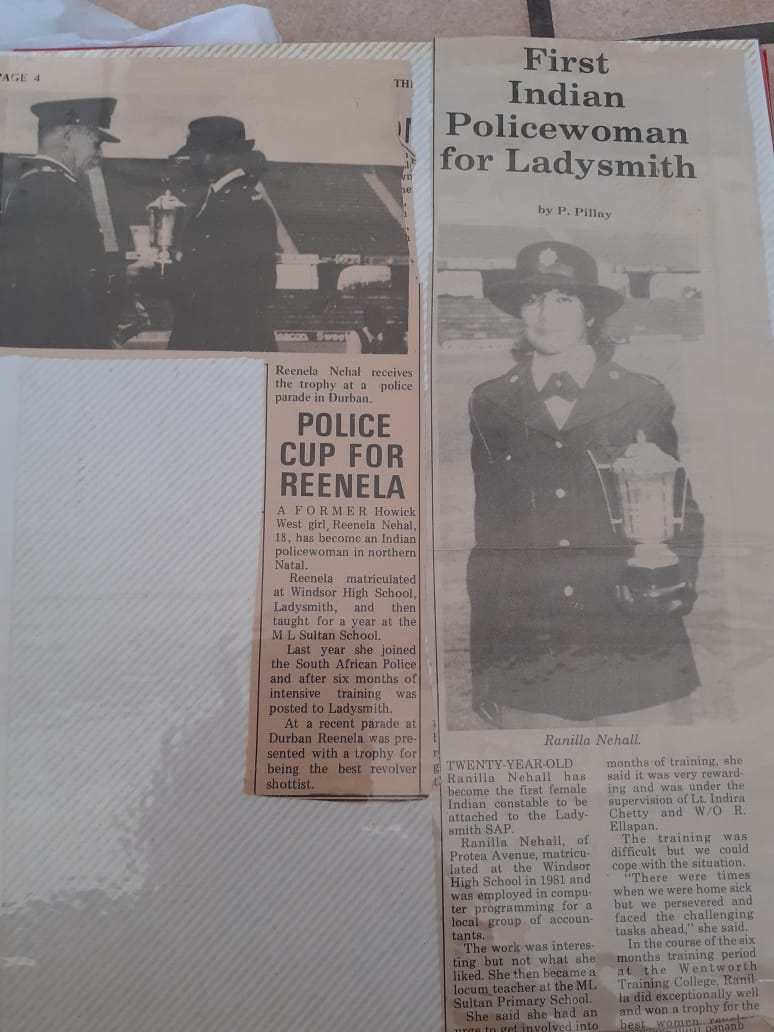
Ronel Haffajee was the first Indian female from Ladysmith (N) to be enlisted into the South African Police. She was awarded a trophy for being the best revolver shootist amongst her Troop mates at the SA Police, Training College, Cato Manor in 1984.
She is seen receiving her award.
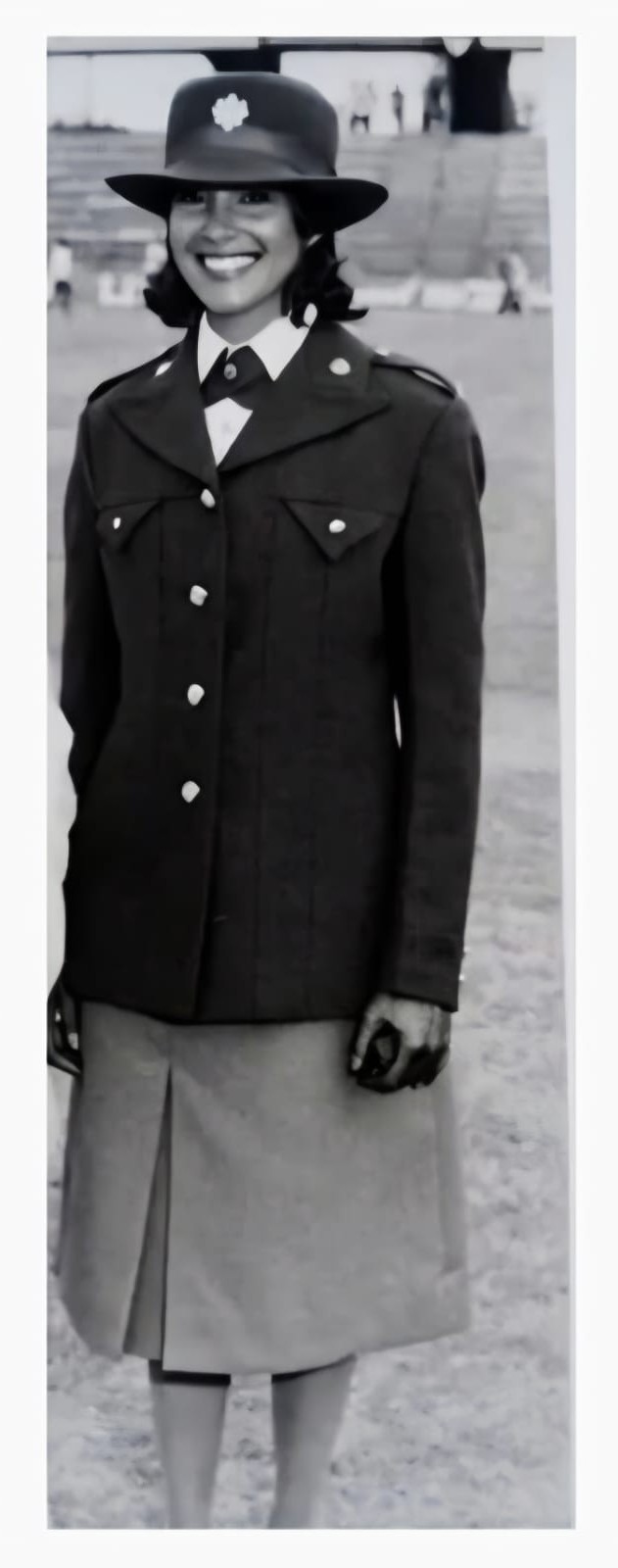
Constable (f) Ronel Haffajee
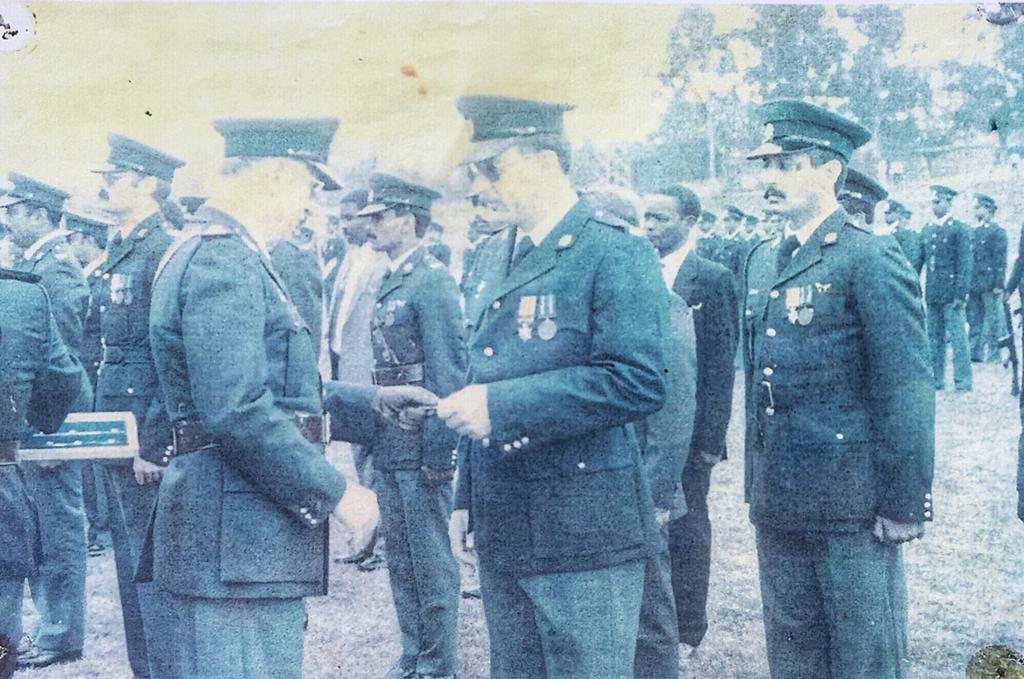
This Medal Parade was held at the Woodburn Stadium grounds in Pietermaritzburg during 1988 to commemorate the 75th anniversary of the South African Police
Sergeant YA Haffajee is seen behind the recipient awaiting the 75th SA Police, Commemorative Medal to be awarded to him.
BORDER DUTY, STAFFORD KWAZULU NATAL
During November to January 1989 Haffajee was once again nominated for border duty. He was sent to Stafford without any incident. He was tasked as the radio operator.
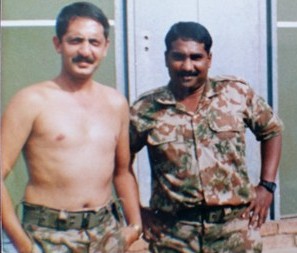
Taken at Stafford during 1989
Sergeant YA Haffajee with an unidentified member
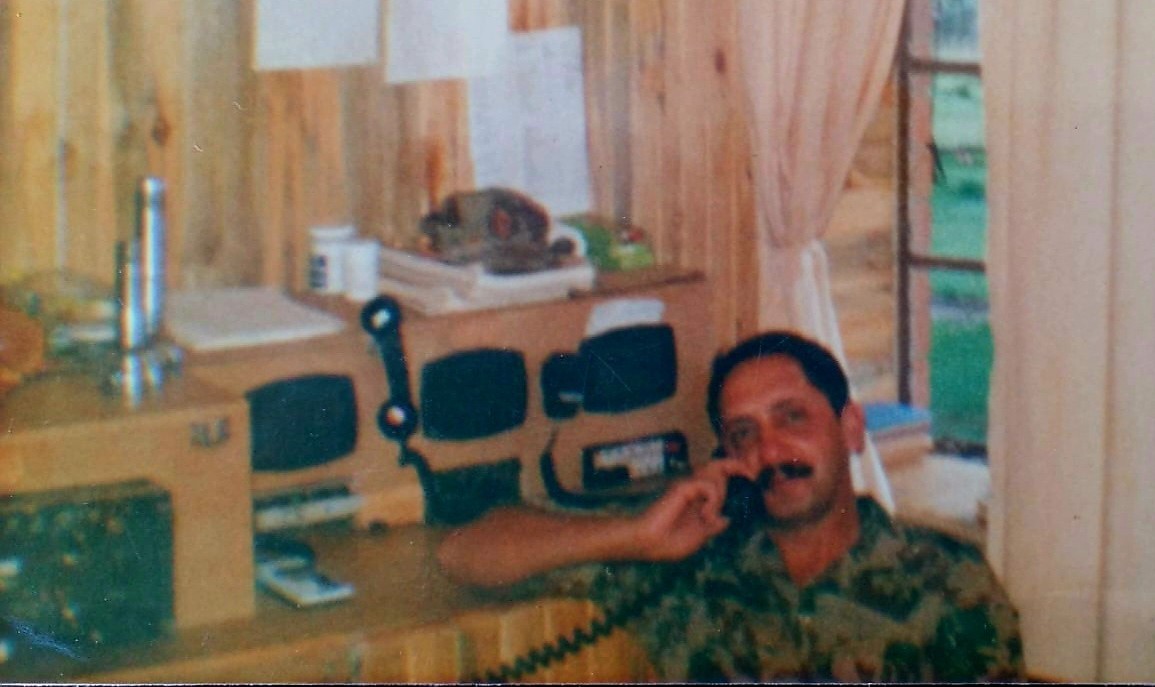
Taken at Stafford during 1989 at the Radio room
Sergeant YA Haffajee on the telephone
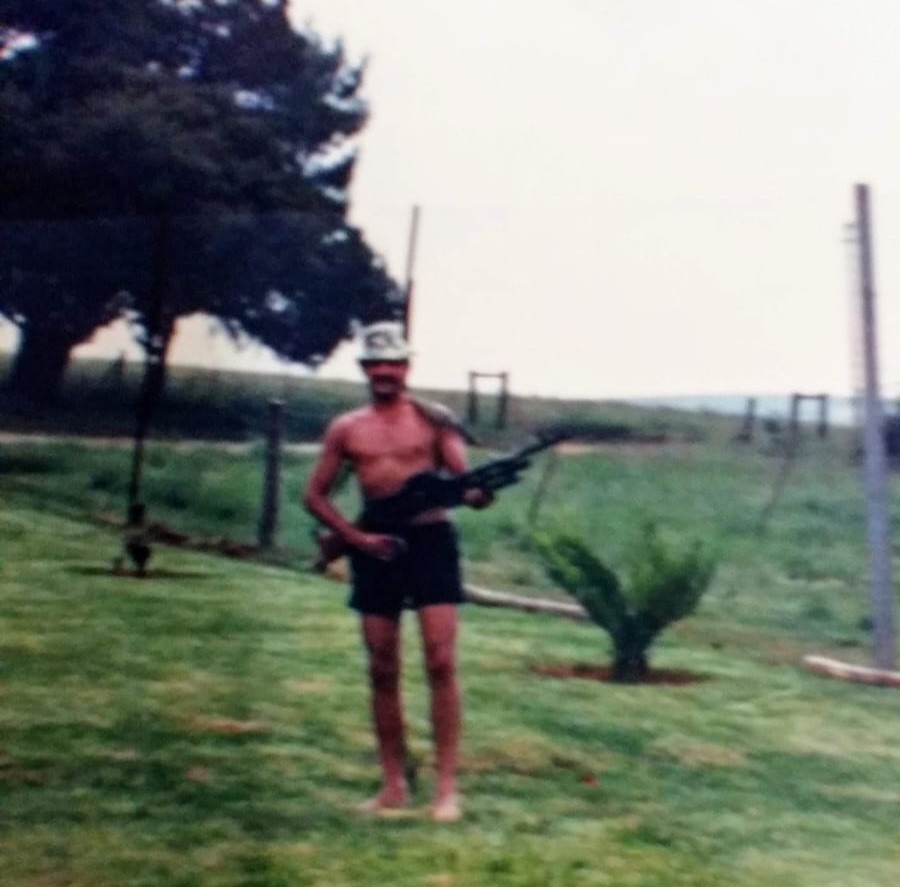
Taken at Stafford during 1989
Sergeant YA Haffajee holding a Light Machine Gun (LMG)
He was once again nominated for border duties. He returned to Stafford during the Christmas of 1989 from November to January 1990. There was no incidents. He was appointed the Radio Operator.
When he returned to the station, Mountain Rise, there was a change of command. Captain Hari Badul was appointed the station commander.
SA POLICE, MOUNTAIN RISE, PIETERMARITZBURG
Haffajee was instructed to form a “Business Watch”. The purpose was to ensure that businesses and shoppers were safe and protected from the criminal elements that usually hang or loiter around business premises, harassing businesspersons and their customers. The Unit consisted of 30 members. Members who possessed valid motorcycle licence were allowed to patrol on police motorcycles, whilst others on pedal cycles. (members using the pedal cycles were compelled to undergo a course). Others were tasked to patrol business premises or shopping malls on foot.
Within the same year he wrote and successful completed the police matric examinations.
PROMOTION TO THE RANK OF WARRANT OFFICER
In 1993 he was promoted to the rank of a Warrant Officer. After his promotion the various other police agencies were amalgamated into the South African Police. He was tasked with arranging and setting out their duties.
PROMOTION TO THE RANK OF CAPTAIN TRANSFER TO THE MOUNTAIN RISE, DETECTIVE BRANCH
Later in 1996 he was promoted to the rank of a Captain and was nominated as detective at Mountain Rise. The duration of the course was for 6 weeks.
COURSES ATTENDED WHILST BASED AT DETECTIVE BRANCH
Whilst in the Detective Branch he underwent the following courses as an investigating officer :-
Investigation Courses;
CAS Managers Course;
Motor Vehicle Circulation Course;
Forensics Course;
Entomology (Entomology is the scientific study of insects, a branch of zoology. In the past the term “insect” was vaguer, and historically the definition of entomology included the study of terrestrial animals in other arthropod groups or other phyla, such as arachnids, myriapods, earthworms, land snails, and slugs) and larva of the household fly. The reasoning behind this was, if a body was located in a field with such samples the investigating officer could determine the area the deceased emanated from.
DNA BIOCHEMISTRY deoxyribonucleic acid, a self-replicating material which is present in nearly all living organisms as the main constituent of chromosomes. It is the carrier of genetic information.
Confessions & Pointing out of Crime scenes;
Cyber Workshop (Cell phone towers);
Gambling – Investigating of casinos, held by The Gambling Board.
During the interview, the humble officer said something that showed his modest nature, even though his colleagues, the media and the public saw him as a legend.
“I may have attended many training courses, but practical experience was my best teacher,” said Haffajee.
He was appointed Acting Branch Commander of the Detective Branch in Mountain Rise. However, he was later chosen to lead the KZN Midlands Rape Project Team, where he served until 2007, when the Area Commissioner’s office was closed.
At the time, Major General Tyrone Davis (now deceased) was the Area Commissioner and later became the Station Commander of Pietermaritzburg Central Police Station. His second-in-command, Brigadier H Badul, returned to Mountain Rise as Station Commander.
Haffajee was then transferred back to the Mountain Rise Detective Branch.
RICHMOND
In 1998 Haffajee was detached to Richmond. Richmond was in turmoil plagued by political murders. The whole world focused their attention to Richmond. News broadcasters from CNN; Fox; NBC; ABC had satellite television stations erected outside the Richmond Police Station. Evenings were dreaded because of the dark and normally it became a hive of activity like days of the West. Human caravans of whole families would walk to the City Town Hall and encamp in and around for self-protection as a state of disorder and lawlessness would prevail in the surrounding townships of Richmond.
Battalions of the National Defence Force, South African Police Services and South African Naval Services were detached to restore law and order and peace to the area until an amicable political solution was found.
It is reported that the unrest was propagated by rebel forces between the Inkatha Freedom Party (IFP) and the African National Congress (ANC).
However, despite the huge military presence killings of whole families was frequently reported on some mornings. It was reported that accusations were levelled at a prominent member of a political party. He subsequently resigned and formed a group known as the United Democratic Front (UDM). The violence then escalated in the Magoda township of Richmond. Residents of Magoda district were forced to pass Ndaleni district. A Joint Operation Committee (JOC) to co-ordinate the operations of the Joint Forces were formed. Captain Yusuf Haffajee was delegated to man and co-ordinate such efforts in June 1998.
SA POLICE, RICHMOND, BRANCH COMMANDER, DETECTIVES
In September 1998, political violence in Richmond became so severe that the local police could no longer cope. The police station was closed and taken over by the National Intervention Unit (NIU). Captain Haffajee was appointed Branch Commander of the Detective Branch. Because of the heavy workload, a Special Investigations Unit was also created, led by Superintendent Clifford Marion (later Brigadier).
At provincial level, General Truter was placed in charge of detectives in KwaZulu-Natal. The Provincial Commissioner at the time was Lieutenant General Serfontein.
Prominent political figures in Richmond were being killed almost daily. In one early incident, a family of five was murdered. Most attacks happened at night, and neighbours were too frightened to leave their homes until morning. According to available information, no arrests were made in that case.
One particularly shocking scene involved a large family who were attacked during what appeared to be a prayer or thanksgiving gathering. They were sprayed with bullets while eating. Some victims were found with food still in their hands. Children were found lying as if asleep. Even the family’s pets were killed. It was a brutal and heartless crime scene.
Violence increased further after the ambush of a key political figure who had left the ANC to join the UDM. He had stopped outside a supermarket when his car was riddled with bullets. Both he and his passenger were seriously injured. Trying to escape, he drove into a side street but lost control and crashed into the Richmond Clinic. One victim was treated locally, while the other was rushed nearly 40 kilometres to Pietermaritzburg MediClinic. Sadly, he died on the way.
After this attack, Richmond became a major hotspot for shootings and killings. Many ordinary citizens visiting the town centre carried high-calibre firearms to protect themselves or to discourage attacks. The town began to resemble a war zone.
Senior police generals from Head Office in Pretoria and other forces arrived by helicopter. Aircraft were constantly landing and taking off. In another tragic case, a family of eleven was murdered late at night. Armed officers guarding the area saw a lone gunman fleeing. He was shot dead, and an AK-47 rifle was recovered.
Superintendent Clifford Marion and Advocate Chris McAdam were appointed to lead a specialised team of experienced investigators to handle the high-profile killings.
In addition, 185 extra police officers and around 300 defence force members were deployed to Richmond. Members were rotated every three months. The defence force built a camp in a nearby forest called “Halala”. Military motorcyclists, paratroopers and mounted soldiers filled the area. The navy managed radio communications. Helicopters and powerful searchlights patrolled the skies. The situation felt like a scene from a “war movie”.
In 1997, a prominent community leader, who was then Deputy Principal of Richmond Combined School and later became Mayor of Richmond, was attacked several times outside his home along with his deputy. Police and private armed guards provided ongoing protection, and a sentry post was built outside his house.
The crisis attracted national attention. The National Police Commissioner, General George Fivaz, together with Lieutenant General Andre Pruis, and Major Generals Morgan Chetty and John Manuel, visited Richmond to assess the situation.
For his dedication and commitment during the State of Emergency, Captain Haffajee received a commendation from Lieutenant General Andre Pruis.
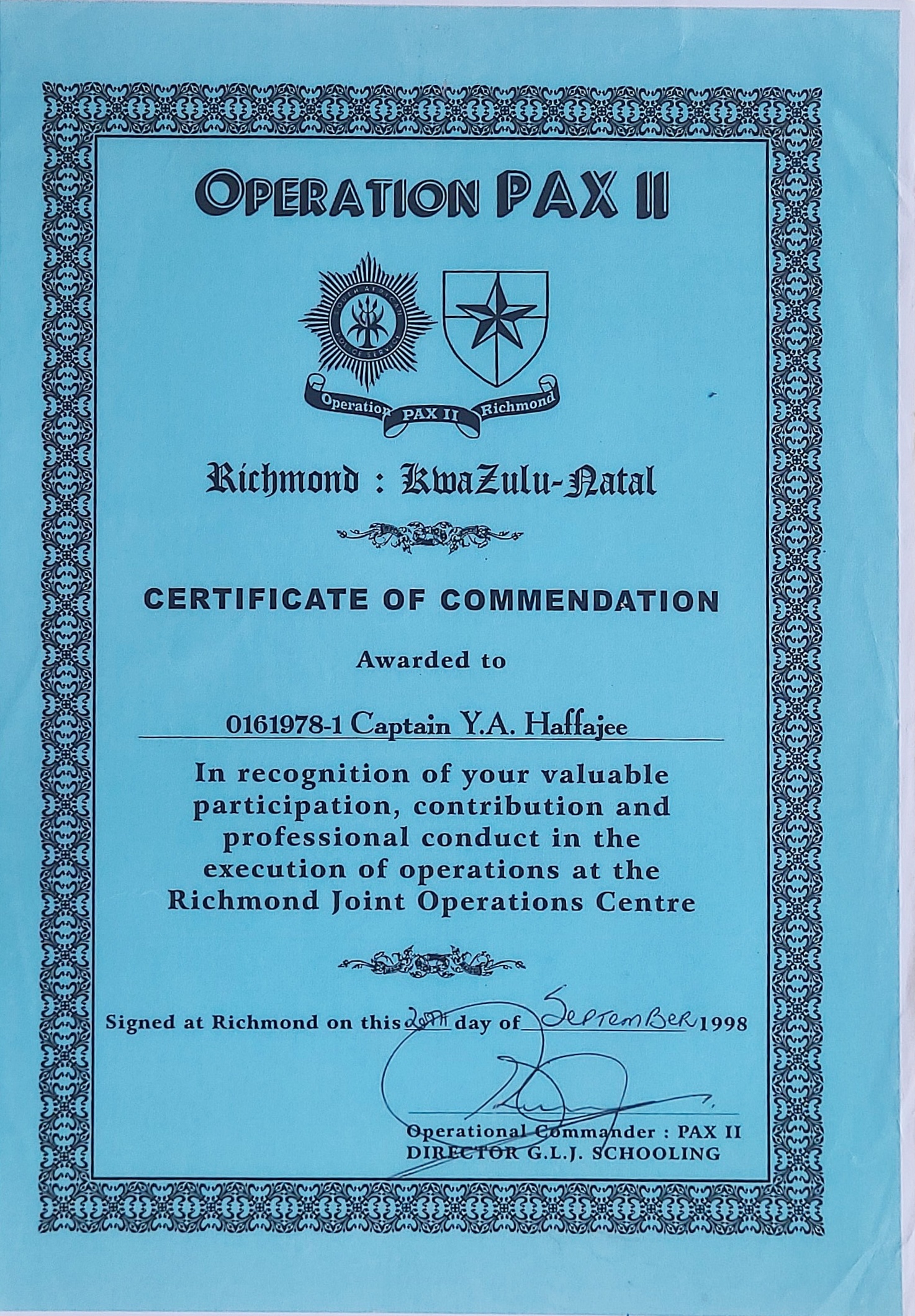
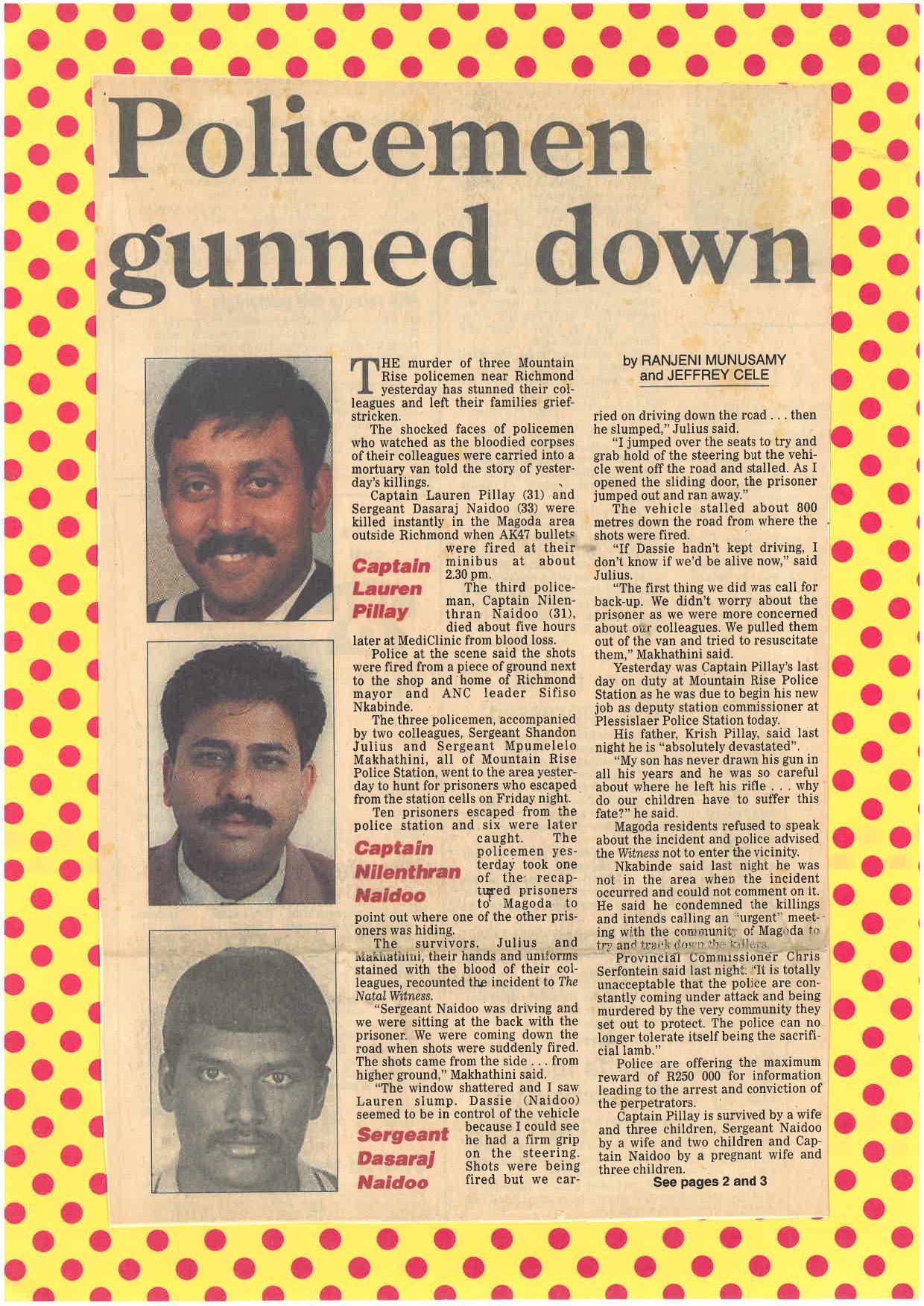
Media article “Policemen gunned down”
Police Officers and embers were ambushed in Richmon (N) on 1996-03-17
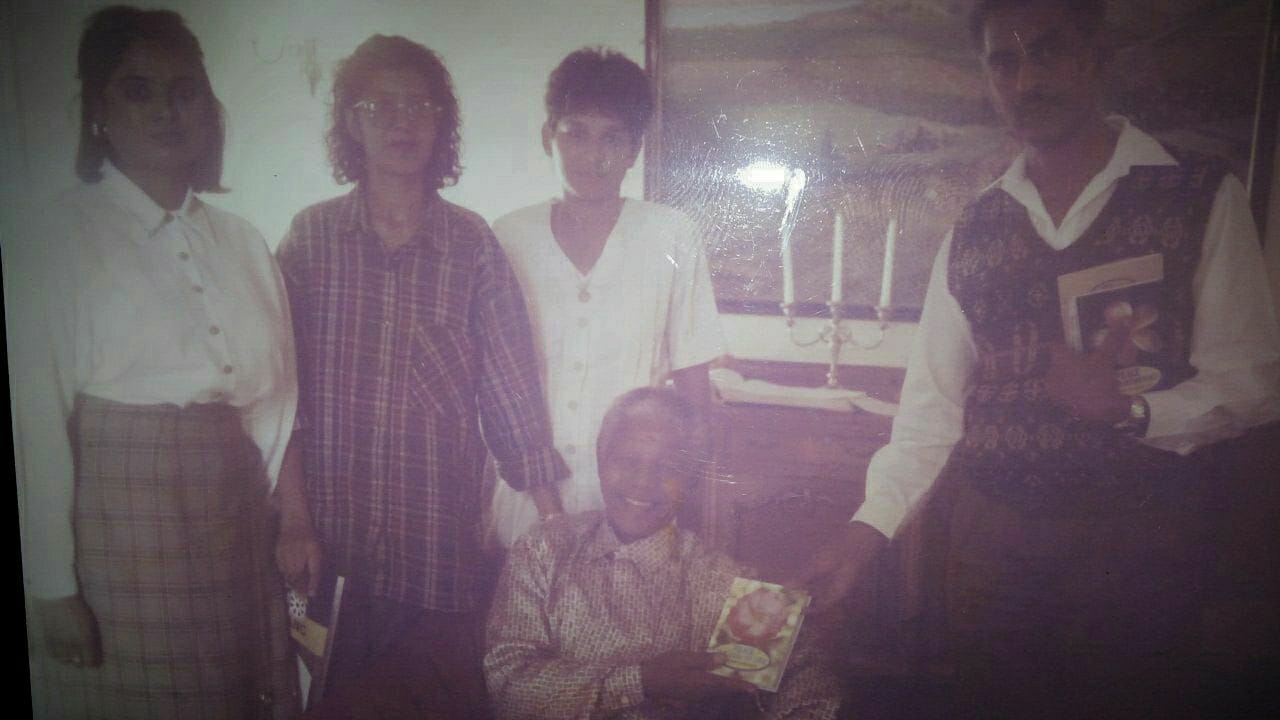
The President, Mr NR Mandela met with the families of the three police officers who were ambushed in Richmond on 1996-03-17 for the purposes of reconciliation and forgiveness at the Pietermaritzburg City Hall on
1996-05-05
Seated up front, President NR Mandel
Rear row, L-R, Colonel Coleen M Paul; Captain Ronel Haffajee (wife of Lieutenant-Colonel YA Haffajee); Mrs Trixie Naidoo (wife of Captain N Naidoo); Mr Krish Pillay (Dad of Captain LK Pillay)
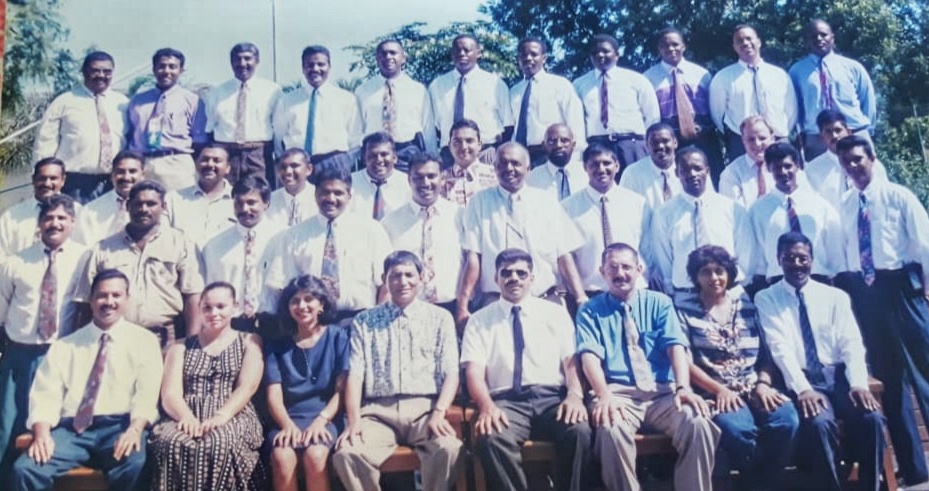
The team of Detectives based at SA Police, Mountain Rise during 1997
7th from left, Captain YA Haffajee
SA POLICE, MOUNTAIN RISE, DETECTIVE BRANCH
During 2001 he returned to Mountain Rise and was tasked with cases of Theft out of motor vehicles.
ORGANISATION OF AFRICAN UNITY (OAU)
AFRICAN UNITY (AU)
On 9 July 2002, President Thabo Mbeki hosted African leaders in Durban for the final summit of the Organization of African Unity (OAU), marking the transition to its successor, the African Union (AU). As South Africa was both host and foundational leader of the new AU, security at the summit was extensive and meticulously coordinated.
Captain Haffajee was selected for duty at the event and stationed at the Hilton Hotel entrance, a central location for receiving heads of state and international delegations. His team was responsible for verifying credentials of foreign dignitaries, including leaders from Egypt, Tunisia, and Zimbabwe. Coordination with the hotel concierge helped them anticipate arrivals, as the concierge would roll out the red carpet before a head of state entered. Attendees wore accreditation tags indicating their level of importance; those with red accreditation could pass freely, while others were required to surrender firearms for safekeeping if the security scanners detected them.
A notable moment involved the arrival of Libyan leader Mu’ammar Gaddafi, whose entourage transported his personal Mercedes-Benz by plane. A SAPS officer drove the vehicle from the airport to the Hilton. Gaddafi’s heavily armed bodyguards carried compact submachine guns concealed in suitcase-style carriers and refused to relinquish their weapons, instead remaining near the secured strong room. Because Haffajee was Muslim, he was permitted to stay in their presence.
One floor of the Hilton had been converted into a commercial area selling clothing, food, and souvenirs. Prices doubled shortly before the arrival of foreign delegations. When Gaddafi entered one clothing shop, all other customers were evacuated. He casually selected garments and tossed them toward staff, and payment was made from a briefcase filled with US dollars.
Throughout the summit, the Joint Operations Centre (JOC) was housed within the Hilton, coordinating all security and operational activities for the event.
THE WORLD SUMMIT ON SUSTAINABLE DEVELOPMENT (WSSD)
Held in Sandton, Johannesburg, from 24 August to 6 September 2002, the World Summit on Sustainable Development brought together tens of thousands of people. These included Heads of State and Government, national delegates, and leaders from non-governmental organisations (NGOs), businesses and other major groups. The aim was to focus the world’s attention and take action on serious global challenges. These challenges included improving people’s lives and protecting natural resources in a world with a growing population and increasing demands for food, water, housing, sanitation, energy, health care and economic security.
After attending the African Union (AU) gathering, he was nominated to carry out duties at this summit. However, he was assigned to patrol on foot in the arrival and departure lounges at OR Tambo Airport from midnight until midday. The planes carrying the various dignitaries usually arrived between 4:00 am and 5:00 am.
On one occasion, he overslept at a restaurant and was rudely awakened by guests.
INAUGURATION OF PRESIDENT THABO MBEKI
President Thabo Mbeki took the Oath of Office for his second term on 27 April 2004. He was sworn in on the steps of the Union Buildings in Pretoria. The ceremony took place on Freedom Day, the national holiday that celebrates South Africa’s first democratic elections in 1994. It was also the 10th anniversary of the country’s freedom.
Haffajee was assigned to work at Waterkloof Air Base. Waterkloof is a military air base and does not normally require immigration officials. His duty was to lead the group of foreign dignitaries from their aircraft to a temporary immigration checkpoint, where their passports were stamped. They were then transported under escort to the Union Buildings. He saw the arrival of several delegations, including those from France, Chile and Zimbabwe. Later that afternoon, the foreign leaders returned to their home countries.
In 2006 he headed the first FCS Rape Project Team for KZN Midlands.
During 2007 the offices of the Area Commissioner KZN Midlands ceased to operate. Major General Tyrone Davis former Area Head was transferred to Pietermaritzburg Central as Station Commander; Brigadier Hari Badul his deputy reposted to Mountain Rise as Station Commander. The different project teams were also suspended, and the members were distributed between these two stations. The Detective Head, Colonel Griesel became the Detective Head at Mountain Rise, he was joined by Lieutenant Hamilton.
SOME OF THE MURDERS INVESTIGATED
MURDER NO 1
VICTIM – ELAINE ANDERSON
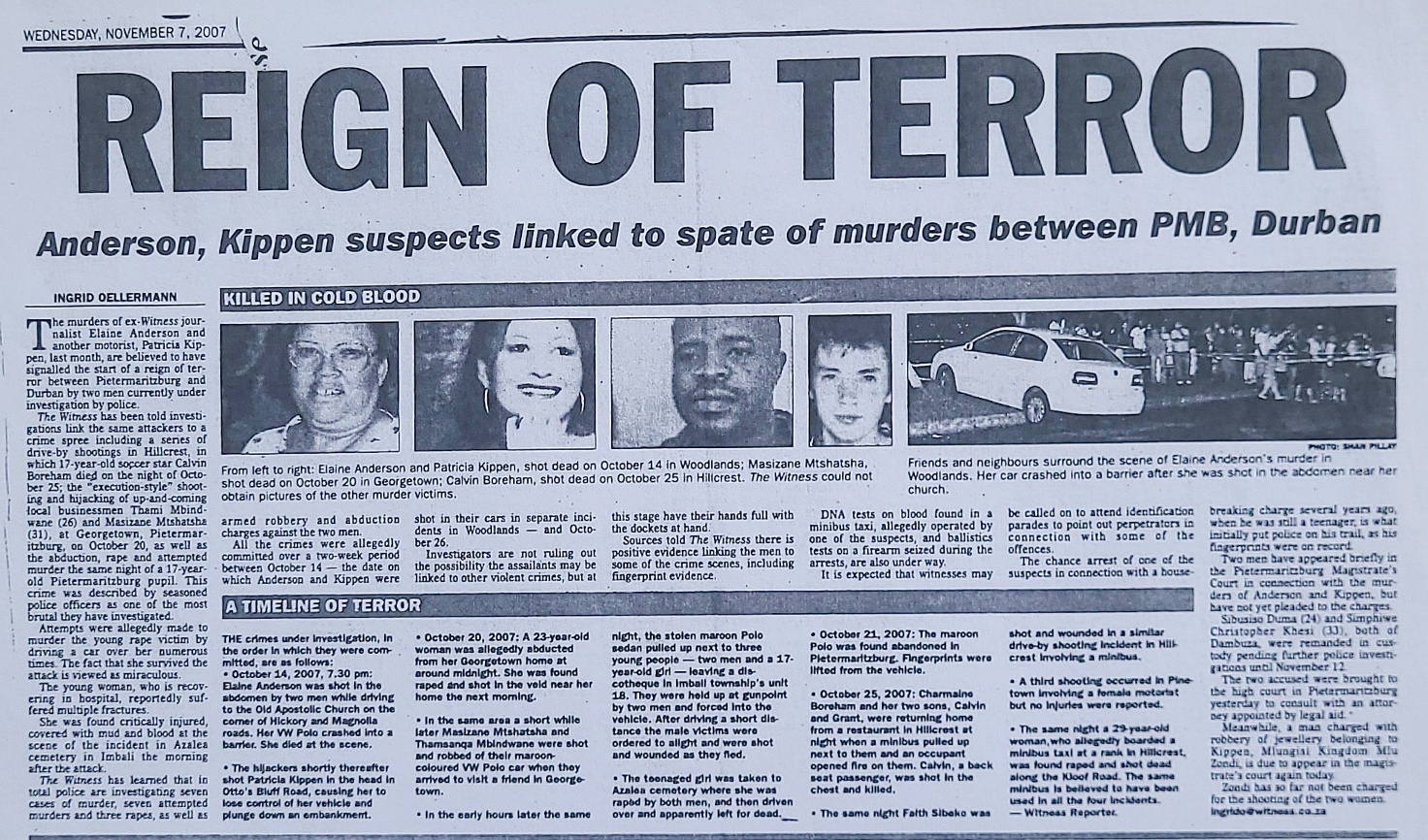
On a Sunday afternoon the 14th day of October 2007, a prominent Pietermaritzburg Journalist based at The Witness, dropped off her daughter at The Old Apostolic Church (South Africa) in Magnolia Road, Woodlands, Pietermaritzburg. As she was driving away two persons tried to open the driver’s door, to either rob or hijack her, but she manged to drive off. Shots were fired by the assailants, and she was struck. She lost control of the vehicle, and it veered onto a steel barrier in Otto’s Bluff Road where the vehicle came to a halt.
Netcare 911 spokesperson Chris Botha said Anderson had been shot twice and was declared dead on the scene.
The Witness newspaper said it was “very shocked” to hear about Anderson’s death.
“She was a very nice person and very involved in her community. She was one of those people that others turned to for help,” said an editorial staff member.
MURDER NO 2
VICTIM – PATRICIA KIPPEN
On the same day, another fatal shooting occurred within the same area. Patricia Kippen was driving along Camphor Road when the same two men, who had been seen walking nearby, fired at her vehicle. She was struck by a bullet in the head, lost control, and landed in a ditch in Otto’s Bluff Road adjacent to an informal settlement, some residents of the settlement attempted to loot both the vehicles and the deceased of their possessions.
Detectives, forensic experts, and a vehicle examiner processed both scenes and motor vehicles. Local enquiries revealed that a gold necklace had been taken from Kippen’s body.
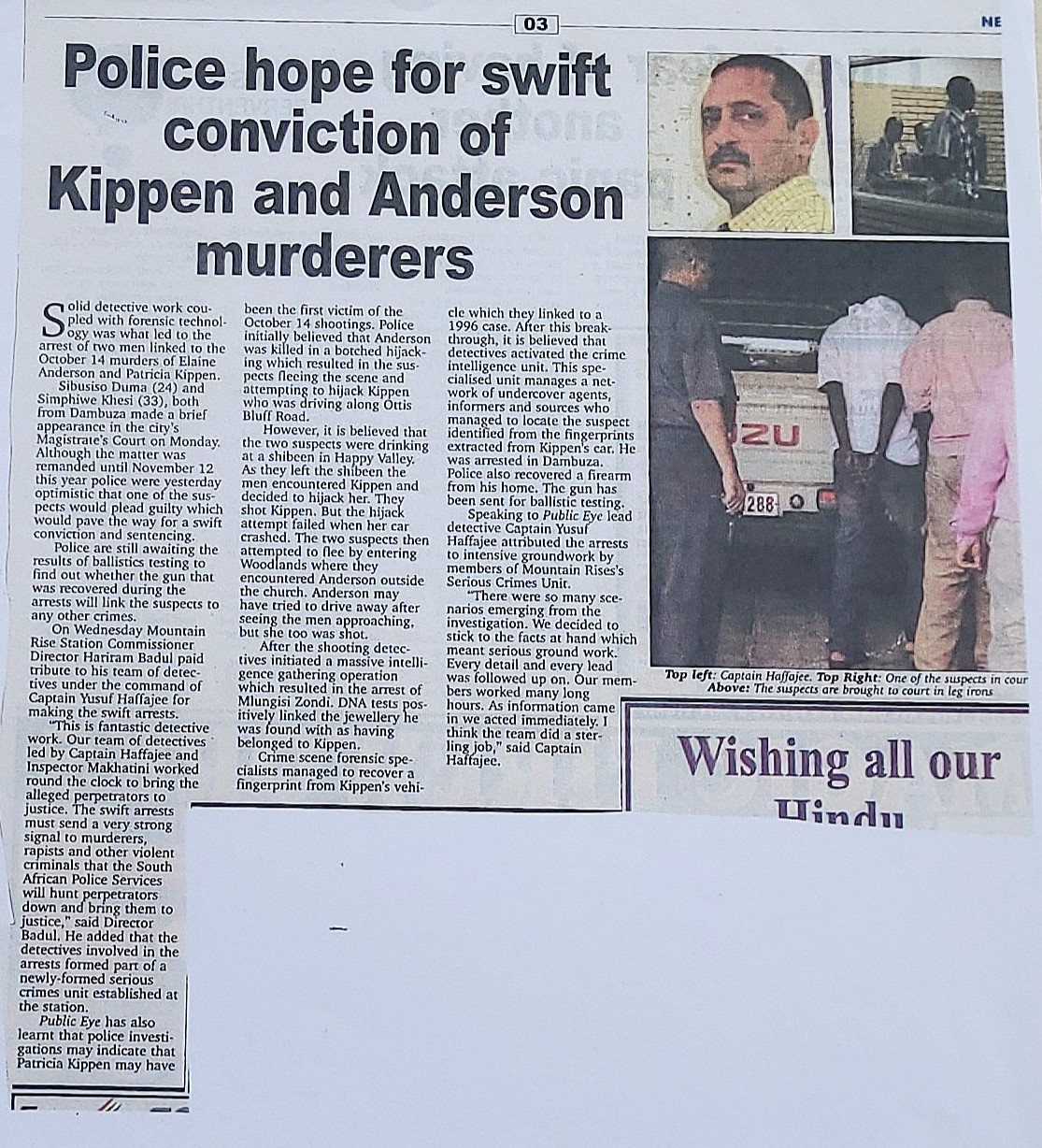
A breakthrough came when a single fingerprint was lifted from Anderson’s car door handle. It matched a man with a prior dagga conviction and listed his grandmother’s home address. (Emphasis was always placed upon this factor at our monthly internal police lectures, i.e. completion of Fingerprint forms, SAP 76 to be done properly, clearly and correctly, particularly the place of abode of the person whose fingerprints were been taken. In the event that he / she could easily able to be traced, even years later. – [LG]).
Detectives traced him to grandmother’s new residence in Petrich, where he was arrested, a firearm was recovered. After questioning he confessed to the killings and elected to make a free and full confession. He also identified his accomplice, who was also later arrested. Both suspects pointed out the crime scenes, they were then charged and ultimately convicted of murder and sentenced to life imprisonment. The case was prosecuted by Mrs Kander and heard by Judge Stan (surname unspecified). The investigation was led by Captain Haffajee together with Warrant Officers Sizwe Makhathini, Shabangu, and Sergeant Madonsela.
A taxi owner and his conductor were each given two life sentences and two long jail terms for the murders of Elaine Anderson and Patricia Kippen.
Taxi owner/driver Sibusiso Duma, 24, and his conductor, Simphiwe Khesi, 33, pleaded guilty to the two murders, aggravated robbery, attempted aggravated robbery and illegal possession of a handgun and ammunition.
After the men were sentenced, they applied for leave to appeal.
However, KwaZulu Natal Judge President Vuka Tshabalala said that it was precisely for these types of crimes that the legislature had enacted life sentences.
The court found no substantial and compelling circumstances that enabled it to deviate from the prescribed sentences for Duma and Khesi.
Khesi had in 1993 been sentenced to 17 years in jail for aggravated robbery. He was on parole when he committed these murders.
Despite speculation linking the men to a series of Hillcrest murders occurring at the time, investigators confirmed that the cases were unrelated.
NB – “There was immense speculation by both the media and police that the accused’s were connected to a series of murders committed in the Hillcrest area at the same time. However, this was proved to be incorrect, says the crack detective”. – (Haffajee)
MURDER NO 3
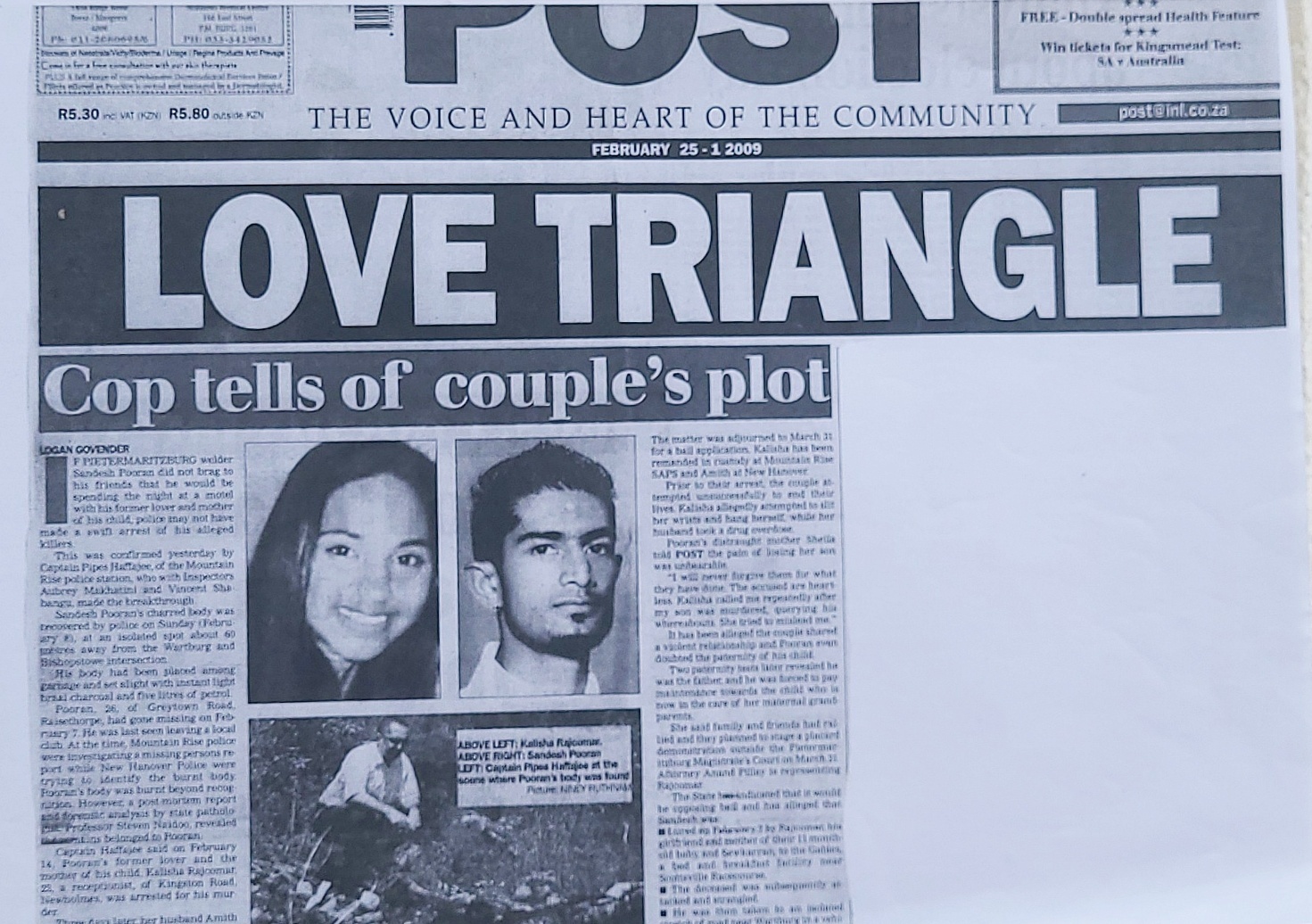
LOVE TRIANGLE
A missing person’s report SAP 55(A) was filed at Mountain Rise on a
The information circulated by the Pietermaritzburg Pathological Laboratory was that the body of an unidentified black male was found. Coincidently the Investigation team got wind of this and travelled to investigate. Upon their arrival they found a charred body that was handed in and recorded as an unidentified black male.
Haffajee inspected the body and spotted a red piece of fabric attached to it. When he spotted the red fabric, it gave him an intuition that there might be a connection. This prompted him to take a DNA sample of the deceased and later one from his mother. This result was positive, and it necessitated the need for a closer examination and an in-depth investigation. An ordinary Inquest docket was changed to one of murder.
Information surfaced later that he was last seen alive enjoying drinks with friends at a local Sports Bar. A visit to the local bar and after locating his friends, brought to light that he was in a jovial mood earlier that evening as his former girlfriend, mother of his child had invited him over for a “possible reconciliation”.
Detectives made their way to the former girlfriend’s home but were told that she usually spends time at her grandparents’ home a short distance away.
They travelled to the grandparents’ home and questioned the grandmother in the presence of her husband. She said that her granddaughter went to Durban with her current boyfriend. However, she was very talkative and that made Haffajee suspicious. He left saying that if the grandmother was lying under oath after making an affidavit. Both grandparents will be charged and arrested for making a false statement and attempting to obstruct or defeat the course of justice. After hearing this, an argument ensured between the grandparents. The grandfather said he was not prepared to get into trouble and provided details of the boyfriend’s place of abode.
They visited his home, and he was not present. They interviewed and took affidavits from his mother and grandmother. A war of words ensued between the boy’s grandmother and Haffajee. He was however, told that the couple did go to Durban and were planning on marrying soon. Before leaving he issued the same warning to the mother and grandmother about making false or untrue affidavits.
Later they received information that the boyfriend was admitted to a local hospital after having attempted to commit suicide. They placed him under police guard. The Detectives then rushed and picked up the girl for questioning. She admitted going to Durban but knew nothing about the murder.
Whilst being interrogated at the station her attorney walked in and was invited to sit in on the confession to the murder that she earlier tendered. Once the confession was adduced. Haffajee would pretend to call and request footage from the various places they alleged to have stopped at after the murder.
She confessed that her former lover was lured to a local BnB under pretence of a “reconciliation” between the former lovers. He was the father of her child. The lady was in a steady relationship with someone else at this time. When the former lover arrived at the BnB the lady made him partake of a concoction of alcohol and mandrax tablets. The person became intoxicated and fell off to sleep. Her current boyfriend entered the room, and the former lover was asphyxiated with a pillow. When the deceased stopped breathing his body was loaded into the car. Braai coal and fuel were purchased after which his body was dumped along Wartburg Road. The deceased was doused with petrol and his body set alight. Braai coal was added to the fire to ensure that the body would be incinerated to ash and beyond recognition.
The BnB was visited and the owner confirmed that both suspects booked in and also the victim. 2 pillows used in his asphyxiation and a bed sheet was removed and not accounted for.
Emotions ran high in the Pietermaritzburg High Court when Kalisha Rajcoomar and her husband Amit Sewkarran wept as they hugged and kissed relatives before leaving the dock to begin serving their 18 and 14 year sentences respectively.
The couple were sentenced by Judge Piet Koen for the murder of Rajcoomar’s ex-lover, Sandesh Pooran, on February 7, 2009, in Pietermaritzburg.
Pooran was strangled at the Gables bed and breakfast and then taken to a remote area outside Pietermaritzburg, where his body was torched. The couple said they had murdered Pooran as he had constantly harassed and threatened them, despite three protection orders being granted against him.
Family and friends of the couple and Pooran packed the courtroom to listen to sentencing. After it had been pronounced and Judge Koen had left the room, there was an outburst of emotion from the gallery, testifying to his statement that “no one sentence, or penalty will satisfy all parties involved”.
Although the judge found reasons to deviate from imposing the mandatory life sentences for murder, he said that a substantial period of imprisonment was required. He said Rajcoomar and Sewkarran were young, capable of rehabilitation and unlikely to commit another crime when released. Sewkarran, said Judge Koen, was clearly influenced by his wife, if not manipulated, to commit the crime. “She has the ability to manipulate the men she shared relationships with,” he said.
Judge Koen added that there were no winners in this case, only losers. Pooran had lost his life, his family had lost a son and brother, and his acquaintances had been deprived of a friend. Rajcoomar’s three-year-old daughter from Pooran had been deprived of a father and would also be deprived of daily contact with her mother, the judge said. “Both accused have been deprived of their liberty and companionship, which they would have otherwise enjoyed as parties to a marriage,” he said, adding that their families and friends would also be deprived of their company. Judge Koen described the case as “a classic tragedy” with two men wanting Rajcoomar’s love. He also said that Rajcoomar could have sent a more clear, decisive message that she did not want anything to do with Pooran.
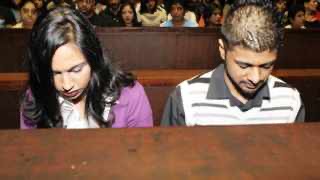
Convicted murderer Kalisha Rajcoomar was portrayed as the puppeteer and her husband Amith Sewkarran
The puppet this morning as they were sentenced to 18 and 14 years respectively. Rajcoomar and Sewkarran, pleaded guilty to the murder of Rajcoomar’s former lover Sandesh Poorun.
Pietermaritzburg high court Judge Piet Koen found there were compelling and substantial circumstances to deviate from sentence of life imprisonment. Convicted murderer Kalisha Rajcoomar was portrayed as the puppeteer and her husband Amith Sewkarran the puppet this morning as they were sentenced to 18 and 14 years respectively. Rajcoomar and Sewkarran, pleaded guilty to the murder of Rajcoomar’s former lover Sandesh Poorun. Pietermaritzburg high court Judge Piet Koen found there were compelling and substantial circumstances to deviate from sentence of life imprisonment.
MURDER 4
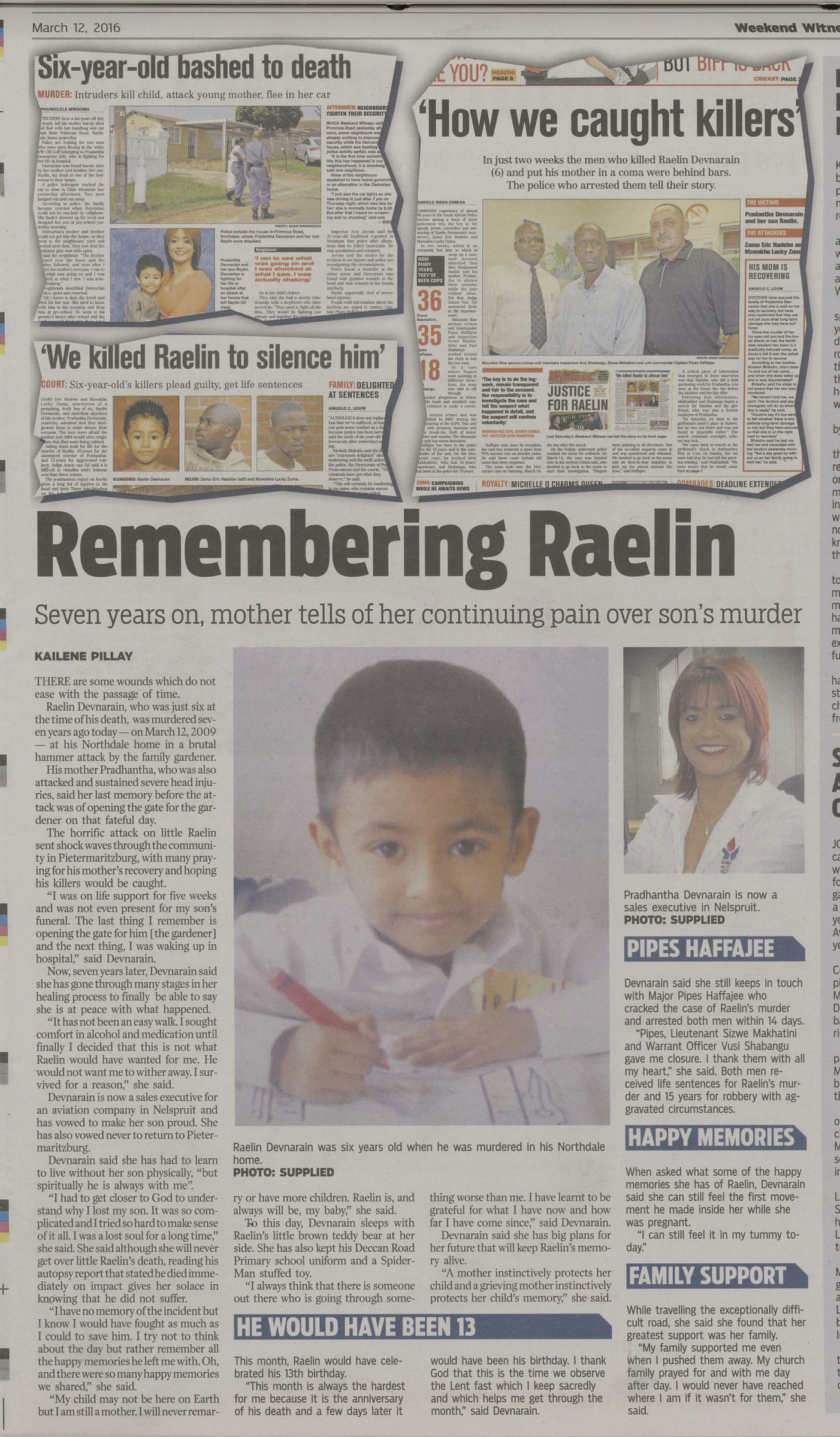
THE HAMMER MURDER RAELIN & PREDANTHA DEVNARIAN
Haffajee and his partner Captain Sizwe Makhathini just returned to the station from an out-of-town investigation. A mother and her seven-year-old son were bludgeoned on their heads with a hammer. The woman was rendered unconscious after a number of blows to her head and stab wounds to the chest. Her son did not survive the blows and was sadly declared dead on the scene. The incident was only discovered the following morning when the driver of her transport to work failed to receive a response from her. Her brother was summoned. He forced entry into the home after there was no response received after tapping her door.
Upon entering the home, he found his sister and her son both with severe injuries to the head. The sister was still alive and was rushed to hospital unconscious. This was
14 March 2009, Saturday morning, Haffajee arrived at the home to find that the home was occupied by a number of family members. He was concerned about important clues of evidence that may be trampled over and lost. In addition, there were no likely know suspects at that stage. He instructed that the home be vacated and declared the home a crime scene thereby out of bounds to unauthorized persons.
The Investigation team together with assistance from the Forensic team combed every “nook and cranny” of the home utilizing the modern Forensic Equipment available. A blue spray was sprayed into every room and with the use of an infra-red lamp light revealed marks on the shelf denoting items were removed. They discovered that miniature trophies were removed from the cabinet and items of bedding appeared to missing. The team set out on foot, visited every home in the vicinity and learnt that a male was seen seated on the kerbstone before the heinous crime was committed. After intensive questioning it revealed that he was known by a domestic worker and was previously spotted visiting someone at an informal settlement about 2 kilometres away. The investigation team visited the domestic worker mentioned and after intensive questioning revealed that the “suspect” would return
Police were informed of his arrival and the fact that he left shortly thereafter, boarding a minibus and was making his way to the CBD. A few police officers were alerted, and the “suspect” was apprehended. He had in his possession the trophies with the name of the deceased engraved on it wrapped in bedding taken from the scene of crime. The suspect was arrested but he denied the grievous assault and heinous murder but implicated an accomplice whose whereabouts were unknown.
Later that day employees of Edgar’s Clothing Store, Pietermaritzburg called the police informing them that a lady was in the process of paying for clothing with the card that had the injured lady’s name printed on it. The lady was arrested and taken in for questioning. She told police that the card was her boyfriends who resided in Swayimane location, Wartburg.
The girlfriend was then transported to Swayimane location to point out and arrest the second suspect. On their way members found Devnarain’s car abandoned at the roadside near the township.
The second “suspect” was arrested and brought to Pietermaritzburg. Upon their arrival to the station the suspect noticed his accomplice chatting with police members in a friendly manner. Presuming that his friend had “sold him out” he implicated his friend in the commission of the offences, he tendered a full admissible confession implicating his friend as an accomplice to the crime. His friend believing the same admitted to his contribution and also made a full confession.
With the two suspects and watertight evidence and confessions filed in the case docket, Haffajee hastened to place the matter on the Court Roll. The Magistrate remanded them to custody, as an early court date at the High Court could not easily be obtained.
Haffajee took the case docket to the Registrar of the High Court explained the circumstances to Mr Alexandra who called the Prosecutor of the High Court to secure a much earlier date. The Judge President, Justice Raymond Zondo of Kwa-Zulu Natal also intervened to ensure a earlier date for the case to proceed in the High Court. Haffajee did not delay and hand delivered the application for pro bono defence. He chatted with Mr Divesh Mottiram who was the defence Advocate. The case was set down within a few days. Both accused were found guilty and life sentences were imposed upon them for murder, including convictions for Robbery and attempted murder.
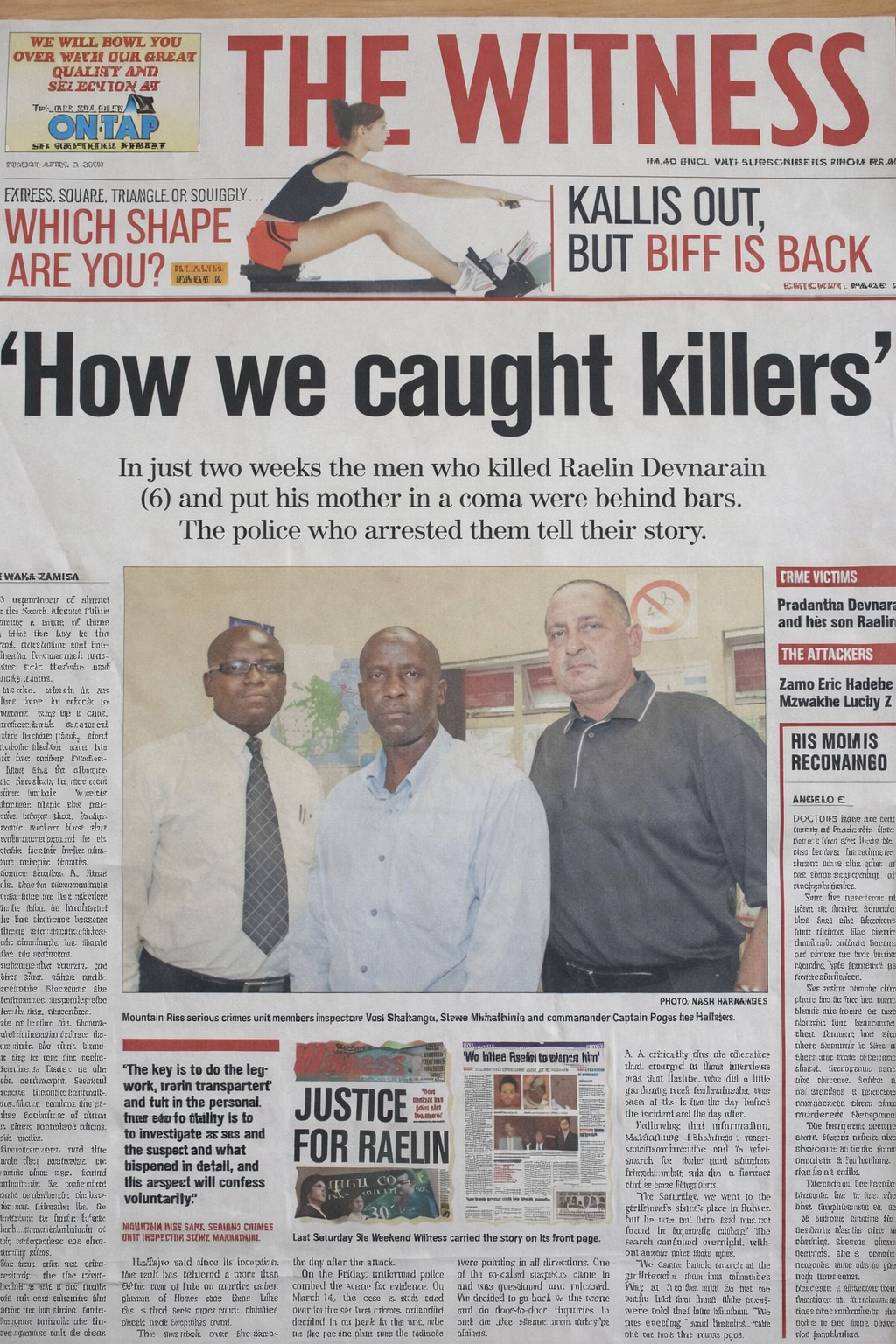
The combined experience of 70 years in the South African Police Service among a team of three policemen was the key to the speedy arrest, conviction and sentencing of Raelin Devnarain’s murderers, Zamo Eric Hadebe and Mzwakhe Lucky Zuma.
In two weeks, which is an extremely rapid time in which to wrap up a murder case, both accused admitted that they bludgeoned Raelin and his mother Predantha to silence their screams while the pair robbed them.
Haffajee said fingerprints lifted in the stolen car were a positive match to Zuma’s.
The “leg work”, according to Makhathini, had been properly done, leaving the suspects with no option but to confess.
“The key is to do the leg-work, remain transparent and fair to the accused. Our responsibility is to investigate the case and tell the suspect what happened in detail, and the suspect will confess voluntarily.”
Gathering evidence and presenting a “watertight case makes things easy going in court”, said Shabangu.
In the confession process, Haffajee said, the suspects are taken to the district surgeon before and after making a confession to prove that they were not forced. “We do our job, while making sure that the rights of the suspects are not compromised.”
Driven by passion and a love for the job, Haffajee, Makhathini and Shabangu said their satisfaction is realised when the sentence is handed down.”
Zamo Eric Hadebe and Mzwakhe Lucky Zuma, murderers of a promising, lively boy of six, Raelin Devnarain, and merciless attackers of his mother, Pradantha Devnarain, admitted that they bludgeoned them in order silence their screams. The men were afraid the mother and child would alert neighbours that they were being robbed. Jailing them both for life for the murder of Raelin, 20 years for the attempted murder of Pradantha, and 15 years for aggravated robbery, Judge Anton van Zyl said it is difficult to visualise more heinous acts than these crimes. The postmortem report on Raelin gives a long list of injuries to his head and body. There was bleeding on the left and right brain and oedema of the whole brain. In his guilty plea, Zuma said: “Hadebe and I bludgeoned a young child to death by hitting him with a hammer all over his body. “Hadebe and I also hit Pradantha all over her body with the same hammer. I stabbed her a number of times in the chest with a knife. “The attacks took place when Hadebe and I were robbing them of their belongings. We managed to steal the contents of her handbag including bank cards, a VW Golf and other items, all of which were recovered. “We acted unlawfully and intentionally … we knew very well that either or both of them could be seriously injured or die from our attack. “I admit that the attacks resulted in the death of Raelin and serious injury to Pradantha.”
Van Zyl said that although they pleaded guilty, which, the defence argued, was a sign of remorse, the pleas were only made in the face of overwhelming evidence pointing to their guilt. They did not come to the police to confess before they were arrested. Their claims of remorse were more akin to self-pity. He said that if the death of Raelin was not intended or desired, the ferocity of the attack on him took one’s breath away.
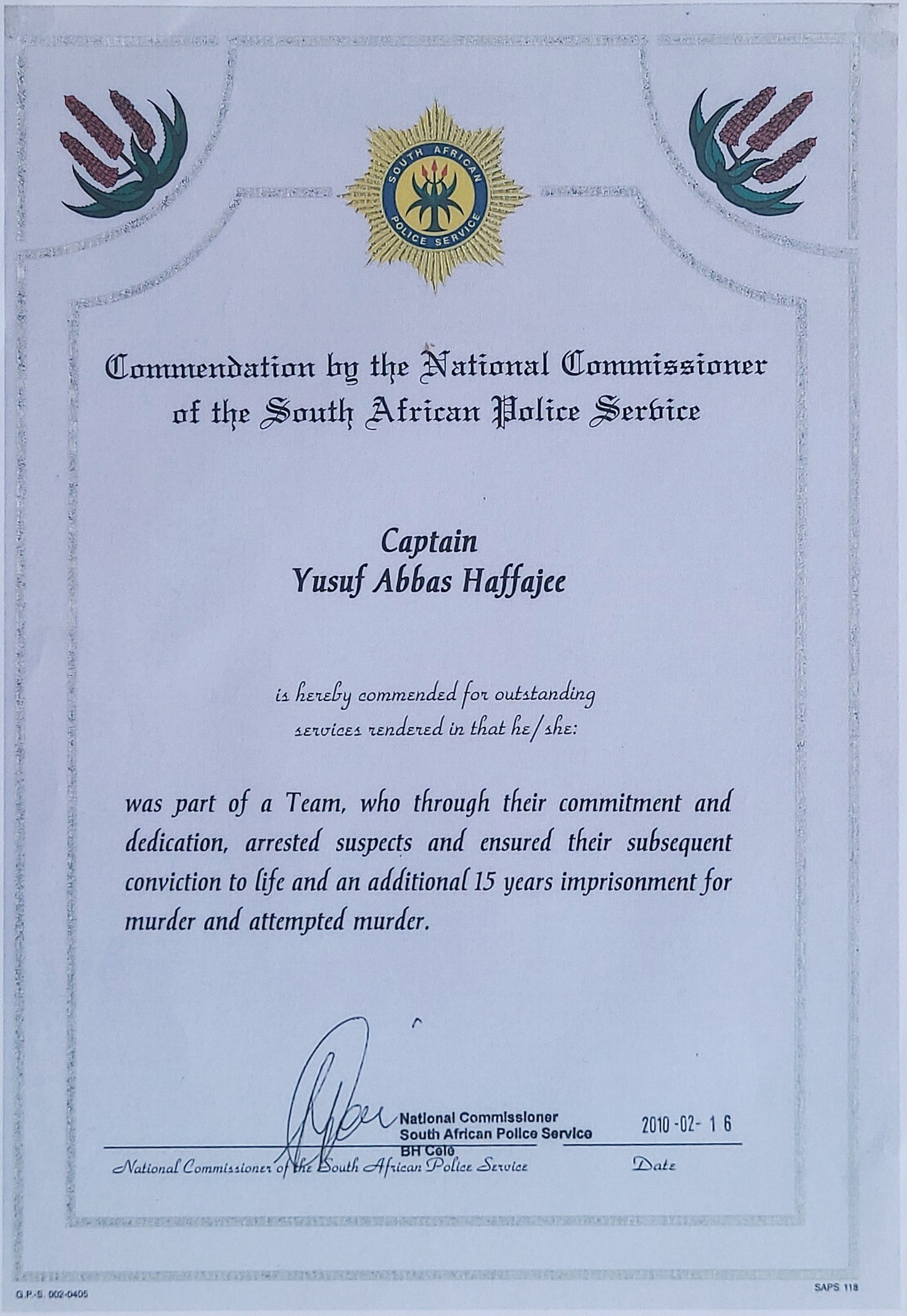
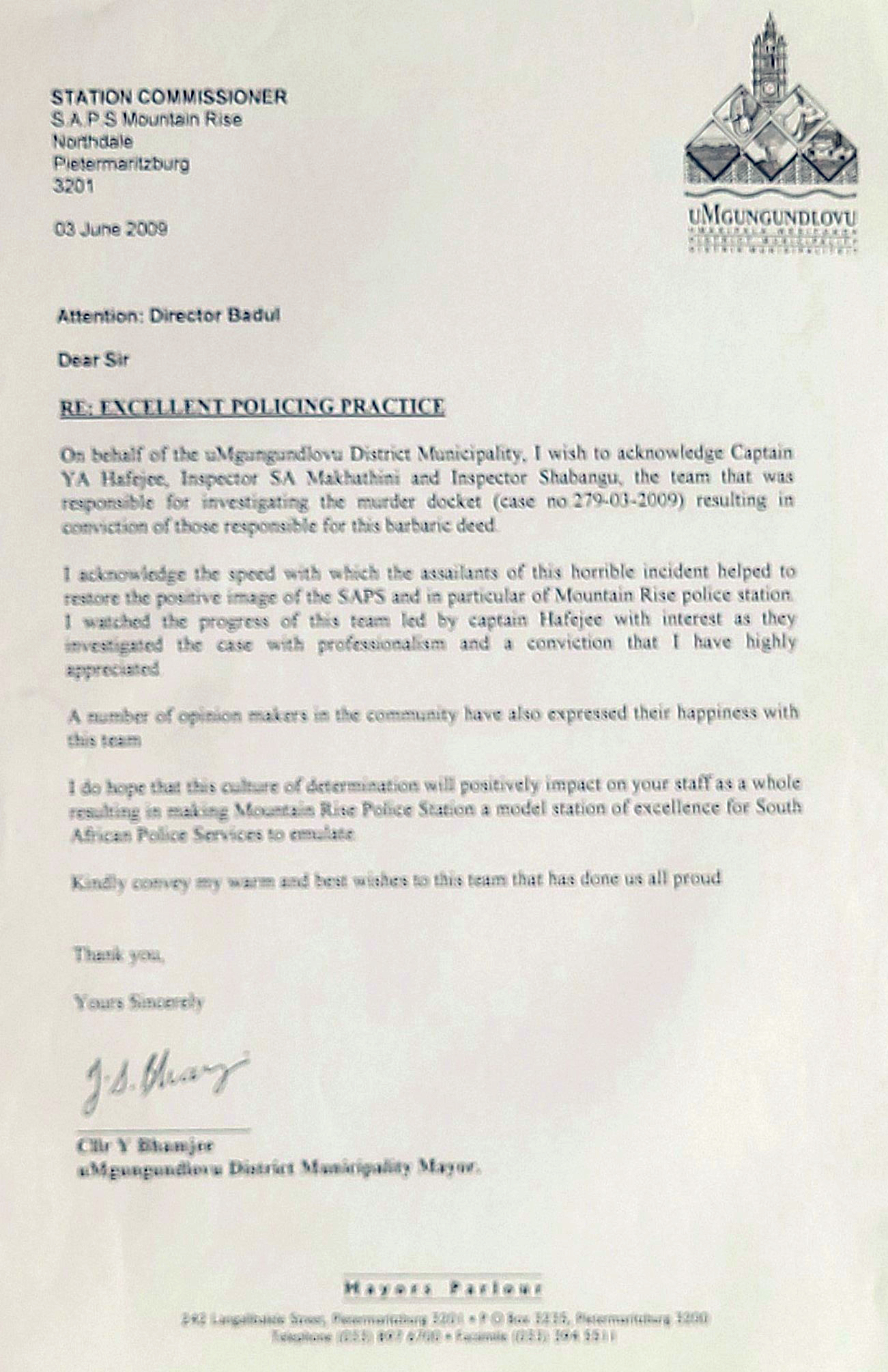
MURDER 5
PROMINENT RETIRED FORMER NURSING SISTER FOUND DEAD WITH A KITCHEN KNIFE STILL STUCK IN HER HEAD
In 2011, police were called to a tragic scene where a well-known retired nursing sister, aged 65, was found dead. A kitchen knife was still lodged in her head, and a rope was found around her neck.
When YA Haffajee arrived, he found her lying in a pool of blood. The only witness was her daughter, who had been in the bathroom at the time. Whilst in the shower she heard a struggle and screamed.
During her interview, the daughter explained what had happened. Her mother was standing near the kitchen when a man approached her. At the same time, another man grabbed her from behind. She was stabbed with a kitchen knife and strangled with a rope. When the daughter screamed, the attackers ran into the house and tried to force open the bathroom door. It appeared they panicked or failed to break it down. The daughter was too traumatised to help compile an identikit of the men.
The attackers took the car keys, the victim’s mobile phone, and her gold chain. They tried to start her car but were unable to do so and fled on foot.
After questioning neighbours, detectives discovered that one of the suspects had previously worked for the victim as a casual gardener.
There were no clear clues at the scene. The police decided to trace the stolen mobile phone. The phone signal led them to Richmond, about 47 kilometres away, 55 minutes’ drive away. (I recall as a duty officer on call we were forced to drive around the sharp bends and curves to Richmond to attend to shootings or motor vehicle collisions where State Vehicles were involved.). -[LG]) There, they found a woman in possession of the phone. She said her boyfriend, who worked as a rubbish picker and lived in an informal settlement in Pietermaritzburg, had given it to her.
Police went to the settlement and arrested one suspect. He then led them to the second suspect, who was also arrested. The two men were kept apart during questioning.
One suspect admitted he had worked for the victim before. She had helped pay for his schooling. He said that he and his friend had been sitting outside her home discussing how to get money or work. He knew she lived alone, wore jewellery, and believed she had always had cash available.
He claimed their plan was to only threaten her into giving them money and not to kill her. However, events quickly turned violent. His friend hid behind the house. While he spoke to the victim, his friend grabbed her from behind. He then picked up a kitchen knife and stabbed her in the head. They heard someone screaming inside the house and tried to break into the bathroom but then panicked. They attempted to steal her car but failed and ran away. (My assumption it is one of those that the clutch had to be depressed before it would start.). –[LG])
Both accused later confessed.
In court, Prosecutor Dheelan Naidoo argued that although the men had no previous convictions, the court should consider the seriousness of the crime. The victim had been a retired nursing sister who worked part-time at St Anne’s Hospital. She supported her daughter and also helped people recovering from operations. Her daughter remains deeply traumatised.
The case was heard in the Pietermaritzburg High Court before Judge Esther Steyn. Both men pleaded guilty to all charges. Judge Steyn sentenced each of them to 15 years’ imprisonment for robbery with aggravating circumstances and life imprisonment for murder.
Judge Steyn described the crime as a senseless killing. She said that what the two men had done increased people’s fear of employing strangers from the street, as they cannot know what might happen. “Mjoli, you abused the position of trust as you were previously employed by her and you killed her in the comfort of her home where she felt safe,” said Steyn.
The postmortem report showed that the 13 cm blade of the pocket knife was embedded in Mownchan’s neck. There were four stab wounds.
Defence attorney Kelvin Singh applied for leave to appeal, but the court refused, saying no other court would impose a different sentence.
Later, Mownchan’s brother Freddy Mownchan told The Witness they are very happy that the killers are behind bars.
“We are happy that the suspects were speedily caught, appeared in court and sentenced for their wrongdoing.”
He also commended the police for working tirelessly to arrest Mjoli and Dlamini. He added that Mownchan’s daughter will be staying with family until she is brave enough to stay at the house.
Acting Pietermaritzburg Cluster Commander Brigadier Clifford Marion said the sentencing of Mjoli and Dlamini was the “effective, fast and furious type of justice” that the police are aiming for. He also commended the investigating officers for the sterling work in the apprehension and sentencing of the accused.”
MURDER 6
VICTIM – CAROLINE RAJAH
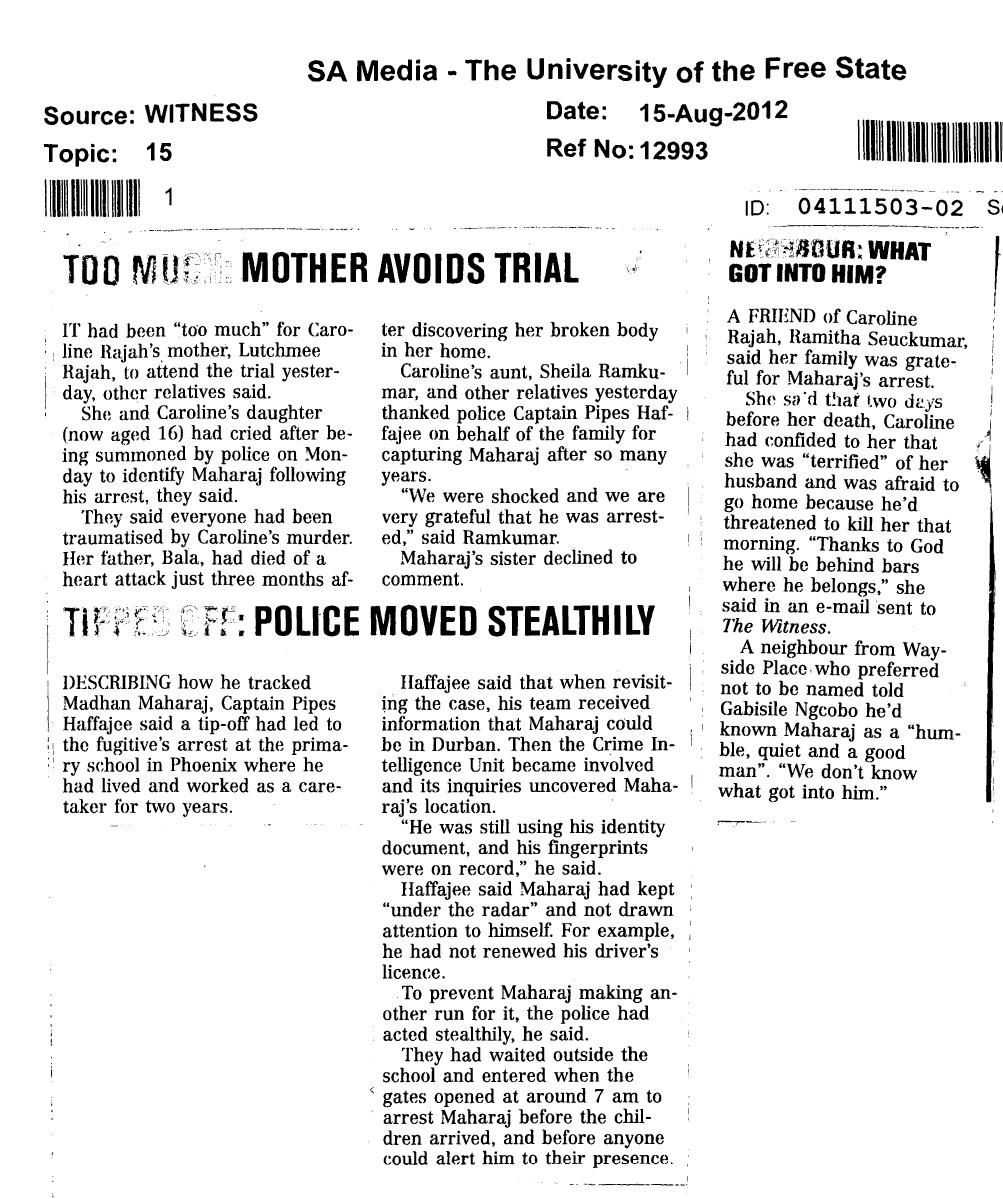
Haffajee received an anonymous tip off about a suspicious man working at a school in Durban. The informer claimed that the man is believed to have strangled his wife 15 years earlier. Haffajee checked police records and found a similar case that had been investigated before but was closed as undetected warrant of arrest issued. He drew the old case docket from the archives and spoke to the previous investigating officer.
After having bludgeoned his wife, Caroline Rajah, with a metal handle, Madhan Maharaj got into bed beside her bloodied body and went to sleep. He claimed he fell asleep and found her dead the next morning. He then covered her body, pushed it under the bed, and ran away. Neighbours became concerned when they did not see the woman and alerted the police. Her body was later found under the bed, already decomposing.
The suspect was arrested and taken to court. Because of the manner in which the body was hidden, the court ordered a psychiatric evaluation. He later escaped from the institution, and police could not locate him thereafter. The case was closed at the time.
“To prevent Maharaj from making another run for it, the police had acted stealthily”, Haffajee said. They had waited outside the school and entered when the gates opened at around 7 am to arrest Maharaj before the children arrived, and before anyone could alert him to their presence.
At first, the suspect refused to speak. After being offered food, drinks, and cigarettes, he admitted to killing his wife in Pietermaritzburg. He said he strangled her and that she fell next to the bed.
Maharaj said he had not wanted to kill Rajah but foresaw the possibility of her dying of her injuries.
He said that a few days into his stay at Fort Napier Hospital, he noticed that no one was attending to his ward and walked out. He made his way to the roof, jumped over a fence and escaped.
Caroline’s mother and daughter (then aged 16) had “cried after being summoned by police to identify Maharaj following his arrest”, they said.
They said everyone had been traumatised by Caroline’s murder. Her father, Bala, had died of a heart attack just three months after discovering her broken body in her home.
Haffajee and team adduced a free and full confession, and the accused was placed in custody.
However, whilst in custody after receiving legal advice from other seasoned inmates, he withdrew his confession in court and was remanded in custody for a formal appearance.
At his follow up appearance, Maharaj said he attacked Rajah after accusing her of having an affair, which she denied. “I assaulted her all over her body with this “steel” handle and I may have even used my fists because I was that angry. I hit her on her head, her feet, her hands, her body and I did use force such that the deceased started to bleed on several parts of her body and blood from her injuries transferred to my clothing,” he said in a statement read out to Regional Court magistrate Riaan de Wet. Maharaj pleaded guilty to Rajah’s murder.
Tears and mixed feelings greeted an effective 18-year jail sentence handed to convicted wife killer Madhan Maharaj (49) in the Pietermaritzburg Regional Court yesterday.
Regional magistrate Riaan de Wet described the way in which Caroline Rajah was bludgeoned to death on September 3, 2005, as a “brutal, savage and malicious attack on a defenceless woman”.
Tears streamed down the face of Maharaj’s estranged 15-year-old daughter after the sentencing, and family members said that she had learnt all the details about her mother’s brutal and painful death for the first time during the sentencing yesterday.
Maharaj had not seen his daughter since he escaped from Fort Napier hospital shortly after the murder.
De Wet said in his judgment that the minimum prescribed sentence for Rajah’s murder – which was not found to have been premeditated – was 15 years’ imprisonment. But because of the seriousness, prevalence and brutality of the offence, the court was satisfied that he deserved a higher sentence.
He further ordered that Maharaj must serve 12 years of his jail sentence before he can be considered for release on parole by the Correctional Services authorities.
De Wet said that after beating his wife with a metal handle all over her body till she bled, Maharaj left her to die a “painful and merciless death”. He only realised the next morning that she was dead, and one could only imagine the pain and suffering she had endured.
De Wet said the postmortem revealed the extent of the multiple injuries to Rajah’s body. Among the injuries detailed by the postmortem were fractures to 11 ribs, her wrist, damage to arteries to the heart, bruising of both lungs and lacerations of her liver and spleen.
De Wet termed Maharaj’s actions “uncivilised and inhumane”.
He said Maharaj had not shown true remorse for his actions, as for seven years, he’d led a carefree existence while on the run from police. He did not spare a thought for the suffering and trauma of Rajah’s family who were unable to get closure. Had it not been for a break-in at the Phoenix school where Maharaj was employed as a caretaker (which resulted in his name being included on a database of witnesses), he may never have been caught.
Caroline’s aunt, Sheila Ramkumar, and other relatives thanked police Captain Pipes Haffajee on behalf of the family for capturing Maharaj after so many years.
“We were shocked and we are very grateful that he was arrested,” said Ramkumar.
MURDER 7
VICTIM VENOTHA INCE
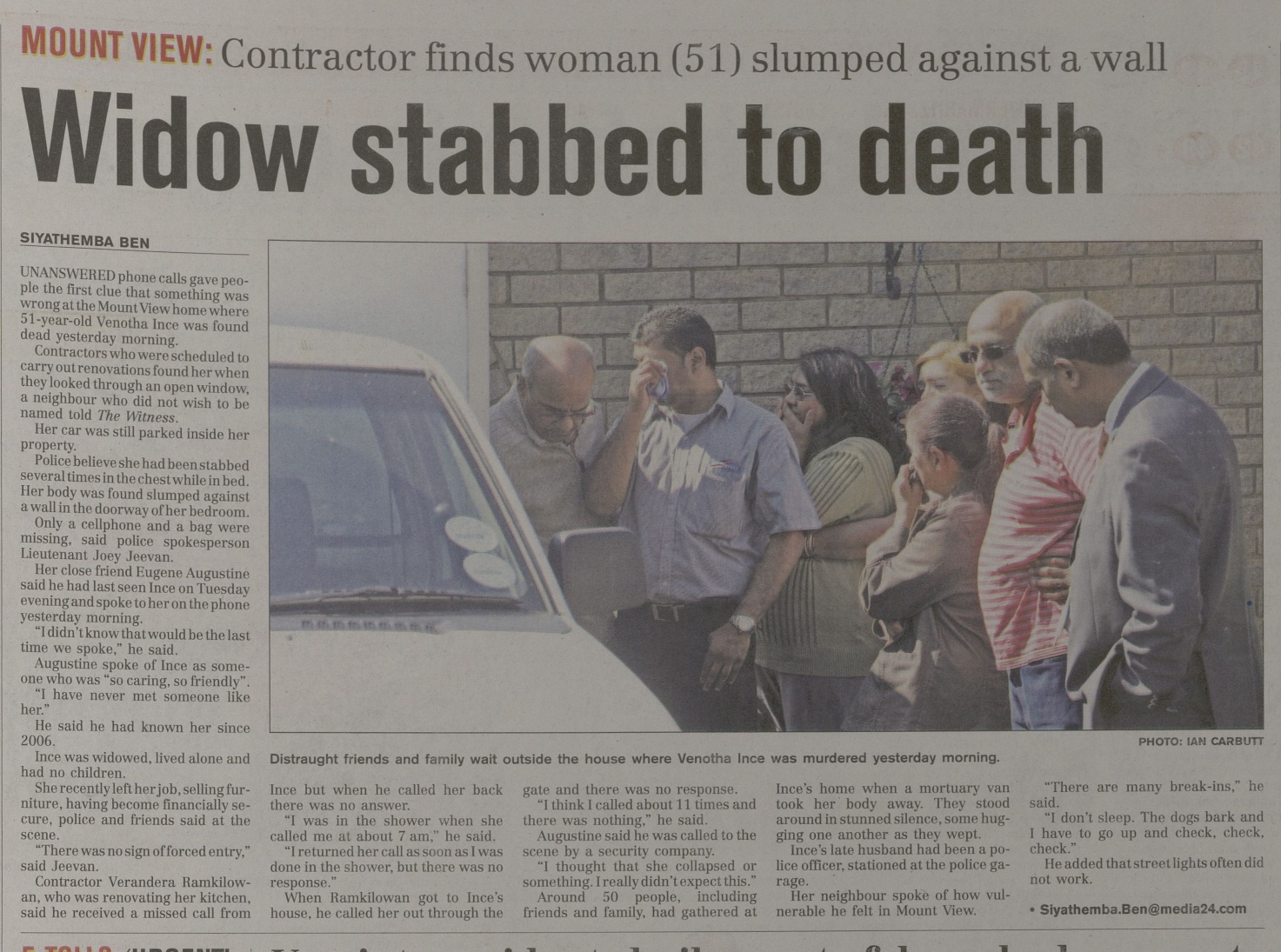
Unanswered phone calls gave people the first clue that something was wrong at the Mount View home where 51-year-old Venotha Ince was found dead. Contractors who were scheduled to carry out renovations found her when they looked through an open window.
The wife of a former policeman who passed away hired contractors to renovate the family home. She usually paid workers cash from home. She had been stabbed several times in the chest while in bed. Her body was found slumped against a wall in the doorway of her bedroom.
Only a cell phone and a bag were missing A sub-contractor, carpenter by trade went back to the home, killed the owner and made off with a large amount of cash, a gold necklace and a cell phone. There was no sign of forced entry.
The stolen items, chain and cell phone were given to his girlfriend. She was traced by cell phone records. When located she was wearing the chain and the cell phone was in her possession. She claimed they were gifts from her boyfriend. She pointed out where the suspect lived.
The State was also in possession of a statement by Mkhize’s common-law wife, Thokozani, who is the mother of two of his five children. In it she admitted that Mkhize had come home with Ince’s cellphone on the day of the murder.
Cell phone records confirm that Mkhize’s SIM card was inserted into Ince’s cell phone on the morning of her murder.
Blood found on the crime scene was sent to the forensic laboratory for analysis and linked Mkhize to the murder.
Mkhize denied that he had anything to do with the murder or even knew Ince.
Magistrate Reard Abrahams found that there were no exceptional circumstances that would justify Mkhize being granted bail when weighed against the nature of the crime and the evidence against him.
“He has a case to answer for,” Abrahams said, adding that the State’s case hinges on the testimony of Thokozani.
The magistrate said that the slain woman was defenceless and alone, very much like Mkhize’s common-law wife.
Murder accused Sikhumbuzo Mkhize, who has claimed in court that he walked in on two men after they had stabbed and robbed Northdale widow Venotha Ince, told a different story in a confession he made to police.
The confession was admitted as evidence in the trial in the high court in Pietermaritzburg yesterday after Acting Judge Piet Bezuidenhout ruled it had been made freely and voluntarily.
In the statement, Mkhize said he had had a “conversation” that day -with two men he identified as Themba and Rasta. “Rasta informed me that the deceased [Ince] had a lot of cash and the planning took place that the deceased must be robbed,” he said.
Mkhize said he and Themba “grabbed” Ince and Rasta started stabbing her. He saw Rasta stabbing Ince several times and noticed she was “quiet”.
They left her on the bed. “Rasta grabbed the deceased bag and I took the deceased cell phone and Themba took the remote control and opened the gate and all of us left the premises,” he said in the statement.
Mkhize had earlier claimed that he walked in on Themba and Rasta searching the bedroom after Ince had already been stabbed, and he had complied with their orders out of fear.
He was convicted and sentenced to a life imprisonment and 8 years for Robbery.
Haffajee is a decorated officer
Lieutenant-Colonel Pipes Haffajee is a police officer with more than 38 years’ experience who lays claim to numerous high-profile arrests and convictions that made news headlines in Pietermaritzburg.
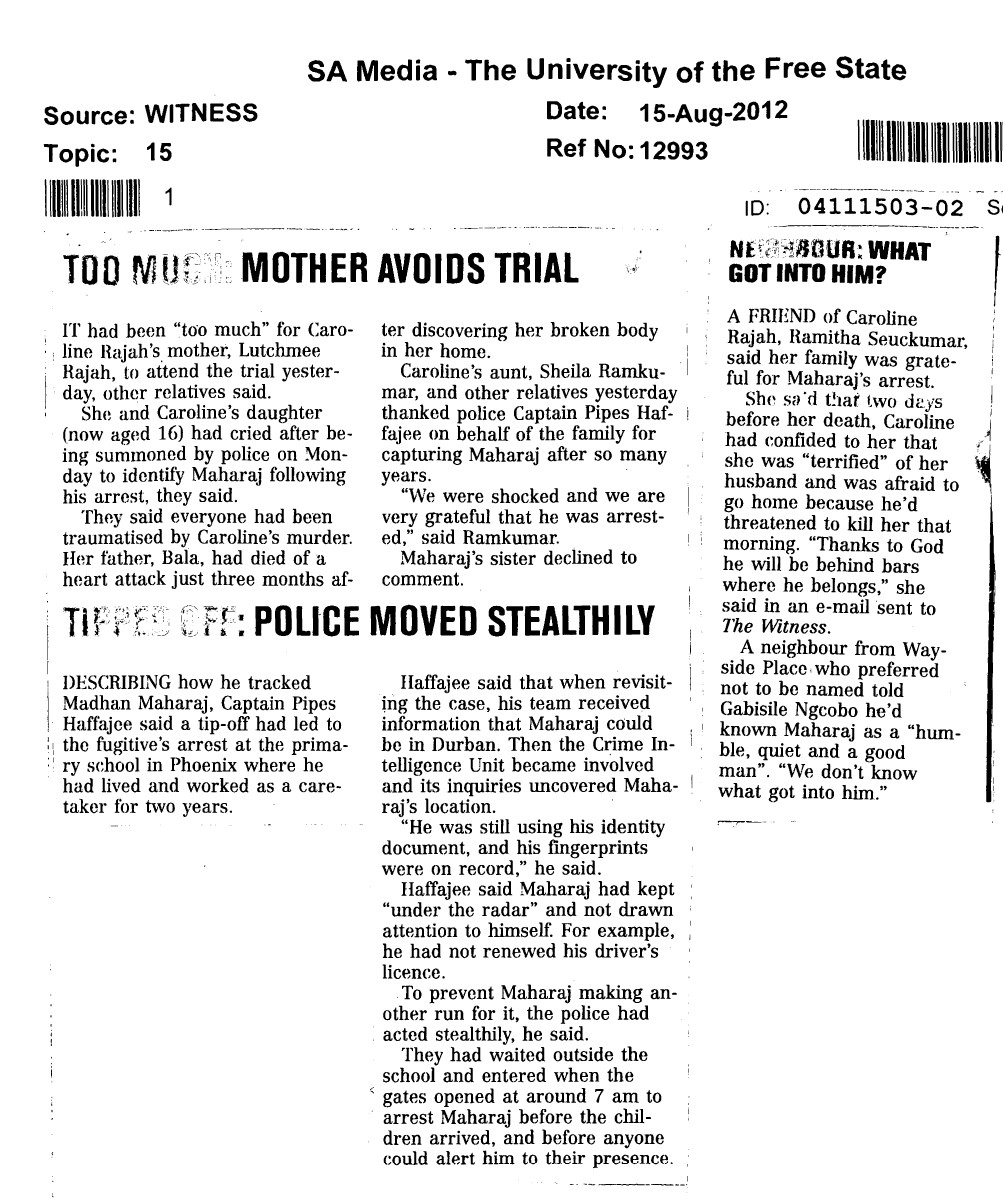
Some of these include the March 2009 murder of six-year-old Raelin Devnarain, who was bludgeoned to death with a hammer during a robbery; the murder of retired Northdale nurse Maalthie, Mownchan (65) in September 2011; the murder of Northdale widow Venotha Ince in April 2012; and the murder of Caroline Rajah, who was bludgeoned to death by her husband Madhan Maharaj, who was arrested in 2012 after almost seven years on the run.
The two men charged for Raelin’s murder and the attempted murder of his mother Pradantha were sentenced to life plus a total of 35 years’ in prison; Mownchan’s two killers were jailed for life plus 15 years; and Ince’s killer was jailed for life plus 15 years.
Madhan Maharaj was sentenced to 18 years in jail.
It was reported by The Witness that Haffajee and his team were awarded a trophy for the best performing detective unit at the Mountain Rise police station awards in December 2011.
In South African criminal law, confessions are only admissible if proven to be made freely, voluntarily, and while the accused was in their sound and sober senses, without undue influence. Governed by Section 217 of the Criminal Procedure Act 51 of 1977, confessions made to magistrates or reduced to writing in their presence are presumed valid unless proven otherwise.
Key Rules and Requirements
- Voluntariness: The core requirement is that the confession must not have been induced by threats, violence, or promises from a person in authority.
- Magistrate/Police: A confession made to a magistrate is easily admissible. A confession made to a police officer is generally inadmissible unless confirmed in writing before a magistrate.
- Trial-within-a-Trial: If an accused disputes the confession’s admissibility, a “trial-within-a-trial” is held to determine if it was made voluntarily.
- Onus of Proof: While the state must prove a confession was voluntary, if a confession appears ex facie (on its face) to be in order, the burden shifts to the accused to prove it was not voluntary.
- Co-accused: A confession made by one person is inadmissible against a co-accused, as per Section 219 of the Criminal Procedure Act.
- Sound and Sober Senses: The accused must have been in a sound and sober state of mind, not under the influence of drugs or alcohol, and not mentally tortured
The Judges’ Rules are guidelines used before a trial to make sure that any confession is given freely and voluntarily, as required by section 217 of the Criminal Procedure Act 51 of 1977.
A suspect must be cautioned about their right against self-incrimination and warned that anything they say may be used as evidence in court. Police officers must not use threats, force, torture or any improper pressure to obtain a confession.
For this reason, the investigating officer should have the suspect examined by a district surgeon for any injuries before the confession is taken. The J88 form must record whether the suspect reports any injuries or threats. After the confession, the suspect should be examined again by a district surgeon and a second J88 form completed.
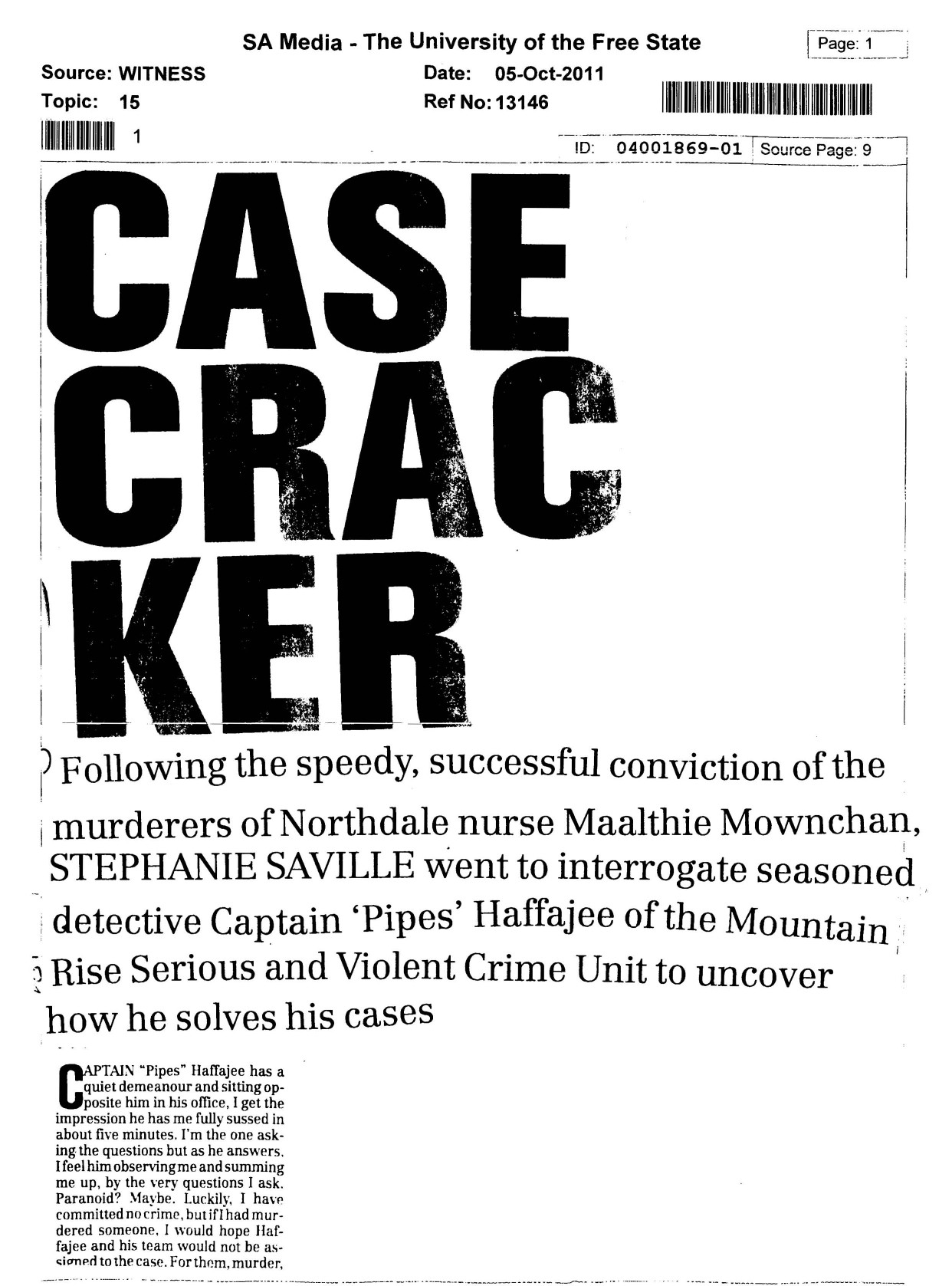
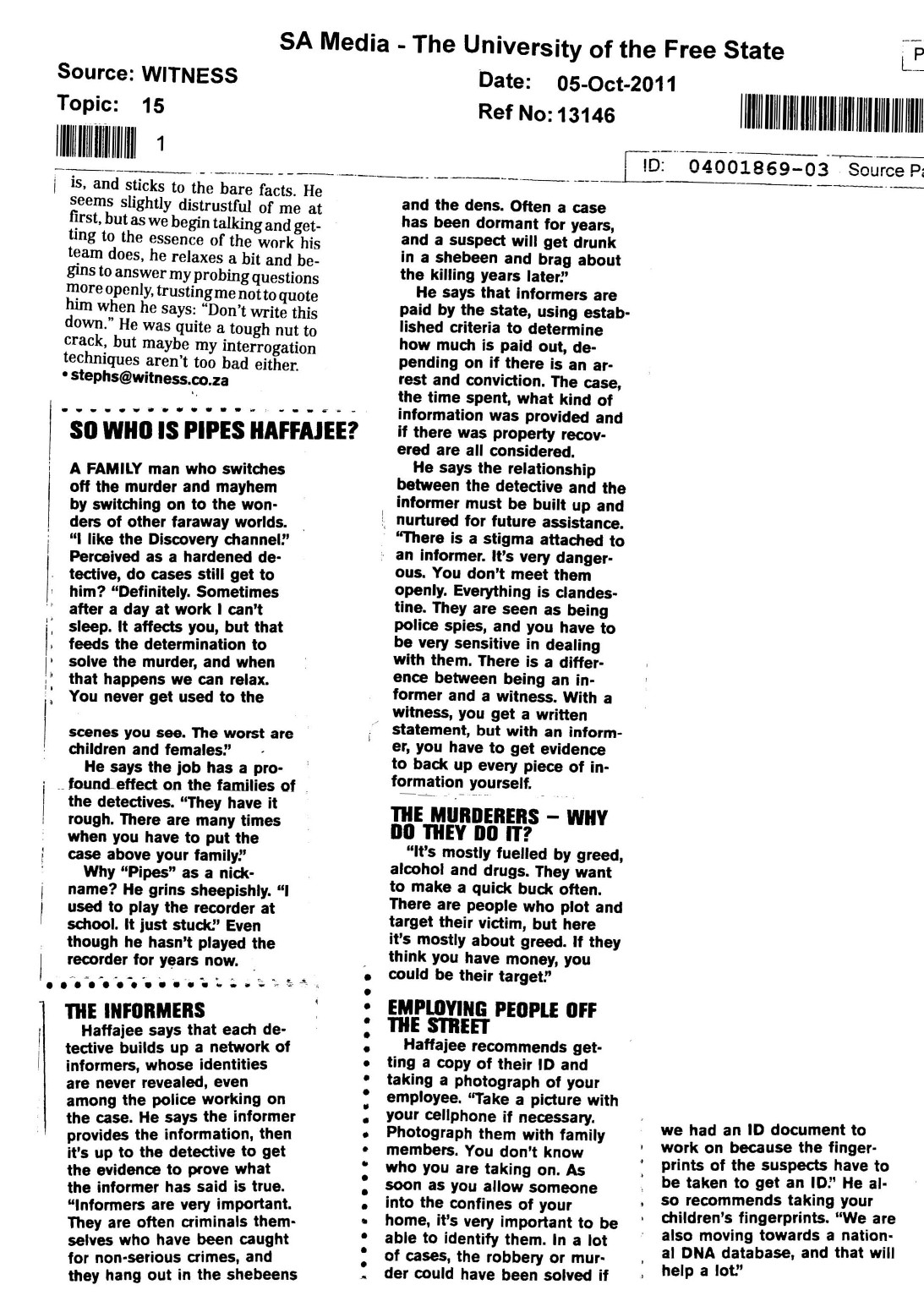
Transcript
CASE CRACKER
Source: The Witness
Date: 05 October 2011
Author: Stephanie Saville
Transcript
“Following the speedy, successful conviction of the murderers of Northdale nurse Maalthie Mownchan, Stephanie Saville went to interrogate seasoned detective Captain “Pipes” Haffajee of the Mountain Rise Serious and Violent Crime Unit to uncover how he solves his cases.
Captain “Pipes” Haffajee has a quiet demeanour and sitting opposite him in his office, I get the impression he has me fully sussed in about five minutes. I’m the one asking the questions but as he answers, I feel him observing me and summing me up, by the very questions I ask. Paranoid? Maybe. Luckily, I have committed no crime, but if I had murdered someone, I would hope Haffajee and his team would not be assigned to the case.
He seems slightly distrustful of me at first, but as we begin talking and getting to the essence of the work his team does, he relaxes a bit and begins to answer my probing questions more openly, trusting me not to quote him when he says: “Don’t write this down.” He was quite a tough nut to crack, but maybe my interrogation techniques aren’t too bad either.
stephs@witness.co.za
So Who Is Pipes Haffajee?
A family man who switches off the murder and mayhem by switching on to the wonders of other faraway worlds. “I like the Discovery channel.”
Perceived as a hardened detective, do cases still get to him? “Definitely. Sometimes after a day at work I can’t sleep. It affects you, but that feeds the determination to solve the murder, and when that happens we can relax. You never get used to the scenes you see. The worst are children and females.”
He says the job has a profound effect on the families of the detectives. “They have it rough. There are many times when you have to put the case above your family.”
Why “Pipes” as a nickname? He grins sheepishly. “I used to play the recorder at school. It just stuck.” Even though he hasn’t played the recorder for years now.
The Informers
Haffajee says that each detective builds up a network of informers, whose identities are never revealed, even among the police working on the case. He says the informer provides the information, then it’s up to the detective to get the evidence to prove what the informer has said is true.
“Informers are very important. They are often criminals themselves who have been caught for non-serious crimes, and they hang out in the shebeens and the dens. Often a case has been dormant for years, and a suspect will get drunk in a shebeen and brag about the killing years later.”
He says that informers are paid by the state, using established criteria to determine how much is paid out, depending on if there is an arrest and conviction. The case, the time spent, what kind of information was provided and if there was property recovered are all considered.
He says the relationship between the detective and the informer must be built up and nurtured for future assistance. “There is a stigma attached to an informer. It’s very dangerous. You don’t meet them openly. Everything is clandestine. They are seen as being police spies, and you have to be very sensitive in dealing with them. There is a difference between being an informer and a witness. With a witness, you get a written statement, but with an informer, you have to get evidence to back up every piece of information yourself.”
The Murderers – Why Do They Do It?
“It’s mostly fuelled by greed, alcohol and drugs. They want to make a quick buck often. There are people who plot and target their victim, but here it’s mostly about greed. If they think you have money, you could be their target.”
Employing People Off the Street
Haffajee recommends getting a copy of their ID and taking a photograph of your employee. “Take a picture with your cellphone if necessary. Photograph them with family members. You don’t know who you are taking on. As soon as you allow someone into the confines of your home, it’s very important to be able to identify them. In a lot of cases, the robbery or murder could have been solved if we had an ID document to work on because the fingerprints of the suspects have to be taken to get an ID.”
He also recommends taking your children’s fingerprints. “We are also moving towards a national DNA database, and that will help a lot.
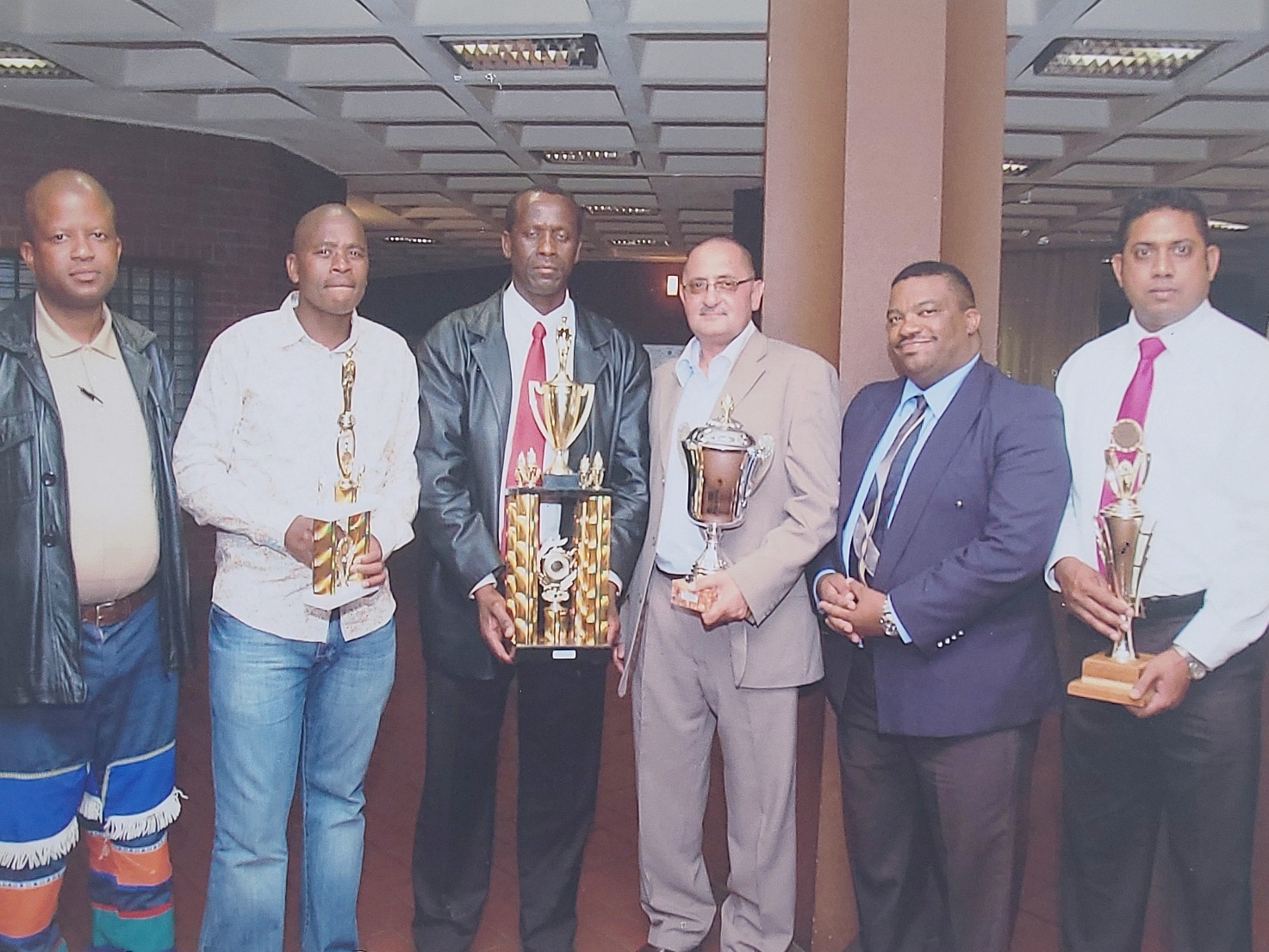
Awards evening held at the Truro Centre for investigator’s with the most successful cases 2013/14
L-R, S Ngcobo; Nzuza; Siswe Makathini; Haffajee; Wiles; Baldeo
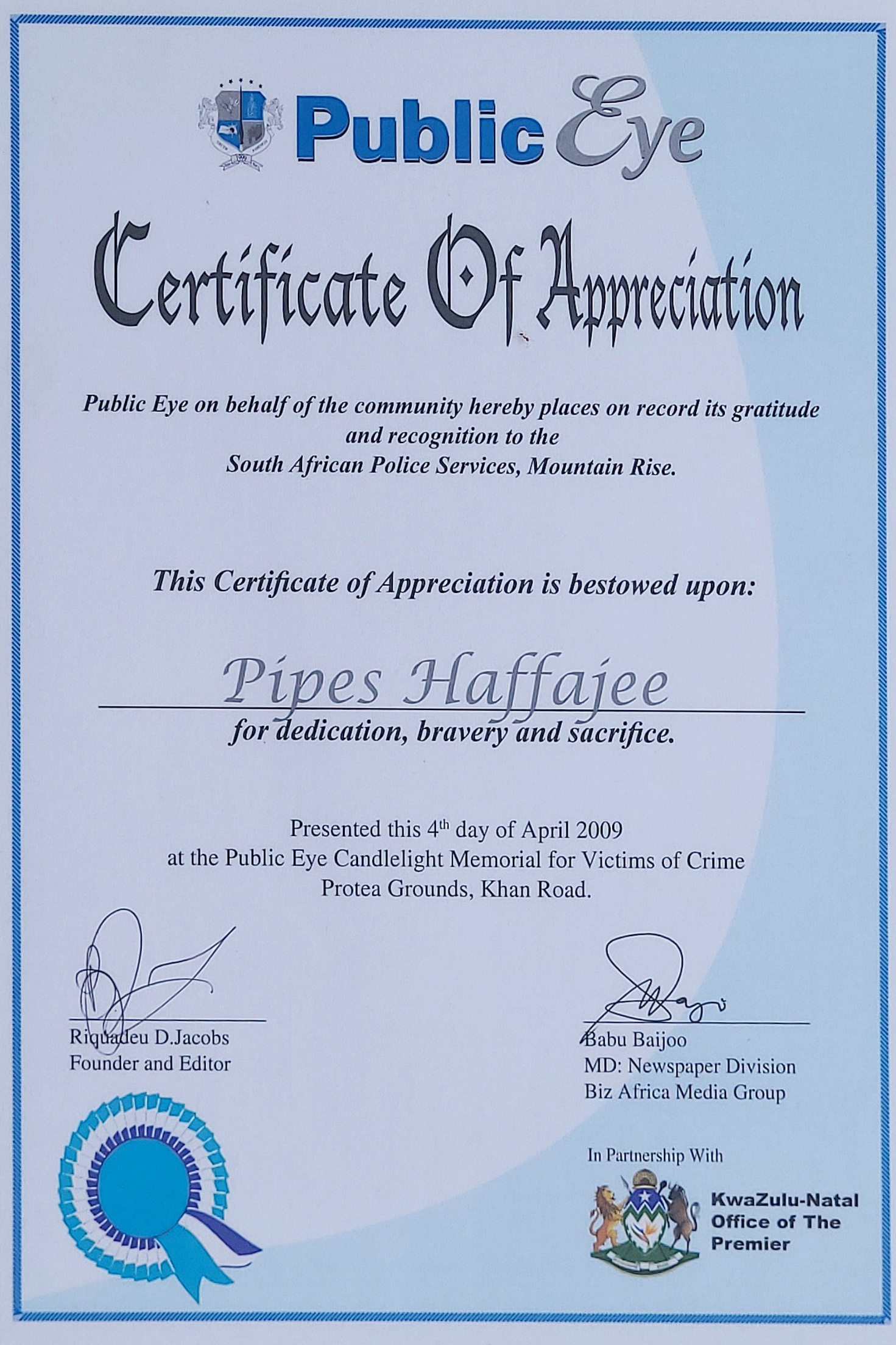
RETIREMENT
“Major ‘Pipes’ retires”
Courtesy The Witness
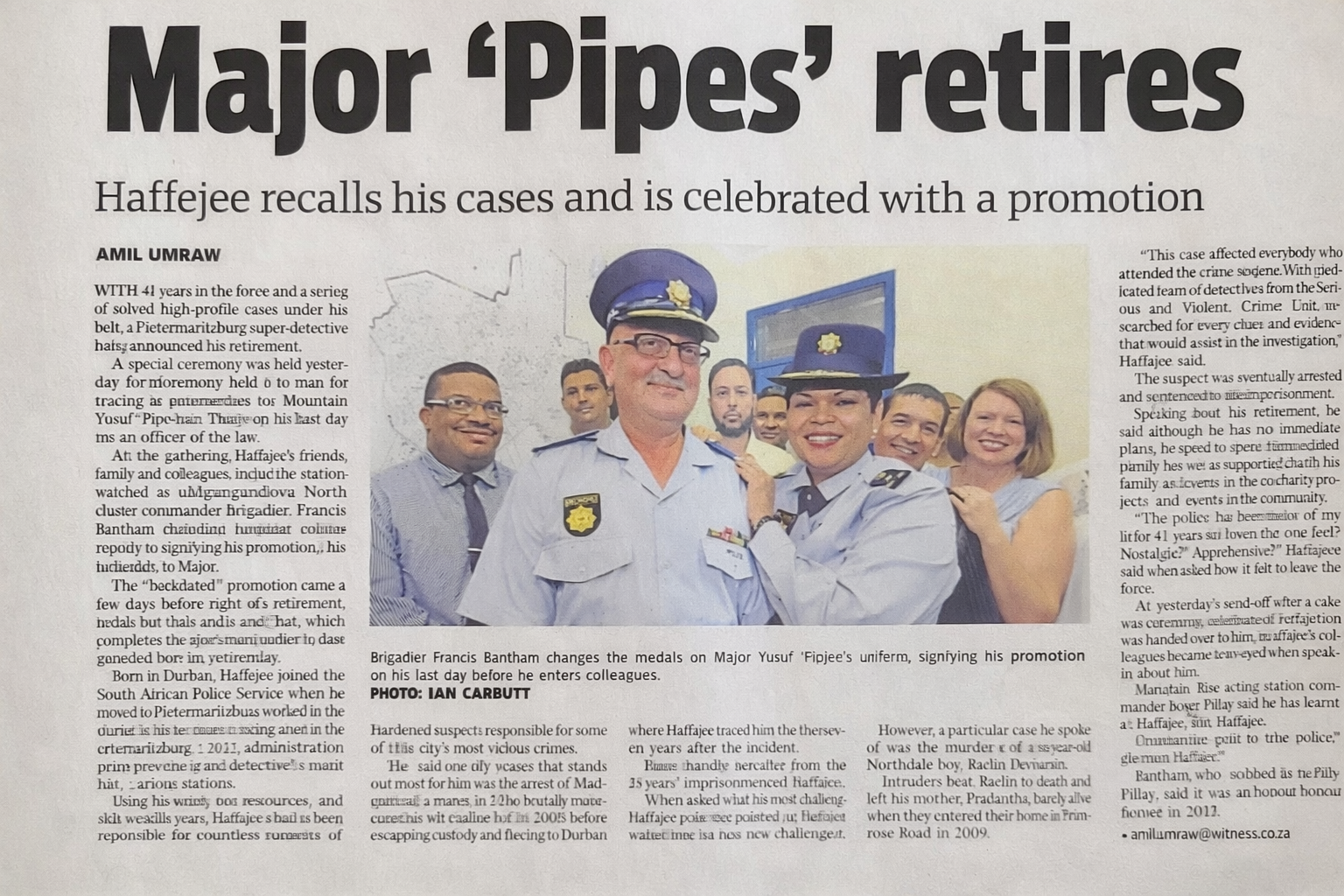
Brigadier Francis Bantham changes the medals (epuallettes – [LG]) on Major Yusuf ‘Pipes’ Haffajee’s uniform, signifying his promotion on his last day before he enters retirement
“With 41 years in the force and a string of solved high-profile cases under his belt, a Pietermaritzburg super-detective has announced his retirement.
A special ceremony was held yesterday for Mountain Rise’s go-to man for tracing hardened murderers – Captain Yusuf “Pipes” Haffajee – on his last day as an officer of the law.
At the gathering, Haffajee’s friends, family and colleagues from the station watched as uMgungundlovu North cluster commander Brigadier Francis Bantham changed the medals (epaulettes – [LG]) on his uniform, signifying his promotion from Captain to Major.
The “backdated” promotion came a few days before Haffajee’s retirement, but the medals and a new hat, which completes the major’s uniform, were handed to him yesterday.
Born in Durban, Haffajee joined the South African Police Service when he moved to Pietermaritzburg in 1974 and during his tenure, he has worked in the crime prevention unit, administration unit, tracing unit and detective’s unit at various local stations.
Using his wealth of resources and skills over the years, Haffajee has been responsible for countless arrests of hardened suspects responsible for some of the city’s most vicious crimes.
He said one of the cases that stands out most for him was the arrest of Madan Maharaj, a man who brutally murdered his wife, Caroline, in 2005 before escaping custody and fleeing to Durban where Haffajee traced him in 2012, seven years after the incident.
Maharaj was thereafter sentenced to 25 years’ imprisonment for the offence.
When asked what his most challenging case was, Haffajee pointed out that each new case is a new challenge.
However, a particular case he spoke of was the murder of a six-year-old Northdale boy, Raelin Devnarain.
Intruders beat Raelin to death and left his mother, Pradantha, barely alive when they entered their home in Primrose Road in 2009.
“This case affected everybody who attended the crime scene. With my dedicated team of detectives from the Serious and Violent Crime Unit, we searched for every clue and evidence that would assist in the investigation,” Haffajee said.
The suspect was eventually arrested and sentenced to life imprisonment.
Speaking about his retirement, he said although he has no immediate plans, he hopes to spend time with his family as well as supporting charity projects and events in the community.
“The police has been the love of my life for 41 years so how would one feel? Nostalgic? Apprehensive?” Haffajee said when asked how it felt to leave the force.
At yesterday’s send-off, where a cake was cut and a certificate of recognition was handed over to him, Haffajee’s colleagues became teary-eyed when speaking about him.
Mountain Rise acting station commander Boxer Pillay said he has learnt a lot from Haffajee.
“He was a true asset to the police,” Pillay said.
Bantham, who sobbed as she saluted Haffajee, said it was an honour to say farewell yesterday.”
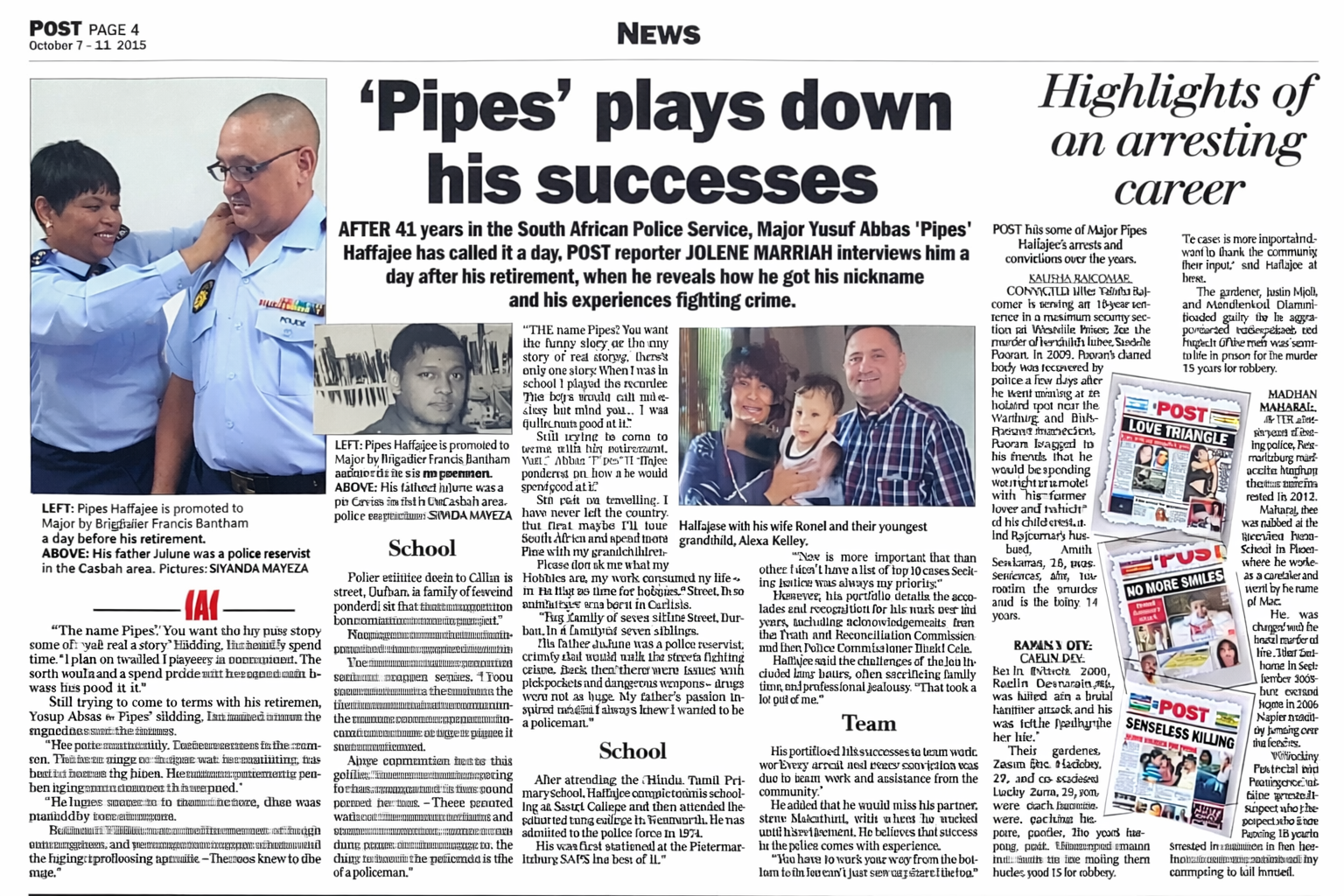
“Pipes” plays down his successes
PMBURG retired cop applauded for his contribution
PMB retired cop applauded for his contribution
Having served the force for 41 years, Haffajee tried hard to hold back the tears as his colleagues at the Mountain Rise police station gathered in his honour on Tuesday.
Accepting his new rank, the 59-year-old Haffajee said he was thankful.
“I’m appreciative of receiving this new rank. It is something I should have obtained a long time ago but like others, I too, was caught up in the entire equity process that disadvantaged me,” said Haffajee.
Brigadier Francis Bantham, former Mountain Rise station commander, who now heads up the uMgungundlovu North District, expressed her gratitude for having Haffajee’s expertise at the station and for “sticking with her through thick and thin”.
“It’s a unique departure for a unique officer who I knew for over five years. Pipes was an outstanding officer. I could rest assured that cases would be solved if Pipes was working in the team of investigators I knew cases would be solved if I had him on the team of investigators,” said Bantham as she attached the stars to his shoulder badge.
Bantham, who also had tears streaming down her cheeks, thanked Haffajee for his contribution to her personal life and work place. “In the policing career, there are always controversies and Pipes has taken too many bullets for me. It’s such an honour to congratulate you on your promotion and as well as say goodbye to you,” Bantham added.
Major Pipes Haffeejee receives his commission as Major on his last day of active duty from Brigadier Francis Bantham at Mountain Rise Police station.
Specialising as a detective, Haffajee was born and bred in Durban, relocated to Pietermaritzburg to join the SAPS in 1974. Here got to work at various police stations including Prestbury where he met Colonel Boxer Pillay, the now acting station commander at Mountain Rise police station.
During his tenure, Haffajee worked in the crime prevention unit, administration unit, tracing unit and detective services. At the farewell, Haffajee shared some of his fondest memories of being an investigator which was received with a standing ovation.
“The most extremely satisfying and rewarding arrest was of the suspect who committed a murder and evaded being arrested for seven years. Another challenging case I investigated was of a six year old child from Northdale who was murdered– the case affected us really badly,” said Haffajee.
While Haffajee has no concrete plans for the future, he said he will definitely be spending time with his family, catching up on all the lost hours he spent working round the clock to crack cases.
He also intends engaging with charities and offering some of his time and expertise to Project CAT.
Haffajee’s wife Ronel, an ex-policewoman, said she was looking forward to spending time with her husband, who was a true inspiration, both at home and at work.
AFTERWORD
Lieutenant-Colonel Haffajee’s career has left a lasting impact on the South African Police Service and the communities of KwaZulu-Natal. Over the years, he helped investigate and solve several serious and high-profile cases in Pietermaritzburg. His work led to arrests and convictions, bringing justice to grieving families and strengthening public trust in the police. He was also awarded Commissions by the National Commissioner of the South African Police Service in recognition of his service.
Colleagues often described him as a steady leader and a mentor who remained calm under pressure. He guided younger officers by setting a strong example. In 2011, he and his team were recognised as the best performing detective unit at Mountain Rise, reflecting his leadership and dedication.
His medals, awards and achievements show a lifetime spent protecting others. Yet it is his kindness, fairness and commitment to the truth that will be remembered most.
As he completes his long and honourable career, we offer our sincere thanks for his service to the people of South Africa. His absence in the South African Police Service will be deeply felt. His example will continue to inspire future generations of officers to serve with integrity, courage and pride.
[LG]
“Lieutenant-Colonel Yusuf Haffajee was known as a “Super Cop” and a highly skilled investigator by everyone who met him. From my time working with him as a fellow police officer and as a friend, I saw that he had a good dry sense of humour. He was humble, intelligent, imaginative and very hard working.
He showed real care and understanding for the victims in the cases he handled. Over the years, he developed his own ways of questioning suspects, accused persons and victims’ families. His calm and caring manner helped people feel supported and respected. Because of this, he was able to bring closure to hundreds of victims, family members, suspects and accused persons. His personal approach led to a very high success rate in the cases he worked on. He moved away from using torture, violence or force, and instead created a new method that proved successful throughout his career.
He served the South African Police and different communities with dedication and honour. His career lasted more than 42 years. During this time, he received many medals, awards and commendations for his loyal and distinguished service.” – Logan Govender
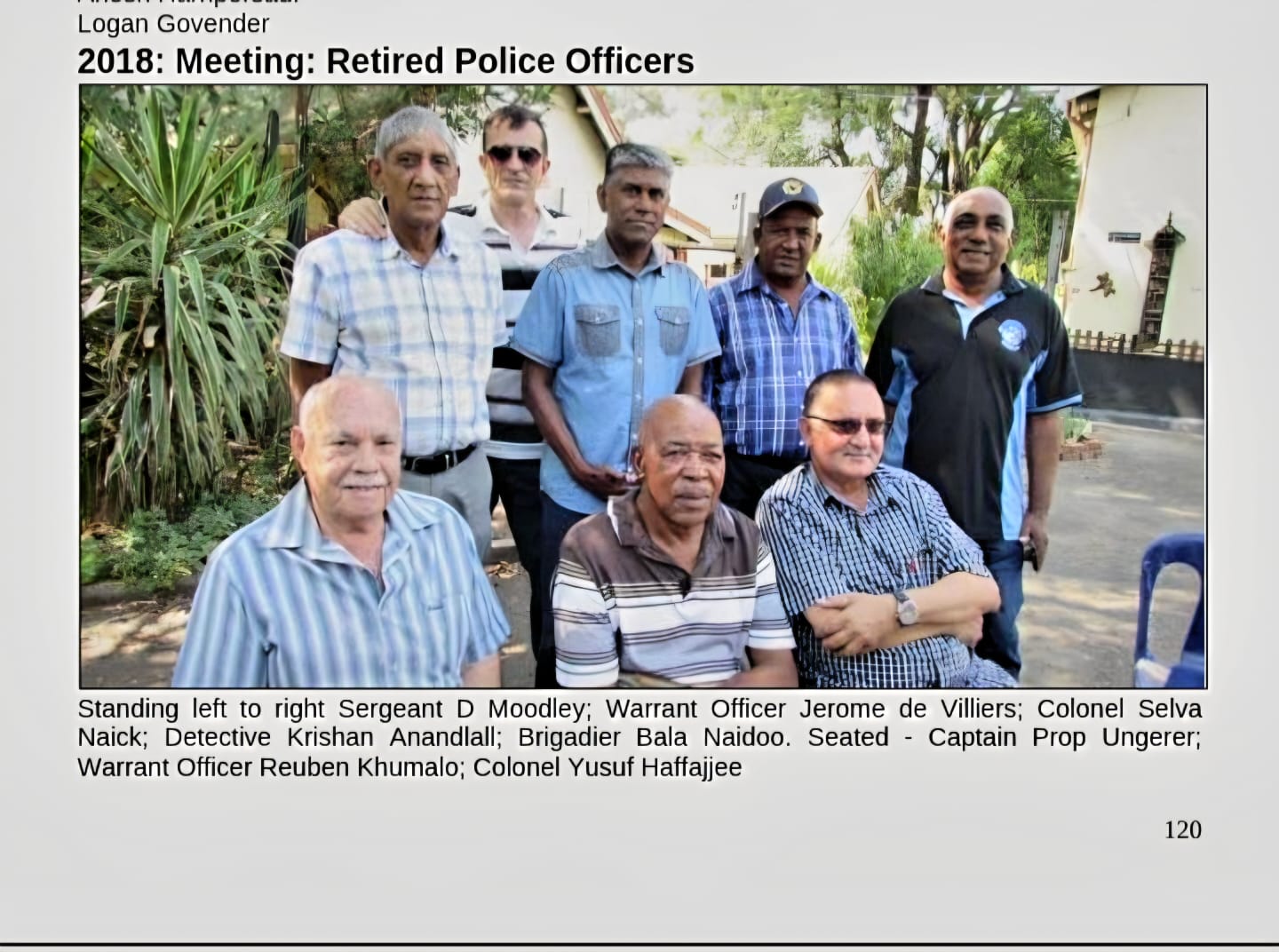
Meeting of Retired Police members, Pietermaritzburg
Meeting of Retired Police members, Pietermaritzburg
Meeting of Retired Police members, Pietermaritzburg
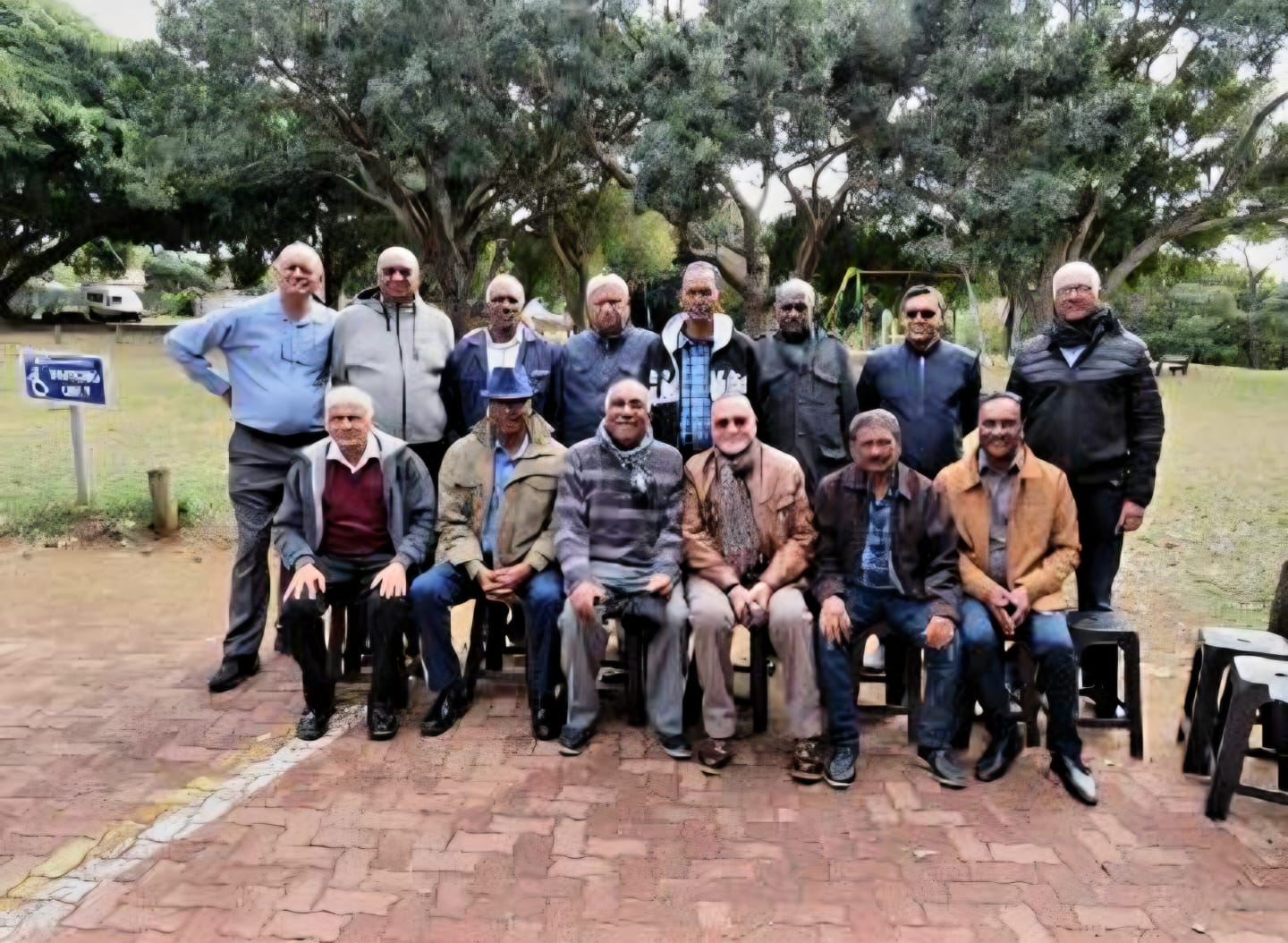
Meeting of Retired Police members, Durban
I want to acknowledge and respect these Officers for tireless behind the scenes, efforts in the production and publication of this magazine.
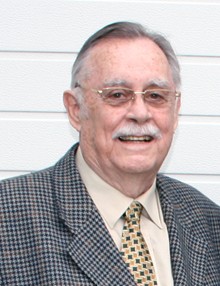
Brigadier Hennie Heymans, Editor in Chief of Nongqai
He worked with Munilall at the SA Police in Wentworth during the 1960s and speaks of him with the highest admiration, offering nothing but praise for our legend.
An experienced and highly skilled officer with an exceptional memory. His Dad was stationed at Somtseu Road and Mount Edgecombe during the 1940’s. Brigadier holds a master’s degree in history. Was stationed with Lieutenant-Colonel (Ray) Mathura Munilall at Wentworth. He was also based at King’s Rest (Brighton Beach); and amongst others, Soweto Region, The Public Relations Officer at Head Office and later a District Commandant at Welkom in the Free State Province.
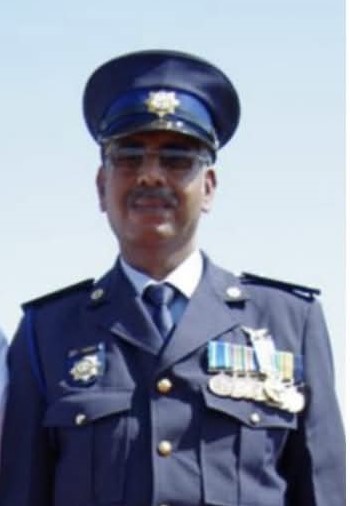
Captain DME Lazarus
A Stalwart of SA Police, Chatsworth, Unit 02 & Unit 05, later SA Police, Training College, Chatsworth and Supply Chain Management, Durban, KwaZulu-Natal. An experienced and highly skilled officer with an exceptional memory.
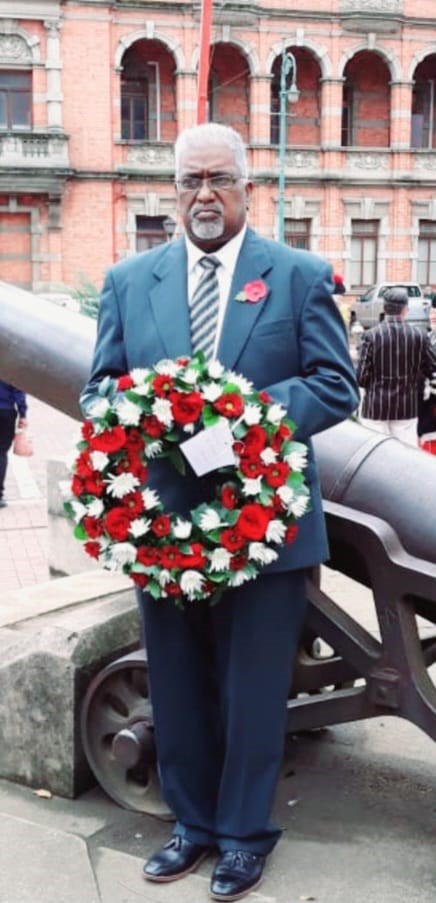
Captain (Sooks) P Sokaloo
Laying a wreath at a Commemoration Service in Pietermaritzburg. His Dad was a World War 11 veteran. An experienced and highly skilled officer. He was nominated by Lieutenant General Andre Pruis to represent the SA Police at Interpol in the illicit trafficking of narcotic drugs, etc
I must also acknowledge the outstanding contributions and enduring commitment of those who strive to preserve our policing heritage.
My sincere thanks go to:
- Brigadier Hennie Heymans [HBH], Editor-in-Chief of Nongqai, whose scholarship, experience, and visionary dedication made this Special Edition of Nongqai for Lieutenant-Colonel Ray Mathura Munilall possible.
- Major General (Professor) George D Govender [GDG], for his guidance, encouragement, and steadfast support.
- Advocate Karen Pillay, daughter of the late Colonel Rungasamy “Dickey” Munsamy, for her professional insight, guidance, steadfast support and motivation.
- Advocates (Lieutenant General) Sally Khan, Yolan Denness, Colonel (Advocate) Jay Govender, Major General Oswald Reddy; Captains DME Lazarus and PS Sokaloo, for their valued contributions and shared historical knowledge;
- And finally, to my family, for their patience, encouragement, and understanding throughout the journey of compiling and refining this tribute.
“agnoscere et honorare servientibus” –
“to acknowledge and honour those who served”
“Soli Deo Gloria” – “To God Alone Glory”
Logan Govender