An Autobiography: Lieutenant-Colonel Subramonia Pillai: Dedicated to my beloved wife, Vimla, my star in life
Abstract
“The life journey of the late Colonel S Pillai, B Proc, (South African Police) is a richly woven biography that reads like a novel, portraying the struggles and triumphs of a man who chose to place his future at the service of the present—transforming helplessness into purpose, choice, and conviction. Colonel Subramonia Pillai, the legend, hero, mentor, and coach to so many, will be remembered for years to come, both by the men and women in blue and by the community he served with such unwavering dedication” – Prof D Govender.
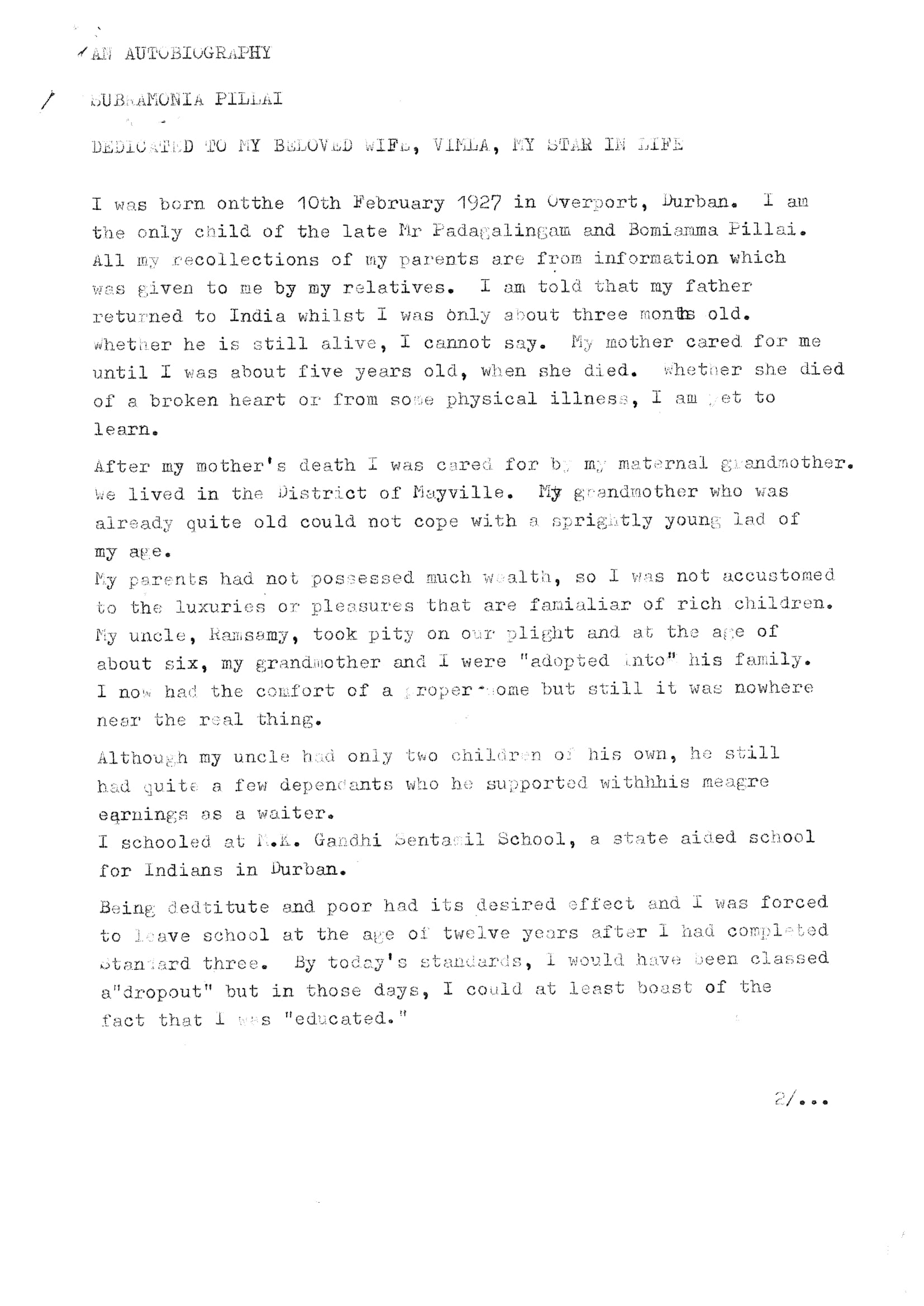
AN AUTOBIOGRAPHY
LIEUTENANT-COLONEL SUBRAMONIA PILLAI
DEDICATED TO MY BELOVED WIFE, VIMLA, MY STAR IN LIFE
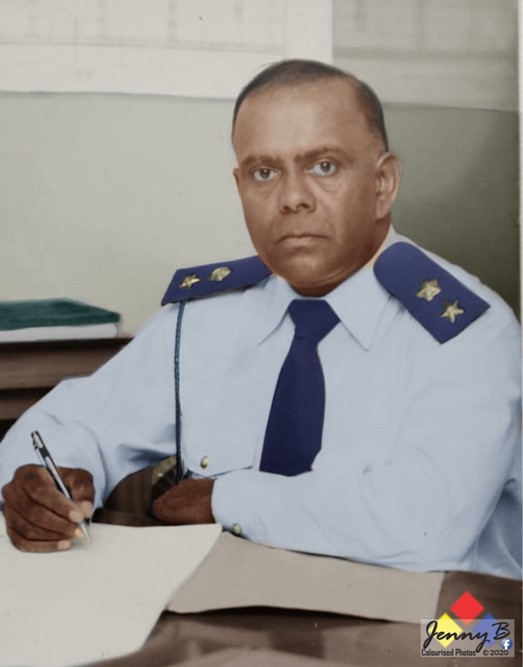
Lieutenant-Colonel Subramonia Pillai in uniform. The original black and white photograph courtesy of Brigadier Natty (NG) Govender. Colourised photo courtesy Mrs Jennifer Bosch
Article compiled by Col Logan Govender
I was born on the 10th February 1927 in Overport, Durban. I am the only child of late Mr Padagalingam and Bomiamma Pillai.
All my recollections of my parents are from information which was given to me by my relatives. I am told that my father returned to India whilst I was only about three months old. Whether he is still alive, I cannot say. My mother cared for me until I was about five years old, when she died. Whether she died of a broken heart or from some physical illness, I am yet to learn.
After my mother’s death I was cared for by my maternal grandmother. We lived in the district of Mayville. My grandmother who was already quite old could not cope with a sprightly young lad of my age.
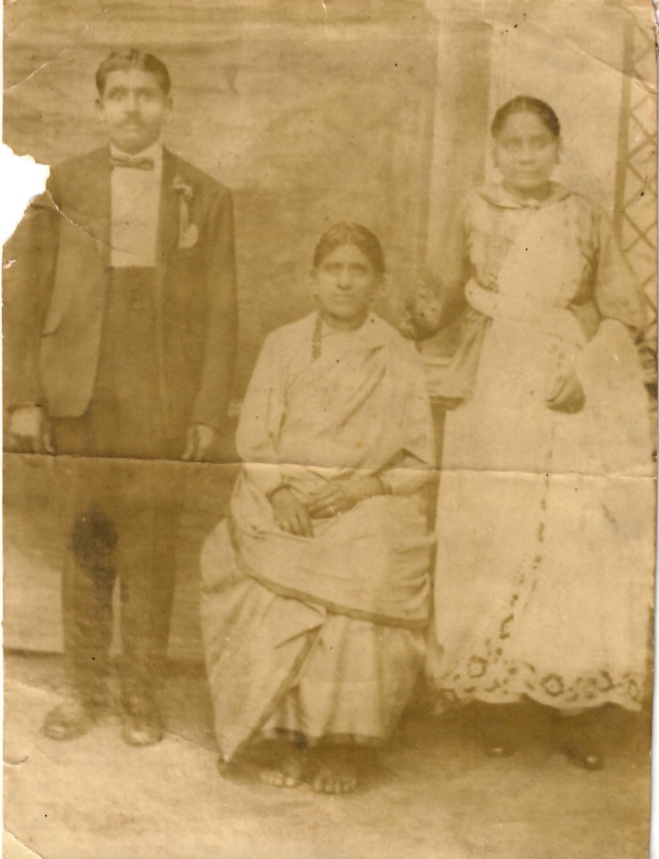
Pillai’s mother, Bomiamma far right. Others per sons not identified.
My parents had not possessed much wealth, so I was not accustomed to the luxuries or pleasures that are familiar of rich children. My uncle, Ramsamy, took pity on our plight and at the age of about six, my grandmother and I were “adopted into” his family. I now had the comfort of a proper home but still it was nowhere near the real thing.
Although my uncle had only two children of his own, he still had quite a few dependants who he supported with his meagre earnings as a waiter.
I schooled at MK Ghandi Sentamil School, a state aided school for Indians in Durban.
Being destitute and poor had its desired effect, and I was forced to leave school at the age of twelve years after I completed Standard three. By today’s standards, I would have been classed a “dropout” but in those days, I could at least boast of the fact that I was “educated”.
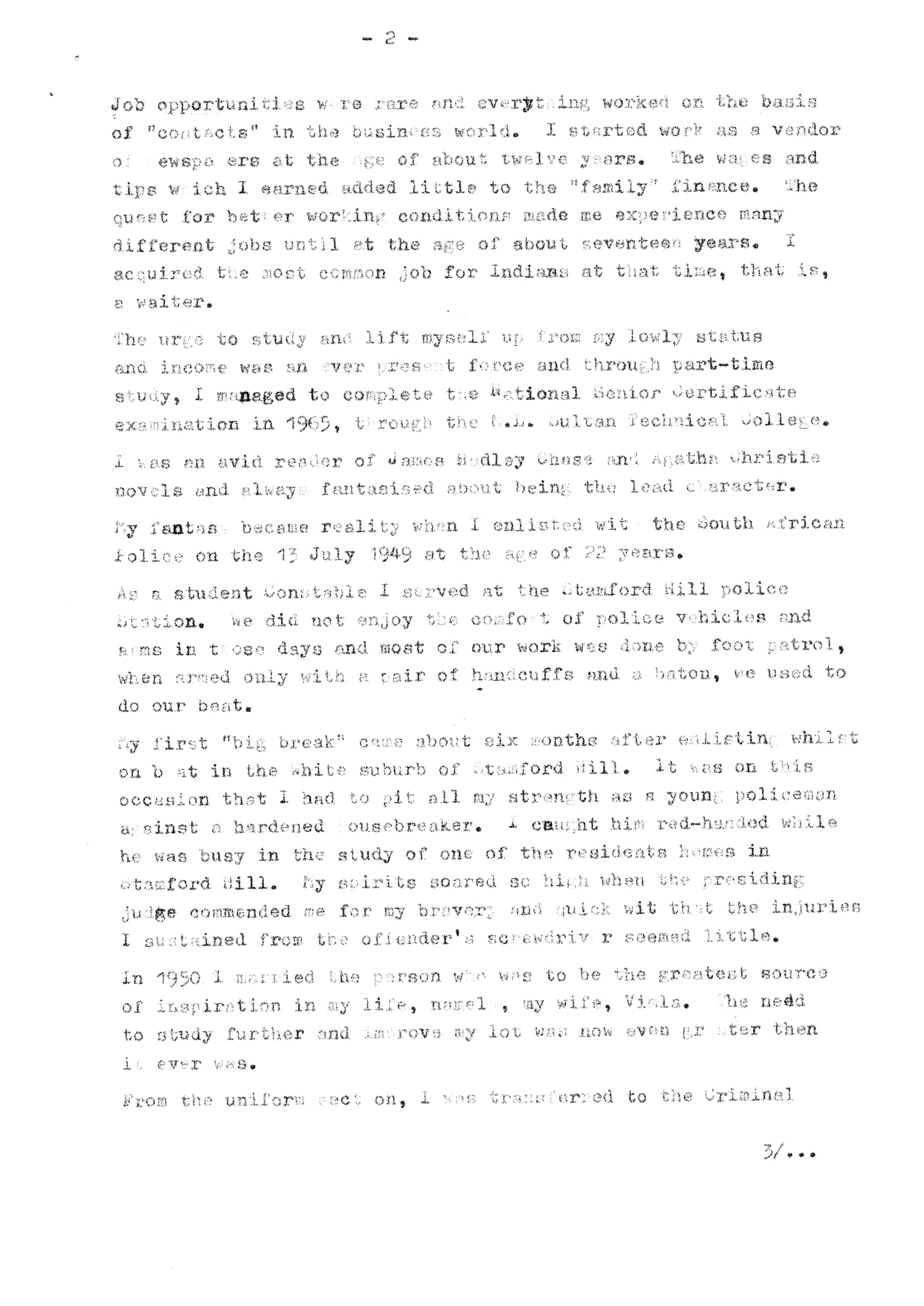
Job opportunities were rare, and everything worked on the basis of “contacts” in the business world. I started work as a vendor of newspapers at the age of about twelve years. The wages and tips which I earned added little to the “family” finance. The quest for better working conditions made me experience many different jobs until the age of about seventeen years. I acquired the most common job for Indians at that time, that is a waiter.
The urge to study and uplift myself up from my lowly status and income was an ever-present force and through part-time study, I managed to complete the National Senior Certificate examination in 1965, through the ML Sultan Technical College.
I was an avid read of James Hadley Chase and Agatha Christie novels and always fantasised about being the lead character.
My fantasy became reality when I enlisted with the South African Police on the 13th July 1949 at the age of 22 years.
As a student Constable I served at the Stamford Hill police station. We did not enjoy the comfort of police vehicles and arms in those days and most of our work was done by foot patrol, when armed only with a pair of handcuffed and a baton, we used to do our beat.
My first “big break” came six months after enlisting whilst on beat in the white suburb of Stamford Hill. It was on this occasion that I had to pit all my strength as a young policeman against a hardened housebreaker. I caught him red-handed while he was busy in the study of one of the residents’ homes in Stamford Hill. My spirits soared so high when the presiding judge commended me for bravery and quick wit that the injuries I sustained from the offender’s screwdriver seemed little.
In 1950 I married the person who was the greatest source of inspiration in my life, namely, my wife Vimla. The need to study further and improve my lot was now even greater than it ever was.
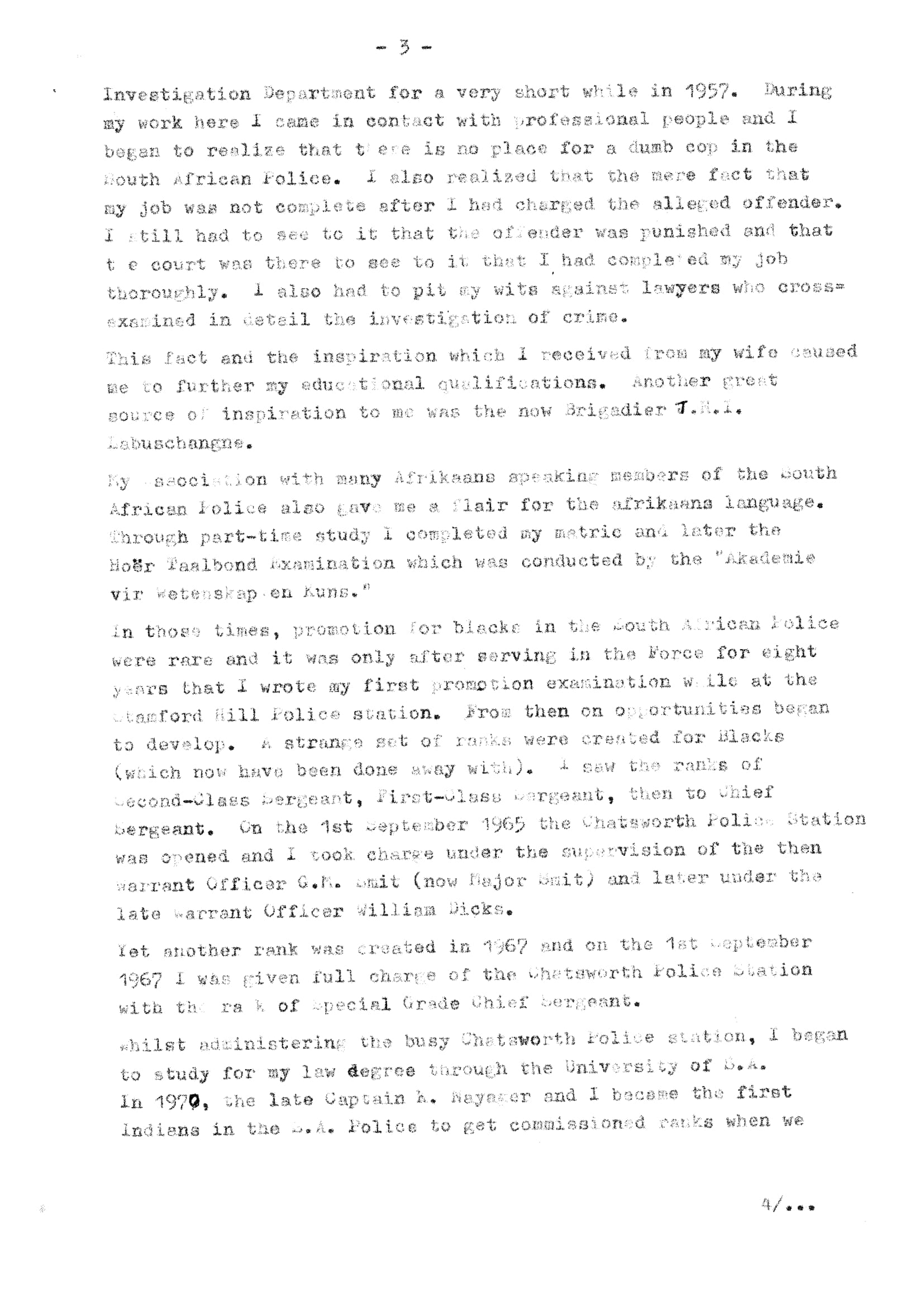
From the uniform section, I was transferred to the Criminal Investigation Department for a very short while in 1958. During my work here I came in contact with professional people, and I began to realize that there is no place for a dumb cop in the South African Police. I also realized that the mere fact that my job was not complete after I had charged the alleged offender. I still had to see to it that the offender was punished and that the court was there to see to it that I completed my job thoroughly. I also had to pit my wit against lawyers who cross-examined in detail the investigation of crime.
This fact and the inspiration which I received from my wife caused me to further my educational qualifications.
Another great source of inspiration to me was the now Brigadier JHI Labuschagne.
My association with many Afrikaans speaking members of the South African Police also gave me a flair for the Afrikaans language.
Through part-time study I completed my Matric and later the Hoër Taalbond Examination which was conducted by the “Akademie vir Wetenskap en Kuns.”
In those times, promotion for blacks in the South African Police were rare and it was only after serving in the Force for eight years that I wrote my first promotion examination while at the Stamford Hill Police Station. From then on opportunities began to develop. A strange set of ranks were created for Blacks (which now have been done away with.)
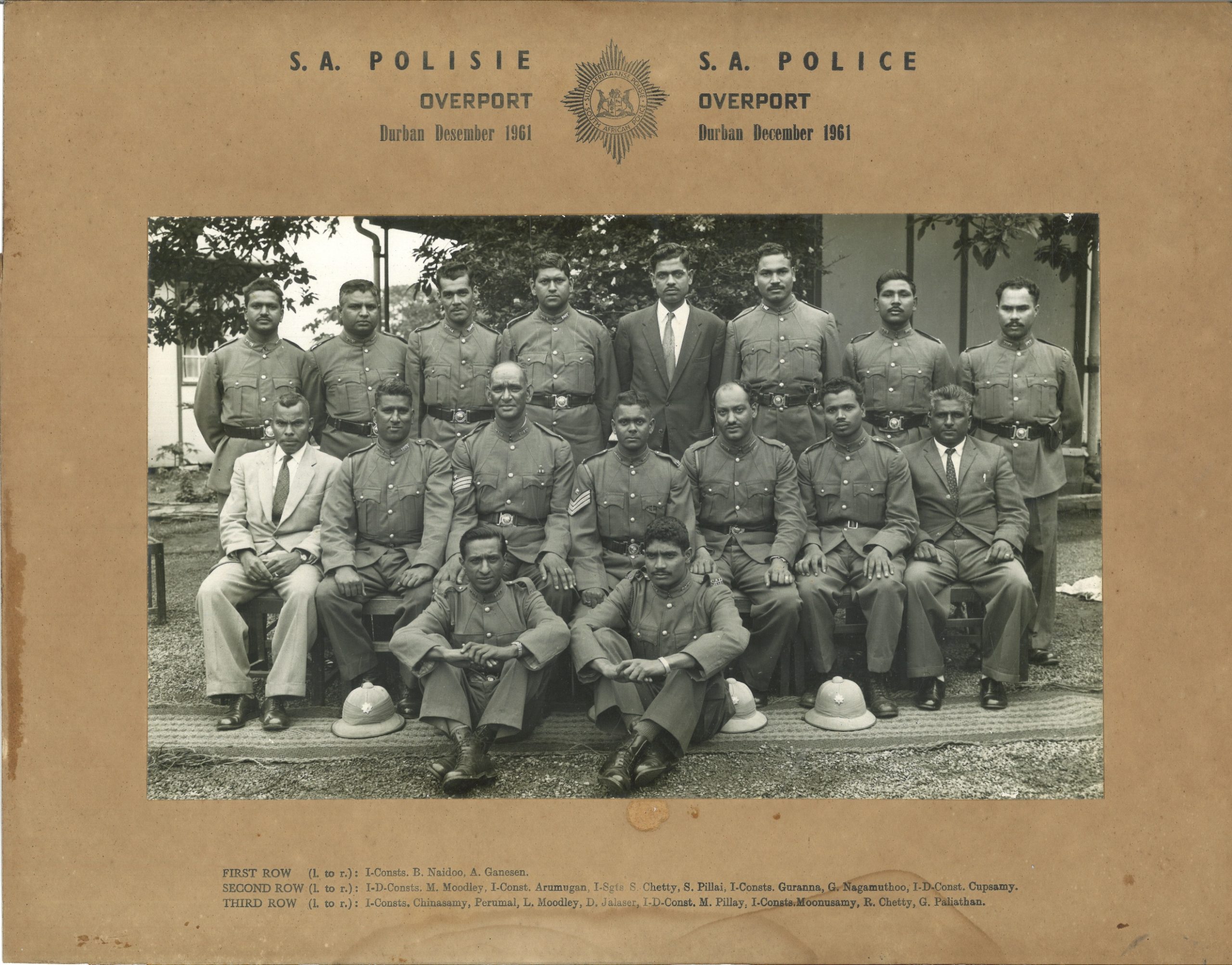
South African Police, Overport, Durban December 1961
Middle row, 4th from left Sergeant S Pillai
I saw the ranks of Second-class Sergeant, First-class Sergeant, then to Chief Sergeant. On 1st September 1965 the Chatsworth Police Station was opened, and I took charge under the supervision of the then Warrant Officer GM Smit (now Major Smit) and later under the late Warrant Officer William Dicks.
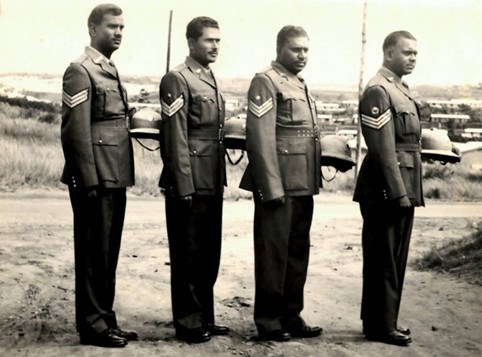
From left to right, I/Lance Sergeant DJ Lamech; I/Second Class Sergeant Kristnasami; I/Senior (First Class) Sergeant Govindsamy Reddy; I/Chief Sergeant S Pillai, Station Commander, SA Police, Unit 2, Chatsworth
Yet another rank was created in 1967 and on the 1st September 1967 I was given full charge of the Chatsworth Police Station with the rank of Special Grade Chief Sergeant.
Whilst and administering the busy Chatsworth Police Station, I began to study for my law degree through the University of SA.
In 1970, the late Captain K Nayager and I became the first Indians in the SA Police to get commissioned ranks when we became Lieutenants. This was the beginning of a slow process towards equality in the ranks in the South African Police.
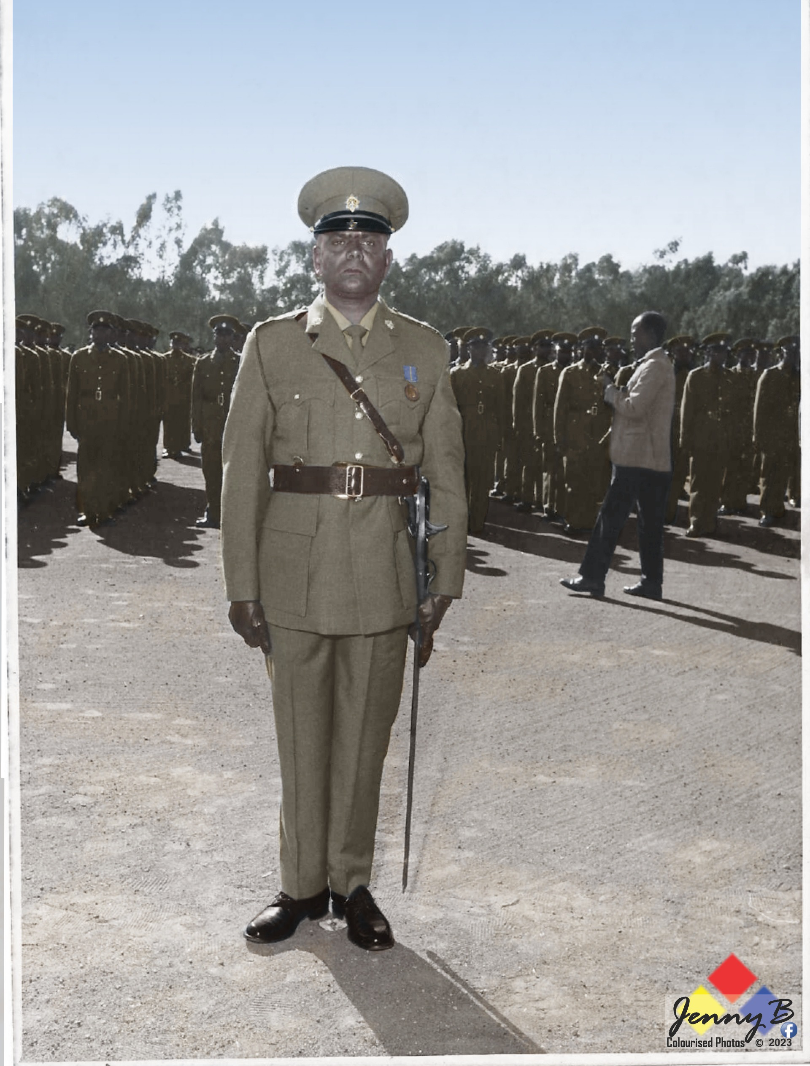
Late, Lieutenant Subramonia Pillai, (Lieutenant-Colonel) proudly standing on the parade ground at the Passing Out Parade of the first group of Black, Coloured and Indian South African Police Commissioned Officers (Lieutenants) during 1970 at the South African Police New Modder Training Institution, Benoni, Gauteng Province (Source: family of late, Lieutenant-Colonel S Pillai, black and white photograph kindly colourised by Ms Jennifer Bosch)
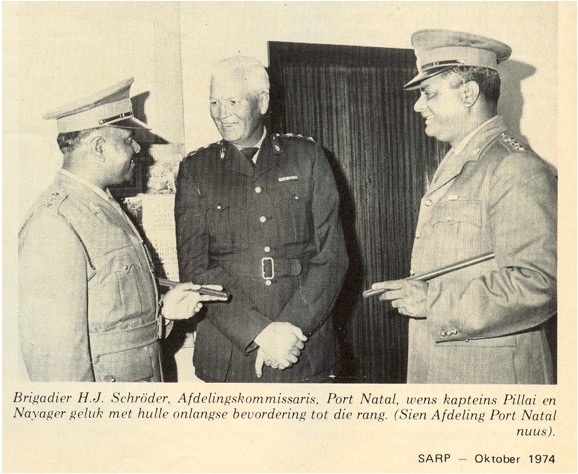
The Divisional Commissioner, SA Police, Port Natal Division, Brigadier HJ Schroeder, congratulates both Captains Pillai and Nayager on their recent (1974) promotion to the rank of Captain
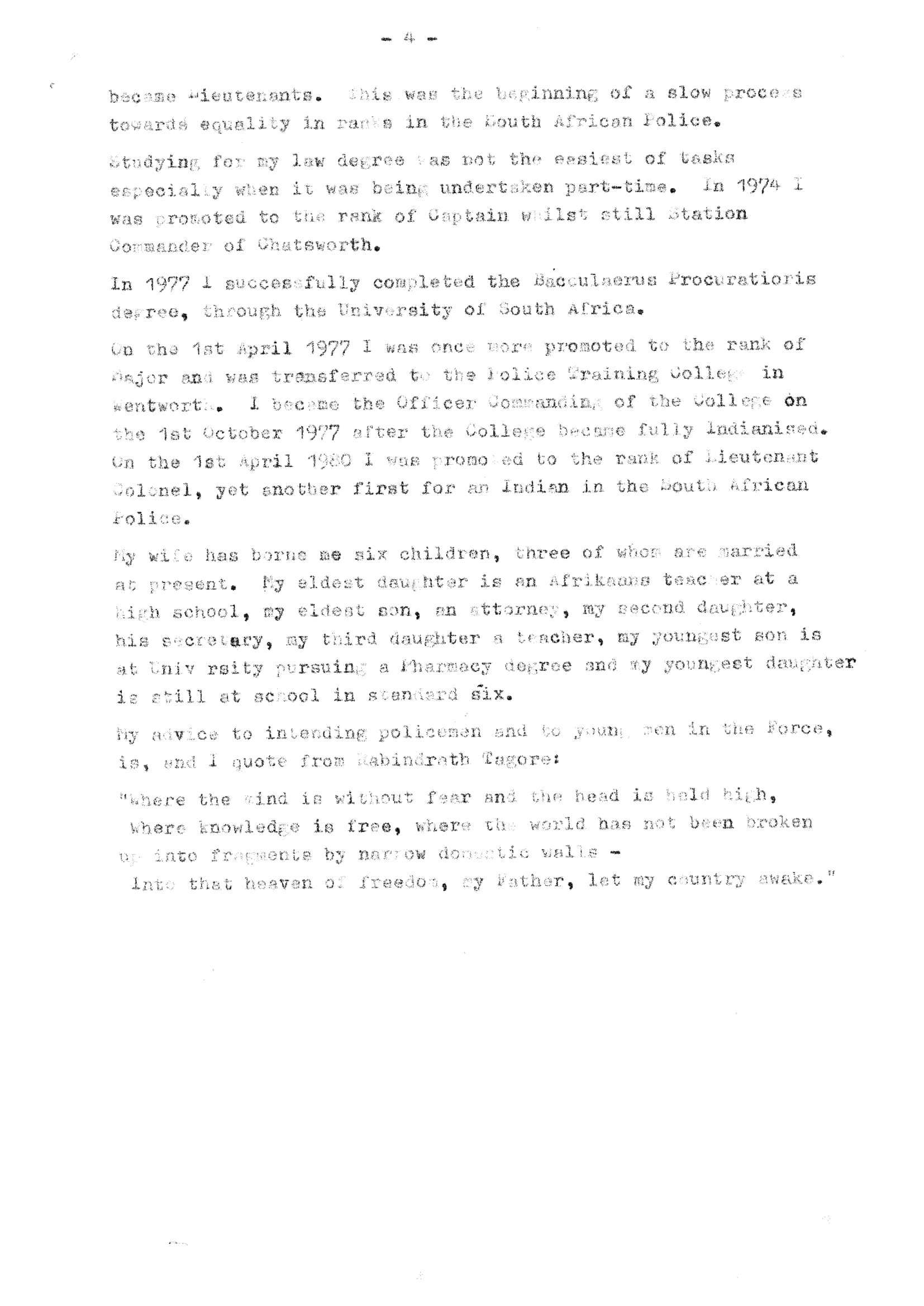
Studying for my law degree was not the easiest of tasks especially when it was being undertaken part-time. In 1974 I was promoted to the rank of Captain whilst still Station Commander of Chatsworth.
In 1977 I successfully completed the Baccalauerus Procurationis degree, through the University of SA.
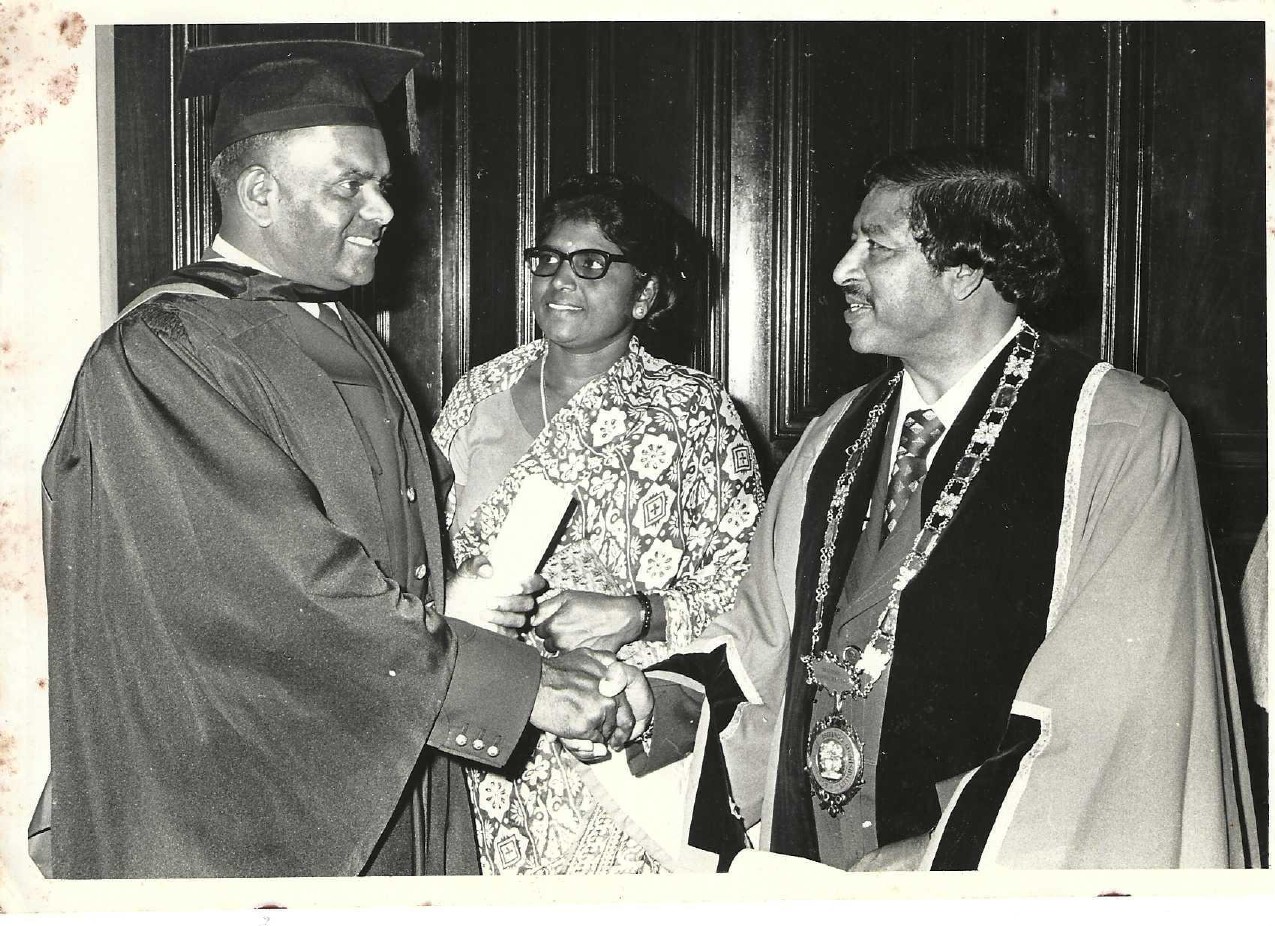
After his graduation Captain Pillai is seen with his dear wife Vimla, being congratulated by the Mayor of Isipingo, His Worship Mr Falcon Khan, circa 1975
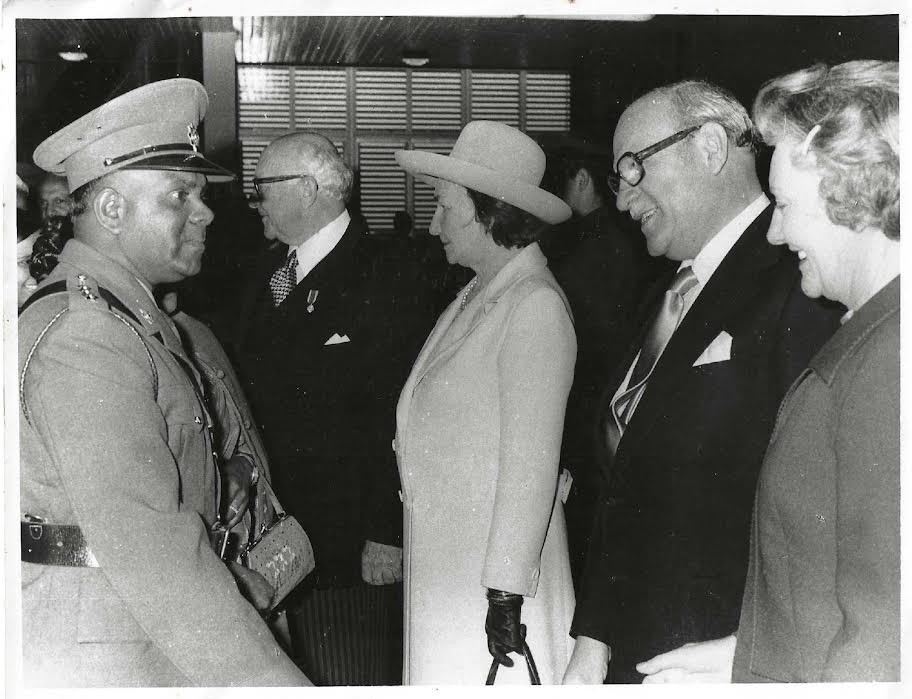
Captain Pillai and his dear wife, Vimla are in con versation with former South African State Presi dent, Dr and Mrs Diedericks and Mr and Mrs Marais Steyn.
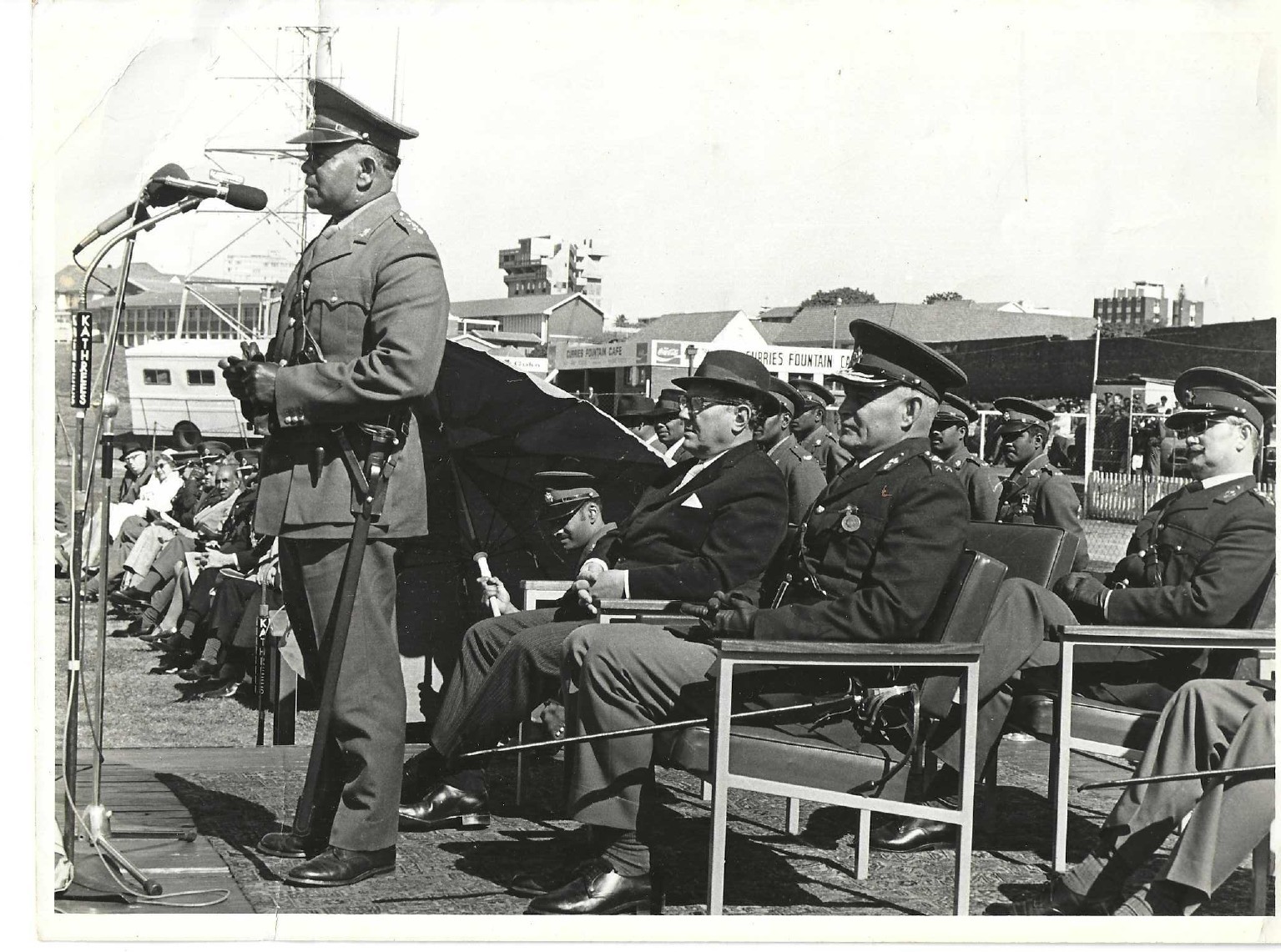
Captain S Pillai addressing the families, relatives and friends during a Passing Out Parade at Curries Fountain Grounds the 1970’s. Minister of Police, The Honourable TJ Kruger seated in the background with Brigadier HG “Hennie” de Witt (later Commissioner) next to him
On the 1st April 1977 I was once more promoted to the rank of Major and was transferred to the Police Training College in Wentworth. I became the Officer Commanding of the College on the 1st October 1977 after the College became fully Indianised.
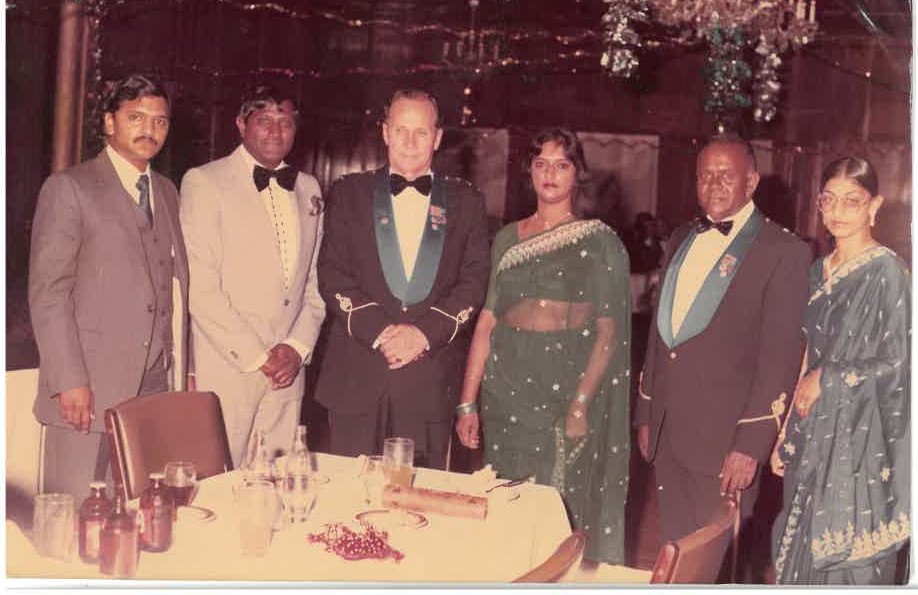
An official Police function probably in Durban, Venue, circa 1980
From left to right, Mohan Deva Gopal; Gona Moopanar; Brigadier Jan Visser, Divisional Commissioner, Port Natal, Durban; Mrs Moopanar; Lieutenant-Colonel S Pillai; Unidentified Lady (Probably Mrs Gopal – [LG])
On the 1st April 1980 I was promoted to the rank of Lieutenant-Colonel, yet another first for an Indian in the South African Police.
My wife has borne me six children, three of whom are married at present. My eldest son, an attorney, my second daughter his secretary, my third daughter a teacher, my youngest son is at university pursuing a Pharmacy degree and my youngest daughter is still at school in standard six.
My advice to intending policemen and young men in the Force, is, and I quote from Rabindrath Tagore:
“Where the wind is without fear and the head is held high, Where knowledge is free, where the world has not been broken up into fragments by narrow domestic walks – Into that heaven of freedom, my Father, let my country awake.”
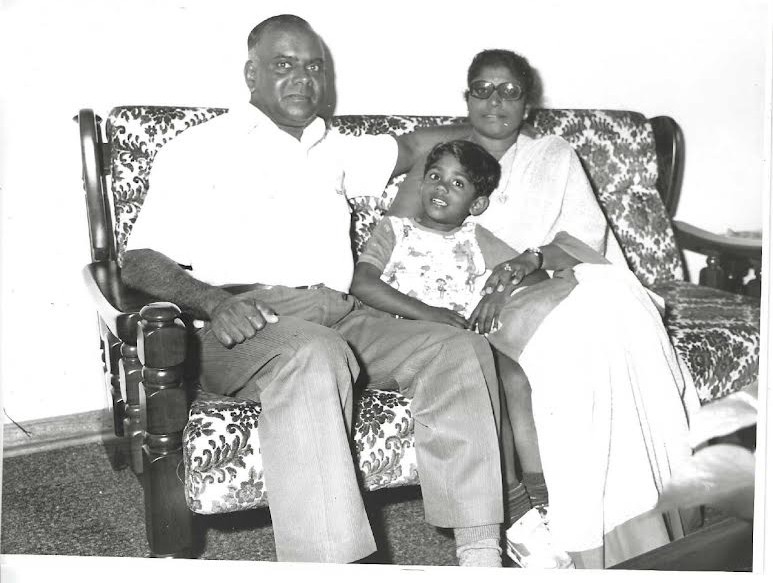
Pillai and his dear wife Vimla and grandson Kyle, circa 1982
The following medals awarded to Colonel Subramoni Pillai, bears testimony of his exemplary conduct in the performance of his police functions.
- 1967–07-13 The South African Police Medal for Faithful Service (10 years), for Long Service and Exemplary Conduct;
- 1979 -05-01 The South African Police Star for Faithful service (20 years), for Faithful Service and Exemplary Conduct;
- 1979-07-13 The South African Police Star for Merit (30 years), Faithful Service and Exemplary Conduct.
Served for 33 years
He sadly passed on 5th December 1982.
“The life journey of Colonel Pillai, is a richly woven biography which reads like a novel, depicting the struggles and accolades to put his future at the service of the present, replacing helplessness with choice and decision. Colonel Subramonia Pillai, the legend, hero, mentor, and coach too many, will be remembered for years to come, both in the minds of men and women in blue and by the community he served so diligently.” – Major General (Professor) (George) Doraval Govender
I vividly remember his official funeral. I participated in the leading detachment (guard of honour) led by the late Captain DJ Lamech. I remember how each Commissioned Officer from all the armed forces approached the grave and gave a final salute. I re member the Police Band which he established playing the LAST POST and REVELLE in his honour and said to myself “THIS WAS A MAN”. In his honour I crafted a table shield with a brass plaque with the words “IT WILL TAKE MOST MEN MANY LIFETIMES TO ACHIEVE WHAT THIS MAN HAS ACHIEVED IN ONE LIFETIME.” – Brigadier (Natty) NG Govender
“The Nation which forgets its defenders will itself be forgotten” – Calvin Coolidge
Copy of the original copy of the autobiography:
Colonel Subramonia Pillai (1927–1982) was a pioneering Indian South African police officer whose distinguished service and trailblazing career broke through the rigid racial barriers of apartheid-era policing. Born on 10 February 1927, he joined the South African Police on 13 July 1949 and went on to serve the force with distinction for over three decades. Rising through the ranks at a time when Indians and other non-white South Africans faced systemic exclusion from senior police positions, Pillai became the first Indian first Indian Station Commander at Chatsworth Unit 2, the first Indian commissioned officer. First Indian Graduate in the SA Police – Circa 1975. His most significant appointment came when he was named Officer Commanding of the Wentworth Police Training College, where he was responsible for training new recruits and fostering discipline and professionalism among officers of colour. Revered for his leadership, integrity, and academic excellence, Colonel Pillai became a symbol of progress and pride for the Indian community in Chatsworth and throughout South Africa. His career embodied perseverance against adversity and inspired future generations to pursue public service with dedication and honour. Although he passed away on 5 December 1982, Colonel Pillai’s contributions continue to be recognized posthumously — particularly through police heritage archives such as Nongqai, and the Ghandhi / Luthuli Documentation Centre, University of UKZN, Durban-Westville, which celebrate him as one of the greatest legends of the South African Police.
Comments by Prof D Govender (Retired: Major General)
Lieut Col Subramonia Pillay should be bestowed with an honorarium rank of General, as the first Indian commissioned officer with a law degree to have been appointed as station commander and subsequently Lieut Colonel (First commanding officer of the Basic Training College in Wentworth). Being one of his proteges in the 1970’s, I bear testimony of the many senior leaders who worked with him. He was truly an inspirational leader and mentor to many leaders who came after him among the Indian diaspora, who were proud to have worked under his leadership.
Kind regards
Prof D Govender (Retired: Major General)
Comments by Brig HB Heymans (SAP Retired): Chief Editor of the Nongqai
I served with Lieutenant Nelson Nyager in Durban and had the opportunity to meet the then Lieutenant Subramonia Pillay on several occasions. I visited him at his station in Chatsworth and witnessed first-hand how everything was conducted in an exemplary manner—neat, orderly, spick and span, and always ready for inspection. That is how I remember him. I was also an early university graduate, and I can confirm that in those days it was exceptionally difficult for a policeman to pursue academic studies.
As a police historian, I wholeheartedly agree with Prof. Govender that the honorary rank of Major General should be bestowed on Lt-Col Subramonia Pillay posthumously. He truly deserves this recognition as a pioneering police officer who excelled in his career during a challenging period in South Africa’s history. We salute his memory – HBH.
“agnoscere et honorare servientibus” –
“to acknowledge and honour those who served”
“Soli Deo Gloria” – “To God Alone Glory”
Logan Govender
