The Unknown Monument: The Rhodesian Viscount Memorial: Voortrekker Monument, Pretoria
Wolfgang Witschas
Abstract
The Rhodesian Viscount Memorial, located at the Voortrekker Monument in Pretoria, South Africa, honours the victims of the 1978 and 1979 Air Rhodesia Viscount disasters. Unveiled in 2012, this site serves as a place of remembrance for the 107 people killed when Zimbabwe People’s Revolutionary Army (ZIPRA) terrorists shot down two civilian Air Rhodesia airliners, Hunyani and Umniati.
Key Words
Rhodesian Viscount Memorial
Air Rhodesia Viscount airliner
Voortrekker Monument in Pretoria
Zimbabwe People’s Revolutionary Army
(ZIPRA)
Introduction
The Rhodesian Viscount Memorial is located at the Voortrekker Monument in Pretoria, South Africa, to te left of the Koevoet Wall of Remembrance. The monument honors the victims of the 1978 and 1979 shooting down of the two Air Rhodesia Vicers Viscount airliners. Unveiled in 2012, this site serves as a place of remembrance for the 107 people killed when ZIPRA terrorists shot down civilian airliners, Hunyani and Umniati.
The monument is sometimes referred to as “The Monument many do not know exists”
In Zimbabwe, the brass plaques bearing the names of the dead were removed from Salisbury’s Anglican Cathedral after independence, ruled by Zanu-PF of Robert Mugabe. They were deemed “colonial relics” and consigned to the basement. Families eventually found them and took them to South Africa.
Background to the Memorial
Location:
The memorial is situated in the gardens at the Voortrekker Monument in Pretoria, South Africa, near the Koevoet Wall of Remembrance, to the west of the Monument.
Description and Features
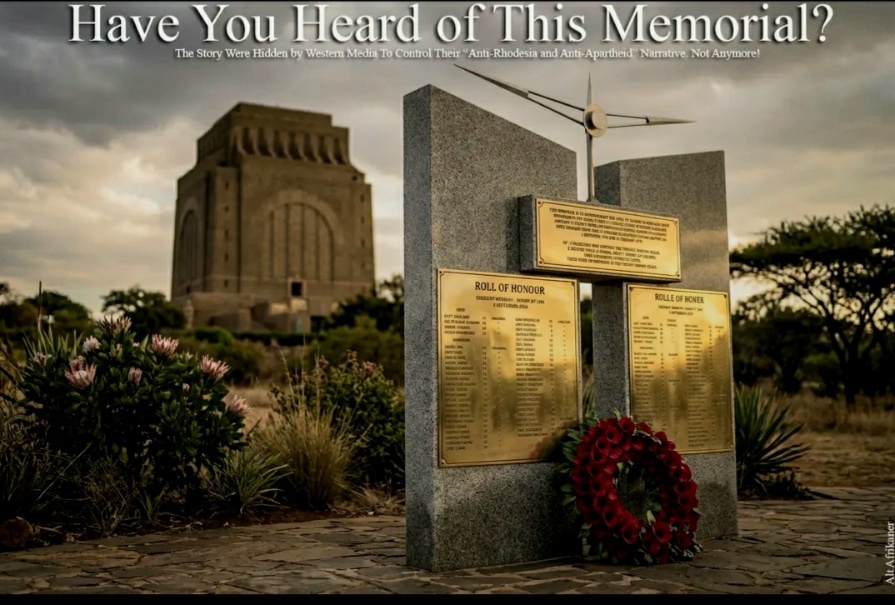
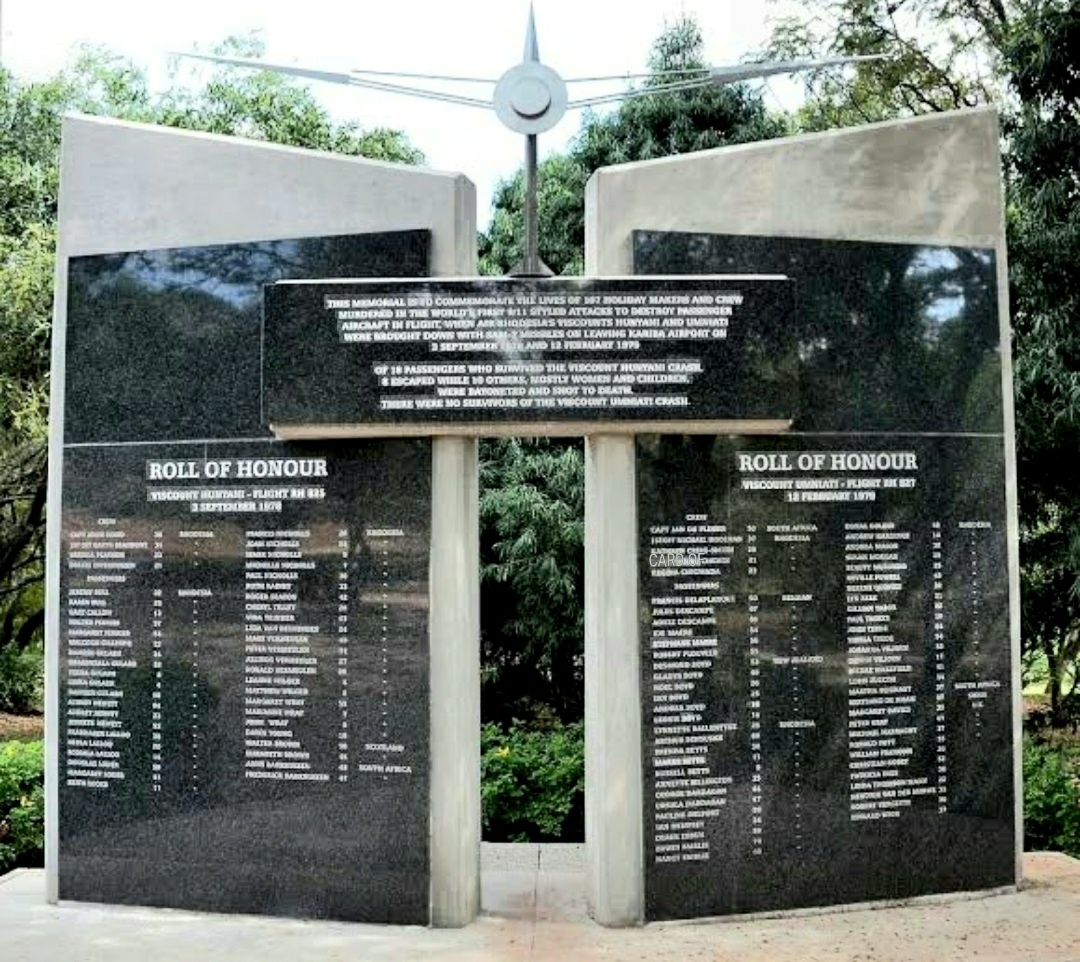
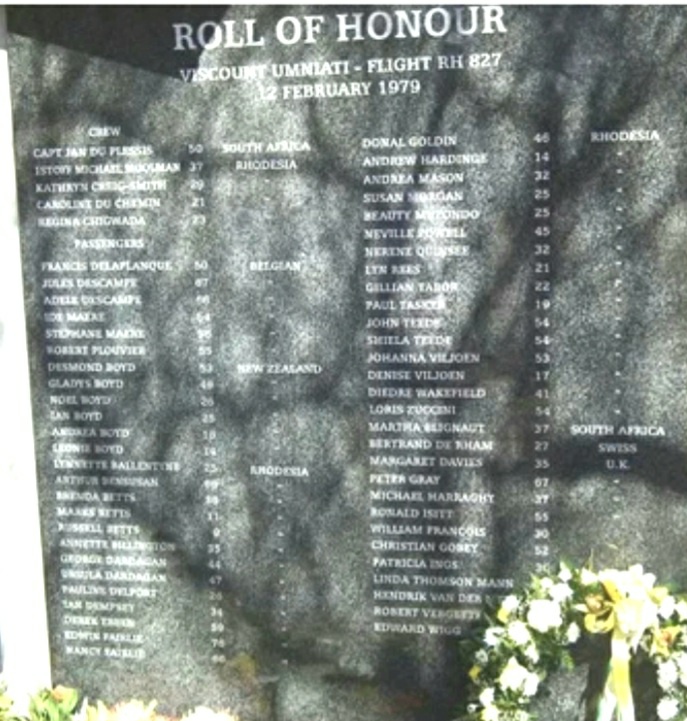
The Memorial consist of two large granite slabs engraved with the names of the passengers and crew, topped by an emblem featuring two propeller blades, symbolizing the aircraft. It is quiet there. The granite catches the light. The names are readable.
The Shooting Down of the Two Air Rhodesia Viscount Airliners
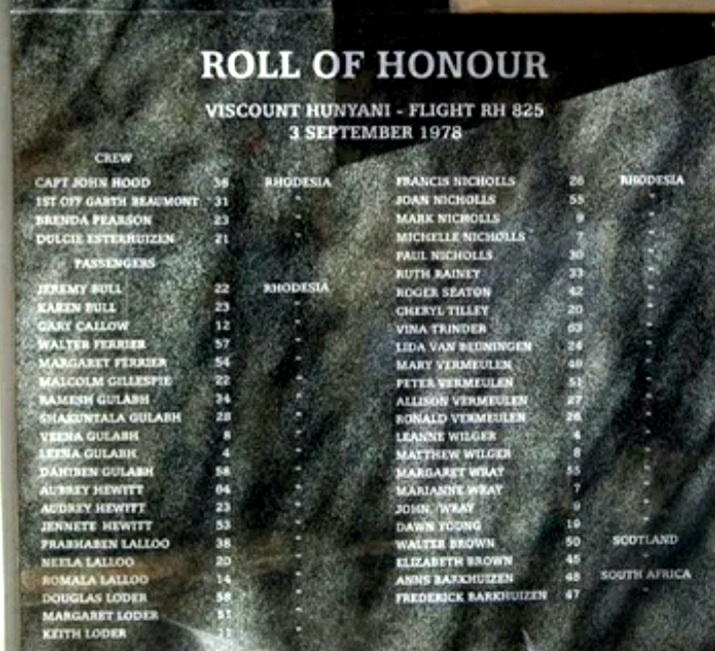
On 03 September 1978 Air Rhodesia Flight 825 (Hunyani) was a regular scheduled passenger flight from Victoria Falls to the capital Salisbury, via the resort town of Kariba.
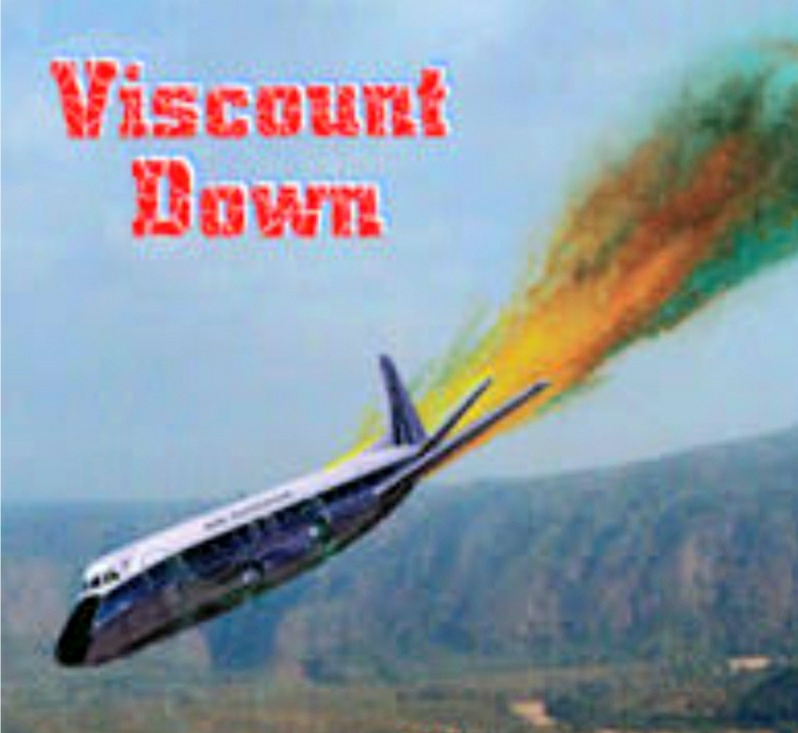
Soon after Flight 825 took off at Victoria Falls, a group of ZIPRA guerrillas hit it on its starboard wing with a Soviet-made Strela-2 surface-to-air infrared homing missile, critically damaging the aircraft and forcing an emergency landing. An attempted belly landing in a cotton field just west of Karoi was foiled by a ditch, which caused the plane to cartwheel and break up. Of the 52 passengers and four crew, 38 died in the crash; the insurgents then approached the wreckage, rounded up the 10 survivors they could see and massacred them with automatic gunfire. Three passengers survived by hiding in the surrounding bush, while a further five lived because they had gone to look for water before the terrorists arrived.
On 12 February 1979 Air Rhodesia Flight 827 (Umniati) was a regular scheduled passenger flight from Victoria Falls to the capital Salisbury, via the resort town of Kariba. On board were 59 crew and passengers. Soon after take off ZIPRA guerrillas using a Strela 2 missile shot down tar Air Rhodesia Vickers Viscount airliner. The circumstances were very similar to the shooting down of Air Rhodesia Flight 825 five months earlier.
Aviation Changes
Air Rhodesia subsequently coated the undersides of its planes with low-radiation paint and shrouded exhaust pipes to reduce heat signatures.
Fatal Mistake by the Pilots
The flight’s departure from Kariba had been delayed, and so the pilots did not take the time to climb over a lake to get above the ceiling of shoulder-launched anti-aircraft missiles before heading for Salisbury. ZIPRA had information that the Rhodesian Security Forces Commander General Peter Walls was on board, and they tried to assassinate him. However, he and his wife were on a second (similar) aircraft that took off 15 minutes later, immediately executing manoeuvres designed to evade missiles, and landing safely in Salisbury.
Aftermath
“The Silence is Deafening”:
What followed was not international outrage. Not condemnation from world leaders. Not urgent sessions at the United Nations. What followed was silence.
At the memorial service in Salisbury’s Anglican Cathedral, the Very Reverend John da Costa delivered a sermon that would echo through decades. Two thousand people crowded inside, another five hundred on the steps outside, listening on portable radios.
“Nobody who holds sacred the dignity of human life can be anything but sickened at the events attending the crash of the Viscount Hunyani. This bestiality, worse than anything in recent history, stinks in the nostrils of Heaven. But are we deafened with the voice of protest from nations which call themselves ‘civilised’? We are not. Like men in the story of the Good Samaritan, they pass by, on the other side.”
He called out the silence of Dr David Owen, the British Foreign Secretary. The silence of President Jimmy Carter of the USA. The silence of the Pope in Rome, the Archbishop of Canterbury in Britain, the Chief Rabbi in Israel.
“One listens for loud condemnation by the President of the United States, himself a man from the Bible-Baptist belt, and again the silence is deafening.” The world knew. The world said nothing. Because the victims were Rhodesian. White. Because acknowledging the massacre might have looked like supporting Ian Smith. Because political convenience trumped moral clarity.
Unveiling of the Monument
On 02 September 2012, thirty-four years after the first attack, the Viscount Memorial was unveiled in the gardens of the Voortrekker Monument near Pretoria. Two granite slabs stand upright, side by side, engraved with the names of all 107 victims. An aircraft emblem tops the monument.
Around 450 people attended the unveiling. Survivors. Families of the dead. Former Rhodesian military personnel who had tracked down the perpetrators. Mike Westcott, a former Rhodesian Broadcasting Corporation announcer, chaired proceedings.
“At last we have a memorial,” he said. “The families of those who died had holes in their hearts. Now they will not be forgotten.”
Annual services continue at the site. Wreaths are laid. The names of the dead are read aloud. The Rhodesian diaspora gathers under the tree canopy to remember what the world forgot.
Why the Voortrekker Monument
The Voortrekker Monument is not merely an Afrikaner shrine. It is a place that has evolved, declared a National Heritage Site in 2011, receiving over 155,000 visitors annually, a monument that has transformed from exclusive Afrikaner nationalism into something broader.
It houses other memorials too, such as the South African Defence Force (SADF) Wall of remembrance and the Koevoet Veterans Unit Wall of Remembrance. It has become a repository for Southern African histories that have no other home, stories the new political order prefers to erase.
The Rhodesian memorial found refuge here because nowhere else would have it. The country where the attacks happened will not acknowledge them. The international community that remained silent then remains silent now. But the names on the granite slabs do not care about politics. They are simply the names of people who boarded an aeroplane to go home from holiday and never arrived.
Memorial Services
Informal gatherings take place at the Viscount Memorial since 2012 but a formal service is held every four years. The next one is to be held on 01 March 2026
Memorial Services in the past:
2012, 2016, 2022 (due to Covert not held 2020) next 2026.
References
Book:
Viscount Down
The complete story of the Rhodesian Viscount disasters as told by SAS 0perator Keith Nell
https://visitstothepark.wordpress.com/2012/09/04/rhodesias-911attack-a-memorial-and-unveilling-of-the-monument/
https://en.wikipedia.orrg/wiki/Air_Rhodesia_Flight_825
https://journals.ufs.ac.za/index.php/jch/article/view/7962
Informal gatherings take place at the Viscount Memorial but a formal service is held every four years. The next one is to be held on 3 September, 2016.
Wolfgang Witschas
