Second Anglo-Boer War (1899-1902): Canadian Unit: Strathcona’s Horse
Wolfgang Witschas
Abstract
At the request of Queen Victoria, Lord Strathcona created, recruited, and equipped the “regiment” (later to be named: “Strathcona’s Horse”) at his own expense.
The “Strathcona’s Horse”, then known as ‘A Squadron, The Canadian Mounted Rifles’, LdSH (RC) which was authorized on 01 February 1900, embarked for South Africa on 17 March 1900. It fought as part of the ‘3rd Mounted Brigade’ and ‘4th Infantry Brigade, II Division’ until its departure from the theatre of operations on 20 January 1901.The unit was disbanded on 09 March 1901. The regiment was one of the last in the British Empire to be created and raised by a private individual, Donald Alexander Smith, 1st Baron Strathcona and Mount Royal.
Key Words
Second Anglo Boer War
Canada
“Strathcona’s Horse”,
Lord Strathcona, Donald Alexander Smith
Zuid-Afrikaansche Republiek (ZAR)
Orange Free State (OFS)
Introduction
Strathcona’s Horse was a mounted infantry unit raised in Canada in 1900 specifically for the Second Boer War. It was one of the last regiments in the British Empire to be created. Lord Strathcona, Donald Alexander Smith, 1st Baron Strathcona was a Scottish-born Canadian businessman who became one of the British Empire’s foremost builders and philanthropists.
Born on 06 August 1820 in Forres, Scotland as “Donald Alexander Smith”. He died on 21 January 1914 at the age of 93 in London. He became commissioner, governor and principal shareholder of the Hudson’s Bay Company. He was president of the Bank of Montreal. He is possibly best known for equipping and maintaining the celebrated cavalry unit known as Lord Stathcona’s Horse during the Second Anglo Boer War (1899-1902). On 11 January 1900 at the request of Queen Victoria, Lord Strathcona, Donald Alexander Smith, 1st Baron Strathcona and Mount Royal offered “to equip and land at Cape Town, at his own expense, 500 Rough-riders from the Canadian North-West, as a special service corps of Mounted Rifles. Two days later his offer was accepted by the Secretary of State for War”. The Mount Royal, and consisted of 537 officers and men, mostly from Western Canada.
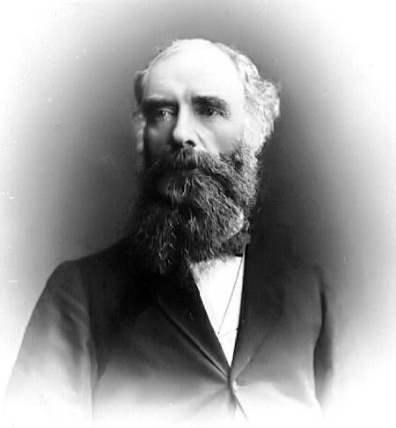
The Lord Strathcona and Mount Royal
Second Anglo Boer War
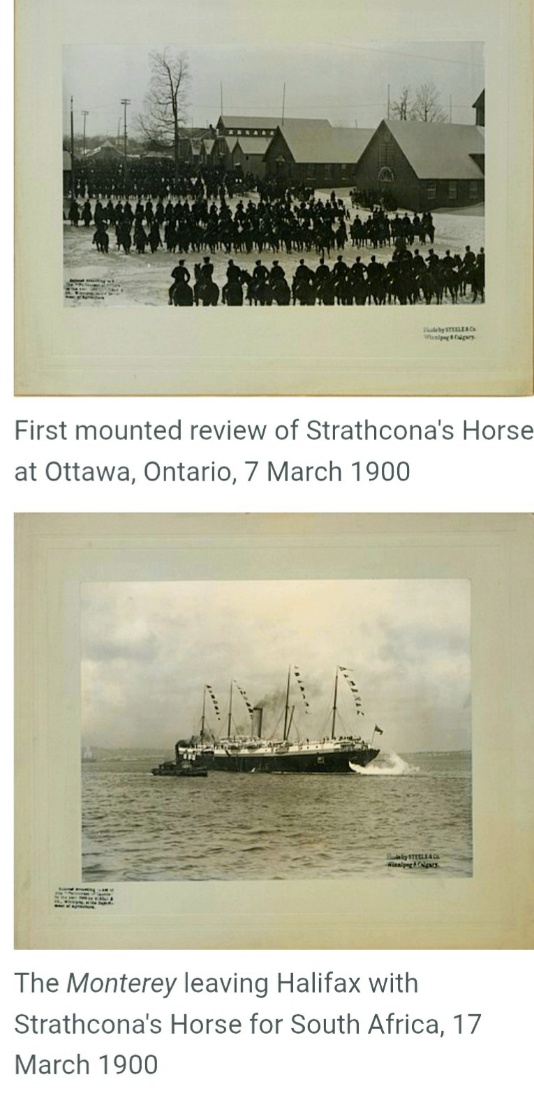
While officially a British unit, the distinction was lost on the Canadian public, politicians, and the men serving in its ranks. It could hardly have been otherwise, as the unit was recruited entirely in the Canadian West. It was equipped by the Canadian government, quartered in Lansdowne Park, Ottawa, and paraded on Parliament Hill. The men cut impressive figures, resplendent in wide-brimmed Stetsons, and mounted on cow ponies with western saddles and lassos.
The unit was made up of three squadrons recruited in Manitoba, the territories that would later become the provinces of Saskatchewan and Alberta, and British Columbia. A cadre of mounted police joined Strathcona’s Horse, among them the commanding officer, the legendary Superintendent Sam Steele.
On 16 March 1900 the force, then known as “A Squadron, The Canadian Mounted Rifles” , LdSH (RC) embarked 28 officers, 512 of other ranks, with 599 horses, 3 Maxim machine guns, 1 Maxim Nordenfeldt 37mm “pom pom” gun, 500 rounds per rifle and 50,000 rounds for each maxim. A more munificent offer has seldom been made by a subject to his country.
The regiment landed at Cape Town on 10 April 1900. Unfortunately nearly 200 horses had been lost at sea and due to an outbreak of disease among its horses, an unusually large proportion. After about five weeks impatiently spent near Cape Town, the force again re-embarked for Natal; two squadrons were put off at Durban and one, ‘B’ was taken to Kosi Bay as part of an expedition into Swaziland, but this did not come off; perhaps the enemy was found to have heard of it. ‘B’ squadron came back to Durban.
Rumour exists that members of the North-West Mounted Police in Canada, serving with the regiment during the Boer War preferred the boots the regiment wore, and adopted them as their own – hence the name “Strathcona boots” for Royal Canadian Mounted Police high brown boots. Another legacy of the official kit is the popularity of the distinctive Stetson Campaign Hat worn by all Canadians serving in Africa during the
Second Boer War. After seeing Canadian troops in this attire at the Relief of Mafeking, British Officer Robert Baden-Powell ordered 10,000 of the hats for his own troops.
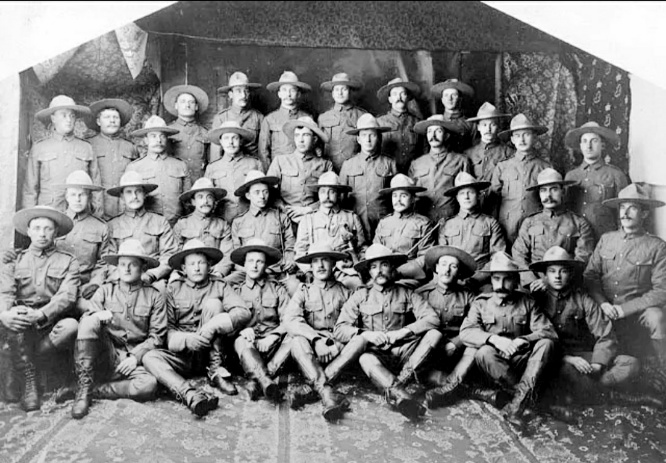
A troop of Strathcona’s Horse
Face Book: group: The Anglo
Boer War: (South African War)
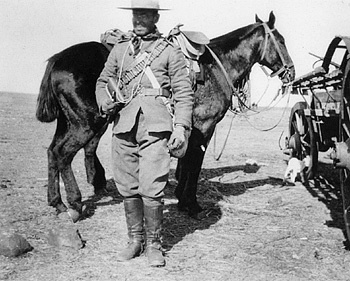
Trooper of the Strathcona’s Horse
Trooper of the Strathcona’s Horse in South Africa. This image strikingly shows why Strathcona’s Horse, perhaps more than any other unit in South Africa, became identified with the popular image of the Canadian cowboy.
In June 1900 the unit was taken by rail to Newcastle and joined General Buller’s army, being put into the 3rd Mounted Brigade under Lord Dundonald, and attached for the time to General Clery’s Division. On 01July 1900 they had, near Waterval on the Natal-Pretoria Railway, the first of many skirmishes, and suffered their first losses in action. That week they were engaged on several occasions, having altogether about 15 casualties. In one of these little actions Sergeant A H L Richardson gained the Victoria Cross. “On 05 July 1900 at Wolve Spruit, about 15 miles north of Standerton, a party of Strathcona’s Horse, only 38 in number, came into contact, and was engaged at close quarters, with a force of 80 Boers.
When the order to retire had been given Sergeant Richardson rode back under a very heavy cross-fire and picked up a trooper whose horse had been shot and who was wounded in two places, and rode with him out of fire. At the time when this act of gallantry was performed Sergeant Richardson was within 300 yards of the enemy, and was himself riding a wounded horse”.
General Buller did the regiment honour by asking them to provide 150 men as escort to himself to Heidelberg, on his way to Pretoria to meet Lord Roberts.
As a result of the conference between these leaders General Buller shortly commenced preparations for moving northwards across the Eastern ZAR, so as to meet and co-operate with Lord Roberts’ army in the neighbourhood of Belfast. Lord Dundonald’s Brigade, the South African Light Horse, and Strathcona’s Corps, were part of the force taken by General Buller, and right well did both regiments serve their General all through the advance to Belfast and Bergendal, and afterwards into the mountains of the Lydenburg district (see South African Light Horse).
Having returned to the Delagoa Railway line on about 07 October1900, the regiment were here told to make over their horses, and they entrained for Pretoria. The regiment parted regretfully from General Buller, a leader in whom they had learned to repose every trust, and who was ever ready to appreciate the good services they heartily gave. When he bade them farewell General Buller said that, having served in the north-west of Canada, he looked upon the corps as old friends, and he gave them and the South African Light Horse the highest praise. In his final despatch General Buller said: “Lord Strathcona’s Horse joined the force in June 1901, and from the moment of their arrival they served with marked success. I can hardly speak too highly of the value Strathcona’s Horse have been to the Natal Field Force”. As to Colonel Steele, he said: “Has great influence with all ranks in his regiment; having a thorough knowledge of frontier work, his services have been most valuable“.
On 20 October 1901 Strathcona’s Horses were again served out to the regiment, and they were sent to reinforce General Barton near Frederickstad (a hamlet some 34 km south-west of Carletonville and 23 km north of Potchefstroom). On 10 November 1901 when acting as advance-guard they earned the commendation of that excellent leader. In a letter to Colonel Steele General Barton said: “I cannot speak too highly of the practical and effective manner in which the duty assigned to your splendid corps was carried out by yourself and all under your command yesterday. I have specially mentioned this in my report”. The regiment had, among other good deeds, effected the capture of 600 cattle and 1200 sheep.
In his despatch of 08 March 1901 Lord Kitchener mentioned that when, in November 1900, he learned that De Wet was to attempt to invade Cape Colony, a big lot of troops was railed from the ZAR (Transvaal) to the south of Bloemfontein, and among these he included Strathcona’s Horse. They were put under General C Knox, and took part in the hard and exciting work which a pursuit of De Wet always entailed. This work lasted throughout December. On 20 January 1901 the regiment re-embarked for Canada, via England; and on 15 February they had the great honour to receive a Colour from King Edward, who also presented them with their medals.
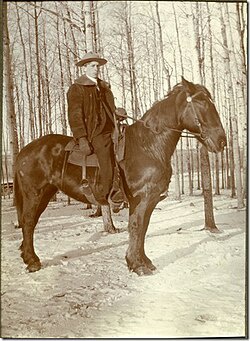
Trooper August Jenkins, killed in action 1 July 1900
Role and Reputation
Strathcona’s Horse was known for their mobility, discipline, and scouting skills, often used for reconnaissance and rapid response missions.
Key Engagements:
They saw action in the ZAR (Transvaal) and Orange Free State (OFS), participating in battles like Paardeberg and Diamond Hill.
Casualties and Impact:
During the war, 19 members were killed, and many more were wounded. Their efforts were recognized for contributing to the British war effort.
1901: “Strathcona’s Horse” Depart South Africa
After the war, the regiment boarded ship at Cape Town on 20 January 1901 and arrived in London on 14 February. Here they met Lord Strathcona for the first time and were presented their medals by King Edward VII personally. On its return to Canada on 9 March 1901, the regiment was disbanded. The name “Strathcona’s Horse” was revived in 1909 when the Royal Canadian Mounted Rifles (which had been created in the Permanent Force in 1901) was renamed “Strathcona’s Horse (Royal Canadians)”. The word Lord was prepended to the regimental title in 1911.
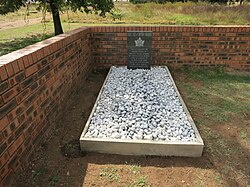
Trooper August Jenkins killed in action 01 July 1900, farm “Paardefontein” R547, near Val, Mpumalanga:
“Here lies a British Soldier”
This is believed to be the grave of Private Angust Jenkins of Strathcona’s Horse who was killed in action near this place on Canada Day, 01 July 1900 during the Anglo-Boer War”(Monument sponsored by David Scholtz, member of the Military History Society)
References:
https://en.wikipedia.org/wiki/Donald_Smith,1st_Baron_Strathcona_and_Mount_Royal
https://en.wikipedia.org/wiki/Lord_Strathcona_Horse_(Royal_Canadian)
*
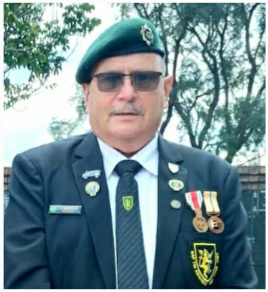
Wolfgang Witschas is a former member of the South African Police (SAP 1976 – 1981)(Uniform & Detective Branch), a member of the National Intelligence Service (NIS 1981 -1994), National Intelligence Agency (NIA 1995 – 2008), and the State Security Agency (SSA Domestic Branch 2008 – 2016).
*
