Second Anglo-Boer War (1899-1902): Field Intelligence Unit: Nesbitt’s Horse
Wolfgang Witschas
Abstract
Nesbitt’s Horse was an irregular unit raised in the Eastern Cape during the Second Anglo-Boer War (1899-1902). The corps, about 300 strong, was formed in December 1899 by Colonel Nesbitt, a veteran South African campaigner. The regiment saw significant service during the war and participated in many engagements with the Boers, they were also mostly employed on advance scouting duties. Most of the men were “Colonials” in South Africa with good knowledge of the country and the farmers employed such that had good horsemanship and rifle skills.
Key Words
Second Anglo-Boer War (1899-1902), Britain, Field Intelligence Department (FID), Nesbitt’s Horse (NH)
Lieutenant-Colonel Richard Atholl Nesbitt, Natal colony, Zuid-Afrikaansche Republiek (ZAR)/Transvaal)
Orange Free State (OFS), Wolfgang Witchas
Introduction
The deteriorating political situation that existed since the botched and unsuccessful “Jamison Raid”, 29 December 1895 – 02 January 1896 (an attempt by British officials and mining industry leaders to overthrow the government of President Paul Kruger’s Zuid-Afrikaansche Republiek (ZAR)/Transvaal Republic,) it became clear that war between Britain and the two Boer Republics, ZAR/Transvaal and the Orange Free State (OFS) was an imminant reality.
To prepare for such an event, the British Military commands in both the Cape Colony and Natal realised the urgent need to obtain intelligence on Boer war preparations and “field intelligence” especially in the border areas were possible future Boer attacks could take place.
Background Nesbitt’s Horse
The unit, which was later named “Nesbitt’s Horse, was raised by Major (later Lieutenant-Colonel) ,Richard Atholl Nesbitt (1837-1905). He was well into his 60s at the time, but was an old Veteran Campaigner of various earlier South African Wars. The unit was formed with the start of the Second Anglo-Boer War.
Background of Lieutenant-Colonel RA Nesbitt,
Lieutenant-Colonel Richard Athol Nesbitt, had served as a sub-inspector with the Frontier Armed and Mounted Police (FAMP) back in 1866. “The FAMP was a paramilitary force established in 1855 in the Cape Colony, South Africa, with the primary goal of protecting the frontier against native attacks and maintaining law and order in the districts along the colony’s border with the Xhosa kingdoms in the Transkei. In 1878 the FAMP were militarised, as a unit of the Colonial Forces, and renamed Cape Mounted Riflemen (CMR).” In October 1899, at the request of the Colonial Government he would come out of retirement and raise and command Nesbitt’s Horse.
Nesbitt’s Horse
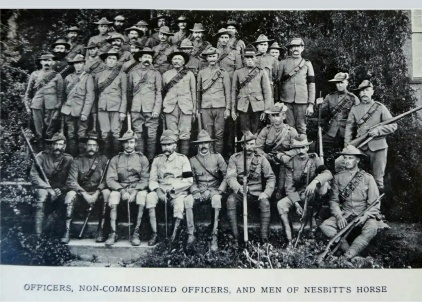
Nesbitt’s Horse was a volunteer unit that served with the British in the war, specifically in the Natal colony, in South Africa. They were part of the Field Intelligence Department and operated as a mounted infantry unit. They were known for their khaki uniforms and were deployed as mounted infantry and mainly for providing reconnaissance and intelligence collection services to the British forces on Boer positions and movements. The unit consisted of approximately 200 men, most of the men were “Colonials”, mostly from Natal and the ZAR/Transvaal, including Europeans, Africans, and Indians in South Africa. They had good knowledge of the country and the farmers employed such as Cawood typically had good horsemanship and rifle skills.
Formation and Strength:
The unit’s strength varied throughout the campaign, with around 5 squadrons at one point, but only about a squadron was in the field when peace came (8 officers, 119 men, and 136 horses). The unit was disbanded in 1901, after the British had gained control of the main Boer strongholds.
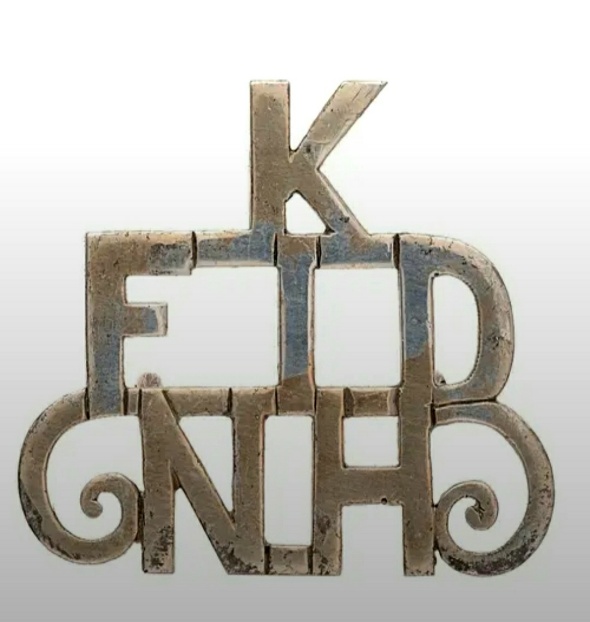
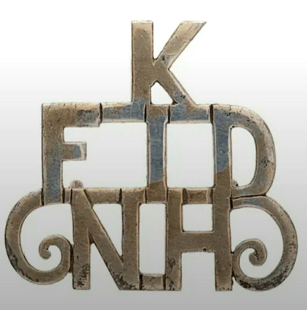
Field Intelligence Department (FID)
Nesbitt’s Horse
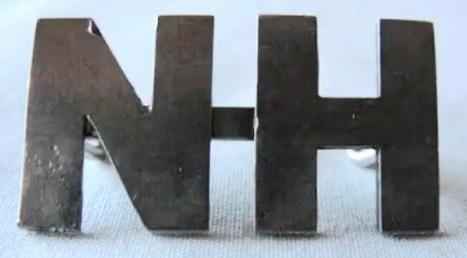
Nesbitt’s Horse slouch hat badge
https://www.angloboerwar.com/unit-information/south-africa-units/440-nesbitts-horse
At the request of the Colonial Government – raise and command Nesbitt’s Horse which, in his own clipped words, “served in most of the principal events of the [Anglo-Boer) war, with Lord Robert’s march – Paardeburg, capture of Bloemfontein, Johannesburg, Pretoria and in clearing the colony of rebels.”
Military Operations
Theatre of War:
Nesbitt’s Horse at the beginning served primarily in Natal, and played a significant role in several operations:
Tugela River:
The Relief of Ladysmith: Nesbitt’s Horse played a key role in the relief of Ladysmith, providing reconnaissance and intelligence to the British forces.
The Battle of Colenso: The unit participated in the Battle of Colenso, where they suffered heavy casualties.
The advance into the OFS and ZAR/ Transvaal: • Nesbitt’s Horse participated in several battles, including Karee Siding. • Part of the corps accompanied Lord Roberts in the great fighting march from Modder River to Bloemfontein, being in the 2nd Brigade of Mounted Infantry, at first under Ridley, afterwards under Le Gallais, and they were generally attached to the VIIth Division under General Tucker. On arriving at Bloemfontein the strength of the corps was officially stated at 8 officers, 119 men, and 136 horses. Very few corps were so well supplied with horses, a fact which tends to prove the good master ship of the South African Colonials. Nesbitt’s Horse were with Le Gallais and Tucker in the stiffly contested battle at Karee Siding on 29 March 1900 Le Gallais’ men taking a very important share in the work. The Boers were driven from their position, and the road towards Brandfort was opened. They did scouting work on the front and flanks of the central divisions of the army during Lord Roberts’ advance from Bloemfontein to Pretoria. Chasing Boer Commandos: Nesbitt’s Horse was involved in several operations to chase down Boer commandos, including the pursuit of General Louis Botha’s forces. When Lord Roberts moved north from Bloemfontein, Nesbitt’s Horse were with the City Imperial Volunteers Mounted Infantry and Lumsden’s Horse in the mounted infantry corps which did the scouting work on the front and flanks of the central divisions of the army, being more particularly attached to Tucker’s VIIth Division. During the whole advance from Bloemfontein to Pretoria they had work which was hard, continuous, and most responsible, and several times had sharp fighting, as at the Vet River on 03 May1900 when they suffered some casualties. After Johannesburg was reached the mounted infantry of the VIIth Division were split up: neither that Division nor Nesbitt’s Horse were present at the battle of Diamond Hill.
• A squadron of Nesbitt’s Horse operated under Lord Kitchener and General Settle in the Prieska district, participating in a sharp fight in the Kheis district, Griqualand West. When Lord Roberts was advancing to Bloemfontein disaffection broke out to the west of the De Aar line. Among other troops employed on the Lower Orange and about Prieska was one squadron of Nesbitt’s Horse which did much hard patrol work. They operated during part of March and April 1900 under Lord Kitchener and General Settle, and were present with Colonel Adye in a sharp fight in the Kheis district, Griqualand West, on 28 May 1900, when Lieutenant Venables and 1 man were wounded. The total British losses in Adye’s action were about 7 killed and 20 wounded, and that of the enemy was heavier, 20 of them being taken prisoners. This squadron of Nesbitt’s remained in the Prieska district for over one year.
Operations in the OFS and Cape Colony
• After Pretoria was occupied, the detachment which had accompanied Lord Roberts northwards was taken south of the Vaal in consequence of De Wet having attacked the railway, and they afterwards did duty in the Orange River Colony and in Cape Colony. In his despatch of 15 November 1900, Lord Roberts mentioned that when the enemy moved south in force in October, Philippolis in the south of the Orange River Colony, was attacked almost daily between 18 and 24 October 1900. The Magistrate with 11 police and 18 British residents skilfully entrenched a kopje having a water-supply, and held out till relieved on the 24th. The enemy at first numbered about 100, but other commandos coming up, their force was increased to 600. On hearing of the investment of the place, the commandant at Colesberg sent on the 20th October Lieutenant Hannah and 34 of Nesbitt’s Horse to relieve or assist the garrison — surely a dangerously small force for the object. Lieutenant Hannah approached Philippolis on the 21st and posted pickets. These were heavily attacked early on the 22nd and were practically annihilated, but he and 6 men succeeded in joining the garrison. The party of Nesbitt’s Horse lost 9 men killed and 12 wounded. During the second phase of the war Nesbitt’s Horse was employed in Cape Colony. They were frequently engaged, and took part in many pursuits. On 14th December a small post near Colesberg, garrisoned by 14 of the corps, was attacked. Lieutenant Kelyl and several men were severely wounded. Lieutenant Hannah was severely wounded on 12th May, and on 9th August Captain Noel Nesbitt was severely wounded at Maraisburg. For a great part of 1901 a portion of the corps was in the western district doing column work under Colonel Capper and Major Jeudwine, and their fine scouting often prevented loss. Another portion worked in the central district of the colony. The corps remained in the field to the very end, and when Commandant Malau was defeated in Central Cape Colony three days before peace was declared, he himself being wounded and captured, the successful British force was composed of the Jansenville district mounted troops, Nesbitt’s Horse, and some other local troops, Lovat’s Scouts helping indirectly.
Casualties and Awards
• The corps suffered casualties, including Lieutenant Kelyl and Captain Noel Nesbitt, who were severely wounded. Colonel Nesbitt was awarded the CB, and Major Currie received the CMG.
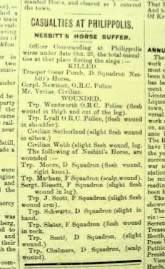
.Newspaper report from the Grahams town Journal which listed the casualties in detail, and importantly listed the Squadron they were with, this clinched and confirmed that:- All the Nesbitt Horse participants came from D and F Squadron and all qualified for the
“Orange Free State clasp”
Post Second Anglo Boer War
Following his service in the Second Anglo Boer War, he married Ada Maria Clayton on 15 December 1903 at Cuylerville. He later died on 17 December 1905 at Violjoenskroon, Orange Free State, South Africa, being a 77 year old retired farmer.
References:
https://www.angloboerwar.com/unit-information/south-africa-units/440-nesbitts-horse
https://www.angloboerwar.com/unit-information/south-africa-units/2476-nesbitts-horse-was-an-irregular-unit-ra
*
Wolfgang Witschas is a former member of the South African Police (SAP 1976 – 1981)(Uniform & Detective Branch), a member of the National Intelligence Service (NIS 1981 -1994), National Intelligence Agency (NIA 1995 – 2008), and the State Security Agency (SSA Domestic Branch 2008 – 2016).
*
